
Introduction
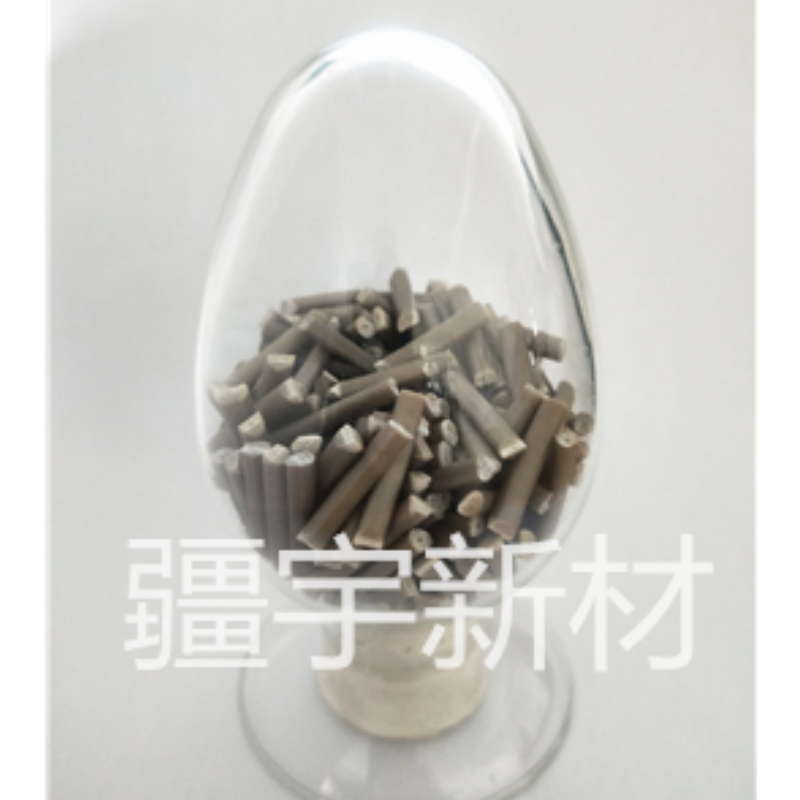
Long fiber thermoplastics are structural thermoplastic composites in which a thermoplastic matrix is reinforced with long discontinuous fibers, typically glass or carbon, to achieve a balance of high stiffness, strength, and impact resistance while remaining moldable by industrial thermoplastic processes. In practice, the term includes both LFT and LFRT, and the materials are widely positioned between short-fiber compounds and continuous-fiber composites in terms of performance and processability.
These materials are important because they enable metal-replacement and lightweighting strategies in mass-produced parts without giving up the cycle times and recyclability associated with thermoplastics. Most commercial grades are based on polypropylene, polyamide, PBT, PPS, PC, or higher-performance matrices, combined with glass fiber, carbon fiber, or, in some systems, natural fibers.
The category has expanded from early automotive structural parts into broader applications in appliances, electronics, construction, logistics, sports equipment, and selected industrial components. At the same time, long fiber thermoplastics sit at the center of current sustainability debates because they can reduce part mass and sometimes replace metals, yet their recycling quality depends strongly on fiber length retention, matrix selection, and end-of-life sorting and reprocessing conditions.
History and Development
Long fiber thermoplastics emerged from the broader evolution of fiber-reinforced plastics, especially the search for composites that could be molded in standard thermoplastic equipment while outperforming short-fiber compounds. Their industrial growth was driven by the automotive sector, where manufacturers needed lighter structural parts with improved crash and fatigue performance, but also wanted shorter cycle times than traditional continuous-fiber layup systems.
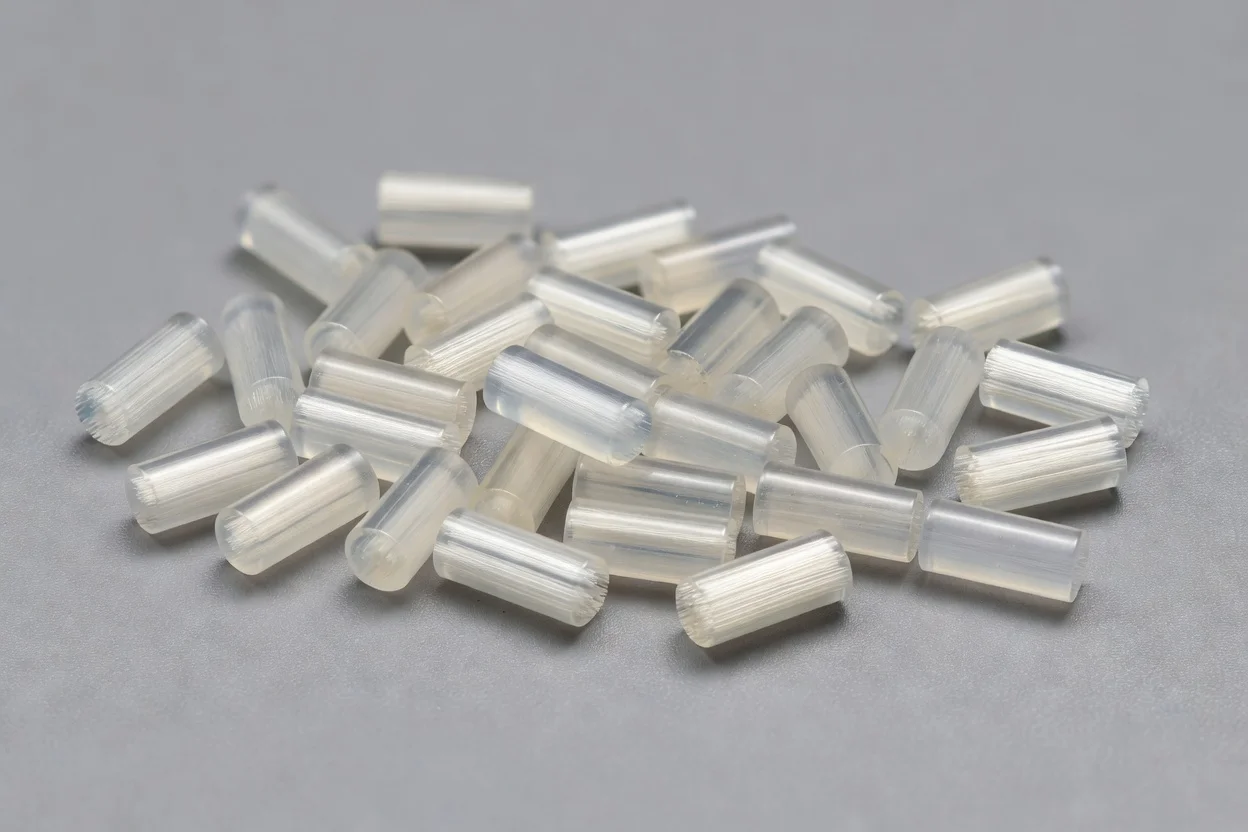
A key technological step was pultrusion-based pellet production, in which continuous fiber rovings are impregnated with molten polymer and then cut into pellets or strands of controlled length. This process preserves fiber length far better than conventional compounding, allowing the final molded part to retain a reinforcing skeleton after injection molding or compression molding.
More recent development has emphasized direct processes such as LFT-D, in which polymer, additives, and fiber are fed into an in-line system and molded without an intermediate pelletization step. This has reduced material handling steps and improved cost efficiency for large structural parts, especially in automotive and transportation applications.
Chemical Structure and Key Properties
Long fiber thermoplastics are composites, not single polymers: their structure combines a thermoplastic matrix with reinforcing fibers, and the performance depends on the interaction between those phases. The matrix phase provides melt processability, weldability, and environmental stress resistance, while the fibers carry much of the applied load and improve creep resistance and dimensional stability.
Typical structural features
- Fiber type: glass, carbon, aramid, basalt, or natural fibers, depending on cost and performance requirements.
- Matrix type: polypropylene, polyamide, PBT, PPS, PC, PEEK, and related engineering thermoplastics.
- Fiber length: often around 6–25 mm in feedstock, with many commercial pellet systems centered near 12 mm; the retained length in molded parts is shorter but still typically exceeds that of short-fiber compounds.
- Fiber content: commonly in the 20% to 60% by weight range, depending on the system and application.
Key properties
- High stiffness-to-weight ratio, which makes the materials attractive for structural parts where mass reduction matters.
- Improved impact toughness relative to short-fiber reinforced thermoplastics, because longer fibers can form a more effective load-bearing network.
- Lower creep than unfilled thermoplastics, especially under sustained load.
- Good processability, because the materials can be injection molded or compression molded with relatively conventional equipment.
Real limits and workarounds
- Limit: Fiber length is reduced during processing → Cause: shear and breakage during melting, conveying, and mold filling → Workaround: use gentler pultrusion or LFT-D routes, lower-shear screw designs, and mold-flow controls that preserve fiber orientation and length.
- Limit: Performance is anisotropic → Cause: fibers align during flow, so properties vary with orientation → Workaround: design gate location, flow paths, and part geometry to align reinforcement with principal stress directions.
- Limit: Surface quality can be harder to match with neat resins → Cause: high fiber loading and fiber print-through → Workaround: use skin-layer strategies, hybrid part designs, or selected surface-treated formulations.
Why LFT outperforms short-fiber compounds
| Attribute | Long fiber thermoplastics | Short-fiber thermoplastics |
|---|---|---|
| Load transfer | Stronger fiber network | More limited reinforcement |
| Impact resistance | Generally higher | Typically lower |
| Stiffness retention | Better at similar loading | More reduction from fiber breakage |
| Processing | Injection/compression moldable | Injection/compression moldable |
| Material cost | Higher than short-fiber compounds | Lower |
| Part design sensitivity | High | Moderate |
The core mechanism is that longer fibers exceed the critical aspect ratio needed for efficient stress transfer from matrix to reinforcement, so the composite can carry load more effectively.
Production Processes and Raw Feedstocks
The two principal manufacturing routes are LFT-G and LFT-D.
LFT-G: pelletized long fiber compounds
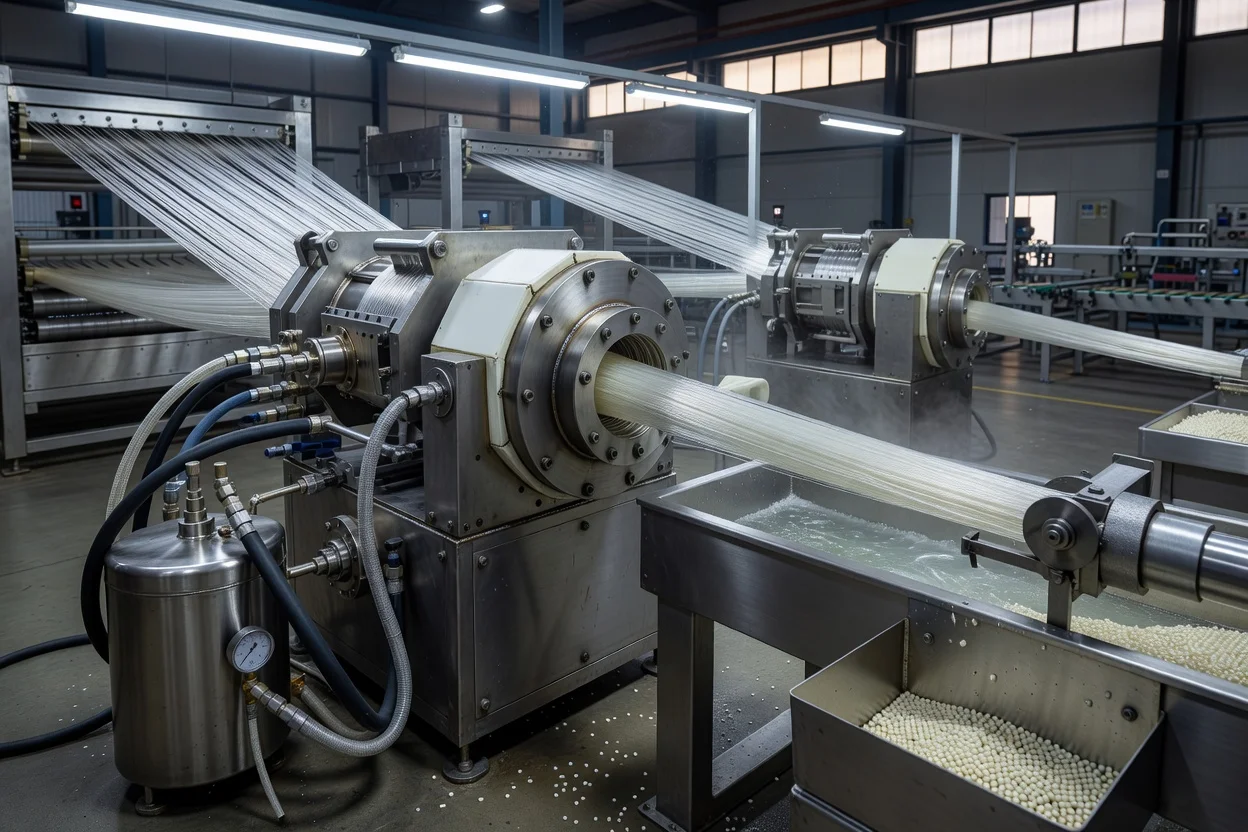
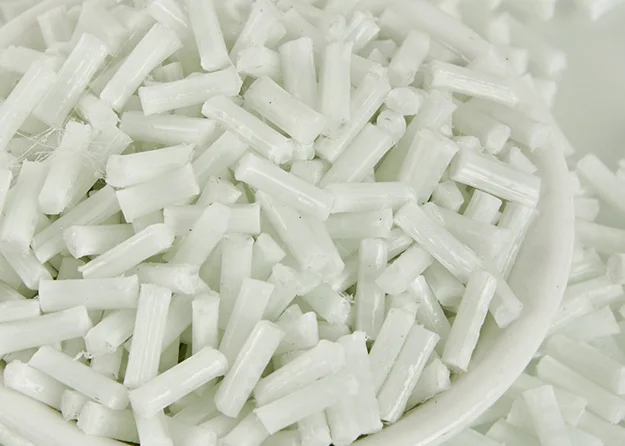
In LFT-G, continuous fiber rovings are impregnated with molten thermoplastic in a pultrusion or continuous impregnation process, cooled, and cut into pellets or rod-shaped granules. These pellets are then processed by injection molding or compression molding into finished parts.
Common inputs include:
- Polymer resins such as PP, PA, PBT, PPS, PC, or PEEK.
- Glass fiber for cost-effective structural reinforcement.
- Carbon fiber where higher stiffness and lower mass justify cost.
- Additives such as heat stabilizers, coupling agents, colorants, and processing aids.
LFT-D: direct long fiber molding
In LFT-D, the matrix and fibers are compounded and formed in-line without pelletizing, often in a twin-screw system followed by compression molding. This route is especially useful for large parts and can reduce cost by eliminating intermediate steps.
Example additive chemistry
- Coupling agents: In glass-fiber PP systems, maleic-anhydride-grafted polypropylene is often used at low loading levels to improve interfacial adhesion by promoting better stress transfer between hydrophilic glass and the nonpolar PP matrix.
- Stabilizers: Heat and UV stabilizer packages are added at small percentages to protect the matrix from processing heat and service aging, particularly in automotive or outdoor parts.
Process-control priorities
- Fiber impregnation quality
- Residual fiber length after compounding
- Orientation control during mold filling
- Thermal history and degradation control
- Moisture management, especially for polyamide-based systems
Applications and End-Use Markets
Long fiber thermoplastics are used where conventional thermoplastics are too weak and metals are too heavy or expensive to process.
Major sectors and common grade choices
| Sector | Typical LFT grade | Common process | Notes |
|---|---|---|---|
| Automotive | PP-LFT, PA-LFT, sometimes carbon-fiber LFT | Injection molding, compression molding, LFT-D | Largest historical market; structural and semi-structural parts. |
| Electronics and appliances | PP-LFT, PA-LFT | Injection molding | Housings, frames, load-bearing brackets. |
| Construction | PP-LFT, PA-LFT, PP with glass fiber | Compression molding, injection molding | Panels, profiles, structural supports. |
| Logistics and industrial handling | PP-LFT | Compression molding, injection molding | Pallets, crates, transport platforms. |
| Aerospace and high-performance transport | Carbon-fiber or high-performance matrix LFT | Compression molding, selected injection molding | Lightweight structural parts where cost is justified. |
| Sports and protective equipment | Carbon- or glass-fiber LFT | Injection molding | Helmets, shields, protective shells. |
Automotive uses
The automotive industry remains the most important application base, with parts such as front-end modules, underbody shields, door modules, seat components, brackets, load floors, and structural body parts. Long fiber materials are especially valuable where parts need a combination of stiffness, impact absorption, and low mass.
Industrial and infrastructure uses
Long fiber thermoplastics are also used in machinery covers, corrosion-resistant housings, outdoor panels, pipes, and selected construction products, particularly where stiffness and environmental resistance matter more than very fine surface finish. A poor-fit use is highly cosmetic, thin-walled consumer parts with premium surface requirements, because fiber print-through and anisotropy can be difficult to eliminate completely.
Market positioning
Commercially, PP-based systems are often the largest volume segment because of their cost advantage, while polyamide-based and carbon-fiber systems serve more demanding structural roles. This creates a clear hierarchy: commodity structural parts at the low end, and high-performance lightweight structures at the upper end.
Environmental and Sustainability Aspects
Long fiber thermoplastics present a mixed sustainability profile. Their main environmental benefit is weight reduction, which can lower energy use in transport applications and help replace heavier metals or thermosets in some designs.
Recyclability
Because the matrix is thermoplastic, LFTs are more recyclable than thermoset composites in principle. However, repeated reprocessing shortens fibers further, so mechanical recycling often leads to performance loss unless recycled material is blended carefully into lower-demand applications.
Bio-based and recycled options
- Bio-based matrices: bio-PP, bio-PA, or other partially bio-based thermoplastics can reduce fossil feedstock dependence, although availability and cost vary.
- Recycled matrices: recycled PP or recycled engineering polymers can be used in selected grades, but property consistency is more difficult to guarantee.
- Natural-fiber LFT: some systems use natural fibers for lower-density, lower-carbon products, although moisture sensitivity and variability remain limiting factors.
Carbon footprint considerations
The carbon footprint advantage of LFT depends on use phase, not just material production. In automotive or transport parts, the embodied emissions of fibers and resins may be offset by reduced mass and improved efficiency over the part’s service life. That said, high-performance carbon-fiber LFT can carry substantial upstream emissions, so the environmental case must be assessed application by application.
Main sustainability trade-offs
- Better recyclability than thermoset composites
- Potential for metal replacement and lightweighting
- Fiber breakage during recycling
- Sorting challenges in mixed-material products
- High energy cost for some high-performance fibers and matrices
Economic and Global Market Impact
According to recent industry analyses, the LFT market continues to expand as manufacturers seek lightweight structural materials that fit high-throughput molding lines. Automotive demand remains central, but growth is also supported by appliances, electronics, construction, and industrial equipment.
Competitive landscape
Leading commercial activity is concentrated among global compounders, fiber suppliers, and integrated composite developers, including firms with strong long-fiber technology platforms and pultrusion capability. The market is shaped by:
- Resin price volatility
- Fiber supply and pricing
- Capital intensity of LFT-D and pultrusion lines
- OEM qualification requirements
- The pace of metal-replacement programs
Economic logic
The value proposition is strongest when:
- Part consolidation reduces assembly cost
- Weight reduction lowers downstream energy use or improves performance
- Structural properties remove the need for metal inserts
- High-volume molding justifies tooling and qualification costs
Current Challenges and Innovations
Technical challenges
- Fiber retention: preserving long fibers through feeding, impregnation, and mold filling remains the central processing challenge.
- Property anisotropy: part performance depends strongly on flow direction and mold design.
- Interface control: weak adhesion between fiber and matrix reduces load transfer efficiency.
- Surface finish: visible fibers and print-through can limit use in visible consumer parts.
Innovations
- Improved pultrusion dies for better fiber wet-out and less breakage.
- LFT-D process optimization for large structural parts and reduced manufacturing steps.
- Hybrid reinforcement systems combining glass and carbon fibers to balance cost and stiffness.
- Digital process simulation to predict fiber orientation, filling behavior, and structural performance.
- Compatibilized matrix systems that improve fiber-matrix bonding and allow higher performance at lower fiber content.
Future Outlook
Long fiber thermoplastics are likely to remain a key structural composite family as industries pursue lightweighting without abandoning thermoplastic processing. The strongest growth opportunities are expected in electric vehicles, battery enclosures, underbody structures, industrial logistics equipment, and selective aerospace and infrastructure components.
Future progress will depend on three developments:
- Better preservation of fiber length during processing
- Greater use of recycled and lower-carbon feedstocks
- More reliable simulation-driven design for anisotropic composite parts
The most promising long-term trend is not simply higher fiber loading, but smarter integration of LFT into multi-material product architecture, where the composite is used exactly where structural reinforcement is needed and avoided where surface quality, precision, or recyclability would suffer.
Summary
Long fiber thermoplastics are injection- or compression-moldable composites that combine thermoplastic processability with the structural advantages of long reinforcing fibers. Their main value lies in the combination of lightweighting, stiffness, impact resistance, and recyclability potential, which has made them especially important in automotive and other structural applications. At the same time, their performance is highly dependent on fiber length retention, interfacial adhesion, and part design, making them a technically demanding but strategically important material class.
References
- •
What are long fiber thermoplastics (LFT)? Uses & benefits. (2025, October 27). Jotaintl. https://jotaintl.com/what-are-long-fiber-thermoplastics/Link
- •
What are long fiber thermoplastics (LFT)? (2022, August 22). Lehvoss. https://blog.lehvoss.de/en/compounds/what-are-long-fiber-thermoplastics-lftLink
- •
What is LFT? (n.d.). Polyone. https://gamma.polyone.com/cn/node/22110Link
- •
Long fiber thermoplastics. (n.d.). Solvay. https://www.solvay.com/sites/g/files/srpend616/files/2018-10/Long-Fiber-Thermoplastics_EN-v1.0_0.pdfLink
- •
Long-fiber-reinforced thermoplastic (LFT) - Production and machine. (2025, November 10). Kerkeextruder. https://www.kerkeextruder.com/es/produccion-de-masterbatch/long-fiber-reinforced-thermoplastic-lft/Link
- •
A review of long fibre-reinforced thermoplastic or long fibre ... (n.d.). Purdue University. https://engineering.purdue.edu/SMARTLab/publications/2019_IMR_%20a%20review%20of%20long%20fiber-reinforced%20thermoplastics%20for%20LFT%20composites%20.pdfLink
- •
Long fiber thermoplastics. (n.d.). Solvay. https://www.solvay.com/sites/g/files/srpend221/files/2018-10/Long-Fiber-Thermoplastics_EN-v1.0_0.pdfLink
- •
Long-fiber-reinforced thermoplastic (LFT). (2025, November 20). Kerkeextruder. https://www.kerkeextruder.com/masterbatch-production/long-fiber-reinforced-thermoplastic-lft/Link
- •
Long-fiber-reinforced thermoplastic. (2005, September 8). Wikipedia. https://en.wikipedia.org/wiki/Long-fiber-reinforced_thermoplasticLink
- •
Long fiber thermoplastics (LFTs) are discontinuous fiber thermoplastic ... (n.d.). University of Tennessee, Knoxville. https://trace.tennessee.edu/cgi/viewcontent.cgi?article=8448&context=utk_graddissLink
- •
LFT-G extrusion line: Long fiber reinforced thermoplastic production. (2026, March 5). Wanplas. https://www.wanplas.com/industry-blogs/lft-g-extrusion-line-long-fiber-reinforced-thermoplastic-production/Link
- •
Long fiber reinforced thermoplastic extrusion (LFT-G) line. (2023, November 23). Cbextrusion. https://www.cbextrusion.com/long-fiber-reinforced-thermoplastics-pelletizing-production-line/Link
- •
What is LFT polymer - Material introduction. (n.d.). Lfrt-plastic. https://www.lfrt-plastic.com/info/what-is-lft-polymer-82695927.htmlLink
- •
Long fiber reinforced thermoplastics (LFRT) | Celstran & ... (n.d.). Celanese. https://www.celanese.com/products/lifrt-cfrt-tapeLink
- •
Complete installations for the production of long fiber reinforced ... (n.d.). Coperion. https://coperion.com/cn/news-media/newsletter/2015/plastics-in-focus-edition-12/complete-installations-for-the-production-of-long-fiber-reinforced-thermoplasticsLink
- •
Natural fiber composites manufactured using ... (n.d.). Diva-portal.org. https://www.diva-portal.org/smash/get/diva2:1012114/FULLTEXT01.pdfLink
- •
LFT (long-fiber reinforce thermoplastic). (2022, April 22). Cowinextrusion. https://www.cowinextrusion.com/lft-long-fiber-reinforce-thermoplastic/Link
- •
Long fibre-reinforced compounds. (2023, September 26). Kdfeddersen. https://kdfeddersen.com/en/products/polymers/long-fibre-reinforced-compoundsLink
- •
LFT-D long fiber reinforced thermoplastics process ... (2022, November 24). Lft-g. https://www.lft-g.com/blog/composite-industry-lft-d-long-fiber-reinforced-thermoplastics-process-introduction_b60Link
- •
ThermoPlastics Amol. (n.d.). Frpinstitute. https://frpinstitute.org/assets/download/info/Thermoplastics%20Composites-anmol.pdfLink
- •
Benefits of long fiber reinforced thermoplastic composites. (n.d.). Avient. https://www.avient.com/products/long-fiber-technology/benefits-long-fiber-reinforced-thermoplastic-compositesLink
- •
Long fiber thermoplastics market report 2026-2031 [320 ... (n.d.). Marketsandmarkets. https://www.marketsandmarkets.com/Market-Reports/long-fiber-thermoplastic-market-143452466.htmlLink
- •
Why long fiber thermoplastics outperform short ... (2026, June 9). Lfrt-plastic. https://www.lfrt-plastic.com/info/why-long-fiber-thermoplastics-outperform-short-103521784.htmlLink
- •
Long fiber reinforcedthermoplastics. (n.d.). Coperion. https://www.coperion.com/media/3688/2012_lft_compounding_world_08-2012_en.pdfLink
- •
Long fiber pultrusion manufacturing process. (n.d.). Avient. https://www.avient.com/content/long-fiber-pultrusion-manufacturing-processLink
- •
Langfaserverstärkte thermoplaste. (2006, January 20). Wikipedia. https://de.wikipedia.org/wiki/Langfaserverst%C3%A4rkte_ThermoplasteLink
- •
What IS LFT composite - Material introduction. (2025, July 22). Lfrt-plastic. https://www.lfrt-plastic.com/info/what-is-lft-composite-103049401.htmlLink
- •
Long fiber-reinforced thermoplastics material and a method ... (2000, June 9). Google Patents. https://patents.google.com/patent/US6846857B1/enLink
- •
Complēt™ long fiber reinforced structural thermoplastics. (2026, February 11). Avient. https://www.avient.com/products/long-fiber-technology/long-fiber-technologies/compl-t-long-fiber-reinforced-structural-thermoplasticsLink
- •
Process factors in long-fiber thermoplastic compression molding ... (2026, March 26). PMC. https://pmc.ncbi.nlm.nih.gov/articles/PMC13074948/Link
- •
Long fiber thermoplastics market. (2026, April 4). Factmr. https://www.factmr.com/report/long-fiber-thermoplastics-marketLink
- •
What are long fiber composites. (2025, August 3). Scribd. https://www.scribd.com/document/383655212/What-Are-Long-Fiber-CompositesLink
- •
How to mold long fiber reinforced thermoplastics. (2025, October 27). Ptonline. https://www.ptonline.com/articles/how-to-mold-long-fiber-reinforced-thermoplasticsLink
- •
Process simulation, design and manufacturing of a long ... (n.d.). ScienceDirect. https://www.sciencedirect.com/science/article/pii/S1359835X08001504Link
- •
Long-fiber-reinforced thermoplastic (LFT) - Production and machine. (2025, November 5). Kerkeextruder. https://www.kerkeextruder.com/ar/%D8%A5%D9%86%D8%AA%D8%A7%D8%AC-%D8%A7%D9%84%D9%85%D8%A7%D8%B3%D8%AA%D8%B1%D8%A8%D8%A7%D8%AA%D8%B4/long-fiber-reinforced-thermoplastic-lft/Link
- •
Fiber-reinforced thermoplastics. (2024, May 21). MCG. https://automotive.mcgc.com/glossary_term/fiber-reinforced-thermoplastics/Link
- •
A review of long fiber-reinforced thermoplastics for LFT composites. (2025, October 2). Scribd. https://www.scribd.com/document/555305533/a-review-of-long-fiber-reinforced-thermoplastics-for-LFT-compositesLink
- •
LFT long fiber reinforced thermoplastics. (n.d.). Coperion. https://coperion.com/en/industries/plastics/lft-long-fiber-reinforced-thermoplasticsLink
- •
What are the benefits of long fiber composites? (2016, October 3). Romeorim. https://romeorim.com/what-are-the-benefits-of-long-fiber-composites/Link