
Introduction
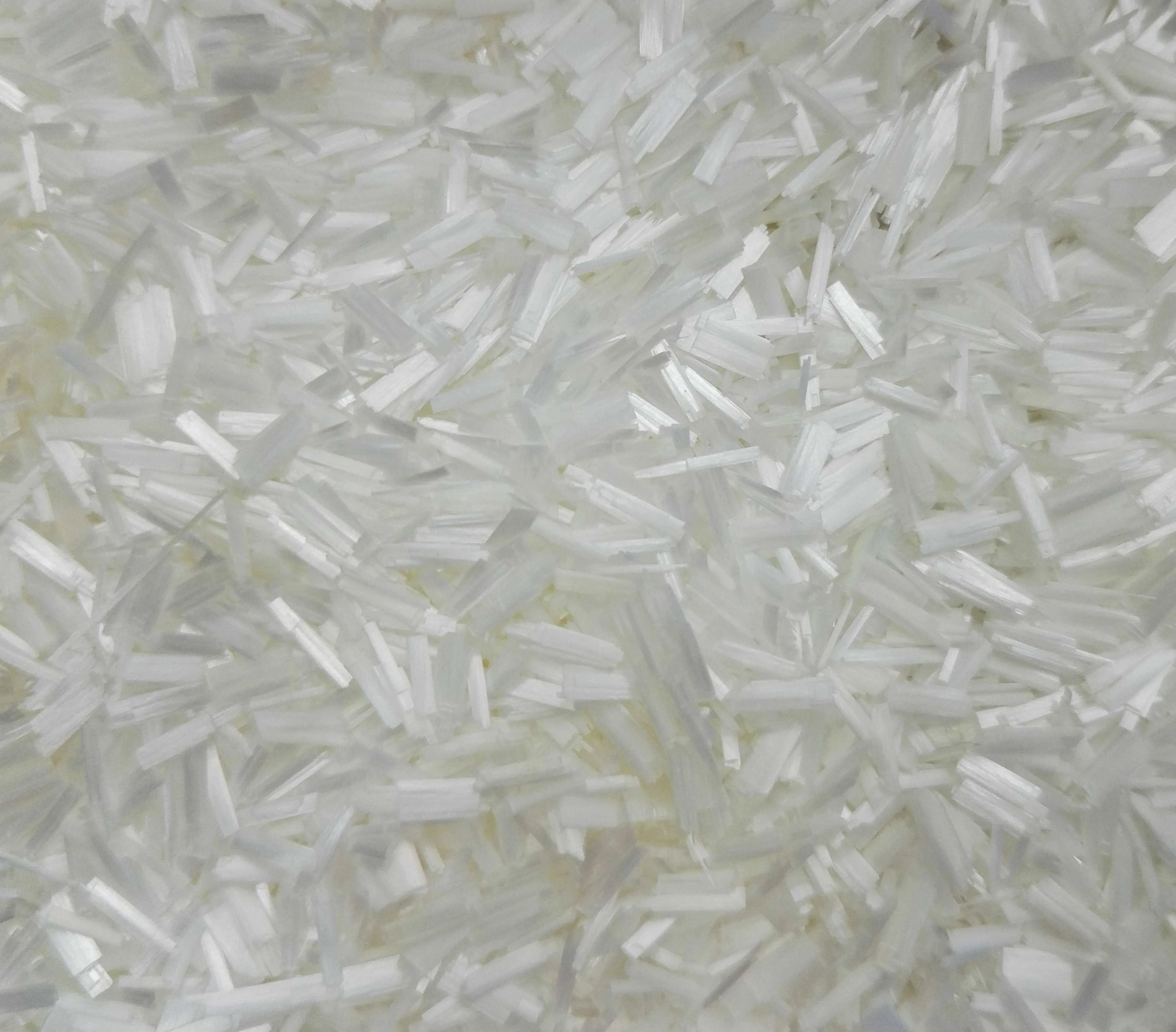
Glass fibers are fine inorganic filaments drawn from molten glass and used primarily as reinforcement in polymer composites, but also as insulation, filtration media, and specialty technical textiles. In the plastics industry, they are among the most important auxiliaries because they convert relatively low-cost thermoplastics and thermosets into materials with much higher stiffness, dimensional stability, heat resistance, and load-bearing capability.
Glass fiber technology spans a wide family of products, including E-glass for general-purpose reinforcement, S-glass for higher strength, AR-glass for alkali resistance in cementitious systems, and specialty formulations tuned for electrical, chemical, or thermal performance. The material is typically supplied as chopped strands, rovings, mats, woven fabrics, and milled fibers, each optimized for a different processing route and end use.
Its modern importance reflects a balance of performance and cost: glass fiber is lighter than metals, electrically insulating, noncombustible, and comparatively economical versus carbon fiber, which has made it the default reinforcement in large-volume composites for transportation, construction, electrical, industrial, and energy markets. At the same time, its environmental profile is shaped by energy-intensive melting, difficult separation from polymer matrices, and the limited recyclability of conventional glass-fiber composites, which are increasingly driving recycling, lower-carbon furnace operations, and hybrid-material innovation.
History and Development
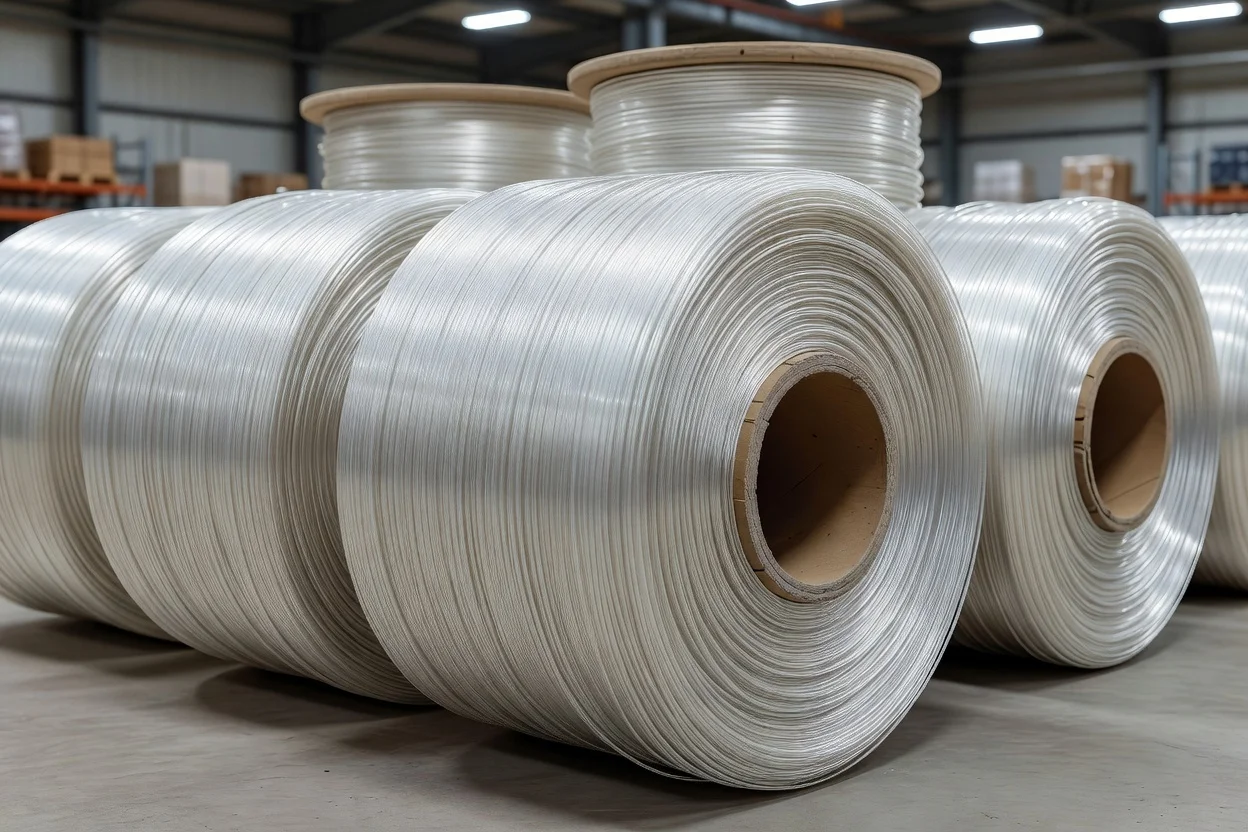
Glass fibers emerged from broader glassmaking and textile experimentation, with industrial production becoming practical once direct-melt drawing and platinum-rhodium bushing technology enabled consistent filament formation. Earlier processes relied more heavily on remelting or intermittent methods, while continuous drawing through multi-hole bushings became the standard route for high-volume production.
The technology matured alongside the growth of reinforced plastics after the mid-20th century, when the combination of glass fiber with polyester, epoxy, and later thermoplastic matrices created a major new class of structural composites. Over time, product development moved from simple reinforcements toward highly engineered fibers, sizings, and surface treatments tailored to specific resins, processing methods, and durability requirements.
Chemical Structure and Key Properties
Glass fiber is an amorphous silicate-based material, meaning it lacks the long-range crystalline order of mineral fibers and is produced by rapid cooling of a molten glass composition. Typical industrial formulations combine silica with oxides such as alumina, lime, magnesia, boron oxide, and alkali oxides, with the exact balance adjusted to control melt behavior, fiberization, chemical durability, electrical properties, and cost.
Key properties
- High tensile strength and good specific stiffness, especially when embedded in a polymer matrix.
- Low density relative to metals, which supports lightweight design.
- Electrical insulation, making it useful in cables, circuit boards, and electrical components.
- Noncombustibility and good heat resistance, especially in E-glass-based products.
- Chemical and corrosion resistance, although resistance varies by composition and environment.
- Dimensional stability and low thermal expansion, which are valuable in composites and electrical applications.
Practical limits and workarounds
- Brittleness → the glassy filament structure resists plastic deformation → workaround: embed fibers in a polymer matrix, use strand sizing, and select fabric architectures that distribute stress.
- Limited abrasion and handling tolerance → fine filaments can be damaged during processing → workaround: apply sizing and lubrication finishes that reduce fiber-fiber friction and improve resin compatibility.
- Poor surface compatibility with many polymers in untreated form → the glass surface is chemically inert and relatively smooth → workaround: use silane-based sizings or coupling agents to promote wet-out and interfacial adhesion.
- Alkali vulnerability in cementitious environments for standard glass → alkaline pore solutions can attack silica-rich glass → workaround: use AR-glass in concrete and mortar reinforcement.
Typical technical ranges
| Property | Typical significance for plastics |
|---|---|
| Fiber diameter | Common reinforcement filaments are roughly 14–24 μm in many continuous-glass products. |
| Density | Around 2.5–2.6 g/cm³, enabling lightweight composites compared with metals. |
| Modulus | E-glass reinforcement typically provides a modulus in the tens of GPa range, contributing to stiffness rather than ductility. |
| Electrical behavior | Strong insulator, especially valuable in electronics and cables. |
Production Processes and Raw Feedstocks
Glass fiber production begins with batching, in which silica sand and other mineral raw materials are weighed and blended to the target composition. The batch is then melted and refined at high temperature into a homogeneous glass melt, after which the melt is conditioned in a forehearth and drawn through a platinum-alloy bushing with many tiny orifices to form filaments.
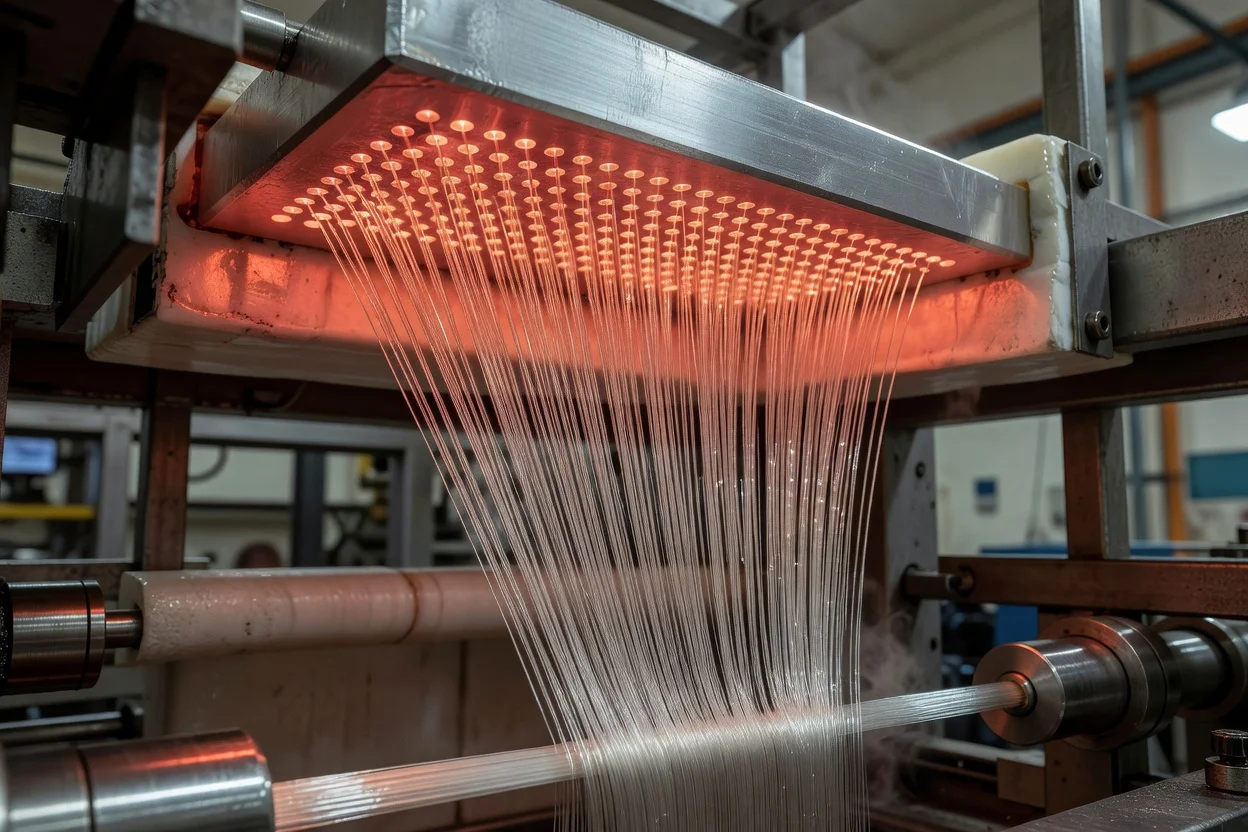
After fiberization, a chemical size is applied while the filaments are still fresh and hot enough for the finish to bond effectively. The size serves multiple functions: it protects the fiber surface, reduces abrasion, helps manage static and processing, and improves compatibility with downstream resins.
Main conversion routes
- Rovings for pultrusion, filament winding, and weaving.
- Chopped strands for injection molding and bulk-molding compounds.
- Chopped strand mat for hand lay-up, spray-up, and general composite laminates.
- Woven fabrics and multiaxial textiles for structural laminates and industrial reinforcement.
- Milled fibers for compounds, coatings, and specialty fillers.
Typical raw feedstocks include silica, limestone, dolomite, alumina-bearing materials, and boron sources, with composition chosen to balance melting behavior, viscosity, durability, and cost. In practice, furnace design, bushing geometry, and sizing chemistry are as important as the glass recipe itself because they shape filament diameter uniformity, strand integrity, and composite performance.
Applications and End-Use Markets
Glass fiber is the dominant reinforcement for large-volume glass-fiber-reinforced plastics and related composites. Its strongest markets are those that need a favorable mix of stiffness, corrosion resistance, electrical insulation, and cost efficiency.
| End-use sector | Common glass fiber form | Usual matrix/process | Typical role |
|---|---|---|---|
| Automotive and transportation | Chopped strands, mats, rovings | Thermoplastics, SMC, RTM, pultrusion | Stiffness, crash management, weight reduction |
| Construction and infrastructure | AR-glass, mats, fabrics, rovings | Cementitious products, laminates, pultrusion | Façades, panels, reinforcement, corrosion resistance |
| Electrical and electronics | Woven fabrics, insulating mats | Epoxy, phenolic, laminates | PCB substrates, insulation, dielectric stability |
| Pipes, tanks, and industrial equipment | Rovings, fabrics, chopped strands | Filament winding, pultrusion, hand lay-up | Corrosion-resistant pressure and storage structures |
| Wind energy | Rovings, fabrics | Infusion, prepreg, hybrid laminates | Blade stiffness and fatigue resistance |
| Consumer and leisure goods | Chopped strand and fabrics | Thermosets, thermoplastics | Enclosures, sporting goods, marine parts |
Major application areas
- Structural composites: automotive panels, truck parts, marine hulls, tanks, pipes, and pultruded profiles.
- Construction products: façades, panels, insulation-related materials, and glass-fiber-reinforced concrete components.
- Electrical and electronic materials: printed circuit board laminates, cable reinforcement, and insulating components.
- Industrial filtration and insulation: filter media, heat-resistant textiles, and thermal insulation products.
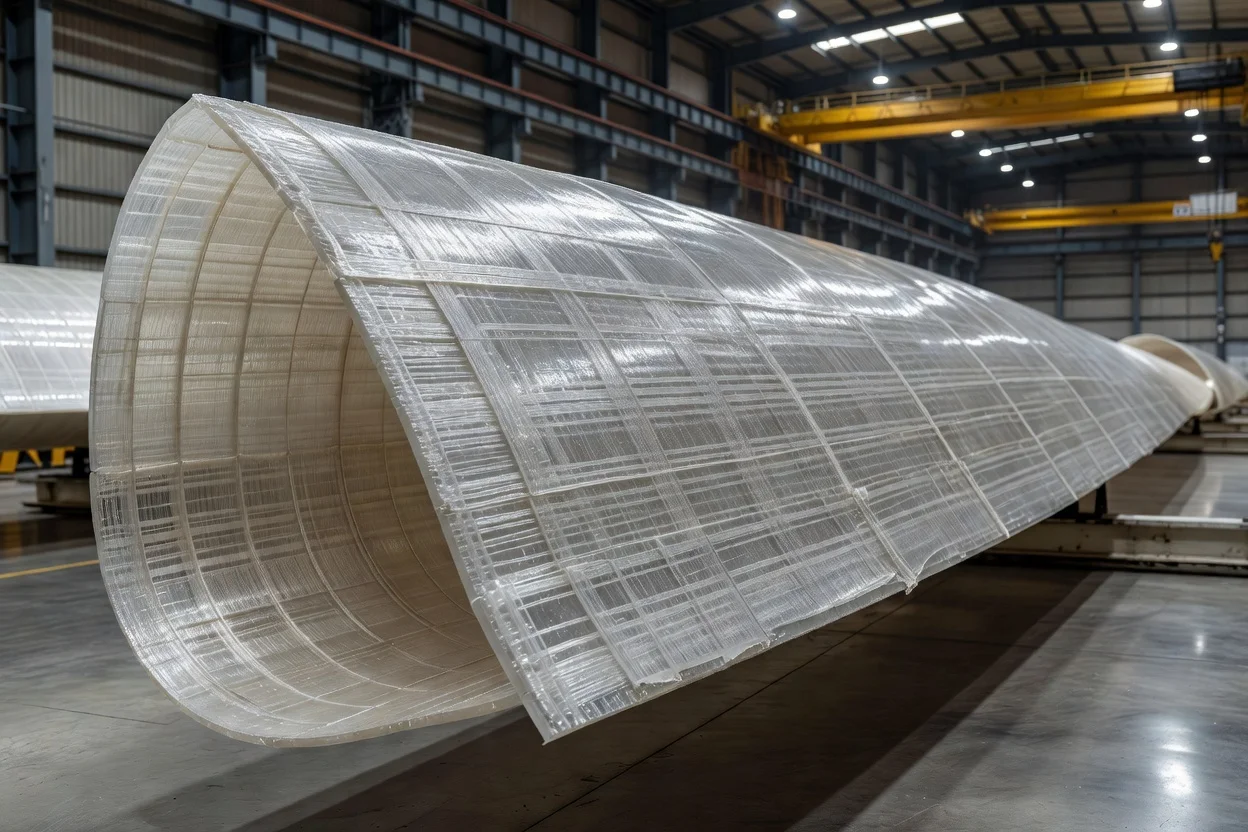
- Specialty reinforcement systems: wind turbine blades, hybrid laminates, and corrosion-resistant process equipment.
A notable poor-fit use is applications requiring high toughness, repeated flexing without matrix support, or very high temperature stability above the practical limits of typical polymer composites; in those cases, unmodified glass fiber alone is not sufficient and must be paired with an appropriate matrix or replaced by a different reinforcement system.
Environmental and Sustainability Aspects
The sustainability profile of glass fiber is mixed. On one hand, its use in lightweight composites can reduce material consumption and improve energy efficiency in transportation and wind energy systems. On the other hand, production requires high-temperature melting, and conventional glass-fiber-reinforced plastics remain difficult to recycle because the fibers are tightly embedded in thermoset or mixed polymer matrices.
Recyclability and circularity
- Mechanical recycling is feasible for some composite waste, but recycled material often has lower performance and shorter fiber length.
- Thermal or chemical routes can recover value from certain composites, but economic viability depends on resin type, contamination, and local infrastructure.
- Design-for-recycling is gaining attention through thermoplastic composites, reversible matrices, and easier disassembly concepts.
Bio-based and lower-carbon directions
- Bio-based resins can reduce fossil-carbon intensity of the matrix, although the glass fiber itself is still mineral-based.
- Lower-energy furnace operations and greater use of cullet or alternative raw-material strategies can reduce environmental burden, subject to quality constraints.
- Hybrid composites can reduce fiber loading while retaining acceptable performance, which may lower total embodied impact.
Trade-offs
Glass fiber is generally less carbon-intensive than carbon fiber and much less expensive, which is one reason it remains the workhorse reinforcement for mass-market composites. However, its end-of-life burden is larger than that of monolithic plastics in many use cases because the composite structure complicates recovery and reuse.
Economic and Global Market Impact
Glass fiber is one of the highest-volume reinforcement materials in the global composites industry, and demand is closely linked to construction, transportation, electrical infrastructure, wind power, and industrial equipment. Its economic advantage comes from broad availability of raw materials, mature process technology, and favorable performance-to-cost balance.
Large global producers and technology leaders typically include multinational composite and textile-glass manufacturers such as Owens Corning, Jushi Group, Taishan Fiberglass, Nippon Electric Glass, Johns Manville, and Saint-Gobain in various product categories and regional markets. Market structure is shaped by furnace scale, energy prices, logistics, and access to mineral feedstocks, making production capacity relatively concentrated compared with many downstream plastic additives and fillers.
Current Challenges and Innovations
Current challenges center on energy use, fiber-matrix adhesion, recycling, and performance under demanding environments. Product developers are addressing these issues through several approaches:
- Advanced sizings and silane chemistries to improve wet-out, interfacial strength, and hydrolytic durability.
- AR-glass and specialty compositions for harsher chemical or alkaline environments.
- Thermoplastic-compatible reinforcements that support faster processing and better recyclability than many thermosets.
- Hybrid systems combining glass fiber with carbon, natural fibers, or mineral fillers to tune cost and performance.
- Low-dielectric and high-frequency grades for electronics and antenna-related applications.
- Improved furnace efficiency and batch optimization to reduce energy intensity and emissions.
A concrete example is the use of silane coupling agents at very low loadings on the glass surface; they form a molecular bridge between hydroxyl-rich glass and organic polymers, improving stress transfer and moisture durability. Another example is the use of chopped strand mat in polyester laminates, where the random fiber orientation distributes load more isotropically and improves handling in hand lay-up and spray-up processing.
Future Outlook
Demand for glass fiber is likely to remain strong because it occupies a strategic middle ground between commodity plastics and higher-cost advanced reinforcements. Growth opportunities are most visible in electric vehicles, renewable energy, infrastructure rehabilitation, cable and electronics insulation, and corrosion-resistant industrial systems.
The main technical direction is not replacement but optimization: lower-carbon production, better surface chemistry, more recyclable composite architectures, and higher-value specialty grades. In parallel, end-of-life policy pressure and corporate sustainability targets are likely to accelerate development of thermoplastic composite systems and recycling pathways that can retain more of the value embodied in glass fiber.
Summary
Glass fibers are the foundational reinforcement of mass-market polymer composites because they combine strength, stiffness, insulation, durability, and cost efficiency in a form adaptable to many processing routes. Their long-term importance will depend on how effectively the industry reduces energy intensity, improves recyclability, and tailors fiber chemistry and sizing to the next generation of plastics applications.
References
- •
Six major application areas of glass fiber. (n.d.). https://www.169chem.net/news/17-59.htmlLink
- •
Glass fiber. (2002, December 13). In Wikipedia. https://en.wikipedia.org/wiki/Glass_fiberLink
- •
Glass Fiber Manufacturing Process: Bushing, Sizing and .... (2026, July 14). https://www.sourcebyspec.com/news/glass-fiber-manufacturing-process-bushing-sizing-and-downstream-conversion.htmlLink
- •
Glass Fiber: Types, Properties, Manufacturing & Uses. (2026, July 19). https://textileengineering.net/glass-fiber-types-properties-manufacturing-uses/Link
- •
Flow Chart of Glass Fiber Manufacturing Process. (2021, August 19). https://www.textileflowchart.com/2021/08/glass-fiber-manufacturing.htmlLink
- •
Glass Fiber Production Steps. (n.d.). https://polser.com/en/frp/glass-fiber-production-stepsLink
- •
The making of glass fiber. (2026, August 24). https://www.compositesworld.com/articles/the-making-of-glass-fiberLink
- •
AP-42, CH 11.13: Glass Fiber Manufacturing. (n.d.). https://www.epa.gov/sites/default/files/2020-10/documents/c11s13.pdfLink
- •
Chapters and Articles. (2025, January 16). https://www.sciencedirect.com/topics/materials-science/glass-fiberLink
- •
Glass Fibers. (n.d.). https://allendalefibertech.com/wp-content/uploads/2023/02/Fiberglas-Production.pdfLink
- •
What Is Glass Fibre (Fibreglass) and its applications. (2023, January 23). https://bisley.biz/news/what-is-glass-fibre-where-is-it-used/Link
- •
An overview of glass fibers. (2015, February 1). https://www.textiletoday.com.bd/an-overview-of-glass-fibersLink
- •
Development and application of glass fiber. (2024, March 15). https://en.stidetec.com/hangyezixun/147Link
- •
40207_07. (2025, August 22). https://www.scribd.com/document/54513464/40207-07Link
- •
Fiberglass. (2003, January 25). In Wikipedia. https://en.wikipedia.org/wiki/FiberglassLink
- •
Glass fiber production, how it works? - CERSA-MCI. (n.d.). https://www.cersa-mci.com/news-articles/glass-fiber-productionLink
- •
How do you Manufacture Fiberglass Products? (n.d.). https://www.tencom.com/blog/how-do-you-manufacture-fiberglass-productsLink
- •
What Is Glass Fiber? Composition, Types, and Uses. (2026, March 26). https://scienceinsights.org/what-is-glass-fiber-composition-types-and-uses/Link
- •
Glass Fiber Guide — Types, Specs, Selection | SpecForge. (n.d.). https://www.sourcebyspec.com/encyclopedia/glass-fiber.htmlLink
- •
Glass Fiber. (2025, February 11). https://www.sciencedirect.com/topics/chemistry/glass-fiberLink
- •
Fiber's and manufacturing of fiber glass | PPTX. (2021, November 25). https://www.slideshare.net/slideshow/fibers-and-manufacturing-of-fiber-glass/250727062Link
- •
Glass Fiber - an overview. (n.d.). https://www.sciencedirect.com/topics/medicine-and-dentistry/glass-fiberLink
- •
The application field of glass fiber. (2024, December 30). https://www.jhd-material.com/knowledge/the-application-field-of-glass-fiberLink
- •
E Glass - an overview. (n.d.). https://www.sciencedirect.com/topics/physics-and-astronomy/e-glassLink
- •
Glass Fiber Reinforced Concrete as a Durable and Enhanced .... (2022, April 8). https://pmc.ncbi.nlm.nih.gov/articles/PMC9032677/Link
- •
Glass Fiber - Alfa Chemistry. (2022, September 15). https://fiber.alfa-chemistry.com/glass-fiber.htmlLink
- •
Glass Fiber: Types, Properties, Manufacturing Process and Uses. (2022, September 19). https://textilelearner.net/glass-fiber-types-properties/Link
- •
Top 5 Uses of Glass Fiber in 2025 | Integration Notes. (2025, October 24). https://www.linkedin.com/pulse/glass-fiber-real-world-5-uses-youll-actually-rkc0fLink
- •
Recent Progress in Modifications, Properties, and .... (2023, March 8). https://pmc.ncbi.nlm.nih.gov/articles/PMC10053231/Link
- •
Glass Fiber: Performance, Manufacturing Process, Application and .... (2025, April 10). https://insights.made-in-china.com/Glass-Fiber-Performance-Manufacturing-Process-Application-and-Future-Development-Trend_ofLaZNBClEiF.htmlLink
- •
Fiberglass Manufacturing. (n.d.). https://www.vetrotextextiles.com/technologies/fiberglass-manufacturingLink
- •
A Brief Introduction to Glass Fibers, with Basic Knowledge Explained. (2025, August 13). https://www.insofire.com/what-is-glass-fiber.htmlLink
- •
Glass fiber (GF) | Automotive Glossary | MCG. (2024, May 21). https://automotive.mcgc.com/glossary_term/glass-fiber-gf/Link
- •
Glass Fibers - ASM International. (2024, November 5). https://www.asminternational.org/results/-/journal_content/56/ASMHBA0003353/BOOK-ARTICLE/Link
- •
1 Introduction to Glass Fiber-Based Composites and .... (n.d.). https://application.wiley-vch.de/books/sample/3527349308_c01.pdfLink
- •
Commercial and Experimental Glass Fibers. (n.d.). https://scispace.com/pdf/commercial-and-experimental-glass-fibers-3d40xjed6u.pdfLink
- •
Fiberglass Manufacturing Overview | PDF | Glasses. (n.d.). https://www.scribd.com/document/395025545/Production-of-Glass-Fiber-972223-pdfLink
- •
Fiberglass | Science | Research Starters. (2020, September 30). https://www.ebsco.com/research-starters/science/fiberglassLink
- •
Fiberglass: History, Characteristics, Types, Forms, and .... (2023, October 18). https://www.xometry.com/resources/materials/what-is-fiberglass/Link