
Introduction
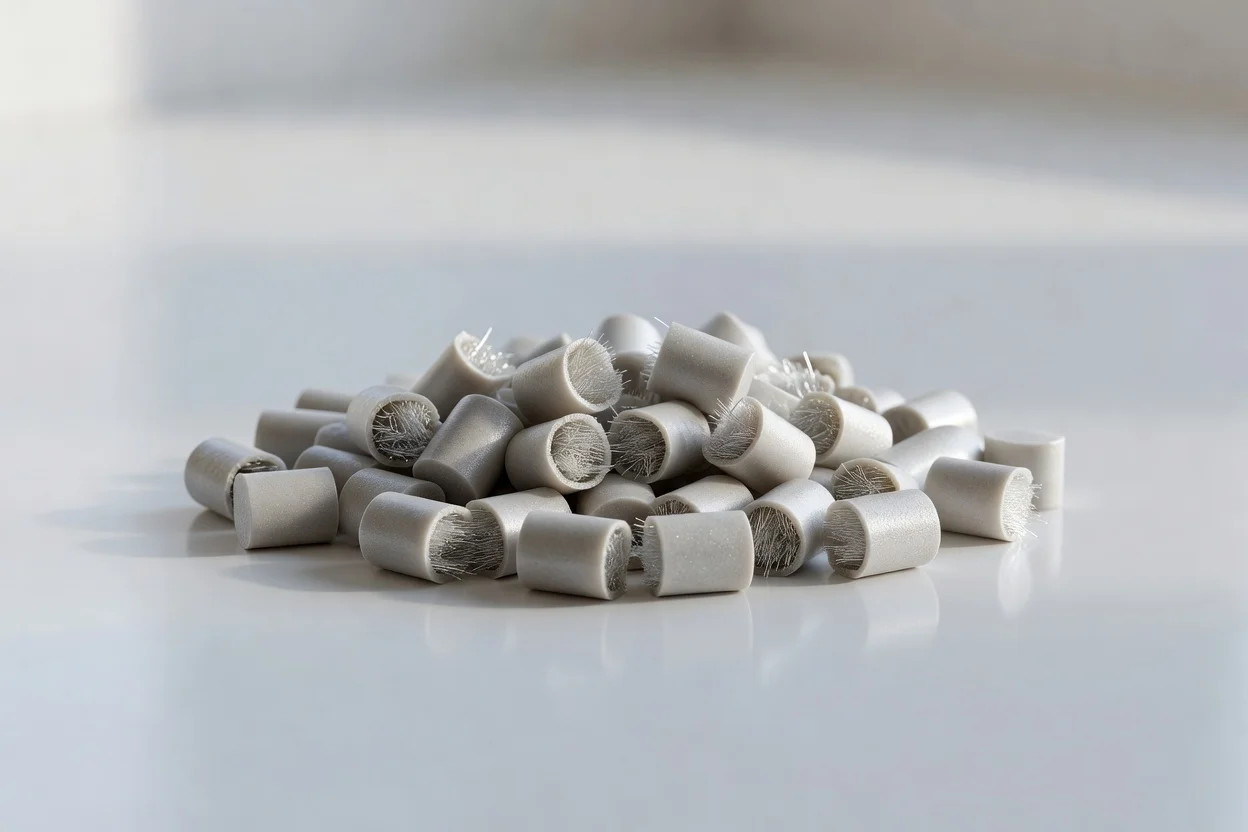
Short fiber thermoplastics are composite materials in which a thermoplastic resin is reinforced with discontinuous fibers, most commonly glass or carbon, to improve stiffness, strength, heat resistance, and dimensional stability while retaining the processing advantages of melt-processable plastics. Commercially, these materials emerged in the 1960s and have since become a large family of engineering compounds used where the balance of mechanical performance, molding speed, and cost is more important than the absolute performance of continuous-fiber composites.
The term covers a broad class of formulations rather than a single material: the matrix may be polypropylene, polyamide, PBT, PPS, PEEK, or other thermoplastics, while the reinforcement may be glass fiber, carbon fiber, aramid, or in some cases natural or mineral fibers. Because the fibers are short and randomly oriented after compounding and molding, these materials are generally easier to process than long-fiber systems, but they also deliver lower tensile strength, modulus, and impact performance than aligned or continuous-fiber composites.
Industrial interest in short fiber thermoplastics is driven by lightweighting, part consolidation, and high-volume manufacturability, especially in transportation, electrical and electronic equipment, consumer goods, and industrial components. At the same time, their environmental profile is mixed: thermoplastic matrices can be remelted and reprocessed, but fiber shortening during recycling, limited closed-loop quality retention, and dependence on fossil-based resins remain important constraints.
History and development
Short fiber-reinforced thermoplastics were commercialized in the 1960s as processors sought materials that could bridge the gap between commodity plastics and higher-cost structural composites. Early adoption was strongest in applications requiring incremental reinforcement rather than maximum load-bearing capability, because chopped fibers could be dispersed in standard extrusion and injection molding operations without the labor-intensive layup steps required by many thermoset composites.
Over time, improvements in compounding, coupling agents, fiber sizing, and simulation tools expanded the design space for these materials. Modern grades now span high-flow compounds for thin-wall electronics housings, wear-resistant engineering materials for sliding parts, and high-temperature carbon-fiber compounds for under-the-hood and structural applications.
Chemical structure and key properties
Short fiber thermoplastics are not a single polymer family but a composite architecture: a continuous thermoplastic matrix embeds numerous short reinforcing fibers. The matrix provides ductility, melt processability, and weldability, while the fibers carry load and suppress thermal expansion.
Key property trends include:
- Higher stiffness and strength than the unfilled resin, especially in the direction of dominant fiber orientation.
- Better dimensional stability and lower creep than unfilled thermoplastics.
- Improved heat resistance, particularly with glass-, carbon-, or mineral-filled engineering resins.
- Good surface quality and complex-shape moldability, especially relative to continuous-fiber laminates.
Important practical limits include:
- Lower mechanical performance than continuous-fiber composites → short, randomly oriented fibers cannot transmit load as efficiently as aligned or long-fiber architectures → use long-fiber or continuous-fiber composites when maximum structural efficiency is required.
- Reduced toughness in some formulations → stiffness gains from reinforcement can come with lower elongation and notch sensitivity → use impact modifiers, rubber-toughened blends, or optimized fiber loading and coupling chemistry.
- Anisotropic part properties → fiber orientation during flow causes direction-dependent performance → use mold-flow simulation, gate optimization, and rib design to manage orientation.
- Poor oxygen and grease barrier in many common thermoplastic matrices, especially polyolefins → the polymer itself is not a barrier-grade material → use multilayer structures, barrier coatings, or different matrix selections when packaging-style barrier performance is needed.
- Low surface energy before treatment for polyolefin-based grades → coatings and adhesives may adhere poorly → use corona, plasma, flame treatment, or tie-layer adhesion promoters.
A useful composition benchmark is a 30 wt% glass-fiber polypropylene compound, which can deliver around 0.5 mm average fiber length in the part and markedly higher modulus and strength than neat polypropylene, but with properties that still depend strongly on flow direction and molding history.
Production processes and raw feedstocks
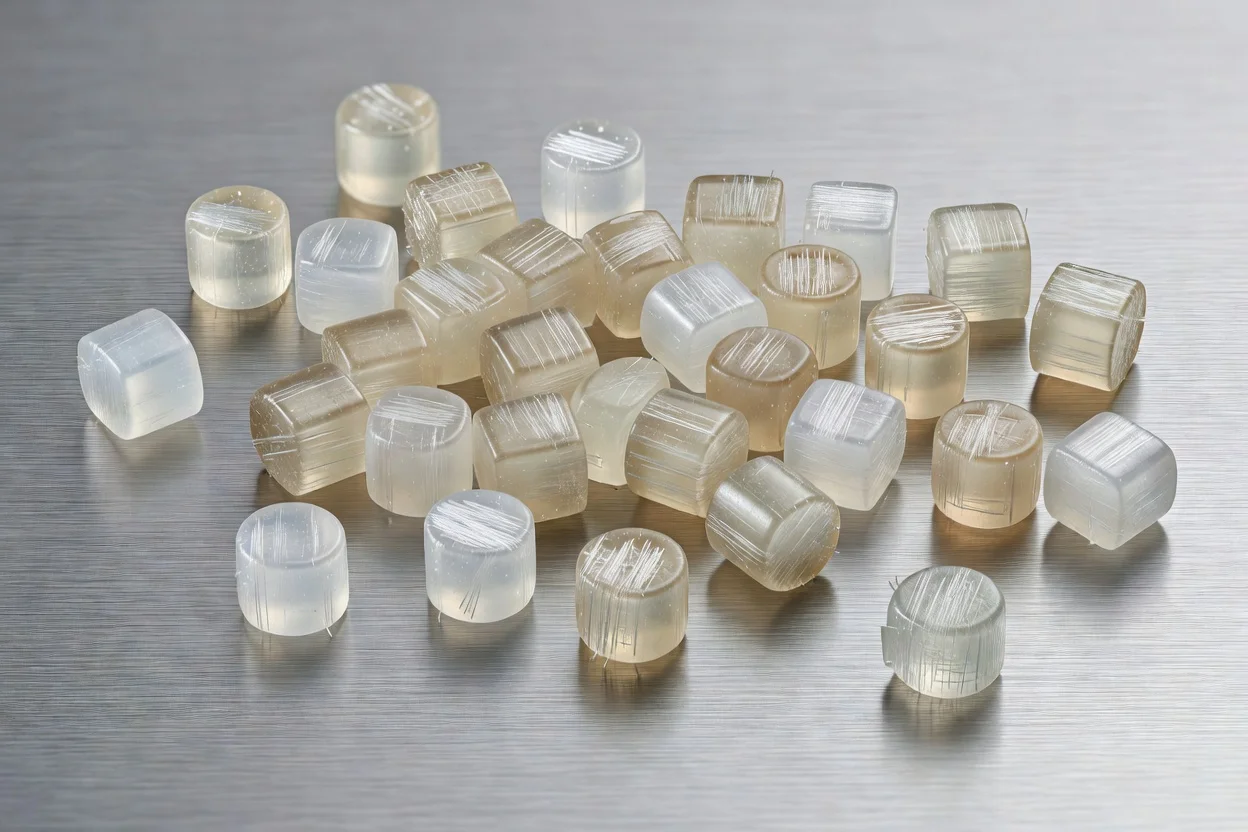
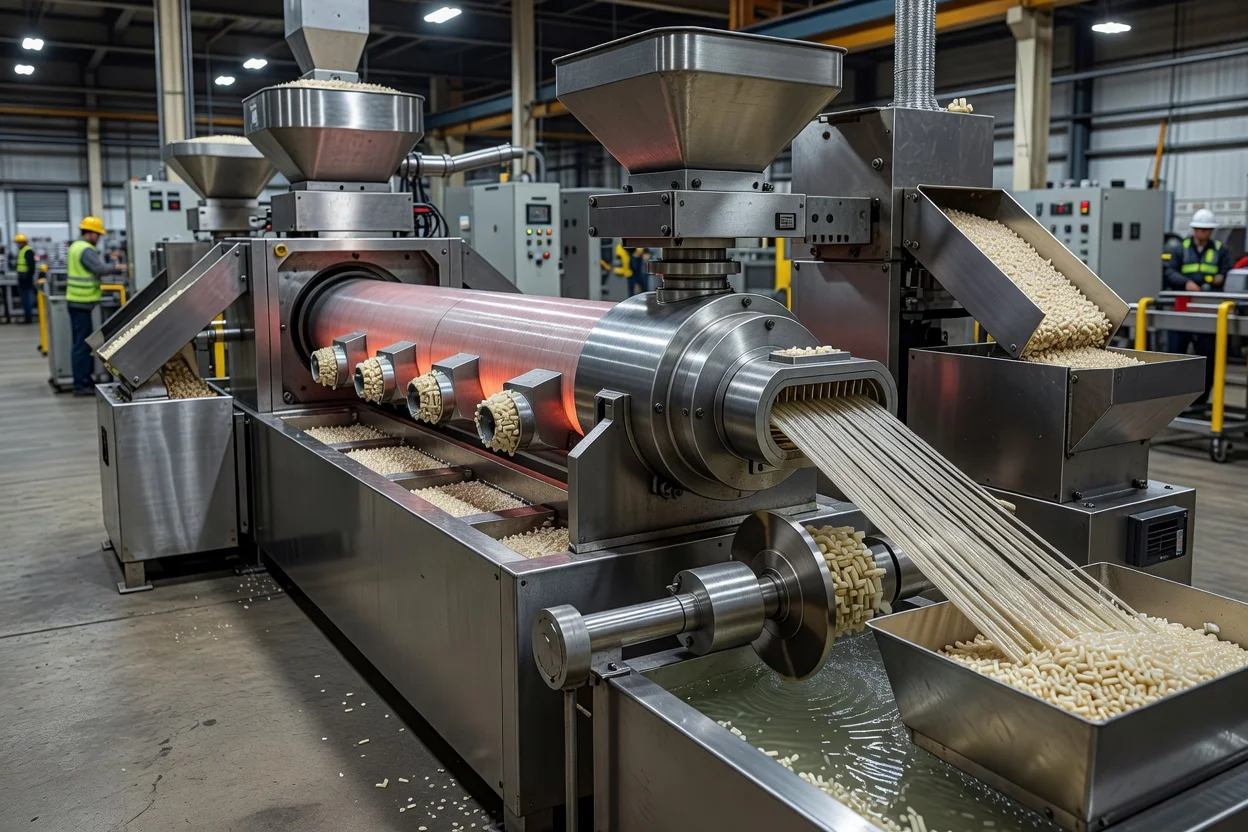
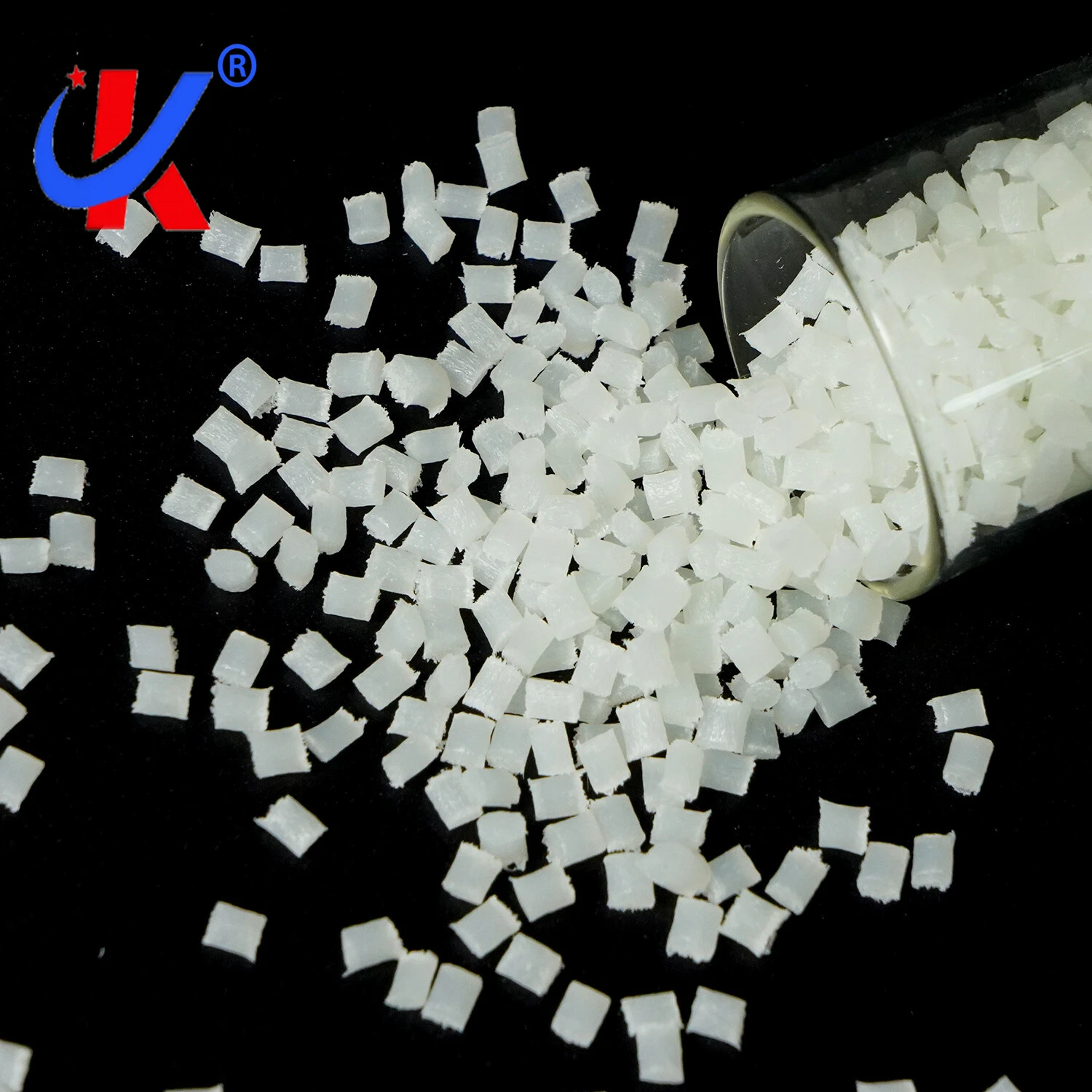
Short fiber thermoplastics are typically produced by melt compounding, in which chopped fibers are fed into an extruder with the chosen resin and additives, then pelletized for later molding. The fiber length is usually on the order of fractions of a millimeter to a few millimeters after compounding and can be shortened further during processing.
Typical production steps include:
- Resin selection and drying, especially for moisture-sensitive polymers such as polyamides.
- Fiber addition through side feeding or premixing.
- Melt compounding in twin-screw or similar extruders.
- Pelletizing and downstream injection molding, compression molding, or extrusion.
- Optional addition of coupling agents, stabilizers, lubricants, pigments, or flame retardants.
Raw feedstocks depend on the grade:
- Matrices: polypropylene, polyamide, PBT, PPS, PEEK, and other engineering thermoplastics.
- Fibers: glass fiber is the volume leader because of cost and availability; carbon fiber is used where stiffness-to-weight, electrical conductivity, or thermal stability are more valuable.
- Additives: coupling agents, heat stabilizers, UV stabilizers, flame retardants, processing aids, and colorants are common in commercial formulations.
A practical compounding example is short glass fiber polypropylene at roughly 20–40 wt% fiber loading, where silane-treated glass and maleic-anhydride-grafted compatibilizers are often used to improve interfacial adhesion and reduce fiber pullout during loading. Another example is chopped carbon fiber in high-temperature thermoplastics, where fiber loading is selected to maximize stiffness and conductivity without making the melt too viscous for molding.
Applications and end-use markets
Short fiber thermoplastics are used where moderately high structural performance, thin-wall moldability, and high production throughput must coexist.
| End-use sector | Typical resin/fiber combination | Usual processing route | Why it fits |
|---|---|---|---|
| Automotive and transportation | PP-GF, PA-GF, PPS-CF | Injection molding, occasional compression molding | Weight reduction, stiffness, heat resistance, part consolidation |
| Electrical and electronics | PA-GF, PBT-GF, PPS-CF | Injection molding | Dimensional stability, electrical insulation, heat resistance |
| Consumer goods | PP-GF, PA-GF | Injection molding | Cost-effective reinforcement for housings, tools, and sporting goods |
| Industrial machinery | PA-GF, PPS-GF, PEEK-CF | Injection molding, compression molding | Wear resistance, rigidity, thermal stability |
| Medical devices | Specialty engineering thermoplastics with short fiber reinforcement | Injection molding | Lightweight housings, instrument components, selected structural parts |
| Aerospace and defense | High-performance CF-reinforced thermoplastics | Compression or injection molding for selected parts | Weight savings and thermal performance in secondary structures |
| Additive manufacturing feedstock | Short fiber-filled filaments or pellets | Fused-filament fabrication or pellet-based printing | Better stiffness than neat polymer, with acceptable printability |
Transportation is the largest and most visible application area, with industry analyses identifying it as the leading end-use segment and noting growing use in electric vehicles for battery housings and structural components. In automotive parts, short fiber thermoplastics are commonly selected for pedals, intake manifolds, seats, interior trim, brackets, and under-the-hood housings. In electronics, they are used for enclosures and structural frames where heat resistance and dimensional precision matter.
A poor-fit use is highly load-critical primary structure in aircraft or high-performance sports equipment, where continuous-fiber composites usually provide much better specific strength and fatigue performance.
Environmental and sustainability aspects
Short fiber thermoplastics have an inherent circularity advantage over thermoset composites because the matrix is melt-processable and can, in principle, be remelted and reprocessed. They are also widely used in high-volume sectors such as automotive, where lightweighting can reduce operational energy demand over the product lifetime.
Their sustainability profile remains constrained by several factors:
- Fiber shortening during recycling reduces property retention across reprocessing cycles.
- Mixed-material systems complicate separation and high-quality closed-loop recovery.
- Fossil-based resins still dominate most commercial grades.
- High-performance carbon-fiber grades can have significant embodied energy, even when used to reduce part mass.
Recycling pathways include mechanical recycling of production scrap, regrinding and re-compounding, and limited use of recycled feedstocks in lower-spec applications. Bio-based or recycled-matrix alternatives are being explored, but their availability, cost, and long-term durability vary widely. In practice, the most mature sustainability strategy is often lightweighting plus scrap recovery, rather than relying on a fully circular fiber-to-fiber loop.
Economic and global market impact
Market analyses describe short fiber thermoplastics as a sizeable and steadily growing segment of the broader composites industry, supported by transportation, consumer goods, and electrical and electronic applications. Recent industry estimates place the market in the tens of billions of US dollars and project continued growth through the end of the decade.
The leading commercial supply base is concentrated among major polymer and composite producers that offer glass- and carbon-fiber compounds, engineered resins, and custom compounding services. Competitive advantage in this segment typically depends on:
- Compound consistency and fiber length control
- Surface finish and moldability
- Thermal and chemical resistance
- Supply reliability for automotive and electronics customers
- Ability to tailor formulations for conductivity, flame retardancy, or wear resistance
Current challenges and innovations
Current technical challenges include the trade-off between fiber content and processability, fiber breakage during compounding, anisotropy caused by flow-induced orientation, and the difficulty of predicting final part performance from nominal formulation alone.
Active innovation areas include:
- Advanced simulation and digital twin tools for fiber orientation, warpage, and shrinkage prediction.
- Better fiber sizings and coupling chemistries to improve interfacial bonding and fatigue life.
- Recycled and bio-based matrices for lower-carbon formulations.
- Additive manufacturing feedstocks that incorporate short fibers for stiffness without the complexity of continuous-fiber printing.
- Hybrid reinforcement systems combining short fibers with particles, minerals, or nanofillers to balance cost, stiffness, and toughness.
One especially important development is the use of short fiber thermoplastics in 3D printing and pellet-based additive manufacturing, where short glass or carbon fibers can raise stiffness and dimensional stability while still permitting relatively simple feeding and processing.
Future outlook
Short fiber thermoplastics are likely to remain a core engineering material wherever manufacturers need a practical compromise between commodity plastics and more expensive structural composites. Their strongest future opportunities lie in electric vehicles, electronics, industrial automation, and additive manufacturing, where lightweighting, thermal stability, and design freedom are increasingly valuable.
Longer term, progress will depend on three linked developments: better control of fiber architecture, broader use of recycled or lower-carbon feedstocks, and more accurate property prediction at the part level rather than the resin level. As these capabilities improve, short fiber thermoplastics will likely expand further into applications that demand not just moldability, but also stable performance under heat, fatigue, and dimensional constraints.
Summary
Short fiber thermoplastics are molded composite materials that combine a thermoplastic matrix with chopped reinforcements, most often glass or carbon fibers, to produce a cost-effective balance of stiffness, strength, heat resistance, and processability. They are widely used in transportation, electronics, consumer goods, and industrial parts, and they remain important because they can be manufactured efficiently at high volumes.
Their main limitation is that short, randomly oriented fibers cannot match the performance of long-fiber or continuous-fiber composites, and recycling can degrade fiber length and part properties. Even so, ongoing improvements in compounding, simulation, recycled content, and additive manufacturing are keeping this material class central to modern plastics engineering.
References
- •
Short fiber thermoplastics. (2014, December 3). Wikipedia. https://en.wikipedia.org/wiki/Short_fiber_thermoplasticsLink
- •
SFT Short Fiber Thermoplastic — Short Carbon Fiber Compounds | Doolike. (n.d.). https://lftmolding.com/product-sftLink
- •
Carbon Fiber Reinforced Thermoplastics: From Materials to ... (n.d.). https://publications.rwth-aachen.de/record/1026912/files/1026912.pdfLink
- •
Short Vs. Long Carbon Fiber Reinforced Thermoplastics. (2025, July 30). https://www.carbonele.com/news/short-vs-long-carbon-fiber-reinforced-thermoplastics/Link
- •
Long vs Short Fiber. (2000, August 31). Avient. https://www.avient.com/products/long-fiber-technology/long-vs-short-fiberLink
- •
Multiscale modeling of short fiber-reinforced thermoplastics under ... (n.d.). https://www.research.unipd.it/retrieve/e14fb26f-b2cc-3de1-e053-1705fe0ac030/Pietrogrande_Riccardo_tesi.pdfLink
- •
Recycling concepts for short-fiber-reinforced and particle-filled thermoplastic composites: A review. (n.d.). https://iris.unitn.it/retrieve/e3835199-2391-72ef-e053-3705fe0ad821/265-Pegoretti-Recycling-short-fiber-reinforced%20thermoplastics_AIEPR-2021.pdfLink
- •
Short Fiber Thermoplastic Composites Market Size, Value, Demand, Forecast to 2031. (2023, January 1). Straits Research. https://straitsresearch.com/press-release/global-short-fiber-thermoplastic-composites-market-valueLink
- •
RVE modelling of short fiber reinforced thermoplastics with ... (2019, December 16). Springer. https://link.springer.com/article/10.1007/s42452-019-1890-5Link
- •
What is Short Fiber Thermoplastic (SFT)? Uses, How It ... (2025, October 3). LinkedIn. https://www.linkedin.com/pulse/what-short-fiber-thermoplastic-sft-uses-how-works-zl0ifLink
- •
Short Carbon Fiber-Reinforced Thermoplastic Composites ... (n.d.). https://www.diva-portal.org/smash/get/diva2:1370712/FULLTEXT01.pdfLink
- •
AMCP-706-313. (n.d.). https://apps.dtic.mil/sti/tr/pdf/ADA015181.pdfLink
- •
Fiber Reinforcement for Thermoplastics: Main Types and ... (2024, August 27). AZoM. https://www.azom.com/article.aspx?ArticleID=23795Link
- •
Short CF Thermoplastic Composites | Supplier. (2000, January 1). https://www.carbonele.com/products/cf-series/Link
- •
Short Fiber Thermoplastics Market Insights, 2021- 2031. (2015, April 9). Transparency Market Research. https://www.transparencymarketresearch.com/short-fiber-thermoplastics-market.htmlLink
- •
Short Fibers - Teijin Carbon. (n.d.). https://www.teijincarbon.com/products/short-fibers/Link
- •
What is Short Fiber Thermoplastic (SFT)? Uses, How It Works & Top Companies (2025). (2025, October 10). LinkedIn. https://www.linkedin.com/pulse/what-short-fiber-thermoplastic-sft-uses-how-works-top-companies-kgp6cLink
- •
Performance of Short Fiber Interlayered Reinforcement Thermoplastic Resin in Additive Manufacturing. (2020, June 26). PMC. https://pmc.ncbi.nlm.nih.gov/articles/PMC7344774/Link
- •
Short Fiber Thermoplastic Composites Market. (2024, June 28). Knowledge Sourcing. https://www.knowledge-sourcing.com/report/short-fiber-thermoplastic-composites-marketLink
- •
Ansys. (2025, September 11). Scribd. https://www.scribd.com/document/505094448/ansysLink
- •
Short Fiber Thermoplastic Composites Market - Size, Share ... (2025, January 27). Mordor Intelligence. https://www.mordorintelligence.com/industry-reports/short-fiber-thermoplastic-composites-marketLink
- •
Short Fiber Thermoplastic Market: Trends, Opportunities, and ... (2026, May 8). Lucintel. https://www.lucintel.com/short-fiber-thermoplastic-market.aspxLink
- •
BRNO UNIVERSITY OF TECHNOLOGY. (n.d.). https://dspace.vut.cz/server/api/core/bitstreams/d14bfdd0-fd61-4f99-a860-bd2cbeaa9bfa/contentLink
- •
短繊維熱可塑性プラスチックの世界市場. (2025, June 20). https://www.gii.co.jp/report/go1753182-short-fiber-thermoplastics.htmlLink
- •
Micromechanical modeling of short-fiber reinforced thermoplastics. (n.d.). https://pure.tue.nl/ws/portalfiles/portal/191013653/20211220_Zhang_hf.pdfLink
- •
Untitled. (n.d.). CiteSeerX. https://citeseerx.ist.psu.edu/document?repid=rep1&type=pdf&doi=e5e7fde813b437f34214fc8d62fbfd8d6836108eLink
- •
Manuscript ACS.doc. (n.d.). https://ris.utwente.nl/ws/files/6128417/Shirazi10factors.pdfLink
- •
Short CF Thermoplastic Composites - Carbon Fiber Compounds Manufacturer | Supplier. (2000, January 1). https://www.carbonele.com/products/cf-series/page/21/Link
- •
Development and characterization of short glass fiber ... (2023, November 17). PMC. https://pmc.ncbi.nlm.nih.gov/articles/PMC10777416/Link
- •
Why Long Fiber Thermoplastics Outperform Short ... (2026, June 9). https://www.lfrt-plastic.com/info/why-long-fiber-thermoplastics-outperform-short-103521784.htmlLink
- •
2014_Synthetic Fibers and TP Short-Fiber-Reinforced Polymers_Properties and Characterization. (2025, July 17). Scribd. https://www.scribd.com/document/372225030/2014-Synthetic-Fibers-and-TP-Short-Fiber-Reinforced-Polymers-Properties-and-CharacterizationLink
- •
Mechanical properties of short fiber reinforced thermoplastic blends. (n.d.). ScienceDirect. https://www.sciencedirect.com/science/article/abs/pii/S0032386105002788Link
- •
Table 2. (2021, January 1). PMC. https://pmc.ncbi.nlm.nih.gov/articles/PMC8587832/table/polymers-13-03846-t002/Link
- •
Chapter 1: Introduction to Short Fiber Composites - Ansys Help. (2026, March 8). https://ansyshelp.ansys.com/public/Views/Secured/corp/v261/en/acp_fiber/acp_fiber_intro_to_short_fiber_reinf_comps.htmlLink
- •
Fused-Filament Fabrication of Short Carbon Fiber-Reinforced Polyamide: Parameter Optimization for Improved Performance under Uniaxial Tensile Loading. (2022, March 23). PMC. https://pmc.ncbi.nlm.nih.gov/articles/PMC9002508/Link