
Introduction
Extrusion lines for composites are integrated continuous-processing systems used to combine polymers with reinforcing or functional constituents such as glass fiber, carbon fiber, wood flour, mineral fillers, barrier layers, metal foils, or adhesive tie-layers, and then form the material into pipes, profiles, sheets, tapes, films, straps, filaments, or compounded pellets. In industrial practice, the term covers both compounding lines that prepare composite feedstocks and forming lines that convert those feedstocks into final or semi-finished composite products, often with coextrusion, multilayer die technology, or downstream reinforcement steps.
These lines occupy a central position in plastics processing because they connect polymer formulation, fiber or filler dispersion, thermal control, melt rheology, and final part performance in a single continuous workflow. Their development has been driven by the need for higher output, tighter dimensional control, lower specific energy use, and the ability to process increasingly complex composite structures, including multilayer barrier pipes, wood-plastic composites, and fiber-reinforced engineering compounds. Recent industry systems also emphasize automation, gravimetric feeding, inline monitoring, and modular line architecture to support product changeovers and reproducible quality.
Sustainability is now a defining design criterion for composite extrusion lines, particularly in wood-plastic composites, recycled-polymer formulations, lightweight packaging structures, and systems intended to reduce scrap through stable melt delivery and precise calibration. Future development is likely to focus on higher levels of digital control, more efficient degassing and dispersive mixing, improved processing of recycled and high-filler materials, and greater compatibility with circular-economy feedstocks.
History and Development
Composite extrusion evolved from conventional single-screw plastic extrusion, which was first applied to simple profiles and later adapted to multilayer and filled-material processing as polymer demand diversified. The transition to co-rotating twin-screw compounding was a major milestone because it enabled much more intensive mixing, better dispersion of additives and fibers, and stable devolatilization for filled and engineering compounds.
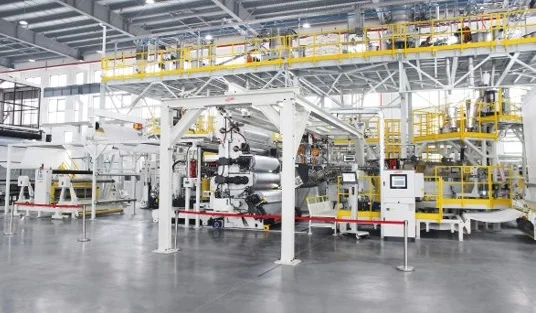
A second milestone was the commercialization of coextrusion line architectures for multilayer pipes, films, and tapes, where separate melt streams are merged in a feedblock or multilayer die to create bonded composite structures with distinct functional layers. This made it practical to combine, for example, structural polyethylene with adhesive tie-layers and aluminum foil or barrier polymers in a single continuous process.
A third milestone came with the rise of specialized composite product lines for WPC profiles, composite straps, reinforced nonwovens, and technical profiles, supported by modular downstream calibration, haul-off, winding, and cutting systems. More recently, EU-funded and manufacturer-led development has focused on easier processing of low-flow-index materials, nanofiller-rich compounds, and more automated small-series or high-mix production environments.
Key Characteristics and Technical Overview
A composite extrusion line is usually organized into upstream material preparation, extrusion or compounding, die forming, and downstream finishing. The specific configuration depends on whether the goal is to compound a composite pellet, extrude a continuous profile, laminate layers, or build a reinforced structure.
- Feed systems often include loss-in-weight feeders, side feeders, gravimetric blenders, and vacuum or hopper dryers for hygroscopic polymers and fillers.
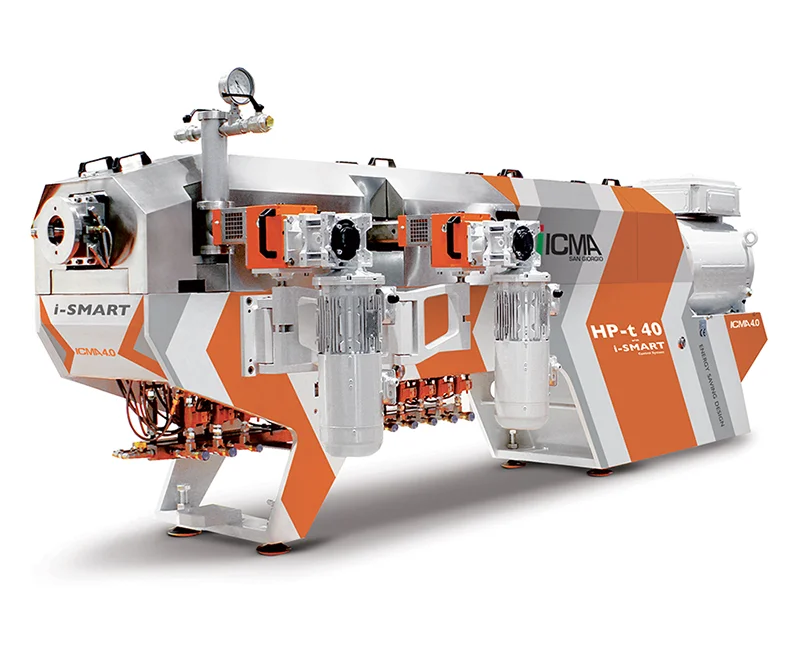
- Extruders may be single-screw for simpler profile or strap lines, or co-rotating twin-screw for intensive compounding and high-filler materials.
- Coextrusion heads and feedblocks are used for multilayer structures, typically with 2 to 9 layers in laboratory and industrial systems; multilayer dies may be preferred when viscosities differ significantly between layers.
- Downstream equipment includes vacuum calibration tanks, cooling baths, haul-off units, strand pelletizers, winders, cutters, and inline gauges for thickness, width, or diameter control.
Typical performance ranges vary widely by product type:
- Composite pipe and profile lines commonly run from modest laboratory outputs to industrial production lines with high linear speeds, with some specialized composite pipe systems reported at up to 80 m/min in line demonstrations.
- Tape and strap extrusion lines may use high-throughput, narrow-web processing with strong orientation control; one composite nonwoven/tape-related platform reports line widths from 1000 to 5400 mm and specific throughput values up to 270 kg/h/m for spunbond-type configurations.
- Compounding lines for filled or fiber-reinforced materials often integrate melting, kneading, devolatilization, and pelletizing; commercial systems are commonly designed around the need to handle glass fiber, wood flour, CaCO\(_3\), talc, or functional additives without excessive fiber breakage or thermal degradation.
Selected quantitative benchmarks commonly associated with composite extrusion and downstream conditioning include:
- Strand pelletizing of compounded composite melts is often followed by water cooling and strand drying; centrifugal or strand drying stages typically reduce surface moisture to a low residual level suitable for pellet storage, with many industrial systems targeting very low surface moisture before cutting and screening.
- Composite filaments for additive manufacturing are frequently produced at controlled diameters such as 1.75 mm or 2.85 mm, illustrating how extrusion lines can be tuned for tight dimensional tolerances in engineering applications.
- Specific energy consumption is highly material- and line-dependent, but twin-screw compounding is generally chosen when process efficiency must be balanced against intensive mixing, degassing, and dispersion requirements.
From an engineering standpoint, the central challenge is to balance melt homogeneity, fiber integrity, interlayer adhesion, thermal stability, and dimensional precision. In composites with long fibers or nanofillers, the line must minimize residence-time variability, uncontrolled shear heating, and clogging while still achieving adequate dispersion.
Main Types and Variations
| Type of extrusion line | Principal function | Typical composite materials | Main advantage |
|---|---|---|---|
| Compounding line | Mixes polymers with fibers, fillers, and additives; often pelletizes the output | Glass-filled, wood-filled, mineral-filled, cable compounds, engineering plastics | High dispersion and formulation flexibility |
| Coextrusion line | Combines two or more melt streams into layered products | Barrier pipes, multilayer films, laminated straps, composite sheets | Functional layering and material economy |
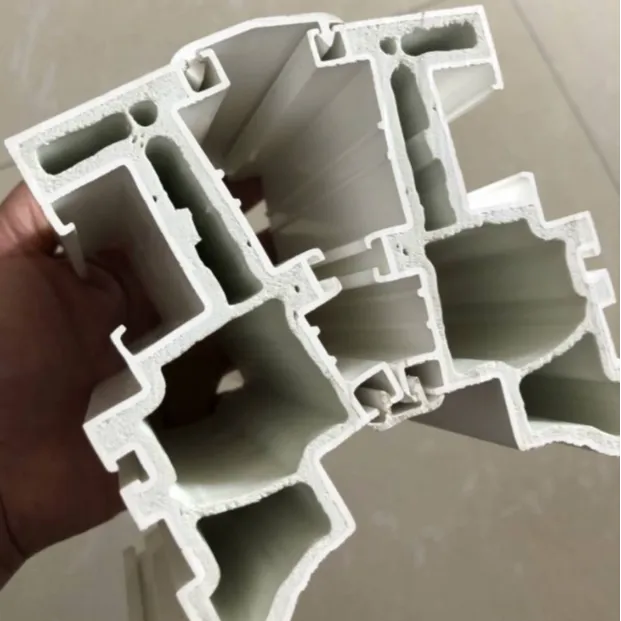
| Profile extrusion line | Forms continuous sections with defined cross-sections | WPC profiles, technical profiles, solid rods | Dimensional consistency and long continuous output |
| Pipe extrusion line | Produces composite pipes and tubing, often multilayer | PE, PP, PERT, EVOH, aluminum-core or bonded-layer pipes | Pressure performance and barrier functionality |
| Sheet extrusion line | Produces composite sheets or boards | Filled sheets, decorative panels, technical laminates | Large-format flat products |
| Strap/tape line | Produces oriented tapes or straps | PP/PET composite straps, slit films, laminar tapes | High tensile performance and low mass |
| Filament extrusion line | Produces composite filament for additive manufacturing | Carbon-fiber, glass-fiber, or filled filaments | Controlled diameter and repeatability |
Applications and Uses
Composite extrusion lines are used across construction, packaging, automotive, electrical, furniture, infrastructure, and advanced manufacturing.
- Construction and building products: WPC decking, cladding, fencing, profiles, and window or door components are produced on profile extrusion lines optimized for filled and recycled feedstocks.
- Piping and plumbing: Multilayer composite pipe lines produce pressure pipes and barrier pipes, including structures with adhesive layers and aluminum foil or EVOH barriers.
- Packaging and logistics: Composite straps and laminar tapes are made on specialized strap or tape extrusion lines for bundling and transport applications.
- Automotive and technical profiles: Precision profile lines produce engineering sections, sealing profiles, and technical components with controlled geometry and surface quality.
- Nonwovens and filtration media: Composite nonwoven lines combine meltblown, spunbond, and multilayer structures for hygiene, filtration, and specialty applications.
- Additive manufacturing feedstock: Filament extrusion lines convert composite pellets into controlled-diameter filament for high-performance 3D printing.
A less suitable application is highly abrasive, thermally unstable, or moisture-sensitive formulations without adequate drying, wear protection, and temperature control, because such materials can accelerate screw wear, cause melt defects, and destabilize throughput.
Technological Innovations and Automation
Modern composite extrusion lines increasingly incorporate modular machine architecture, recipe-based controls, and automatic feed management to improve repeatability and reduce setup time. Coextrusion systems use feedblocks, manifold dies, and specialized flow-channel design to stabilize layer distribution even when the polymers have very different viscosities.
Important automation features include:
- Gravimetric dosing for accurate resin, fiber, and filler addition.
- Inline thickness, diameter, or basis-weight monitoring for closed-loop correction.
- Vacuum degassing for volatile removal in filled or recycled compounds.
- Servo-synchronized haul-off and winding to stabilize orientation and dimensional accuracy.
- Digital line control for recipe storage, alarms, traceability, and quality logging.
EU-backed development has also targeted simpler processing of low-flow and nanofiller-rich composites, reflecting the broader shift toward machinery that can accommodate more difficult formulations with less operator intervention.
Environmental and Sustainability Aspects
Composite extrusion lines can support sustainability when they enable lightweighting, material substitution, recycled content, and process scrap reduction. WPC lines, in particular, are associated with renewable or recycled feedstocks and with durable outdoor products that can replace some traditional wood products.
Key sustainability considerations include:
- Energy efficiency: Single-screw lines may be simpler and less energy-intensive, while twin-screw compounding offers superior mixing for difficult formulations; the optimal choice depends on whether process intensity or energy minimization is the priority.
- Waste reduction: Stable extrusion, precise calibration, and automated feedback reduce off-spec material and start-up scrap.
- Circularity: Composite lines increasingly process recycled polymers, reclaimed fibers, and filled blends, although contamination control remains critical.
- Material efficiency: Coextrusion allows expensive barrier or functional layers to be used only where needed, reducing overall material cost and resource use.
The principal trade-off is that more complex composite structures can improve product performance and service life, but they may also complicate recycling unless the line and product are designed with end-of-life separation or mono-material compatibility in mind.
Economic and Global Market Impact
Composite extrusion lines are commercially important because they produce high-volume intermediate materials and finished goods for construction, packaging, infrastructure, and industrial markets. Their economics are driven by throughput, uptime, material cost, energy consumption, changeover efficiency, and the value added by multilayer or reinforced structures.
Suppliers position these systems as turnkey or modular investments for broad application sectors, including technical profiles, WPC products, composite pipes, and specialty films. Market demand is shaped by the need for performance differentiation: barrier pipes, durable decking, reinforced straps, and filled compounds all command stronger technical requirements than conventional single-polymer products.
Current Challenges and Innovations
The main technical challenges are fiber degradation, abrasive wear, poor dispersion, moisture sensitivity, interlayer bonding control, and recycling complexity.
Current innovations address these issues through:
- wear-resistant screws, barrels, and dies for filled and fiber-rich compounds;
- improved venting and devolatilization for recycled and hygroscopic materials;
- better melt distribution in multilayer dies and feedblocks;
- more stable downstream calibration for thin-wall and high-speed products;
- compact laboratory systems that allow faster formulation development before scale-up.
For advanced composites, especially those using continuous fiber or high nanofiller content, the engineering challenge is not merely forming the shape but preserving reinforcement architecture through the entire line.
Future Outlook
Composite extrusion lines are likely to move toward higher automation, broader recycled-feedstock compatibility, more precise multilayer control, and greater integration with digital quality systems. In construction and infrastructure, demand should remain strong for WPC profiles, composite pipes, and other durable extrusions with favorable life-cycle performance.
A parallel development is the convergence of composite extrusion with additive manufacturing, laboratory compounding, and specialty filament production, where the same principles of melt control, dispersion, and dimensional accuracy are being adapted to smaller-scale, higher-value applications. As a result, extrusion lines for composites are increasingly less like standalone machines and more like material engineering platforms that link formulation science, process control, and end-use performance.
References
- •
Collin Solutions. (2024, October 23). Technology. https://www.collin-solutions.com/en/technology/Link
- •
Oak Ridge National Laboratory. (2021). Polymer and composites additive manufacturing: Material extrusion. https://impact.ornl.gov/en/publications/polymer-and-composites-additive-manufacturing-material-extrusion-/Link
- •
Reifenhäuser. (n.d.). RF5 composite lines. https://reifenhauser.com/en/lines-components/extrusion-lines/nonwoven-lines/rf5-compositeLink
- •
EXTRUDEX Kunststoffmaschinen. (2024, April 3). Multilayer extrusion lines. https://extrudex.de/en/products/extrusion-lines/multilayer-extrusion-linesLink
- •
Sakshi Plasto Craft Industries. (n.d.). Heat & melting system - Extruder. https://www.sakshiplastocraft.com/s-projects-basicLink
- •
Noztek. (2025, October 5). Noztek complete extrusion line. https://noztek.com/product/full-filament-extrusion-system/Link
- •
Hybrid Manufacturing Technologies. (2025, August 5). Composites. https://hybrid-am.com/technology/composites/Link
- •
Jwell. (n.d.). Plastic sheet extrusion line manufacturer. https://jwellanhui.com/product-category/sheet-extrusion-line/Link
- •
Reifenhäuser. (n.d.). Extrusion lines product finder. https://reifenhauser.com/en/lines-components/extrusion-lines-product-finder/Link
- •
bella Extrudex. (2024, February 13). Extrusion lines. https://extrudex.de/en/products/extrusion-linesLink
- •
CYKF. (2020, November 24). Co-rotating twin screw strand pelletizing compounding extrusion line. https://www.cykf.com.tw/en/product/Strand-Pelletizing-System.htmlLink
- •
Satellite Plastic Industries. (2018, January 30). SIMA. https://www.satelliteindia.com/portfolio-items/sima/Link
- •
CORDIS. (2022, October 7). Improved machines for composite material manufacturing. https://cordis.europa.eu/article/id/442189-improved-machines-for-composite-material-manufacturingLink
- •
Lohia Group. (n.d.). Tape extrusion lines [PDF]. https://www.lohiagroup.com/storage/app/media/products/LCL_CoEx.pdfLink
- •
Xtrusion Machinery. (n.d.). Co-extrusion lines for multi-layer reinforced structures. https://xtrusionmachinerys.com/product/co-extrusion-lines-for-multi-layer-reinforced-structuresLink
- •
Making.com. (2025, May 26). High-performance compounding extruder. https://making.com/equipment/high-performance-compounding-extruderLink
- •
SIMA. (2016, April 11). Technologies. https://sima-ds.com/en/technologies/extrusion-lines/Link
- •
Luigi Bandera. (2024, March 22). Flat die sheet extrusion lines. https://www.luigibandera.com/products/flat-die/industrial-sheet/Link
- •
GS Extruder. (2024, January 19). Экструдер для компаундирования инженерных пластмасс. https://www.gsextruder.com/ru/engineering-plastic/Link
- •
Design Consulting. (2024, September 27). Anisoprint archives. https://www.designconsulting.com.au/category/3d-printers/anisoprint/Link
- •
Noztek. (n.d.). Noztek | Desktop filament extruders & extrusion equipment. https://noztek.com/Link
- •
Baodie. (n.d.). China knitted TPV tube extrusion line factories & product. http://bdextrusionline.com/catalog/china-knitted-tpv-tube-extrusion-line-factories-product/Link
- •
BOMAC Industries. (2017, June 20). Extrusion lines: How do they work? https://bomac-industries.com/tr/2017/06/20/extrusion-lines-how-do-they-work/Link
- •
Pexco. (2026, June 4). Custom plastic profile extrusions. https://www.pexco.com/capabilities/custom-profile-extrusions/Link
- •
Bausano. (n.d.). WPC extrusion lines. https://www.bausano.com/en/applications/extrusion-lines-for-wpcLink
- •
AKMA Technology. (n.d.). Solid rods. http://www.akma.de/en/final-good/solid-rodsLink
- •
Tech-Labs Pro. (n.d.). Heron AM. https://tech-labs.pro/products/heron-amLink
- •
Jwell Machinery. (2026, August 20). WPC pellet extruder compounding machine. https://www.jwell-machinery.com/products/battery-compound-extruder.htmlLink
- •
Bausano. (n.d.). Plastic profiles extrusion lines. https://www.bausano.com/en/complete-lines/extrusion-lines-for-profilesLink
- •
Qingdao Yongte Plastic Machinery Manufacturing. (n.d.). Qingdao Yongte Plastic Machinery Manufacturing Co., Ltd. https://www.ytplasticmachine.com/Link
- •
Hans WEBER Maschinenfabrik. (n.d.). Extrusion of technical profiles. https://www.hansweber.de/en/extrusion/technology/extrusion-of-technical-profilesLink
- •
Heaven Extrusions. (n.d.). Engineering excellence in extrusion [PDF]. http://5.imimg.com/data5/SELLER/Doc/2026/5/609477210/XS/BW/JS/8884010/cast-film-extrusion-line.pdfLink
- •
Polytechme. (2025, September 16). WPC profile extrusion line. https://polytechme.com/product/wpc-profile-machine/Link
- •
3devo. (n.d.). 3devo: Industrial filament makers & extrusion systems. https://www.3devo.com/Link
- •
Scribd. (2026, April 16). Polymer processing lab machines [PDF]. https://www.scribd.com/document/464677997/Coex-BlownFilm-0805Link
- •
DirectIndustry. (2025, January 1). Multilayer coextrusion line - All industrial manufacturers. https://www.directindustry.com/industrial-manufacturer/multilayer-coextrusion-line-116283.htmlLink
- •
DirectIndustry. (2025, January 1). Composite pipe extrusion line - All industrial manufacturers. https://www.directindustry.com/industrial-manufacturer/composite-pipe-extrusion-line-236203.htmlLink
- •
CHUANGBO. (2026, April 9). Linha de extrusão de filamentos 3D de fibra contínua para desenvolvimento de compósitos em escala laboratorial. https://www.cbextrusion.com/pt/lab-continuous-fiber-3d-filament-extrusion-line/Link
- •
ESI - Extrusion Services. (2024, September 23). ESI - Extrusion Services, LLC. https://esi-extrusion.com/Link
- •
Alibaba. (2026, March 11). Etfe Pfa extruding line: Technical specifications, production. https://www.alibaba.com/product-insights/etfe-pfa-extruding-line.htmlLink
- •
Google Patents. (2016, May 27). Extruder for a system for the additive manufacture of metal parts using the composite extrusion modeling (CEM) method (Patent No. US11541593B2). https://patents.google.com/patent/US11541593B2/en?oq=US11541593B2Link
- •
Conair Group. (2022, February 15). Extrusion processing: The basic guide to using auxiliary equipment. https://www.conairgroup.com/resources/resource/extrusion-processing-basic-guide-to-auxiliary-equipment/Link
- •
Zortrax. (n.d.). Industrial [PDF]. https://irp.cdn-website.com/8ecbc4ef/files/uploaded/ZORTRAX%20Endureal%20Brochure.pdfLink
- •
CompositesWorld. (2006, November 1). Extrusion. https://www.compositesworld.com/articles/extrusionLink
- •
Coperion. (n.d.). Extruders & compounding machines. https://coperion.com/en/products-services/extruders-compounding-machinesLink
- •
Raise3D. (2024, December 17). Composite 3D printing: Ultimate guide. https://www.raise3d.com/blog/composite-3d-printing/Link
- •
Alibaba. (2026, February 25). An in-depth guide to 3d filament extrus line: Standards, grades. https://www.alibaba.com/product-insights/3d-filament-extrus-line.htmlLink
- •
3DS. (2023, June 14). Material extrusion. https://www.3ds.com/make/guide/process/material-extrusionLink
- •
Additive Manufacturing. (n.d.). Material extrusion additive manufacturing of continuous fibre reinforced polymer matrix composites: A review and outlook. https://www.sciencedirect.com/science/article/pii/S1359836821005266Link
- •
Polytechme. (2025, September 16). Plastic extrusion lines by POLYTECH. https://polytechme.com/plastic-extrusion-lines/Link
- •
Wikipedia. (2006, June 11). Plastic extrusion. https://en.wikipedia.org/wiki/Plastic_extrusionLink