
Introduction
A haul-off unit is a downstream machine in a plastics extrusion line that grips, pulls, and precisely synchronizes the movement of the extrudate after it leaves the die and cooling section. Its primary function is to control line speed and tension so that pipe, profile, tube, cable, film, or similar continuous products remain within dimensional tolerance and retain a stable surface finish.
In industrial plastics processing, the haul-off unit is often described as a puller or tractor, and it may use belts, caterpillar tracks, or roller-based traction depending on product geometry, surface sensitivity, and required pulling force. The same basic principle is used across pipe extrusion, profile extrusion, cable coating, and selected film or sheet lines, but the mechanical design differs substantially by application.
Although the machine is mechanically less complex than the extruder itself, it has a major effect on product quality because speed mismatch can change wall thickness, draw-down ratio, straightness, and ovality. Modern systems increasingly use servo drives, closed-loop speed control, adjustable clamping pressure, and size-change mechanisms to reduce slippage, improve repeatability, and shorten changeover time.
From a process perspective, haul-off units sit at the intersection of mechanical handling, process control, and dimensional accuracy. Their importance is growing as processors pursue higher line speeds, more frequent product changes, tighter tolerances, and better energy efficiency, especially in pipe and profile extrusion where downstream stability directly affects throughput and scrap rates.
History and Development
Early extrusion lines relied on relatively simple mechanical pullers that provided traction but limited speed precision and poor adaptability to different product sizes. As extrusion output increased and tolerances tightened, the haul-off evolved from a basic pulling device into a synchronized control element in the line.
A major development was the shift from simple frictional gripping to purpose-built caterpillar and belt haul-offs, which improved contact area and reduced localized deformation on hot or semi-cooled products. This was especially important for pipe and profile production, where ovality, surface marking, and instability can occur if pulling forces are uneven.
Another milestone was the adoption of servo-driven and electronically synchronized drives. Contemporary systems can coordinate belt speed and pulling force more precisely with the extruder output, improving dimensional stability and enabling faster changeovers for different diameters or profile sections. In specialized testing and rheology applications, haul-off concepts were also adapted into laboratory equipment, such as controlled pull-off systems used with capillary rheometers to measure melt strength and extensional behavior.
Key Characteristics and Technical Overview
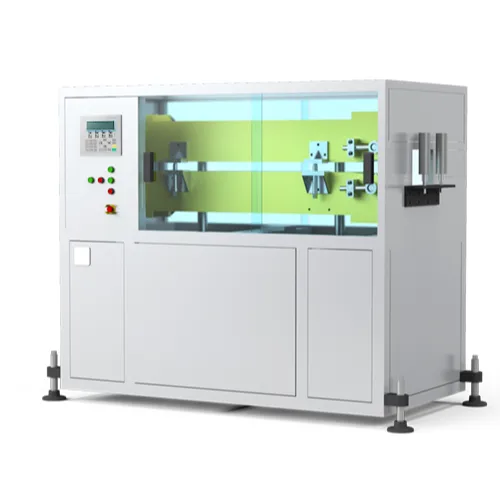
A haul-off unit typically consists of a rigid frame, traction belts or tracks, drive motors, pressure-adjustment mechanisms, guiding elements, and a control system linked to the line speed setpoint. The product is usually supported and gripped after cooling and sizing, then pulled at a controlled rate to downstream equipment such as cutters, saws, coilers, embossing units, or winding stations.
Typical engineering features include:
- Traction type: flat belt, caterpillar track, multi-track, or roller system.
- Drive system: AC or servo motor with inverter or closed-loop speed control.
- Contact pressure control: pneumatic, mechanical, or servo-assisted adjustment to match product size and surface sensitivity.
- Pulling force: from a few kilonewtons on small pipe units to very high forces on large-diameter or heavy profile lines.
- Speed range: small pipe units may run up to about 15 to 30 m/min in quoted specifications, while specialized profile haul-offs can reach 25 m/min and above.
Common design benchmarks reported by manufacturers and technical documents include:
- Pipe diameter coverage: from small-diameter tubing to large systems up to 1,800 mm OD or more in customized designs.
- Track count: 2-track, 3-track, 4-track, 6-track, or larger multi-track arrangements depending on load and geometry.
- Gripping length: often several hundred millimeters on compact machines; one published model lists 600 mm.
- Motor power: small machines may use roughly 0.75 kW per track, while larger haul-offs scale upward with line size and traction demand.
For pipe extrusion, the haul-off speed must closely match the melt throughput and cooling shrinkage behavior. If the haul-off runs too fast, wall thickness decreases; if too slow, the pipe can thicken, buckle, or accumulate compressive distortion. For profiles and boards, speed stability helps prevent twist, camber, and dimensional drift.
Types and Variations
| Type | Main gripping principle | Typical use | Main advantage | Main limitation |
|---|---|---|---|---|
| Belt haul-off | Wide belts press against the product | Boards, flat profiles, some film and sheet applications | Broad contact area, gentler on surfaces | Lower point-load traction than caterpillar systems |
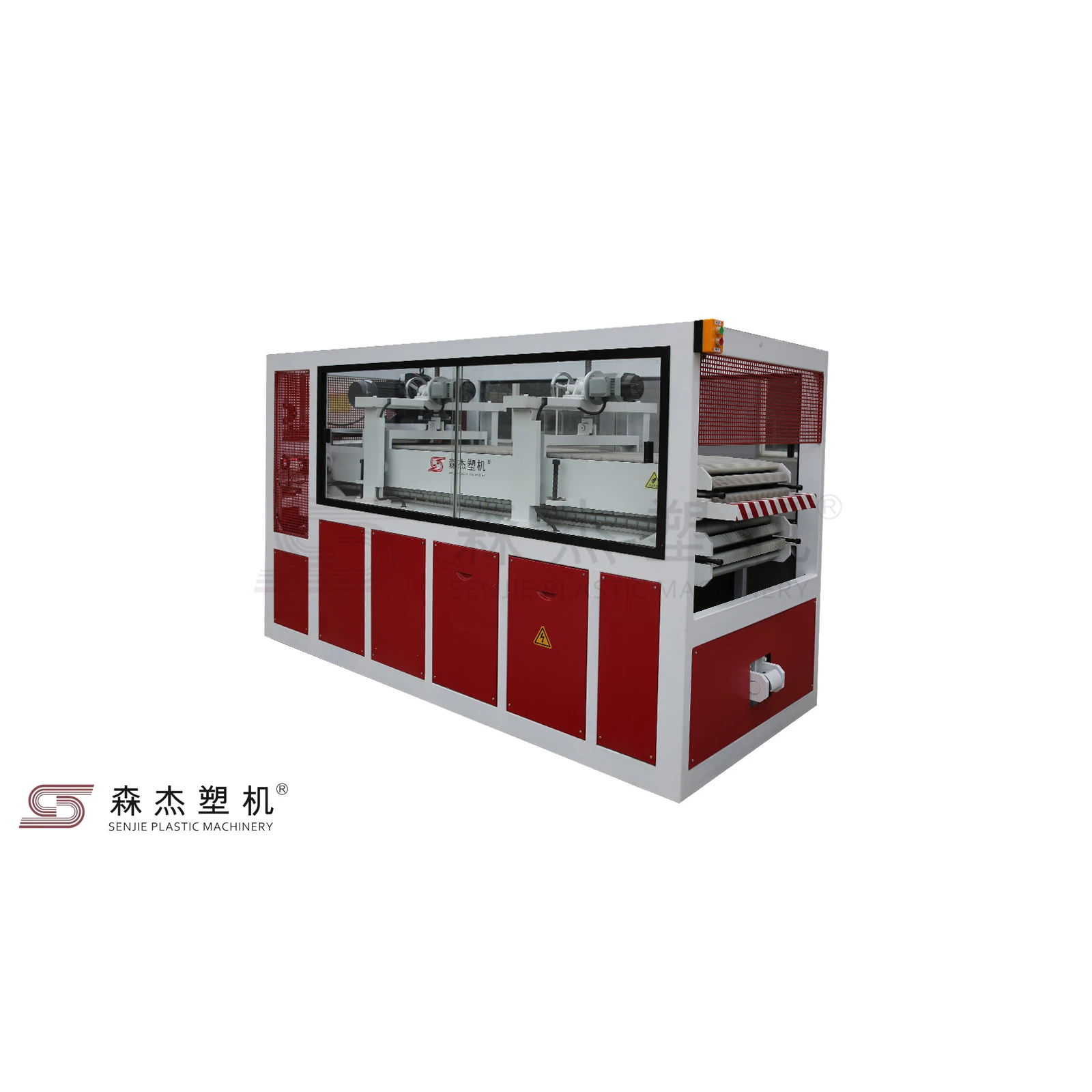
| Caterpillar haul-off | Continuous tracks grip the product linearly | Pipe, cable, profile, tube | High traction and stable pull | More complex mechanics and wear parts |
| Roller haul-off | Rotating rollers pull the product | Narrow or precise profiles | Accurate guidance and compact design | Less suitable for soft or easily marked products |
| Multi-track haul-off | Several synchronized tracks | Large pipe, heavy sections, technical profiles | High pulling force and better balance | Higher cost and footprint |
Caterpillar designs are common in pipe and cable extrusion because they can deliver continuous traction with a strong, stable grip. Belt-type machines are often preferred for flat products and sensitive surfaces because the contact area is larger and surface marking is reduced. Roller systems are more specialized and tend to be used where guidance precision is more important than maximum pulling force.
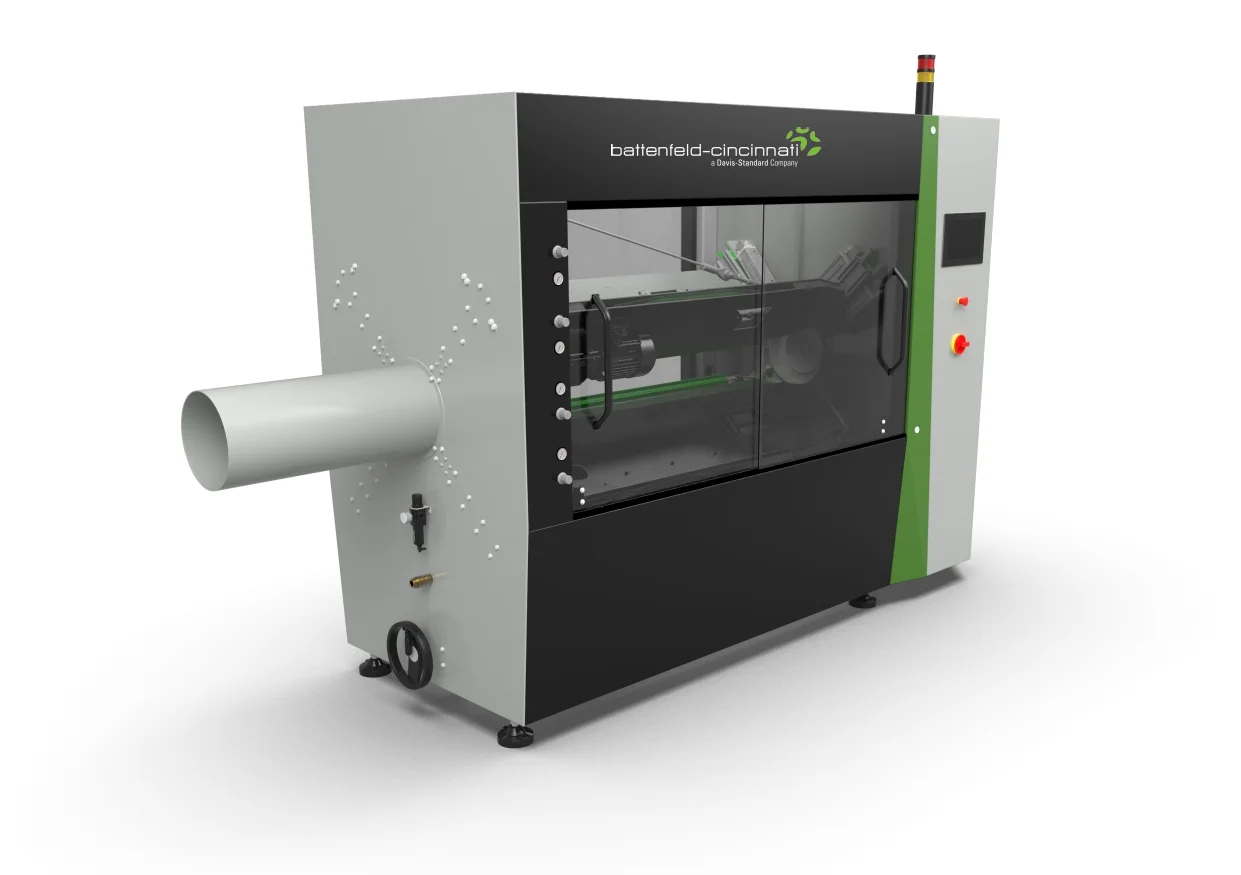
Some haul-off units are built with tilting upper tracks, self-centering mechanisms, or adjustable height and stroke systems to speed up changeovers and accommodate variation in product dimensions. Large-capacity machines may be customized for heavy-duty pipe, automotive profiles, fiberglass profiles, or composite sections.
Applications and Uses
Haul-off units are used wherever a continuous plastic product must be transported at a controlled rate after extrusion or related forming processes.
- Pipe extrusion: The haul-off maintains pipe diameter and wall thickness while coordinating with cooling, sizing, cutting, and socketing units.
- Profile extrusion: It stabilizes window profiles, cable ducts, technical profiles, and building sections by preventing twist and camber.
- Cable and wire coating: It governs draw-down ratio and helps hold coating thickness within tolerance.
- Film and sheet handling: In some lines, it contributes to flatness and controlled stretching, particularly where post-extrusion tension matters.
- Pultrusion and specialty continuous processes: It can exert the required pull on reinforced or continuously formed sections.
- Laboratory and rheological testing: Adapted haul-off systems can measure melt drawability and extensional response in test setups.
One poor-fit application is highly fragile or highly tacky extrudates that cannot tolerate traction after cooling, because the haul-off may deform or surface-mark the product unless the line is redesigned with specialized support and traction control.
Working Principle in the Extrusion Line
The haul-off is located downstream of the die, sizing, and cooling sections, where the product has gained enough integrity to withstand traction. The unit pulls the product forward at a set speed, and that speed effectively becomes the line speed reference for the entire downstream process.
In practical terms, the machine performs four functions:
- It pulls the extrudate through the line.
- It stabilizes tension so the product remains straight and dimensionally consistent.
- It synchronizes with the extruder output and cooling shrinkage.
- It feeds downstream equipment such as cutters, coilers, and stackers.
A mismatch between extruder output and haul-off speed changes the product geometry. Published technical explanations consistently note that faster haul-off tends to reduce wall thickness, while slower haul-off can increase wall thickness and create instability or bunching.
Technological Innovations and Automation
Modern haul-off units increasingly use variable-frequency drives, servo motors, and closed-loop synchronization with extruder controls to maintain speed accuracy and repeatability. This improves response to load changes, startup transients, and product-size transitions.
Current automation trends include:
- Recipe-based changeover for pipe and profile sizes.
- Self-centering belts or tracks to improve alignment during rapid product swaps.
- Integrated line control with extrusion, cooling, cutting, and coiling systems.
- Condition monitoring for belt wear, traction loss, and drive performance.
- Reduced manual adjustment through pneumatic or motorized clamping systems.
These features are particularly valuable in high-output lines where even small speed fluctuations can translate into visible dimensional variation.
Environmental and Sustainability Aspects
Haul-off units contribute to sustainability mainly through process stability, scrap reduction, and energy-efficient drive technology. A stable pull helps reduce off-spec pipe, profile warp, and rework, which lowers material waste and the energy embodied in rejected output.
Energy efficiency improvements come from:
- Servo and inverter drives that avoid unnecessary power draw.
- Optimized belt pressure, which reduces friction and wear.
- Shorter changeovers, which cut downtime and waste during product transitions.
- Better synchronization, which lowers the risk of dimensional defects and scrap.
In some film and flat-product applications, improved haul-off control can support modest stretching that improves downstream converting efficiency and reduces the need for corrective processing.
Economic and Global Market Impact
Haul-off units are a critical part of the value chain in pipe, profile, and cable extrusion because they directly affect throughput, yield, and product acceptance. In commercial terms, the haul-off is not usually the most expensive machine in the line, but it is one of the most consequential for maintaining output quality at speed.
Global demand is shaped by:
- Growth in pipe infrastructure, irrigation, and building products.
- Expansion of profile extrusion for construction and technical applications.
- Continued demand for cable and wire coating equipment.
- Adoption of larger diameter pipe lines and higher-force pullers for municipal and industrial systems.
Manufacturers differentiate themselves by traction design, pulling force, speed stability, customization, and ease of changeover rather than by haul-off concept alone.
Current Challenges and Innovations
The main engineering challenges are slippage, surface marking, traction loss, wear, and synchronization drift under changing load conditions. These issues become more severe as line speeds increase and as processors run softer, thinner, or more dimensionally sensitive products.
Current innovation priorities include:
- Better grip materials that balance traction and surface protection.
- More accurate force control for thin-wall pipe and delicate profiles.
- Faster automatic adjustment across product sizes.
- Improved integration with downstream cutting and coiling systems.
- More compact layouts for plants with limited floor space.
For large-diameter pipe, the challenge is often not only pulling force but maintaining uniform load distribution across multiple belts or tracks. For profile lines, the challenge is preventing torsion and camber without over-clamping the product.
Future Outlook
The haul-off unit is likely to become more deeply integrated into line-level digital control, with greater use of servo synchronization, predictive maintenance, and recipe automation. As extrusion systems move toward tighter quality windows and more frequent product changeovers, downstream traction control will remain central to competitive performance.
Future developments are likely to focus on:
- Higher precision speed control at elevated line speeds.
- Adaptive traction that adjusts automatically to product stiffness and surface condition.
- Lower-maintenance belt and track systems with longer service life.
- Stronger data integration with extrusion analytics and quality inspection.
- Energy-optimized drives that reduce operating cost while improving stability.
Summary
A haul-off unit is the traction and synchronization system that determines how a plastic extrudate moves through the downstream stages of production. In pipe, profile, cable, film, and specialty extrusion, it is essential for dimensional accuracy, surface quality, and stable throughput, and its continuing evolution reflects broader industry goals of automation, efficiency, and waste reduction.
References
- •
Understanding the Haul-off Unit: Key to Success in PE Pipe Extrusion Processes. (2025, May 14). Dekuma. https://www.extruder.dekuma.com/understanding-the-haul-off-unit-key-to-success-in-pe-pipe-extrusion-processes/Link
- •
HAUL OFF AND Definition & Meaning. (2024, August 5). Merriam-Webster. https://www.merriam-webster.com/dictionary/haul%20off%20andLink
- •
EXTRUDEX Belt and Caterpillar Haul-Offs. (2024, April 4). Extrudex. https://extrudex.de/en/products/downstream-equipment/haul-offs/Link
- •
Haul Off Unit - Pipe Haul Off Machine. (2022, July 15). Dekuma. https://en.dekuma.com/product/haul-off-unit/Link
- •
Haul off machine for extruding line. (2025, January 20). Alibaba. https://www.alibaba.com/showroom/haul-off-machine-for-extruding-line.htmlLink
- •
Part 4: The Haul off - The Key to Buying Pipe Extrusion Machinery. (2023, August 18). LinkedIn. https://www.linkedin.com/pulse/part-4-haul-off-key-buying-pipe-extrusion-machinery-nader-aminLink
- •
Haul-Off and Cutting Units - AMUT - PDF Catalogs. (2025, January 1). DirectIndustry. https://pdf.directindustry.com/pdf/amut/haul-off-cutting-units/20400-505543.htmlLink
- •
Haul off - Definition, Meaning & Synonyms. (2025, February 14). Vocabulary.com. https://www.vocabulary.com/dictionary/haul%20offLink
- •
HAUL OFF. (2025, July 1). Sarem. https://www.sarem.com.tr/en/haul-off/Link
- •
Module 5 (Lecture 11). (2025, August 31). Scribd. https://www.scribd.com/document/678811645/Module-5-Lecture-11Link
- •
Product Catalog. (n.d.). Adescor. https://adescor.com/wp-content/uploads/2021/10/Adescor_Updated_Brochure_Oct_2021_FA_DIGITAL_SPREADS.pdfLink
- •
An Introduction to Single Screw Extrusion. (2021, February 3). AZoM. https://www.azom.com/article.aspx?ArticleID=13566Link
- •
Screw Plastic Extruder Decoded: From Raw Pellet To Perfect .... (2026, August 24). NHY Screws. https://www.nhyscrews.com/blog/screw-plastic-extruderLink
- •
HAUL-OFF Operating Manual Overview | PDF | Safety. (2026, April 12). Scribd. https://www.scribd.com/document/832818032/HAUL-OFF-BA-RevA-enLink
- •
Role of Haul Off Machine in Downstream Pipe Extrusion Industry. (2026, July 30). Sicaindia. https://sicaindia.com/role-of-haul-off-machine-in-downstream-pipe-extrusion-industry/Link
- •
What Is a Caterpillar Haul-Off in Cable Extrusion? (2026, June 4). Sai Extrumech. https://www.saiextrumech.com/caterpillar-haul-off-cable-extrusion/Link
- •
What is the role of the haul - off unit in a plastic board extrusion line? (2025, August 18). Beierplas. https://www.beierplas.com/blog/what-is-the-role-of-the-haul-off-unit-in-a-plastic-board-extrusion-line-837811.htmlLink
- •
Haul-off - Translation in LEO's German ⇔ English dictionary. (2024, November 1). LEO. https://dict.leo.org/german-english/haul-offLink
- •
Haul off machine. (2025, January 20). Alibaba. https://www.alibaba.com/showroom/haul-off-machine.htmlLink
- •
Advantage of Haul-Off Machine for Profile Extrusion. (2025, January 7). Acemien. https://www.acemienextrusion.com/haul-off-machine-for-profile/Link
- •
To haul off. (2012, January 1). LEO. https://dict.leo.org/german-english/to%20haul%20offLink
- •
HAUL OFF Definition & Meaning. (2025, November 4). Merriam-Webster. https://www.merriam-webster.com/dictionary/haul%20offLink
- •
HAUL OFF Definition & Meaning - Dictionary.com. (2026, March 1). Dictionary.com. https://www.dictionary.com/browse/haul-offLink
- •
[PDF] Technical Specification TS – Haul off HO 75 2T PN. (n.d.). https://5.imimg.com/data5/SELLER/Doc/2025/7/531115440/TJ/GA/AE/29850330/haul-off-unit-suitable-for-16-75-mm-pipe.pdfLink
- •
Haul Off Machine - Automatic Haul Off Machine Manufacturer from Ahmedabad. (n.d.). Jimkhaasextrusions. https://www.jimkhaasextrusions.in/haul-off-machine.htmlLink
- •
Sprint Electric Industry Plastic Applications. (2017, November 16). Sprint Electric. https://www.sprint-electric.com/industries/plastics/Link
- •
Haul Off Machine in Pipe Extrusion. (2023, November 3). Liansu Machinery. https://www.ls-extrusion.com/index.php/news/49.htmlLink
- •
Technical Glossary from A to Z – Hyères Profilés. (2026, May 5). Hyères Profilés. https://hyeres-profiles.com/en/accueil-english/glossary/Link
- •
EVO. (n.d.). Reifenhäuser. https://reifenhauser.com/en/lines-components/extrusion-lines/blown-film-lines/evoLink
- •
Haul you off. (2024, January 1). TheFreeDictionary. https://idioms.thefreedictionary.com/haul+you+offLink
- •
Haul Off Machine in Pipe Extrusion - LIANSU MACHINERY. (2023, November 3). Liansu Machinery. https://www.ls-extrusion.com/news/49.htmlLink
- •
Haul-off Definition. (n.d.). YourDictionary. https://www.yourdictionary.com/haul-offLink
- •
Haul-offs - Baruffaldi. (2021, May 20). Baruffaldi. https://www.baruffaldi.eu/product/haul-offs/Link
- •
Extruder Haul-off Unit. (2022, January 1). Liansu Machinery. https://www.ls-extrusion.com/product/extruder_haul_off_unit.htmlLink
- •
Haul somebody off. (n.d.). Longman Dictionary. https://www.ldoceonline.com/dictionary/haul-offLink
- •
PVC Pipe Production Line|How to start a pipe plant? (2020, February 26). Benk Extruder. https://www.benkextruder.com/pvc-pipe-production-line/Link
- •
Haul Off / Puller. (2013, January 15). HMG Extrusions. https://www.hmg-extrusions.at/pipe-downstream/pipe-haul-off/Link
- •
Haul Off Machine For Pipe. (2025, January 1). Top HD Extruder. https://www.tophdextruder.com/dp-haul-off-machine-for-pipe.htmlLink
- •
PipeMaster™ MBC Series Pipe Haul-Off Unit - Conair Group. (2024, November 21). Conair Group. https://www.conairgroup.com/product/pipemaster-mbc-series-pipe-haul-off-unit/Link
- •
Bfe0fc06-20a9-4297-a4ad-e468c1bb2fae. (2025, May 13). Scribd. https://id.scribd.com/presentation/738648258/bfe0fc06-20a9-4297-a4ad-e468c1bb2faeLink
- •
Faqs - Eans Machinery. (2025, December 26). Eans Machinery. https://www.eansmachine.com/faqs/Link
- •
Haul away - Definition, Meaning & Synonyms - Vocabulary.com. (n.d.). Vocabulary.com. https://www.vocabulary.com/dictionary/haul%20awayLink
- •
CONSTRUCTION EQUIPMENT MANAGEMENT - ppt download. (2019, January 1). SlidePlayer. https://slideplayer.com/slide/15789294/Link
- •
Haul off. (n.d.). WordReference. https://forum.wordreference.com/threads/haul-off.1037026/Link
- •
HAUL | definition in the Cambridge English Dictionary. (2026, January 1). Cambridge Dictionary. https://dictionary.cambridge.org/us/dictionary/english/haulLink
- •
Roll-Off Trucks 101: Cable Hoists, Hooklifts & More. (2025, August 4). Custom Truck. https://www.customtruck.com/read-this-before-you-buy-your-next-roll-off/Link
- •
DRTS Pipe Haul-Off/Puller. (n.d.). DRTS. https://drts.com/products/pipe-haul-offs/Link
- •
Haul off Machine for Pipe Production Line. (2000, February 28). Made-in-China. https://m.made-in-china.com/product/Haul-off-Machine-for-Pipe-Production-Line-681030105.htmlLink