
Introduction
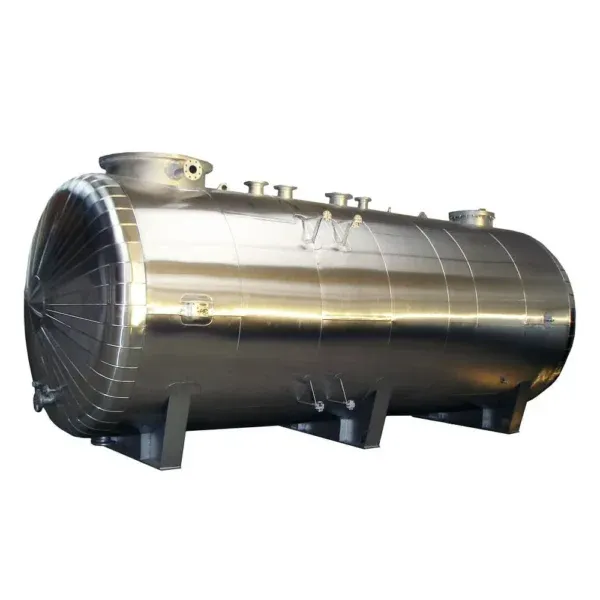
Ancillary equipment in plastics processing refers to the supporting machines, devices, and utility systems that enable primary processing equipment to operate efficiently, consistently, and safely. In a plastics plant, these systems typically include material conveying, drying, blending, dosing, temperature control, size reduction, separation, dust collection, conveying, storage, and automation interfaces that surround and complement the main machine rather than forming the core processing unit itself.
Although ancillary equipment is not the “headline” machine in a production cell, it often determines product quality, uptime, scrap rate, and overall energy performance. In practice, a high-performance injection molding, extrusion, blow molding, or compounding line is only as stable as its auxiliaries: a resin dryer that reduces moisture to specification, a vacuum loader that prevents contamination, a chiller that holds melt or mold temperature, or a granulator that returns runners and edge trim to a usable regrind state. The segment has expanded with the rise of centralized material handling, closed-loop process control, and Industry 4.0 integration, while sustainability pressure has increased demand for energy-efficient drying, precise gravimetric dosing, and better recyclate handling.
History and Development
Ancillary equipment evolved alongside the mechanization of plastics processing itself. Early plastics plants relied heavily on manual handling, batch charging, and basic cooling utilities, but growing production volumes and tighter tolerances made dedicated support systems increasingly necessary.
Key milestones include:
- Post-war industrial expansion: As injection molding and extrusion scaled up in the mid-20th century, plants adopted dedicated dryers, mixers, conveyors, and chillers to improve throughput consistency and reduce operator dependence.
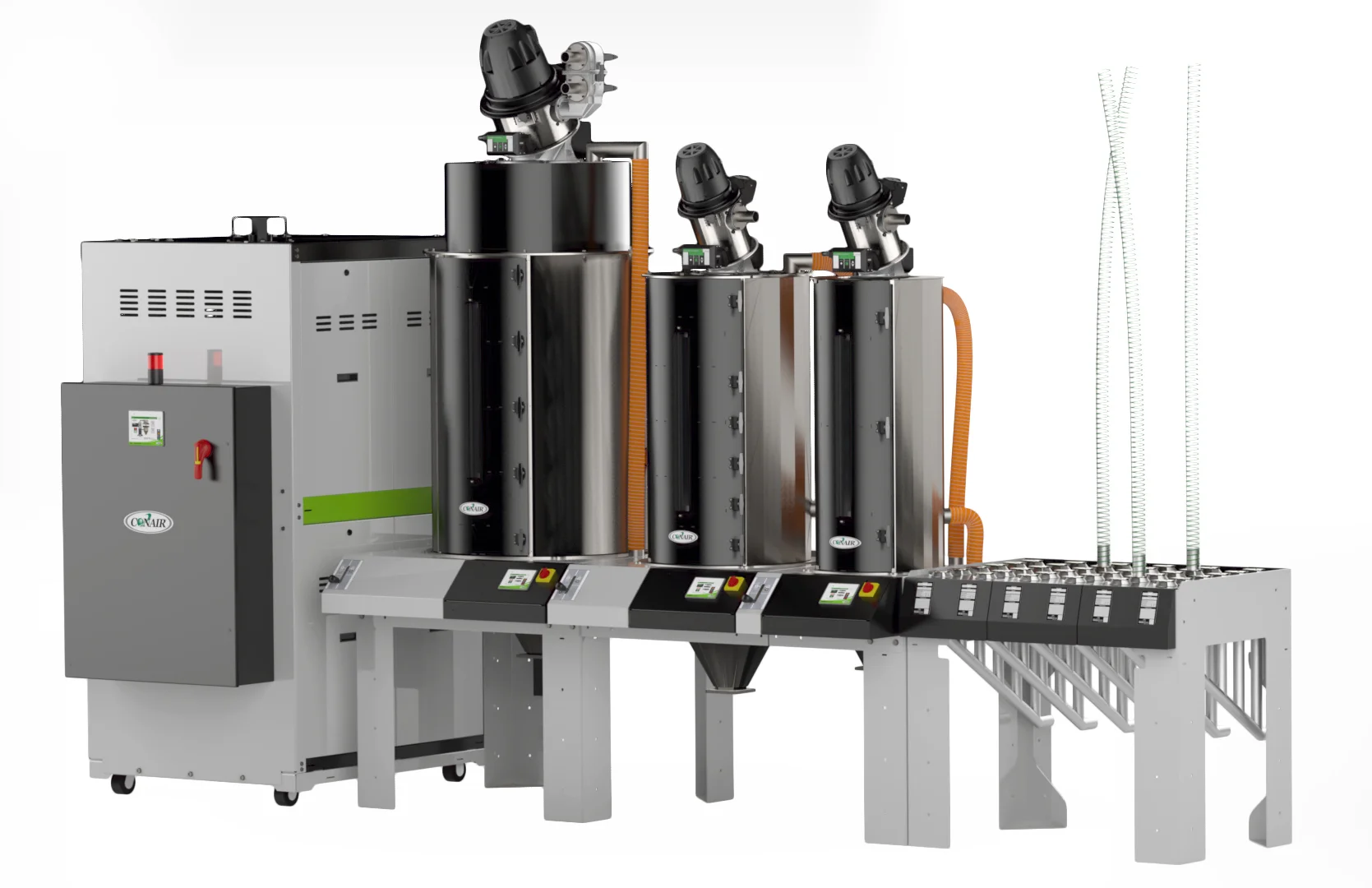
- Centralized material handling: Resin distribution systems, vacuum loaders, and silo-to-machine feed networks reduced contamination and labor intensity, especially in multi-machine molding and extrusion plants.
- Automation and closed-loop control: Modern ancillary equipment increasingly incorporates PLCs, sensors, recipe management, load cells, dew-point monitoring, and network connectivity so that feeding, drying, and temperature control can respond in real time to process conditions.
In recent decades, the growth of recycling, biopolymers, and lightweight packaging has pushed ancillary systems to become more specialized. Regrind handling, wash-line dewatering, flake conveying, metal separation, and contamination control are now common in facilities that previously handled only virgin resin. The shift toward data-driven manufacturing has also made ancillary equipment a key source of operational data rather than a passive utility layer.
Technical Overview
Ancillary equipment is best understood as a set of process-support subsystems. Each subsystem addresses a specific physical requirement of plastics production: material delivery, thermal conditioning, moisture removal, particle size control, metering, or environmental control.
Main functional categories
- Material handling: silos, hoppers, vacuum loaders, conveyors, robotic pick-and-place, bag dump stations, and receivers
- Drying and conditioning: desiccant dryers, hopper dryers, hot-air dryers, resin preheaters, and crystallizers
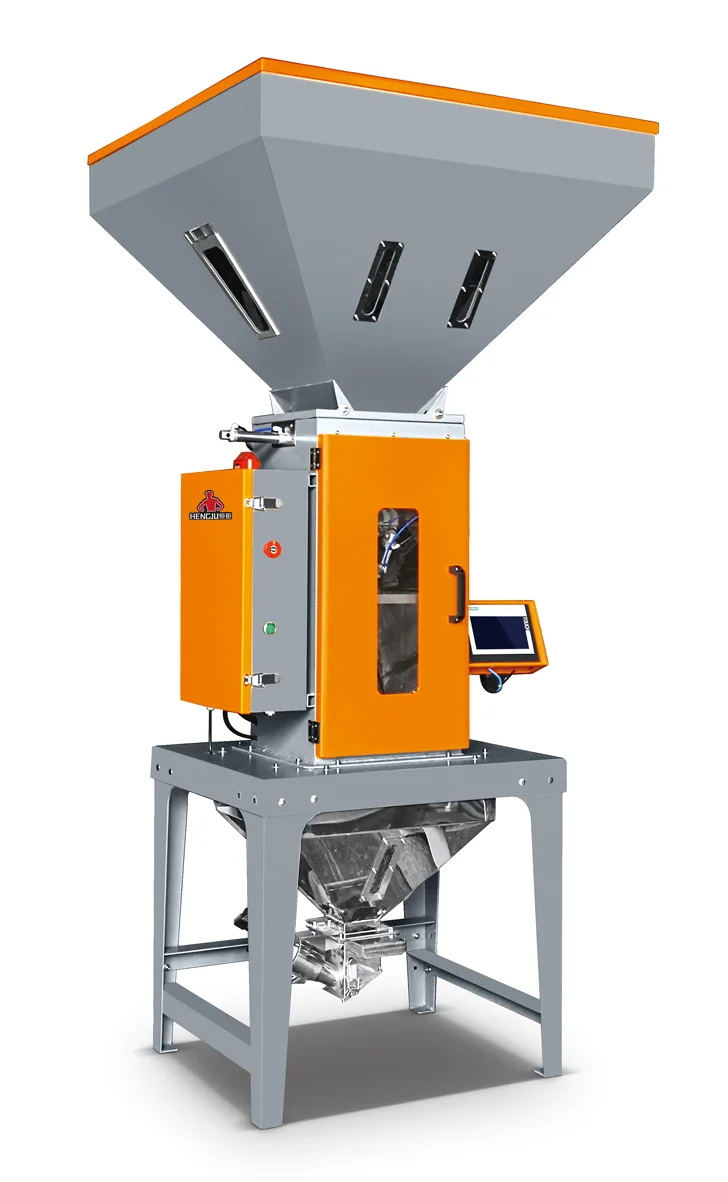
- Blending and dosing: gravimetric blenders, volumetric feeders, loss-in-weight feeders, masterbatch dosers, and additives handling systems
- Temperature control: chillers, cooling towers, mold temperature controllers, oil heaters, and process water skids
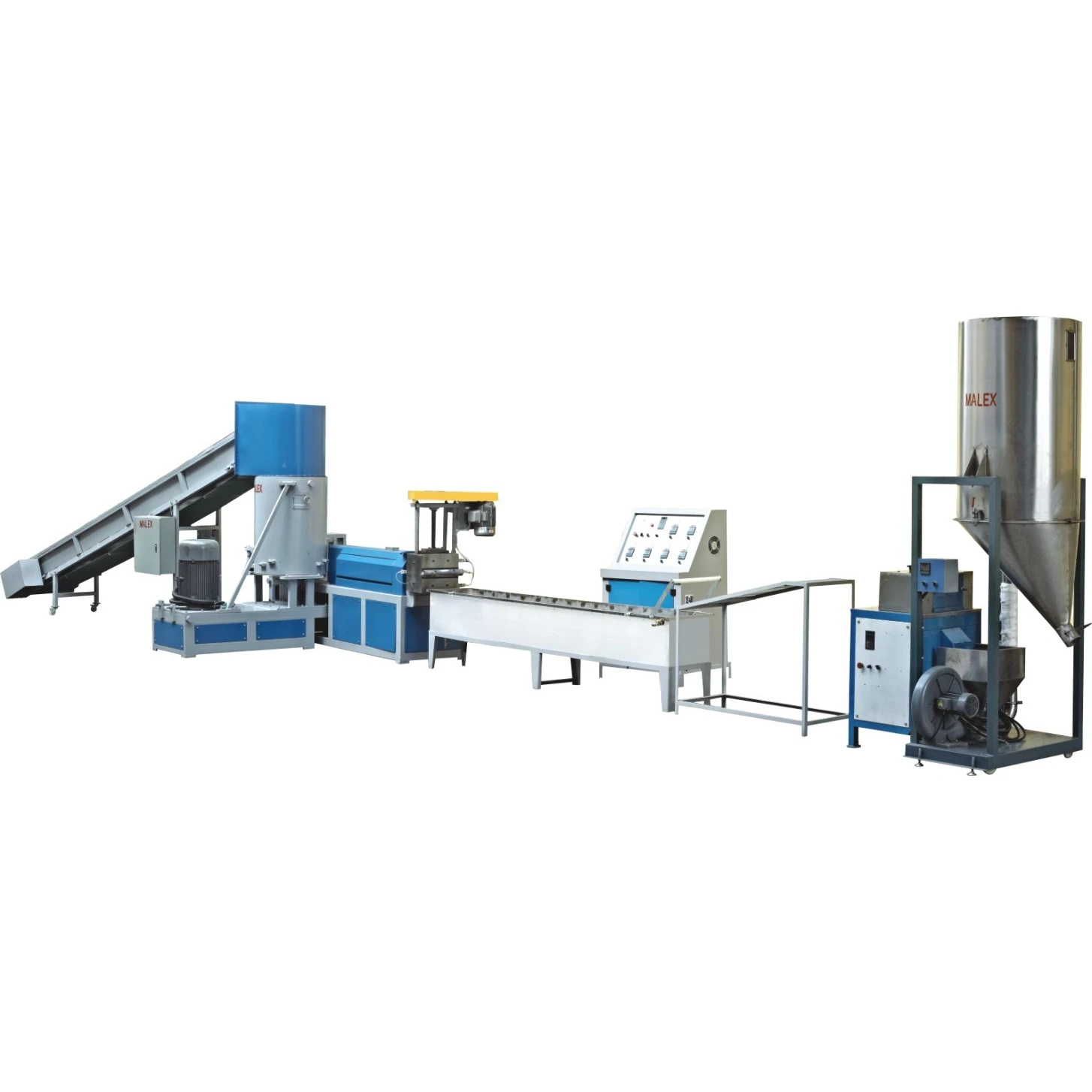
- Size reduction and recovery: granulators, shredders, crushers, and edge-trim reclaim systems
- Separation and cleaning: metal detectors, magnets, dust collectors, screens, and cyclone separators
- Utility support: compressed air systems, pumps, vacuum pumps, filtration, electrical controls, and instrumentation
Typical operating parameters
The exact specifications vary by machine class and polymer, but common industry ranges include:
- Granulator output size: typically about 6–12 mm flakes or regrind for most injection and extrusion scrap recovery applications; finer or coarser screens are used depending on downstream reuse requirements.
- Centrifugal dewatering: after mechanical dewatering, residual moisture is commonly reduced to roughly 5–10%, with final moisture for packaging-grade or extrusion-grade recycle often requiring further thermal drying.
- Dryer dew point: desiccant dryers for hygroscopic resins often target very low dew points, commonly around -30 °C to -40 °C or lower in demanding applications.
- Conveying capacity: small vacuum loaders may handle only a few hundred kg/h, while centralized resin distribution systems can move multiple tonnes per hour across a plant.
- Blending accuracy: gravimetric blending systems are generally selected where tight ratio control is required, especially for multilayer packaging, engineering compounds, and color-critical parts.
- Specific energy use: energy consumption varies widely, but dehumidifying dryers, compressed air systems, and chillers are frequently among the largest auxiliary energy users in a molding or extrusion facility.
Mechanism and performance notes
- Drying systems remove moisture that would otherwise cause splay, hydrolysis, bubbles, reduced mechanical properties, or unstable viscosity in processing.
- Gravimetric feeders and blenders improve repeatability by dosing by mass rather than volume, which is especially important for bulk-density variations in regrind and masterbatch.
- Chillers and mold temperature controllers stabilize cycle times and dimensional consistency by maintaining predictable thermal conditions.
- Granulators and shredders convert runners, off-spec parts, and edge trim into reusable regrind, but particle geometry, contamination, and heat history must be controlled to avoid quality degradation.
- Metal separation and filtration protect downstream machinery from wear and contamination, particularly in recycled-content operations.
Types and Variations
Ancillary equipment in plastics plants can be grouped by process stage and plant architecture.
| Type | Main function | Typical plastics use |
|---|---|---|
| Resin dryers | Remove moisture from hygroscopic polymers | PET, PA, PC, TPU, PMMA |
| Vacuum loaders and conveyors | Transport pellets or flake to processing machines | Injection molding, extrusion, blow molding |
| Blenders and feeders | Dose virgin resin, regrind, and additives | Color control, compounding, multilayer processing |
| Chillers and temperature controllers | Stabilize process and mold temperatures | Molding, thermoforming, extrusion auxiliaries |
| Granulators and shredders | Size reduction of scrap and runners | Reclaim, recycling, edge trim recovery |
| Dust and fines collectors | Remove airborne fines and improve housekeeping | Pellet handling, regrind operations |
| Metal detection and separation | Prevent contamination and equipment damage | Recycled resin and high-value production |
| Silo and storage systems | Bulk storage and controlled discharge | Large-volume resin plants |
| Drying and dewatering systems for recycling | Remove water from washed flakes | PET, PP, HDPE reclaim lines |
Common configurations
- Point-of-use auxiliaries: mounted near a single machine for flexibility and simpler installation.
- Centralized systems: feed multiple machines from a common drying, conveying, or chilled-water infrastructure.
- Modular skid systems: preassembled units designed for rapid deployment and easier expansion.
- Integrated cell packages: auxiliaries supplied as part of a complete machine cell for synchronized operation.
Applications and Uses
Ancillary equipment is used in nearly every plastics-processing sector, but the supporting hardware differs by process and resin type.
- Injection molding: dryers, loaders, blenders, mold temperature controllers, and part take-off automation are central to stable cycle performance and quality.
- Extrusion: gravimetric feeders, degassers, screen changers, cooling systems, pellet handling, and trim recovery are critical to output stability.
- Blow molding: resin conveying, drying, cooling, and flash recovery systems support bottle and container production.
- Thermoforming: sheet handling, chillers, scrap grinders, and trim conveyors improve sheet quality and material recovery.
- Compounding: loss-in-weight feeders, vacuum degassing, metal separation, and bulk handling are essential for formulation accuracy.
- Recycling and reprocessing: shredders, granulators, wash-line dewatering, float-sink separation, air classification, and contamination control dominate the auxiliary package.
- Film and packaging: edge trim recovery, tension control, dryers for sensitive resins, and precise blending support gauge consistency and optical quality.
One poor-fit use is highly abrasive mineral-filled scrap without appropriate wear protection; standard granulators, feeders, and conveying components can suffer rapid wear and contamination unless specifically engineered for that duty.
Technological Innovations and Automation
Ancillary equipment has become increasingly intelligent and interconnected. Modern systems often include:
- PLC-based recipe control for automatic material switching and setpoint management
- IoT sensors for dew point, flow rate, pressure, vibration, temperature, and energy monitoring
- Load-cell and gravimetric control for accurate dosing and loss-in-weight feeding
- Predictive maintenance tools that track motor current, bearing condition, and filter loading
- Central plant supervisory software that coordinates multiple dryers, loaders, and feeders from one dashboard
Automation creates measurable benefits in resin traceability, labor reduction, and process stability, but it also increases system complexity. Centralized architectures can reduce footprint and improve oversight, yet they may create single points of failure if redundancy is not designed into the utility and material-distribution network.
Environmental and Sustainability Aspects
Ancillary equipment plays an outsized role in sustainability because it strongly influences scrap recovery, energy use, and material efficiency.
- Energy efficiency: Variable-speed drives, heat recovery, insulated drying hoppers, efficient compressors, and optimized chilled-water loops can reduce auxiliary energy demand.
- Waste reduction: Better conveying, blending, and regrind handling lower contamination and improve internal recycling rates.
- Circular economy compatibility: Recycling lines depend on shredders, washers, dewatering units, separators, dryers, and filtration systems to convert post-consumer or post-industrial scrap into usable feedstock.
- Material conservation: Accurate dosing reduces overuse of masterbatch, additives, and expensive engineering polymers.
At the same time, sustainability trade-offs are real. Centralized compressed-air systems, oversized chillers, and poorly insulated dryers can become major energy liabilities, so the environmental performance of ancillary equipment depends heavily on system design and controls rather than on equipment category alone.
Economic and Global Market Impact
The ancillary-equipment segment is a major enabler of plastics manufacturing competitiveness because it affects:
- Throughput
- Labor productivity
- Scrap rates
- Quality consistency
- Facility layout and expansion flexibility
Demand is strongest where plants are scaling automation, adopting higher recycled content, or processing moisture-sensitive and high-value polymers. Growth is also linked to regional manufacturing expansion in packaging, automotive, consumer goods, medical products, and electronics.
Globally, suppliers compete on application engineering, energy performance, integration depth, and service support rather than on machine size alone. In many facilities, ancillary systems are purchased in packages because the real value lies in compatibility among drying, conveying, dosing, cooling, and control.
Current Challenges and Innovations
The sector faces several persistent engineering challenges:
- Moisture control for advanced resins: PET, polyamides, and other hygroscopic materials require tightly controlled drying conditions.
- Recycled feedstock variability: Flake size distribution, contamination, fines, and residual moisture can destabilize feeding and processing.
- Energy intensity: Dryers, air systems, and chillers can dominate auxiliary utility consumption.
- Maintenance burden: Filters, screens, hoses, valves, and wear parts require regular service.
- Space constraints: High-output plants often need compact modular systems without sacrificing accessibility.
Current innovations address these issues through:
- More efficient desiccant and heat-pump drying
- Closed-loop gravimetric control
- Improved dewatering and drying for recyclate
- Wear-resistant conveying and size-reduction components
- Digital twins and remote diagnostics
- Hybrid centralized-decentralized plant layouts
Future Outlook
Ancillary equipment is likely to become more software-defined, energy-aware, and recycling-oriented. Future systems will probably emphasize:
- Deeper integration with machine controls
- Automated material identification and routing
- Higher tolerance for variable recycled feedstocks
- Lower specific energy consumption
- Greater use of predictive analytics and condition monitoring
- Designs optimized for circular manufacturing and traceable material streams
As plastics processing becomes more regulated and more data-driven, ancillary equipment will remain a strategic part of plant engineering rather than a peripheral afterthought. The most competitive facilities will treat auxiliaries as core infrastructure: the hidden architecture that determines whether primary machines operate at their advertised capability or merely at nominal capacity.
Summary
Ancillary equipment in plastics processing is the support infrastructure that makes molding, extrusion, recycling, and compounding possible at industrial scale. Its functions include drying, conveying, feeding, cooling, size reduction, separation, and automation, and its design directly affects quality, energy consumption, and plant productivity.
References
- •
Ancillary equipment. (n.d.). Collins Dictionary. https://www.collinsdictionary.com/us/dictionary/english/ancillary-equipmentLink
- •
Ancillary equipment. (2025, October 29). Law Insider. https://www.lawinsider.com/dictionary/ancillary-equipmentLink
- •
Ancillary equipment. (2024, November 1). Vocab Dictionary. https://vocabdictionary.com/english/ancillary-equipment/Link
- •
Attachments or ancillary equipment. (2025, July 10). Law Insider. https://www.lawinsider.com/dictionary/attachments-or-ancillary-equipmentLink
- •
Understanding ancillary vs. auxiliary equipment: A comprehensive guide. (2024, August 26). Wilpac Packing. https://www.wilpacpacking.com/blog/understanding-ancillary-vs--auxiliary-equipment--a-comprehensive-guideLink
- •
What exactly is ancillary packaging equipment? (2023, November 23). EDL Packaging. https://edlpackaging.com/what-exactly-is-ancillary-packaging-equipment/Link
- •
Ancillary equipment & components. (n.d.). Adarsh. https://www.adarsh.com.au/ancillary-equipmentLink
- •
3GPP TS 36.124. (n.d.). TEC. https://tec.gov.in/pdf/3gpp/25117%202020.pdfLink
- •
40 CFR § 280.12 - Definitions. (n.d.). Legal Information Institute. https://www.law.cornell.edu/cfr/text/40/280.12Link
- •
Auxiliary equipment examples. (n.d.). https://assets-global.website-files.com/66000c4413d5a8d681cda800/67b61fc9272ce7e4e4893068_mifuzopomixas.pdfLink
- •
What is ancillary equipment? Types and examples. (2025, October 4). Engineer Fix. https://engineerfix.com/what-is-ancillary-equipment-types-and-examples/Link
- •
टीईसी 25369:2020 विकभसत यूननिससल टेरेस्ट्रियल रेडडयो. (n.d.). TEC. https://tec.gov.in/pdf/3gpp/25369%202020.pdfLink
- •
Ancillary equipment. (n.d.). Michigan State University. https://www.canr.msu.edu/fpic/equipment/ancillary-equipmentLink
- •
Ancillary supplies, equipment, and services definition. (2025, July 7). Law Insider. https://www.lawinsider.com/dictionary/ancillary-supplies-equipment-and-servicesLink
- •
Cryptographic ancillary equipment (crypto- ...). (n.d.). NIST. https://csrc.nist.gov/glossary/term/cryptographic_ancillary_equipmentLink
- •
Ancillary equipment. (2013, October 11). IADC Lexicon. https://iadclexicon.org/ancillary-equipment/Link
- •
Types of ancillary equipment for optimizing operations. (2020, October 23). React Power. https://www.reactpower.com/blog/types-of-ancillary-equipment-for-optimizing-operations/Link
- •
Ancillary equipment. (n.d.). Making.com. https://making.com/technologies/ancillary-equipmentLink
- •
Ancillary equipment - An overview. (n.d.). ScienceDirect. https://www.sciencedirect.com/topics/agricultural-and-biological-sciences/ancillary-equipmentLink
- •
FCS1362:2016. (n.d.). FCS. https://www.fcs.org.uk/wp-content/uploads/2021/02/FCS-1362-2016.pdfLink
- •
[PDF] ANCILLARY EQUIPMENT. (n.d.). Offspring International. https://www.offspringinternational.com/wp-content/uploads/2024/05/MAN-Oil-and-Marine-ANCILLARY-EQUIPMENT-Catalogue.pdfLink
- •
The clinical trial ancillary supplies and equipment universe. (2024, June 26). Imperial CRS. https://www.imperialcrs.com/blog/ancillary-clinical-trial-supplies-and-equipment/the-clinical-trial-ancillary-supplies-and-equipment-universe-making-it-work/Link
- •
[PDF] Ancillary equipment operation. (n.d.). CCBBI. https://ccbbi.osu.edu/sites/ccbbi.osu.edu/files/Ancillary%20Equipment%20Operation.pdfLink
- •
Ancillary equipment - Water treatment. (2020, October 1). Delco Water. https://delco-water.com/solutions/water-treatment/ancillary-equipment/Link
- •
Uses for ancillary equipment. (2025, July 29). Livernois Engineering. https://www.livernois.com/uses-for-ancillary-equipment/Link
- •
What are examples of auxiliary equipment? (2024, January 4). Sailik. https://www.sailik.com/info/what-are-examples-of-auxiliary-equipment--90581230.htmlLink
- •
Ancillary equipment - Gas engines. (2026, February 13). Clarke Energy. https://www.clarke-energy.com/us/gas-engines/ancillary-equipment/Link
- •
What is auxiliary equipment? Definition and examples. (2026, March 27). Science Insights. https://scienceinsights.org/what-is-auxiliary-equipment-definition-and-examples/Link
- •
Ancillary equipment. (n.d.). Oxford Reference. https://www.oxfordreference.com/abstract/10.1093/acref/9780199651450.001.0001/acref-9780199651450-e-117Link
- •
Ancillary technologies in healthcare. (2025, January 8). Mott. https://www.mottcorp.com/blog/ancillary-technology-in-healthcare/Link
- •
Ancillary equipment. (2024, July 24). Caterpillar. https://www.cat.com/en_US/by-industry/electric-power/electric-power-products/custom-power-solutions/ep-custom-products/ancillary-equipment.htmlLink