
Introduction
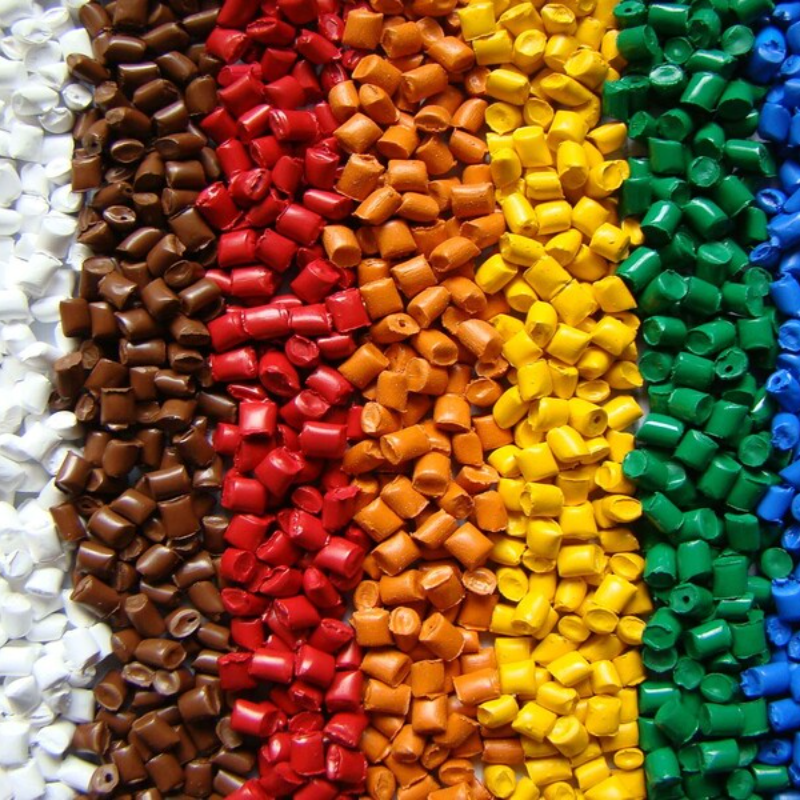
Colour masterbatches are concentrated preparations of pigments or dyes dispersed in a polymer carrier resin, used to colour plastics efficiently and reproducibly during processing. They are a core enabling material in the plastics value chain because they combine colour control, handling convenience, and process compatibility, while also supporting brand identity, grade differentiation, and, in some formulations, added functionality such as UV protection or antistatic performance.
In industrial practice, colour masterbatches are supplied as pellets or granules and let down into a base polymer at low dosage, typically a few percent by weight, so the final article can be coloured consistently without direct handling of fine powders. The formulation normally includes three elements: pigment or dye, carrier resin, and selected additives or dispersants. Depending on the application, the carrier may be chosen to match polyethylene, polypropylene, PET, or another host polymer to improve compatibility and dispersion.
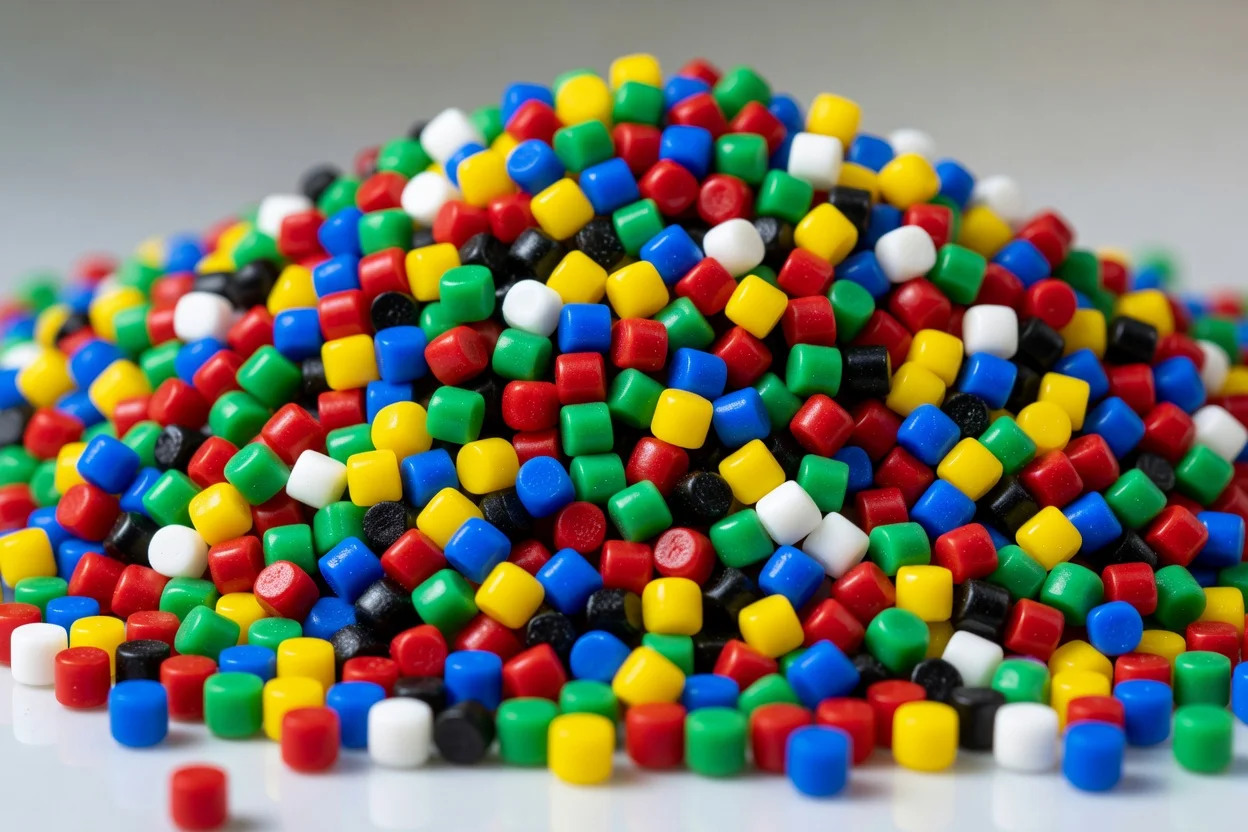
Colour masterbatch technology developed as plastics processing shifted from small-batch colouring toward high-throughput, tightly controlled manufacturing, where colour repeatability and contamination control became essential. Today, the field spans standard colour concentrates, custom colour matching systems, and specialised grades for film, injection moulding, blow moulding, fibre spinning, and extrusion. Sustainability has become a central design constraint: colour masterbatches can reduce dusting and improve dosing precision versus raw pigments, but they also interact with recyclability, sorting, and the performance of recycled polymers.
History and Development
Colour masterbatches emerged from broader masterbatch technology, in which concentrated additives are pre-dispersed in a polymer carrier and later diluted into the final compound during processing. This approach simplified plant handling compared with direct pigment addition and improved the uniformity of colour distribution in finished plastics.
As plastics production expanded in packaging, automotive, consumer goods, construction, and fibres, demand increased for more precise colour matching, better dispersion, and more efficient compounding. The industry responded with improved extrusion, tighter gravimetric feeding, and multicomponent custom colour systems that can reproduce specific shades from standardised colour libraries. More recent development has focused on higher-opacity and higher-chroma pigments, low-warp and low-migration formulations, and masterbatches designed for recycled-content and bio-based polymers.
Chemical Structure and Key Properties
Colour masterbatches are not single chemicals but engineered concentrates consisting of dispersed colourants inside a continuous polymer matrix. The colourant phase may contain organic pigments, inorganic pigments, or dyes, while the carrier resin is commonly selected from the same polymer family used in the end product to improve melt blending and compatibility. The final performance depends on pigment chemistry, particle size, dispersion quality, carrier selection, and the presence of processing additives.
Key properties include:
- High colour strength, because pigments are pre-concentrated before use.
- Improved dispersion, reducing specks, streaks, and colour variation in finished parts.
- Metered dosing, which supports repeatable production and easier inventory control.
- Processing compatibility, especially when the carrier matches the base resin.
- Functional flexibility, since colour masterbatches may also carry UV stabilisers, heat stabilisers, or antistatic agents.
Real limits and common workarounds include:
- Poor O2 and grease barrier in the final coloured plastic → the colour masterbatch itself does not create an effective barrier structure → use multilayer packaging, barrier coatings, or dedicated barrier polymers instead of relying on colour alone.
- Low surface energy before treatment → many polyolefins remain difficult to print, paint, or laminate after colouring → apply corona, plasma, flame, or chemical surface treatment after moulding or extrusion.
- Risk of shade variation during recycling blends → regrind and post-consumer recyclate can vary in contamination and melt history → use tighter QC, higher loading of stabilised colour concentrates, and colour correction masterbatches.
- Potential impact on optical clarity → pigments can reduce transparency or haze in clear articles → choose transparent dyes or low-haze formulations where clarity is required.
A practical formulation example is a black masterbatch for film or pipe using carbon black at a high pigment loading in a PE carrier; the pigment acts as both colourant and UV screen by absorbing and scattering ultraviolet radiation. Another example is a white masterbatch using titanium dioxide in a compatible carrier; titanium dioxide functions mainly through strong light scattering, which produces opacity and brightness.
Production Processes and Raw Feedstocks
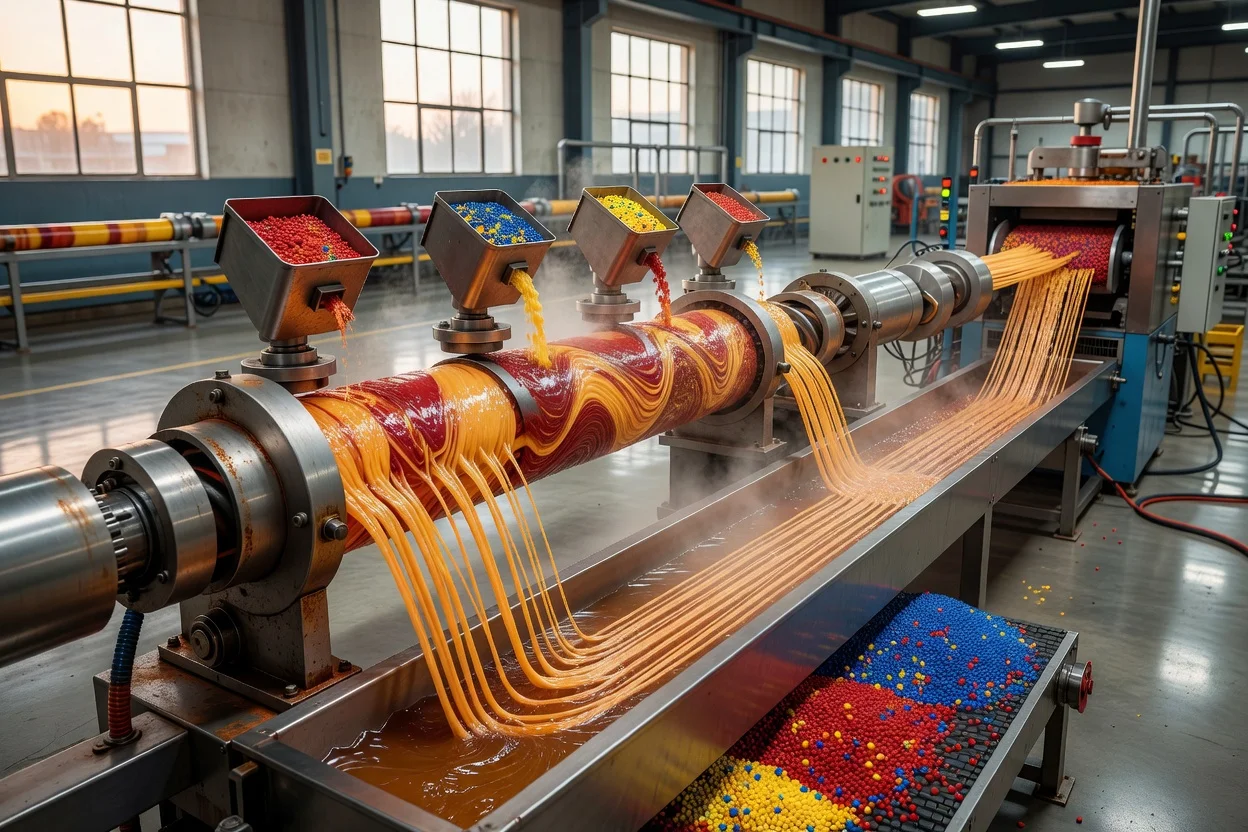
Colour masterbatch manufacture is a compounding process that aims to disperse pigments uniformly in a carrier resin and convert the blend into pellets. Typical steps include formulation, weighing, premixing, melt compounding in an extruder, cooling, pelletising, testing, and packaging.
Common process routes include:
- Premix extrusion, in which polymer, pigment, and dispersion aids are blended before feeding into the extruder.
- Split-feed compounding, in which the polymer is plasticised first and pigments are introduced later through side feeders.
- Wet or paste-based methods, used for difficult-to-disperse pigments where a fine paste is prepared before extrusion.
- Custom colour matching, where standard colour concentrates are combined in predefined ratios to reproduce a target shade.
Raw feedstocks typically include:
- Pigments or dyes, organic or inorganic, chosen for hue, opacity, heat stability, lightfastness, and migration behaviour.
- Carrier resins, often PE or PP for commodity applications, but also other polymers matched to the host resin.
- Dispersion aids and additives, which improve wetting, reduce agglomeration, and stabilise processing.
The dispersion step is critical because poor wetting of pigment agglomerates can cause colour streaks, die build-up, or inconsistent final appearance. Twin-screw extrusion is widely used because its higher mixing intensity improves pigment distribution and batch consistency.
Applications and End-Use Markets
Colour masterbatches are used across nearly all polymer processing routes, with the main selection criteria being colour consistency, processability, regulatory compliance, and cost.
| End-use sector | Typical products | Common processing route | Usual masterbatch characteristics |
|---|---|---|---|
| Packaging | Bottles, containers, films, bags, closures | Blow moulding, injection moulding, blown film, extrusion | High colour consistency, food-contact compliant options, high throughput |
| Consumer goods | Toys, appliances, housings, furniture parts | Injection moulding, extrusion | Broad colour palette, surface appearance, good dispersion |
| Automotive | Interior trim, housings, clips, covers | Injection moulding, extrusion | Heat stability, UV resistance, low odour, tight shade control |
| Construction | Pipes, profiles, fittings, panels | Pipe extrusion, profile extrusion, injection moulding | Weatherability, long-term colour retention, outdoor durability |
| Agriculture | Greenhouse film, irrigation parts, silage wraps | Film extrusion, pipe extrusion | UV-stable black and coloured grades, weather resistance |
| Textiles and fibres | Filaments, PP fibre, PET fibre, nonwovens | Melt spinning, fibre extrusion | Low filter pressure, fine dispersion, colour uniformity |
| Industrial and medical | Diagnostic housings, device parts, technical items | Injection moulding, extrusion | Controlled pigmentation, traceability, low extractables where required |
Packaging is one of the largest and most visible markets because colour masterbatch supports brand identity, product differentiation, and consumer appeal in bottles, films, containers, and flexible packaging. In films and bags, the concentrate must disperse well at high line speeds and may need slip, antiblock, or UV-stabilised systems when used outdoors.

For construction and infrastructure, colour masterbatches are used in pipes, fittings, panels, and profiles, where long-term weatherability matters more than decorative appearance. Black masterbatches are especially important in agricultural films and pipes because carbon black improves UV resistance and service life.
In fibres and nonwovens, colour masterbatches are often dosed directly during spinning rather than by post-dyeing, which can simplify production and reduce water use. A poor-fit use is highly transparent optical packaging or lenses, where ordinary pigment-filled masterbatches can introduce haze and reduce clarity.
Environmental and Sustainability Aspects
Colour masterbatches have a mixed environmental profile. On one hand, they improve dosing accuracy, reduce dust exposure, and often lower waste compared with manual pigment handling. On the other hand, pigments, additives, and carrier selection can affect the recyclability, reprocessability, and sortability of plastic articles.
Important sustainability considerations include:
- Recyclability: Colour masterbatches can complicate mechanical recycling if they contain carbon black, high-opacity pigments, or incompatible carrier systems that alter melt flow or colour sorting behaviour.
- Design for recycling: Recyclable-packaging strategies increasingly prefer lighter colour loads, recyclable pigment sets, and carrier resins compatible with the target polymer stream.
- Bio-based alternatives: Some suppliers now offer carrier resins derived partly from bio-based feedstocks, but the colourant itself still needs to meet the same performance and safety requirements.
- Carbon footprint: Using concentrated masterbatch can reduce downstream scrap through better process control, yet the total footprint depends on pigment synthesis, carrier polymer choice, and whether the final article is recyclable or contains recycled content.
A practical trade-off is that darker colours can conceal recyclate variability and expand the usable range of post-consumer resin, while also reducing material circularity if the stream becomes difficult to sort into high-value applications. In packaging, this has led to greater interest in recyclable colour palettes, near-infrared-sorting-friendly formulations, and masterbatches designed for recycled polyethylene and polypropylene.
Economic and Global Market Impact
Colour masterbatches are a relatively small volume segment compared with commodity resins, but they have high value density because colour consistency, brand protection, and process reliability are commercially important. Demand is tied closely to packaging, consumer goods, automotive trim, construction materials, and fibre production, making the segment sensitive to construction cycles, packaged goods consumption, and resin price volatility.
According to recent industry analyses, the market is shaped by regional compounding capacity, access to pigments, and proximity to polymer processors who require short lead times and rapid colour matching. Major producers are typically specialised masterbatch and compounding companies rather than large polymer producers alone, although many resin and additive suppliers also participate through integrated colour and additive solutions.
Current Challenges and Innovations
The main technical challenges are dispersion quality, colour repeatability, regulatory compliance, and compatibility with evolving recycling systems. Even small differences in pigment particle size, carrier viscosity, or screw design can produce visible shade shifts or defects in the final article.
Current innovation areas include:
- High-dispersion concentrates, engineered for lower dosing and better optical uniformity.
- Low-migration and food-contact formulations, especially for packaging and personal-care containers.
- Recycling-compatible masterbatches, designed to preserve mechanical properties and sorting performance in circular polymers.
- Digital colour matching, using spectral data and multicomponent dosing to shorten development cycles.
- Functional colour systems, where colour is combined with UV, antistatic, or process-stabilising additives in a single concentrate.
A representative additive example is a UV-stabilised black masterbatch for outdoor polyethylene products, where carbon black provides both colour and light-screening action, reducing photodegradation in service. Another is a white masterbatch using titanium dioxide in a compatible carrier, where the pigment’s high refractive index boosts opacity and brightness while enabling controlled tinting with small letdown ratios.
Future Outlook
Colour masterbatches are likely to remain essential because plastics processing still depends on efficient, repeatable, and scalable colour control. Future growth will be driven less by simple colour addition and more by multifunctional design, recyclability-aware formulations, and digitalised production workflows.
The most significant trends are likely to be:
- More recycled-content formulations, requiring robust colour correction and contamination tolerance.
- Greater alignment with circular economy rules, especially in packaging and consumer goods.
- Higher-performance additive integration, combining colour with UV, barrier-supporting, or durability-enhancing functions.
- Tighter regulatory scrutiny, especially for food contact, medical, and children’s products.
- Automation in colour development, including spectral matching, gravimetric feeding, and process analytics.
Summary
Colour masterbatches are concentrated pigment-and-resin systems that enable precise, efficient, and scalable colouring of plastics across packaging, automotive, construction, fibre, and consumer markets. Their value lies in controlled dispersion, repeatable dosing, and compatibility with modern plastics processing, while their main limitations involve recycling compatibility, optical constraints, and the need for careful carrier and pigment selection.
References
- •
Color Masterbatch Production Process. (2024, December 5). LinkedIn. https://www.linkedin.com/pulse/color-masterbatch-production-process-cecelia-yan-ass1cLink
- •
Color Masterbatch: A brief guide. (2024, August 26). Carbokene. https://carbokene.com/color-masterbatch/Link
- •
Masterbatch. (2026, August 25). Monomex. https://www.monomex.com/processes/masterbatchLink
- •
Masterbatch. (2011, July 25). Wikipedia. https://en.wikipedia.org/wiki/MasterbatchLink
- •
Color masterbatch demystified: Applications, production, .... (2025, February 28). Greenpoly. https://greenpoly.com/news/color-masterbatch-demystified.htmLink
- •
Color masterbatch manufacturing process and .... (2025, April 16). Gsextruder. https://www.gsextruder.com/color-masterbatch-manufacturing-process-and-manufacturing-machine-guide/Link
- •
What is color masterbatch? (2024, December 26). Ispigment. https://www.ispigment.com/blog/what-is-color-masterbatch_b151Link
- •
Masterbatch applications and usage. (2024, December 26). Supremepetrochem. https://supremepetrochem.com/masterbatch-applications-and-usage/Link
- •
Masterbatch manufacturing process: A complete guide. (2025, September 4). Debaomasterbatch. https://www.debaomasterbatch.com/News_Events/2025-09-04/masterbatch-manufacturing-process.htmlLink
- •
Dai A Industry: "Color masterbatch is more than a product...." (2021, August 13). Daiaplastic. https://daiaplastic.com/dai-a-industry-color-masterbatch-is-more-than-a-product-it-is-a-complete-and-comprehensive-experience/Link
- •
How to use different types of color masterbatch in various .... (2026, May 25). Mascomglobal. https://mascomglobal.com/using-different-color-masterbatch-types/Link
- •
Colour masterbatch production guide. (2025, August 21). Scribd. https://www.scribd.com/document/852230712/Color-Masterbatch-ProcessLink
- •
Masterbatch: Advantage and sustainability in the plastics .... (2024, September 9). Deltatecnic. https://deltatecnic.com/complete-guide-to-masterbatch/Link
- •
Comprehensive custom colour masterbatch. (2025, May 23). Polymerlink. https://polymerlink.net/custom-colour-masterbatch/Link
- •
The manufacturing process of masterbatch: How it's made? (2023, October 12). Polyfill. https://polyfill.com.vn/the-manufacturing-process-of-masterbatch-how-its-made/Link
- •
What is masterbatch? (2022, November 1). Broadway Colours. https://broadwaycolours.com/what-is-masterbatch/Link
- •
Color masterbatch application & benefits for industries. (2000, January 1). Kotharipolymers. https://kotharipolymers.com/colour-masterbatch-applications-and-advantages/Link
- •
What is masterbatch? Types and manufacturing process .... (2025, November 18). Alokmasterbatches. https://alokmasterbatches.com/blogs/what-is-masterbatch-its-manufacturing/Link
- •
Masterbatch - An overview. (2010, October 19). ScienceDirect. https://www.sciencedirect.com/topics/engineering/masterbatchLink
- •
Understanding color masterbatch: Applications .... (n.d.). Gbgummi. https://gbgummi.com/understanding-color-masterbatch-applications-advantages-and-industry-impact/Link
- •
What is masterbatch? The real reason your plastic isn't .... (2025, July 9). Naphthaplastics. https://naphthaplastics.co.uk/blog/what-is-masterbatch/Link
- •
Top 5 most used colour masterbatch in the market. (2025, January 10). Perfectcolourants. https://perfectcolourants.com/blog/top-5-most-used-colour-masterbatch/Link
- •
Color vs additive vs filler masterbatch – Key differences & .... (2026, March 11). Mundhramasterbatch. https://mundhramasterbatch.com/difference-between-color-additive-filler-masterbatch/Link