
Introduction
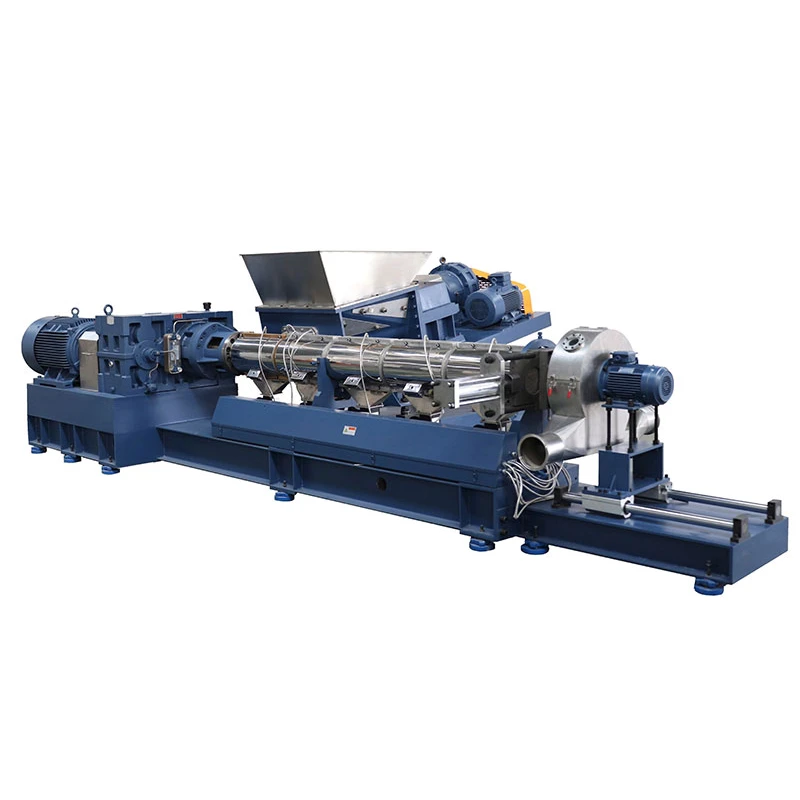
Single-screw extruders are the most widely used continuous processing machines in plastics manufacturing, converting thermoplastic pellets, powder, or regrind into a uniform melt stream that is then shaped through a die into pipe, sheet, film, profile, wire coating, or pelletized product. Their enduring dominance comes from a combination of mechanical simplicity, stable output, relatively low capital cost, and strong suitability for high-volume, steady-state production of commodity and engineering thermoplastics.
In industrial practice, the machine is usually understood as a barrel-and-screw system divided into feed, compression/transition, and metering zones, where solids are conveyed, compacted, melted, homogenized, and pressurized before discharge. Although twin-screw systems are favored for intensive compounding and highly filled formulations, the single-screw type remains the default platform for many extrusion lines because it delivers robust melt pumping and consistent throughput for well-behaved materials.
The technology has evolved from early heat-and-force melting devices into highly engineered extruders with precise screw geometries, grooved feeds, venting, melt filtration, gravimetric dosing, closed-loop temperature control, and digital process monitoring. Recent development trends include improved energy efficiency, better melt-quality control, and compatibility with recycled and bio-based feedstocks, all of which are becoming increasingly important as plastics producers respond to circular-economy and decarbonization pressures.
History and Development
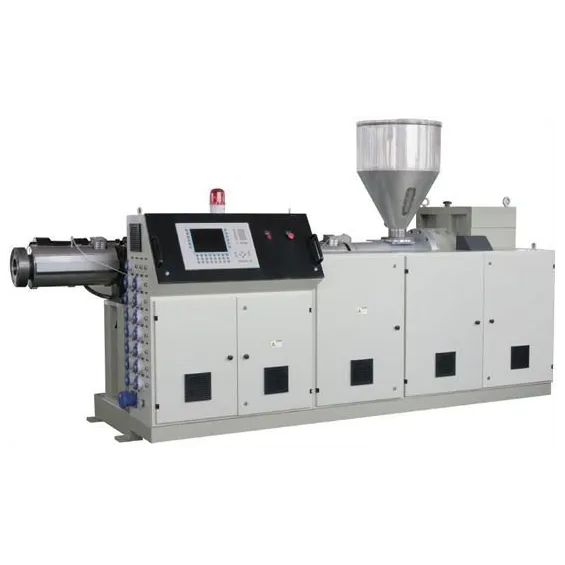
Single-screw extrusion developed from early screw-based material transport concepts into an industrial polymer-processing method as thermoplastics became widely commercialized in the 20th century. The basic architecture—one rotating screw inside a heated barrel—proved attractive because it could continuously convey solid feed, generate heat through shear, and build pressure for die shaping in a single machine.
A key milestone was the refinement of the three-zone screw concept, in which the feed section handles solids conveying, the transition section promotes melting and compression, and the metering section stabilizes pressure and melt quality. This architecture became the foundation of modern plastics extrusion because it improved repeatability and allowed machine builders to tune residence time, shear, and pumping behavior for different polymers.
A second milestone was the broad industrialization of single-screw lines for pipe, film, sheet, and profile extrusion, where steady throughput and low operating complexity were especially valuable. In parallel, extruders became central to pelletizing and reprocessing operations, extending their use beyond finished-product conversion into recycling and compounding-adjacent workflows.
A third milestone is the modern shift toward instrumented control and energy monitoring. Recent academic and industrial work has focused on correlating screw speed, melt temperature, pressure, and specific energy input with product quality, helping manufacturers reduce scrap and improve consistency.
Technical Overview
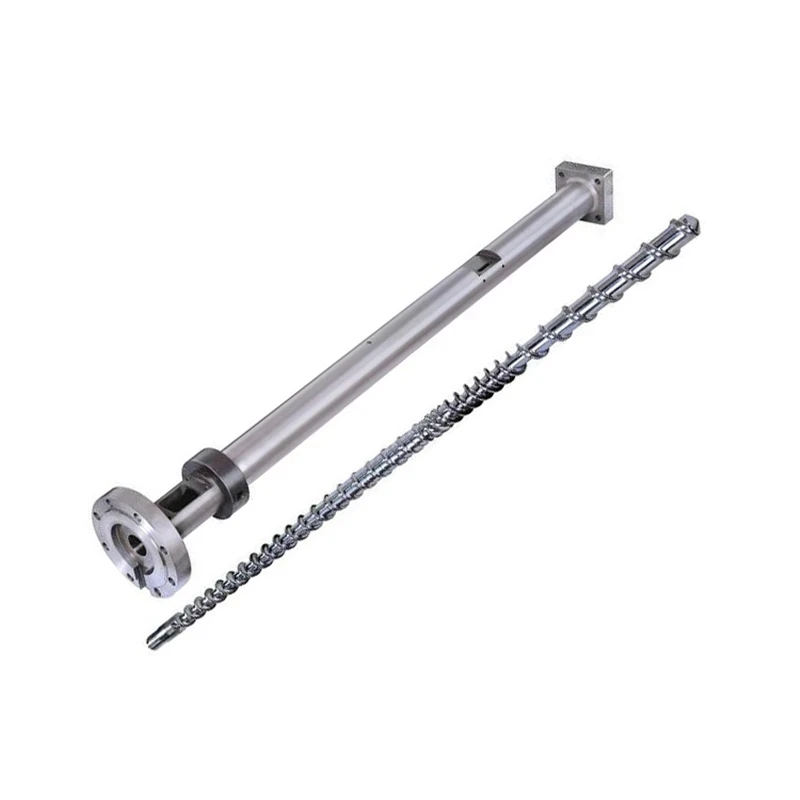
A single-screw extruder consists of a hopper, heated barrel, rotating screw, drive system, heater and cooling zones, and a die or downstream tooling package. Solid polymer enters by gravity from the hopper, is dragged forward by screw rotation, and is progressively compacted and melted by a combination of barrel heat and viscous shear.
The screw performs three functions at once: it conveys solids, melts the polymer, and pumps the melt under pressure to the die. In the feed zone, friction between pellets, screw flights, and the barrel wall moves the material forward; in the transition zone, the channel depth typically decreases and the melt fraction rises; in the metering zone, the machine stabilizes flow and pressure so that the die receives a more uniform melt stream.
Common engineering parameters include:
- Screw speed: often in the range of roughly 20–200 rpm for many plastics applications, depending on diameter, L/D ratio, and output target; lower speeds are used when thermal sensitivity or dimensional stability is critical.
- L/D ratio: frequently around 20:1 to 36:1 in industrial machines, with longer screws generally improving melting and homogenization.
- Compression ratio: commonly around 2:1 to 4:1, with many general-purpose screws around 3:1 for balanced melting and pressure generation.
- Throughput: from small laboratory machines at a few kg/h to production lines ranging from tens of kg/h to several t/h, especially in pipe, sheet, and pelletizing service.
- Specific energy consumption: strongly dependent on polymer, screw design, and line speed, but modern extrusion lines are commonly discussed in terms of process optimization because drive energy and thermal management materially affect operating cost and melt quality.
For recycling and washing-related feedstocks, upstream dewatering and size reduction matter greatly. In integrated lines, centrifugal dewatering systems can reduce moisture to very low residual levels before extrusion, and granulators or pelletizers may produce flakes or regrind typically in the low-millimeter range, with particle size distribution influencing feed stability and melting behavior. When feed quality is inconsistent, single-screw extruders are more sensitive to surging and devolatilization limitations than twin-screw systems.
How It Works
- Material is fed from the hopper into the barrel.
- The screw conveys the solids forward while friction and heating raise temperature.
- The polymer softens, compresses, and melts as the channel geometry changes.
- Melt is homogenized and pressurized in the metering zone.
- The die converts the melt stream into the desired shape.
- Downstream cooling, sizing, and haul-off equipment set final dimensions and surface quality.
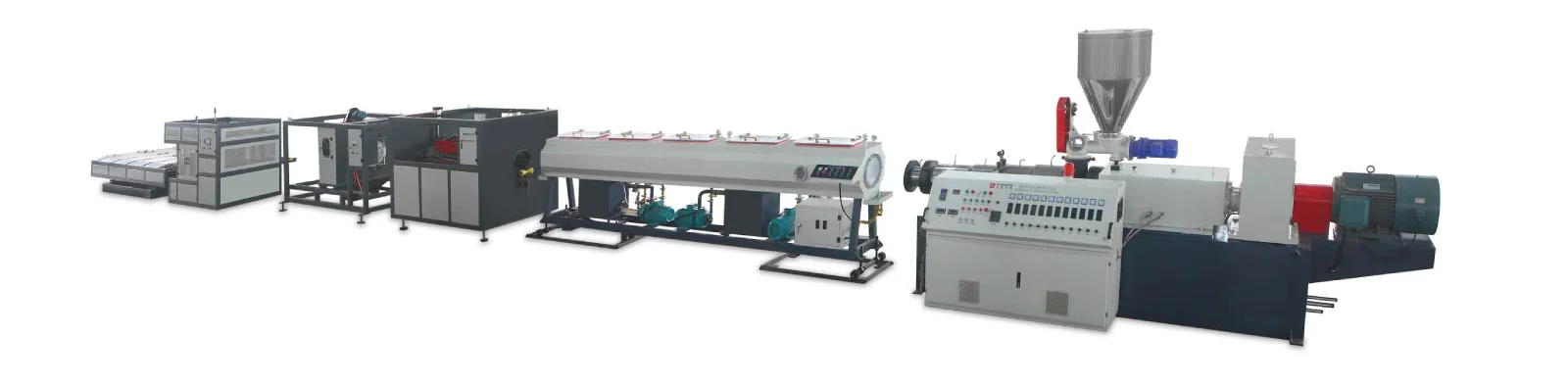
This continuous mode of operation makes the machine especially suitable for lines that require stable output over long runs, such as pipe extrusion or cable coating.
Types and Variations
Single-screw extruders are commonly differentiated by screw design, feed strategy, and end-use configuration.
| Type or variation | Main feature | Typical use |
|---|---|---|
| General-purpose extruder | Balanced conveying, melting, and pumping | Pipes, sheet, profiles |
| Barrier screw extruder | Improved melt separation and melting efficiency | Higher output and better melt uniformity |
| Grooved-feed extruder | Enhanced solids conveying in the feed zone | Polyolefins and high-throughput lines |
| Vented extruder | Atmospheric or vacuum venting for volatiles/moisture | Recycled material and moisture-sensitive formulations |
| Reactor or compounding-oriented single screw | Specialized screw and downstream handling | Certain modified materials and masterbatch-like duties |
| Small-diameter lab/pilot extruder | Flexible trial-scale processing | R&D, formulation screening, teaching |
The machine is generally less suitable than a twin-screw extruder for highly filled, reactive, or strongly compounded formulations, but it is often preferred where the feed is stable and the required process is primarily melt shaping rather than intensive mixing.
Applications and Uses
Single-screw extruders are used across most major plastics-processing sectors:
- Pipe and tubing for water supply, drainage, gas distribution, medical tubing, and protective conduits, often using PVC, PE, PP, or multilayer composite constructions.
- Sheet and film production for packaging, thermoforming, signage, and industrial laminates, especially with PE, PP, PS, PET, and PVC.
- Profile extrusion for window frames, trims, ducts, and construction profiles, where dimensional stability and surface finish are critical.
- Wire and cable coating, where a stable melt stream and accurate die pressure support concentric insulation and jacketing.
- Pelletizing and reprocessing, including the conversion of scrap or recycled polymer into reusable granules.
A less suitable application is highly filled engineering-compound production with aggressive mixing requirements, where twin-screw systems generally provide better distributive and dispersive mixing.
Engineering Characteristics and Performance
Several machine features govern performance:
- Screw geometry controls melt rate, shear history, and pressure development.
- Barrel temperature profiling reduces thermal gradients and helps prevent degradation.
- Drive torque limits the machine’s ability to process high-viscosity melts or overloaded feeds.
- Melt filtration improves contaminant removal and is especially important in recycling.
- Die design determines final geometry and strongly affects pressure drop and product uniformity.
In practice, the best-performing lines are those where screw design, barrel temperature, and downstream cooling are matched to the polymer’s viscosity-temperature behavior. Poor matching can cause surging, incomplete melting, excessive melt temperature, or dimensional instability.
Technological Innovations and Automation
Recent innovations are centered on process control, digital monitoring, and material flexibility. Academic reviews of single-screw extrusion control emphasize that stable pressure, melt temperature, and screw-speed regulation are essential for consistent product quality, making the extruder an increasingly instrumented machine rather than a purely mechanical one.
Industrial upgrades commonly include:
- Gravimetric feeders for tighter mass-flow control
- Melt-pressure and melt-temperature sensors
- Vacuum venting for volatile removal
- Automated screen changers for contamination control
- Model-based control systems for speed, torque, and temperature optimization
- Data logging for quality assurance and energy benchmarking
These features are particularly valuable when manufacturers process recycled polymers, which often vary in melt flow, moisture, and contamination level from batch to batch.
Environmental and Sustainability Aspects
Single-screw extruders can support sustainability when they are used to process recycled polymers, regrind, and bio-based materials. Their continuous operation also allows efficient integration with melt filtration, degassing, and pelletizing systems that recover material otherwise lost to scrap streams.
At the same time, sustainability performance depends heavily on operating discipline. Energy use rises when the machine is poorly matched to the polymer, when excessive shear generates unnecessary heat, or when start-up and purge losses are high. For this reason, current best practice emphasizes optimized screw design, accurate feeding, and closed-loop control to reduce scrap and specific energy consumption.
Economic and Global Market Impact
Single-screw extruders remain economically important because they are widely deployed, mechanically robust, and suitable for many of the highest-volume plastic products in the world. Their relative simplicity usually means lower purchase and maintenance costs than more complex compounding systems, which is a major reason they are common in both mature and emerging manufacturing regions.
Their market relevance is especially strong in sectors such as construction, packaging, wire and cable, and consumer goods, where continuous throughput and low unit cost are central competitive factors. In these sectors, the single-screw platform often serves as the backbone of long extrusion lines rather than as a standalone machine.
Current Challenges and Innovations
The main technical challenges are:
- Limited mixing intensity compared with twin-screw systems
- Sensitivity to feed consistency, especially with recycled or blended materials
- Thermal degradation in heat-sensitive polymers
- Output-pressure instability at high throughput or poor screw design
- Energy losses from inefficient heating and over-shearing
Current innovation is focused on screw geometries that improve melting efficiency, greater use of sensors and automation, and better accommodation of circular feedstocks. These advances are aimed at preserving the single-screw machine’s traditional strengths while extending its usefulness in lower-quality and more variable input streams.
Future Outlook
The future of the single-screw extruder is likely to be shaped by three trends: automation, recycling integration, and energy optimization. Machine builders are increasingly expected to deliver extruders that are easier to monitor, faster to commission, and more tolerant of variable recycled feedstocks.
Design evolution is also likely to continue in the direction of more efficient melting sections, improved venting, and tighter process analytics. Even as twin-screw technology expands in compound-heavy applications, the single-screw extruder is expected to remain the principal platform for high-throughput shaping of thermoplastics because its fundamental operating logic is simple, durable, and difficult to replace in standard extrusion lines.
References
- •
Principle of single screw extruder. (2024, December 19). JWELL Machinery. https://www.jwell-group.com/blog/Principle-of-Single-Screw-Extruder/Link
- •
Single-screw extruder. (n.d.). In Wikipedia. https://en.wikipedia.org/wiki/Single-screw_extruderLink
- •
Single screw extrusion. (n.d.). ScienceDirect. https://www.sciencedirect.com/topics/materials-science/single-screw-extrusionLink
- •
Single-screw extrusion. (n.d.). https://beckassets.blob.core.windows.net/product/readingsample/10272905/9780470711187_excerpt_001.pdfLink
- •
Understanding single screw extrusion: Working principle, advantages & industrial applications. (2025, April 29). Granuwel Extruder. https://granuwelextruder.com/understanding-single-screw-extrusion-working-principle-advantages-industrial-applications/Link
- •
Single-screw extruder: Principles, applications, and material science. (n.d.). Bohrium. https://www.bohrium.com/en/sciencepedia/feynman/keyword/single_screw_extruderLink
- •
Single screw plastic extruder: What your supplier won't teach you. (2026, August 21). NHY Screws. https://www.nhyscrews.com/blog/single-screw-plastic-extruderLink
- •
Single screw extruder. (2025, December 23). UET Machine. https://uetmachine.com/single-screw-extruder/Link
- •
Single screw extruder. (n.d.). ScienceDirect. https://www.sciencedirect.com/topics/engineering/single-screw-extruderLink
- •
Single screw extruder diagram, working principle, design & applications. (2026, June 16). Saini Engineering. https://www.sainiengineering.com/single-screw-extruder-diagram/Link
- •
Understanding the single screw extruder. (2024, December 5). UDTECH. https://ud-machine.com/blog/single-screw-extruder-working-principle/Link
- •
An introduction to single screw extrusion. (2017, February 14). AZoM. https://www.azom.com/article.aspx?ArticleID=13566Link
- •
Principle of single screw extruder and its application in the plastic production. (2023, October 10). Jorbin Machinery. https://www.jorbinmachinery.com/news/principle-of-single-screw-extruder-and-its-application-in-the-plastic-production.htmlLink
- •
Understanding the single screw extruder: A comprehensive guide. (2024, August 14). Jieya Twin Screw. https://jieyatwinscrew.com/blog/single-screw-extruder/Link
- •
Principles of single screw extrusion. (n.d.). Scribd. https://www.scribd.com/document/76936594/Principles-of-Single-Screw-ExtrusionLink
- •
Single screw extruder. (2024, July 31). Wanplas. https://www.wanplas.com/industry-knowledge/plastic-machine/single-screw-extruder/Link
- •
Single screw extruder vs twin screw extruder. (2021, November 19). USEON. https://www.useon.com/guide/single-screw-extruder-vs-twin-screw-extruder/Link
- •
The design and construction of a single screw extruder. (n.d.). JMEST. https://www.jmest.org/wp-content/uploads/JMESTN42352996.pdfLink
- •
Levine, L., & Miller, R. C. (n.d.). Extrusion processes. https://zero.sci-hub.se/6086/9c37fc6e5416096ff3b6828ac8a1a5ae/levine2006.pdfLink
- •
Single screw extrusion control: A comprehensive review and directions for improvements. (n.d.). ScienceDirect. https://www.sciencedirect.com/science/article/abs/pii/S0967066116300508Link
- •
Extruders. (n.d.). ScienceDirect. https://www.sciencedirect.com/topics/agricultural-and-biological-sciences/extrudersLink
- •
Study of the single-screw extrusion process using polylactide. (2023, September 25). PMC. https://pmc.ncbi.nlm.nih.gov/articles/PMC10575316/Link
- •
Design of a single screw extruder machine for .... (n.d.). Jurnal UMJ. https://jurnal.umj.ac.id/index.php/sintek/article/download/15953/8979/47321Link
- •
Energy monitoring and quality control of a single screw extruder. (n.d.). ScienceDirect. https://www.sciencedirect.com/science/article/pii/S0306261913007289Link
- •
Single vs twin screw extruder: Key differences. (n.d.). Bausano. https://www.bausano.com/en/press-and-news/the-difference-between-single-screw-and-twin-screw-extrudersLink
- •
Abeykoon, C. (2016). Single screw extrusion control: A comprehensive review and directions for improvements. Control Engineering Practice, 51, 69–80. https://doi.org/10.1016/j.conengprac.2016.03.008Link
- •
International Journal of Food Studies. (n.d.). https://pdfs.semanticscholar.org/8e63/9b9808c675ad2bc0e396b814d6d5b713b07d.pdfLink
- •
Single screw extruder vs twin screw extruder. (2026, August 8). JF Extruder. https://jfextruder.com/single-screw-extruder-vs-twin-screw-extruder/Link
- •
Understanding melting in single-screw extruders. (2021, December 28). Plastics Technology. https://www.ptonline.com/articles/understanding-melting-in-single-screw-extruders-Link
- •
Tonner, T. (n.d.). Understanding the effect of extrusion conditions on melt viscosity to aid in modeling of a .... Purdue University. https://docs.lib.purdue.edu/cgi/viewcontent.cgi?article=2540&context=open_access_thesesLink
- •
The modelling of extrusion processes for polymers—A review. (2020, June 8). PMC. https://pmc.ncbi.nlm.nih.gov/articles/PMC7361957/Link