
Introduction
Thermoplastic elastomers (TPEs) are a broad family of polymeric materials that combine rubber-like elasticity with thermoplastic processability, allowing them to be melted, shaped, and reprocessed like plastics while behaving like elastomers in service. They are used as material systems rather than a single polymer type, and the family includes several major subgroups such as styrenic block copolymers, thermoplastic polyolefins, thermoplastic polyurethanes, thermoplastic copolyesters, and thermoplastic polyamides.
TPEs occupy a strategic position in the plastics value chain because they can replace thermoset rubber in many applications, reduce processing steps, and support multi-material designs such as overmolding and co-injection molding. Their commercial relevance spans automotive, construction, wire and cable, medical, footwear, consumer goods, and industrial products, where a combination of softness, resilience, sealing performance, and recyclability is valued.
The modern TPE market reflects two major trends: first, continued substitution of conventional rubber in high-volume manufactured goods, and second, growing demand for more recyclable and lower-waste material solutions. At the same time, TPEs are not universally superior to rubber or engineering thermoplastics, because performance varies strongly by chemistry, and some grades face limits in heat resistance, fuel resistance, or long-term outdoor durability.
History and Development
The concept of TPEs emerged from the search for materials that could deliver elastomeric performance without the curing and vulcanization required by traditional rubber. Early commercial success came from styrenic block copolymers, which use a microphase-separated structure to create reversible physical crosslinks and thus a rubber-like network that softens on heating.
Subsequent development expanded the family to include polyolefin-based blends and dynamically vulcanized systems, then to higher-performance chemistries such as TPU, TPC, and TPA, each designed to address specific demands in abrasion resistance, oil resistance, temperature capability, or chemical compatibility. This diversification turned TPEs from a niche substitute for rubber into a platform technology for soft-touch, sealing, damping, and flexible functional parts across many industries.
Chemical Structure and Key Properties
TPEs are defined by a structure that creates physical rather than permanent chemical crosslinks. In many TPEs, hard domains act as reversible anchors while soft segments provide elasticity; when heated, the hard domains lose integrity and the material flows, and when cooled, the network re-forms.
| TPE family | Structural basis | Typical strengths | Common trade-offs |
|---|---|---|---|
| Styrenic block copolymers | Hard styrene domains in soft rubbery blocks | Soft feel, easy processing, low-temperature flexibility | Lower heat and oil resistance than some other TPEs |
| TPO / TPV | Polyolefin matrix; TPVs include dynamically vulcanized rubber phase | Cost-effective, lightweight, good weathering in selected grades | Property balance depends strongly on formulation |
| TPU | Urethane hard/soft segment structure | Excellent abrasion resistance, toughness, wide hardness range | Hydrolysis and chemical resistance vary by grade |
| TPC | Polyester hard/soft segmented structure | Good mechanical performance and fatigue resistance | Hydrolysis sensitivity can be a concern |
| TPA | Polyamide-based segmented structure | High heat and chemical resistance | Higher cost and greater moisture sensitivity in some grades |
A key practical advantage of TPEs is their broad tunability in hardness, often spanning very soft to semi-rigid grades, which supports applications from soft grips to structural seals. They also process by standard thermoplastic methods such as injection molding and extrusion, and many grades are suitable for overmolding onto rigid substrates like PP, PE, PC, ABS, or nylon.
Important real-world limits include:
- Poor oxygen and grease barrier in many polyolefin-based TPEs → caused by low polarity and relatively open amorphous structure → workaround: multilayer construction, barrier coatings, or switching to a higher-barrier chemistry such as certain TPU or specialty copolyester systems.
- Low surface energy before surface treatment in many styrenic and polyolefin TPEs → caused by chemically nonpolar surfaces → workaround: corona, plasma, flame treatment, primers, or mechanical interlocks in overmolding.
- Limited long-term resistance to fuels, oils, or solvents in some grades → caused by swelling of soft segments or phase-specific chemical attack → workaround: selecting TPU, TPA, or specialty TPVs with improved resistance, or redesigning the seal geometry.
- Heat-aging limits in lower-cost grades → caused by softening or relaxation of the reversible network at elevated temperature → workaround: using higher-performance TPE families or moving to thermoset rubber or engineering plastics where required.
In practice, TPE selection is a balance among elasticity, compression set, tensile strength, abrasion resistance, chemical resistance, and processing temperature. Typical service behavior differs markedly across TPE families, so the generic label “TPE” should never be treated as a single performance class.
Production Processes and Raw Feedstocks
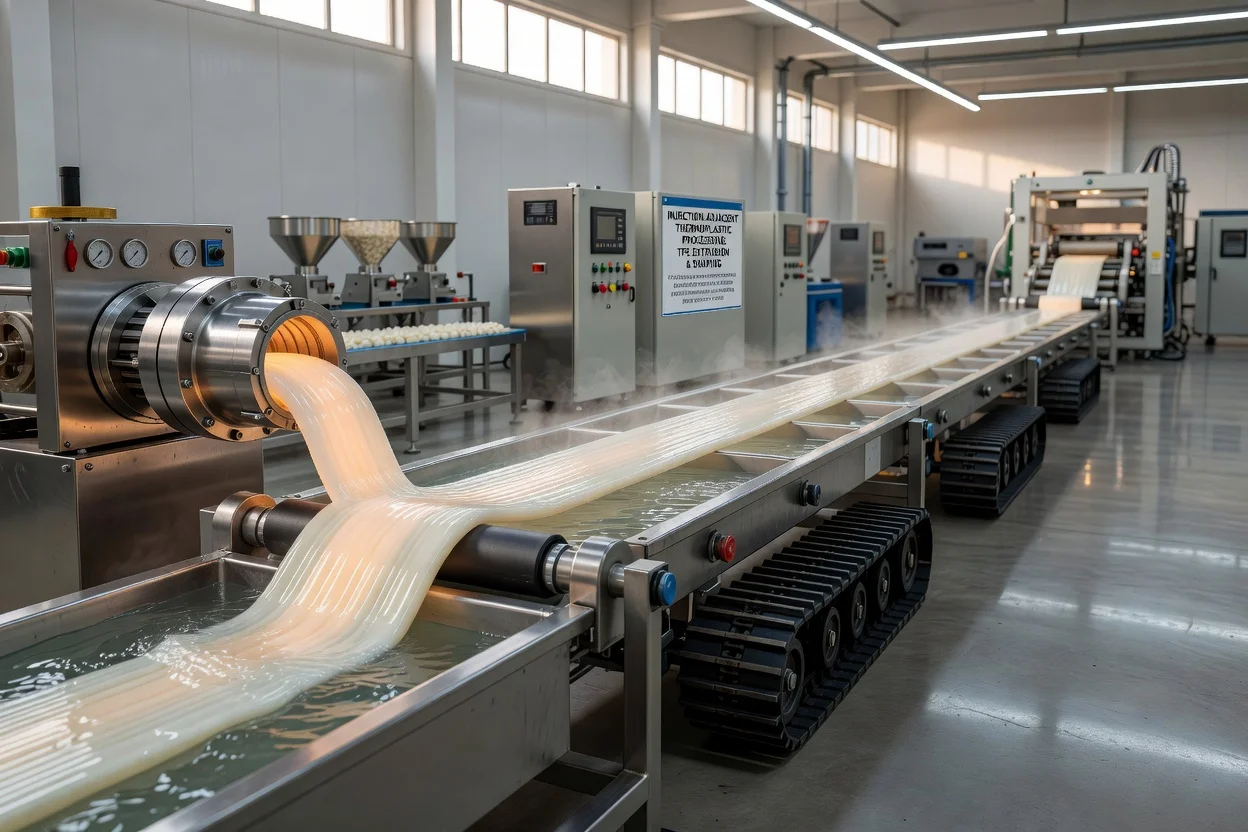
TPEs are produced either by polymer synthesis or by blending and compounding. Block copolymer TPEs are made through controlled polymerization, while TPVs and some TPOs rely on blending followed by dynamic vulcanization or intensive compounding to create a morphology with rubber-like elasticity and thermoplastic processability.
Typical feedstocks include:
- Petrochemical olefins and aromatics for polyolefin, styrenic, and some copolymer systems
- Isocyanates and polyols for TPU
- Polyester or polyamide precursors for TPC and TPA
- Fillers, plasticizers, stabilizers, pigments, processing aids, and flame retardants for compound tailoring
Processing commonly occurs through:
- Injection molding
- Extrusion
- Blow molding in selected grades
- Overmolding and two-shot molding
- Calendering and film/sheet production for selected formulations
Formulators often add small quantities of auxiliary ingredients to tune processing or end use. For example, 0.2–1.0% of a phenolic antioxidant system may be used in some TPE compounds to slow thermal oxidation during melt processing, while 1–5 phr of mineral filler or reinforcing additive may be used to adjust stiffness and dimensional stability; the exact package depends on the chemistry and target application. These additions work by interrupting radical degradation pathways, modifying melt viscosity, or reinforcing the polymer matrix at the microstructural level.
Applications and End-Use Markets
TPEs are used wherever a component must flex repeatedly, seal reliably, or provide a soft-touch interface while remaining producible at scale.
| End-use sector | Typical TPE role | Common grades/processes | Notes |
|---|---|---|---|
| Automotive | Seals, gaskets, trim, grips, vibration damping, interior soft-touch parts | TPV, TPU, TPO; injection molding, extrusion, overmolding | One of the largest consumption sectors |
| Construction | Weather seals, roofing membranes, expansion joints, waterproofing elements | TPV, TPO, TPU; extrusion, sheet, profile forming | Weatherability and sealing are key drivers |
| Wire and cable | Jacketing, insulation, flexible overmolds, connector strain relief | TPU, TPE-S, specialized halogen-free grades; extrusion | Flexibility and electrical insulation are central |
| Medical | Tubing, syringe parts, seals, wearables, grips | Medical-grade TPU, TPE-S, TPE-A; extrusion and molding | Biocompatibility and sterilizability are critical |
| Footwear | Soles, midsoles, foamed components, straps | TPU, TPE-S, some TPVs; injection, foaming, extrusion | Abrasion resistance and energy return matter |
| Consumer goods | Grips, cases, handles, sporting goods | TPE-S, TPU; overmolding and injection molding | Soft-touch feel and colorability are key |
| Industrial | Hoses, seals, gaskets, damping parts, machine covers | TPU, TPV, TPE-A; extrusion and molding | Chemical and wear resistance often dominate |
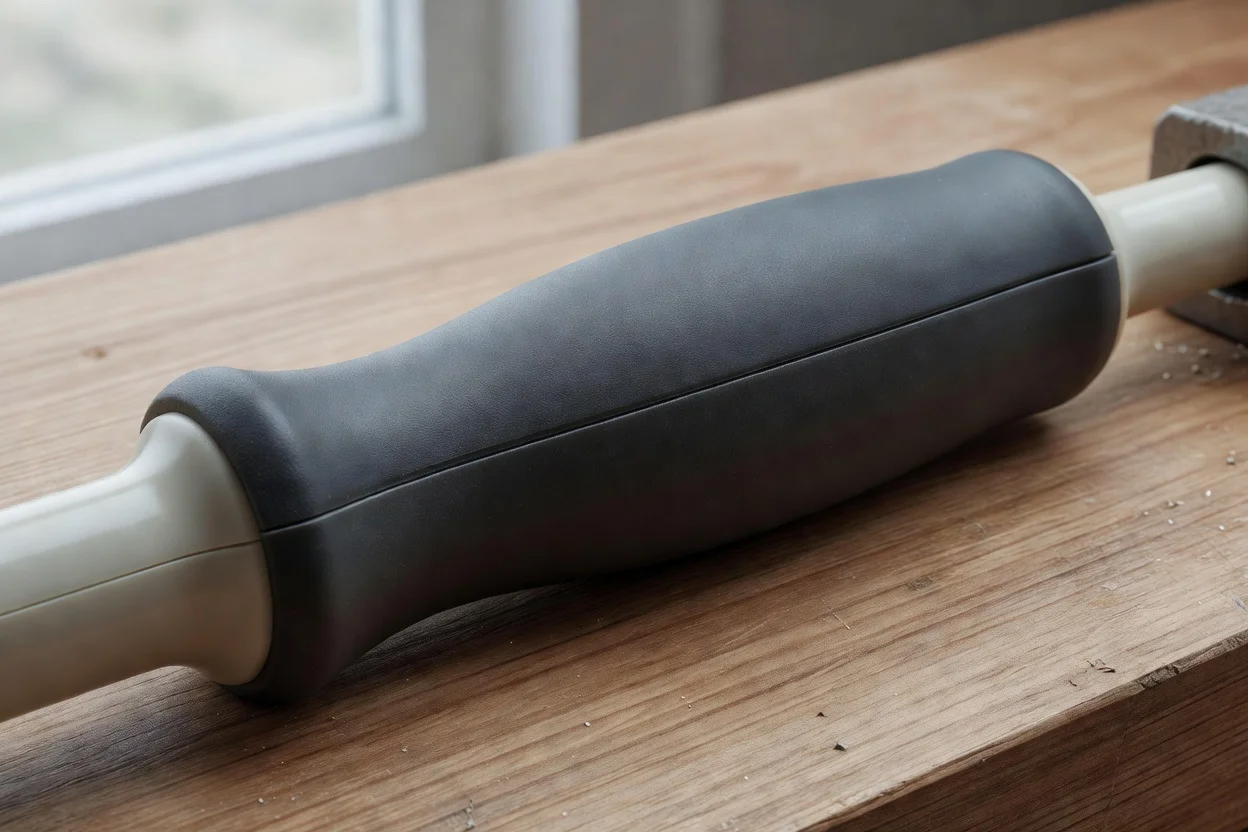
TPEs are especially important in overmolded parts, where a soft elastomeric layer is bonded to a rigid core to combine comfort, grip, and structural support. This design approach is common in tools, toothbrushes, appliance controls, portable electronics, and medical devices.
A notable poor-fit use is high-pressure, long-life fuel-system exposure for low- to mid-grade TPEs, because swelling, permeation, or property loss can occur unless a chemically resistant grade is selected. In such cases, fluoropolymers, specialized thermoset rubbers, or multilayer structures may be more suitable.
Environmental and Sustainability Aspects
TPEs are often presented as more recyclable than thermoset rubber because they can be remelted and reprocessed, at least in principle, while thermoset elastomers cannot be re-fused after curing. This is one reason TPEs are attractive in manufacturing systems that generate regrind or production scrap.
Their sustainability profile, however, is mixed:
- Potential benefits
- Lower curing energy and shorter cycle times than many rubber processes
- Easier reprocessing of clean production scrap
- Potential for lightweighting and part consolidation
- Compatibility with design-for-disassembly strategies in selected applications
- Persistent challenges
- Many TPEs are still derived from fossil feedstocks
- Multilayer and overmolded parts can be difficult to recycle mechanically
- Property loss from repeated thermal reprocessing can limit closed-loop reuse
- Some high-performance grades depend on chemistry that is not easily bio-based or circular at scale
Bio-based and recycled-content developments are expanding, especially in TPU, polyolefin-based systems, and specialty compounds, but performance consistency and feedstock availability remain constraints. In broader circular-economy terms, the key issue is not whether a TPE is nominally recyclable, but whether the full product design, collection system, and reprocessing route allow economically viable recovery.
Economic and Global Market Impact
According to recent industry analyses, demand for TPEs is being supported by growth in automotive interiors and seals, construction membranes and profiles, medical devices, and consumer products that require soft-touch or flexible features. Market competition is shaped by the balance between cost, performance, and processing efficiency rather than by chemistry alone.
Leading global suppliers commonly include major specialty polymer and compound producers such as Kraton, Kraiburg TPE, Avient, Hexpol TPE, Celanese in copolyester-related elastomer systems, BASF in TPU, and other large compounders and polymer manufacturers active in regional markets. Supplier leadership varies by TPE family, with TPU, TPV, and styrenic compounds often having distinct competitive landscapes.
Because TPEs reduce assembly complexity and can support lower-cost high-volume manufacturing, they are especially attractive in industries seeking part consolidation, better ergonomics, and faster cycle times. Their commercial value therefore lies not only in raw material sales, but in system-level manufacturing advantages.
Current Challenges and Innovations
Current technical challenges include:
- Improving heat and chemical resistance without sacrificing soft feel
- Reducing permeability and compression set in seals and tubing
- Enhancing adhesion in multi-material assemblies
- Increasing recycled content while preserving consistency
- Lowering dependence on fossil-based feedstocks
- Developing halogen-free flame-retardant systems for cable and transportation uses
Innovation is focused on:
- Bio-based TPU and other renewable-feedstock elastomers
- Chemically recyclable or depolymerizable elastomer systems
- Recycled-content compounds with controlled odor, color, and mechanical performance
- Advanced compatibilization to improve overmolding and recyclate use
- Low-VOC, medical-grade, and food-contact formulations for regulated markets
A particularly important innovation pathway is the design of TPEs for monomaterial or near-monomaterial product architectures, which can reduce recycling complexity and improve end-of-life recovery compared with heavily heterogeneous assemblies.
Future Outlook
The future of TPEs is likely to be shaped by three forces: materials substitution, circularity requirements, and performance specialization. Demand should remain strong in seals, soft-touch parts, wire and cable, medical devices, and lightweight transportation components, especially where manufacturers want thermoplastic processing with elastic function.
At the same time, the sector will face pressure to demonstrate credible recycling pathways and lower lifecycle emissions, which should favor designs that use recycled feedstock, simplify material combinations, and support repair or remanufacture. Higher-performance grades will continue to expand into environments once dominated by thermoset rubbers, but only where they can meet demanding durability and regulatory requirements.
Summary
TPEs are versatile, melt-processable elastomers that bridge the performance gap between plastics and rubber, enabling high-volume manufacture of flexible, durable, and often recyclable parts. Their broad chemistry platform gives them a major role in automotive, construction, cable, medical, footwear, and consumer products, while ongoing innovation is focused on sustainability, durability, and easier circularity.
References
- •
Thermoplastic elastomer. (2006, February 15). Wikipedia.Link
- •
Thermoplastic elastomers (TPE): Meaning, types, and uses. (2022, June 27). Xometry.Link
- •
Thermoplastic elastomers (TPE): Materials combining plastic and rubber properties. (n.d.). Ocean Chemie.Link
- •
TPE material: Thermoplastic elastomer compounds & formulations. (2018, March 6). Aurora Material Solutions.Link
- •
7 uses of thermoplastic elastomers and their differences. (2022, June 27). Xometry.Link
- •
TPE (thermoplastic elastomers): Properties, applications, and innovations. (2025, February 19). Eureka PatSnap.Link
- •
Thermoplastic elastomeric (TPE) materials and their applications. (n.d.). IPME.Link
- •
Thermoplastic elastomer: An overview. (n.d.). ScienceDirect.Link
- •
TPE (thermoplastic elastomers) properties & uses. (2025, March 13). Iplast.Link
- •
Thermoplastic elastomer (TPE) FAQs. (2025, February 17). Avient.Link
- •
Thermoplastic elastomers (TPE): Bridging flexibility and function across industries. (2025, October 6). ChemAnalyst.Link
- •
Emerging trends and developments in thermoplastic elastomers. (2020, November 10). SpecialChem.Link
- •
What is TPE: Thermoplastic elastomer materials. (n.d.). HEXPOL.Link
- •
What is TPE material? Properties, types, and common uses. (2025, August 7). HLC Metal Parts.Link
- •
7 types of thermoplastic elastomers (TPEs). (2022, June 27). Xometry.Link
- •
Thermoplastic elastomers. (n.d.). DKT2024.Link
- •
Thermoplastic elastomers in the real world: 5 uses you'll want to know. (2025, October 1). LinkedIn.Link
- •
What is TPE? (Thermoplastic elastomer material). (2025, May 23). KRAIBURG TPE.Link
- •
Thermoplastic elastomers TPE, TPR. (n.d.). British Plastics Federation.Link
- •
What is TPE: The complete guide to thermoplastic elastomer. (2024, September 20). Eureka PatSnap.Link
- •
Thermoplastic elastomer. (2020, November 3). ScienceDirect.Link
- •
Thermoplastic elastomers: Properties & applications. (n.d.). HEW-Kabel.Link
- •
TPE (thermoplastic elastomers): Properties, applications, and innovations. (2025, February 19). Eureka PatSnap.Link
- •
What is TPE thermoplastic elastomer? Injection molding, extrusion, and overmolding guide. (2026, August 4). LSM Chem.Link
- •
A beginner's guide to TPE. (2025, February 18). Avient.Link
- •
TPE vs. silicone and their differences. (2022, August 15). Xometry.Link