
Introduction
Acrylonitrile butadiene styrene (ABS) is a widely used engineering thermoplastic valued for its balance of impact resistance, rigidity, surface quality, and processability. It is a terpolymer built from acrylonitrile, butadiene, and styrene, typically organized as a rubber-toughened structure in which polybutadiene-based elastomeric particles are dispersed in a styrene-acrylonitrile (SAN) matrix, with SAN grafting helping to compatibilize the phases.
ABS has been a major industrial plastic since the mid-20th century and remains important in automotive interiors, appliance housings, consumer electronics, toys, and technical molded parts. Its commercial significance comes from the way its three monomers contribute different functions: acrylonitrile improves heat resistance and chemical resistance, butadiene provides toughness and impact strength, and styrene contributes stiffness, gloss, and ease of processing.
The material also occupies a notable position in sustainability debates. ABS is mechanically recyclable in principle, but post-consumer recovery can be constrained by product complexity, mixed-material assemblies, additives, and contamination; at the same time, industry development is moving toward recycled-content ABS, lower-emission production routes, and bio-attributed or bio-based feedstocks where feasible. Future innovation is likely to focus on better circularity, improved weathering and flame-retardant formulations, and lower-carbon resin production while preserving the hallmark balance of toughness and appearance.
History and Development
ABS emerged during the expansion of postwar synthetic polymers, when formulators sought materials that combined the stiffness of styrenics with the toughness of rubbers. Early commercial development established ABS as a practical replacement for more brittle plastics in housings, consumer goods, and transportation components.
The key developmental advance was the recognition that a grafted rubber phase could dramatically improve impact performance without eliminating thermoplastic processability. This architecture became the basis for modern ABS grades, with composition and morphology adjusted to serve different applications, from general-purpose molding to high-heat, flame-retardant, electroplatable, and high-gloss grades.
Chemical Structure and Key Properties
ABS is not a simple homogeneous polymer; it is a two-phase system composed of a rigid SAN matrix and dispersed rubber particles, usually based on polybutadiene. The rubber phase absorbs impact energy, while the SAN phase provides stiffness and heat resistance.
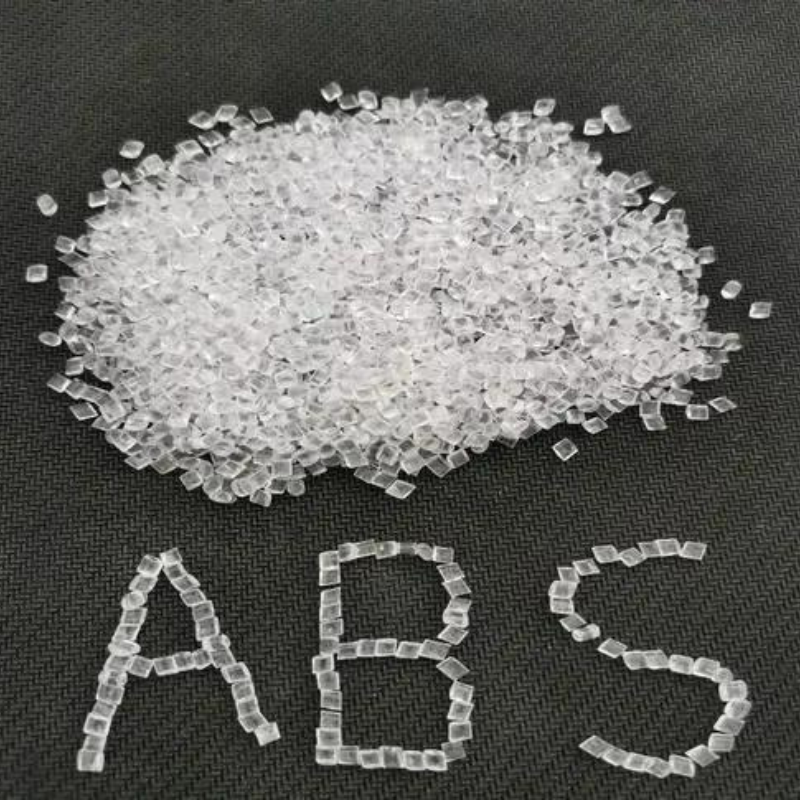
Typical ABS formulations vary by grade, but published ranges commonly place acrylonitrile at about 15 to 35 percent, butadiene at about 5 to 30 percent, and styrene at about 40 to 60 percent. Those ratios are adjusted to trade off impact strength, gloss, chemical resistance, and thermal resistance.
Key performance characteristics
- Impact resistance: high for an unfilled amorphous thermoplastic, especially in low-temperature service.
- Rigidity and dimensional stability: good balance of stiffness and toughness, supported by the SAN phase.
- Surface finish: excellent, with good gloss and suitability for painting, plating, and decorative finishing.
- Electrical insulation: useful for enclosures and housings.
- Low water absorption: supports dimensional stability in many indoor applications.
Important limits and workarounds
- Poor weathering resistance → the butadiene-rich phase is vulnerable to UV and outdoor oxidation → workaround: use ASA, UV-stabilized ABS, coatings, pigments, or protective design placement.
- Moderate heat resistance → the amorphous structure softens before high-temperature engineering plastics → workaround: select heat-resistant ABS grades, blends, mineral reinforcement, or a different resin for sustained high-heat service.
- Low solvent resistance to certain organic liquids → aromatic chlorinated and ketone solvents can attack ABS → workaround: avoid incompatible chemicals, use solvent-resistant materials, or apply barrier coatings.
- Poor fit for long-term exterior exposure → UV and weathering degrade appearance and mechanical properties → workaround: use indoor applications, co-extruded layers, or weatherable specialty styrenics.
Representative property profile
| Property | Typical character |
|---|---|
| Structure | Amorphous thermoplastic with rubber-toughened morphology |
| Density | Low, around 1.0 to 1.07 g/cm³ in published sources |
| Heat performance | Moderate; service temperature typically below that of PC or PA |
| Impact behavior | Strong, especially relative to pure styrenics |
| Surface quality | High gloss, excellent aesthetics |
Production Processes and Raw Feedstocks
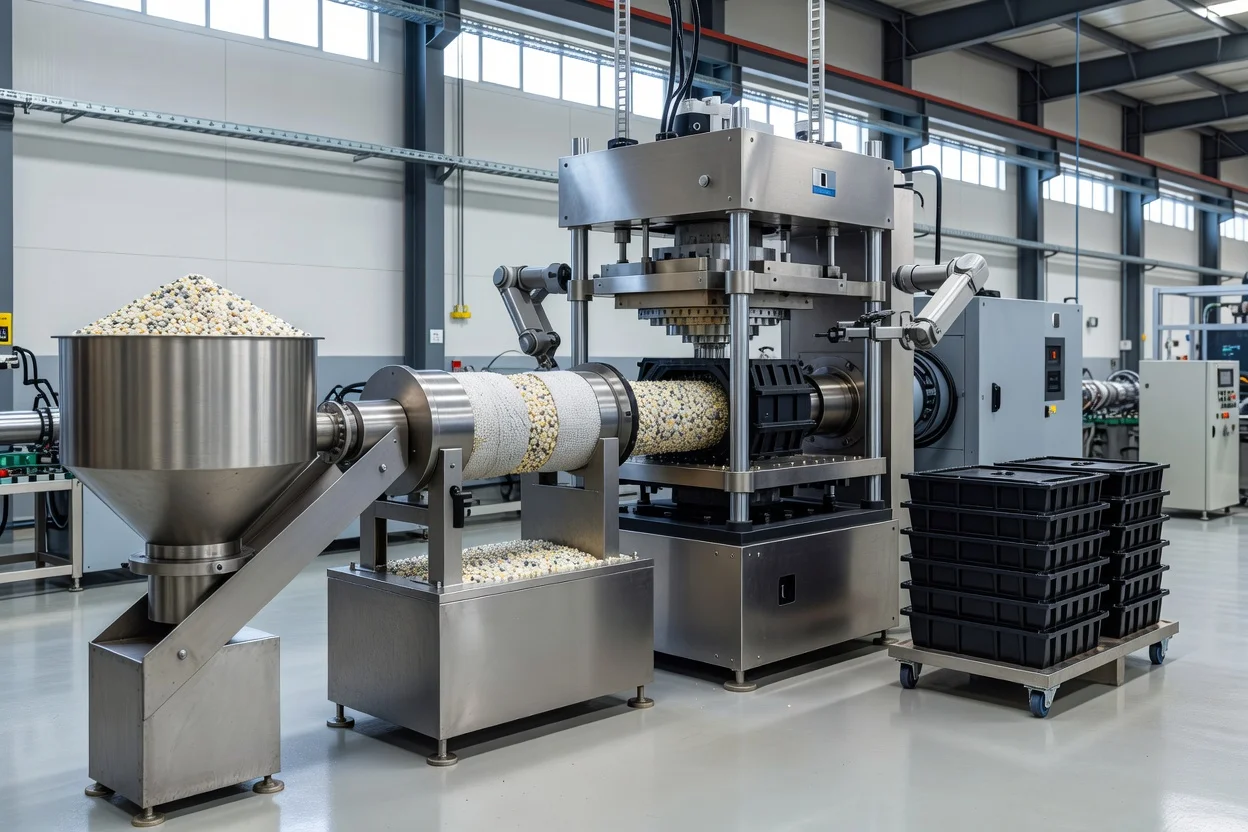
ABS is produced from acrylonitrile, butadiene, and styrene, typically through grafting and blending routes that create the desired two-phase morphology. Two broad manufacturing approaches are described in technical sources: emulsion grafting of acrylonitrile and styrene onto polybutadiene, and related processes that disperse an elastomeric phase within a SAN matrix.
The raw feedstocks are petrochemical derivatives:
- Acrylonitrile is generally derived from propylene chemistry.
- Butadiene is commonly recovered from steam-cracker C4 streams.
- Styrene is typically produced from ethylbenzene via dehydrogenation.
Commercial ABS production is therefore linked to the broader olefins and aromatics value chain, and its economics depend on monomer spreads, energy costs, and the supply-demand balance of upstream petrochemicals.
Process and property linkage
- Higher butadiene content generally increases impact resistance but can reduce tensile strength and heat deformation temperature.
- Higher acrylonitrile content generally improves chemical resistance and thermal stability but can reduce toughness if overemphasized.
- Styrene enhances rigidity, surface finish, and moldability, which is critical for visible consumer and automotive parts.
Applications and End-Use Markets
ABS is used where a combination of toughness, stiffness, and appearance is required, especially in injection-molded parts.
| End-use sector | Typical ABS grade/process | Why ABS fits |
|---|---|---|
| Automotive interiors | Injection-molded general-purpose or heat-resistant ABS | Good dimensional stability, surface quality, and impact resistance |
| Consumer electronics | Flame-retardant or high-flow ABS | Electrical insulation, cosmetics, and moldability |
| Appliances | Injection-molded housing grades | Good appearance, rigidity, and durability |
| Toys and games | General-purpose ABS | Impact resistance and excellent molding detail |
| Pipe fittings and building components | Specialty ABS or ABS blends | Toughness and ease of joining for non-pressure uses |
| 3D printing filaments | Extrusion-grade ABS | Processability and dimensional stability |
| Medical and laboratory housings | Cleanable housing grades | Toughness and formed-part aesthetics |
Major application areas
- Automotive: dashboards, instrument panels, interior trim, mirror housings, and console parts are common ABS uses.

- Consumer electronics: television backs, keyboards, computer peripherals, phone cases, and equipment housings rely on ABS for impact protection and finish quality.
- Household appliances: vacuum cleaner bodies, blender housings, coffee makers, and similar products use ABS for durability and appearance.
- Toys: ABS is especially important for precision-molded, interlocking toys because of its dimensional accuracy and toughness.
- Building and sanitary products: fittings, decorative panels, and some piping components use ABS where heat and weather exposure are controlled.
- Additive manufacturing: ABS remains one of the classic thermoplastics for fused-filament fabrication because it prints into rigid parts with useful toughness.
A poor-fit use
ABS is generally a poor choice for prolonged outdoor structural exposure because standard grades weather poorly compared with more weather-resistant polymers such as ASA. That limitation is a major reason exterior-grade applications often migrate to UV-stabilized systems or alternative resins.
Environmental and Sustainability Aspects
ABS is a fossil-derived polymer tied to petrochemical feedstocks and therefore to upstream greenhouse-gas emissions from monomer production and resin manufacture. Its environmental profile is shaped not only by production chemistry but also by product design, service life, and end-of-life recovery.
Recyclability and circularity
- Mechanical recycling is technically feasible, especially for clean industrial scrap and homogeneous post-industrial streams.
- Post-consumer recycling is more difficult because ABS often appears in mixed assemblies with paints, metals, electronics, or flame-retardant packages.
- Compatibility issues with other plastics can reduce recycled material quality, so sorting and traceability are important.
Bio-based and lower-carbon options
Industry pathways under discussion include:
- recycled-content ABS
- mass-balance or bio-attributed feedstocks
- lower-energy polymerization processes
- design-for-recycling formulations that reduce problematic additives and incompatible layers
Trade-offs
ABS can extend product life because of its toughness and repairability, which can partially offset environmental burden in durable goods. At the same time, the material remains difficult to circularize in some high-complexity applications, especially electronics and transport interiors with mixed polymers and coatings.
Economic and Global Market Impact
ABS is one of the most commercially important styrenic engineering plastics, with demand concentrated in Asia, Europe, and North America through automotive, appliances, electronics, and consumer goods supply chains. Its market position is strengthened by broad processability, established supply chains for its feedstocks, and the ability to tailor grades for appearance, impact, and heat performance.
Industry structure
ABS production is typically integrated with large petrochemical and styrenics manufacturers, including major global producers with substantial capacities in Asia and other industrial regions. The market is highly sensitive to:
- styrene, acrylonitrile, and butadiene price cycles
- crude oil and cracker economics
- downstream manufacturing output
- regulatory pressure on additives, recycling, and carbon intensity
Strategic importance
ABS occupies an important middle ground between commodity plastics and higher-cost engineering polymers. It is often selected when product designers need better appearance and toughness than polystyrene can provide, but do not require the full heat or chemical resistance of higher-performance polymers.
Current Challenges and Innovations
Core challenges
- Outdoor durability: standard ABS remains vulnerable to UV and weathering.
- Circularity: mixed-material products complicate recovery and high-quality reprocessing.
- Flame retardancy: some legacy FR systems face regulatory scrutiny and recycling complications.
- Cost volatility: dependence on petrochemical feedstocks exposes ABS to upstream price swings.
Innovation directions
- Weatherable grades: development of ABS/ASA-type solutions and improved stabilizer packages.
- Recycled ABS: use of post-industrial and post-consumer recyclate in controlled applications.
- Low-emission formulations: process optimization and lower-carbon feedstocks.
- Additive engineering: targeted use of impact modifiers, lubricants, nucleants, and flame-retardant systems to extend performance without overcomplicating recycling.
- Illustrative additive examples:
- 0.2 to 0.5 percent lubricant packages, such as waxes or metal stearates, can improve mold release and surface finish by reducing melt/friction interactions during processing.
- 5 to 15 percent elastomeric impact modifiers in specialty blends can raise low-temperature toughness by dispersing energy during crack propagation, although excessive loading can reduce stiffness and heat resistance.
Future Outlook
ABS is likely to remain an important engineering plastic because it offers a rare combination of toughness, appearance, and manufacturability. Near-term growth should continue in consumer electronics, appliance housings, transport interiors, and precision-molded components, while long-term competitiveness will depend increasingly on circular design and carbon reduction.
The most durable opportunities are likely to be:
- higher recycled content without major loss of properties
- improved outdoor and thermal grades
- better compatibility with solvent-free joining and closed-loop recovery
- lower-carbon monomer supply and resin production
- substitution into applications where ABS’s cosmetic and impact balance offers an economic advantage over more expensive engineering polymers
Summary
ABS is a rubber-toughened thermoplastic that combines SAN rigidity with butadiene-based impact resistance, giving it enduring value in molded consumer, automotive, and electrical applications. Its strengths are balanced by clear limits in weathering and high-temperature service, which has driven the development of specialty grades, blends, and sustainability-focused redesigns.
References
- •
ABS plastic guide: Key properties, applications, and benefits. (2026, May 22). https://salesplastics.com/abs-plastic/Link
- •
Acrylonitrile-butadiene-styrene copolymers (ABS). (n.d.). https://nvlpubs.nist.gov/nistpubs/Legacy/IR/nbsir85-3248.pdfLink
- •
Acrylonitrile–butadiene–styrene (ABS) polymers. (n.d.). https://onlinelibrary.wiley.com/doi/10.1002/0471238961.01021911211209.a01.pub3Link
- •
ABS plastic (Acrylonitrile butadiene styrene). (2025, July 9). https://www.specialchem.com/plastics/guide/acrylonitrile-butadiene-styrene-abs-plasticLink
- •
Acrylonitrile butadiene styrene. (2003, May 25). In Wikipedia. https://en.wikipedia.org/wiki/Acrylonitrile_butadiene_styreneLink
- •
Acrilonitrilo butadieno estireno. (2006, April 14). In Wikipedia. https://es.wikipedia.org/wiki/Acrilonitrilo_butadieno_estirenoLink
- •
Acrylonitrile-butadiene-styrene copolymer (ABS). (2026, March 16). In Encyclopædia Britannica. https://www.britannica.com/science/acrylonitrile-butadiene-styrene-copolymerLink
- •
Styrene-butadiene copolymer. (n.d.). https://www.sciencedirect.com/topics/chemistry/styrene-butadiene-copolymerLink
- •
Poly(acrylonitrile/butadiène/styrène) ABS. (n.d.). https://www.inrs.fr/dam/jcr:d8e7e9b8-217c-408f-bba1-970998b162be/POLYMERE_ABS.pdfLink
- •
ABS: Acrylonitrile-butadiene-styrene copolymer. (n.d.). https://polymers.netzsch.com/Materials/Details/1Link
- •
Plastics data file – ABS. (n.d.). https://tangram.co.uk/wp-content/uploads/Plastics-Data-File-ABS.pdfLink
- •
Acrylonitrile butadiene styrene ABS plastic polymer. (2026, April 10). https://www.chemategroup.com/acrylonitrile-butadiene-styrene-abs/Link
- •
Acrylonitrile butadiene styrene (ABS) and other specialist styrenics. (n.d.). https://www.bpf.co.uk/plastipedia/polymers/ABS_and_Other_Specialist_Styrenics.aspxLink
- •
Acrylnitril-butadien-styrol-copolymer. (2004, May 26). In Wikipedia. https://de.wikipedia.org/wiki/Acrylnitril-Butadien-Styrol-CopolymerLink
- •
ABS plastic | Acrylonitrile butadiene styrene copolymer. (n.d.). https://www.formary.de/en/materials/abs-plasticLink
- •
ABS 수지. (2015, January 11). In 위키백과. https://ko.wikipedia.org/wiki/ABS_%EC%88%98%EC%A7%80Link
- •
ABS: Properties, applications and advantages of the material with Plasnor. (2025, November 18). https://www.plasnor.com/en/abs-properties-applications-and-advantages-of-the-material-with-plasnor/Link
- •
ABS plastic: Advantages, disadvantages, and applications. (n.d.). https://www.protolabs.com/materials/abs/Link
- •
Acrylonitrile butadiene styrene (ABS) resins NOSE CODE. (n.d.). https://www.eea.europa.eu/en/analysis/publications/emepcorinair5/B4515vs1.1.pdf/@@download/fileLink
- •
Styrene copolymers (ABS, SAN, ASA, MABS). (n.d.). https://res.cloudinary.com/sternwald-systems/raw/upload/v1/hugoprd/ARTIKEL_ATTACH/00243F19_1AA47E263C73/7caaeb2f597c25ab0c5da8b4e7204d203aa44307/PE_2010_10_Styrene-Copolymers-ABS-SAN-ASA-MABS.pdfLink
- •
Butadiene acrylonitrile butadiene styrene material. (n.d.). https://eureka.patsnap.com/materials/abs-composition-propertiesLink
- •
Acrylonitrile butadiene styrene. (2025, January 10). https://www.sciencedirect.com/topics/materials-science/acrylonitrile-butadiene-styreneLink
- •
Acrylonitrile butadiene styrene - An overview. (n.d.). https://www.sciencedirect.com/topics/engineering/acrylonitrile-butadiene-styreneLink
- •
Styrene copolymers (ABS, ASA, SAN, MABS, and ABS blends). (n.d.). https://res.cloudinary.com/sternwald-systems/raw/upload/v1/hugoprd/ARTIKEL_ATTACH/00243AFB_0E3D7BBF5B50/ec1644289eee76d252abcc3c272e798c667c7784/PE_2011_10_Styrene-Copolymers-ABS-ASA-SAN-MABS-and-ABS-Blends.pdfLink
- •
ABS plastic: Properties, processing & applications. (2026, January 13). https://www.cncmachiningshops.com/abs-plastic/Link
- •
Acrylonitrile butadiene styrene | C15H17N | CID 24756 - PubChem. (n.d.). https://pubchem.ncbi.nlm.nih.gov/compound/Acrylonitrile-butadiene-styreneLink
- •
What should I know about Acrylonitrile butadiene styrene (ABS)? (2026, May 5). https://adrecoplastics.co.uk/key-facts-you-may-not-have-known-about-acrylonitrile-butadiene-styrene-abs/Link
- •
ABS resins. (n.d.). https://www.sciencedirect.com/topics/chemical-engineering/abs-resinsLink
- •
ABS. (2007, January 4). https://www.mexpolimeros.com/eng/abs.htmlLink
- •
Uses of ABS plastic. (2023, May 19). https://sintac.es/en/uses-of-abs-plastic/Link
- •
The basics of Acrylonitrile butadiene styrene (ABS). (n.d.). https://www.ulprospector.com/knowledge/11655/pe-the-basics-of-acrylonitrile-butadiene-styrene-abs/Link