
Introduction
Thermoplastic polyamide elastomer (TPA) is a high-performance thermoplastic elastomer family built from hard polyamide segments and soft flexible segments, typically polyether and sometimes polyester, arranged as block copolymers with alternating rigid and elastic domains. This molecular architecture gives TPA materials the unusual combination of rubber-like elasticity, thermoplastic melt-processability, good low-temperature flexibility, and strong resistance to fuels, lubricants, abrasion, and aging that makes them important in technical applications rather than mass commodity uses.
TPA is also known in industry under related names such as PEBA, COPA, or TPE-A, depending on composition and nomenclature practice, with ISO 18064 describing it as a polyamide thermoplastic elastomer composed of hard amide-containing blocks and soft ether and/or ester-linked blocks. The family includes variants based on different polyamide hard segments and different soft segment chemistries, which allows tuning of stiffness, hardness, impact behavior, and thermal response. In practice, TPA occupies a niche between conventional rubbers and engineering plastics, serving applications where both elasticity and precision processing are required.
From a sustainability perspective, TPA sits within the broader thermoplastic elastomer landscape that is valued for reprocessability and scrap recovery compared with vulcanized rubber, although its polyamide content and performance-grade formulation mean that feedstock origin, additive package, and end-of-life sorting still matter for circularity. Current development work focuses on higher-performance grades, lighter-weight designs, additive and compatibilization strategies, powder-bed-fusion 3D printing materials, and more circular production pathways.
History and Development
TPA emerged from the broader development of block copolymer thermoplastic elastomers, in which segmented hard and soft domains create a reversible physical network that behaves like an elastomer at room temperature and melts or softens for processing. Its commercialization followed the same general industrial logic as other TPE families: to replace some rubber parts and plasticized flexible plastics with materials that could be injection molded or extruded without vulcanization or external plasticizers.
The material became especially attractive in high-value sectors because its hard polyamide blocks provide mechanical integrity and thermal resistance, while the soft segments create flexibility and low-temperature performance. Over time, product development expanded from basic flexible parts toward medical tubing, sports equipment, cable and wire components, seals, precision injection-molded parts, and additive-manufactured powders.
Chemical Structure and Key Properties
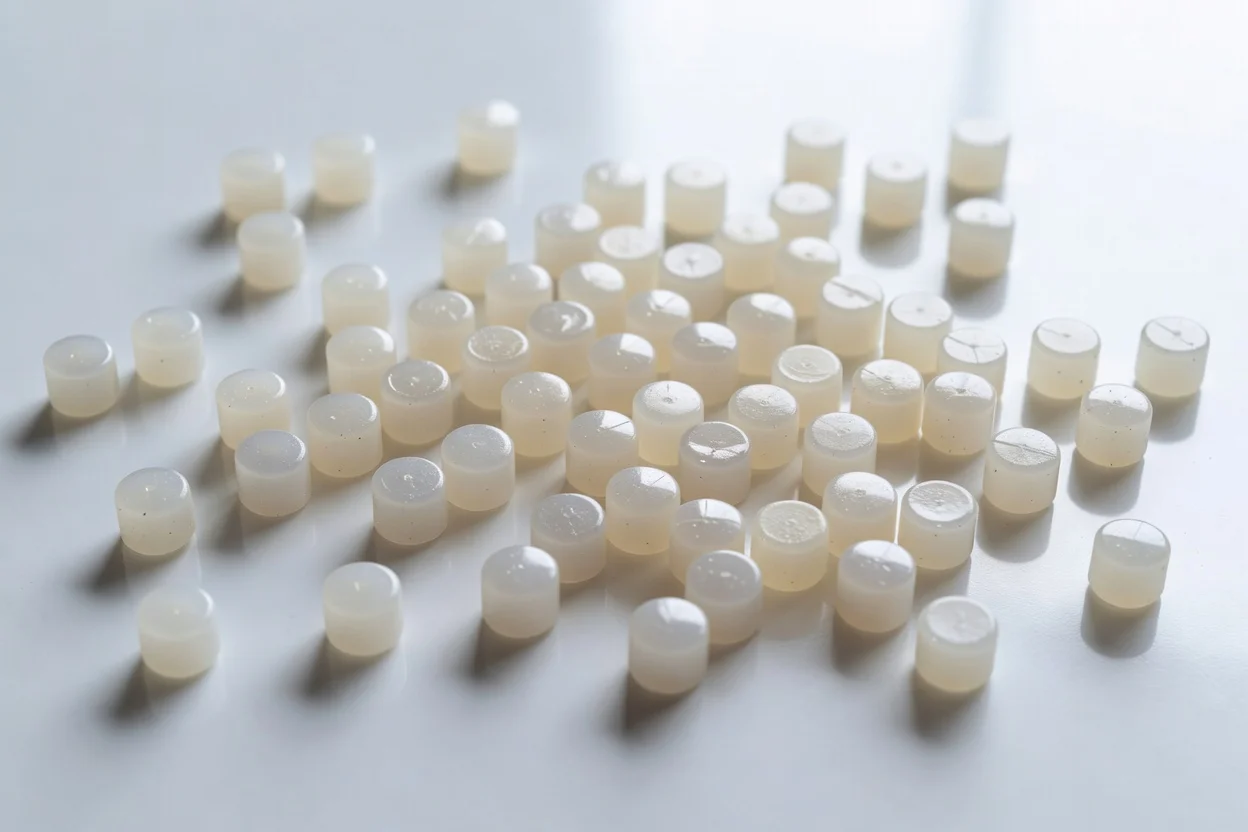
TPA is a segmented block copolymer: the hard domains are polyamide-rich and crystallizable, while the soft domains are ether- or ester-based and amorphous or weakly crystalline. This phase-separated morphology is the source of the material’s property balance, because the hard domains act as physical crosslinks and the soft domains provide reversible deformation.
Structure-property relationship
- Hard segments: contribute strength, heat resistance, chemical resistance, and elastic recovery by crystallizing into physically anchoring domains.
- Soft segments: contribute flexibility, low-temperature toughness, and damping.
- Phase separation: controls modulus, hardness, elongation, and compression set; property variation is therefore strongly grade-dependent.
Real limitations and typical workarounds
- Lower structural stiffness than engineering nylons → caused by soft-segment content and elastomeric morphology → workaround: choose a higher-hard-segment grade or reinforce with fillers and fibers when dimensional stability is more important than softness.
- Property drift under moisture and heat exposure → caused by polyamide moisture uptake and morphology changes → workaround: use appropriate drying, design allowances, and grade selection for the intended humidity/temperature window.
- Cost and complexity versus commodity polyolefins → caused by segmented synthesis and specialty-grade positioning → workaround: limit use to functions where elasticity, chemical resistance, and precision justify the premium.
Typical performance profile
Recent technical summaries and product data describe TPA as having broad property windows, with grade-dependent values such as glass transition behavior in the low-temperature range, melting points around the mid-hundreds of degrees Celsius, and relatively low density for a high-performance engineering elastomer. Typical published property ranges include a Young’s modulus from about 20 to 500 MPa in some material families, tensile strength from about 10 to 45 MPa, and melting temperatures roughly in the 145 to 200 C range, depending on composition.
Selected property comparison
| Property | Typical implication |
|---|---|
| Low-temperature flexibility | Suitable for cold-environment seals, tubing, and sports goods. |
| Chemical resistance | Useful in fuel, oil, and lubricant exposure. |
| Abrasion resistance | Suits gears, hoses, wear components, and moving parts. |
| Melt-processability | Enables injection molding, extrusion, blow molding, and powder-bed fusion. |
| Elastic recovery | Supports repeated deformation in dynamic applications. |
Production Processes and Raw Feedstocks
TPA is produced by step-growth or block-copolymer synthesis routes that combine polyamide hard blocks with flexible soft blocks, followed by controlled molecular architecture development to obtain phase-separated morphology. The exact chemistry varies by manufacturer and grade, but industrial descriptions consistently emphasize the alternating hard/soft segment design.
Typical feedstock logic
- Hard segment precursors: polyamide-related monomers or oligomers, commonly based on nylon-type chemistries such as polyamide 6 or polyamide 12 building blocks in some grades.
- Soft segment precursors: polyether or polyester chains, which lower crystallinity and introduce elasticity.
- Formulation additives: stabilizers, lubricants, pigments, and processing aids may be used to tune processing and durability, though the core elastomeric behavior comes from the block structure itself.
Processing methods
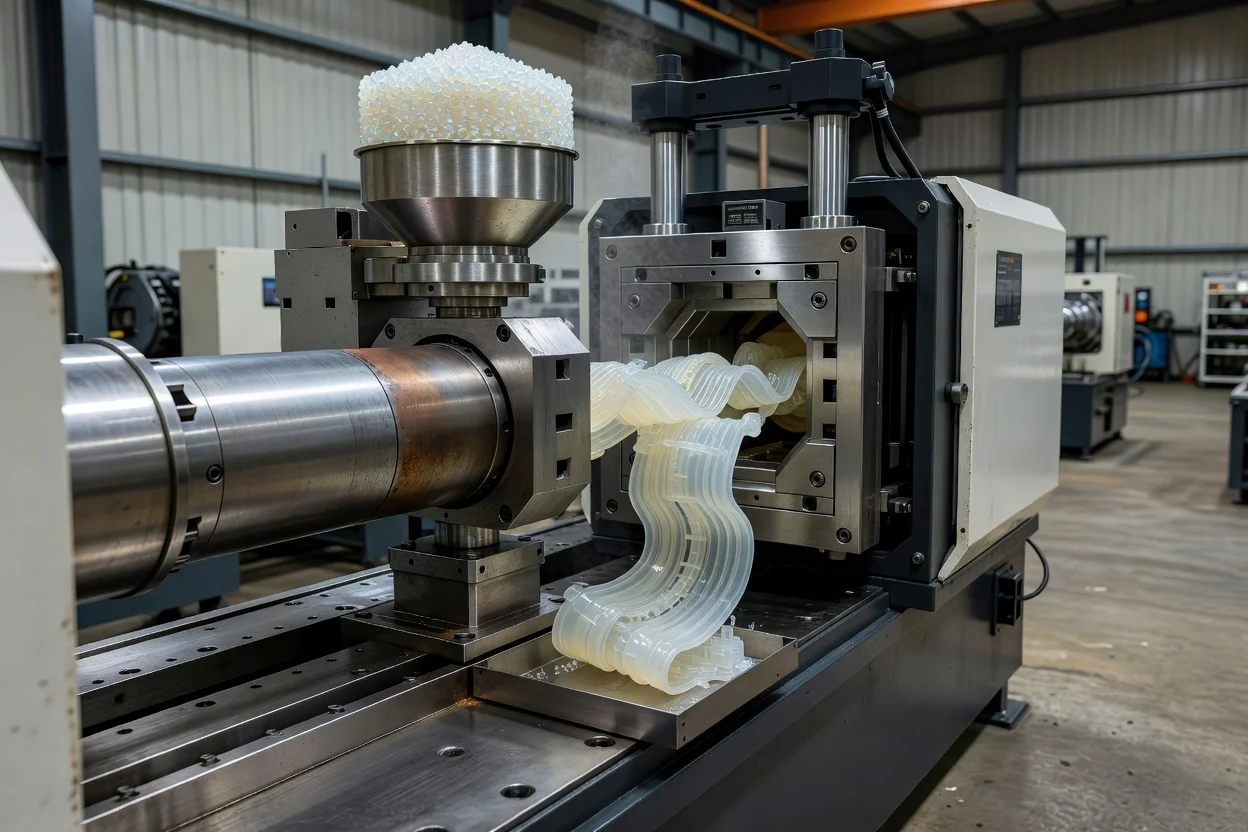
TPA is designed to be processed with conventional thermoplastic equipment, including:
- Injection molding.
- Extrusion.
- Blow molding.
- Powder bed fusion 3D printing for selected powder grades.
A practical formulation example from the literature shows how performance can be modified by blending and compatibilization: in an ethylene-vinyl acetate rubber/polyamide thermoplastic elastomer system, adding maleic anhydride-grafted material improved dispersion and mechanical performance, and a formulation with 5 wt % compatibilizer plus 3.5 phr dicumyl peroxide achieved substantially improved strength and elongation. This illustrates a broader processing principle relevant to TPA-based systems: interfacial chemistry and phase morphology strongly govern final performance.
Applications and End-Use Markets
TPA is used where rubber-like deformation must coexist with thermoplastic processing, especially in demanding technical environments.
Main application sectors
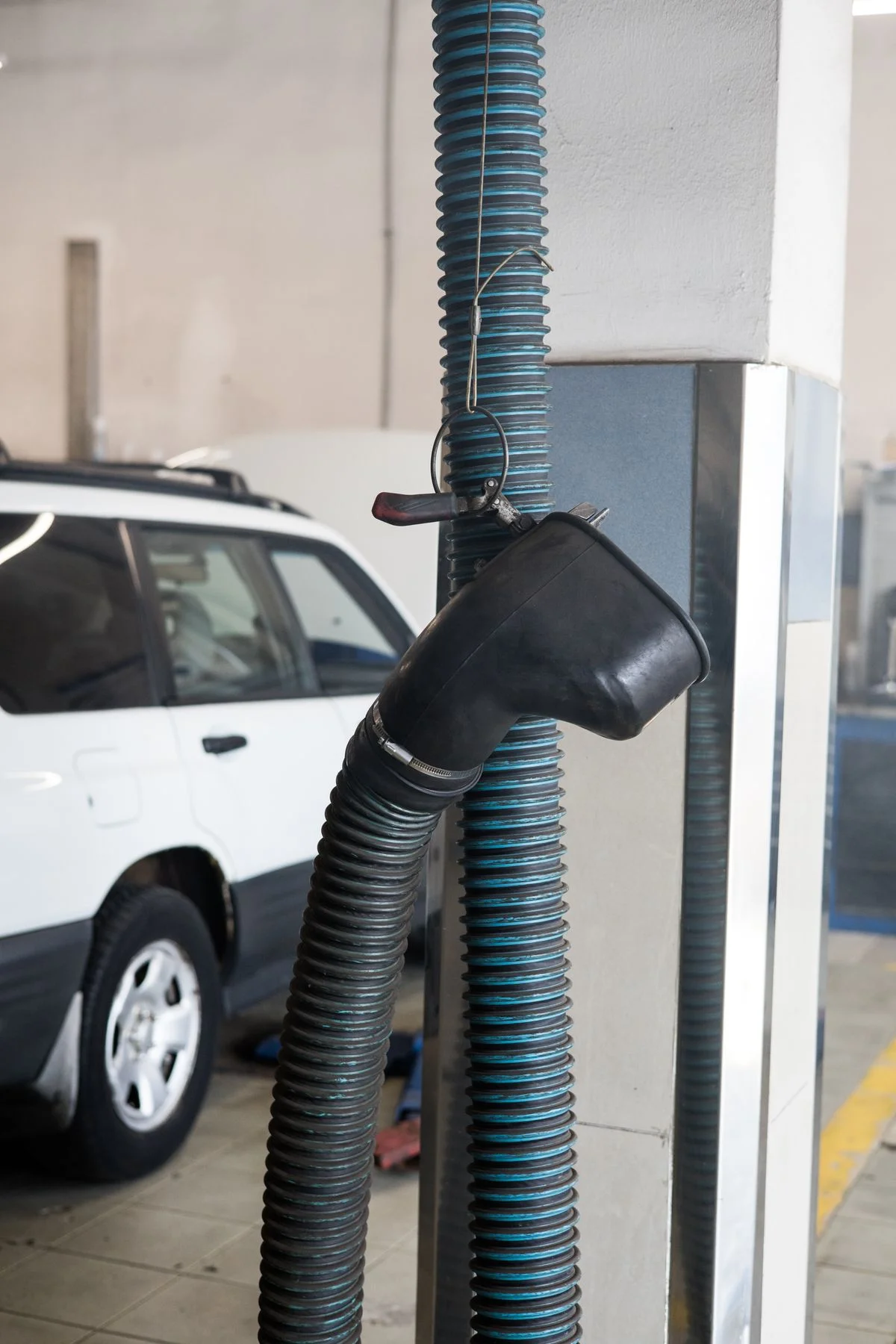
- Automotive
- Seals, hoses, flexible joints, under-hood components, clips, and soft-touch parts.
- Usual grade/process: medium- to high-hardness injection-molding grades and extrusion grades.
- Sports and leisure
- Footwear components, ski boots, grips, protective gear, and rebound-sensitive parts.
- Usual grade/process: low-density, flexible, fatigue-resistant grades; injection molding and specialized footwear processing.
- Medical and healthcare
- Tubing, catheters, seals, syringe components, and device housings.
- Usual grade/process: medical-grade extrusion and molding compounds with validated biocompatibility and sterilization resistance.
- Industrial and mechanical
- Gears, conveyor elements, seals, tubes, vibration-control parts, and protective covers.
- Usual grade/process: wear-resistant grades, often injection molded or extruded.
- Additive manufacturing
- Functional powder grades for powder bed fusion, especially where flexibility and impact resistance are needed.
- Usual grade/process: engineered powder with controlled particle size and flow behavior.
Poor-fit use
- High-load structural parts are generally a poor fit because TPA is designed for elastic and dynamic performance rather than maximum rigidity; engineering nylons or fiber-reinforced plastics are usually better choices when stiffness dominates.
Environmental and Sustainability Aspects
TPA participates in the broader TPE sustainability conversation because it is thermoplastic, not crosslinked, which makes reprocessing and scrap recovery easier than with traditional vulcanized rubber. This is a meaningful advantage in manufacturing systems where runners, off-spec parts, and production waste can be remelted or mechanically recycled, at least within controlled streams.
At the same time, TPA is not automatically a circular material. Its sustainability profile depends on several factors:
- Feedstock origin: fossil-based versus bio-based or partially bio-based precursors.
- Product design: monomaterial design improves recoverability, while multilayer or metal-composite assemblies complicate recycling.
- Use phase: long service life can offset higher production impacts when the material replaces shorter-lived alternatives.
- Sorting and contamination: specialty elastomers are harder to recover from mixed post-consumer waste than from industrial scrap streams.
Bio-based and lower-carbon options remain an area of innovation in the wider polyamide and TPE ecosystem, but published technical summaries still place TPA primarily in performance applications where environmental improvement is usually pursued through durability, lightweighting, manufacturing efficiency, and better recycling routes rather than through simple substitution with lower-grade materials.
Economic and Global Market Impact
TPA is a specialty engineering elastomer, so its market is smaller than that of PE, PP, or PVC, but its value per kilogram is often higher because it serves technically demanding uses. Market commentary consistently places demand growth in sports, medical, automotive, industrial, and additive manufacturing segments.
The economic logic of TPA is tied to substitution: it can replace selected rubber, TPU, or plasticized flexible-parts solutions when better rebound, lower-temperature flexibility, or stronger resistance to fuels and lubricants is needed. This makes it strategically relevant in lightweight mobility, premium sports goods, and medical devices, where performance differentiation supports higher margins.
Published market commentary and product-level reporting identify major commercial TPA families associated with established polyamide and specialty polymer producers, including well-known engineering-polymer suppliers such as Evonik and other global TPE and polyamide manufacturers.
Current Challenges and Innovations
Current challenges
- Cost-performance tradeoff: TPA often competes against TPU, TPC, and high-end rubber formulations, so it must justify its premium with clear performance gains.
- Moisture sensitivity: polyamide-based segments can absorb water, affecting dimensions and properties.
- Recycling complexity: performance grades are harder to sort and recycle than commodity thermoplastics.
- Supply-chain specialization: high-performance grades depend on controlled chemistry and consistent quality.
Active innovation areas
- Powder-bed-fusion materials for industrial 3D printing.
- Semi-aromatic and tailored segment chemistries to improve heat resistance and modulus retention.
- Compatibilization and blending to optimize phase dispersion and dynamic mechanical behavior.
- Application-specific grades for footwear, medical devices, and fluid-handling systems.
A recent research example shows how segment chemistry can be used to raise high-temperature mechanical performance: by adjusting hard-segment composition in semi-aromatic TPAEs, researchers reported substantial gains in modulus and tensile properties at elevated temperature. This is important because it points to a route for expanding TPA into hotter or more demanding service environments without abandoning processability.
Future Outlook
TPA is likely to remain a specialty performance elastomer rather than a commodity material, but its role should expand in areas where durable elasticity and thermoplastic processing are both essential. The strongest growth signals are in sports footwear, medical devices, precision industrial components, and additive manufacturing powders.
Future development is likely to focus on:
- Lower-carbon and bio-based feedstocks where performance targets can still be met.
- Improved recyclability through cleaner mono-material designs and better industrial scrap recovery.
- Higher-temperature grades for under-the-hood and industrial service.
- Better powder and extrusion grades for advanced manufacturing.
- Tighter property control through segment engineering and morphology management.
Summary
TPA is a segmented polyamide-based thermoplastic elastomer that combines hard polyamide blocks with soft ether- or ester-based blocks to deliver rubber-like elasticity, thermoplastic processability, and strong resistance to wear, fuels, oils, and low-temperature embrittlement. It is used in demanding applications such as automotive seals and hoses, sports and footwear components, medical tubing, industrial parts, and additive manufacturing powders, while ongoing research continues to improve heat resistance, recyclability, and material efficiency.
References
- •
Netzsch. (n.d.). TPA: Thermoplastic polyamide elastomer. https://analyzing-testing.netzsch.com/en-US/polymers-netzsch-com/thermoplastic-elastomers/tpa-thermoplastic-polyamide-elastomerLink
- •
Netzsch. (n.d.). TPA: Термопластичный полиамидный эластомер. https://analyzing-testing.netzsch.com/ru/polimery-netzsch-com/thermoplastic-elastomers/tpa-termoplastichnyi-poliamid-elastomerLink
- •
Optinova. (2021, October 15). 5 things to know about thermoplastic polyamide elastomer (TPA). https://optinova.com/news/5-things-to-know-about-thermoplastic-polyamide-elastomer-tpa/Link
- •
Farr. (2025, December 2). What is a thermoplastic polyamide elastomer (TPA)? https://farr.ae/what-is-a-thermoplastic-polyamide-elastomer-complete-material-guide-2025Link
- •
Netzsch. (n.d.). TPA: Elastómero de poliamida termoplástica. https://analyzing-testing.netzsch.com/es/polimeros-netzsch-com/thermoplastic-elastomers/tpa-termoplastico-poliamida-elastomeroLink
- •
Netzsch. (n.d.). TPA: Termoplastický polyamidový elastomer. https://analyzing-testing.netzsch.com/cs/polymery-netzsch-com/thermoplastic-elastomers/tpa-thermoplasticky-polyamid-elastomerLink
- •
International Organization for Standardization. (n.d.). ISO 18064:2003. https://cdn.standards.iteh.ai/samples/33352/f2be4e0f5cbd467fb166268687253fb4/ISO-18064-2003.pdfLink
- •
Kraiburg TPE. (2025, May 27). What is TPA material? Thermoplastic polyamide elastomers. https://www.kraiburg-tpe.com/en/what-tpa-material-thermoplastic-polyamide-elastomersLink
- •
De Beer Plastics. (2026, April 15). TPA injection moulding. https://www.debeerplastics.com/en/areas-of-expertise/plastic-injection-moulding/soft-plastics/tpa-injection-mouldingLink
- •
Phon Tech. (n.d.). What is thermoplastic amide elastomer (TPA)? https://www.phon-tech.com.tw/faq/detail/16/What+is+Thermoplastic+Amide+Elastomer+(TPA)%3F.htmlLink
- •
Evonik. (n.d.). INFINAM® TPA. https://www.evonik.com/en/company/businesslines/hp/polyamides/infinam/thermoplastic-amides.htmlLink
- •
Ocean Chemie. (n.d.). Thermoplastic elastomers (TPE): Materials combining plastic and rubber properties. https://oceanchemie.com/thermoplastic-elastomers-tpe-materials-combining-plastic-and-rubber-properties/Link
- •
Kraiburg TPE. (2025, June 5). TPA 소재란? Thermoplastic polyamide elastomers. https://www.kraiburg-tpe.com/ko/TPA-%EC%86%8C%EC%9E%AC%EB%9E%80-%EC%97%B4%EA%B0%80%EC%86%8C%EC%84%B1-%ED%8F%B4%EB%A6%AC%EC%95%84%EB%AF%B8%EB%93%9C-%EC%97%98%EB%9D%BC%EC%8A%A4%ED%86%A0%EB%A8%B8-thermoplastic-polyamide-elastomersLink
- •
Wiley. (n.d.). Morphology and mechanical properties of ethylene‐vinyl acetate rubber/polyamide thermoplastic elastomers. https://onlinelibrary.wiley.com/doi/pdf/10.1002/app.39046Link
- •
Plastics-material.com. (n.d.). 熱可塑性ポリアミドエラストマー. https://plastics-material.com/tpae/Link
- •
Wikipedia. (2006, February 15). Thermoplastic elastomer. https://en.wikipedia.org/wiki/Thermoplastic_elastomerLink
- •
Netzsch. (n.d.). TPA: Thermoplastisch polyamide elastomeer. https://analyzing-testing.netzsch.com/nl/polymeren-netzsch-com/thermoplastic-elastomers/tpa-thermoplastisch-polyamide-elastomeerLink
- •
Vennemann, N. (n.d.). Thermoplastic elastomers. https://dkt2024.de/wp-content/uploads/1.-Vennemann_Thermoplastic-Elastomers-An-Overview.pdfLink
- •
IEKnet. (2017, November 14). 全球熱塑性聚醯胺彈性體的市場動態及應用發展. https://ieknet.iek.org.tw/iekrpt/rpt_more.aspx?actiontype=rpt&indu_idno=7&domain=71&rpt_idno=661631946Link
- •
Suzhou Jwell Machinery. (n.d.). Application inventory of 6 major varieties of thermoplastic elastomers. https://www.jwellmachine.com/application-inventory-of-6-major-varieties-of-thermoplastic-elastomers/Link
- •
Netzsch. (n.d.). TPA熱可塑性ポリアミドエラストマー. https://analyzing-testing.netzsch.com/ja/polymers-netzsch-com/thermoplastic-elastomers/tpa-re-ke-su-xing-poriamido-erasutomaLink
- •
RSC. (2022, August 30). Structures and properties of newly synthesized semi-aromatic polyamide thermoplastic elastomers. https://pubs.rsc.org/en/content/articlelanding/2022/py/d2py00541gLink
- •
K.D. Feddersen. (2022, August 18). Thermoplastic elastomers (TPE): Properties, applications. https://kdfeddersen.com/en/products/polymers/thermoplastic-elastomersLink
- •
Baidu. (2022, September 13). 聚酰胺热塑性弹性体. https://baike.baidu.com/item/%E8%81%9A%E9%85%B0%E8%83%BA%E7%83%AD%E5%A1%91%E6%80%A7%E5%BC%B9%E6%80%A7%E4%BD%93/6243587Link
- •
GII Korea. (2025, February 1). [시장보고서]세계의 열가소성 폴리아미드 엘라스토머(TPA ...). https://www.giikorea.co.kr/report/prco1761683-thermoplastic-polyamide-elastomers-tpa-market.htmlLink
- •
Wiley. (n.d.). Thermoplastic polyamide elastomers: Synthesis, structures/properties, and applications. https://onlinelibrary.wiley.com/doi/10.1002/mame.202100568Link
- •
Allod. (2025, September 13). What are thermoplastic elastomers (TPE)? Education. https://www.allod.com/en/company/education/article/what-are-thermoplastic-elastomers-tpeLink
- •
Plasma. (n.d.). TPA thermoplastic elastomer polyamide. https://www.plasma.com/en/plasma-technology-glossary/thermoplastic-elastomer-polyamide-tpa/Link