
Introduction
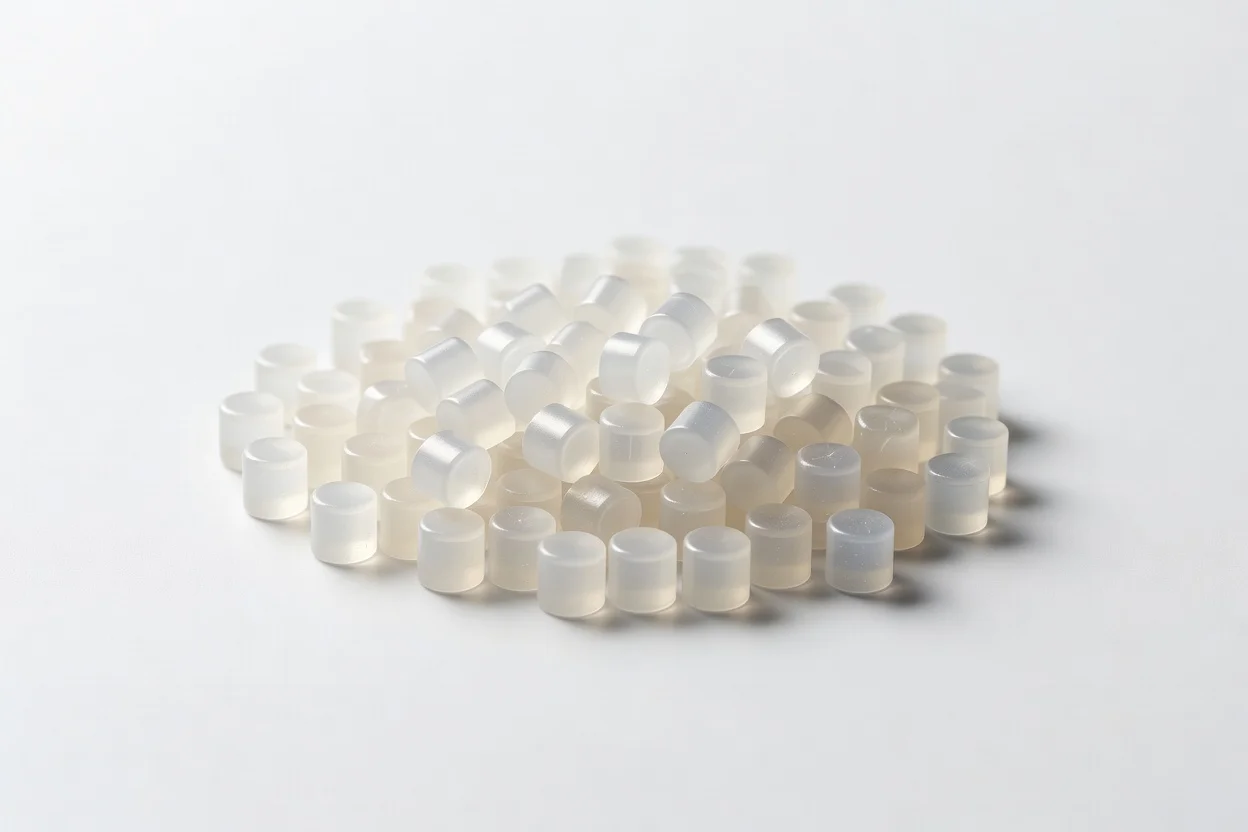
Polylactic acid (PLA) is a bio-based thermoplastic polyester made from lactic acid or, more commonly in industrial practice, from lactide produced by fermenting renewable sugars and starches. It has become one of the most important bioplastics because it combines relatively high stiffness, transparency, and processability with compostability under industrial conditions and a lower fossil-carbon footprint than many conventional petrochemical plastics when manufactured from renewable feedstocks.
PLA occupies a distinctive position in the plastics value chain: it is a polymer raw material used in packaging, fibers, consumer goods, medical devices, and additive manufacturing, while also serving as a platform for blends, copolymers, and reinforced compounds that extend its performance envelope. Its growth reflects broader industry trends toward renewable feedstocks, lightweight packaging, and circularity, but its technical and environmental profile remains nuanced because PLA is not a universal substitute for petroleum-based polymers and is only industrially compostable under the right conditions.
History and Development
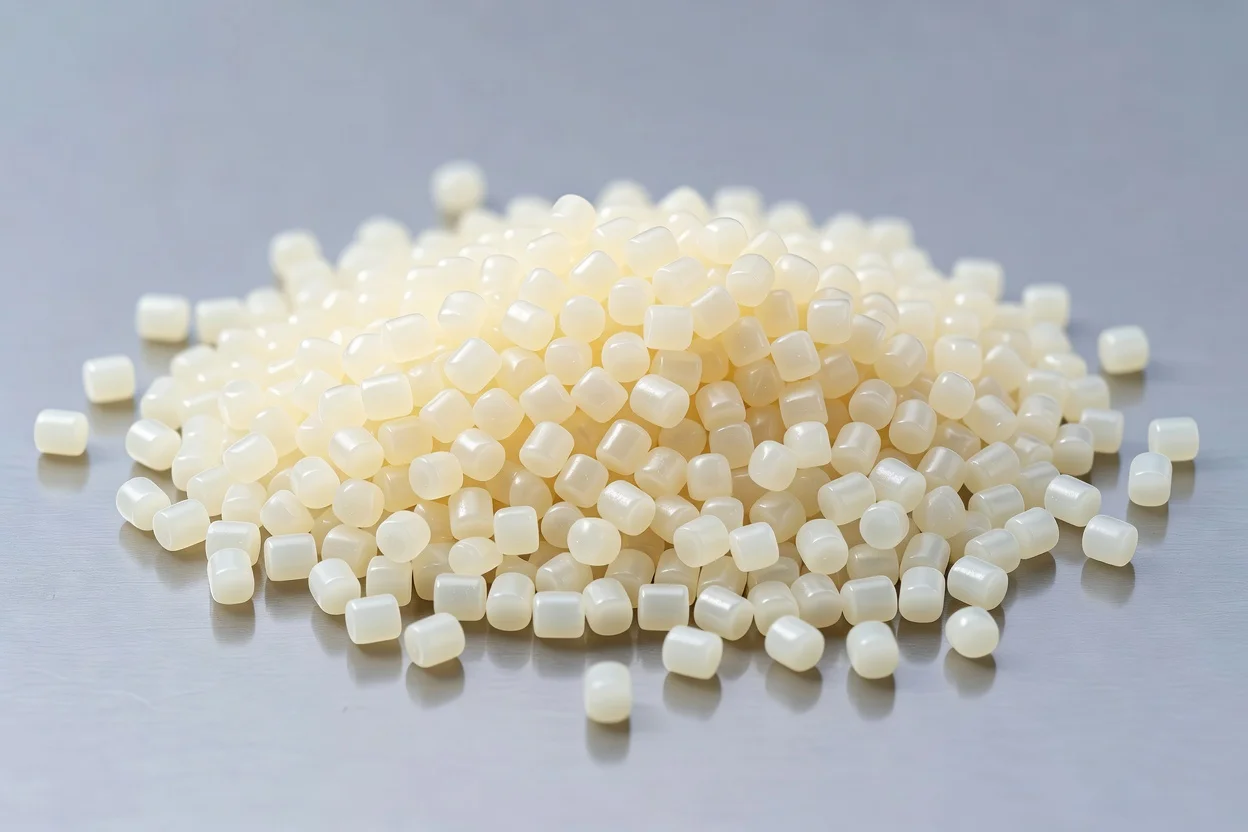
PLA was first developed in the early 20th century, with early research focused on the polymerization of lactic acid and later on more controllable routes through lactide and ring-opening polymerization. For many decades, limited monomer purity, cost, and processing challenges constrained commercial use, but advances in fermentation, catalytic conversion, and polymer purification enabled industrial-scale production from the late 20th century onward.
Commercialization accelerated as companies and brand owners sought renewable packaging materials and medical-grade absorbable polymers. Today, PLA is established in multiple market segments, supported by ongoing work on heat resistance, toughness, barrier performance, and end-of-life pathways.
Chemical Structure and Key Properties
PLA is an aliphatic polyester whose repeating backbone contains ester linkages, a structure that gives it thermoplastic behavior and susceptibility to hydrolytic degradation. Industrial PLA is usually produced from lactide, which can yield different stereochemical forms such as poly-L-lactic acid and poly-D-lactic acid; stereochemistry strongly affects crystallinity, thermal behavior, and mechanical performance.
Key technical characteristics
| Property | Typical behavior of PLA | Practical significance |
|---|---|---|
| Stiffness | High modulus, often around 3 GPa in semi-crystalline grades | Useful for rigid packaging, thermoformed articles, and print parts |
| Strength | Good tensile strength compared with many commodity biopolymers | Supports load-bearing packaging and technical parts |
| Transparency | Naturally clear or glossy in many grades | Valuable for food packaging and display applications |
| Heat resistance | Limited continuous service temperature, often around 55 to 60 °C for standard grades | Restricts hot-fill and high-temperature uses unless modified |
| Barrier performance | Weak oxygen and moisture barrier relative to high-barrier packaging materials | Limits shelf-life performance unless coated or blended |
| Toughness | Relatively brittle without modification | Requires plasticizers, blends, or copolymers for many uses |
PLA has several important limitations:
- Low heat resistance → caused by a glass transition near room-to-warm temperatures and modest crystallization in standard grades → improved by stereocomplexing, nucleating agents, annealing, or heat-resistant copolymer designs.
- Brittleness / low impact toughness → caused by its relatively rigid chain structure and limited energy dissipation → improved by blending with PBAT, adding plasticizers, or using impact modifiers and reactive compatibilizers.
- Poor oxygen and moisture barrier → caused by its polymer free-volume structure and limited intrinsic barrier properties → improved by coatings, multilayer structures, nanofillers, or barrier blends.
- Slow degradation in ambient conditions → caused by hydrolysis and microbial breakdown requiring specific temperature, moisture, and microbial environments → addressed by industrial composting infrastructure or chemical recycling routes.
Production Processes and Raw Feedstocks
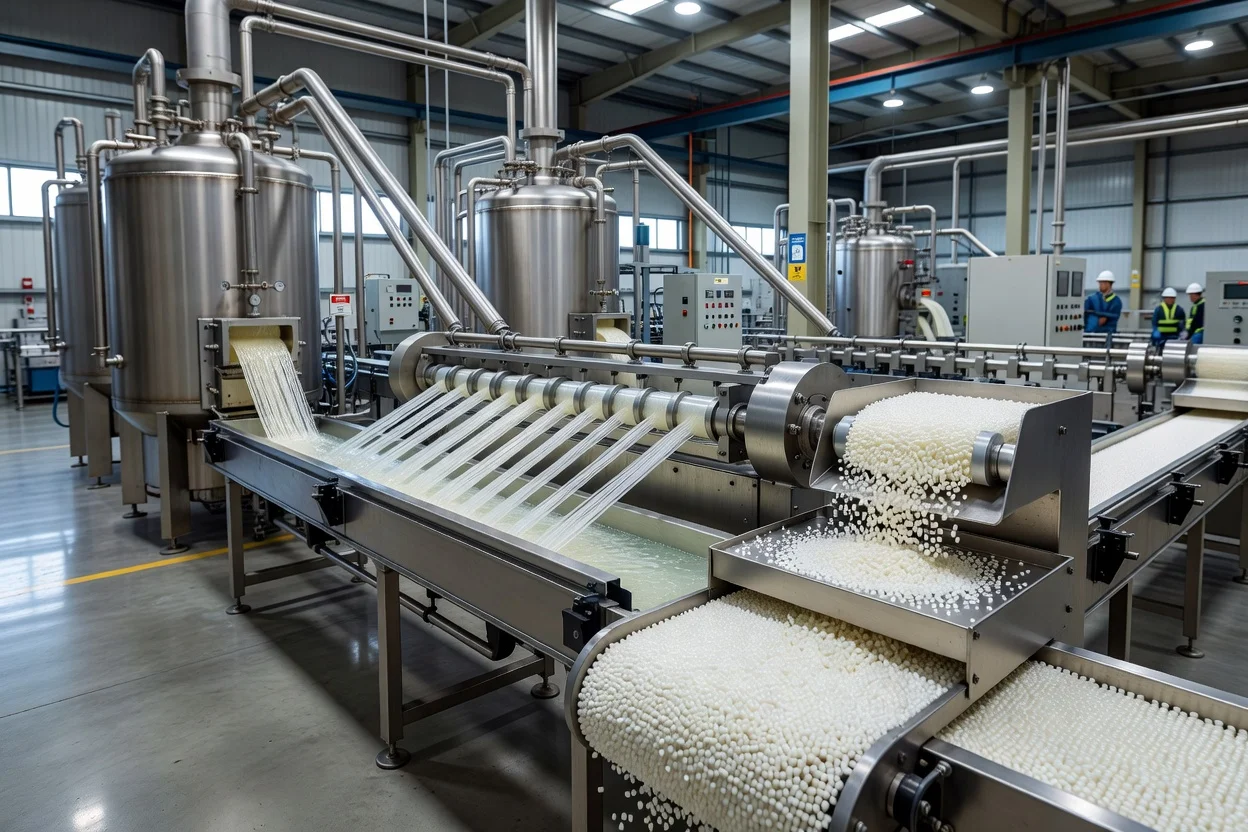
PLA production begins with renewable carbohydrate feedstocks such as corn starch, sugarcane, cassava, sugar beet pulp, or other fermentable biomass. These sugars are fermented to produce lactic acid, which is purified and converted to lactide; lactide is then polymerized by ring-opening polymerization to yield high-molecular-weight PLA.
A simplified industrial sequence is:
- Feedstock preparation and saccharification.
- Fermentation to lactic acid.
- Purification and concentration.
- Cyclization to lactide.
- Ring-opening polymerization.
- Pelletizing, compounding, or conversion into filament, resin, or finished forms.
Industrial production has been led by firms such as NatureWorks, TotalEnergies Corbion, Futerro, and several Asian producers that have expanded capacity in response to packaging, textile, and 3D-printing demand. These companies are important because PLA economics depend heavily on fermentation efficiency, monomer purity, energy use, and the scale of downstream compounding and conversion.
Applications and End-Use Markets
PLA is used where clarity, stiffness, renewable content, and ease of processing matter more than heat resistance or toughness.
| End-use sector | Typical PLA form/grade | Usual processing route | Notes |
|---|---|---|---|
| Food packaging | Clear or semi-rigid sheet, tray, cup, film | Thermoforming, extrusion, injection molding | Common for cold-fill packs, fresh produce, and disposable food service items. |
| Films and wraps | Flexible or blended PLA film | Cast or blown film, often blended or multilayer | Needs modification for sealability and toughness. |
| Bottles and containers | Oriented or heat-enhanced grades | Injection stretch blow molding, injection molding | Limited by heat and barrier performance compared with PET. |
| Fibers and nonwovens | Spun PLA fibers | Melt spinning, nonwoven processing | Used in hygiene, filters, and textiles. |
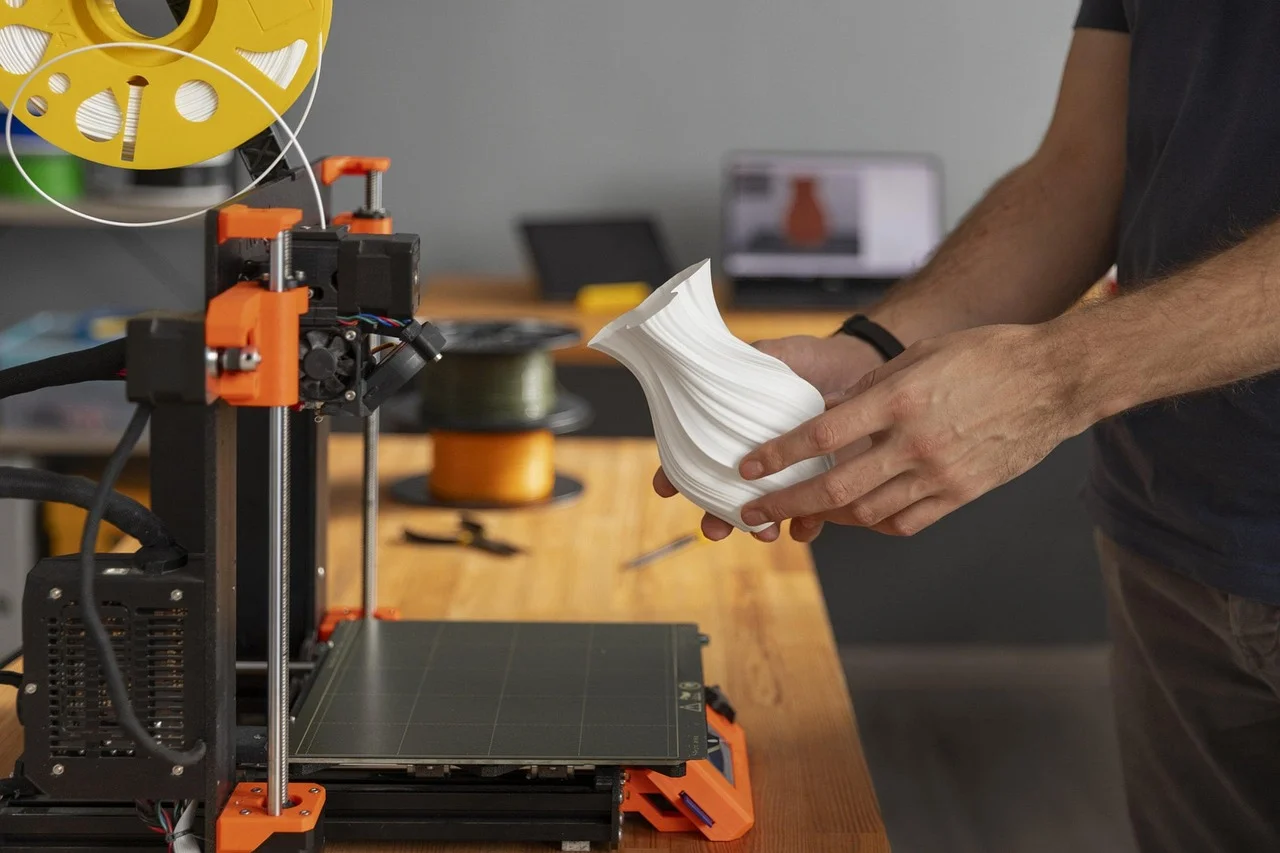
| 3D printing | PLA filament | Filament extrusion for FDM/FFF | A dominant desktop additive manufacturing material because of low warpage and easy printing. |
| Medical devices | Medical-grade PLA / copolymers | Extrusion, molding, machining, scaffold fabrication | Used in sutures, fixation devices, drug delivery, and tissue engineering. |
| Agricultural and disposable goods | Compostable items, mulch films in niche uses | Film extrusion, molding | Adoption depends on disposal infrastructure and cost. |
| Poor-fit use | Hot-fill beverage bottles or high-temperature food containers | Conventional PLA processing is insufficient | Standard PLA softens too easily; heat-resistant grades are required but still have limits. |
PLA is especially prominent in medical applications because its biodegradability, biocompatibility, and mechanical strength make it suitable for temporary implants and controlled-resorption devices. In consumer manufacturing, it is also valued in desktop 3D printing because it extrudes predictably and has relatively low shrinkage and odor compared with some engineering thermoplastics.
Environmental and Sustainability Aspects
PLA is often described as a biobased and compostable plastic, but those terms do not mean the same thing. Biobased refers to renewable carbon in the feedstock, whereas compostable refers to breakdown under defined composting conditions; PLA generally requires industrial composting temperatures and controlled humidity for effective biodegradation.
Sustainability strengths
- Reduced dependence on fossil feedstocks when produced from renewable sugars or starches.
- Potentially lower cradle-to-gate carbon footprint than some petrochemical polymers, depending on feedstock, energy mix, and production route.
- Chemical recyclability pathways are under development, including depolymerization back to lactide or lactic acid.
Sustainability constraints
- Limited sorting compatibility with conventional plastic recycling streams in many regions, especially when mixed with PET or other packaging polymers.
- Compostability is infrastructure-dependent and does not resolve littering or marine leakage.
- Feedstock sourcing can raise land-use, agricultural input, and food-versus-material debates, although waste-derived and non-food biomass routes are expanding.
PLA’s environmental case is strongest when the application matches its material profile and when end-of-life systems are aligned. Misapplication in durable, heat-exposed, or high-barrier settings can negate both performance and sustainability benefits.
Economic and Global Market Impact
PLA sits within the broader bioplastics segment that has grown as brand owners and regulators look for lower-carbon materials and improved packaging sustainability. Its market position is reinforced by relatively mature conversion technology, broad resin availability, and compatibility with existing thermoplastic processing equipment.
Economically, PLA competes on a combination of resin cost, performance, and sustainability claims rather than on price alone. It is usually more expensive than commodity polyethylene or polypropylene, but it can justify premium positioning in food service, consumer goods, medical products, and 3D printing where functional and branding advantages matter.
The main regional drivers are:
- Asia: strong feedstock availability, significant conversion capacity, and packaging demand.
- Europe: policy pressure for lower-carbon and compostable packaging, though end-of-life regulation is a critical constraint.
- North America: major production and downstream use in packaging, food service, and additive manufacturing.
Current Challenges and Innovations
PLA development now focuses less on proving viability and more on engineering performance and circularity.
Major challenges
- Heat distortion and dimensional stability.
- Brittleness and crack sensitivity.
- Oxygen and moisture barrier limitations.
- Inconsistent composting and recycling infrastructure.
- Consumer confusion between biobased, biodegradable, and compostable claims.
Active innovation areas
- Blending with PBAT, starch, polycarbonate, or other biopolymers to improve toughness and flexibility.
- Stereocomplex PLA to raise thermal resistance through stronger crystalline domains.
- Nucleating agents and fillers such as talc, calcium carbonate, or nano-reinforcements to improve crystallization and stiffness; for example, low loadings around 1 to 5 percent can accelerate crystallization and improve heat resistance, while higher loadings are used when rigidity is prioritized over clarity.
- Plasticization with citrate esters or similar additives to improve elongation and processing, typically at moderate loadings where flexibility is needed but migration must remain controlled.
- Chemical recycling and monomer recovery to close the loop for higher-value applications.
Future Outlook
PLA is likely to remain one of the most strategically important bioplastics because it combines a renewable feedstock base with established industrial processing routes and broad end-use versatility. Its future growth will depend on whether producers can improve thermal and impact performance, reduce cost volatility, and integrate PLA into realistic recycling or composting systems rather than relying on generic biodegradability claims.
The most promising directions are:
- higher-heat PLA grades for packaging and reusable items;
- broader use of recycled and waste-derived feedstocks;
- multilayer and coated structures that solve barrier limits without sacrificing recyclability;
- medical and pharmaceutical uses where biodegradability has clear functional value;
- selective expansion in additive manufacturing and technical fibers.
Summary
PLA is a renewable, thermoplastic polyester that has evolved from a laboratory polymer into a commercially relevant material for packaging, 3D printing, fibers, and medical devices. Its appeal lies in the combination of biobased origin, good stiffness and transparency, and broad processability, while its main constraints are heat resistance, toughness, barrier performance, and dependence on proper end-of-life infrastructure.
References
- •
Polylactic acid. (2005, July 24). Wikipedia. https://en.wikipedia.org/wiki/Polylactic_acidLink
- •
PLA (Polylactic Acid): Definition, Applications, and Types. (2022, November 11). Xometry. https://www.xometry.com/resources/materials/what-is-pla/Link
- •
Ácido poliláctico. (2007, May 7). Wikipedia. https://es.wikipedia.org/wiki/%C3%81cido_polil%C3%A1cticoLink
- •
Poly(lactic Acid) Polymer - an overview. (n.d.). ScienceDirect. https://www.sciencedirect.com/topics/chemistry/poly-lactic-acid-polymerLink
- •
Polylactic Acid or Polylactide (PLA). (2021, May 19). Bioplastics News. https://bioplasticsnews.com/polylactic-acid-or-polylactide-pla/Link
- •
Critical Review on Polylactic Acid: Properties, Structure, Processing, Biocomposites, and Nanocomposites. (2022, June 17). PMC. https://pmc.ncbi.nlm.nih.gov/articles/PMC9228835/Link
- •
Acide polylactique. (2007, April 5). Wikipédia. https://fr.wikipedia.org/wiki/Acide_polylactiqueLink
- •
Poly(lactic Acid): A Versatile Biobased Polymer for the Future. (2021, May 31). PMC. https://pmc.ncbi.nlm.nih.gov/articles/PMC8198026/Link
- •
What is PLA? (Everything You Need To Know). (n.d.). TWI. https://www.twi-global.com/technical-knowledge/faqs/what-is-plaLink
- •
POLYLACTIC ACID: SYNTHESIS, PROPERTIES AND APPLICATIONS. (n.d.). Vietnam Journal of Science and Technology. https://vjs.ac.vn/index.php/jst/article/download/16721/2543254346Link
- •
Medical applications and prospects of polylactic acid materials. (2024, December 1). PMC. https://pmc.ncbi.nlm.nih.gov/articles/PMC11699620/Link
- •
Polylactic Acid Granule Properties and Applications. (2025, November 12). Goodfellow. https://www.goodfellow.com/usa/resources/polylactic-acid-biopolymer-pla-granule-material-information/Link
- •
What is PLA | A Comprehensive Guide to Polylactic Acid. (2026, June 23). Good Start Packaging. https://www.goodstartpackaging.com/guide-to-pla-polylactic-acid/Link
- •
Polylactic Acid (PLA) as a Bioplastic and its Possible Applications in the Food Industry. (n.d.). Herald Open Access. https://www.heraldopenaccess.us/openaccess/polylactic-acid-pla-as-a-bioplastic-and-its-possible-applications-in-the-food-industryLink
- •
Polylactic Acid (PLA): How to select the right grade? (2025, July 8). SpecialChem. https://www.specialchem.com/plastics/guide/polylactide-pla-bioplasticLink
- •
Polylactic acid. (2023, February 4). Simple English Wikipedia. https://simple.wikipedia.org/wiki/Polylactic_acidLink
- •
Polylactic Acid - an overview. (n.d.). ScienceDirect. https://www.sciencedirect.com/topics/agricultural-and-biological-sciences/polylactic-acidLink
- •
Polylactic acid (PLA): Properties, synthesis, and biomedical applications. (n.d.). ScienceDirect. https://www.sciencedirect.com/science/article/pii/S0022286024007634Link
- •
Polylactic acid: synthesis and biomedical applications. (2019, December 1). Journal of Applied Microbiology. https://academic.oup.com/jambio/article/127/6/1612/6714800?guestAccessKey=Link
- •
Biodegradable Polylactic Acid and Its Composites. (2023, July 19). PMC. https://pmc.ncbi.nlm.nih.gov/articles/PMC10384257/Link
- •
Polylactide. (2005, July 4). Wikipedia. https://de.wikipedia.org/wiki/PolylactideLink
- •
What is PLA (polylactic acid) filament? (n.d.). Hubs. https://www.hubs.com/knowledge-base/what-is-pla/Link
- •
Full article: Poly lactic acid (PLA) polymers: from properties to biomedical applications. (2023, October 1). Taylor & Francis. https://www.tandfonline.com/doi/full/10.1080/00914037.2021.1944140Link
- •
Applications of PLA in modern medicine. (2020, September 6). PMC. https://pmc.ncbi.nlm.nih.gov/articles/PMC7474829/Link
- •
Paul, A., Sreedevi, K., Sharma, S. S., & Anjana, V. N. (2023). Polylactic Acid (PLA). In S. Thomas, A. AR, C. Jose Chirayil, & B. Thomas (Eds.), Handbook of Biopolymers. Springer. https://doi.org/10.1007/978-981-19-0710-4_44Link
- •
What Is PLA Plastic. (2023, May 8). BioPak. https://www.biopak.com/au/resources/what-is-plaLink
- •
Applications Of Pla Filament. (2024, August 8). Wevolver. https://www.wevolver.com/article/what-is-pla-filament-composition-advantages-applicationsLink
- •
Chen, T., Zhao, X., & Weng, Y. (2023). Self-assembled polylactic acid (PLA): Synthesis, properties and biomedical applications. Frontiers in Chemistry, 10, Article 1107620. https://doi.org/10.3389/fchem.2022.1107620Link
- •
A comprehensive review on polylactic acid (PLA) – Synthesis, processing and application in food packaging. (n.d.). International Journal of Biological Macromolecules. https://www.sciencedirect.com/science/article/pii/S0141813023006086Link
- •
Polylactide - an overview. (n.d.). ScienceDirect. https://www.sciencedirect.com/topics/materials-science/polylactideLink
- •
Polylactic acid (PLA): Research, development and industrialization. (n.d.). Wiley. https://onlinelibrary.wiley.com/doi/abs/10.1002/biot.201000135Link
- •
Natural Fiber-Reinforced Polylactic Acid Composites. (2022, January 5). PMC. https://pmc.ncbi.nlm.nih.gov/articles/PMC8747475/Link
- •
Paul, A., Sreedevi, K., Sharma, S. S., & Anjana, V. N. (2022). Polylactic Acid (PLA). In S. Thomas et al. (Eds.), Handbook of Biopolymers. Springer. https://doi.org/10.1007/978-981-16-6603-2_44-1Link
- •
Polylactic acid: A future universal biobased polymer with ... (n.d.). ScienceDirect. https://www.sciencedirect.com/science/article/pii/S2772416625001688Link
- •
Tailoring of advanced poly(lactic acid)‐based materials. (2022, March 20). Wiley. https://onlinelibrary.wiley.com/doi/full/10.1002/app.51839Link
- •
A Perspective on Polylactic Acid-Based Polymers Use for Nanoparticles Synthesis and Applications. (2019, October 11). Frontiers in Bioengineering and Biotechnology. https://www.frontiersin.org/journals/bioengineering-and-biotechnology/articles/10.3389/fbioe.2019.00259/fullLink
- •
Taib, N. A. A. B., Rahman, M. R., Huda, D., et al. (2023). A review on poly lactic acid (PLA) as a biodegradable polymer. Polymer Bulletin, 80, 1179–1213. https://doi.org/10.1007/s00289-022-04160-yLink
- •
3.1 Natural Organic... (n.d.). Wiley. https://onlinelibrary.wiley.com/doi/full/10.1002/app.53477Link
- •
Polylactic Acid (PLA) Filament Review. (2025, December 9). JuggerBot 3D. https://juggerbot3d.com/pla-filament-review/Link
- •
A review of research and application of polylactic acid composites. (n.d.). Wiley. https://onlinelibrary.wiley.com/doi/10.1002/app.53477Link
- •
PLA-Based Biodegradable Polymer from Synthesis to ... (2025, December 31). PMC. https://pmc.ncbi.nlm.nih.gov/articles/PMC12787803/Link