
Introduction
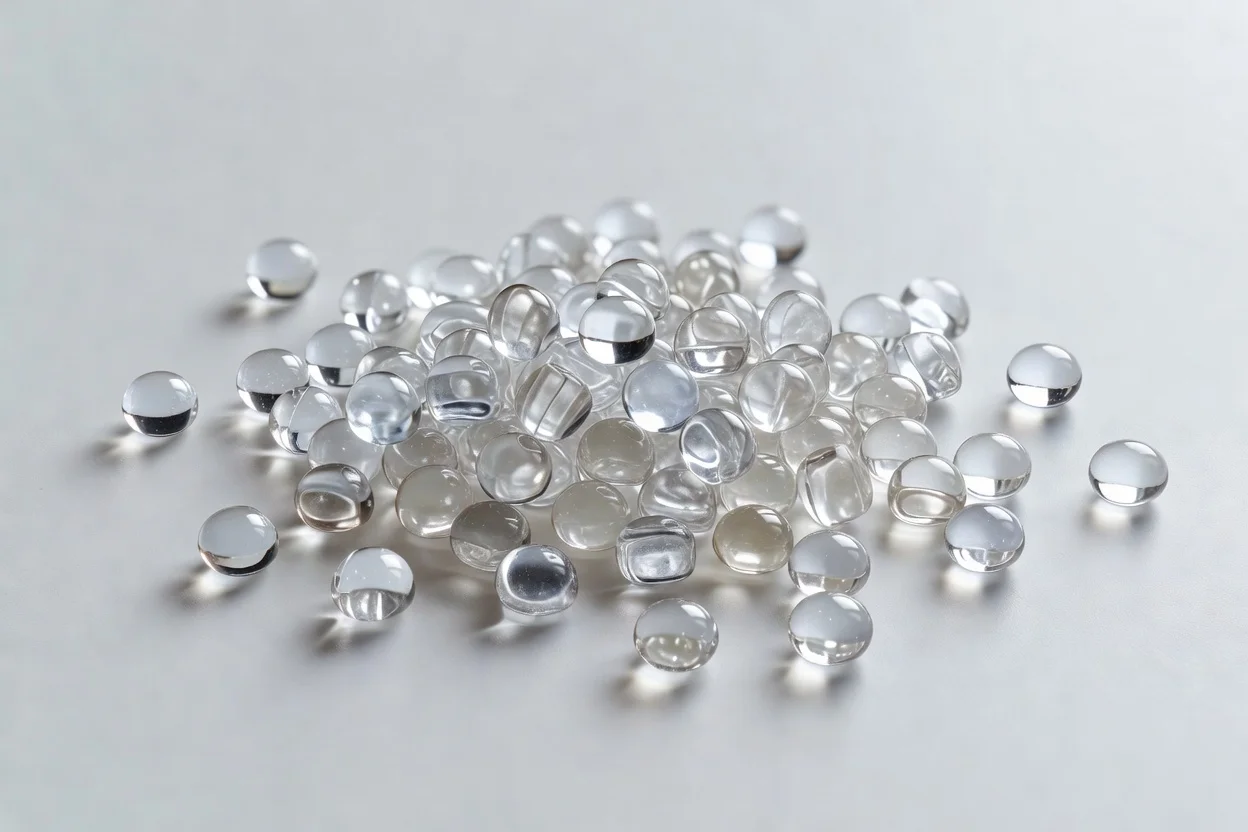
MABS (methyl methacrylate-acrylonitrile-butadiene-styrene) is a transparent, amorphous styrenic engineering thermoplastic designed to combine the optical clarity of acrylic-like materials with the toughness and processability associated with ABS. It is typically produced as a transparent or translucent specialty resin for injection molding and extrusion, and it is widely used where visibility of the contents or internal components matters, but ordinary clear plastics such as PMMA or polystyrene do not provide enough impact resistance.
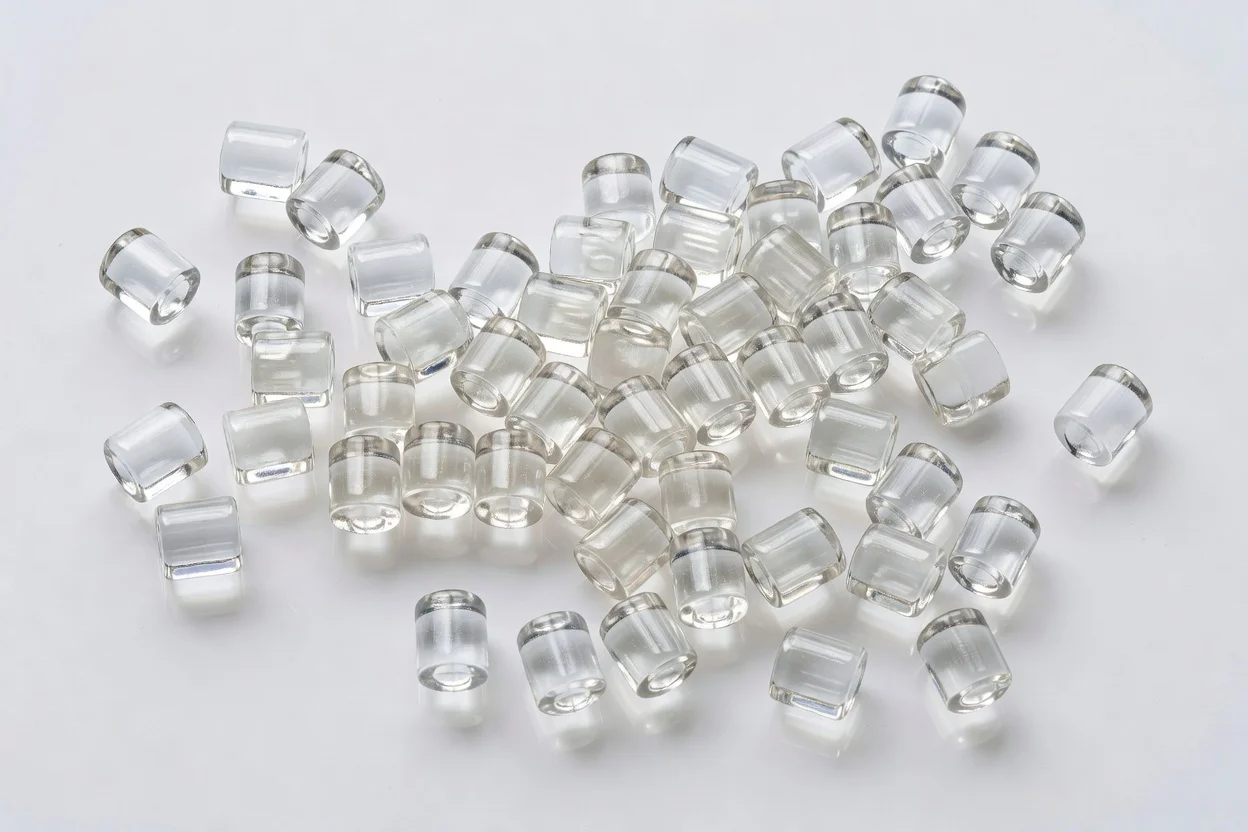
In structural terms, MABS is a multiphase material with a continuous matrix based mainly on styrene, acrylonitrile, and methyl methacrylate, and a dispersed elastomeric phase based mainly on polybutadiene. Recent technical descriptions and patent literature emphasize that the transparency of MABS depends on reducing optical mismatch between phases, while the rubber phase preserves toughness. This balance makes MABS particularly important in medical housings, cosmetic packaging, transparent appliance parts, consumer goods, and other applications where aesthetics, dimensional stability, and durability must coexist.
MABS is best understood as part of the broader family of styrenic copolymers that includes ABS, SAN, ASA, and related transparent grades. Within that family, MABS occupies a niche between high-clarity but more brittle polymers and highly impact-resistant opaque engineering plastics. Its development reflects a wider industry trend toward materials that are not only mechanically functional, but also visually premium, sterilizable or easy to clean, and compatible with efficient processing methods.
Sustainability considerations are increasingly relevant for MABS. Like other fossil-derived engineering polymers, it is generally produced from petrochemical feedstocks, and its recycling pathway is constrained by sorting challenges, additive packages, and the limited volume of separated transparent styrenic streams. At the same time, MABS can contribute to resource efficiency through lightweight design, long service life, and the replacement of glass or metal in selected applications, while innovation continues in compounding, design-for-recycling, and compatibility with circular-economy systems.
History and development
MABS emerged as a specialty development from ABS chemistry, with methyl methacrylate incorporated to improve clarity and surface quality while maintaining useful impact performance. ISO standards now formally recognize MABS as a distinct material class for moulding and extrusion, indicating its maturation from a niche formulation into an established engineering resin family.
Commercial growth has been driven by sectors that value transparent engineering plastics, especially medical technology, cosmetics, appliance components, and consumer electronics. Unlike conventional ABS, which is usually opaque, MABS is tailored for applications where part visibility, gloss, and color consistency are part of the product function as well as the product appearance.
Chemical structure and key properties
MABS is an amorphous styrenic copolymer system rather than a single simple polymer chain architecture. In practical terms, the material is formulated to create a transparent matrix and a dispersed rubber phase that toughens the resin without producing the strong light scattering typical of standard ABS.
Key property profile:
| Property | Typical significance for MABS |
|---|---|
| Transparency | Enables clear or tinted parts with visible contents or internal features. |
| Impact resistance | Higher than PMMA and polystyrene in many clear-part uses. |
| Surface gloss | Supports premium appearance in cosmetic and consumer products. |
| Chemical resistance | Useful against many household and cleaning chemicals, though not universal. |
| Processability | Suitable for injection molding and extrusion; generally easy to process. |
A few important limits define the material’s design space:
- Lower heat resistance than high-performance engineering plastics → cause: amorphous styrenic backbone and transparency-oriented formulation → workaround: use heat-stabilized grades, redesign part geometry, or choose PC/other polymers when continuous high-temperature service is required.
- Poor fit for high-oxygen or high-barrier packaging → cause: styrenic polymers do not provide the barrier performance of dedicated barrier resins → workaround: multilayer structures, coatings, or alternative barrier polymers where shelf-life protection is critical.
- Limited suitability for abrasive wear components → cause: MABS is optimized for appearance and toughness rather than low-friction tribology → workaround: use filled compounds, surface treatments, or wear-grade engineering plastics for sliding-contact parts.
- Transparency can be reduced by incompatible additives or fillers → cause: phase contrast and light scattering increase with poorly matched formulations → workaround: use transparent-compatible colorants, carefully matched compounding, and refractive-index-balanced formulations.
A useful technical point is that optical design matters as much as chemistry. Patent and journal literature indicate that transparency improves when refractive indices of the matrix and rubber-related phases are brought closer together, and when matrix composition is tuned to maintain toughening efficiency without excessive light scattering.
Production processes and raw feedstocks
MABS is manufactured using petrochemical monomers common to styrenic resin production, especially styrene, acrylonitrile, methyl methacrylate, and butadiene-derived elastomeric components. Exact synthesis routes vary by producer, but the essential industrial objective is to build a transparent matrix while dispersing a rubber phase that increases impact resistance.
Typical manufacturing and compounding steps include:
- Monomer preparation and purification
- Formation of the matrix polymer and rubber-modified phase
- Control of particle size and refractive-index compatibility
- Pelletizing and formulation with colorants, stabilizers, release agents, or other additives
- Final drying and processing into moulding or extrusion grades
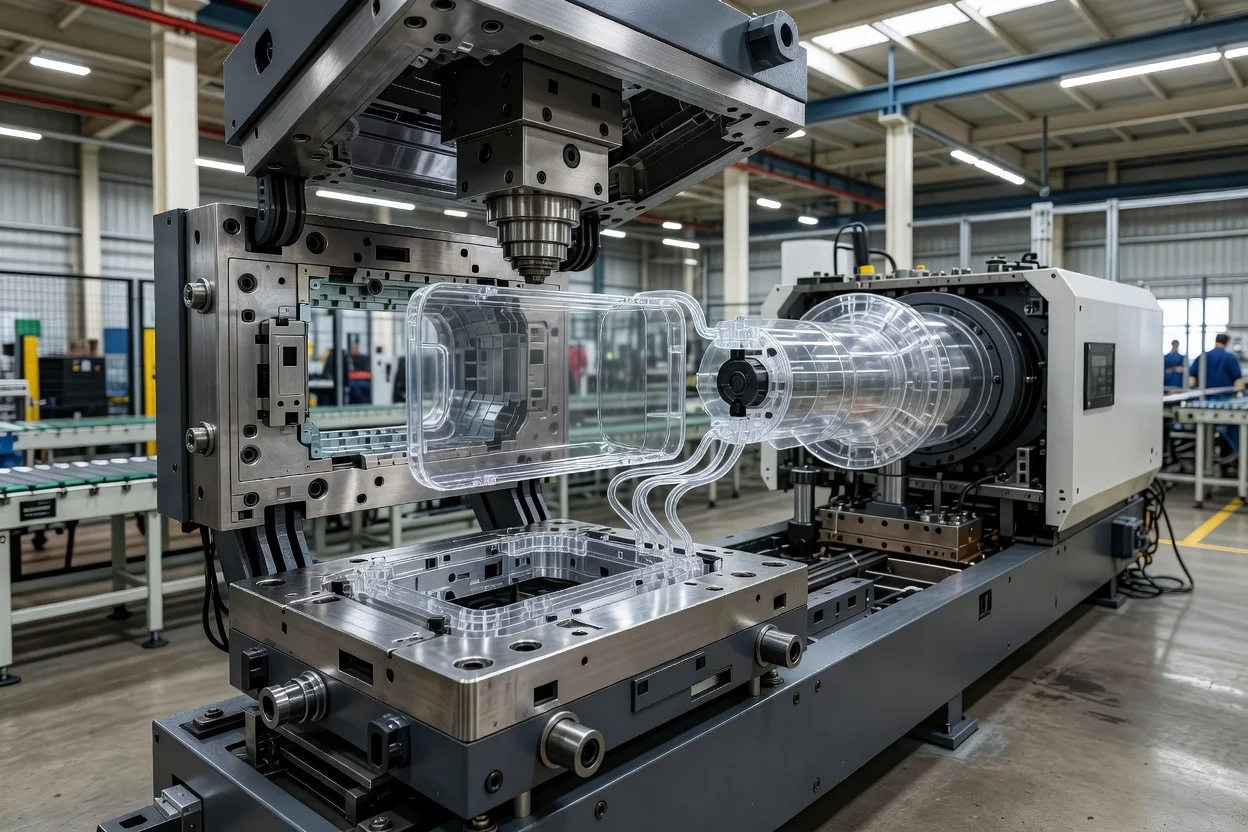
ISO designation systems classify MABS grades by properties such as Vicat softening temperature, melt volume-flow rate, Charpy notched impact strength, and tensile modulus, along with application and additive information. This reflects the fact that MABS is not a single commodity resin but a family of specialty grades optimized for different flow, stiffness, and toughness targets.
In compounding practice, typical additive levels are usually modest and application-specific. For example, 0.5–2 wt% of a suitable nucleating or processing aid may be used to improve mould filling or cycle time in selected formulations, while mechanism-compatible UV stabilizers or antistatic agents may be introduced at low levels to preserve appearance and function in consumer or electronic housings. For transparent medical or cosmetic parts, additive selection is especially restrictive because haze, extractables, and color drift must be minimized.
Applications and end-use markets
MABS is used where the part must be seen through, inspected visually, or presented as a premium surface while still resisting impact better than more brittle clear plastics.
| End-use sector | Typical MABS grade or processing focus | Why MABS is used |
|---|---|---|
| Medical devices and diagnostics | High-purity, often transparent injection-molding grades | Visibility, sterilizability, chemical resistance, and premium finish. |
| Cosmetic packaging | High-gloss transparent grades | Aesthetic clarity, scratch-acceptable presentation, and luxury appearance. |
| Household appliances | Transparent or tinted injection grades | Windows, drawers, covers, and control-panel components. |
| Consumer electronics | Dimensional-stability and appearance grades | Light covers, control windows, and visible housings. |
| Toys and leisure goods | Impact-balanced grades | Safety, clarity, and decorative effects. |
| Food-contact containers and storage | Clear grades where regulatory compliance is met | Visibility of contents and resistance to many detergents. |
| Office and organizer products | General-purpose clear grades | Transparency, stiffness, and cost-effective molding. |

A commonly cited poor-fit application is high-temperature structural automotive exterior parts, where MABS generally lacks the thermal and weathering performance of more specialized engineering polymers. It is more at home in interior or decorative transparent elements than in exterior load-bearing or long-term heat-exposed components.
Environmental and sustainability aspects
MABS is typically fossil-derived and therefore inherits the upstream carbon footprint of petrochemical monomer production. As with other engineering thermoplastics, its environmental profile depends heavily on part design, product lifetime, processing efficiency, and end-of-life management rather than on resin chemistry alone.
Main sustainability considerations include:
- Recyclability: MABS is thermoplastic and therefore technically recyclable, but real-world recycling is limited by collection, sorting, contamination, and the relatively small size of separated MABS streams.
- Circularity: Recycled-content opportunities are more plausible in non-critical or color-sensitive applications than in medical or optical-grade uses, where purity and consistency are strict.
- Bio-based alternatives: Bio-attributed or bio-based styrenic and methacrylate feedstocks are under development across the plastics sector, but broad commercial substitution in MABS remains limited and application dependent.
- Carbon footprint: The main footprint drivers are monomer sourcing, energy use in polymerization and molding, and the service-life benefit compared with heavier or less durable substitutes.
- Design-for-recycling: Transparent mono-material construction, avoidance of incompatible coatings, and careful choice of labels, inks, and additives can improve end-of-life options.
A balanced assessment is that MABS is not inherently a circular material, but it can support circularity better than multi-material glass-metal-plastic assemblies when used in durable, repairable, and easy-to-sort product designs.
Economic and global market impact
MABS is a specialty segment of the much larger styrenic polymer market, and it is usually produced by a smaller number of suppliers than mainstream ABS. Industry references indicate that only a limited group of manufacturers serves this niche, which tends to make supply relationships and grade qualification especially important for medical, cosmetic, and premium consumer applications.
Demand is driven by:
- Visible, premium consumer products
- Medical and diagnostic devices
- Transparent appliance components
- Cosmetic and personal-care packaging
- Selected electronics and leisure goods
Because MABS occupies a value-added niche, economics are influenced less by sheer volume than by optical performance, regulatory compliance, and customer-specific design windows. Grades with better flow, higher gloss, or enhanced biocompatibility can command a premium over general-purpose transparent plastics.
Current challenges and innovations
Current technical challenges include:
- Maintaining clarity while improving impact and heat resistance
- Balancing chemical resistance with stress-crack resistance
- Meeting medical, food-contact, and cosmetic compliance requirements
- Reducing brittleness at low temperature without losing surface quality
- Integrating recycled content without visible defects or property drift
Innovation is focused on:
- Refractive-index matching to improve transparency in thick sections.
- Rubber-particle engineering to preserve toughness without sacrificing clarity.
- Higher-flow grades for thinner walls, faster cycles, and more complex parts.
- Functionalized transparent grades with antistatic, biocompatible, or improved chemical-resistance performance.
- Hybrid formulations that extend usable temperature or surface-performance windows while retaining the MABS aesthetic profile.
Recent research on epoxy/MABS systems also illustrates how MABS functions as a toughener in composite design, confirming that its rubber-modified architecture can improve crack resistance and phase morphology in engineered blends.
Future outlook
MABS is likely to remain a niche but strategically important transparent engineering polymer. Its strongest future position is in products that must unite clarity, toughness, and premium surface finish in a single material.
The most plausible growth areas are:
- Medical and diagnostic devices
- Transparent premium packaging
- Appliance and electronics windows and housings
- Consumer products with visible functionality
- Multi-functional parts that reduce assembly count and material diversity
Longer-term progress will depend on three issues: lower-carbon feedstocks, improved recycling pathways, and formulation innovations that expand thermal and chemical performance without eroding transparency. If those constraints are addressed, MABS can continue to serve as a high-value bridge between commodity transparent plastics and more expensive engineering resins.
Summary
MABS is a transparent, amorphous styrenic copolymer that delivers a rare combination of clarity, impact resistance, and processability. It is most successful in applications where visual appearance and functional durability must coexist, especially in medical, cosmetic, appliance, and consumer-product markets. Its main limitations are moderate heat resistance, limited barrier performance, and the practical challenges of recycling specialty transparent streams, but ongoing formulation and circularity work continue to strengthen its role in the plastics value chain.
References
- •
ISO 10366-1:2002. (2014, September 24). ISO. https://www.iso.org/standard/33493.htmlLink
- •
ISO 19066-1:2014. (2024, November 21). ISO. https://www.iso.org/standard/63850.htmlLink
- •
MABS polymer for impact resistance & clarity. (n.d.). Salesplastics. https://salesplastics.com/mabs/Link
- •
Safety data sheet (SDS). (n.d.). Hongrun Plastics. https://hongrunplastics.com/public/uploads/images/20251012/T500.pdfLink
- •
Electronic supporting information. (n.d.). RSC. https://www.rsc.org/suppdata/d2/sm/d2sm01074g/d2sm01074g1.pdfLink
- •
Epoxy/methyl methacrylate acrylonitrile butadiene styrene (MABS) copolymer blends: Reaction-induced viscoelastic phase separation, morphology development and mechanical properties. (2019, June 10). RSC. https://pubs.rsc.org/en/content/articlelanding/2019/nj/c8nj05653fLink
- •
Methyl methacrylate / ABS (MABS). (n.d.). Entec Polymers. https://www.entecpolymers.com/products/resin-types/methyl-methacrylate-abs-mabsLink
- •
Methyl methacrylate acrylonitrile butadiene styrene (MABS) market. (2025, November 4). Transparency Market Research. https://www.transparencymarketresearch.com/methyl-methacrylate-acrylonitrile-butadiene-styrene-market.htmlLink
- •
Methyl methacrylate (MM): MABS. (n.d.). UL Prospector. https://www.ulprospector.com/plastics/en/generics/21/classifications/260Link
- •
Methyl methacrylate and acrylonitrile butadiene styrene (MABS). (2024, September 19). Kruse Training. https://krusetraining.com/micro/methyl-methacrylate-and-acrylonitrile-butadiene-styrene-mabs/Link
- •
Miscibility, thermal degradation and rheological analysis of epoxy/MABS blends. (n.d.). PubMed. https://pubmed.ncbi.nlm.nih.gov/36468626/Link
- •
MABS – Methyl methacrylate acrylonitrile butadiene styrene. (n.d.). ReplastMD. https://replast.md/en/mabs-methyl-methacrylate-acrylonitrile-butadiene-styrene/Link
- •
MABS - Thermoplastic polymers, elastomers and additives. (n.d.). Mexpolimeros. https://www.mexpolimeros.com/eng/mabs.htmlLink
- •
Transparent ABS (MABS) complete guide: Properties, grades & applications. (2026, May 12). Jinsu. https://www.maxnmtech.com/en/buying-guide/transparent-abs-mabs-complete-guideLink
- •
MABS resin suppliers | MABS plastic material. (2025, April 27). Suke Plastics. https://sukeplastics.com/general-plastics/mabs-resin-plastic/Link
- •
Effect of methyl methacrylate– acrylonitrile -butadiene– styrene on the properties of epoxy resin. (2012, April 20). SCIRP. https://www.scirp.org/html/21049.htmlLink
- •
Styrene copolymers (ABS, SAN, ASA, MABS). (n.d.). Cloudinary. https://res.cloudinary.com/sternwald-systems/raw/upload/v1/hugoprd/ARTIKEL_ATTACH/00243F19_1AA47E263C73/7caaeb2f597c25ab0c5da8b4e7204d203aa44307/PE_2010_10_Styrene-Copolymers-ABS-SAN-ASA-MABS.pdfLink
- •
Effect of methyl methacrylate– acrylonitrile -butadiene– styrene on the properties of epoxy resin. (n.d.). SCIRP. https://www.scirp.org/pdf/JMMCE20120400003_55334131.pdfLink
- •
MABS - Methylmethacrylate acrylonitrile butadiene styrene. (2025, January 1). Distrupol. https://www.distrupol.com/mabs.htmlLink
- •
MABS resin plastic & clarity polymer. (2026, January 14). Suke Plastics. https://sukeplastics.com/mabs-resin-plastic/Link
- •
MABS | Perfect compound for cosmetics & consumer goods. (2023, April 20). Aurora Material Solutions. https://www.auroramaterialsolutions.com/materials/mabs/Link
- •
MABS. (2014, January 1). Mexpolimeros. https://www.mexpolimeros.com/termoplasticos/mabs.htmlLink
- •
What is MABS (transparent ABS)? What are its advantages? (2025, December 5). Polyhdpe. https://www.polyhdpe.com/article/what-is-mabs-transparent-abs-material.htmlLink
- •
MABS – Methylmethacrylat-acrylnitril-butadien-styrol. (2021, November 22). TW-Plastics. https://www.tw-plastics.de/de/produkte/standard-kunststoffe/mabs-methylmethacrylat-acrylnitril-butadien-styrol/Link
- •
Newsletter - Substitution. (n.d.). Ineris. https://substitution.ineris.fr/sites/substitution-portail/files/newsletter/sna_ndeg12_en.pdfLink
- •
Rapid synthesis and properties of segmented block copolymers based on monodisperse aromatic poly(N-methyl benzamide) and poly(propylene oxide). (2017, July 4). RSC. https://pubs.rsc.org/en/content/articlelanding/2017/ra/c7ra05161aLink
- •
Mabs vs. Abs: The ultimate guide for innovative design & material selection. (n.d.). Qdprime. https://www.qdprime.com/news/mabs-vs.-abs:-the-ultimate-guide-for-innovative-design-&-material-selection.htmlLink
- •
Polystyrene and styrene copolymers. (n.d.). Wiley. https://onlinelibrary.wiley.com/doi/10.1002/14356007.a21_615.pub2Link
- •
Mabs vs. Abs: The ultimate guide for innovative design & material selection. (2025, August 23). Qdprime. https://www.qdprime.com/news/news1084.htmlLink
- •
Effect of methyl methacrylate– acrylonitrile -butadiene– styrene on the properties of epoxy resin. (2012, April 20). SCIRP. https://www.scirp.org/journal/paperinformation?paperid=21049Link
- •
Transparent ABS, MABS, ASA, SAN. (n.d.). Terplastics. https://terplastics.com/en/produkte/technische-kunststoffe/transparente-pc-pmma-transparent-abs-mabs-asa-san.phpLink
- •
Control of the composition of matrix resin for the design of MABS resin with good transparency and toughness. (2023, February 5). ScienceDirect. https://www.sciencedirect.com/science/article/abs/pii/S0927775722023639Link
- •
A kind of MABS polymer and preparation method thereof. (2019, April 26). Google Patents. https://patents.google.com/patent/CN110144030A/enLink
- •
Acrylonitrile butadiene styrene. (2003, May 25). Wikipedia. https://en.wikipedia.org/wiki/Acrylonitrile_butadiene_styreneLink