
Introduction
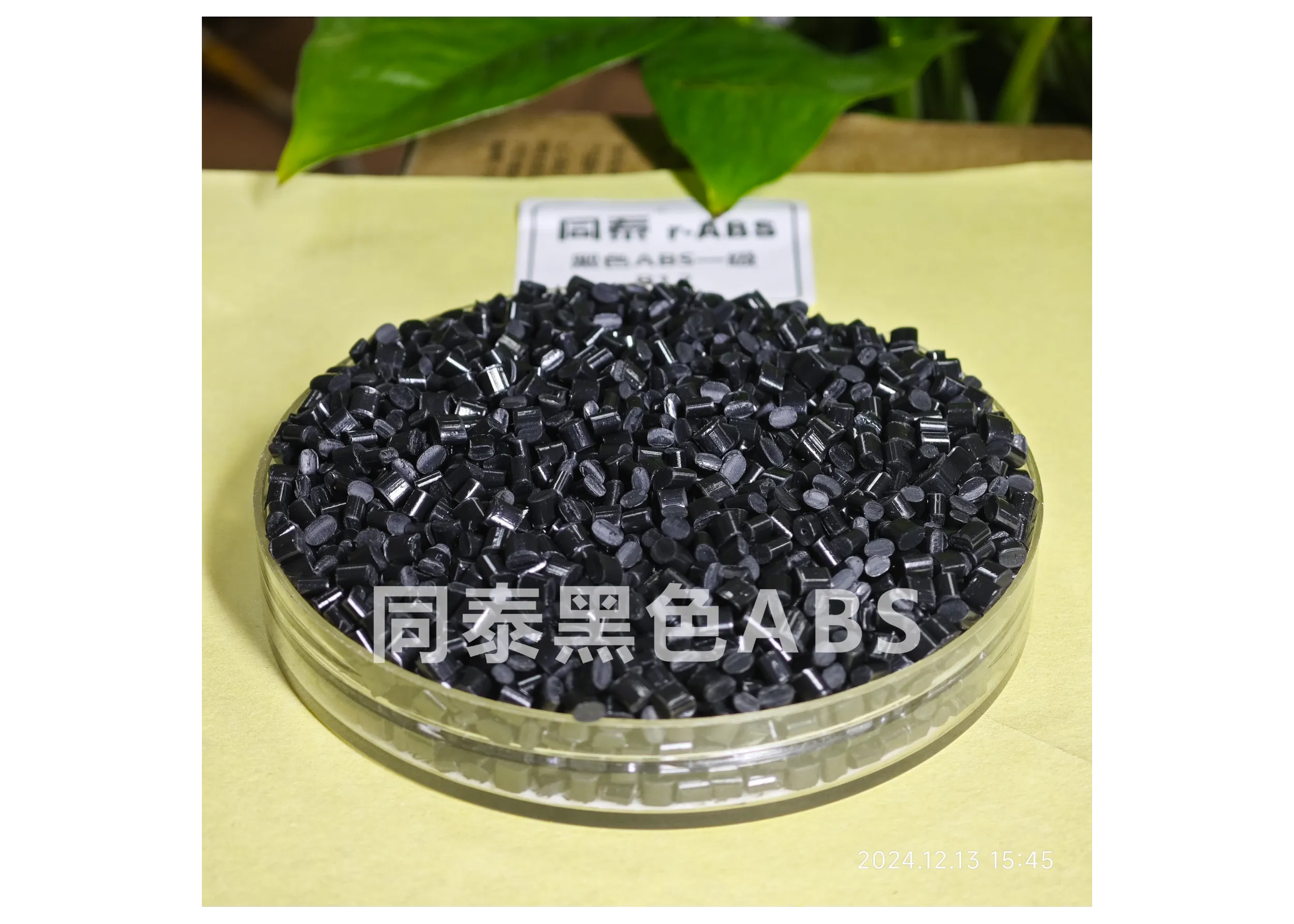
Recycled acrylonitrile butadiene styrene (rABS) is a recycled engineering thermoplastic made from post-consumer or post-industrial ABS waste, commonly recovered from electronics, appliances, automotive parts, and other durable goods. It is valued because it preserves much of virgin ABS’s impact resistance, stiffness, surface quality, and processability while reducing reliance on fossil-based feedstock and diverting plastic waste from landfill or incineration.
In practice, rABS is not a single material but a family of recyclate grades that vary by source stream, contamination level, color consistency, melt flow, and additive package. The most common commercial routes are mechanical recycling of sorted ABS-rich waste and, more recently, circular schemes that combine recycled feedstocks with additive-based restoration or chemical recycling of monomers to enable higher-purity recycled-content ABS. Its development sits at the intersection of plastics circularity, electronics waste management, automotive lightweighting, and additive manufacturing.
rABS is now positioned as a practical substitute for virgin ABS in many visible and structural parts, particularly where a balance of toughness, appearance, and cost matters. At the same time, its performance is more variable than virgin ABS because recyclate properties depend strongly on feedstock purity, prior thermal history, and the extent of sorting and compatibilization. This makes rABS a technically useful but quality-sensitive material, with ongoing innovation focused on property stabilization, odor control, flame-retardant safety, and closed-loop recovery.
History and Development
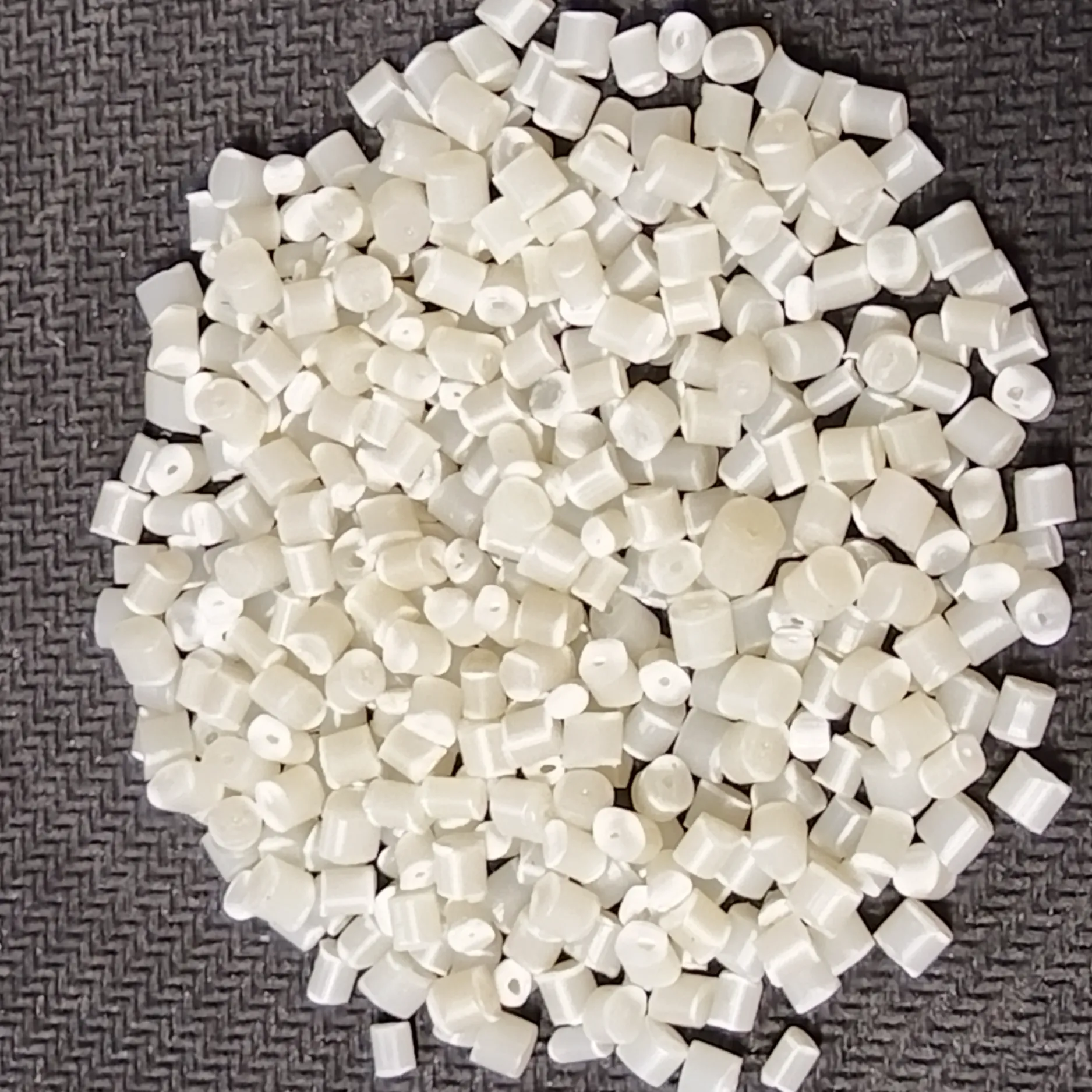
ABS became an established engineering plastic because its three-component structure combines rigidity, toughness, and processability. As ABS use expanded in consumer electronics, automotive interiors, appliances, luggage, and toys, large waste streams emerged from both post-industrial scrap and end-of-life products.
Early rABS use was largely opportunistic, relying on regrind from clean manufacturing scrap. Over time, more sophisticated sorting and wash/sort systems made it possible to recover ABS from mixed waste electrical and electronic equipment and end-of-life vehicles, although contamination with other polymers, fillers, paints, and flame retardants remained a major obstacle. Research has repeatedly shown that recycled ABS can be blended with virgin ABS or toughening agents to restore impact strength and processability.
More recent development has shifted toward higher-value circular systems. These include in-situ compatibilization, chain extension, reactive blending, and additive-manufacturing reuse of recycled ABS, as well as chemical recycling projects that recover styrene and butadiene for new ABS production. The result is a gradual move from “downcycled” recyclate toward controlled, specification-grade recycled ABS suitable for demanding applications.
Chemical Structure and Key Properties
ABS is a multiphase terpolymer built from acrylonitrile, butadiene, and styrene, with each component contributing a different performance function. Acrylonitrile improves chemical resistance and heat stability, butadiene provides impact toughness, and styrene gives rigidity, gloss, and ease of processing. rABS inherits the same basic structure, but its final properties depend on the ratio and integrity of these phases after recycling.
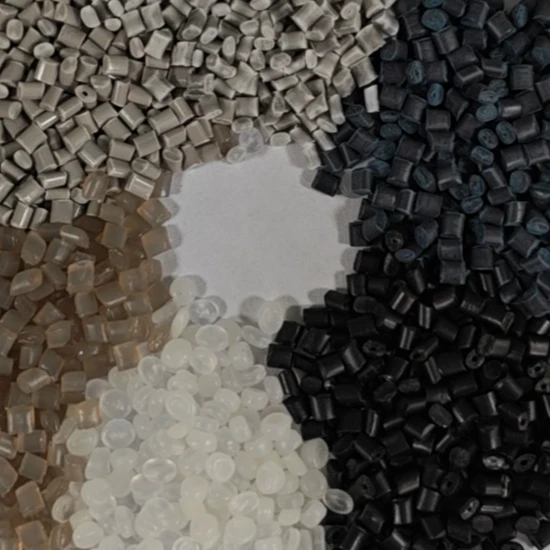
Typical rABS is described as a high-impact, rigid, dimensionally stable thermoplastic with good electrical insulation and acceptable heat resistance for many housings and structural parts. It is commonly supplied as pellets or regrind for injection molding and extrusion. Reported property ranges vary by source and formulation, but the material is generally used where moderate heat resistance, good surface finish, and impact performance are required.
Important practical limits include:
- Limited oxygen and grease barrier performance → ABS chemistry does not provide strong barrier properties, so rABS is not suitable for packaging or fuel-containment uses that require low gas permeation → workaround: use barrier multilayers, coatings, or a different polymer family.
- Low surface energy before treatment → like virgin ABS, rABS can be difficult to bond, print, or paint consistently without surface preparation → workaround: corona, plasma, primers, or formulation adjustments are used to improve adhesion.
- Property drift after repeated thermal histories → repeated reprocessing can reduce impact strength or increase brittleness depending on the feedstock and stabilization → workaround: blending with virgin ABS, SEBS-based tougheners, chain extenders, or compatibilizers helps recover performance.
A simple formulation principle is that small additive doses can have outsized effects. For example, epoxy-based chain extenders have been used at low loading levels to rebuild molecular weight and improve recycled ABS performance, while SEBS-g-MAH compatibilizers have been shown to improve toughness and notched impact strength in blends. These approaches do not turn poor recyclate into virgin-equivalent material automatically, but they can narrow the performance gap substantially.
Production Processes and Raw Feedstocks
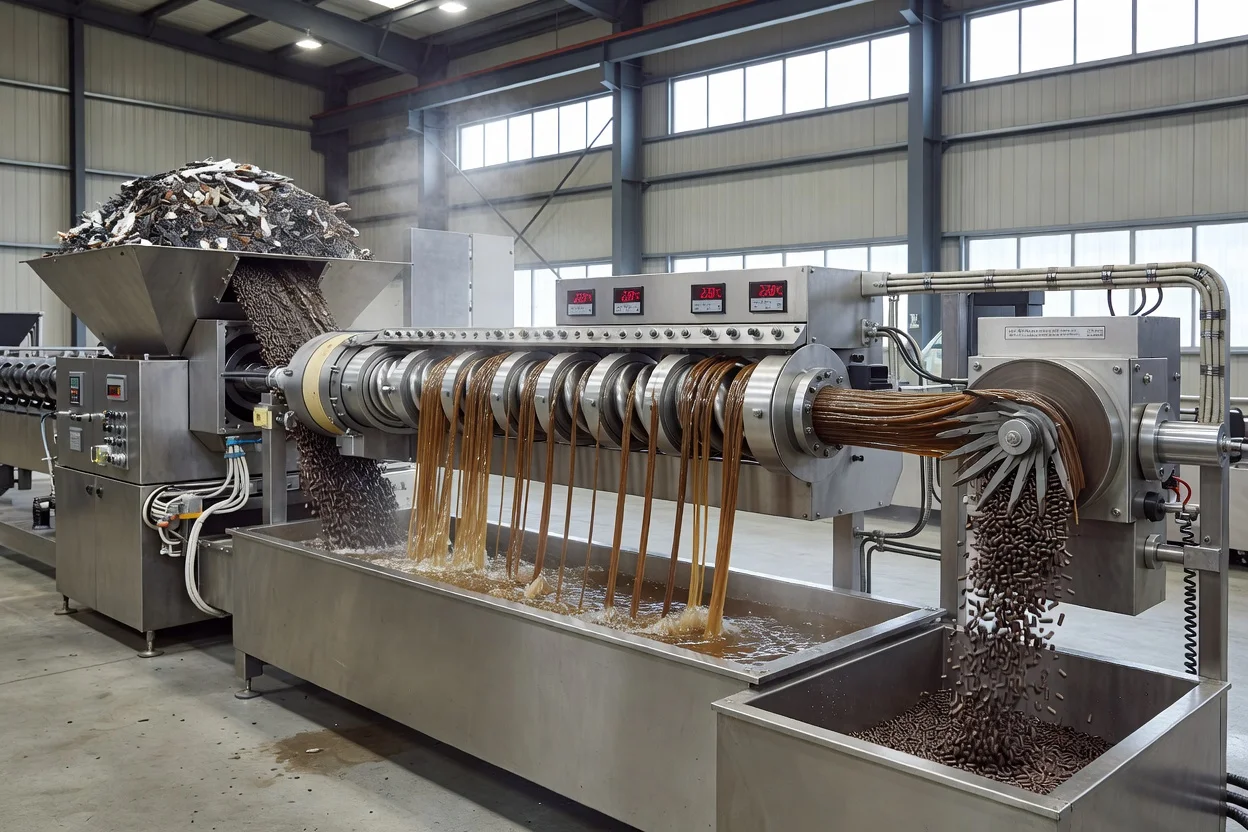
rABS production begins with the collection and identification of ABS-containing waste streams, most often from WEEE, automotive trim, appliance housings, luggage, and industrial offcuts. The quality of the incoming stream is the single most important determinant of final recyclate quality.
Typical steps include:
- Collection and sorting of ABS-rich fractions
- Removal of metals, labels, coatings, and incompatible polymers
- Washing, shredding, and density or optical separation
- Melt filtration and extrusion into pellets
- Optional compounding with stabilizers, colorants, flame retardants, virgin ABS, or impact modifiers
The main feedstock routes are:
- Post-industrial recyclate (PIR): cleaner, more consistent, and often best suited to high-value applications.
- Post-consumer recyclate (PCR): broader environmental benefit, but more variable properties and greater contamination risk.
- E-waste-derived ABS: an important source for electronics-grade rABS, though legacy flame retardants and mixed plastics can complicate processing.
Mechanical recycling remains the dominant route because it is commercially mature and energy-efficient relative to polymer-to-monomer pathways. However, the presence of pigments, rubber degradation products, and legacy additives means recycled ABS often needs formulation correction to meet specifications. Chemical recycling is emerging as a complementary route, especially where the goal is to recover monomers or very high-purity feedstock for near-virgin ABS.
Applications and End-Use Markets
rABS is used primarily in applications that benefit from its combination of toughness, rigidity, appearance, and processability. It is most successful in molded parts, especially where recycled content can be specified without compromising safety or aesthetics.
| End-use sector | Common rABS grade focus | Typical processing route | Notes |
|---|---|---|---|
| Automotive interiors | High-impact or appearance-grade rABS | Injection molding | Dashboard trims, center consoles, pillar covers, vents, housings |
| Electronics | Flame-retardant or high-gloss rABS | Injection molding | Laptop housings, printer parts, routers, appliance controls |
| Consumer goods | Standard or high-impact rABS | Injection molding, extrusion | Cases, luggage shells, tools, helmets, home storage |
| Appliances | Dimensional-stability grades | Injection molding | Refrigerator liners, vacuum housings, structural panels |
| Additive manufacturing | Filament-grade or blended rABS | Fused deposition / material extrusion | Prototyping, repair, low-volume parts |
| Industrial parts | General-purpose rABS | Injection molding | Brackets, covers, cable reels, fittings |
One poor-fit use is high-barrier packaging, because rABS does not provide the gas and grease barrier performance needed for many food and sensitive-content applications. Another technically difficult area is highly demanding outdoor exposure without stabilization, since UV and heat aging can expose recyclate variability unless the grade is specifically formulated for weathering.
In automotive and electronics, rABS is especially attractive because these sectors already use ABS widely and value the same surface and dimensional properties that ABS offers. In 3D printing, recycled ABS has been investigated as a closed-loop feedstock, with studies showing that recycled material can be reformulated into usable filaments and, in some cases, retain useful performance over multiple recycling cycles.
Environmental and Sustainability Aspects
The main sustainability benefit of rABS is displacement of virgin ABS, which reduces demand for fossil-based feedstock and can lower waste disposal impacts. Recycled-content ABS also supports circular-economy design strategies in electronics, automotive, and consumer goods, especially where parts can be recovered, sorted, and remade into similar applications.
Environmental performance, however, depends on the recycling pathway:
- Mechanical recycling usually offers the lowest immediate processing burden, but quality loss and contamination can limit how many cycles material can undergo in demanding uses.
- Closed-loop manufacturing can maintain value better if product design, sorting, and material purity are controlled.
- Chemical recycling can improve feedstock quality and enable higher recycled content, but it is generally more energy- and infrastructure-intensive than mechanical routes.
Research indicates that recycled ABS can sometimes maintain or even improve selected mechanical responses across a limited number of recycling cycles when properly processed, although this behavior is not universal and depends on formulation, contamination, and heat history. Because ABS often contains legacy flame retardants in electronic waste streams, responsible recycling also requires careful management of substances of concern and traceability of feedstock origin.
Bio-based alternatives do not directly replace rABS in most ABS applications today, because they would need to match ABS’s balance of toughness, aesthetics, and processability at competitive cost. The more immediate sustainability pathway is therefore recycled content, design for disassembly, and better sorting rather than full material substitution.
Economic and Global Market Impact
rABS occupies a premium niche within recycled polymers because its end markets are more demanding than those for commodity recyclates. Its value is influenced by feedstock purity, color consistency, odor, flame retardancy, and the degree to which properties approach virgin ABS. As a result, clean PIR rABS generally commands higher and more stable value than mixed post-consumer grades.
Demand is supported by three large sectors:
- Electronics, where housing and internal components can tolerate recycled content if appearance and safety are maintained.
- Automotive, where interior trim and non-visible structural parts can absorb some property variability.
- Consumer goods, where cost, color flexibility, and sustainability claims are commercially important.
The market is also shaped by regulatory pressure and customer requirements for recycled content, especially in Europe and parts of Asia. In addition, the rise of extended producer responsibility and product passports is expected to improve traceability, which should benefit higher-quality rABS grades that can document feedstock origin and performance.
The leading players in this area are usually not standalone rABS specialists alone, but rather ABS producers, compounders, recyclers, and integrated circularity platforms that can guarantee consistent quality. Companies involved in recovered-content ABS initiatives and electronics-grade recyclate have become important references for the market because they demonstrate that high-recycled-content ABS can reach commercial specification levels.
Current Challenges and Innovations
The central challenge for rABS is variability. Recycled feedstock may differ in impact performance, melt flow, color, odor, and additive legacy from batch to batch. Contamination with PC, HIPS, PVC, metals, or coatings can alter processing behavior and final properties, especially in mixed e-waste streams.
Current innovation themes include:
- Compatibilization and toughening: SEBS-g-MAH and related systems are used to recover impact strength in recycled ABS blends.
- Chain extension: epoxy-based additives can help rebuild molecular weight and improve melt performance after recycling.
- Closed-loop additive manufacturing: repeated reprocessing and filament regeneration are being studied as a route to local circular manufacturing.
- Chemically recycled ABS feedstocks: monomer recovery projects aim to produce recycled-content ABS with fewer quality penalties.
- Low-odor, flame-retardant grades: important for electronics and appliance applications where consumer perception and compliance matter.
A practical formulation example is a recycled ABS compound modified with a small percentage of impact modifier to restore toughness, or with a low-dose chain extender to offset molecular degradation. The mechanism is straightforward: the modifier improves phase interaction and stress dissipation, while the chain extender helps reconnect degraded polymer chains, improving melt strength and impact performance.
Future Outlook
The future of rABS is likely to be defined by specification control rather than simple recycled-content claims. Grades with reliable color, low odor, consistent melt flow, and documented recycled origin are expected to gain the most acceptance in electronics, appliance, and automotive supply chains.
Three trends appear especially important:
- Better sorting and traceability will improve feedstock quality and reduce contamination.
- Reactive compounding will make it easier to tune recycled ABS for demanding applications.
- Design for recycling will increase the supply of cleaner ABS streams from durable goods and electronics.
The strongest growth opportunities are likely in molded consumer electronics housings, appliance panels, automotive interior components, and additive manufacturing feedstocks. The weakest areas will remain those requiring very tight optical, odor, medical, or barrier specifications unless recycling and purification technologies advance further.
Summary
rABS is a high-value recycled engineering plastic that extends ABS’s established role in tough, attractive, easily processed parts while reducing reliance on virgin polymer. Its success depends on feedstock quality, formulation control, and end-use selection, making it one of the most technically demanding but commercially promising recycled thermoplastics in the plastics industry.
References
- •
Recycled ABS – Properties, Applications, and Benefits. (n.d.). https://www.ambiomaterials.com/en/materials/rabsLink
- •
rABS from E-Waste: Electronics and Automotive Flame-Retardant Applications Guide. (2026, June 7). https://www.geotopcentral.com/rabs-e-waste-sourced-recycled-acrylonitrile-butadiene-styrene/Link
- •
Recycling of Acrylonitrile Butadiene Styrene from Electronic Waste. (2024, June 18). https://pmc.ncbi.nlm.nih.gov/articles/PMC11442160/Link
- •
Microsoft Word - NicolasVanDamme_Final_paper-2.doc. (n.d.). https://backoffice.biblio.ugent.be/download/8501101/8501108Link
- •
Compatibilizing and toughening blends of recycled acrylonitrile-butadiene-styrene and high-impact polystyrene. (2023, April 17). https://researchportal.northumbria.ac.uk/en/publications/compatibilizing-and-toughening-blends-of-recycled-acrylonitrile-b/Link
- •
1. (n.d.). https://irep.ntu.ac.uk/id/eprint/37132/1/14303_Ford.pdfLink
- •
[PDF] LIFE ABSolutely Circular Layperson's report. (n.d.). https://www.ineos.com/contentassets/65553324c0a74f6bad48e04e2b9ea1c7/life_absolutely_circular_layperson_report_final-incl-logo.pdfLink
- •
Recycling of acrylonitrile-butadiene-styrene (ABS) copolymers from waste electrical and electronic equipment (WEEE), through using an epoxy-based chain extender. (2009, March 15). https://hero.epa.gov/hero/index.cfm/reference/details/reference_id/4398431Link
- •
[PDF] Polymer - The University of Tennessee, Knoxville. (n.d.). https://composites.utk.edu/papers%20in%20pdf/Reparation_Polymer_Wu_2017.pdfLink
- •
Material recycling of acrylonitrile butadiene styrene (ABS) from waste electrical and electronic equipment (WEEE). (n.d.). https://www.sciencedirect.com/science/article/pii/S2949839224000385Link
- •
Recyceltes ABS – Eigenschaften, Anwendungen und Vorteile - Ambio. (n.d.). https://www.ambiomaterials.com/de/materialen/rabsLink
- •
China PCR Recycled plastics RABS (Recycled Acrylonitrile Butadiene Styrene). (2025, December 1). https://www.unibrom.com/pcr-recycled-plastics-rabs-recycled-acrylonitrile-butadiene-styrene-for-electronic-device-housings-product/Link
- •
Återvunnet ABS – Egenskaper, användningsområden och fördelar. (n.d.). https://www.ambiomaterials.com/se/material/rabsLink
- •
Blends of rABS and SEBS: Influence of In-Situ Compatibilization on the Mechanical Properties. (2019, July 24). https://pubmed.ncbi.nlm.nih.gov/31344891/Link
- •
IWT-TETRA. (n.d.). https://medialibrary.uantwerpen.be/oldcontent/container49257/files/Design%20Experience_rABS_English%20booklet.pdfLink
- •
[PDF] Evaluating Combination of Solvent-Based Recycling and Mechanical Recycling for ABS. (n.d.). https://pdfs.semanticscholar.org/d4cc/73052d8d5ccc990a3d6d5f2355f1244ced4b.pdfLink
- •
PCR r-ABS - Acrylnitril-Butadien-Styrene - Sinox Polymers. (n.d.). https://www.sinox-polymers.com/en/plastic-recycled-pellets-pcr-abs-acrylnitril-butadien-styrene.htmlLink
- •
Blends of rABS and SEBS: Influence of In-Situ Compatibilization on the Mechanical Properties. (2019, July 24). https://pmc.ncbi.nlm.nih.gov/articles/PMC6695779/Link
- •
Typical Properties. (n.d.). https://rowadplastic.com/wp-content/uploads/2016/10/ABS_TS.pdfLink
- •
Recycled rABS - Material Guide. (2013, September 7). https://craftcloud3d.com/en/material-guide/recycled-rabsLink
- •
Embracing a sustainable future with rabs. (2023, July 5). https://www.syloon.com/latest-news/embracing-a-sustainable-future-with-rabsLink
- •
rABS - Recyceltes Acrylnitril-Butadien-Styrol. (2024, September 11). https://we-are-pa.com/service/rabs/Link
- •
Three-dimensional printing with waste acrylonitrile butadiene styrene: Processing and characterization. (2025, May 28). https://journals.sagepub.com/doi/abs/10.1177/07316844231225686Link
- •
European project yields recycled-content ABS. (2025, March 17). https://www.recyclingtoday.com/news/elix-repsol-anqore-plastic-abs-chemical-recycling-europe/Link
- •
Sustainable strategies towards better utilization of synthetic polymers. (2024, July 19). https://pubmed.ncbi.nlm.nih.gov/38666470/Link
- •
Recycled polycarbonate and polycarbonate/acrylonitrile butadiene styrene feedstocks for circular economy product applications with fused granular fabrication-based additive manufacturing. (n.d.). https://www.sciencedirect.com/science/article/pii/S2214993723001653Link
- •
[PDF] Using 100% Recycled ABS (rABS) in Plastic Products (Phase 2). (n.d.). https://irep.ntu.ac.uk/id/eprint/35511/7/13042_a1331_Ford.pdfLink
- •
Lightweight High Strength Flexible Radar Absorbing. (n.d.). https://www.drdo.gov.in/drdo/sites/default/files/inline-files/LHSF_RAbS30082024.pdfLink
- •
Cirplus - rabs #recycled #automotive #electronics #3d. (2024, August 13). https://www.linkedin.com/posts/cirplus_rabs-recycled-automotive-activity-7229033264907255808-tX3jLink
- •
Engineering plastic, rABS, Recycled - Spot material - Spot material. (2025, August 7). https://spotmaterial.com/material/acrylonitrile-butadiene-styrene-abs/engineering-plastic-rabs-recycled/Link
- •
Investigating the use of 100% recycled Acrylonitrile Butadiene Styrene (ABS) for 3D printing. (2017, August 7). https://research.utwente.nl/en/publications/ecoprinting-investigating-the-use-of-100-recycled-acrylonitrile-b/Link
- •
rABS in Consumer Appliances. (2026, June 5). https://www.geotopcentral.com/rabs-in-consumer-appliances/Link
- •
RECYCLING CARBON FIBER FILLED ACRYLONITRILE-BUTADIENE-STYRENE. (n.d.). https://repositories.lib.utexas.edu/bitstreams/de30e1d1-5756-4bd7-969f-1e79d8df8799/downloadLink
- •
Low‐Temperature and High‐Rate Rechargeable Aluminum Batteries Enabled by Ternary Eutectic Electrolytes. (2021, January 1). https://www.osti.gov/biblio/2529505Link
- •
An effective sustainable approach towards recycling and value addition of waste poly(vinyl chloride) and acrylonitrile butadiene styrene (ABS) recovered from electronic waste (e-waste). (n.d.). https://link.springer.com/article/10.1007/s10965-021-02678-9Link
- •
Polymer-Based Additive Manufacturing: Recent Developments. (2019, June 19). https://pubs.acs.org/doi/abs/10.1021/bk-2019-1315.ch003Link
- •
bage rABS. (2025, April 17). https://bage-plastics.com/products/bage-abs/Link
- •
Investigation of Closed-Loop Manufacturing with Acrylonitrile Butadiene Styrene over Multiple Generations Using Additive Manufacturing. (2019, June 24). https://pubs.acs.org/doi/10.1021/acssuschemeng.9b02368Link
- •
Recycled Polystyrene & ABS | International Polymers Ltd. (2021, January 22). https://www.internationalpolymersltd.com/recycled-polystyrene-abs/Link
- •
Exploring the Versatile Uses of Recycled ABS Resins. (2024, June 12). https://www.midcontinentplastics.com/blog/sustainable-innovations-exploring-the-versatile-uses-of-recycled-abs-resins/Link
- •
Recovery of recycled acrylonitrile–butadiene–styrene, through mixing with styrene–ethylene/butylene–styrene. (n.d.). https://www.sciencedirect.com/science/article/abs/pii/S0924013613000721Link
- •
Recycled Acrylonitrile Butadiene Styrene (rABS) for Automotive Interior Parts Market Research Report 2026-2034. (n.d.). https://www.24chemicalresearch.com/reports/308923/recycled-acrylonitrile-butadiene-styrene-for-automotive-interior-parts-marketLink
- •
Recent Progress in Sustainable Recycling of Waste Acrylonitrile–Butadiene–Styrene. (2025, September 29). https://www.mdpi.com/2071-1050/17/19/8742Link
- •
Mechanical recycling of acrylonitrile-butadiene-styrene copolymer and high impact polystyrene from waste electrical and electronic equipment to comply with the circular economy. (n.d.). https://www.frontiersin.org/journals/sustainability/articles/10.3389/frsus.2023.1203457/pdfLink
- •
B. Rabs (recycled Abs). (2024, October 14). https://www.linkedin.com/pulse/material-guide-your-promotional-merchandise-part-hyogcLink
- •
3D printing with recycled ABS resin: Effect of blending and printing temperature. (2023, November 1). https://www.sciencedirect.com/science/article/abs/pii/S0254058423010258Link
- •
RABS: restricted access barrier system for aseptic processing of pharmaceutical products. (2009, December 17). https://www.comecer.com/rabs-restricted-access-barrier-systems-for-aseptic-processing-pharmaceutical-products/Link
- •
Sustainable Additive Manufacturing: Mechanical Response of Acrylonitrile-Butadiene-Styrene over Multiple Recycling Processes. (2020, April 27). https://www.mdpi.com/2071-1050/12/9/3568Link
- •
Recycled ABS: Materials Explained. (2024, October 16). https://www.mondaymerch.com/us/resources/fabrics-and-materials/recycled-absLink
- •
Upcycling Polystyrene - PMC - NIH. (2022, November 18). https://pmc.ncbi.nlm.nih.gov/articles/PMC9695542/Link
- •
ABS Plastic (Acrylonitrile Butadiene Styrene). (2026, April 22). https://www.specialchem.com/plastics/guide/acrylonitrile-butadiene-styrene-abs-plasticLink
- •
Exploring ABS Material: Properties and Applications. (2023, June 21). https://sendcutsend.com/blog/what-is-abs-material/Link
- •
Replacing ABS plastic sustainably. (2024, May 2). https://www.sulapac.com/blog/replacing-abs-plastic-sustainably/Link