
Introduction
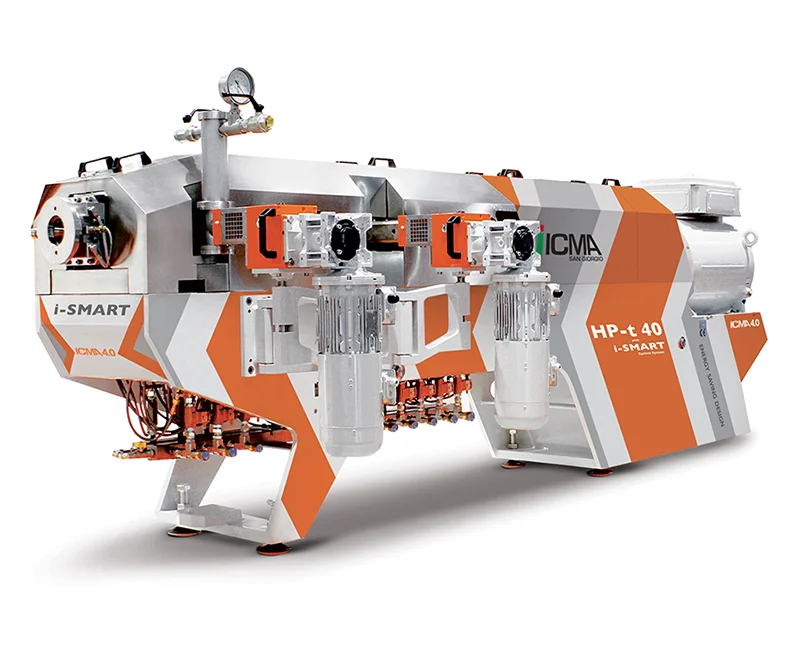
Extruders, multiple screw type are continuous polymer-processing machines that use two or more screws within a heated barrel to convey, melt, mix, devolatilize, react, and shape plastics or plastic-based formulations. In industrial practice, the term is most often used for twin-screw extruders, but it also includes triple-screw, quad-screw, octa-screw, ring-type, planetary roller, and multi-rotation-system (MRS) machines, each developed to address specific mixing, throughput, or devolatilization requirements.
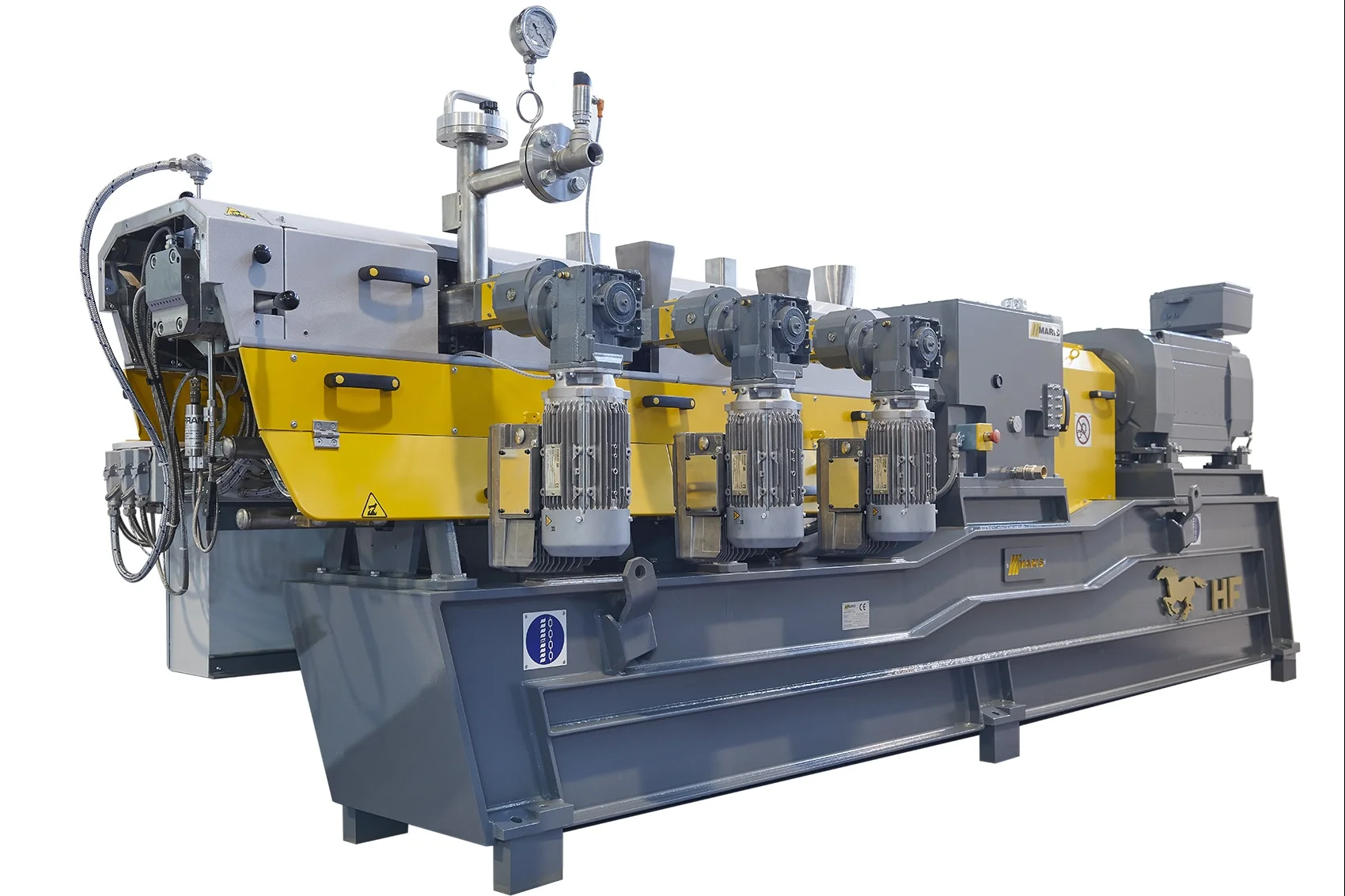
Compared with single-screw machines, multiple-screw extruders provide stronger positive-displacement conveying, more controllable residence time distribution, and greater flexibility for compounding, reactive extrusion, venting, and direct feed of powders or fillers. Their evolution has been driven by demands for higher output, better distributive and dispersive mixing, improved devolatilization, and tighter control of material quality in sectors such as masterbatch, engineering compounds, PVC, food, pharmaceuticals, and specialty polymers.
History and Development
Multiple-screw extrusion developed from the broader screw-extrusion principle that emerged as plastics processing industrialized in the twentieth century. The twin-screw machine became the dominant multiscrew configuration because it offered a practical balance of mixing intensity, pumping capability, and process control.
Several milestones shaped the field:
- Twin-screw industrialization established the modern baseline for multiscrew processing, especially in co-rotating intermeshing and counter-rotating forms used for compounding and profile production.
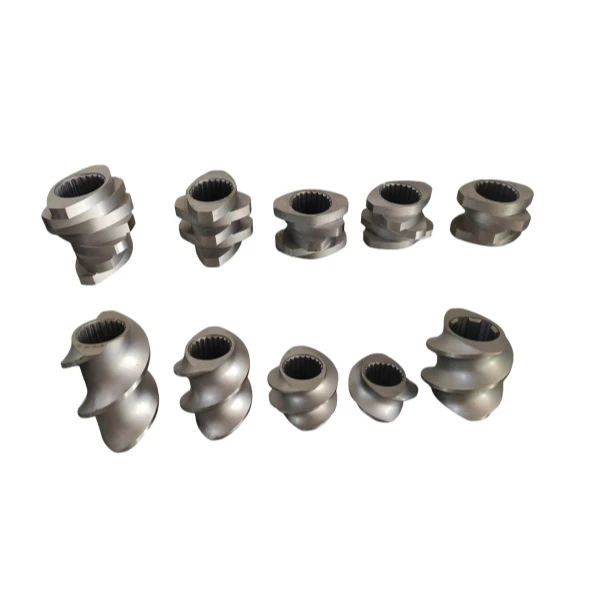
- Modular screw-element design enabled configuration-specific processing, allowing barrels, kneading blocks, conveying elements, and venting sections to be rearranged for different formulations and reactions.
- Specialized multiscrew architectures such as planetary roller extruders and MRS systems were introduced to enhance devolatilization and processing of sensitive or high-solids materials by creating multiple melting and mixing paths.
- Higher-order screw counts such as triple- and quad-screw concepts were proposed for niche compounding tasks where additional intermeshing zones or free volume could improve output or dispersion in highly filled systems.
Technical Overview
A multiple-screw extruder works by combining mechanical conveying and controlled shear inside one or more intermeshing or non-intermeshing screw channels. In intermeshing designs, the screws create a self-wiping action that reduces stagnant regions and improves thermal and material uniformity.
Core operating principles
- Feed and conveying: Solid feed enters one or more screws and is transported forward by rotation and channel geometry.
- Melting: Heat transfer occurs through barrel heating, shear heating, and compressive work in the screw channel.
- Mixing: Material is split, recombined, stretched, and reoriented, which improves both distributive mixing and dispersive mixing.
- Devolatilization: Venting zones remove moisture, residual monomers, solvents, or reaction by-products under atmospheric or vacuum conditions.
- Pressurization and die feeding: Melt is built to a stable pressure before passage through a die, pelletizer, sheet die, strand die, or downstream forming system.
Typical engineering characteristics
- Screw speed: Industrial co-rotating twin-screw extruders commonly operate from low hundreds up to about 1200 rpm in high-speed compounding applications.
- Throughput: Capacity ranges from laboratory-scale output to industrial rates of hundreds to several thousand kg/h, with larger systems designed for high-volume compounding and devolatilization duty.
- Residence time: Multiple screws generally provide shorter and more controllable residence time than many low-speed single-screw systems, which benefits heat-sensitive materials.
- Pressure generation: Intermeshing twin-screw systems rely on positive displacement, but pressure profile can be deliberately shaped by element selection and venting; some process zones are operated at near-zero pressure to facilitate sequential operations.
- Specific energy consumption: Energy demand depends strongly on screw speed, formulation, and mixing intensity. High-shear compounding systems consume more energy than simple conveying systems, but they can reduce downstream processing steps and improve product consistency.
Practical quantitative notes
- Granulator or pelletizing-related flake size: When multiscrew extruders are paired with recycling lines, upstream shredded or flaked feed commonly falls in the rough 5–15 mm range, depending on the recycler and feeder design.
- Centrifugal dewatering residual moisture: After mechanical dewatering, residual moisture is commonly reduced to about 1–3%, and further thermal drying may follow when very low moisture is required.
- Rotor or screw-related operating intensity: High-speed compounding systems may run at up to 1200 rpm, whereas low-speed designs prioritize pressure build and gentle treatment.
- Output scaling: Larger multiscrew platforms are available in diameters spanning roughly 25 to 145 mm in commercial co-rotating twin-screw ranges, with output rising with screw diameter, L/D ratio, and formulation.
Main Types and Variations
| Type | Structural idea | Main advantages | Typical uses |
|---|---|---|---|
| Twin-screw extruder | Two screws, usually intermeshing or non-intermeshing | Best-established multiscrew platform; strong mixing and conveying control | Compounding, masterbatch, reactive extrusion, devolatilization |
| Triple-screw extruder | Three screws, often arranged in parallel or triangular layouts | Additional intermeshing zone and higher free volume in some designs | High-fill compounds, masterbatch, niche high-output mixing |
| Quad-screw and octa-screw extruders | Four or eight screws in specialized arrangements | Large number of mixing paths and layered or multichannel processing potential | Specialized multilayer or high-complexity processing |
| Planetary roller extruder | Central screw with planetary satellites | Large heat-transfer area and good devolatilization behavior | PVC, heat-sensitive formulations, devolatilization duty |
| MRS extruder | Single-screw base with satellite screw section | Enhanced devolatilization with long melt surface renewal | Reprocessing, PET and other devolatilization-sensitive tasks |
| Ring-type multiscrew extruder | Multiple sub-screws arranged around a principal axis | Intensive mixing and high configurability | Niche compounding and multilayer-related processing |
Twin-screw subtypes
Twin-screw extruders are commonly classified by:
- Rotation direction: Co-rotating or counter-rotating.
- Screw engagement: Intermeshing or non-intermeshing.
- Geometry: Parallel or conical.
Co-rotating intermeshing machines dominate compounding because of self-wiping action and flexible modularity, while counter-rotating systems are often selected for PVC profiles, pipe, and shear-sensitive formulations.
Applications and Uses
Multiple-screw extruders are used where a single screw cannot provide enough mixing, devolatilization, or process flexibility.
- Polymer compounding: Incorporation of fillers, glass fiber, flame retardants, impact modifiers, colorants, stabilizers, and recycled polymers.
- Masterbatch production: High-load pigment or additive concentrates that demand strong dispersion.
- Reactive extrusion: In-situ polymerization, grafting, chain extension, compatibilization, and reactive blending.
- Devolatilization and purification: Removal of solvents, water, monomer residues, or by-products, especially in PET and specialty compounds.
- Engineering resins and high-performance materials: Precise thermal and rheological management for demanding formulations.
- PVC processing: Particularly with counter-rotating or conical systems for rigid profiles, pipe, and cable compounds.
- Multilayer products: Specialized multiscrew systems can support layered structures, including extrudate architectures with multiple material streams.
- Recycling and reprocessing: Washing-line output, flakes, and reclaimed polymer can be re-compounded after drying and contamination control.
One poor-fit use is simple, low-cost, high-volume production of uncomplicated melt streams where mixing is minimal; in such cases, a single-screw extruder is usually more economical and easier to operate.
Technological Innovations and Automation
Recent development has focused on improving process stability, cleaning, and integration.
- Modular screw elements allow rapid adaptation to changed recipes or output targets.
- Vacuum venting and side feeding improve moisture removal and filler incorporation.
- Online monitoring of melt pressure, torque, temperature, and motor load supports closed-loop control.
- Automation and recipe management reduce operator dependence and improve repeatability in compounding plants.
- Industry 4.0 integration increasingly uses digital process records, predictive maintenance, and energy monitoring.
In high-performance plants, the extruder is often part of a system rather than a standalone machine, linked to gravimetric feeders, melt filtration, strand or underwater pelletizers, dryers, and packaging lines.
Environmental and Sustainability Aspects
Multiple-screw extruders contribute to sustainability mainly through recycling compatibility, material efficiency, and formulation flexibility.
- They can process post-consumer or post-industrial recyclate after washing and drying, enabling mechanical recycling into new compounds.
- Strong devolatilization helps lower residual solvents and monomers, improving suitability for food-contact or higher-purity applications when regulations permit.
- High mixing efficiency can reduce scrap and off-spec production.
- When used with optimized screw design and motor control, energy consumption can be reduced relative to less efficient multi-stage processing routes.
The sustainability trade-off is that high-shear and high-speed operation may increase power demand, so the environmental benefit depends on whether the machine replaces multiple downstream steps or simply adds complexity.
Economic and Global Market Impact
Multiple-screw extruders occupy a strategic position in the plastics machinery market because they sit at the intersection of compound quality, production volume, and formulation complexity. Demand is closely tied to growth in automotive compounds, packaging masterbatch, building products, wire and cable, medical materials, and recycled polymers.
Commercial suppliers offer a broad size spectrum, from laboratory and pilot systems to industrial lines with screw diameters above 100 mm and extensive peripheral equipment packages. Manufacturers with recognized positions in this segment include established compounding-equipment firms specializing in co-rotating twin-screw platforms, high-pressure PVC systems, planetary and devolatilization technologies, and pilot-scale modular lines.
Current Challenges and Innovations
- Wear and maintenance: Abrasive fillers, glass fiber, and mineral-loaded compounds accelerate screw and barrel wear.
- Thermal sensitivity: Some polymers degrade if residence time or shear becomes excessive.
- Process complexity: More screws and more elements increase setup demands and operator skill requirements.
- Cleaning and changeover: Frequent product changes can raise downtime, especially in heavily filled or reactive formulations.
- Feed consistency: Stable output depends on reliable dosing, powder flowability, and moisture control.
Current innovation is focused on improving wear-resistant metallurgy, optimized screw profiling, low-residence-time devolatilization, better feeding systems, and digital twin/process simulation for recipe design and scale-up.
Future Outlook
Multiple-screw extrusion is expected to remain central to advanced compounding and recycling because it combines continuous processing, high formulation flexibility, and integration with automation. The strongest growth areas are likely to be recycled-content compounding, specialty masterbatch, reactive compatibilization, and high-consistency processing of difficult feedstocks.
Further development will likely emphasize:
- Lower-energy screw and barrel designs
- Improved venting for recycled and contaminated streams
- Greater use of simulation for scale-up and troubleshooting
- More integrated inline quality control
- Expanded use in circular-economy processing chains
Summary
Extruders, multiple screw type are advanced continuous processors used when conventional single-screw extrusion is insufficient for mixing, devolatilization, or formulation control. Their major forms include twin-screw, triple-screw, planetary, MRS, and ring-type machines, with twin-screw systems remaining the industrial standard for compounding and reactive processing.
References
- •
Microsoft Word - Multiscrew extruders - review 04.01. (n.d.). https://www.takimsan.com/Manuscript_13_01.pdfLink
- •
P O L I M E R Y. (n.d.). https://polimery.ichp.vot.pl/index.php/p/article/download/2411/2328/7077Link
- •
[PDF] "Extrusion". In: Encyclopedia of Polymer Science and Technology. (n.d.). https://masters.donntu.ru/2016/feht/glovatskiy/library/rauwendaal__extrusion.pdfLink
- •
What Is A Multi-screw Extruder? - Product knowledge encyclopedia - News - Shenzhen Superb Heater Technology Co.,Ltd. (2019, January 16). https://www.superbheater.com/news/what-is-a-multi-screw-extruder-20543482.htmlLink
- •
EXTRUSION. (n.d.). https://yunus.hacettepe.edu.tr/~isilg5/kmu408/kmu408-week3.pdfLink
- •
Extrusion Processes. (n.d.). https://zero.sci-hub.se/6086/9c37fc6e5416096ff3b6828ac8a1a5ae/levine2006.pdfLink
- •
Types of Plastic Screw Extruder and Their Applications - GSmach. (2025, March 26). https://www.gsextruder.com/types-of-plastic-screw-extruder-and-their-applications/Link
- •
What you should know about a triple screw extruder - Kerke. (2025, November 27). https://www.kerkeextruder.com/news/know-how/what-you-should-know-about-a-triple-screw-extruder/Link
- •
Classification of Plastic Extruders. (2019, April 8). https://www.monofilamentextruder.com/news/classification-of-plastic-extruders.htmlLink
- •
What is a Twin Screw Extruder? Types, Applications, and Benefits Explained.... (2025, December 23). https://www.nanoscience.com/blogs/what-is-a-twin-screw-extruder-types-applications-and-benefits-explained/Link
- •
Extruders. (n.d.). https://encyclopedia.che.engin.umich.edu/extruders/Link
- •
Leistritz Extrusion: Quick TSE overview technical article, ref. 11.2020. (n.d.). https://extruders.leistritz.com/en-us/extrusion/newsletter/2022-01/3-Quick-overview-of-TSEs.pdfLink
- •
Words of Wisdom : The 10 (11) key principles of extrusion. (2023, November 10). https://www.plasticstoday.com/plastics-processing/words-of-wisdom-the-10-11-key-principles-of-extrusionLink
- •
Multi-screw extruder. (2002, October 2). https://patents.google.com/patent/US7080935B2/enLink
- •
[PDF] ON THE DESIGN AND TECHNOLOGY OF CO-ROTATING TWIN .... (n.d.). https://repositorio.usp.br/directbitstream/4408acc3-7491-49fa-9e52-6feea63d3170/OK___trabalho+15+-+On+the+design+and+technology+of+co-rotating+twin-screw+extruders+(COBEF+2017)_removed+(1).pdfLink
- •
WO1998013189A1 - Multiple-screw extruder. (1997, September 23). https://patents.google.com/patent/WO1998013189A1/enLink
- •
Extrusion. (n.d.). https://www.dlg.org/fileadmin/downloads/Expertenwissen/lebensmitteltechnologie/e_2022_2_Expertenwissen_Extruder_EN.pdfLink
- •
HOW DO MULTIPLE FLIGHTS IMPROVE THE .... (n.d.). https://bussmann.mie.utoronto.ca/wp-content/uploads/2010-ANTEC-WangBussmannPark.pdfLink
- •
Progress in Twin Screw Extrusion Technology Focused on .... (n.d.). https://www.4spe.org/files/Chapters/D22/email/D22-2021-05-02-extrusionpresentationofthemonth.pdfLink
- •
Twin Screw Extruders as Continuous Mixers for ... - PMC - NIH. (2016, February 16). https://pmc.ncbi.nlm.nih.gov/articles/PMC4766122/Link
- •
Sample Pages. (n.d.). http://files.hanser.de/Files/Article/ARTK_LPR_9781569906989_0001.pdfLink
- •
Extruders - Davis-Standard. (2022, December 15). https://davis-standard.com/extrusion_system/extruders/Link
- •
4 Types Of Twin Screw Extruders. (2021, November 26). https://www.cowinextrusion.com/4-types-of-twin-screw-extruders/Link
- •
7 Twin Screw Extruder Types: Design, Benefits & Uses. (2025, April 21). https://www.twinscrew.net/en/article/types-of-twin-screw-extruder.htmlLink
- •
Screw Extruder Decoded: Types, Design Secrets, and Selection. (2026, August 24). https://www.nhyscrews.com/blog/screw-extruderLink
- •
An Ultimate Guide to Different Types of Extruders. (2025, November 20). https://jwellanhui.com/an-ultimate-guide-to-different-types-of-extruders/Link
- •
US7080935B2 - Multi-screw extruder. (2002, October 2). https://patents.google.com/patent/US7080935B2/deLink
- •
Range of extruders and peripheral equipment for industrial ... - Clextral. (2022, February 16). https://www.clextral.com/our-offer/Link
- •
Twin Screw Extruder | Thermo Fisher Scientific - US. (2020, April 16). https://www.thermofisher.com/us/en/home/industrial/manufacturing-processing/extrusion-compounding-equipment/instruments/twin-screw-extruders.htmlLink
- •
Plastic extrusion - Wikipedia. (2006, June 11). https://en.wikipedia.org/wiki/Plastic_extrusionLink
- •
Triple Screw Extruder for High Filler Masterbatch. (2026, June 28). https://granuwelextruder.com/ko/triple-screw-extruder-for-high-filler-masterbatch/Link
- •
Types Of Plastic Extruders - Industrial Extrusion Machinery. (n.d.). http://www.industrialextrusionmachinery.com/types_of_plastic_extruders.htmlLink
- •
Twin Screw Extrusion & Compounding Machines - B&P Littleford. (n.d.). https://www.bplittleford.com/twin-screw.htmlLink
- •
Santech Machinery And Equipment Pvt. Ltd. (2023, November 1). https://www.exportersindia.com/m-s-santechs-corporation/other-products.htmLink
- •
Modeling of Twin Screw Extrusion of Polymeric Materials - PMC. (2022, January 10). https://pmc.ncbi.nlm.nih.gov/articles/PMC8779974/Link
- •
Classification of Twin-Screw Extruders - JWELL Machinery. (2025, March 19). https://jwell.co/company-news/classification-of-twin-screw-extruders/Link
- •
US4162854A - Multi-shaft screw extruder. (1997, March 2). https://patents.google.com/patent/US4162854A/enLink
- •
twin screw extruder system design & case studies for pla, .... (n.d.). https://www.4spe.org/files/Chapters/D22/presentationofthemonth_springenewsletter.pdfLink
- •
Twin Screw Extruders | Modular Barrrels | John Halvorsen. (n.d.). https://labtechusa.com/twin-screw-extruders/Link
- •
Screw Functionality and Screw Profile Design for Extrusion .... (2024, March 6). https://content.ces.ncsu.edu/screw-functionality-and-screw-profile-design-for-extrusion-processingLink
- •
Triple Screw Extruder - UET Machine. (2025, December 23). https://uetmachine.com/triple-screw-extruder/Link
- •
Screw Extruder - an overview. (n.d.). https://www.sciencedirect.com/topics/engineering/screw-extruderLink
- •
Analysis and experimental evaluation of twin screw extruders. (2021, July 15). https://www.academia.edu/49967925/Analysis_and_experimental_evaluation_of_twin_screw_extrudersLink
- •
Embedded short spiral shell rib asymmetric multi-screw extruder in the same direction. (2016, December 9). https://patents.google.com/patent/CN206967925U/enLink
- •
Single Screw Extruder vs Twin Screw Extruder. (2021, November 19). https://www.useon.com/guide/single-screw-extruder-vs-twin-screw-extruder/Link
- •
Used Twin Screw Co-Rotating Extruders for Sale - Aaron Equipment. (n.d.). https://www.aaronequipment.com/equipment/plastics-equipment/extruders-twin-screw-corotateLink