
Introduction
Polyphenylene sulfide (PPS) is a high-performance, semi-crystalline engineering thermoplastic valued for its combination of heat resistance, chemical resistance, dimensional stability, and inherent flame retardancy. It is widely used in demanding applications where conventional engineering plastics are insufficient, especially in automotive, electrical and electronics, industrial, and chemical-processing environments.
PPS is typically associated with a repeating aromatic backbone linked by sulfur atoms, which gives the polymer its high thermal and oxidative stability relative to many commodity and engineering plastics. In commercial practice, PPS is supplied in unfilled and reinforced grades, including glass-fiber-filled, carbon-fiber-filled, mineral-filled, and tribology-modified compounds, each tuned for stiffness, wear performance, conductivity, or processing behavior.
The material’s historical significance lies in its transition from a specialty polymer to a mainstream high-temperature material for molded components, electrical hardware, under-the-hood automotive parts, and filtration media. Its continued relevance is tied to electrification, miniaturized electronics, lightweighting, and the need for polymers that can survive prolonged exposure to heat, fluids, and aggressive chemicals.
At the same time, PPS sits within the broader sustainability debate for high-performance plastics: it is durable and long-lived, which supports component life extension, but it is also energy-intensive to produce and difficult to recycle in mixed waste streams. Current innovation therefore focuses on cleaner production routes, higher-purity grades, improved compounding, and better recovery of reinforcement-filled PPS parts.
History and Development
PPS emerged as part of the broader development of poly(arylene sulfide) polymers, with early industrial interest centered on heat-resistant and chemically inert materials for severe-service environments. As processing methods improved, PPS became more commercially viable for injection molding, compounding, and fiber and membrane applications.
A key industrial milestone was the establishment of reliable solution polymerization and subsequent purification routes, which made it possible to produce PPS with sufficient molecular weight and consistency for engineering applications. Over time, the polymer moved from niche use in specialty industrial parts to broader adoption in automotive, electrical, and fluid-handling systems.
More recent development has emphasized:
- Higher-flow and lower-volatile grades for complex molding.
- Reinforced compounds for metal replacement.
- Ultra-low-void and high-purity grades for electronics and filtration.
- Modified PPS formulations for wear, friction, and conductivity control.
Chemical Structure and Key Properties
PPS is an aromatic polymer in which benzene rings are connected by sulfide linkages, creating a rigid backbone that resists thermal motion and chemical attack. This structure is central to the material’s performance: aromaticity contributes to heat resistance, while the sulfide linkage supports high crystallinity and low permeability relative to many other thermoplastics.
Core property profile
| Property | Typical behavior |
|---|---|
| Density | About 1.34 to 1.36 g/cm³ for unfilled resin |
| Melting temperature | About 280 to 290°C |
| Glass transition temperature | About 80 to 95°C |
| Continuous service temperature | Commonly 200 to 240°C, depending on grade and environment |
| Moisture absorption | Very low, supporting dimensional stability |
| Flammability | Inherently flame resistant; many grades achieve UL 94 V-0 without additives |
| Chemical resistance | Resistant to a broad range of acids, bases, solvents, fuels, and steam |
Real limitations and practical workarounds
- Brittleness in unmodified grades → caused by the rigid aromatic backbone and high crystallinity → workaround: use glass-fiber, carbon-fiber, or impact-modified compounds, and adjust wall design and knit-line control during molding.
- Low impact resistance relative to tougher polymers → caused by the stiff semi-crystalline structure → workaround: incorporate mineral or fiber reinforcements, or select blends/modified compounds for snap-fit and impact-prone parts.
- Processing sensitivity and crystallization control challenges → caused by the high melt temperature and rapid crystallization behavior → workaround: maintain tight thermal management, optimize mold temperature and packing, and choose high-flow grades for thin-wall or complex geometry parts.
- Poor fit for transparent or highly flexible applications → caused by its rigid, opaque morphology → workaround: use PPS in structural, electrical, and chemically exposed components rather than clear packaging or elastomeric uses.
Functional implications
- Its low moisture uptake supports tight tolerances in precision parts and connectors.
- Its inherent flame resistance reduces or eliminates the need for halogenated flame retardants in many applications.
- Its chemical inertness makes it suitable for pumps, valves, seals, and aggressive media handling.
- Its dimensional stability supports long-term performance in hot, electrically demanding assemblies.
Production Processes and Raw Feedstocks
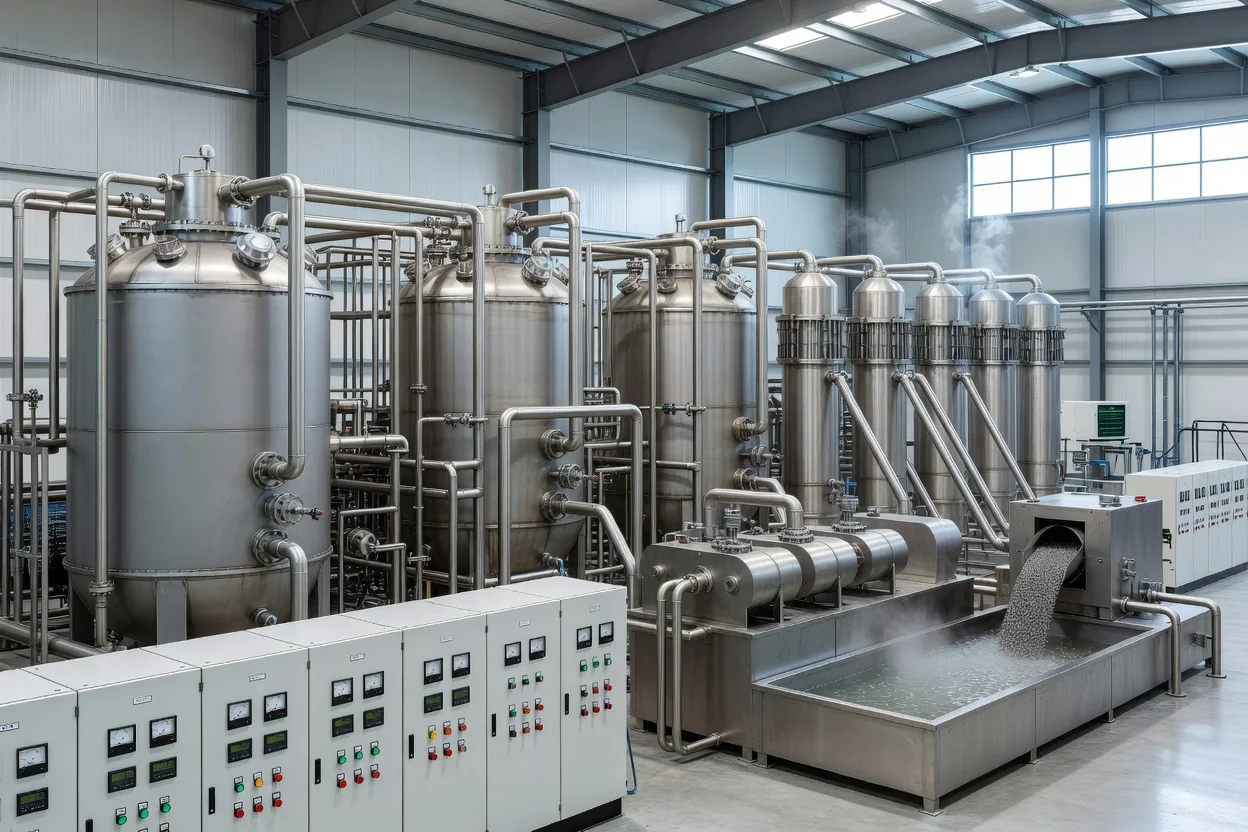
Commercial PPS is most commonly produced by condensation polymerization of a dihalogenated aromatic compound, especially para-dichlorobenzene, with sodium sulfide or related sulfide salts in a polar aprotic solvent such as N-methyl-2-pyrrolidone. The process chemistry is often carried out at elevated temperature and pressure, followed by purification, recovery, and pelletization or powder processing.
Typical feedstocks and process inputs
- Para-dichlorobenzene or related aromatic halides as the aromatic monomer.
- Sodium sulfide or sodium hydrosulfide-derived sulfide systems as the sulfur source.
- Polar aprotic solvent such as NMP to dissolve intermediates and support polymer growth.
- Water, salts, and low-molecular-weight by-products requiring downstream separation and purification.
Production pathway considerations
- Solution polymerization remains the mainstream industrial route, but it can generate low-molecular-weight fractions that affect gas evolution and processing behavior if not adequately controlled.
- Purification and fraction control are important for reducing volatiles, improving thermal stability, and ensuring consistent molding performance.
- Particle engineering matters for powder grades used in coatings, sintering, or specialty compounding, including narrow particle-size distributions.
Industry leadership
Publicly disclosed capacity is concentrated in a relatively small number of producers. Kureha reports PPS production at its Iwaki Factory in Japan and at Fortron Industries in the United States, with combined annual capacity of 32,700 tonnes. Celanese’s Fortron, DIC, and other established compounders and resin suppliers are also significant participants in the global PPS supply chain.
Applications and End-Use Markets
PPS is selected when a component must retain strength, insulation, and chemical resistance at elevated temperature. Its end-use profile is strongly shaped by grade selection, since neat resin, glass-filled, carbon-filled, and tribology-modified PPS serve different mechanical and thermal requirements.
| End-use sector | Typical PPS grade | Usual processing route | Why PPS fits |
|---|---|---|---|
| Automotive under-the-hood parts | Glass-filled or mineral-filled PPS | Injection molding | Heat, fluids, and dimensional stability |
| Electrical and electronics | Unfilled or glass-filled PPS | Injection molding | Dielectric performance, flame retardancy, precision molding |
| Chemical equipment | Filled or reinforced PPS | Injection molding, machining | Resistance to acids, bases, solvents, steam |
| Filtration media and nonwovens | Specialty PPS fibers or powder-based media | Fiber spinning, web formation | Hot gas and corrosive filtration |
| Industrial pumps, valves, seals | Filled PPS | Injection molding, machining | Wear resistance and chemical compatibility |
| Semiconductor equipment | High-purity filled PPS | Precision molding | Cleanliness, stability, low outgassing |
| Wear parts and bearings | PTFE- or lubricant-modified PPS | Injection molding | Low friction and abrasion resistance |
Major application areas
- Automotive: PPS is used in engine bay and fluid-handling parts such as sensors, connectors, pumps, valves, air intake components, and cooling-system hardware, where heat and chemical exposure are severe.
- Electrical and electronics: It is widely used for connectors, sockets, housings, relay parts, and precision insulating components because it combines flame resistance, low moisture uptake, and dimensional stability.
- Industrial and chemical processing: PPS serves in valves, bushings, pump components, nozzles, and wear parts where corrosive fluids and elevated temperature are routine.
- Semiconductor and precision equipment: High-purity grades are employed in fixtures, retaining rings, and other parts requiring dimensional stability and chemical resistance.
- Filtration: PPS is valuable in hot-gas filtration and chemically aggressive environments because it retains integrity under temperature and exposure conditions that degrade many alternative polymers.
Poor-fit use
PPS is a poor fit for flexible packaging and other applications that require softness, high optical clarity, or very low-cost large-volume film production, because its rigid semi-crystalline structure and high processing temperature are mismatched to those requirements.
Environmental and Sustainability Aspects
PPS has a mixed sustainability profile. Its strongest environmental advantage is durability: components often last longer, tolerate harsher operating conditions, and can enable material substitution that reduces metal mass and maintenance frequency. In many applications, longer service life can lower total lifecycle impact even if resin production is relatively energy-intensive.
Recyclability and circularity
- Mechanical recycling is possible for clean, segregated PPS scrap, especially industrial regrind from molding operations.
- Mixed waste recovery is difficult because PPS is often compounded with glass fiber, carbon fiber, or fillers that complicate reprocessing and property retention.
- Chemical recycling remains less mature than for major commodity polymers, so industrial practice still relies mainly on segregation, regrind reuse, and controlled compounding streams.
Bio-based and alternative feedstocks
There is no widely established bio-based PPS platform at commercial scale comparable to bio-based polyethylene or bio-PET. As a result, sustainability efforts have focused more on process efficiency, solvent management, energy reduction, and higher-value long-life applications than on bio-sourced monomers.
Carbon footprint and use-phase trade-off
- PPS manufacturing is associated with specialty-chemical complexity and high-temperature processing.
- The use phase can offset some of this burden when PPS replaces metals or lower-performance plastics in hot, corrosive environments.
- The best environmental cases are typically in applications where durability, lightweighting, and reduced maintenance materially improve lifecycle performance.
Economic and Global Market Impact
PPS occupies a premium segment of the engineering plastics market. Its price is substantially higher than that of commodity resins and generally above many standard engineering plastics, but it is justified in applications where failure at elevated temperature or in aggressive media would be expensive or unsafe.
Demand is closely tied to:
- Automotive electrification and under-the-hood thermal management.
- Growth in electronics and connectors.
- Industrial demand for chemical resistance and precision parts.
- Semiconductor and high-purity equipment.
Because PPS supply is concentrated among relatively few producers and compounders, the market is sensitive to capacity additions, feedstock economics, and regulatory constraints on solvent handling and emissions. This concentration can support quality consistency, but it also creates supply-chain exposure during maintenance outages or regional disruptions.
Current Challenges and Innovations
Current challenges
- Cost pressure: PPS remains more expensive than many competing engineering thermoplastics, which limits adoption in applications where performance headroom is not essential.
- Processing window: High melt temperature and crystallization control make mold design and processing discipline important.
- Compounding complexity: Fiber reinforcement improves stiffness but can reduce impact strength and complicate recycling.
- Environmental scrutiny: Solvent-heavy production and difficult end-of-life separation remain points of concern.
Ongoing innovations
- High-flow PPS grades for thin-wall and complex molded parts.
- Low-volatile, low-outgassing grades for electronics and precision equipment.
- Tribology-modified compounds using PTFE or lubricants to reduce friction and wear.
- Conductive and EMI-management formulations for electronics and smart mobility.
- Cleaner process development aimed at solvent recovery and lower emissions.
A practical formulation example is glass-fiber-filled PPS at about 30 to 40 wt%, commonly used to raise stiffness and heat distortion resistance for structural molded parts. Another example is PTFE-modified PPS for bearings and slide components, where the fluoropolymer additive lowers friction by forming a lubricious transfer film during sliding contact.
Future Outlook
PPS is likely to remain a strategic material where thermal, chemical, and electrical demands overlap. Its strongest future opportunities are in electrified vehicles, advanced connectors, compact thermal-management hardware, semiconductor equipment, and harsh-environment industrial systems.
Future growth will depend on:
- Further cost reduction through process optimization.
- Better recycling and re-use pathways for compounded scrap.
- Expanded use in lightweight metal replacement.
- Higher-purity grades for electronics and clean manufacturing.
- More sustainable production with improved solvent recovery and energy intensity.
If these developments progress, PPS should retain its role as a premium engineering polymer whose value lies not in volume alone, but in enabling reliable performance where failure margins are narrow.
References
- •
PPS plastics - Polyphenylene sulfide properties & applications. (2026, August 20). https://www.mcam.com/en/products/ppsLink
- •
Properties and application of polyphenylene sulfide (PPS). (2024, July 8). https://www.honyplastic.com/news/properties-and-application-of-polyphenylene-sulfide-pps-259914.htmlLink
- •
What is polyphenylene sulfide (PPS)? (2026, July 16). https://www.xometry.com/resources/materials/what-is-polyphenylene-sulfide-pps/Link
- •
Polyphenylene sulfide (PPS): Properties & uses. (2025, November 5). https://sabreen.com/terminology/polyphenylene-sulfide/Link
- •
Polyphenylene sulfide. (2004, June 17). In Wikipedia. https://en.wikipedia.org/wiki/Polyphenylene_sulfideLink
- •
Polyphenylene sulfide (PPS) plastic: Structure, material properties.... (2025, July 8). https://www.specialchem.com/plastics/guide/polyphenylene-sulfide-pps-plastic-guideLink
- •
Polyphenylene sulfide (PPS). (n.d.). https://www.makeitfrom.com/material-properties/Polyphenylene-Sulfide-PPSLink
- •
Polyphenylene sulfide (PPS): Properties, processing &.... (2025, December 30). https://salesplastics.com/polyphenylene-sulfide-pps-material/Link
- •
Polyphenylene sulphide PPS. (n.d.). https://www.bpf.co.uk/plastipedia/polymers/PPS.aspxLink
- •
PPS (polyphenylene sulfide). (n.d.). https://www.bearingworks.com/uploaded-assets/pdfs/retainers/pps-datasheet.pdfLink
- •
Poly(1,4-phenylene sulfide). (2024, January 2). https://www.chembk.com/en/chem/poly(1,4-phenylene%20sulfide)Link
- •
General purpose polyphenylene sulfide: Comprehensive analysis.... (n.d.). https://eureka.patsnap.com/materials/general-purpose-pps-analysisLink
- •
What are PPS compounds? (n.d.). https://www.dic-global.com/en/products/pps/about.htmlLink
- •
PPS: Polyphenylenesulfide. (n.d.). https://analyzing-testing.netzsch.com/en/polymers-netzsch-com/high-temperature-resistant-thermoplastics/pps-polyphenylenesulfideLink
- •
FORTRON® PPS. (n.d.). https://www.celanese.com/-/media/cewebjssapp/project/productdocuments/fortron-pps/pps-012-fortronshorttermproperties-tg-en-0916.ashxLink
- •
PPS vs PEEK. (n.d.). https://www.ensingerplastics.com/en-us/thermoplastic-materials/pps-plasticLink
- •
Thermoplastic polyphenylene sulfide: Comprehensive analysis of.... (n.d.). https://eureka.patsnap.com/materials/thermoplastic-pps-analysisLink
- •
Polyphenylene sulfide (PPS): A temperamental, yet invaluable.... (2026, July 10). https://polyfluoroltd.com/blog/polyphenylene-sulfide-pps-a-temperamental-yet-invaluable-polymer/Link
- •
PPS plastic: Properties, grades, processing & applications. (2025, December 7). https://www.rapid-protos.com/what-is-pps-plastic/Link
- •
Polyphenylene sulfide polymer: Comprehensive analysis of.... (n.d.). https://eureka.patsnap.com/materials/polyphenylene-sulfide-polymerLink
- •
Polyphenylene sulfide (PPS). (n.d.). https://res.cloudinary.com/sternwald-systems/raw/upload/v1/hugoprd/ARTIKEL_ATTACH/00243AB9_78CEFC080173/283431268c6979e4d42978eec318a51ec6e2030c/PE_2011_10_Polyphenylene-Sulfide-PPS.pdfLink
- •
PPS (polyphenylene sulfide). (2026, January 8). https://help.prusa3d.com/article/pps-polyphenylene-sulfide_788028Link
- •
Fortron KPS. (n.d.). https://www.kureha.co.jp/en/business/material/kps.htmlLink
- •
PPS (polyphenylene sulfide) precision manufacturing. (n.d.). https://insulfab.com/ppsLink
- •
Polyphenylene sulfide resin composition and method of manufacturing same. (2016, July 22). https://patents.google.com/patent/US10294330B2/jaLink
- •
Preparation method of PPS (polyphenylene sulfide) resin particles. (2016, April 12). https://patents.google.com/patent/CN105801885A/enLink
- •
ポリフェニレンスルフィド. (2007, March 2). In Wikipedia. https://ja.wikipedia.org/wiki/%E3%83%9D%E3%83%AA%E3%83%95%E3%82%A7%E3%83%8B%E3%83%AC%E3%83%B3%E3%82%B9%E3%83%AB%E3%83%95%E3%82%A3%E3%83%89Link
- •
Polyphenylene sulfide production plant DPR & unit setup. (2026, July 21). https://www.openpr.com/news/4582615/polyphenylene-sulfide-production-plant-dpr-unit-setup-2026Link
- •
Polyphenylene sulfide (PPS). (n.d.). https://res.cloudinary.com/sternwald-systems/raw/upload/v1/hugoprd/ARTIKEL_ATTACH/0024318F_582656AFAC81/236a1ec445ee0cd36bd295db9dd7771a1a73a8e4/PE_2007_10_Polyphenylene-Sulfide-PPS.pdfLink
- •
Polyphenylene sulfide member and its manufacturing method. (2002, February 21). https://patents.google.com/patent/EP1375574B1/enLink
- •
Polyphenylensulfid. (2006, May 31). In Wikipedia. https://de.wikipedia.org/wiki/PolyphenylensulfidLink
- •
PPS polyphenylene sulfide plastic grades. (2026, August 21). https://www.boedeker.com/Family/PPSLink
- •
Polyphenylene sulfide (PPS) manufacturers, suppliers, and distributors. (2025, January 1). https://www.matweb.com/reference/Manufacturers.aspx?MatGroupID=43Link
- •
Major players - polyphenylene sulfide PPS industry. (2025, January 1). https://www.coherentmarketinsights.com/blog/insights/major-players-polyphenylene-sulfide-pps-industry-1419Link
- •
Polyphenylene sulfide (PPS). (2022, January 24). https://drakeplastics.com/ultra-high-performance-plastic-materials-solutions-for-your-most-demanding-applications/polyphenylene-sulfide-pps/Link