
Introduction
Natural rubber is a renewable elastomer obtained primarily from the latex of Hevea brasiliensis and valued for its exceptional elasticity, strain-induced crystallization, fatigue resistance, and low heat buildup in dynamic service. It remains a foundational raw material in the plastics-and-elastomers value chain, especially where repeated flexing, impact absorption, and high resilience are more important than chemical or weather resistance.
Industrial natural rubber is not a single material but a family of grades and forms, including field latex, concentrated latex, ribbed smoked sheet, technically specified rubber, and compound-ready bales. Its development has been shaped by plantation agriculture, vulcanization chemistry, tire engineering, and increasingly by sustainability concerns such as deforestation risk, traceability, farmer livelihoods, and the need for circular material systems.
History and Development
Natural rubber was used long before modern polymer science, with early indigenous processing of latex from tropical plants predating industrial production by centuries. The modern industry expanded after the global commercialization of Hevea brasiliensis plantations and the discovery of vulcanization, which transformed a sticky, temperature-sensitive material into a durable engineering elastomer suitable for tires, seals, and mechanical goods.
The rise of the automotive industry made natural rubber strategically important, particularly for tires, where its combination of wet grip, crack resistance, and dynamic durability remains difficult to replace in full with synthetic alternatives. Today, the material competes and blends with synthetic rubbers, but it still occupies a critical role in high-performance tire compounds and many vibration-control products.
Chemical Structure and Key Properties
Natural rubber is composed mainly of cis-1,4-polyisoprene, a long-chain hydrocarbon elastomer formed biologically from isoprenoid precursors in latex-producing plants. Its long, flexible chains can align under strain and partially crystallize, which helps explain its high tensile strength and excellent tear resistance compared with many other elastomers.
Key properties
- High elasticity and large reversible deformation, which make it suitable for shock loading and repeated flexing.
- High tensile and tear strength, especially after compounding and vulcanization.
- Low hysteresis, which reduces heat buildup in dynamic applications such as tires and mounts.
- Good abrasion resistance, useful in conveyor belts, footwear, and vibration-control parts.
- Good tack and green strength, which improve handling in tire and adhesive manufacturing.
Important limits
- Poor oil and solvent resistance → hydrocarbon swelling and softening → use nitrile rubber, fluorocarbon rubber, or protective blend formulations instead.
- Poor ozone and weather resistance → chain cracking at stressed surfaces → use antiozonants, waxes, carbon black, or switch to EPDM or other weathering-resistant elastomers.
- Limited barrier performance compared with specialty barrier polymers → high gas and grease permeability → use multilayer structures or barrier liners when permeability matters.
- Latex-protein sensitivity in some healthcare uses → allergic reactions in susceptible users → use low-protein latex grades or non-latex alternatives.
Practical formulation examples
- Carbon black at roughly 30–50 phr is commonly used in reinforcing natural rubber compounds; it increases modulus, abrasion resistance, and fatigue life by interacting with the polymer matrix at the nanoscale.
- Sulfur vulcanization at about 1–3 phr sulfur with accelerators and activators forms crosslinks between polymer chains, converting the raw elastomer into a dimensionally stable engineering material with higher resilience and heat resistance.
Production Processes and Raw Feedstocks
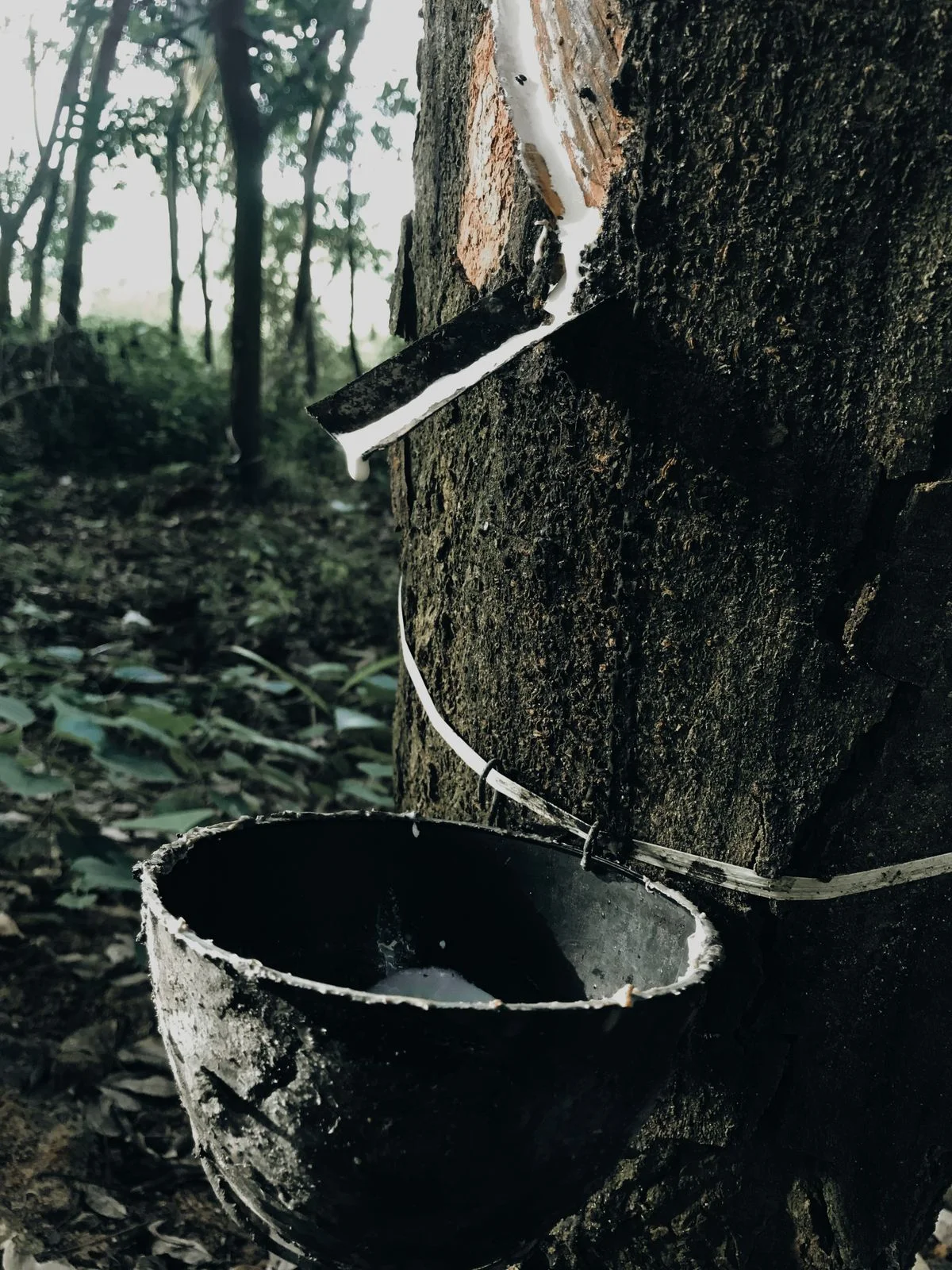
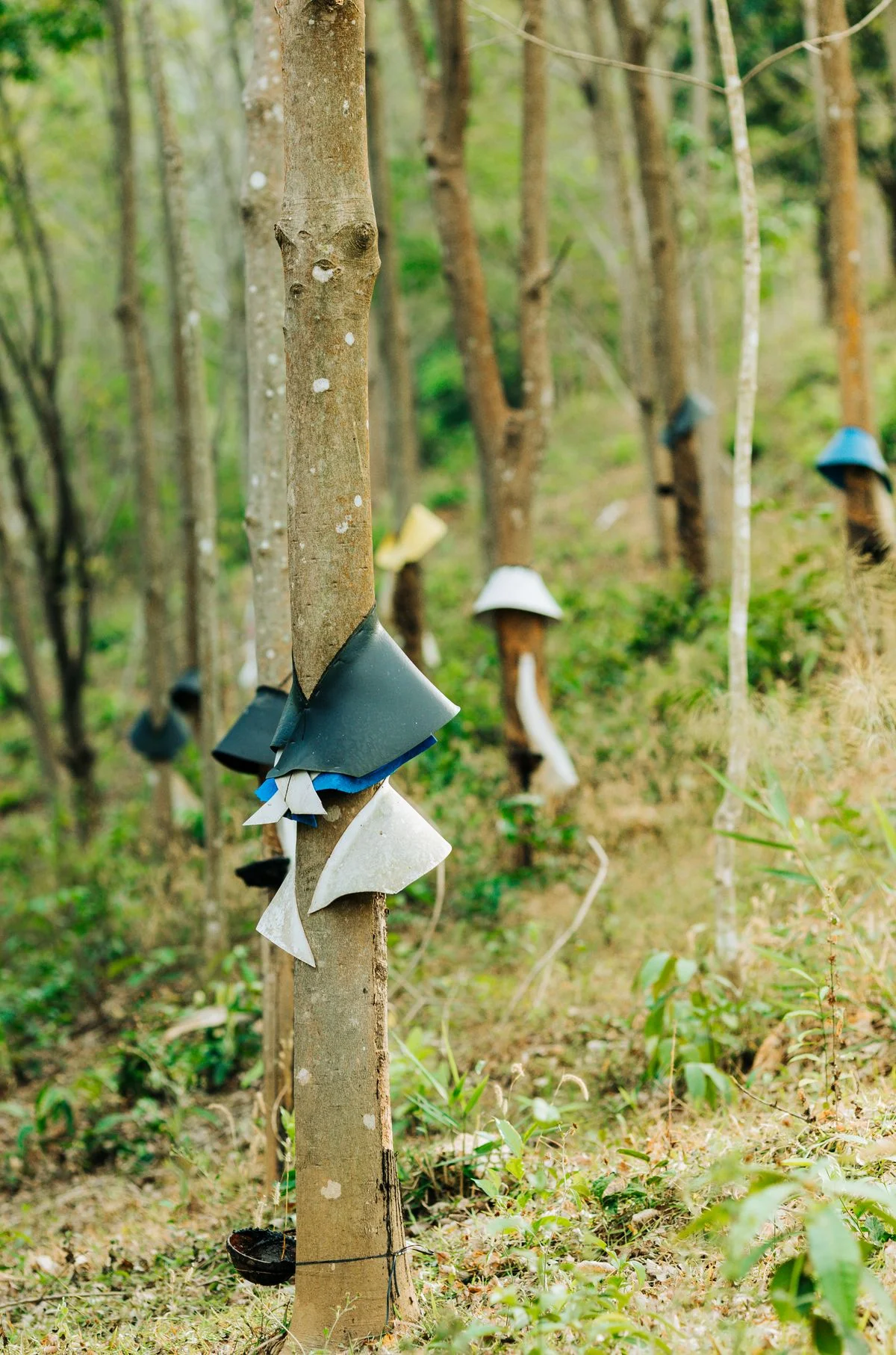
Natural rubber begins in tropical plantation systems where latex is harvested from rubber trees by controlled tapping of the bark. The latex is then preserved, transported, and processed into dry rubber or concentrated latex depending on the intended end use.
Main feedstocks and process routes
- Field latex is collected directly from tapping and is commonly stabilized with ammonia or other preservatives to prevent premature coagulation.
- Coagulum and cup lump are used for dry rubber production and technically specified rubber grades.
- Concentrated latex is typically produced by centrifugation and is used in dipped goods, foams, threads, and medical or hygienic products.
Typical processing sequence
- Tapping and collection of latex from Hevea brasiliensis.
- Stabilization, filtration, and transport to processing facilities.
- Coagulation using acid, or concentration by centrifugation for latex grades.
- Milling, sheeting, drying, or smokehouse curing for sheet rubber.
- Compounding with fillers, oils, sulfur, accelerators, and antioxidants.
- Vulcanization to create the final performance profile.
Applications and End-Use Markets
Natural rubber is most valuable where dynamic mechanical performance dominates. Its market is therefore concentrated in transportation, industrial equipment, construction, healthcare, and consumer goods.
| End-use sector | Typical grade | Common processing route | Why natural rubber is used |
|---|---|---|---|
| Tires | Technically specified rubber, blended compounds | Mastication, compounding, vulcanization | Traction, fatigue resistance, tear strength, low heat buildup |
| Belts and hoses | Dry rubber compounds | Mixing, extrusion, vulcanization | Flex fatigue and abrasion resistance |
| Seals and gaskets | Compounded NR or blends | Mixing, molding | Elastic recovery and cost efficiency |
| Anti-vibration mounts and bushings | High-resilience NR compounds | Compression or transfer molding | Low hysteresis and shock absorption |
| Footwear and sports goods | Sheet rubber and compounded NR | Molding, calendering | Grip, flexibility, comfort |
| Gloves, balloons, dipped goods | Concentrated latex | Dipping and curing | Thin-film elasticity and extensibility |
| Medical and hygiene products | Low-protein latex or specialized compounds | Dipping, leaching, curing | Stretch and film-forming behavior |
| Conveyor belts and linings | Reinforced NR compounds | Calendering, molding | Abrasion resistance and dynamic durability |
Major application sectors
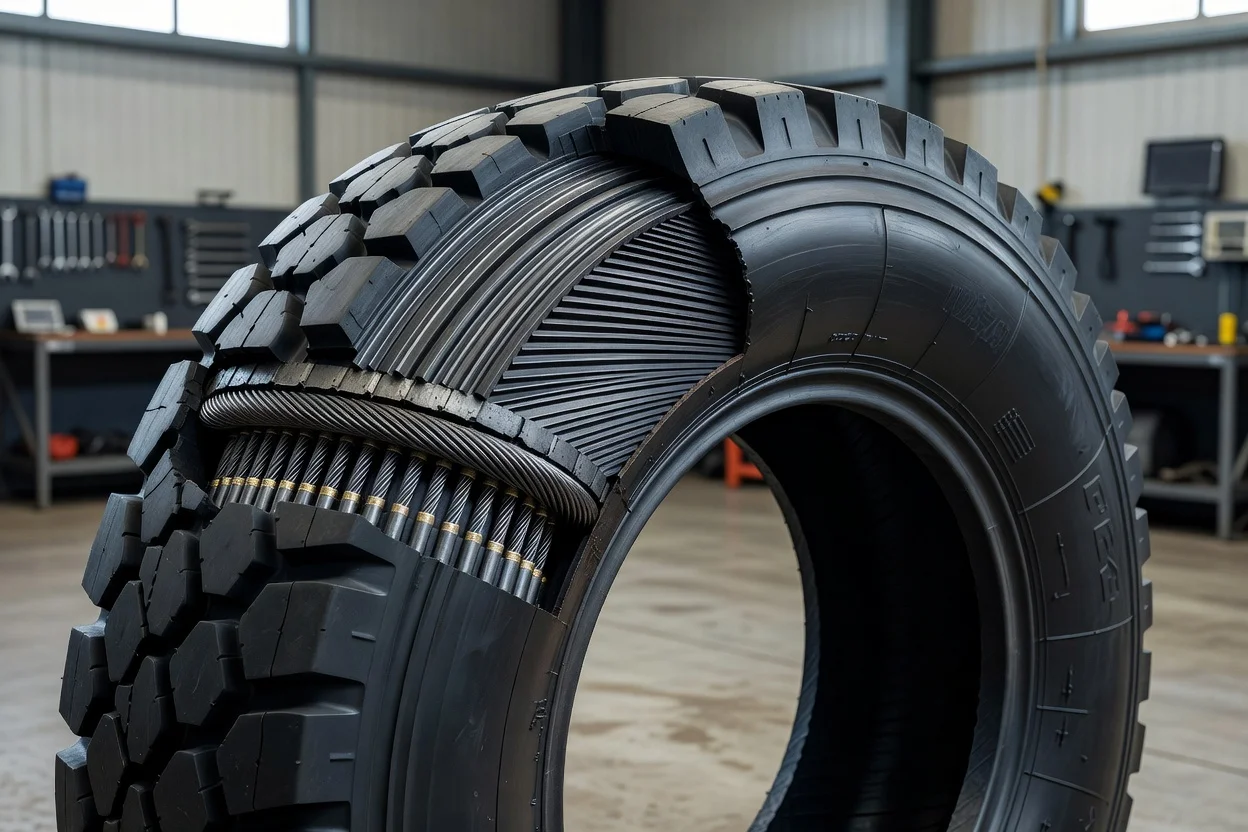
- Tires: The dominant outlet for natural rubber, especially in truck, bus, off-road, aircraft, and high-performance tire formulations.
- Industrial goods: Conveyor belts, hoses, couplings, anti-vibration mounts, engine mounts, diaphragms, and flexible connectors benefit from NR’s fatigue resistance.
- Construction and civil engineering: Bridge bearings, seismic isolation pads, expansion joints, and fenders exploit resilience and load recovery.
- Consumer and sporting goods: Footwear, mats, erasers, balls, and elastic components are common uses.
- Healthcare and latex products: Gloves, catheters, condoms, and elastic medical goods often use latex grades, subject to protein and sensitization constraints.
- Specialty uses: Adhesives, coatings, and rubber thread products use concentrated latex or lightly compounded NR.
A poor-fit use
Natural rubber is a poor fit for oil-immersed or hydrocarbon-solvent service because swelling and property loss can occur; nitrile, fluoroelastomers, or blends are usually more suitable.
Environmental and Sustainability Aspects
Natural rubber has a mixed sustainability profile. Its renewable biological origin is a major advantage over petrochemical elastomers, but land use, biodiversity impacts, labor conditions, and supply-chain traceability can create serious environmental and social burdens if plantations are poorly managed.
Advantages
- Renewable feedstock: The carbon in the polymer originates from plant biomass rather than fossil hydrocarbons.
- Long service life in demanding uses: High fatigue resistance can reduce replacement frequency in tires and industrial parts.
- Potential for responsible sourcing: Traceability systems and sustainability standards are expanding in major tire supply chains.
Challenges
- Land-use change and deforestation risk: Plantation expansion can threaten biodiversity if not managed responsibly.
- Supply concentration: Production is heavily concentrated in tropical regions, creating geopolitical and climatic exposure.
- Allergen concerns: Latex proteins can trigger sensitization in some users, especially in medical and hygiene products.
- End-of-life complexity: Vulcanized rubber is difficult to remelt or reprocess like thermoplastics, which limits closed-loop recycling.
Recyclability and circularity
Natural rubber is not thermoplastic and therefore cannot be remelted into new parts after vulcanization. Recycling generally relies on grinding into crumb, devulcanization, energy recovery, or incorporation into lower-value rubber products, although these routes usually do not fully restore virgin performance.
Bio-based alternatives and substitutes
- Synthetic polyisoprene can mimic some properties of natural rubber while avoiding agricultural supply constraints.
- Guayule and dandelion-derived rubber are being developed as alternative botanical sources, mainly to diversify supply and reduce dependence on tropical plantations.
- Blends with synthetic rubbers are common when producers want to balance dynamic performance, weather resistance, and processability.
Economic and Global Market Impact
Natural rubber is a strategically important commodity because tire manufacturing alone consumes a large share of global output, linking the material to automotive production, freight movement, and global trade flows. Recent industry analyses continue to place Southeast Asia at the center of production, with Hevea brasiliensis cultivation and downstream processing especially important in Thailand, Indonesia, Vietnam, and Malaysia.
The market is shaped by plantation yields, labor availability, monsoon patterns, and tire demand. Price volatility affects growers and processors, while large tire companies increasingly emphasize responsible sourcing, traceability, and deforestation-free supply chains.
Current Challenges and Innovations
Key challenges
- Climate sensitivity: Rubber trees require tropical conditions and are vulnerable to weather variability, disease pressure, and yield swings.
- Fungus and disease management: Plantation health is critical to stable supply.
- Performance trade-offs: NR excels dynamically but performs poorly in oils, ozone, and some harsh chemical environments.
- Sustainability scrutiny: Buyers increasingly require traceability and environmental compliance.
Innovation directions
- Improved cloning and agronomy for higher-yield, disease-resistant trees.
- Low-protein latex processing to reduce allergenicity in medical products.
- Advanced compounding with silica, coupling systems, and optimized carbon black to improve rolling resistance and wear balance in tires.
- Devulcanization and recycling technologies to recover higher-value rubber from post-consumer products.
- Alternative feedstocks such as guayule for climate diversification.
Future Outlook
Natural rubber is likely to remain indispensable in tires, vibration-control components, and selected latex products because no single substitute fully matches its combination of elasticity, fatigue life, and reinforcement potential. The most important changes will probably involve more traceable sourcing, more efficient plantations, lower-allergen latex grades, and tighter integration with circularity strategies in tire and industrial-rubber systems.
The strategic challenge for the industry is not whether natural rubber will remain relevant, but how it can be produced with lower land-use risk, better social transparency, and improved end-of-life recovery while preserving the performance advantages that keep it central to global elastomer demand.
Summary
Natural rubber is a renewable, high-performance elastomer whose value comes from its cis-1,4-polyisoprene structure, strain-crystallizing behavior, and exceptional dynamic mechanical properties. It is most important in tires, industrial rubber goods, vibration-control parts, and latex products, while its main weaknesses are oil sensitivity, ozone sensitivity, and difficult recycling after vulcanization.
References
- •
How is rubber made? (2020, December 1). ERCA. https://erca.cefic.org/how-is-rubber-made/Link
- •
What is natural rubber? Properties, applications & more. (2022, September 29). Lake Erie Rubber. https://lakeerierubber.com/what-is-natural-rubber-properties-applications-more/Link
- •
Natural rubber. (2002, February 9). In Wikipedia. https://en.wikipedia.org/wiki/Natural_rubberLink
- •
All about natural rubber – Properties, applications and uses. (2025, October 10). Thomas Net. https://www.thomasnet.com/articles/plastics-rubber/what-is-natural-rubber/Link
- •
NR–natural rubber: High elasticity with limited media resistance. (2026, June 23). GUMe. https://www.gume.de/en/natural-rubber/Link
- •
NR rubber – Definition, types, properties, applications. (2024, March 9). Inpart24. https://inpart24.com/en/resources/article/68/natural-rubber-nr-rubber-definition-types-properties-applicationsLink
- •
Natural rubber: Properties, production, applications. (2025, April 21). College Search. https://www.collegesearch.in/articles/natural-rubberLink
- •
Natural rubber: Production, properties and applications. (n.d.). https://2024.sci-hub.se/6081/024c4d77464cbbc12b5f67c3ec107733/[email protected]Link
- •
How natural rubber is produced from tree to industrial raw material. (2026, July 7). Terabox. https://posts.terabox.com/hub/how-natural-rubber-is-produced-from-tree-to-industrial-raw-materialLink
- •
Natural rubber and synthetic rubber: Definition and history. (2024, October 19). Careers360. https://www.careers360.com/chemistry/natural-rubber-and-synthetic-rubber-topic-pgeLink
- •
NR / natural rubber – All knowledge. (2025, August 30). Savvy Rubber. https://savvyrubber.com/what-is-nr-natural-rubber/Link
- •
Natural rubber / latex – Production of natural rubber. (2006, November 9). AZoM. https://www.azom.com/article.aspx?ArticleID=3580Link
- •
Natural rubber at a glance. (n.d.). Michelin. https://natural-rubber.michelin.com/natural-rubber-by-michelin/natural-rubber-at-a-glanceLink
- •
What is natural rubber and why are we searching for new sources? (2019, July 19). Frontiers for Young Minds. https://kids.frontiersin.org/articles/10.3389/frym.2019.00100Link
- •
Natural rubbers in industry – Properties and uses. (2025, May 14). Helsingin Kumi Oy. https://www.helsinginkumi.fi/en/luonnonkumit/Link
- •
Natural rubber: Properties, uses, and industrial applications. (2025, January 1). Rubber and Seal. https://www.rubberandseal.com/nature-rubber-material/Link
- •
16 uses of natural rubber. (2025, November 11). Rubber-Cal. https://rubbercal.com/uses-of-natural-rubberLink
- •
What is natural rubber? (2025, March 24). Killarney Metals. https://www.killarneymetals.com/media/blog/311-what-is-natural-rubber.htmlLink
- •
Rubber. (1998, July 20). In Encyclopædia Britannica. https://www.britannica.com/science/rubber-chemical-compoundLink
- •
From tree to tyre: The complete guide to natural rubber. (2023, November 17). Rheometer Spares. https://rheometerspares.com/guide-to-natural-rubberLink
- •
Natural rubber. (n.d.). International Rubber Study Group. https://www.rubberstudy.org/natural-rubberLink
- •
Unveiling the journey of natural rubber, from production process to diverse applications. (2024, May 28). LinkedIn. https://www.linkedin.com/pulse/unveiling-journey-natural-rubber-from-production-process-diverse-oiu9cLink
- •
What are the special applications of SMR20? (2022, May 27). Rubber Malaysia. https://rubbermalaysia.com/2022/05/27/special-applications-of-natural-rubber-and-synthetic-rubber/Link
- •
Natural rubber – What is it? (2022, November 25). Reichelt Chemietechnik. https://www.rct-online.de/magazin/en/natural-rubber/Link
- •
Natural rubber and synthetic rubber. (2023, June 2). BYJU'S. https://byjus.com/chemistry/natural-rubber-and-properties/Link
- •
Uses of rubber in everyday life: Chemistry explained. (2025, September 4). Vedantu. https://www.vedantu.com/chemistry/uses-of-rubberLink
- •
How is natural rubber made? (2023, May 22). Apple Rubber. https://www.applerubber.com/blog/how-is-natural-rubber-made/Link
- •
Natural rubber. (n.d.). Institute of Making. https://www.instituteofmaking.org.uk/materials-library/library/natural-rubberLink
- •
What is natural rubber? (2025, January 22). RIS Rubber. https://www.risrubber.com/en/knowledge-base/what-is-natural-rubber/Link
- •
Natural vs. synthetic rubber vs plastics: Top differences and why you should go natural. (n.d.). Yulex. https://www.yulex.com/post/natural-vs-synthetic-rubber-top-differences-and-why-you-should-go-naturalLink
- •
Rubber. (2021, December 19). GeeksforGeeks. https://www.geeksforgeeks.org/chemistry/rubber/Link
- •
Uses of natural rubber, you must know! (2015, January 15). https://natural-rubber.blogspot.com/2015/01/uses-of-natural-rubber-latex-product.htmlLink
- •
Natural rubber (NR) | Properties, grades & applications. (2026, April 14). Wayne Rubber. https://waynerubber.com/materials/natural-rubber/Link
- •
The manufacturing process of rubber. (2022, March 24). Sciencing. https://www.sciencing.com/manufacturing-process-rubber-5206099/Link
- •
Rubber manufacturing process explained for industrial use. (2020, February 11). Khatabook. https://khatabook.com/blog/industrial-rubber-manufacturing-process/Link
- •
Natural and synthetic rubber. (2025, January 1). In Britannica Kids. https://kids.britannica.com/students/article/natural-and-synthetic-rubber/276807Link
- •
Natural rubber: Comprehensive analysis of biosynthesis, processing, applications. (n.d.). Eureka Patsnap. https://eureka.patsnap.com/materials/natural-rubber-biosynthesis-processing-applicationsLink
- •
Difference between “latex,” “natural rubber,” “natural rubber latex,” and “dry natural rubber”. (2014, December 1). West Pharmaceutical Services. https://www.westpharma.com/blog/2014/december/the-difference-between-latex-natural-rubber-natural-rubber-latex-and-dry-natural-rubberLink
- •
Natural rubber. (2020, September 30). EBSCO. https://www.ebsco.com/research-starters/science/natural-rubberLink
- •
Uses of rubber. (2022, August 8). BYJU'S. https://byjus.com/chemistry/uses-of-rubber/Link
- •
A guide to natural vs. synthetic rubber. (2026, January 15). APIMIX. https://apimix.net/a-guide-to-natural-vs-synthetic-rubber/Link
- •
How rubber is made for industrial uses. (2022, January 3). Airboss. https://airboss.com/how-rubber-is-made-for-industrial-uses/Link
- •
Responsibly sourced natural rubber. (2026, January 21). Continental Tires. https://www.continental-tires.com/about-us/sustainability/activities-and-initiatives/design-and-sourcing/naturalrubber/Link
- •
Rubber manufacturing & process. (2021, October 5). Kent Elastomer Products. https://www.kentelastomer.com/rubber-manufacturing/Link
- •
Biosynthesis of natural rubber: Current state and perspectives. (2018, December 22). PMC. https://pmc.ncbi.nlm.nih.gov/articles/PMC6337083/Link
- •
Natural or synthetic rubber? (n.d.). Canada Rubber Group. https://www.canadarubbergroup.com/en-ca/blog/natural-or-synthetic-rubber/Link
- •
Types and applications of rubber. (2026, September 2). Scribd. https://www.scribd.com/document/635626755/552-Shazia-RubberLink