
Introduction
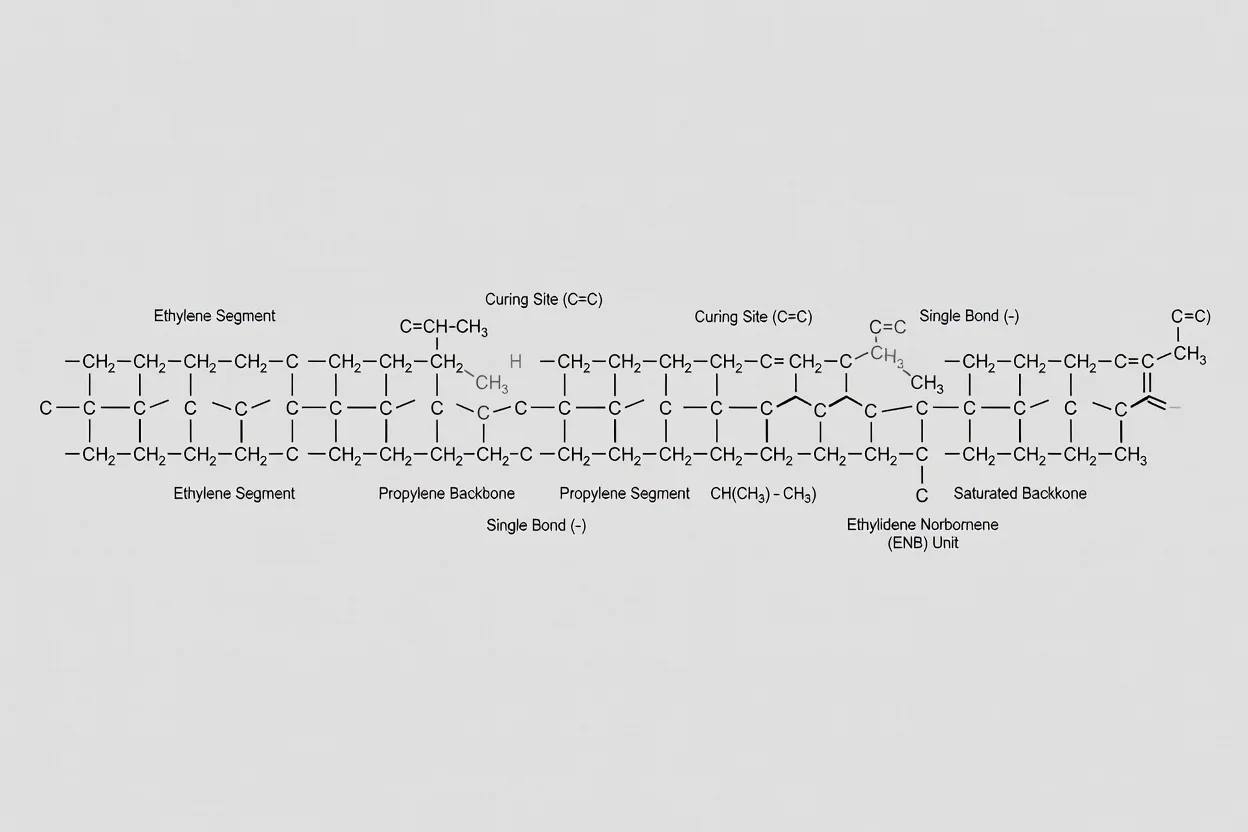
EPDM (ethylene propylene diene monomer rubber) is a synthetic elastomer valued for its exceptional resistance to weathering, ozone, heat, steam, and many polar chemicals. It is built from ethylene, propylene, and a small amount of a non-conjugated diene that supplies curing sites, while the main polymer backbone remains largely saturated; this structure is the basis of its durability and long service life in demanding outdoor and sealing applications.
EPDM is one of the most important general-purpose specialty rubbers in the plastics and elastomers value chain because it combines low density, good electrical insulation, and tunable elasticity with processability in extrusion, molding, and sheet production. At the same time, it has clear limitations: poor resistance to oils and hydrocarbons is caused by its non-polar polyolefin-like structure, and low unfilled mechanical strength arises because the polymer is amorphous and noncrystallizing; in practice, these limits are addressed through reinforcing fillers, compounding, and careful cure-system selection.
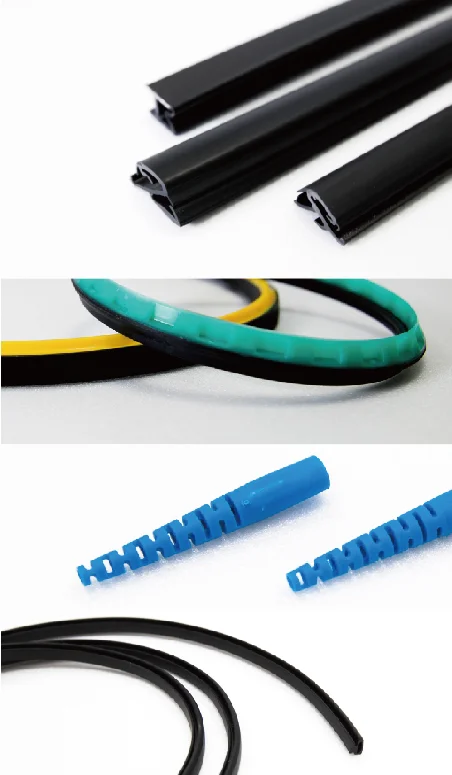
The material was developed and commercialized in the early 1960s and has since expanded from niche sealing uses into automotive weatherstrips, roofing membranes, cable insulation, industrial hoses, geomembranes, potable-water components, and thermoplastic vulcanizates. Current industry development is increasingly shaped by process efficiency, catalyst innovation, recycled-content strategies, and efforts to reduce the environmental footprint of elastomer production and end-of-life management.
History and Development
EPDM emerged as part of the broader postwar expansion of synthetic rubbers, which sought materials that could outperform natural rubber in weathering and thermal stability. Its commercialization in the early 1960s reflected advances in coordination catalysis and the ability to polymerize ethylene and propylene with a small amount of a diene monomer while maintaining a mostly saturated backbone.
Over time, production technology moved toward continuous solution polymerization and later adapted variations such as slurry and gas-phase approaches for selected grades and process economics. Improvements in catalyst systems, especially Ziegler-Natta and later metallocene-based options, have supported tighter control of molecular weight, comonomer distribution, and processability.
Chemical Structure and Key Properties
EPDM is a terpolymer made from ethylene, propylene, and a non-conjugated diene such as ethylidene norbornene, dicyclopentadiene, or 1,4-hexadiene. The diene is used at low levels, typically only a few percent of the formulation, to provide residual unsaturation for sulfur or peroxide vulcanization while preserving the saturated nature of the main chain.
Structure-property relationships
- The saturated backbone gives EPDM high resistance to ozone, UV radiation, oxidation, weathering, and steam.
- The non-polar chemistry gives good compatibility with water, dilute alkalis, and polar fluids, but poor compatibility with oils, fuels, and many hydrocarbons.
- The amorphous, noncrystallizing character makes unfilled EPDM mechanically weak on its own, so carbon black, silica, oils, and other reinforcements are commonly used.
- The low specific gravity is attractive in lightweight sealing and insulation applications.
Typical performance profile
- Hardness: commonly adjustable across a wide Shore A range through compounding.
- Temperature resistance: useful at low temperatures and up to roughly 120 to 150 C in many service conditions, depending on grade and cure system.
- Compression set: often a defining design criterion for gaskets and seals because good recovery helps maintain sealing force over time.
- Electrical insulation: one reason EPDM is widely used in wire and cable systems and electrical accessories.
Key limitations and workarounds
| Limitation | Cause | Common workaround |
|---|---|---|
| Poor oil and fuel resistance | Non-polar, saturated polyolefin-like structure | Use alternative elastomers such as NBR, HNBR, FKM, or fluorosilicone when hydrocarbon exposure is high |
| Low unfilled tensile strength and tear resistance | Amorphous, noncrystallizing morphology | Add reinforcing fillers such as carbon black or silica and optimize crosslink density |
| Limited structural rigidity | Elastomeric molecular architecture | Form blends, use fabric or metal reinforcement, or switch to thermoplastic vulcanizates for semi-rigid parts |
Production Processes and Raw Feedstocks
EPDM is typically manufactured from ethylene, propylene, and a diene comonomer supplied in purified form from the petrochemical chain. Industrial production most commonly uses solution polymerization in hydrocarbon solvent, although slurry and gas-phase variants also exist in commercial practice.
Main production stages
- Feed preparation: monomers are purified, compressed, and metered, and catalyst systems are prepared under tightly controlled conditions.
- Polymerization: ethylene, propylene, and the diene are reacted in a continuous stirred reactor or related system, with the catalyst determining molecular architecture and comonomer incorporation.
- Catalyst deactivation and recovery: the catalyst is removed or quenched, solvent is recovered, and unreacted monomers are recycled where possible.
- Finishing: the polymer is washed, dewatered, dried, and often pelletized or baled for shipment; anti-agglomerants and other auxiliaries may be used to maintain crumb handling quality.
Typical formulation and compounding inputs
After polymer manufacture, EPDM is compounded for end use with:
- Carbon black or silica as reinforcing fillers and rheology modifiers.
- Processing oils to adjust flexibility and low-temperature behavior.
- Sulfur, peroxide, accelerators, and coagents to control crosslink density and cure speed.
- Antioxidants and antiozonants to improve long-term durability.
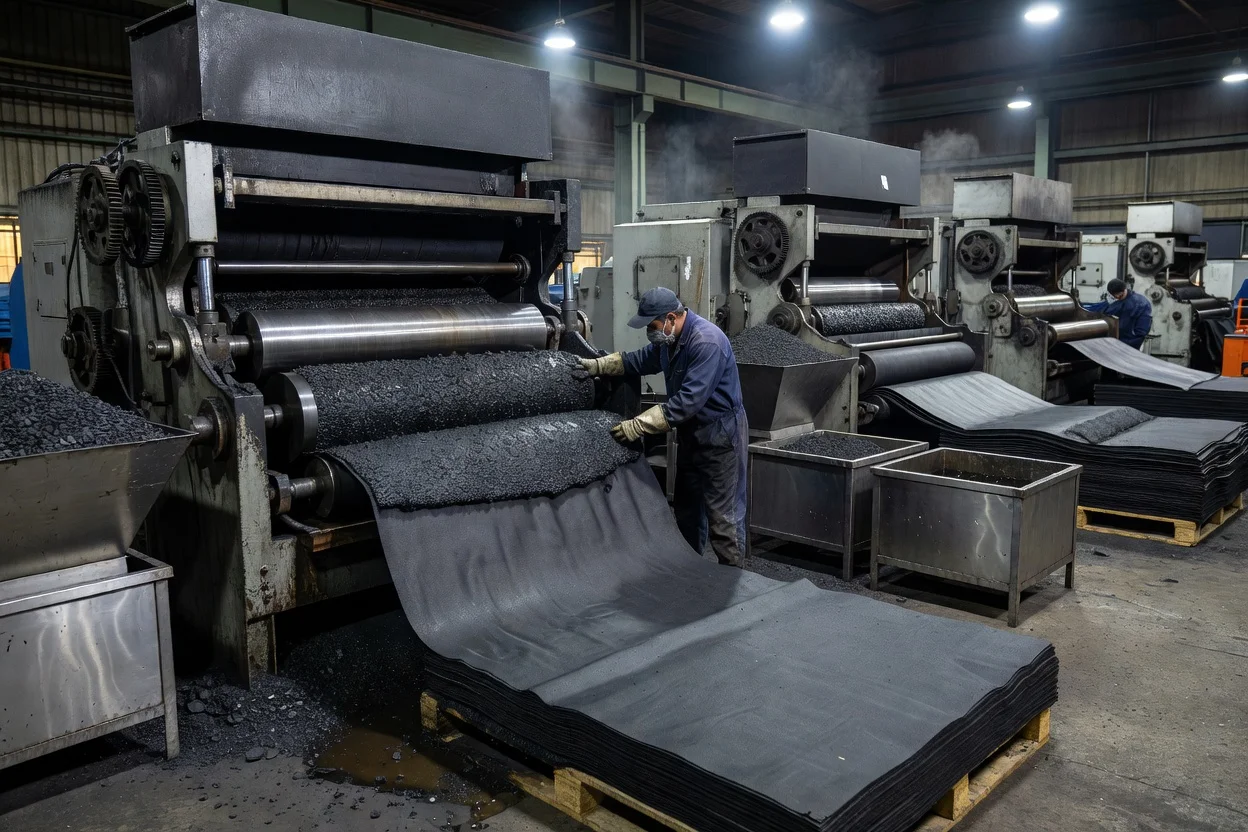
A practical example is a roofing or seal compound containing carbon black at a substantial loading to improve reinforcement and weathering resistance, while sulfur cure systems are used to create a flexible network with good recovery. In sulfur-cured grades, the diene sites enable crosslinks; in peroxide-cured grades, the diene can act as a coagent to support a more heat-stable network.
Applications and End-Use Markets
EPDM is used wherever long-term outdoor durability, sealing reliability, and resistance to polar media matter most. Its main markets are construction, automotive, electrical, water management, and industrial goods.
Major end uses
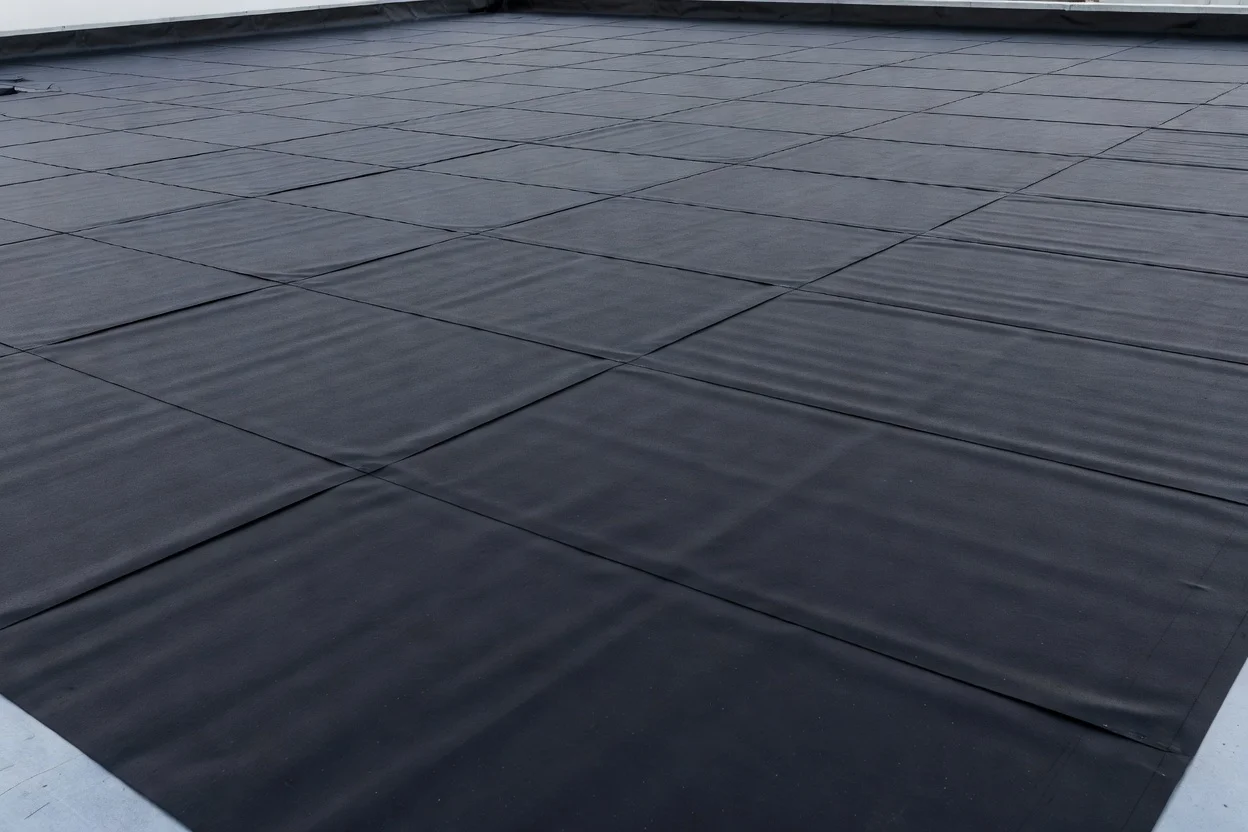
- Roofing membranes and waterproofing: EPDM sheet is widely used for flat roofs, pond liners, and below-grade waterproofing because of its weatherability, low maintenance, and flexible sheet fabrication.
- Automotive weatherseals and hoses: door seals, window seals, radiator and coolant hoses, vibration-damping parts, and under-hood components benefit from heat and ozone resistance.
- Wire and cable: EPDM is used in cable insulation and jacketing where thermal stability and electrical resistance are needed.
- Industrial seals and gaskets: static seals, O-rings, expansion joints, valve components, and tank seals use its compression-set performance and chemical resistance.
- Water and potable-water components: selected grades are used in gaskets, hoses, and fittings in contact with water and, where approved, drinking-water systems.
- Geomembranes and environmental liners: its weatherability and sheet-forming ability make it suitable for containment and barrier applications.
- Thermoplastic vulcanizates and modified polyolefins: EPDM is used as the elastomeric phase in impact-modified plastics and rubber-plastic blends.
- UHMWPE wear and medical systems: EPDM is not a primary material of choice here; it is a poor-fit for high-wear sliding parts or blood-contact applications that require different abrasion, sterilization, or biocompatibility profiles.
Process fit by application
| End use | Typical EPDM form | Common process |
|---|---|---|
| Roofing membrane | Sheet | Calendering, extrusion, sheet lamination, vulcanization |
| Weatherstripping | Profile compound | Extrusion and post-cure |
| Hoses and tubing | Extruded compound | Continuous extrusion and curing |
| O-rings and seals | Molded compound | Compression, transfer, or injection molding |
| Cable insulation | Compound for jacketing | Extrusion and crosslinking |
| Geomembranes | Large sheet | Sheet extrusion and bonding |
Environmental and Sustainability Aspects
EPDM is durable in service, which is environmentally beneficial when long lifetimes reduce replacement frequency, especially in roofs, seals, and infrastructure liners. Its resistance to UV, ozone, and weathering is a major sustainability advantage because premature failure is a key driver of material waste in outdoor elastomer applications.
Recyclability and end of life
- Mechanical recycling: post-industrial scrap can often be reprocessed more readily than heavily crosslinked post-consumer waste.
- Vulcanized waste: conventional EPDM thermoset waste is difficult to remelt, so recycling options are limited compared with thermoplastics.
- Downcycling and blending: ground rubber may be used in mats, modified asphalt, or secondary products.
- Devulcanization and chemical recycling: these routes are being explored, but they remain technically and economically more challenging than recycling of thermoplastics.
Bio-based and lower-carbon pathways
- Bio-based ethylene can reduce fossil feedstock dependence, but the diene and many auxiliaries are still usually petrochemical.
- Recycled-content systems may be possible in certain compounded products, especially where performance requirements are less severe.
- Process decarbonization focuses on solvent recovery, energy efficiency, catalyst productivity, and emissions control in polymer plants.
EPDM therefore occupies a nuanced sustainability position: it is not inherently circular in the way that thermoplastics are, but its long life can offset some upstream footprint, and current innovation is aimed at improving both manufacture and end-of-life options.
Economic and Global Market Impact
EPDM is a globally traded elastomer with production concentrated among a limited number of large manufacturers that operate integrated petrochemical and rubber assets. The market is closely tied to construction activity, automotive output, industrial maintenance cycles, and weatherproofing demand.
Key economic features include:
- dependence on ethylene and propylene supply and pricing;
- sensitivity to energy costs because purification, solvent recovery, and drying are energy-intensive;
- grade differentiation based on ethylene content, Mooney viscosity, diene type, oil extension, and cure system.
Leading producers commonly include major international chemical companies and regional specialists in Asia, Europe, and North America; production leadership can shift by region as capacities are added, rationalized, or integrated with downstream compounding.
Current Challenges and Innovations
- Hydrocarbon incompatibility: EPDM remains unsuitable for oil- and fuel-rich environments, keeping demand for alternative elastomers strong in automotive and industrial sealing.
- Thermoset recycling: end-of-life treatment remains the central sustainability challenge because standard EPDM vulcanizates cannot be remelted.
- Process efficiency: plants continue to refine catalyst systems, solvent recovery, and finishing operations to reduce energy use and emissions.
- Performance tuning: metallocene catalysts, better filler dispersion, and advanced cure packages are being used to widen process windows and tighten property control.
- Thermoplastic vulcanizates: EPDM-based TPVs provide a route to elastomeric performance with improved processability and recyclability relative to fully crosslinked rubber.
Future Outlook
EPDM is expected to remain a core elastomer for weather-sealing, roofing, cable, and water-management systems because its combination of durability and cost-performance is difficult to replace. Future growth is likely to be shaped by three forces: more energy-efficient production, broader use of lower-carbon feedstocks, and continued expansion of recyclable or partially recyclable EPDM-containing materials.
In application terms, the strongest opportunities are likely in long-life infrastructure, electric-vehicle sealing systems, cable protection, and durable construction membranes, where weathering resistance and service life are still decisive performance metrics. In sustainability terms, the main technical frontier is not replacing EPDM’s intrinsic weatherability, but reducing the footprint of how it is made and how spent vulcanizates are managed at end of life.
Summary
EPDM is a high-durability synthetic rubber whose saturated backbone, tunable diene content, and versatile compounding make it indispensable in outdoor sealing, roofing, automotive, electrical, and industrial applications. Its main strengths are weather resistance, low-temperature flexibility, and chemical stability, while its main weaknesses are poor oil resistance and limited recyclability after vulcanization.
References
- •
EPDM rubber. (2005, February 25). Wikipedia. https://en.wikipedia.org/wiki/EPDM_rubberLink
- •
Ethylene propylene diene monomer rubber - an overview. (n.d.). ScienceDirect. https://www.sciencedirect.com/topics/engineering/ethylene-propylene-diene-monomer-rubberLink
- •
Technology profile: Production of EPDM rubber. (2022, April 1). ChemEngOnline. https://www.chemengonline.com/technology-profile-production-of-epdm-rubber/Link
- •
What is EPDM rubber? Properties, applications, and key advantages. (2025, July 29). Elastec JSC. https://elastecjsc.com/en/news/what-is-epdm-rubber/Link
- •
A review of EPDM (ethylene propylene diene monomer). (2024, June 17). PMC. https://pmc.ncbi.nlm.nih.gov/articles/PMC11207359/Link
- •
Industrial EP(D)M rubber production process: A first. (n.d.). CET Journal. https://www.cetjournal.it/cet/23/100/028.pdfLink
- •
B2B internet for chemical products. (2024, May 14). Chemsky. https://www.chemsky-cn.com/news/view/11643.htmlLink
- •
Manufacturing process of EP(D)M. (n.d.). KUMHO POLYCHEM. https://www.polychem.co.kr/eng/product/epdmProcessLink
- •
Comprehensive guide to EPDM rubber. (2026, April 8). Scribd. https://www.scribd.com/document/327372170/Ravi-Shankar-2012Link
- •
EPDM material characterization. (2016, March 3). Lorric. https://www.lorric.com/en/Articles/Material/rubber/epdm-material-datasheetLink
- •
Understanding the EPDM rubber manufacturing process. (2025, August 20). Rajshila. https://rajshila.com/blog/understanding-the-epdm-rubber-manufacturing-processLink
- •
Ethylene propylene. (n.d.). Globalso. https://ecdn6.globalso.com/upload/p/606/source/2023-12/656ef3f297e6152152.pdfLink
- •
EPDM rubber: Properties, uses and grades explained. (2026, April 7). Delta Rubber. https://deltarubber.co.uk/epdm-rubber-properties-uses-grades/Link
- •
Features of EPDM elastomers. (n.d.). Imimg. https://3.imimg.com/data3/JC/ME/MY-8754992/epdm-rubber-sheets.pdfLink
- •
What is EPDM rubber? (2023, November 22). Essentra Components. https://www.essentracomponents.com/en-us/news/solutions/general-protection/what-is-epdm-rubberLink
- •
Understanding the production process of EPDM rubber. (2025, July 15). ChemAnalyst. https://www.chemanalyst.com/NewsAndDeals/NewsDetails/understanding-the-production-process-of-epdm-rubber-37938Link
- •
Ethylene propylene diene monomer (EPDM): Properties. (2026, July 2). Xometry. https://www.xometry.com/resources/materials/ethylene-propylene-diene-monomer-epdm/Link
- •
What is EPDM rubber? (2020, November 11). Rubberband. https://www.rubberband.com/blog/what-is-epdm-rubber/Link
- •
What is EPDM rubber? Properties, applications, & uses. (2022, August 11). Lake Erie Rubber. https://lakeerierubber.com/what-is-epdm-rubber-properties-applications-uses/Link
- •
EPDM rubber: Properties and applications. (2025, May 23). Scribd. https://www.scribd.com/document/304520817/EPDM-RubberLink
- •
A complete guide to EPDM rubber - properties and applications. (n.d.). Seals Direct. https://www.sealsdirect.co.uk/epdm-rubberLink
- •
EPDM rubber manufacturing process. (2023, February 6). Global Risk Community. https://globalriskcommunity.com/profiles/blogs/epdm-rubber-manufacturing-processLink
- •
Understanding the production process of EPDM rubber. (2026, March 30). Ningbo Yuanheng Plastic Technology. https://yuanhengtec.com/my/understanding-the-production-process-of-epdm-rubber/Link
- •
Ethylene-propylene-diene-monomer. (2005, November 6). ScienceDirect. https://www.sciencedirect.com/topics/engineering/ethylene-propylene-diene-monomerLink
- •
What is EPDM rubber and what is it used for? (n.d.). Reid Supply. https://www.reidsupply.com/en-us/industry-news/what-is-epdm-rubber-what-is-it-used-forLink
- •
What is EPDM material? (2024, November 27). WARCO. https://warco.com/what-is-epdm/Link
- •
Development of EPDM grades with good processability. (n.d.). Sumitomo Chemical. https://www.sumitomo-chem.co.jp/english/rd/report/files/docs/04_2007-1e.pdfLink
- •
EPDM and how it changed rubber forever. (2023, November 27). AirBoss Rubber Solutions. https://airbossrubbersolutions.com/epdm-and-how-it-changed-rubber-forever/Link
- •
EPDM - ethylene propylene rubber. (2017, July 12). Rahco Rubber. https://rahco-rubber.com/materials/epdm-ethylene-propylene-rubber/Link
- •
Uses of EPDM rubber in construction and beyond. (2024, October 16). Kemipex. https://www.kemipex.com/news/uses-of-epdm-rubber-in-construction-and-beyondLink
- •
9 ways EPDM rubber can transform your application. (2022, November 17). Ramsay Rubber. https://www.ramsayrubber.com/9-uses-of-epdm-rubber/Link
- •
EPDM: The manufacture of a rubber roof. (2024, March 21). Permaroof UK. https://www.permaroof.co.uk/news/video/epdm-rubber-roof-manufactureLink
- •
Compositions and methods for making EPDM rubber sheeting. (2021, June 29). Google Patents. https://patents.google.com/patent/US11958963B2/enLink
- •
EPDM rubber solutions. (2018, November 1). Echo Supply. https://www.echosupply.com/blog/epdm-rubber-solutions/Link
- •
Materials and manufacturing processes. (n.d.). EPDM Roofs. https://epdmroofs.org/wp-content/uploads/2018/04/epdmmembraneproductionmaterialsandmanufacturingprocesses_era.pdfLink