
Introduction
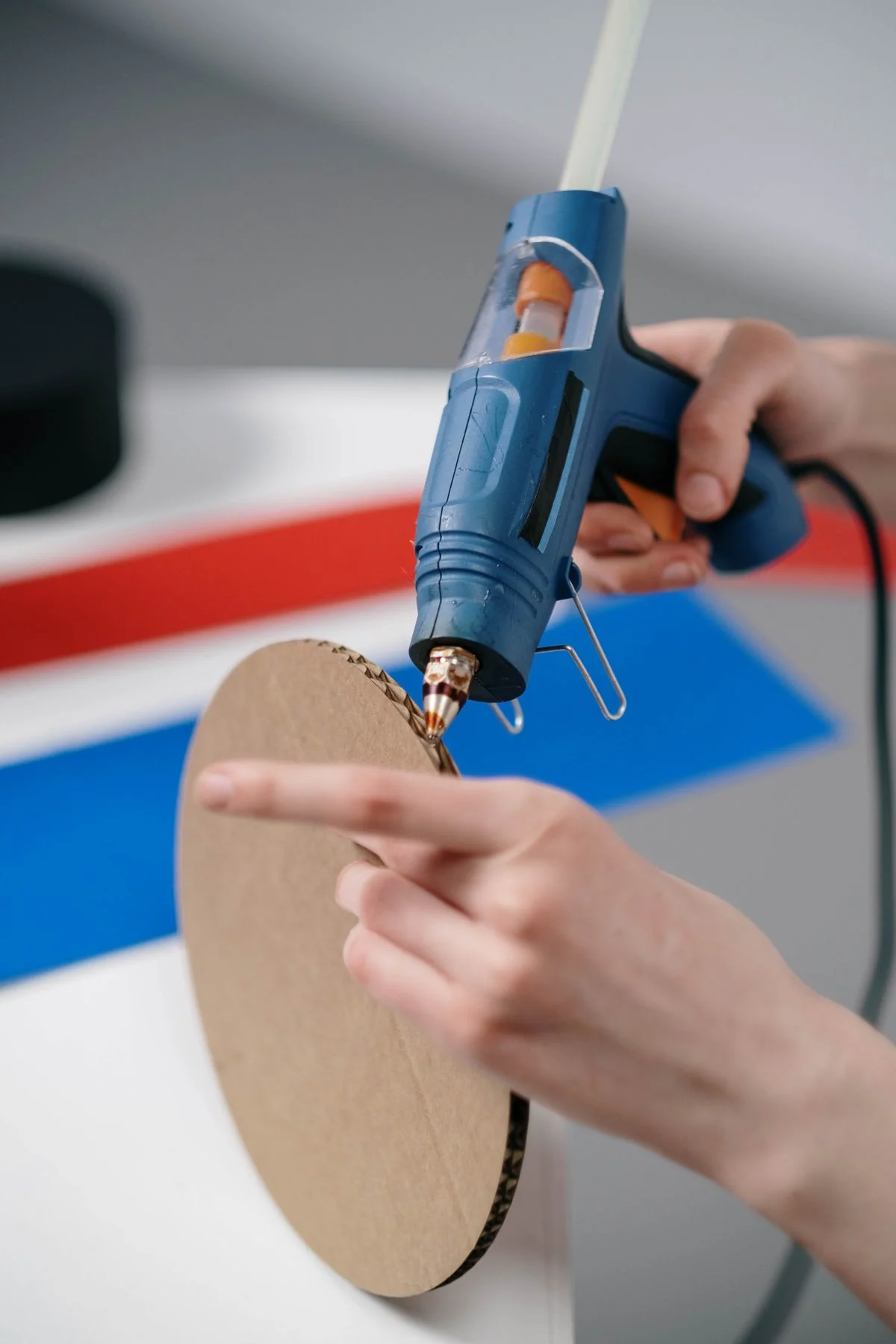
Hot melt adhesives are 100% solid, thermoplastic bonding materials that are applied in the molten state and develop bond strength as they cool and solidify. They occupy an important position in the plastics value chain because they convert polymer chemistry into a fast-setting joining technology used in packaging, hygiene, furniture, automotive interiors, electronics, textiles, bookbinding, and many other manufacturing sectors.
Unlike waterborne or solvent-based adhesive systems, hot melts do not rely on evaporation or chemical curing to form a bond; instead, their performance depends on thermal softening, wetting of the substrate, and rapid physical solidification after application. This makes them especially valuable in high-throughput production lines where short cycle time, clean processing, and immediate handling strength are critical.
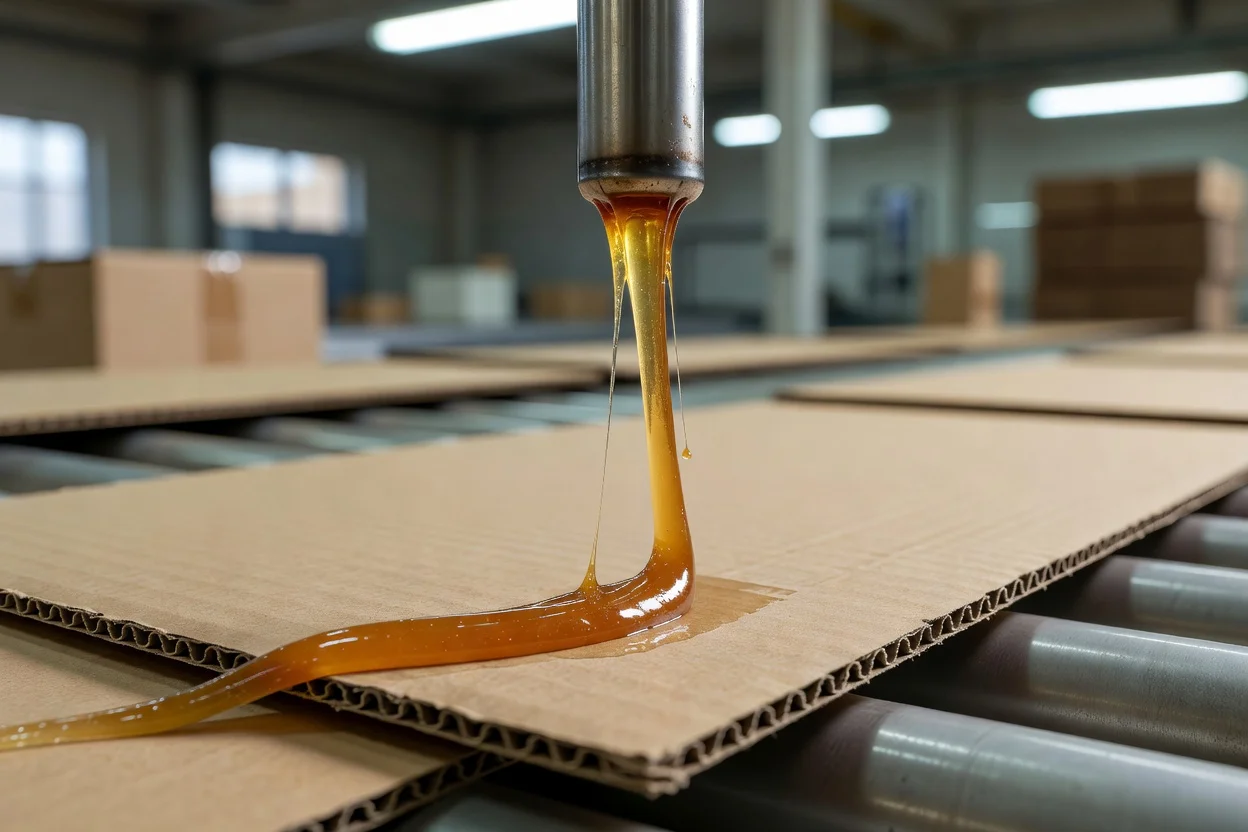
The category includes several major chemistries, notably ethylene-vinyl acetate (EVA), polyolefin, polyamide, polyester, pressure-sensitive hot melts, and reactive polyurethane hot melts (PUR), each tuned for different combinations of flexibility, heat resistance, adhesion, and durability. Their industrial importance has grown alongside packaging automation, lightweight product assembly, and the expansion of disposable hygiene products, while sustainability pressures are driving reformulation toward lower-energy processing, more recyclable systems, and renewable or recycled feedstocks.
History and Development
Hot melt bonding developed as manufacturers sought faster alternatives to conventional adhesives that required drying, solvent removal, or long clamp times. Early commercial hot melts were broadly based on thermoplastic polymers combined with tackifiers, waxes, and stabilizers, creating a formulation that could be melted, applied, and set almost immediately.
Industrial adoption accelerated in packaging and woodworking, where rapid set time translated directly into higher line speeds and lower labor demand. Later development broadened the technology into more demanding sectors through new polymer backbones and reactive systems, especially PUR hot melts, which combine the processing advantages of a hot melt with post-application crosslinking for higher heat and chemical resistance.
Chemical Structure and Key Properties
Hot melt adhesives are usually formulated from a base polymer, a tackifier resin, a wax or plasticizer, and smaller amounts of stabilizers, fillers, pigments, and antioxidants. The base polymer provides cohesive strength, the tackifier promotes wetting and stickiness, waxes help adjust viscosity and open time, and antioxidants slow thermal degradation during repeated heating in equipment.
| Property | Typical characteristic | Technical significance |
|---|---|---|
| Physical state at room temperature | Solid | Enables clean handling and storage |
| Application mode | Heated melt | Eliminates solvent evaporation |
| Set mechanism | Cooling and solidification | Provides very fast fixture time |
| Viscosity at use temperature | Low to medium | Supports spray, bead, slot-die, or extrusion application |
| Bond type | Mainly mechanical and physical | Strength depends on wetting, cohesion, and crystallization |
| Reformulation range | Broad | Allows tuning for packaging, hygiene, assembly, and specialty uses |
A key feature is that bond formation occurs when the molten adhesive wets the micro-roughness of the substrate, then solidifies as heat dissipates. In many systems, especially semicrystalline polymers, strength develops partly through recrystallization of the polymer phase on cooling.
Several practical limits shape material selection:
- Poor heat resistance → many EVA and general-purpose hot melts soften at elevated service temperatures → use higher-melting polyamide, polyester, or PUR systems.
- Lower performance on difficult low-surface-energy substrates → some formulations wet polypropylene, polyethylene, or fluoropolymer surfaces poorly because of limited surface energy → use modified polyolefin systems, primers, plasma/corona treatment, or specialized hot-melt grades.
- Thermal aging during processing → repeated residence at elevated temperature can oxidize the adhesive and raise viscosity → use stabilizers, nitrogen blanketing in melt tanks, and controlled equipment temperature.
A useful formulation example is 3–10% tackifier plus wax adjustment in a base polymer system to increase initial grab while controlling open time; the tackifier improves interfacial wetting, while wax lowers viscosity and accelerates set. In polyurethane reactive hot melts, the mechanism changes after application: the molten adhesive first sets by cooling, then further crosslinks with moisture, which increases final strength and heat resistance.
Production Processes and Raw Feedstocks
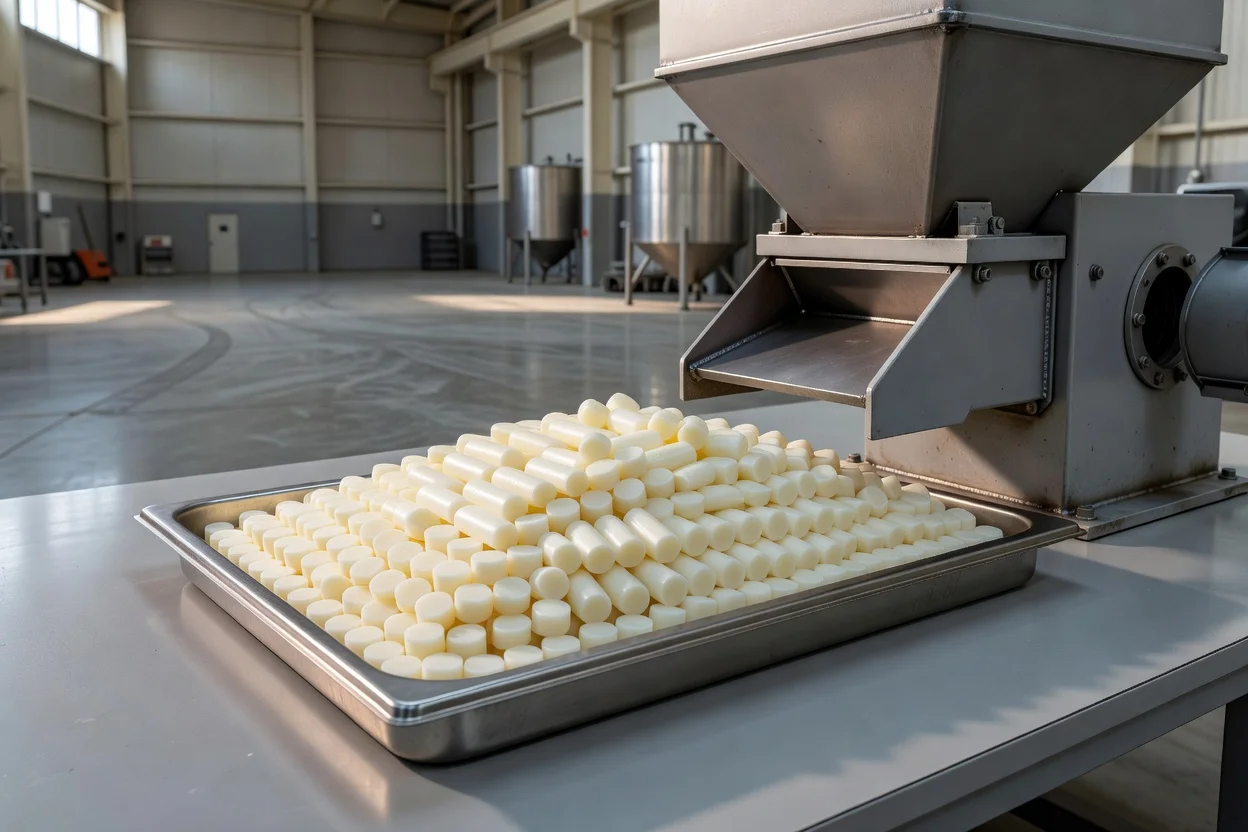
Commercial hot melts are made by compounding thermoplastic polymers with functional additives in heated mixers or extrusion systems, then converting the blend into pellets, blocks, sticks, pillows, or films depending on the application. The precise feedstock package varies with the target performance profile.
Common raw-material families include:
- EVA for low-cost, versatile packaging and assembly grades.
- Polyolefins for improved moisture resistance and better compatibility with some packaging substrates.
- Polyamides for higher thermal and chemical resistance.
- Polyesters for balanced adhesion to polar surfaces and good mechanical performance.
- PUR prepolymers for high-performance reactive bonding.
Processing typically involves melting the adhesive in a heated reservoir, transporting it through insulated hoses, and depositing it by bead, spray, slot, wheel, or extrusion methods. Equipment design matters because residence time, shear, and temperature stability influence viscosity drift, char formation, and final bond consistency.
Applications and End-Use Markets
Hot melt adhesives are best suited to high-speed, non-structural or semi-structural joining where fast handling strength is more important than long cure time. Their use extends across packaging, consumer goods, industrial assembly, and technical laminating.
| End-use sector | Common grade or chemistry | Typical process/use |
|---|---|---|
| Packaging and corrugated cartons | EVA, polyolefin | Carton sealing, tray forming, case closing |
| Hygiene products | EVA, polyolefin, pressure-sensitive hot melts | Diaper construction, elastic attachment, positioning bonds |
| Bookbinding and graphic arts | EVA, PUR | Spine gluing, cover attachment |
| Furniture and woodworking | EVA, PUR, polyolefin | Edge banding, lamination, assembly |
| Automotive interiors | Polyolefin, polyamide, PUR | Trim attachment, headliners, wire harness fixation |
| Electronics and appliances | Polyamide, polyester, specialized low-temperature grades | Potting, strain relief, component fixation |
| Textiles and footwear | Polyamide, polyester, PU film systems | Lamination, bonding, upper assembly |
| Industrial and construction uses | PUR, polyamide | Panel lamination, flooring, general assembly |
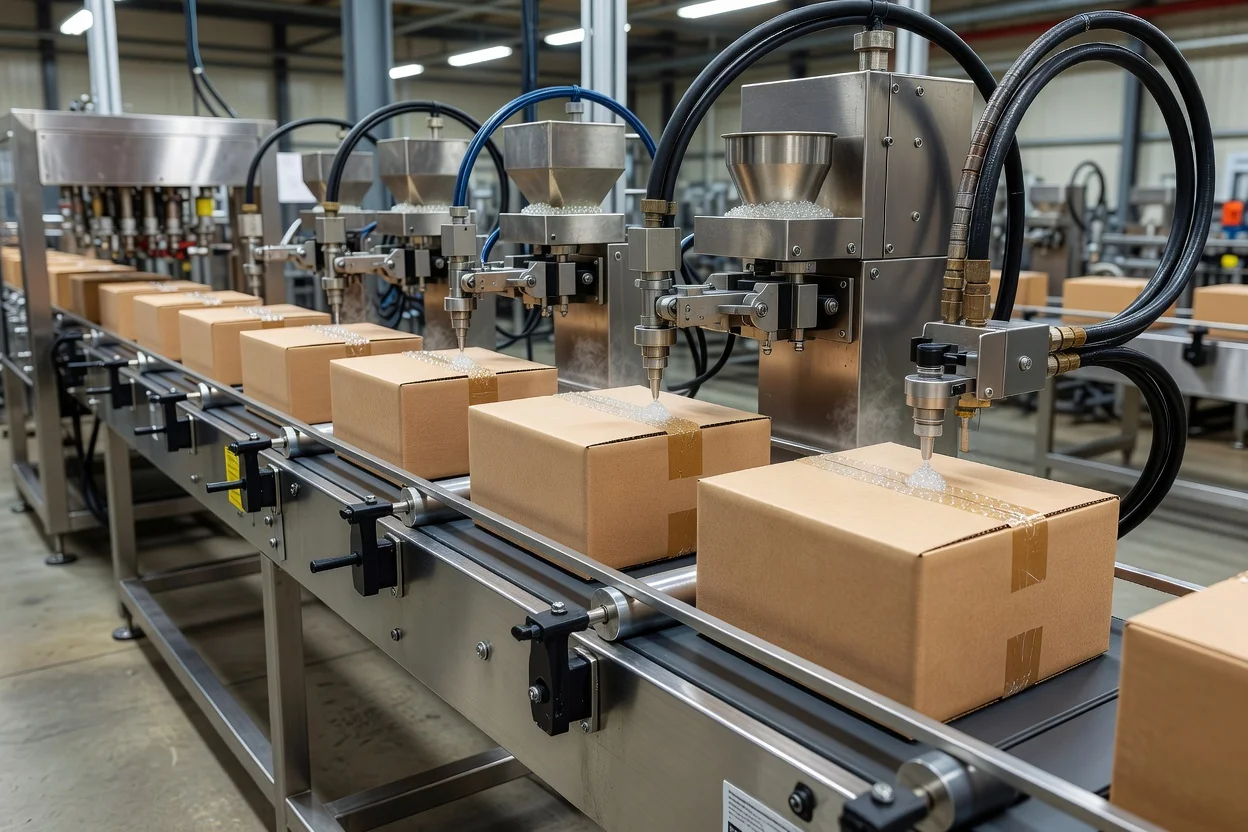
Packaging is the largest and most visible outlet because hot melts support fast carton sealing, wrap-around cases, labels, and food-packaging operations with minimal odor and no solvent emissions. Hygiene products also rely heavily on hot melts for disposable diapers, feminine care, and adult incontinence articles, where elastic attachment and construction bonds must be applied at high speed to nonwoven substrates.
In furniture and woodworking, hot melts enable edge banding, lamination, and rapid assembly with less clamping time. In automotive interiors and appliances, they are used for trim, headliner, wire-harness, and lightweight assembly tasks where immediate fixture strength is valuable. A weaker-fit application is highly structural, load-bearing bonding exposed to continuous high temperature or long-term creep, where epoxy, structural acrylic, or reactive systems are often more appropriate.
Environmental and Sustainability Aspects
Hot melt adhesives offer several environmental advantages relative to solvent-based systems: they are solvent-free, generally low in volatile organic compound emissions, and eliminate drying ovens or carrier removal steps. This can reduce process energy demand and simplify plant emissions control.
However, sustainability outcomes depend strongly on chemistry and end use. Because many hot melts are formulated from fossil-derived polymers, tackifiers, and waxes, their upstream carbon footprint is tied to petrochemical feedstocks. In addition, adhesive layers can complicate recycling when they contaminate paper fibers, multilayer packaging, textiles, or mixed-material assemblies.
Current sustainability directions include:
- Recyclable-design formulations that improve debonding or fiber repulpability in paper and packaging systems.
- Bio-based content using renewable tackifiers, polyols, or alternative waxes where performance allows.
- Lower-temperature processing to cut energy use and protect heat-sensitive substrates.
- Reactive systems with reduced overall material use when stronger bonding permits lighter constructions or fewer fasteners.
The net climate benefit is therefore application-specific: a hot melt may reduce emissions by removing solvents and speeding production, but it may also hinder circularity if the adhesive prevents efficient recovery of the bonded material stream.
Economic and Global Market Impact
Hot melt adhesives are strategically important because they support mass production efficiency, low labor intensity, and broad substrate compatibility. Their economics are driven less by unit price alone than by line speed, reduced rework, lower clamp time, and simplified plant infrastructure.
The largest demand centers are packaging, hygiene, and industrial assembly, which together create stable volume demand across global manufacturing regions. Major global suppliers include large specialty-chemicals and adhesive companies such as H.B. Fuller, 3M, Henkel, and other multinational formulators active in packaging, hygiene, and industrial assembly markets.
Current Challenges and Innovations
Current technical challenges include thermal stability in equipment, adhesion to low-surface-energy plastics, compatibility with recycling systems, and maintaining performance across increasingly diverse substrate combinations. Another challenge is the trade-off between fast set time and sufficient wetting, since very rapid solidification can limit penetration on rough or porous surfaces.
Important innovation areas include:
- Reactive PUR hot melts for higher final strength and heat resistance.
- Low-temperature hot melts for heat-sensitive foams, electronics, and thin substrates.
- Specialized pressure-sensitive hot melts for removable or repositionable bonds in hygiene and labeling.
- Recycling-compatible adhesive designs for paper packaging and fiber recovery.
- Bio-based and lower-VOC formulations to reduce fossil feedstock dependence and improve regulatory alignment.
Future Outlook
Hot melt adhesives are likely to remain a core enabling technology in packaging automation, hygiene products, lightweight assembly, and converting operations because they combine speed, simplicity, and strong production economics. Future growth will likely be shaped by three forces: higher manufacturing throughput, tighter environmental regulation, and increasing demand for recyclable or renewable material systems.
The most important technical direction is not simply higher bond strength, but better fit between adhesive chemistry and circular design. Formulations that preserve recyclability, reduce processing temperature, or incorporate renewable feedstocks while maintaining fast set and reliable adhesion are likely to define the next generation of hot melt systems.
References
- •
What is a hot melt adhesive? (2024, August 29). H.B. Fuller. https://www.hbfuller.com/en/blog/thegluetalkblog/2024/august/what-is-a-hot-melt-adhesiveLink
- •
Hot melt adhesives - an overview. (n.d.). ScienceDirect. https://www.sciencedirect.com/topics/materials-science/hot-melt-adhesivesLink
- •
Hot-melt adhesive. (2005, November 14). In Wikipedia. https://en.wikipedia.org/wiki/Hot-melt_adhesiveLink
- •
The complete guide to different hot melt glue types. (2025, November 24). Hotmelt.com. https://www.hotmelt.com/blogs/blog/hot-melt-glue-typesLink
- •
Hot melt adhesives: Types & applications. (n.d.). IQS Directory. https://www.iqsdirectory.com/articles/adhesive/hot-melt-adhesives.htmlLink
- •
Technical paper – Introduction to hot melt adhesives. (2026, August 3). Chemique Adhesives. https://www.chemiqueadhesives.com/us/introduction-to-hot-melt-adhesives/Link
- •
Hot-melt adhesive - an overview. (n.d.). ScienceDirect. https://www.sciencedirect.com/topics/engineering/hot-melt-adhesiveLink
- •
What is a hot-melt adhesive (HMA)? (2024, May 13). Kuraray. https://www.elastomer.kuraray.com/us/blog/hot-melt-adhesive/Link
- •
How hot-melt adhesives work. (2020, October 1). Applied Adhesives. https://www.appliedadhesives.com/blog/how-hot-melt-adhesives-work/Link
- •
The versatility of hot melt adhesives: Beyond crafts. (2024, September 20). Power Adhesives. https://www.poweradhesives.com/2024/09/20/the-versatility-of-hot-melt-adhesives-beyond-crafts/Link
- •
What are hot melt adhesives and where are they used? (2025, March 20). Power Adhesives. https://www.poweradhesives.com/2025/03/20/what-are-hot-melt-adhesives-and-where-are-they-used/Link
- •
Hot melts. (n.d.). Caplinq. https://www.caplinq.com/hot-melts.htmlLink
- •
Hot melt adhesives: How to formulate with right ingredients? (2026, April 22). SpecialChem. https://www.specialchem.com/adhesives/guide/hot-melt-adhesivesLink
- •
Hot melt glue - an overview. (n.d.). ScienceDirect. https://www.sciencedirect.com/topics/engineering/hot-melt-glueLink
- •
Packaging hot melt adhesives 101. (n.d.). H.B. Fuller. https://www.hbfuller.com/-/media/project/hbfuller/hbfuller/files/detail/equipment-manufacturer-support/packaging-hot-melt-adhesives-101.pdfLink
- •
7 industrial hot melt adhesive applications. (n.d.). Sure Tack Systems. https://suretacksystems.com/2020/05/7-industrial-hot-melt-adhesive-applications/Link
- •
Hot melt adhesive film: Types, properties & application guide. (2026, April 30). NACO Carbon Fiber. https://www.nacocarbonfiber.com/news/industry-news/hot-melt-adhesive-film-types-properties-application-guide.htmlLink
- •
Packaging hot melt adhesives 101. (n.d.). H.B. Fuller. https://www.hbfuller.com/-/media/project/hbfuller/hbfuller/files/industries/packaging/1hotmeltadhesive101guide-final.pdfLink
- •
What is hot melt adhesive: Uses, types, and benefits. (2026, March 20). Mahisa. https://mahisa.com/what-is-hot-melt-adhesive/Link
- •
Hot melt adhesives: Complete technical & application guide. (2025, May 7). Stuk Solutions. https://stuk.solutions/blogs/news/hot-melt-adhesives-in-manufacturing-a-complete-technical-application-guideLink
- •
3M™ hot melt adhesive 3789. (n.d.). 3M. https://www.3m.com/3M/en_US/p/d/b40065547/Link
- •
3M™ hot melt adhesive systems - Efficiency. Flexibility. https://multimedia.3m.com/mws/media/1823556O/emea-hot-melt-adhesives-brochure-low-res.pdfLink
- •
Hot melt adhesives. (n.d.). 3M. https://www.3m.com/3M/en_US/bonding-and-assembly-us/products/hot-melt-adhesives/Link
- •
Top 12 industrial applications for hot melt glue sticks. (2025, August 14). Hotmelt.com. https://www.hotmelt.com/blogs/blog/top-12-industrial-applications-for-hot-melt-glue-sticksLink
- •
10 applications for industrial hot melt glue you might not know! (n.d.). L.D. Davis. https://blog.lddavis.com/10-applications-for-industrial-hot-melt-glue-you-might-not-knowLink