
Introduction
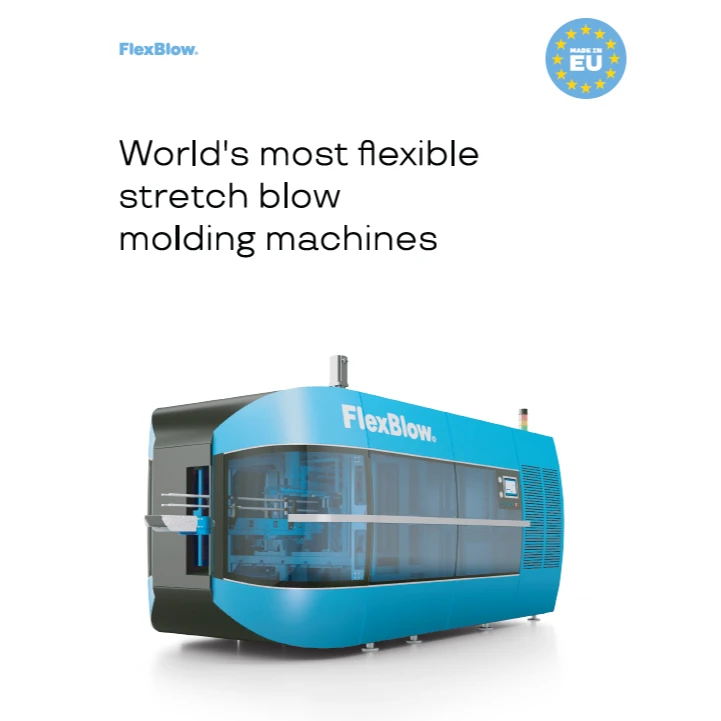
Extrusion blow molding machines are specialized plastic-processing systems used to produce hollow thermoplastic parts by extruding a softened tube, or parison, into a mold and inflating it with compressed air until it conforms to the cavity shape. The technology is one of the most widely used blow molding methods because it combines relatively simple machine architecture with the ability to make parts ranging from small bottles and jars to large drums, tanks, ducts, and automotive reservoirs.
In industrial practice, extrusion blow molding is valued for its flexibility in part size, wall-thickness distribution, and multi-cavity production, while also presenting engineering challenges such as parison control, flash generation, cooling efficiency, and trim management. The machine class has evolved from mechanically simpler hydraulic systems toward more precise, servo-driven, and energy-efficient platforms, with current development focused on automation, material savings, recycled-content processing, and lower specific energy consumption.
History and Development
Extrusion blow molding emerged as an industrial adaptation of the broader blow molding concept, using an extruder to create a continuous hollow parison that is captured in a cooled mold and inflated into the final shape. The process became especially important as polymer packaging expanded after the mid-20th century, when thermoplastics such as polyethylene and later polypropylene enabled economical mass production of hollow containers.
Key milestones in the machine’s development include:
- Standardization of the parison-extrusion concept, which established the core sequence of extrusion, mold closure, inflation, cooling, and ejection used in modern machines.
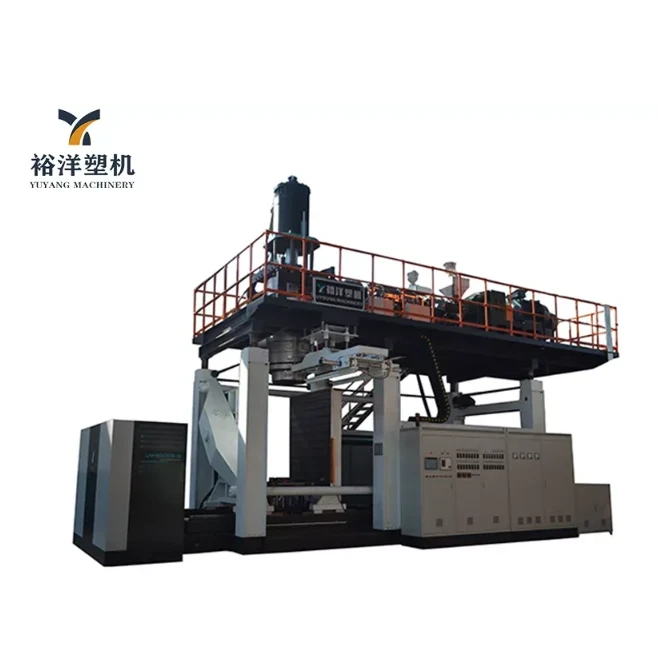
- Adoption of accumulator-head systems for larger parts, improving shot control and enabling the manufacture of large drums, tanks, and industrial containers with higher melt output than simple continuous heads.
- Transition to mechatronic and energy-saving machines, with modern manufacturers emphasizing precision, repeatability, reduced maintenance, and lower energy consumption through servo drives and improved control architectures.
As the process matured, machine builders diversified into continuous, intermittent, linear, shuttle, and multi-station configurations to suit different part sizes, output rates, and resin viscosities.
Working Principle and Technical Overview
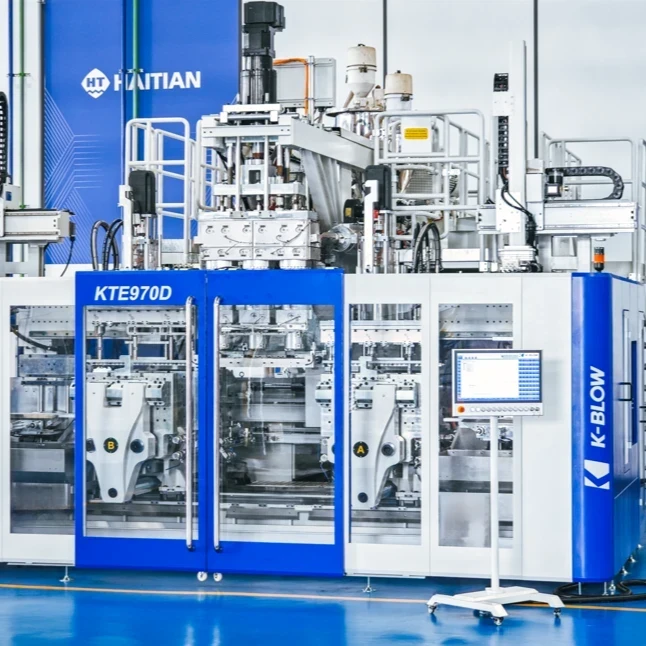
An extrusion blow molding machine typically consists of an extruder, die head, clamping unit, blow pin or air system, mold, and trim/ejection system. The resin is fed into a hopper, plasticized in the barrel by a rotating screw and heating zones, then forced through the die to form a tubular parison. The mold closes around the parison, pinching off the ends where needed, and compressed air inflates the hot polymer against the chilled cavity wall until the part cools and solidifies.

The process is thermally and rheologically sensitive. Melt temperature, die swell, parison sag, inflation ratio, and mold cooling rate all influence wall thickness, surface finish, and dimensional stability. In practice, the goal is to balance melt strength and extensibility so that the parison can be stretched without excessive thinning or collapse.
Typical machine and process benchmarks include:
- Throughputs ranging from small packaging lines to large industrial systems producing containers from a few milliliters to 300 liters, and in some heavy-duty configurations up to 1,000 liters for very large containers.
- Clamping forces for double-station machines reported in the range of 6 to 30 tons for compact-to-mid-size systems, with larger industrial equipment designed substantially higher depending on mold size and part geometry.
- Rotor and screw operation commonly in the low-to-mid hundreds of rpm depending on resin, output target, and screw design; the exact speed is machine- and material-specific rather than standardized.
- Residual moisture after centrifugal dewatering is typically low enough for regrind handling, with common industrial flake drying systems targeting roughly 1–3% moisture before downstream washing or extrusion, depending on washline design and polymer type; this is more relevant to recycling lines that feed blow-molding regrind than to the molding machine itself.
- Specific energy consumption is highly dependent on part size, hydraulics, servo drive adoption, and auxiliary loads, but modern energy-optimized machines are generally designed to reduce consumption through precise drive control and shorter cooling or cycle times.
In engineering terms, parison control is one of the defining technical variables. Wall-thickness programming, die-gap adjustment, and accumulator discharge control are used to compensate for gravity-induced sag, mold geometry, and local stretching during inflation. These controls are especially important for containers with handles, offset necks, or nonuniform cross-sections.
Types and Variations
Extrusion blow molding machines are commonly grouped by how the parison is generated and how the mold stations are arranged.
| Machine type | Main feature | Typical use |
|---|---|---|
| Continuous extrusion blow molding | Parison is extruded continuously | High-volume bottles, jerrycans, household containers |
| Intermittent extrusion blow molding | Melt is accumulated, then discharged in a shot | Larger or more demanding parts requiring better parison control |
| Linear machines | Mold stations arranged in a linear sequence | Standard industrial production; easier automation integration |
| Shuttle machines | Mold moves between blowing and cooling stations | Better for larger parts and flexible production |
| Accumulator-head machines | Large melt reservoir for heavy shots | Drums, tanks, large containers, technical parts |
| Single-station machines | One mold station | Small to medium output, simpler layouts |
| Multi-station machines | Several cavities or stations | Higher productivity for smaller containers |
Accumulator-head systems are particularly important for large articles because they decouple plasticization from parison discharge, allowing a large volume of melt to be delivered rapidly and with better control than a continuously extruded hollow tube. By contrast, linear or shuttle systems often prioritize cycle repeatability, mold accessibility, and easier integration with downstream trimming, leak testing, or labeling.
Materials and Part Design
Extrusion blow molding is most commonly associated with polyethylene grades, especially HDPE, and also uses PP, PVC, PETG, and selected engineering thermoplastics depending on part requirements. Material choice affects melt strength, barrier performance, chemical resistance, impact strength, and process window.
Common design considerations include:
- Neck geometry, which must integrate with caps, closures, or threaded finishes.
- Wall-thickness distribution, which is strongly influenced by parison programming and inflation ratio.
- Flash management, because the pinched-off parison typically creates excess material that must be trimmed and, where permitted, reprocessed.
- Barrier and multilayer structures, used when oxygen, aroma, fuel, or chemical resistance is critical.
The process is especially suited to hollow geometries that would be expensive or impractical to produce by injection molding, such as large bottles, jerrycans, fuel tanks, and ducts.
Applications and Uses
Extrusion blow molding machines serve a broad range of sectors.
- Packaging: bottles, jars, closures, detergent containers, and food-contact packaging are the largest and most recognizable application area.
- Household and consumer goods: storage bins, laundry containers, cleaning-product bottles, watering cans, and similar hollow items.
- Industrial and chemical packaging: jerrycans, lubricants containers, drums, open-top kegs, and corrosive-fluid packaging.
- Automotive: ducts, reservoirs, air-intake components, washer-fluid tanks, and selected fuel-system parts.
- Medical and healthcare: sterile fluid containers, waste containers, and selected disposable housings, especially where cleanroom-compatible production is available.
- Agricultural and construction-related products: tanks, barriers, watering containers, and durable outdoor articles.
One comparatively poor-fit use is thin-wall, highly transparent, precision optical packaging, where injection molding or injection-stretch blow molding often provides better dimensional consistency and optical quality than standard extrusion blow molding.
Technological Innovations and Automation
Modern extrusion blow molding machinery increasingly incorporates servo drives, closed-loop parison control, automatic deflashing, robotic part handling, leak testing, and in-line inspection. These systems reduce variation, lower labor intensity, and improve repeatability, especially in high-output packaging lines.
Important innovations include:
- Wall-thickness programming, which varies die opening during extrusion to distribute material more efficiently.
- Electric or hybrid drive systems, which reduce energy demand and improve motion accuracy relative to conventional hydraulic actuation.
- Integrated downstream automation, including trimming, vision inspection, and packaging cells.
- Multilayer coextrusion, which supports barrier, recycled-content, and functional-layer architectures.
- Industry 4.0 connectivity, enabling traceability, OEE monitoring, maintenance analytics, and process optimization.
Automation has clear productivity benefits, but it also increases system complexity. Manufacturers must balance higher capital cost and skill requirements against improved consistency, material savings, and labor efficiency.
Environmental and Sustainability Aspects
Sustainability performance in extrusion blow molding depends on both the machine and the product design. The process can be material-efficient when parison programming and mold design minimize flash and overweighting, but conventional systems may still generate trim that must be reground or discarded.
Key sustainability factors include:
- Energy efficiency: mechatronic and servo-driven machines reduce electrical consumption compared with older hydraulic systems.
- Material efficiency: improved parison control reduces flash and scrap.
- Recycled content compatibility: many machines can process regrind or recycled polyolefins, provided melt stability and contamination are controlled.
- Circular economy alignment: blow-molded packaging is increasingly designed for mono-material structures and easier recyclability.
- Lifecycle trade-offs: lightweight hollow parts often reduce transport emissions and material intensity relative to heavier alternatives.
A central sustainability challenge is that recycled resin often has more variable viscosity and contamination than virgin resin, which can complicate wall distribution, surface quality, and cycle stability. Machine control and resin qualification therefore remain critical.
Economic and Global Market Impact
Extrusion blow molding is economically important because it supports high-volume production with relatively moderate tooling complexity compared with some alternative hollow-forming methods. The technology is deeply embedded in global packaging, household chemicals, food and beverage, and industrial container markets, where consistent unit economics matter more than extreme geometric complexity.
Market demand is influenced by:
- Packaging growth, especially for consumer goods, chemicals, and food-contact containers.
- Industrial logistics, where durable reusable containers and drums remain important.
- Regional manufacturing patterns, with strong machine-building and application clusters in Europe, Asia, and North America.
- Regulatory pressure, including food-contact compliance, recycled-content mandates, and emissions-related reporting.
Companies such as Bekum, Plastiblow, Meccanoplastica, and Graham Engineering are recognized for long-standing involvement in extrusion blow molding machine design, large-part capability, or mechatronic machine development.
Current Challenges and Innovations
Despite its maturity, the sector continues to face several technical challenges:
- Parison sag and thickness variability, especially for tall parts and long cycle times.
- Flash reduction, which remains a direct cost and sustainability issue.
- Cooling limitations, particularly in thick-walled containers and large molds.
- Material variability, especially with recycled resins and multi-supplier feedstocks.
- Medical and food packaging compliance, where cleanliness and traceability are increasingly strict.
Current innovation work is concentrated on:
- More precise melt metering and head design
- Improved mold thermal management
- Closed-loop process control
- Better compatibility with recycled and bio-based polymers
- Lower-maintenance machine architectures with longer service intervals.
Future Outlook
The next generation of extrusion blow molding machines is likely to emphasize energy efficiency, digital process control, recycled-content capability, and higher product consistency. Demand is expected to remain strongest in packaging and industrial containers, while technical applications in automotive, healthcare, and specialty logistics continue to expand where the process provides a favorable mix of cost, size, and chemical resistance.
Further development will probably center on:
- Broader use of servo-electric subsystems
- AI-assisted parameter optimization
- More stable processing of post-consumer recyclate
- Greater use of lightweighting and mono-material design
- Integrated inspection and traceability for regulated markets
As sustainability requirements tighten, the competitive position of extrusion blow molding will depend on how effectively machine builders and processors reduce scrap, lower energy consumption, and enable circular material flows without sacrificing output or part performance.
Summary
Extrusion blow molding machines are essential equipment for producing hollow plastic parts efficiently across packaging, industrial, automotive, and specialty markets. Their core advantage is the ability to form large and complex hollow shapes at scale, while their continuing evolution is shaped by automation, energy efficiency, material circularity, and tighter process control.
References
- •
Extrusion blow molding - an overview. (2025, January 15). ScienceDirect. https://www.sciencedirect.com/topics/engineering/extrusion-blow-moldingLink
- •
Blow molding. (2022, January 13). Graham Engineering. https://www.grahamengineering.com/products-solutions/blow-molding/Link
- •
Extrusion blow molding machine manufacturer - BlowPacker. (2026, June 25). BlowPacker. https://blowpacker.com/products/blow-molding-machines/extrusion-blow-molding-machine/Link
- •
HE Series: Extrusion blow moulding machines. (2025, July 8). Meccanoplastica Group. https://www.meccanoplastica-group.com/extrusion-blow-moulding-he-series/Link
- •
Plastic transformation techniques: Everything you need to know. (2025, February 12). Luiso. https://www.luiso.net/en/2025/02/12/extrusion-blow-molding-machines-innovation-and-reliability-for-the-industry/Link
- •
Extrusion blow molding machines: Unleash unmatched efficiency in production. (2025, April 29). Zjgshengrong. https://zjgshengrong.com/extrusion-blow-molding-machines/Link
- •
Bekum - Home. (n.d.). Bekum. https://www.bekum.com/en/Link
- •
Extrusion-blow-molding-guidebook.pdf. (2025, May 22). Scribd. https://www.scribd.com/document/465739320/Extrusion-Blow-Molding-Guidebook-pdfLink
- •
Fax. (2023, December 18). Akei. https://akei.com.cn/en/nf36.htmlLink
- •
Extrusion blow molding process guide. (2026, July 27). Jonh Huah Machinery. https://www.wangbrand.com/en/faq_12.htmLink
- •
Extrusion blow molding machines (EBM) - Knavi. (n.d.). Knavi. https://knavi.us/catalog/extrusion-blow-molding-machines-ebmLink
- •
Die ovalization. (2024, January 1). Cmppin. https://cmppin.com/blog/the-process-of-extrusion-blow-moulding-machine/Link
- •
13.2 Extrusion blow molding. (2013, January 1). BYU-Idaho. https://books.byui.edu/plastics_materials_a/_extrusion_blow_moldLink
- •
Extrusion blow moulding machine process | PDF. (2025, December 23). Scribd. https://www.scribd.com/document/959775054/Extrusion-Blow-Moulding-Machine-ProcessLink
- •
Bekum - Millholland Conrad. (2025, January 8). Millholland Conrad. https://www.millconinc.com/bekum/Link
- •
Extrusion blow moulding machine process. (2025, February 14). Kingplas Machinery. https://www.kingplasmc.com/extrusion-blow-moulding-machine-process/Link
- •
Versatile applications of extrusion blow molding technology. (n.d.). Parker. https://smp.parker-global.com/en/application/extrusion-blow-molding-series/Link
- •
Blow molding. (n.d.). University of Michigan. https://encyclopedia.che.engin.umich.edu/blow-molding/Link
- •
Extrusion blow molding machines. (2021, January 1). Mega Machinery. https://www.megamachinery.com/products/extrusion-blow-molding-machines/Link
- •
Powerjet extrusion blow molding machine (EB10H). (2026, April 2). Made-in-China. https://wmpowerjet.en.made-in-china.com/product/BqwxEAQXOmci/China-Powerjet-Extrusion-Blow-Molding-Machine-EB10H-.htmlLink
- •
6 functional categories of extrusion blow molding applications. (2025, August 1). Cm-pet. https://www.cm-pet.com/6-functional-categories-of-extrusion-blow-molding-applicationsLink
- •
Top 10 product examples: Extrusion blow molding. (n.d.). Wangbrand. https://www.wangbrand.com/en/faq_05.htmLink
- •
Extrusion blow moulding. (n.d.). British Plastics Federation. https://www.bpf.co.uk/plastipedia/processes/Extrusion_Blow_Moulding.aspxLink
- •
What is the extrusion blow moulding machine? (2025, October 17). Vfine Machine. https://www.vfine-machine.com/blog-what-is-the-extrusion-blow-moulding-machine.htmlLink
- •
Extrusion blow molding machines. (2024, January 23). Hitech Machinery. https://hitech-machinery.com/extrusion-blow-molding-machinery/Link
- •
Extrusion blow-moulding machines: Plastiblow made in Italy. (n.d.). Plastiblow. https://www.plastiblow.it/en/homeLink
- •
Application. (2024, October 14). Tongda Machine. https://www.tongdamachine.net/extrusion-blow-molding-machine/Link
- •
How extrusion blow moulding process step by step? (2024, July 30). Aman Machine. https://www.amanmachine.com/how-extrusion-blow-moulding-process-step-by-step/Link
- •
Extrusion blow molding 101. (2024, December 20). MJS Packaging. https://www.mjspackaging.com/blog/extrusion-blow-molding-101/Link
- •
Blow molding machines — Extrusion, injection & stretch blow molding systems. (n.d.). Knavi Group. https://knavi.us/catalog/blow-molding-machinesLink
- •
Blow molding machine. (2026, August 1). Jwell Extrusions. https://www.jwellextrusions.com/products/blow-molding-machine/Link
- •
Extrusion blow molding machine. (2018, June 27). Mauser Packaging Solutions. https://www.directindustry.com/prod/mauser-packaging-solutions/product-54725-1729443.htmlLink
- •
Extrusion blow molding machine. (2026, January 8). Wanplas. https://www.wanplas.com/products/molding-machine/extrusion-blow-molding-machine/Link
- •
What is extrusion blow molding. (2023, July 7). Molding Machine Tepai. https://www.moldingmachinetepai.com/resources/what-is-extrusion-blow-molding.htmlLink
- •
Top 6 extrusion blow molding examples. (2020, September 18). Full Shine. https://www.full-shine.com/news-top-6-examples-by-extrusion-blow-moldingLink
- •
Extrusion blow molding machine factory - Automatic extrusion blow molding machine. (n.d.). Extrusionblow-moldingmachine. https://www.extrusionblow-moldingmachine.com/Link
- •
Extrusion blow molding. (2023, November 2). Silgan Plastics. https://www.silganplastics.com/technologies/extrusion-blow-molding/Link
- •
Blow molding machines manufacturer | EBM, PET & injection. (2026, June 23). BlowPacker. https://blowpacker.com/products/blow-molding-machines/Link
- •
HDPE extrusion blow molding machines | AMAN. (n.d.). Aman Machine. https://www.amanmachine.com/products/ebm-hdpe.htmlLink
- •
Fully automatic extrusion blow molding machine. (2022, June 13). Molding Machine Tepai. https://www.moldingmachinetepai.com/productstags/fully-automatic-extrusion-blow-molding-machine.htmlLink
- •
Extrusion blow molding machine manufacturer in Toronto. (n.d.). Petall Manufacturing. https://www.petallmfg.com/pages/products/plastic-extrusion-blow-molding-machineLink
- •
The power of extrusion blow molding machine. (2025, September 22). GTIG. https://zjgshengrong.com/es/the-power-of-extrusion-blow-molding-machine/Link
- •
Extrusion blow molding explained: Process and benefits. (2025, April 29). UKPACK. https://www.ukpackchina.com/extrusion-blow-molding/Link
- •
Blow molding. (2005, June 12). Wikipedia. https://en.wikipedia.org/wiki/Blow_moldingLink
- •
Guide to blow molding. (n.d.). Formlabs. https://formlabs.com/blog/blow-molding/Link
- •
Here is everything you need to know about blow molding. (2019, March 26). Mayco International. https://maycointernational.com/here-is-everything-you-need-to-know-about-blow-molding/Link
- •
Injection blow molding vs extrusion blow molding. (2021, November 30). E2Global. https://e2global.com/blog/injection-blow-molding-vs-extrusion-blow-molding/Link
- •
Extrusion blow molding process. (2024, June 3). Gemini Group. https://geminigroup.net/engineered-plastics/technical-blow-molding/manufacturing-capabilities/extrusion-blow-molding/Link