
Introduction
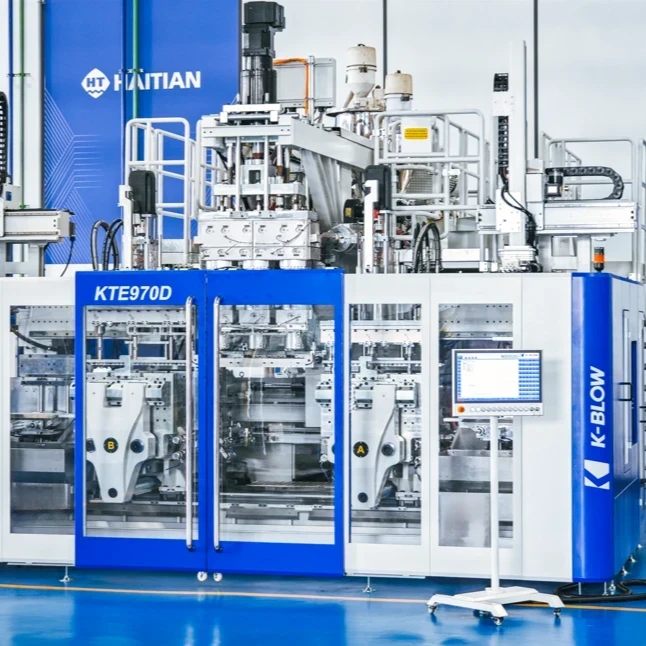
Blow molding machines are plastic processing systems used to form hollow thermoplastic products by inflating a heated parison or preform inside a mold until it conforms to the cavity walls. They are central to the production of bottles, jerrycans, drums, fuel tanks, and many other hollow parts used in packaging, automotive, chemical, medical, and consumer goods applications.
The term covers several machine families, most importantly extrusion blow molding (EBM), injection blow molding (IBM), and injection stretch blow molding (ISBM), each optimized for different materials, part geometries, and performance requirements. Modern blow molding machinery increasingly incorporates servo drives, multilayer coextrusion, high-speed rotary layouts, and aseptic filling integration, reflecting the industry’s shift toward higher productivity, tighter quality control, and lower energy use.
From a manufacturing perspective, blow molding machines occupy a unique position between polymer processing and packaging engineering: they must combine melt handling, mold mechanics, air-pressure control, cooling, and dimensional precision while maintaining low scrap and consistent wall distribution. The technology continues to evolve toward electric actuation, digital monitoring, barrier structures, and compatibility with lightweighting and circular-economy goals.
History and Development
Early commercial blow molding emerged from glass-blowing principles adapted to thermoplastics, with the decisive industrial breakthrough occurring when polymers could be extruded or injection-formed into stable hot blanks suitable for inflation. This transition enabled mass production of seamless hollow plastic articles at industrial scale.
Three development milestones stand out:
- Extrusion blow molding became the dominant general-purpose method for bottles, containers, drums, and large industrial parts because it accommodates a wide range of shapes and sizes and supports continuous production.
- Injection stretch blow molding established a high-clarity, high-strength route for PET beverage bottles by combining precise preform molding with biaxial orientation during stretching and blowing.
- Servo-electric and digitally controlled machines improved parison control, repeatability, and energy efficiency, with newer systems using servo motors and advanced controllers to reduce energy consumption and stabilize wall thickness and cycle timing.
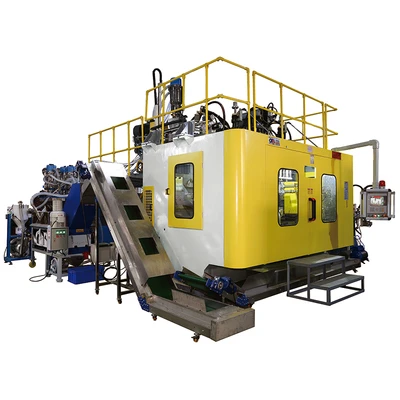
In parallel, machine scale expanded significantly. Industrial blow molding systems now range from small bottle machines producing milliliter-scale containers to large accumulator-head systems and multicavity setups used for 20 L to 1,500 L drums, IBC bottles, and jerrycans.
Technical Overview
Blow molding machines generally consist of an extrusion or preform unit, mold clamping system, blow-air circuit, cooling system, and control architecture. In EBM, molten polymer is extruded as a tubular parison, captured in a closed mold, and inflated with compressed air; in IBM, a molded preform is transferred to a blow station; in ISBM, a heated preform is stretched axially and then inflated radially to orient the polymer and improve mechanical performance.
Working principle
- The polymer is heated into a flowable melt, typically in the range used for thermoplastic processing.
- A parison or preform is formed.
- The mold closes around the hot blank.
- Compressed air expands the blank against the cavity walls.
- Cooling solidifies the part, after which it is ejected.

Engineering parameters and performance benchmarks
Typical machine and process parameters vary by machine class and product size, but common industrial benchmarks include:
- Extrusion blow molding pressure: about 0.5–1.2 MPa for many applications, with higher demands in specialized systems.
- Cooling and cycle time: generally from a few seconds to several tens of seconds, depending on wall thickness, resin, and part geometry.
- Production speed: high-output systems can reach several thousand bottles per hour; some commercial systems are advertised at around 3,600 articles per hour, while certain multihead machines can exceed 8,000 pieces per hour under suitable conditions.
- Large container capacity: machine and mold systems are available for 20 L to 1,500 L containers such as drums and IBC bottles.
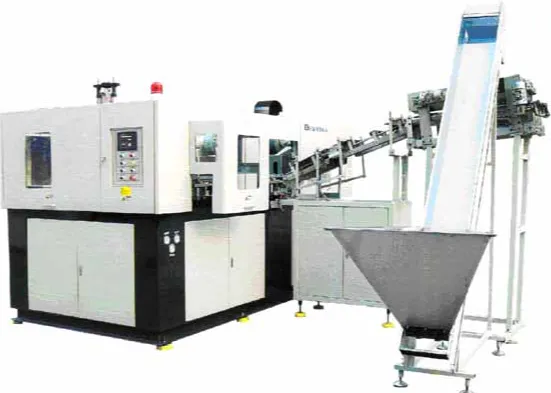
- Rotary stretch blow systems: commonly used for PET beverage production, where high cavity counts and continuous motion improve output efficiency.
For recycling-oriented workflows, blow molding plants often integrate granulators and regrind handling. In practice, recovered flakes are usually cut to a manageable granule size for reprocessing, while centrifugal dewatering and drying are used to reduce residual moisture before extrusion; the exact values depend on the washing line and polymer type, but industrial systems are commonly engineered to deliver low-moisture regrind suitable for stable melt processing.
Mechanical and control subsystems
- Clamping units provide mold closure force and alignment.
- Parison control systems adjust wall thickness to compensate for sag and local stretching, improving weight distribution and reducing weak spots.
- Servo and hydraulic actuators are used depending on machine size and duty cycle; electric actuation is increasingly favored where energy efficiency and cleanliness are priorities.
- HMI and PLC controls manage temperature zones, air timing, mold motion, and quality interlocks.
- Vision inspection and leak testing are increasingly integrated to reject defective parts automatically.
Types and Variations
| Machine type | Core process | Typical strengths | Common products |
|---|---|---|---|
| Extrusion blow molding (EBM) | Continuous or intermittent parison extrusion and inflation | Broad material compatibility, large part capability, relatively flexible tooling | Bottles, jerrycans, drums, tanks, fuel tanks |
| Injection blow molding (IBM) | Injection-molded preform transferred to blow station | High neck finish precision, good dimensional consistency | Small bottles, pharmaceutical and personal-care containers |
| Injection stretch blow molding (ISBM) | Preform stretching plus blowing | Excellent clarity, strength, and barrier performance in PET | Beverage bottles, edible oil bottles, premium packaging |
| Accumulator-head blow molding | Stored melt shot for large parts | Handles high-volume parisons and thick walls | Large drums, IBCs, industrial containers |
| Rotary blow molding machines | Multiple stations on a rotating carousel | High throughput and compact high-output layouts | PET beverage bottles, consumer packaging |
| Shuttle-type blow molding machines | Mold shuttles between extrusion and cooling positions | Useful for large or technical parts | Specialty containers, industrial parts |
EBM remains the most versatile and widespread category, especially for HDPE, PP, PVC, and multilayer barrier structures. IBM is valued for precision neck and thread formation, while ISBM dominates applications where transparency, top-load strength, and lightweight PET performance are critical.
Applications and Uses
Blow molding machines serve a wide spectrum of markets, with the machine configuration typically determined by product size, resin choice, barrier needs, and required output.
- Beverage packaging: ISBM machines produce PET water, soft drink, and juice bottles with high clarity and lightweight structures.
- Food packaging: EBM and ISBM systems produce edible oil, sauce, dairy, and condiment containers.
- Household and personal care: EBM and IBM machines are widely used for detergent, shampoo, cosmetics, and cleaning-product bottles.
- Industrial packaging: Accumulator-head EBM machines make drums, jerrycans, and large chemical containers, including multilayer barrier versions.
- Automotive: EBM is used for fuel tanks, air ducts, reservoirs, and technical hollow parts requiring complex geometry and sometimes multilayer barriers.
- Medical and pharmaceutical: IBM and specialized ISBM systems support clean, dimensionally accurate bottles and containers with controlled finishes.
- Agricultural and consumer goods: Large hollow parts, spray tanks, and utility containers are common EBM outputs.
One poor-fit use is the production of very thin, highly intricate structural parts, where injection molding or thermoforming is usually more suitable because blow molding is optimized for hollow shells rather than precision ribbed structures.
Technological Innovations and Automation
Recent innovation has focused on three main areas: motion control, process monitoring, and system integration.
Motion and drive technology
Servo-electric systems reduce energy consumption and improve repeatability compared with older hydraulic designs, particularly in medium-size machines and high-precision bottle applications. Hydraulic systems still remain important for large clamping forces, heavy molds, and accumulator-head industrial machines where high force density is required.
Parison and wall-thickness control
Advanced parison programming allows local wall redistribution so that necks, shoulders, handles, and bases can be optimized without excessive overpacking. This improves impact resistance and material efficiency, especially in fuel tanks and large containers.
Digital quality systems
- In-line leak testing
- Vision inspection
- Weight monitoring
- Recipe-based process control
- Production data logging for traceability
These features support consistent quality and faster changeover, especially in packaging operations with many SKUs.
Aseptic integration
For beverage and sensitive liquid packaging, aseptic blow-fill systems combine sterilized preforms, sterile air, and integrated filling/capping within a controlled zone. This architecture reduces contamination risk and eliminates some downstream handling steps.
Environmental and Sustainability Aspects
Blow molding has a favorable material-efficiency profile because it produces lightweight hollow parts with relatively low resin input per unit of function. This is one reason the process is central to packaging lightweighting strategies.
Sustainability considerations include:
- Energy efficiency: Servo-electric motion systems and optimized heating reduce power demand compared with older designs.
- Material savings: Wall-thickness control and lightweighting reduce polymer use while maintaining performance.
- Recycled-content compatibility: EBM is often compatible with regrind and recycled polyolefins, subject to contamination, odor, and melt-stability constraints.
- Multilayer barrier design: Coextrusion can extend shelf life and reduce product loss in food and chemical packaging.
- Circular economy trade-offs: While mono-material designs can improve recyclability, barrier and multilayer structures may complicate reprocessing and require careful material selection.
Residual moisture control, clean regrind handling, and melt filtration are especially important when recycled material is introduced into blow molding lines, because inconsistent moisture or contamination can affect parison stability and part quality.
Economic and Global Market Impact
Blow molding machines are a core capital asset in the global packaging supply chain. Demand is supported by beverage packaging, consumer goods, chemical logistics, and industrial container production, while regional machine suppliers compete on throughput, energy use, service, and application know-how.
Industrial market structure is shaped by:
- High-volume PET beverage production, which favors integrated rotary and high-cavity ISBM lines.
- Industrial packaging growth, which supports large EBM and accumulator-head machines for drums and IBCs.
- Aftermarket and used-equipment activity, reflecting long machine lifecycles and the value of rebuilt systems in emerging and cost-sensitive markets.
Well-established machine builders are associated with specific process segments rather than the market as a whole. For example, Graham Engineering is strongly identified with wheel and industrial extrusion systems, while GEA is recognized for aseptic blow-fill technology and Moog for motion-control components and parison-related actuation systems.
Current Challenges and Innovations
Several technical and commercial challenges continue to shape machine development:
- Wall-thickness uniformity: Particularly difficult in asymmetrical parts and large containers, where sag and thermal gradients can distort the parison.
- Energy management: Heating, compressed air, and cooling all contribute materially to operating cost.
- Material variability: Recycled and bio-based resins can introduce process instability and cosmetic variation.
- Barrier performance: Multilayer structures improve protection but can complicate recycling.
- Labor and skills: Automated lines reduce dependence on operator skill, but advanced troubleshooting requires more specialized maintenance capability.
- Food and pharmaceutical compliance: Sterility, extractables, and traceability requirements increase system complexity.
Innovation is therefore moving toward cleaner electric drives, predictive maintenance, better thermal control, smarter data systems, and designs that support recycled and mono-material packaging.
Future Outlook
The next phase of blow molding machinery is likely to emphasize electrification, data-driven optimization, and packaging circularity. Machines will increasingly be specified not only by output speed, but also by energy per bottle, recycled-content tolerance, changeover time, and integration with inspection and filling systems.
For packaging producers, the most important technical direction is likely to be the combination of lightweighting with performance retention: thinner but stronger bottles, lower-carbon manufacturing, and improved compatibility with recycling streams. For industrial container makers, future growth will likely favor large-format EBM systems with better multilayer control, higher automation, and improved handling of post-consumer and post-industrial polymers.
Summary
Blow molding machines are essential plastics-processing systems for manufacturing hollow thermoplastic products. Their principal variants—EBM, IBM, and ISBM—serve distinct product families, from large industrial drums to high-clarity PET beverage bottles, and the technology continues to advance through servo control, multilayer coextrusion, aseptic integration, and sustainability-focused design.
References
- •
中国吹塑机(用于加工橡胶或塑料)市场:规模、趋势及至2035年的预测 | IndexBox. (2026, August 15). https://www.indexbox.io/zh-hans/store/china-blow-moulding-machines-for-working-rubber-or-plastics-market-analysis-forecast-size-trends-and-insights/Link
- •
吹塑机 - 18 制造商、经销商&供应商. (n.d.). https://www.industrystock.cn/zh/companies/gong-yi-liu-cheng/ji-chu-ji-ji-ji-chu-ji-zhi-zao/chui-su-jiLink
- •
吹塑机_全自动吹塑机_中空吹塑机_挤出/托盘成型机-苏州同大机械有限公司. (2021, October 29). http://tongdamachine.com/Link
- •
自动50 Kw单步拉伸吹塑机100 2000毫升pet/pe注射吹塑机 - Buy Product on Alibaba.com. (n.d.). https://chinese.alibaba.com/product-detail/Automatic-50-kW-Single-Step-Stretch-1601514272114.htmlLink
- •
GEA Aseptic Blow Fill System ABF 2.0. (n.d.). https://www.gea.com/en/products/filling-packaging/aseptic-fillers/abf-aseptic-blow-fill-system/Link
- •
自动hdpe大托盘旧吹塑机160l 200l 220l滚筒第二二手吹塑机 - Buy Product on Alibaba.com. (n.d.). https://chinese.alibaba.com/product-detail/Automatic-HDPE-Big-Pallet-Old-Blow_1600827013225.htmlLink
- •
自动注射拉伸吹塑机pet/pe/pp Hdpe Ldpe瓶塑料加工 - Buy Product on Alibaba.com. (2026, September 23). https://chinese.alibaba.com/product-detail/Automatic-Injection-Stretch-Blow-Molding-Machine_1601403026209.htmlLink
- •
机械. (2025, October 24). https://mauserpackaging.com/zh-hans/%E4%BA%A7%E5%93%81%E4%B8%8E%E5%88%9B%E6%96%B0/%E6%9C%BA%E6%A2%B0%E8%AE%BE%E5%A4%87/Link
- •
Used Plastic Blow Molding Machines for Sale - Meadoworks. (2026, June 14). https://www.meadoworks.com/equipment/blow-molding-machineryLink
- •
"Blow Molding Machine" - Made-in-China.com. (2026, October 2). https://www.made-in-china.com/products-search/hot-china-products/Blow_Molding_Machine.htmlLink
- •
New & Used blow molding machines. (n.d.). https://www.machinio.com/cat/blow-molding-machinesLink
- •
Active Inventory. (n.d.). https://machinerycenter.com/active-inventoryLink
- •
Used Blow Molding Machines For Sale. (n.d.). https://www.sigmaequipment.com/equipment/packaging/blow-molding/Link
- •
AKEI 50SN-TS-DH-PP.PE. (2025, March 7). https://www.machinetools.com/en/for-sale/machines/type/blow-molding-machinesLink
- •
Machinery Exchange for Plastics Industry - Plasticker. (n.d.). https://plasticker.de/requipment/listaog_en.php?aog=&spec=&sort=r.time%20DESC&snation=&art=Blasformanlagen&show=2Link
- •
Used Blow Molding Machine. (n.d.). https://www.machinepoint.com/machinepoint/inventory.nsf/web2utreetype?openform&catarbol=blowmoulding&ln=enLink
- •
Machinery Exchange for Plastics Industry - Plasticker.de. (n.d.). https://plasticker.de/requipment/listuser_en.php?usrid=39849&art=Blasformanlagen&sort=artLink
- •
塑胶与化纤生产设备类别:. (n.d.). http://www.xiechangzhijia.com/sujiao.htmlLink
- •
Blow Molding. (n.d.). https://encyclopedia.che.engin.umich.edu/blow-molding/Link
- •
中国吹塑机行业发展趋势调研与未来投资研究报告_出口_技术_生产. (2025, March 14). https://news.sohu.com/a/870808550_121114988Link
- •
Blow Molding Equipment Currently Available. (n.d.). https://cdn.thomasnet.com/ccp/30124946/48163.pdfLink
- •
ALL PRODUCT LIST | FULL SHINE PLASTIC MACHINERY CO., LTD. (2022, March 25). https://www.cens.com/censv1/en/product_list.jsp?SUP_ID=6338&CAT_ID=Link
- •
现代吹塑机. (2026, June 6). https://b2bwiki.baidu.com/encyclopedic/modern-blow-molding-machineLink
- •
Blow Molding - Francis College of Engineering - UMass Lowell. (n.d.). https://www.uml.edu/engineering/plastics/about-us/labs/blowmolding.aspxLink
- •
吹塑机产品信息、经销网络. (n.d.). https://www.directindustry-china.cn/zhizaoshang-gongye/chui-su-ji-80224-_2.htmlLink
- •
吹塑机 (吹瓶机) - 36 制造商、经销商&供应商. (n.d.). https://www.industrystock.cn/zh/companies/ji-chuang/cheng-xing-ji/chui-su-jiLink
- •
Flexibly into the Future. (n.d.). https://res.cloudinary.com/sternwald-systems/raw/upload/v1/hugoprd/ARTIKEL_ATTACH/00243D57_D7190254FA19/48a5c27f32789ee820b882f8859739aa84457edb/PE_2012_10_Flexibly-into-the-Future.pdfLink
- •
吹塑机和吹瓶机有什么区别. (2026, February 3). https://b2bwiki.baidu.com/article/d1v1ct1ftjst7v86ahigLink
- •
www.exapro.com › plastic-rubber-blowmouldingUsed Blowmoulding machines for sale - Exapro. (n.d.). https://www.exapro.com/plastic-rubber-blowmoulding-machines-c143/Link
- •
2025年吹塑机行业市场深度调研及未来发展趋势. (2025, May 16). https://www.chinairn.com/hyzx/20250516/173727984.shtmlLink
- •
Machinery. (2025, October 16). https://mauserpackaging.com/products-innovations/machinery/Link
- •
【吹塑机怎么选】吹塑机如何选型,吹塑机都能做什么?. (2024, August 2). https://www.apollo-machine.com/home/news/detail/id/17.htmlLink
- •
Blow Molding Machinery. (n.d.). https://www.moog.com/markets/industrial-automation/plastics-machine-building/blow-molding-machinery.htmlLink
- •
Blow Molding - Graham Engineering. (2022, January 13). https://www.grahamengineering.com/products-solutions/blow-molding/Link
- •
我国吹塑机内销、出口市场规模持续增长 行业发展前景广阔. (2022, November 18). https://www.gzweisu.com/baike/show/6412/Link
- •
吹塑机产品信息、经销网络 - DirectIndustry. (n.d.). https://www.directindustry-china.cn/zhizaoshang-gongye/chui-su-ji-80224.htmlLink
- •
吹塑机|中空吹塑机|全自动吹塑机--山东通佳智能装备有限公司{官网 .... (n.d.). https://www.tongjiahi.com/Link
- •
电动高产吹塑机. (2026, July 22). https://b2bwiki.baidu.com/encyclopedic/electric-high-output-blow-molding-machineLink