
Introduction
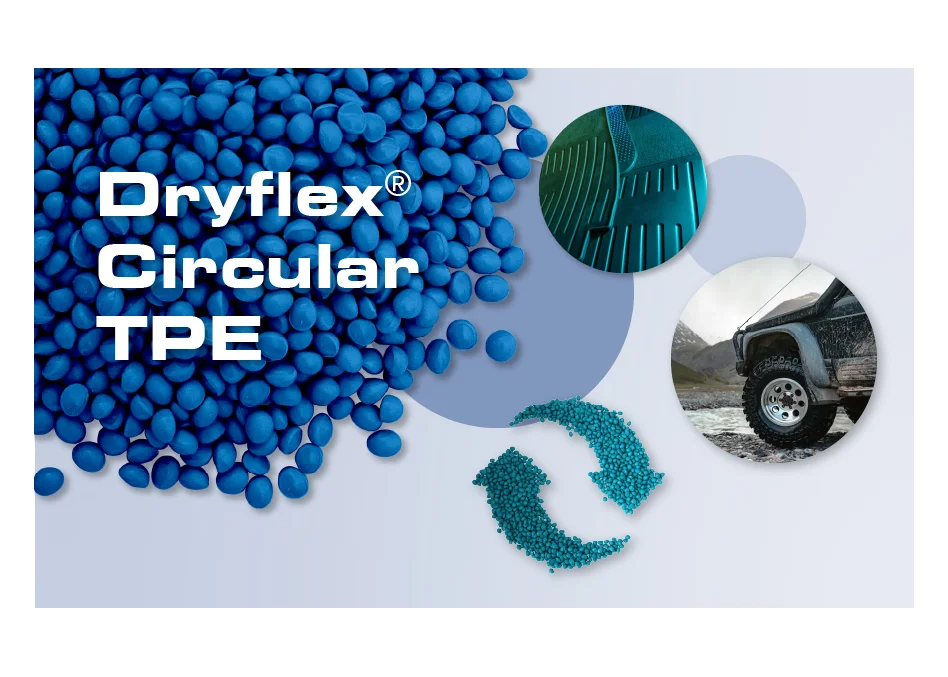
Recycled thermoplastic elastomers (rTPE) and recycled thermoplastic rubber (rTPR) are recycled, reprocessable elastomeric materials that combine rubber-like flexibility with thermoplastic melt processability. In industry usage, the terms are often applied broadly to compounds made from post-consumer recycled or post-industrial recycled polymers, recycled rubber, or mixed recycled streams that have been reformulated into materials suitable for extrusion, injection molding, or compression-type downstream operations.
As a material family, rTPE/rTPR sits at the intersection of rubber recycling, polymer compounding, and circular plastics design. It is used to convert waste elastomers, plastics, and sometimes tire-derived feedstocks into new products with lower virgin material demand, reduced product carbon footprint, and easier mechanical recyclability than conventional thermoset rubber systems. Recent research and commercial product lines also show a growing shift from “downcycled” recycled rubber blends toward more engineered rTPE systems with better consistency, tunable hardness, and clearer certification pathways such as GRS traceability.
History and Development
Thermoplastic elastomers emerged as an important materials class because they bridge two otherwise conflicting performance targets: the elastic recovery of rubber and the melt processability of plastics. Their recycled variants developed later, initially as compounding solutions for rubber waste and post-consumer plastic streams, especially in applications where full virgin-performance parity was not required.
A major historical driver has been tire and rubber waste valorization. Research and patents describe blending ground tire rubber or devulcanized rubber with thermoplastics, often polypropylene or polyethylene, to create new thermoplastic elastomeric materials. One notable technical route is devulcanization of EPDM waste followed by blending with polypropylene and dynamic vulcanization, producing recycled-rubber-based TPE in a continuous process. This type of approach helped establish the technical foundation for modern rTPR and recycled-rubber-based TPV-like materials.
In parallel, commercial recycled-content TPEs expanded for consumer and industrial goods. TSRC has reported rTPE products with Global Recycled Standard certification and applications as impact modifiers that can reduce post-consumer recycled plastic hardness to 80 Shore A or below. Freudenberg has also introduced apparel interlinings based on 100% recycled TPE base content, indicating that recycled elastomers are moving beyond commodity compounding into value-added textile and soft-goods markets.
Chemical Structure and Key Properties
rTPE/rTPR is not a single polymer, but a family of recycled elastomeric compounds. The final structure depends on the base resin, recycled rubber fraction, compatibilizers, fillers, oils, stabilizers, and processing history. In practice, recycled formulations may be based on polyolefin elastomers, styrenic block copolymers, polyurethane-derived recyclate, recycled HDPE or PP blends, or rubber/plastic hybrids made from tire-derived materials.
Key property profile
- Elastic recovery: Rubber-like deformation and rebound, especially when the formulation retains a soft phase or dispersed rubber domain.
- Thermoplastic processability: Melt processing allows regrinding, remelting, and re-extrusion, unlike crosslinked thermoset rubber.
- Property tunability: Hardness, flexibility, compression set, tear resistance, and abrasion resistance can be adjusted through blend ratio and compatibilization.
- Lower density than many engineering plastics: Often useful for lightweight flexible parts.
Technical limits and workarounds
- Poor consistency in recycled feedstock → variable composition and contamination → use sorting, washing, melt filtration, and compatibilizers to stabilize properties.
- Reduced thermal and mechanical performance versus virgin elastomers in some grades → chain scission, oxidation, or incomplete devulcanization → add antioxidants, coupling agents, elastomeric modifiers, or reinforcements such as fiber and mineral fillers.
- Limited chemical and high-temperature resistance in some TPR-like grades → soft polyolefin-rich morphology or weaker crosslink density → use TPV-style dynamic vulcanization, higher-performance base polymers, or blending with more resistant elastomers.
- Adhesion and surface-compatibility issues in some recycled soft TPEs → low surface energy and migration of oils/waxes → use corona/plasma treatment, primers, or formulation control.
Typical formulation examples
- Ground tire rubber + recycled HDPE + EVA: research has shown that recycled HDPE can be compounded with regenerated tire rubber and EVA to form thermoplastic elastomeric materials with improved morphology and mechanical response when compatibilized properly.
- Recycled rubber + polypropylene: a common route for recycled-rubber-based TPE, including devulcanized EPDM/PP systems with dynamic vulcanization.
Production Processes and Raw Feedstocks
rTPE/rTPR production begins with recovered feedstocks, typically:
- Post-consumer recycled plastics such as PE, PP, or mixed polyolefins.
- Post-industrial recycled scrap from elastomer or TPE processing.
- Ground tire rubber and other devulcanized rubber streams.
- Recycled textile or mineral reinforcements where required for performance.
Main production routes
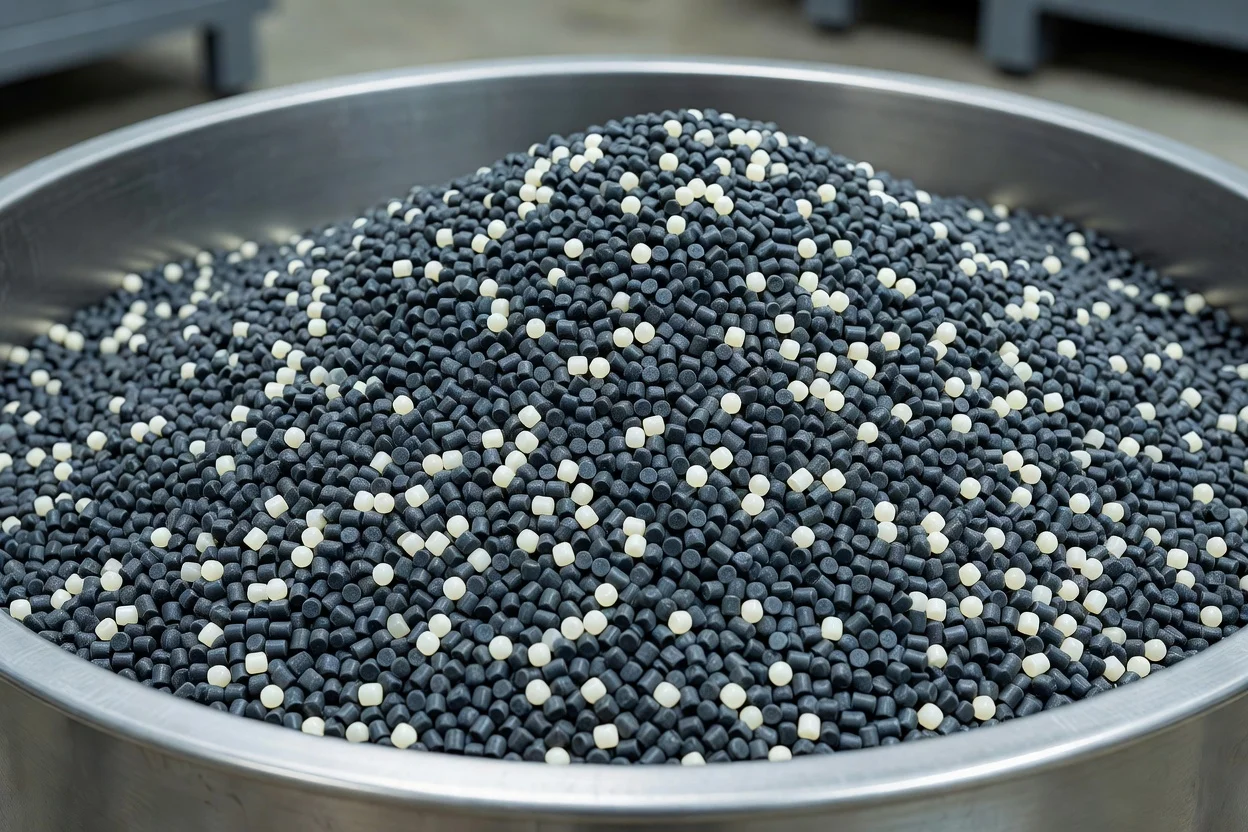
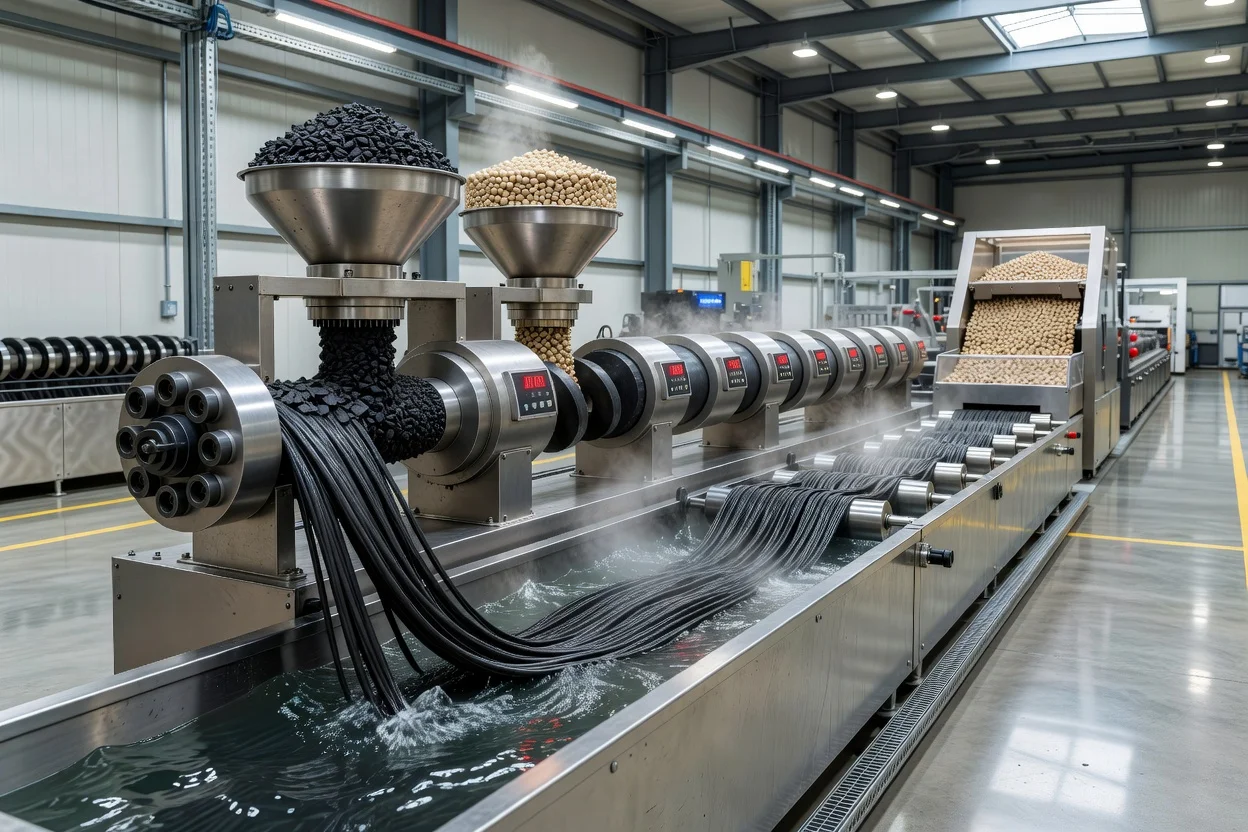
- Mechanical recycling and recompounding Sorted recycled pellets or regrind are melted, blended, filtered, and pelletized into new TPE compounds.
- Rubber-plastic blending Waste rubber powders are melt blended with thermoplastics to create elastomeric compounds with improved processability and reduced cost.
- Devulcanization plus dynamic vulcanization Rubber waste is partially broken down, blended with thermoplastic resin, then dynamically vulcanized to create finer rubber morphology and better elastic recovery.
- Compatibilized composite compounding Additives such as maleated polymers, coupling agents, or surface modifiers improve interfacial bonding and mechanical performance.
Typical auxiliaries and their function
- Compatibilizers, often 1–5 wt% → improve phase adhesion between recycled rubber and polyolefin matrices → reduce interfacial slippage and improve tensile strength.
- Antioxidants and stabilizers, often low-percent additions → limit thermo-oxidative degradation during reprocessing → preserve melt flow and elongation.
- Fillers and reinforcements → raise stiffness, wear resistance, or dimensional stability → useful in footwear, mats, and industrial parts.
- Processing oils or plasticizers → soften hard recycled blends and tune Shore hardness.
Applications and End-Use Markets
rTPE/rTPR is used where elasticity, softness, grip, damping, and recyclability matter more than absolute premium mechanical performance.
Major applications
| Sector | Typical product forms | Usual grade/process fit | Notes |
|---|---|---|---|
| Footwear | Soles, midsoles, overlays | Soft recycled TPR/TPE, injection molding | Common due to grip, cushioning, and low cost. |
| Automotive | Seals, gaskets, dust boots, mats, trim | Recycled TPE and TPV-like compounds, extrusion and injection molding | Used where softness and processability are important. |
| Cable and electronics | Cable jackets, grips, soft-touch parts | Flexible recycled TPE, extrusion | Value depends on consistency and electrical performance. |
| Consumer goods | Handles, toys, phone cases, appliance grips | Soft recycled TPE/TPR, injection molding | Attractive for tactile feel and recycled content. |
| Textiles and apparel | Interlinings, elastic inserts | Fine-gauge recycled TPE components | Emerging market with certified recycled content. |
| Industrial parts | Bushings, vibration dampers, seals | Higher-hardness recycled TPE, injection molding | Often needs reinforcement and compatibilization. |
| Construction and infrastructure | Seals, mats, sound barriers, flooring | Recycled rubber-rich TPE compounds | Can absorb vibration and reduce cost. |

Notable use-case differences
- Soft, low-hardness rTPE is preferred for comfort goods, grips, and footwear.
- Harder rTPR-like grades are more common in durable parts such as bushings, seals, and protective covers.
- High-performance or safety-critical uses such as medical tubing or demanding under-hood automotive parts are possible only in tightly controlled formulations with validated compliance.
Poor-fit use
- High-precision medical, food-contact, or aerospace components are generally a poor fit for commodity recycled elastomer grades because feedstock variability, extractables, odor, and traceability constraints can be difficult to control.
Environmental and Sustainability Aspects
rTPE/rTPR is primarily valued for its circularity advantage: it can reduce dependence on virgin petrochemical feedstocks and divert usable material from landfill or incineration.
Sustainability benefits
- Lower virgin polymer demand through PCR and PIR content.
- Reduced waste generation by reprocessing scrap and post-use elastomeric material.
- Potential carbon footprint reduction when recycled content displaces fossil-based resin.
- Support for circular design, especially when parts are designed for remelting and re-compounding.
Limits and trade-offs
- Mechanical recycling does not eliminate all environmental impact; repeated heat history can degrade properties and may require additional additives or blending.
- Recycled rubber streams may contain contaminants, mixed polymers, and odor issues that limit high-value reuse.
- Not all “recycled” elastomers are equally circular; some are blends that are technically recyclable but difficult to sort back into pure streams after use.
Bio-based and advanced circular alternatives
Recent research has demonstrated fully recyclable and tough TPEs from bio-sourced monomers and biorenewable polyolefin-like TPE systems with closed-loop chemical recyclability. These developments are relevant because they may eventually compete with recycled-content compounds in applications where consistent performance and circularity must coexist.
Economic and Global Market Impact
The economic appeal of rTPE/rTPR is built on three factors:
- Lower raw material cost versus virgin elastomers in many compounding contexts.
- Processing efficiency because thermoplastics can be remelted and molded on conventional plastic equipment.
- Commercial sustainability value driven by recycled-content requirements and carbon reporting.
Global market development is being shaped by:
- Rising demand for recycled-content products in automotive, apparel, consumer goods, and packaging-adjacent soft materials.
- Brand-owner pressure for traceability and certified recycled inputs.
- Competition between mechanically recycled compounds and new chemically recyclable or bio-based elastomer platforms.
Industry leadership
- TSRC has positioned its rTPE line as a certified recycled-content platform, emphasizing traceability and impact-modifying performance.
- Kraiburg TPE has marketed recycled-content TPE compounds that reduce product carbon footprint while preserving processability.
- Teknor Apex has highlighted sustainable TPE solutions based on PCR and PIR content.
- Freudenberg Performance Materials has introduced recycled-TPE-based textile interlinings, extending the market into apparel and technical textiles.
Current Challenges and Innovations
Current challenges
- Feedstock heterogeneity remains the main barrier to consistent mechanical performance.
- Odor, color variability, and extractables can restrict use in consumer-facing or regulated applications.
- Recycled blends can show inferior fatigue, compression set, or thermal resistance unless carefully formulated.
Innovations
- Devulcanization and dynamic vulcanization for more rubber-like recycled compounds.
- Compatibilization strategies to improve interfacial bonding in multi-polymer blends.
- Bio-based and closed-loop recyclable TPE chemistries that may complement recycled-content materials.
- Certified recycled-content platforms with traceability from feedstock to finished compound.
- Smart and functional recycled TPE composites for self-healing, shape-memory, and advanced packaging concepts.
Future Outlook
rTPE/rTPR is likely to expand as a practical circular-material category rather than a single standardized resin family. Growth will be strongest where recycled content, softness, and processing ease matter more than maximum performance, particularly in footwear, consumer goods, textiles, mats, seals, and general-purpose industrial parts.
Longer term, the market may segment into three broad directions:
- Mass-market recycled compounds for cost-sensitive applications.
- Certified high-consistency recycled elastomers for premium consumer and industrial uses.
- Advanced circular TPEs based on bio-sourced or chemically recyclable architectures that can compete with recycled-content materials on both performance and end-of-life design.
Summary
rTPE/rTPR refers to recycled thermoplastic elastomeric materials that preserve the core advantage of TPEs: rubber-like flexibility with melt reprocessability. Their value lies in converting recycled plastics and rubber waste into useful compounds for footwear, automotive parts, consumer goods, textiles, and industrial components, while reducing virgin material demand and supporting circularity. Their main constraints are feedstock variability, property retention during reprocessing, and limited suitability for highly regulated or safety-critical applications, which is why innovation in compatibilization, devulcanization, certification, and advanced recyclable chemistries remains central to the field.
References
- •
Thermoplastic elastomers. (2025, July 31). Gianeco. https://gianeco.com/en/products/thermoplastic-elastomers/Link
- •
rTPE. (2025, September 10). TSRC. https://www.tsrc.com.tw/tw/products-services/rtpe/Link
- •
Devulcanization of EPDM waste and dynamic vulcanization of the rubber component. (n.d.). Toyoda Gosei. https://www.toyoda-gosei.co.jp/seihin/technology/report/vol45_2/pdf/vol45_2_002.pdfLink
- •
Recent developments in synthesis, properties, applications and recyclability of thermoplastic elastomers. (2024, January 12). PMC. https://pmc.ncbi.nlm.nih.gov/articles/PMC10819226/Link
- •
From the sector. (2023, March 29). Textination. https://textination.de/en/news/archive?;newstype=205&;page=,1&newstype=211&page=,25Link
- •
Valorization of waste tires, recycled HDPE, and recycled EVA. (2022, June 27). Frontiers in Sustainability. https://www.frontiersin.org/journals/sustainability/articles/10.3389/frsus.2025.1638375/fullLink
- •
Thermoplastic elastomers based on recycled high-density polyethylene/ground tire rubber/ethylene vinyl acetate: Effect of ground tire rubber regeneration on morphological and mechanical properties. (2022, April 25). PMC. https://pmc.ncbi.nlm.nih.gov/articles/PMC10235528/Link
- •
Recycling content TPE. (n.d.). Kraiburg TPE. https://www.kraiburg-tpe.com/en/recycling-content-tpeLink
- •
Waste rubber recycling: A review on the evolution and properties of thermoplastic elastomers. (2020, February 8). PubMed. https://pubmed.ncbi.nlm.nih.gov/32046356/Link
- •
Ribonucleoside triphosphate: An overview. (n.d.). ScienceDirect. https://www.sciencedirect.com/topics/chemistry/ribonucleoside-triphosphateLink
- •
rTPE. (2025, August 12). TSRC. https://www.tsrc.com.tw/products-services/rtpe/Link
- •
Production and characterization of thermoplastic elastomers based on recycled rubber. (n.d.). Collectionscanada. https://www.collectionscanada.gc.ca/obj/thesescanada/vol2/QQLA/TC-QQLA-30327.pdfLink
- •
An overview of TPE recycling: Standards, grades, and mechanical properties. (2026, March 5). Alibaba. https://www.alibaba.com/product-insights/tpe-recycling.htmlLink
- •
Thermoplastic elastomers based on waste rubber and plastics. (2004, July 1). Rubber Chemistry and Technology. https://rct.kglmeridian.com/view/journals/rcat/77/3/article-p569.xmlLink
- •
Thermoplastic elastomers in modern rubber. (n.d.). International Journal of Materials Science and Technology. https://internationaljournalssrp.org/index.php/ijmst/article/download/171/123Link
- •
Sustainable TPE solutions & TPE recycling. (2024, June 12). Teknor Apex. https://www.teknorapex.com/en-us/teknor-apexs-extensive-product-portfolio-of-vinyl-thermoplastic-elastomers-nylon-and-colorants/sustainable-solutions/sustainable-tpe-solutionsLink
- •
The fundamentals of recyclable thermoplastic rubber. (2026, March 14). Alibaba. https://www.alibaba.com/product-insights/recyclable-thermoplastic-rubber.htmlLink
- •
Smart TPE materials based on recycled rubber shred. (2021, October 20). Materials. https://www.mdpi.com/1996-1944/14/21/6237Link
- •
Applied. (n.d.). Semantic Scholar. https://pdfs.semanticscholar.org/aa2c/a5decca3a57d8f6e97756a2a3099599e0d11.pdfLink
- •
Phase morphology, mechanical, and thermal properties of fiber-reinforced thermoplastic elastomer: Effects of blend composition and compatibilization. (2021, October 22). PMC. https://pmc.ncbi.nlm.nih.gov/articles/PMC9028046/Link
- •
Biorenewable and circular polyolefin thermoplastic elastomers. (2024, October 1). Nature Communications. https://www.nature.com/articles/s41467-024-52850-0Link
- •
Recycled polypropylene improved with thermoplastic elastomers. (n.d.). Wiley. https://onlinelibrary.wiley.com/doi/10.1155/2017/7525923Link
- •
Fully recyclable and tough thermoplastic elastomers from simple bio-sourced δ-valerolactones. (2024, September 10). Nature Communications. https://www.nature.com/articles/s41467-024-52229-1Link
- •
Thermoplastic elastomers and polymers derived from recycled rubber and plastics. (2001, September 21). Google Patents. https://patents.google.com/patent/US20020113333A1/enLink
- •
Enhanced recyclability of thermoplastic elastomer. (2024, October 30). PMC. https://pmc.ncbi.nlm.nih.gov/articles/PMC11561595/Link
- •
Thermoplastic elastomer. (2006, February 15). Wikipedia. https://en.wikipedia.org/wiki/Thermoplastic_elastomerLink
- •
Understanding thermoplastic elastomers: Versatile and recyclable. (2024, June 15). Plastics Engineering. https://www.plasticsengineering.org/2024/06/understanding-thermoplastic-elastomers-versatile-and-recyclable-005255/Link
- •
A guide to thermoplastic elastomers. (n.d.). Vanden Recycling. https://blog.vandenrecycling.com/a-guide-to-thermoplastic-elastomersLink
- •
Emerging trends and developments in thermoplastic elastomers. (2020, November 10). SpecialChem. https://www.specialchem.com/plastics/guide/emerging-trends-and-developments-in-thermoplastic-elastomersLink
- •
The differences between TPE and TPR. (2024, January 14). Essentra Components. https://www.essentracomponents.com/en-us/news/manufacturing/injection-molding/the-differences-between-tpe-and-tpr-a-handy-guideLink
- •
Thermoplastic elastomer (TPE) recycling. (2023, May 5). Reclaim Plastics. https://reclaimplastics.com/materials-we-recycle/tpe-recycling/Link
- •
Class II ribonucleotide reductases catalyze carbon−cobalt bond reformation on every turnover. (1999, August 6). ACS Publications. https://pubs.acs.org/doi/10.1021/ja9913840Link
- •
Thermoplastic elastomers TPE, TPR. (n.d.). BPF. https://www.bpf.co.uk/plastipedia/polymers/Thermoplastic_Elastomers.aspxLink
- •
Understanding TPE materials: Characteristics, differences with TPR. (2024, September 14). TPE-SP. https://en.tpe-sp.com/news/340.htmlLink
- •
Developing recyclable TPE materials (thermoplastic elastomers). (2024, July 31). Eureka. https://eureka.patsnap.com/blog/material-tech-resources/developing-biodegradable-and-recyclable-tpe/Link
- •
Thermoplastic elastomer: An overview. (n.d.). ScienceDirect. https://www.sciencedirect.com/topics/materials-science/thermoplastic-elastomerLink
- •
TPR vs TPE: What is the difference between them. (n.d.). ECHEMI. https://www.echemi.com/cms/1418036.htmlLink
- •
TPR vs. TPE: Material differences and comparisons. (2023, January 20). Xometry. https://www.xometry.com/resources/materials/tpr-vs-tpe/Link
- •
Thermoplastic rubber (TPR): Materials and properties. (2022, August 15). Xometry. https://www.xometry.com/resources/materials/thermoplastic-rubber-tpr/Link
- •
Thermoplastic rubber (TPR) & thermoplastic elastomers (TPEs). (n.d.). Molding Dynamics. https://www.moldingdynamics.net/materials/tpr-tpes/Link
- •
TPR vs. TPE: Similarities and differences. (2023, March 21). Fictiv. https://www.fictiv.com/articles/tpr-vs-tpe-similarities-and-differencesLink
- •
TPR vs. TPE: Which material is right for your project? (2025, June 11). VMT. https://vmtcnc.com/tpr-vs-tpe/Link
- •
Thermoplastic elastomer (TPE): An ultimate guide. (2026, April 1). SpecialChem. https://www.specialchem.com/plastics/guide/thermoplastic-elastomerLink
- •
Thermoplastic rubber (TPR): Meaning, properties, uses. (2025, November 26). Farr. https://farr.ae/thermoplastic-rubber-meaning-properties-benefits-real-world-applicationsLink
- •
Structural. (2024, April 26). RTP Company. https://www.rtpcompany.com/products/structural/Link