
Introduction
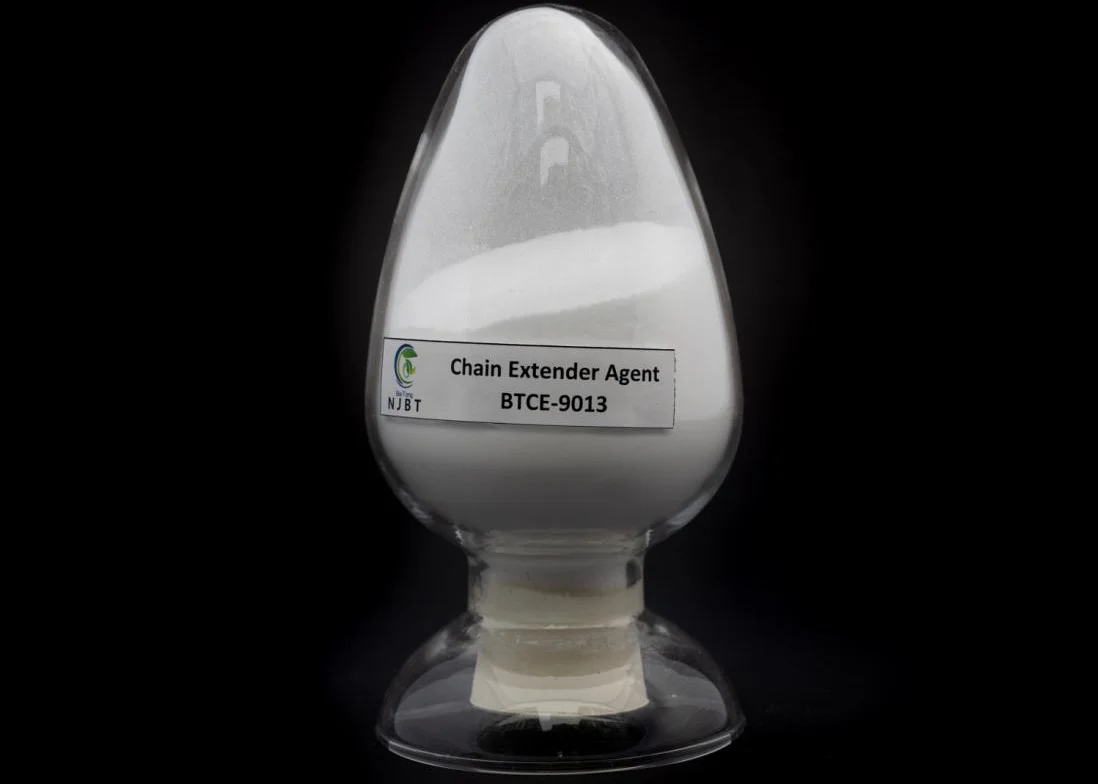
Chain extenders are low-molecular-weight reactive compounds used to increase polymer molecular weight, build molecular architecture, and improve final performance during polymer manufacture or recycling. In practice, the term most often refers to additives for polyurethanes, polyesters such as PET and PLA, and recycled polymer streams, where they react with chain ends to restore melt strength, toughness, and processability.
Chain extenders are important because many modern plastics and elastomers are made from partially degraded, short-chain, or low-viscosity intermediates that must be rebuilt before conversion into useful products. Their industrial role spans polyurethane elastomers and thermoplastic polyurethanes, reactive extrusion of polyester and biodegradable plastics, and upgrading of recycled materials into higher-value applications.
The chemistry and performance of chain extenders are closely tied to the polymer system being modified. In polyurethanes, they are typically short diols or diamines that react with isocyanates to lengthen hard segments and tune mechanical properties. In condensation polymers and recycled polyesters, they are often epoxy-, anhydride-, oxazoline-, carbodiimide-, or isocyanate-functional compounds that react with hydroxyl, carboxyl, or other end groups to rebuild chain length and sometimes create branched structures.
Their importance has increased with the growth of mechanical recycling, lightweighting, and bioplastics, because chain extenders can partially compensate for molecular damage caused by heat history and reprocessing. At the same time, they are not a universal solution: the wrong functionality, dosage, or mixing window can cause gel formation, unwanted branching, or property imbalance, so selection is highly formulation-specific.
History and Development
Chain extension emerged as a practical polymer-processing strategy alongside the development of step-growth polymers and reactive polyurethane chemistry. Early industrial use was concentrated in polyurethane elastomers, where low-molecular-weight glycols and diamines were used to control hard-segment formation and improve strength and abrasion resistance.
As polymer recycling expanded, chain extension became a key post-reactor and reactive-extrusion tool for compensating for molecular-weight loss in degraded polyesters and polyamides. More recently, the concept has broadened to include multifunctional additives for PLA, PBAT, PET, and rPET, especially in film, sheet, foaming, and bottle preform applications where melt strength is critical.
Chemical Structure and Key Properties
Chain extenders are defined by reactive functionality, not by a single chemical family. They are commonly bifunctional, although multifunctional variants are used when controlled branching or light crosslinking is desired.
Main structural classes
| Polymer system | Common chain-extender chemistry | Typical function |
|---|---|---|
| Polyurethanes | Diols, diamines, short polyols | Extend hard segments and raise molecular weight |
| PET, rPET, polyesters | Epoxy, anhydride, oxazoline, carbodiimide, oligomeric reactive extenders | Rebuild molecular weight and improve melt strength |
| PLA and biodegradable polyesters | Epoxy and multifunctional reactive extenders | Improve melt strength, reduce brittleness, aid foaming and extrusion |
| Recycled polyolefins and blends | Reactive coupling additives, often multifunctional | Reconnect degraded chains and improve processability |
Key property effects
- Higher molecular weight: chain extension increases chain length and often intrinsic viscosity, especially in polyesters.
- Improved melt strength: crucial for film blowing, thermoforming, foaming, and bottle blowing.
- Better toughness and elongation: especially in polyurethane elastomers and modified polyesters.
- Greater thermal stability in use or processing: often by reducing chain-end concentration and limiting further degradation.
Real limits and workarounds
- Poor melt-strength recovery in some polyester systems → low compatibility or insufficient end-group reactivity → workaround: use epoxy-functional extenders or a reactive-extrusion temperature window matched to the resin.
- Gelation or excessive branching → multifunctionality too high or dosage too large → workaround: lower addition rate, improve dispersion, or select a less reactive extender.
- Limited barrier improvement in recycled polyesters → chain extension raises molecular weight but does not fundamentally change gas permeability → workaround: combine chain extension with barrier layers, coatings, or fillers.
- In polyurethane processing, slow or fast reactivity can upset phase formation → mismatch between extender and isocyanate kinetics → workaround: choose diol versus diamine chemistry to control hard-segment build and cure profile.
Mechanism examples
- PET/rPET: epoxy-functional chain extenders react with hydroxyl and carboxyl end groups, reconnecting broken chains and increasing molecular weight during extrusion.
- Polyurethane elastomers: 1,4-butanediol or similar short diols react with isocyanate-terminated prepolymers, creating hard segments that raise stiffness, toughness, and abrasion resistance.
Production Processes and Raw Feedstocks
Chain extenders are themselves formulated specialty chemicals, but their industrial value depends on how they are introduced into polymer processing.
Main processing routes
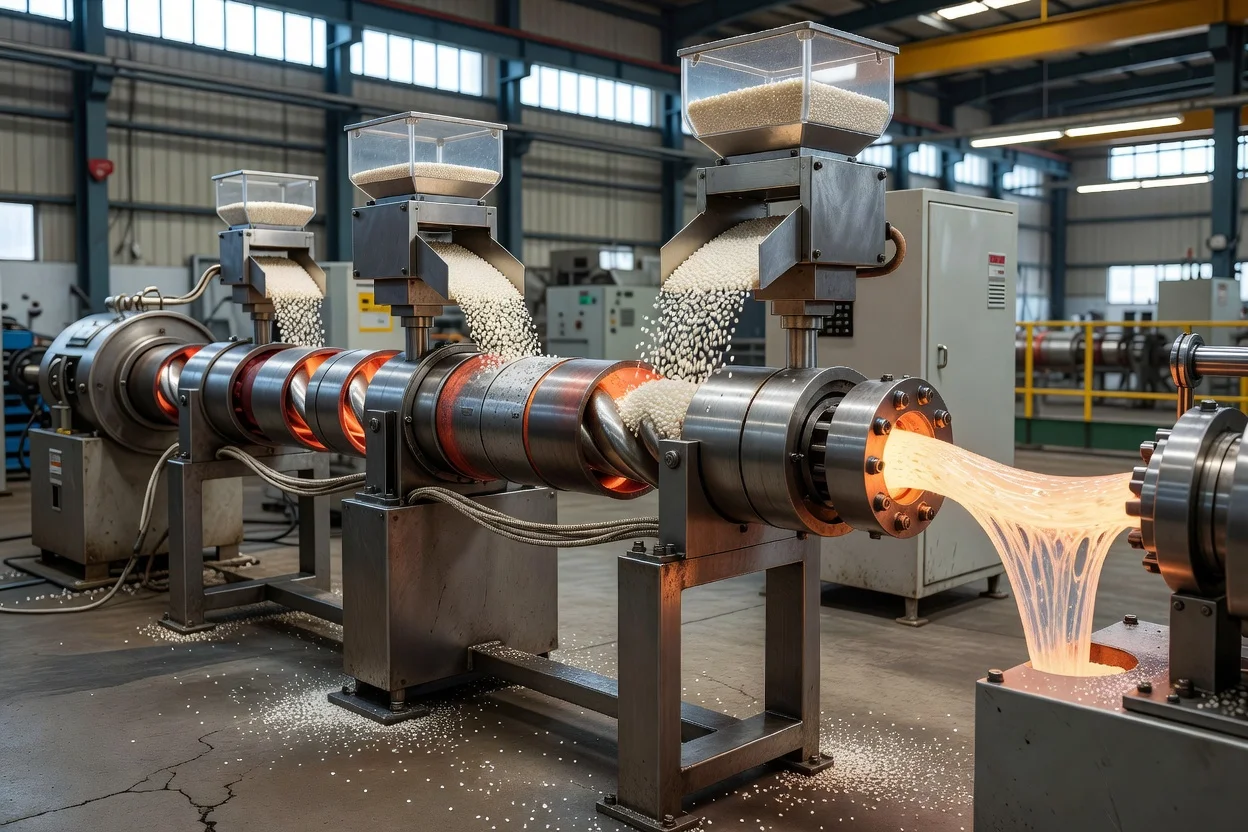
- Reactive extrusion: the most common route for PET, rPET, PLA, and blends, where the extender is metered into the melt and reacts in-line.
- Polyurethane prepolymer chain extension: extender is added after prepolymer formation to build molecular weight and segment structure.
- Solid-state or post-processing modification: used in some condensation polymers to improve molecular weight before final conversion.
Raw feedstocks and chemistry sources
- Diols and diamines are typically petrochemical-derived in polyurethane systems.
- Epoxy-functional chain extenders are often built from epichlorohydrin-based intermediates or glycidyl chemistry.
- Reactive oligomers and carbodiimides are used where broader end-group tolerance or hydrolysis resistance is desired.
- Bio-based or partially bio-based extenders are emerging, especially for compostable and recycled polymer platforms, although cost and performance consistency remain challenges.
Applications and End-Use Markets
Chain extenders are used wherever polymer chains must be rebuilt, toughened, or adapted to a specific process window.
| End-use sector | Usual polymer system | Typical role of chain extender | Common process |
|---|---|---|---|
| Films and sheet | PLA, PBAT, PET, rPET | Raise melt strength and reduce sag | Film blowing, sheet extrusion |
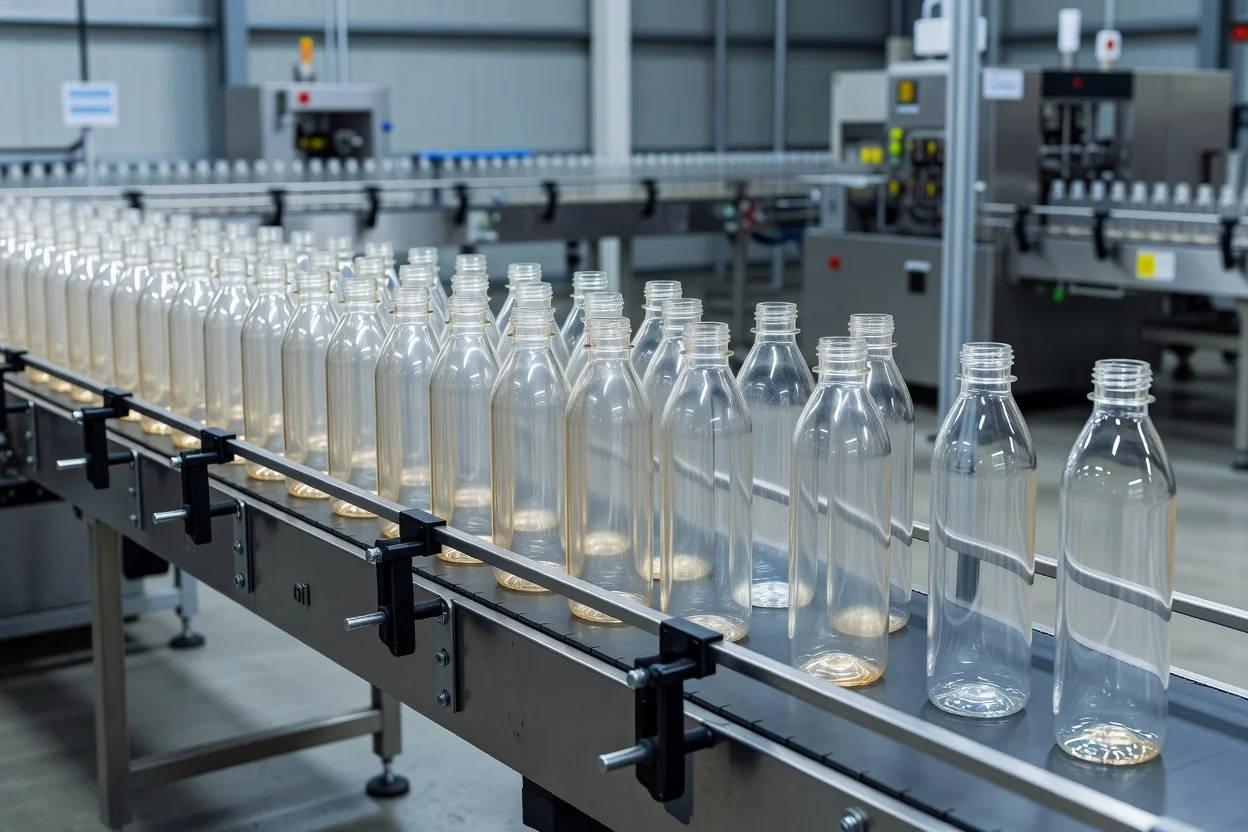
| Bottles and preforms | PET, recycled PET | Restore intrinsic viscosity and processability | Injection stretch blow molding |
| Pipes and profiles | Modified polyesters, some PU systems | Improve toughness and processing stability | Extrusion |
| Cable and wire | Polyurethane-based compounds | Tune flexibility and abrasion resistance | Extrusion, compounding |
| Footwear | Polyurethane elastomers | Increase resilience, wear resistance, and abrasion resistance | Casting, molding |
| Automotive | TPU, PU, modified recycled plastics | Balance durability, heat resistance, and toughness | Injection molding, extrusion, reactive compounding |
| Adhesives and sealants | Polyurethane systems | Improve joint strength and fatigue resistance | Formulation and cure |
| Foams | PLA, PET, PU systems | Improve melt strength and cell stability | Foaming, extrusion |
| Recycled plastics | rPET, recycled polyesters, recycled polyolefins | Recover molecular weight and expand reuse options | Reactive extrusion |
A poor-fit use
Chain extension is generally a poor fit for applications requiring maximal gas barrier on its own, because raising molecular weight does not inherently create low-permeability structures; barrier performance usually requires copolymers, coatings, or multilayer design.
Environmental and Sustainability Aspects
Chain extenders have become strategically important to plastics circularity because they can upgrade degraded recycled polymers into more demanding applications. In rPET, for example, they help restore molecular weight after thermal and hydrolytic scission, allowing recycled material to re-enter higher-value processing routes such as sheet, thermoforming, and some bottle-related applications.
Sustainability benefits
- Extends the usable life of recycled polymers by restoring processability.
- Supports downgauging and lightweighting through improved melt strength and dimensional control.
- Enables incorporation of more recycled content in applications that would otherwise reject low-viscosity recyclate.
Trade-offs and constraints
- The additives are often petrochemical-derived and add cost and formulation complexity.
- Reactive processing can create side products, gels, or waste streams if not controlled.
- Chain extension does not eliminate the need for sorting, cleaning, or decontamination in recycling systems.
Bio-based alternatives
Bio-based polymer platforms increasingly use chain extenders to compensate for the brittleness or low melt strength of compostable polyesters. However, the sustainability value depends on the complete system, including feedstock origin, conversion efficiency, end-of-life route, and local composting or recycling infrastructure.
Economic and Global Market Impact
Chain extenders are a specialty additive segment, but they have outsized influence because they can determine whether a recycled or biodegradable polymer is commercially processable at scale. Their market relevance has increased with demand for recycled-content packaging, lightweight automotive compounds, and high-throughput reactive extrusion.
Leading activity is concentrated among producers of polyurethane intermediates, additive suppliers, and formulation companies serving PET, PLA, TPU, and rPET conversion markets. In commercial terms, the most attractive value proposition is not the additive price itself but the ability to unlock higher-value end uses for otherwise marginal polymer streams.
Current Challenges and Innovations
Key challenges
- Dosage sensitivity: small changes can swing the product from under-modified to over-branched.
- Compatibility: not all extenders work across all polyester or polyurethane chemistries.
- Food-contact and regulatory constraints: additives used in packaging require careful compliance testing.
- Process stability: moisture, residence time, and temperature strongly affect reaction outcomes.
Innovation directions
- More selective epoxy and oligomeric extenders for controlled branching in rPET and PLA.
- Hybrid additive systems that combine chain extension with stabilizers, compatibilizers, or nucleating agents.
- Circularity-focused formulations designed for repeated recycling rather than one-pass recovery.
- Application-specific TPU and PU extenders that optimize phase separation, toughness, and fatigue resistance.
Future Outlook
Chain extenders are likely to remain essential as plastics manufacturers seek to balance performance, recyclability, and cost. Their strongest growth potential lies in recycled PET, compostable polyesters, thermoplastic polyurethanes, and other reactive-compounding platforms where molecular-weight recovery directly translates into processability and market value.
Future development is expected to focus on lower-dosage, higher-selectivity chemistries; reduced odor and volatility; better food-contact compliance; and additive packages tailored to specific recycling streams rather than generic polymer classes. As circular manufacturing expands, chain extenders will increasingly function not only as performance modifiers but also as enablers of polymer re-entry into high-value supply chains.
Summary
Chain extenders are reactive additives that rebuild or extend polymer chains, most importantly in polyurethanes and recycled or biodegradable polyesters. Their industrial significance comes from the way they improve molecular weight, melt strength, toughness, and processability, while also helping recyclers and compounders recover value from degraded materials.
References
- •
Chain Extender - an overview. (n.d.). ScienceDirect. https://www.sciencedirect.com/topics/engineering/chain-extenderLink
- •
Chain extender. (2023, June 3). Wikipedia. https://en.wikipedia.org/wiki/Chain_extenderLink
- •
Chain Extenders. (2025, June 26). SpecialChem. https://www.specialchem.com/polymer-additives/pf-chain-extendersLink
- •
Chain Extender in the Real World: 5 Uses You'll Actually See (2025). (2025, September 18). LinkedIn. https://www.linkedin.com/pulse/chain-extender-real-world-5-uses-youll-actually-vqu1fLink
- •
Why Do You Need Chain Extenders For Jewelry? 101 Guide. (2025, September 5). OOTB Jewelry. https://www.ootbjewelry.com/chain-extenders-for-jewelry/Link
- •
How to Use a Chain Extender? (2024, August 20). YFN Jewelry Blog. https://www.yfn.com/blog/14k-gold-bracelet-extender/Link
- •
What is a chain extender? (2025, July 2). Roquette. https://www.roquette.com/faq/performance-materials/what-is-a-chain-extenderLink
- •
Chain Extenders for adhesives. (2024, July 5). Quimidroga. https://www.quimidroga.com/en/raw-materials-adhesives-and-sealants/chain-extenders-for-adhesives/Link
- •
All Information About Chain Extender. (2022, June 1). ECHEMI. https://www.echemi.com/cms/691441.htmlLink
- •
Industry news. (2025, January 1). DNI Trade. https://www.dni-trade.com/?list_4/2201.htmlLink
- •
Polyurethane Chain Extenders in the Real World: 5 Uses ... (2025, October 24). LinkedIn. https://www.linkedin.com/pulse/polyurethane-chain-extenders-real-world-r6s7cLink
- •
Chain Extenders - Custom Lengths. (2025, January 20). Fine Jewellery Supplies. https://ore-metals.com/fr/pages/chain-extendersLink
- •
Types of PU Chain Extenders and Their Applications. (2024, December 5). TNC International Chem. https://www.tncintlchem.com/types-of-pu-chain-extenders-and-their-applications/Link
- •
Chain Extenders for PLA and Recycled PET. (2026, February 8). Chemzip. https://chemzip.com/blog/chain-extenders-pla-pet-recycling-applicationsLink
- •
Chain Extension - an overview. (n.d.). ScienceDirect. https://www.sciencedirect.com/topics/engineering/chain-extensionLink
- •
Are there two commonly used polyurethane chain extenders? (2023, June 9). Ytzhuotai. https://www.ytzhuotai.com/en/sys-nd/13.htmlLink
- •
PET mechanical recycling. A new principle for chain extender ... (n.d.). ScienceDirect. https://www.sciencedirect.com/science/article/abs/pii/S2214993724000666Link
- •
Polymeric Chain Extender leading producer. (2025, July 8). Univook. https://www.univook.com/product/polymeric-chain-extender/Link
- •
Jewelry Chain Extenders: A Complete Guide. (2024, January 10). Jewepiter. https://www.jewepiter.com/jewelry-chain-extenders/Link
- •
How Gold Chain Extenders Enhance Jewelry Versatility. (2025, August 12). Fashionisers. https://fashionisers.com/2025/08/12/how-gold-chain-extenders-enhance-jewelry-versatility/Link
- •
polyurethane auxiliary agent chain extender selection guide. (n.d.). Bdmaee. https://www.bdmaee.net/polyurethane-auxiliary-agent-chain-extender-selection-guide/Link
- •
What is the Function of Chain Extender in rPET? (2025, August 9). Carbodiimide. https://carbodiimide.com/what-is-the-function-of-chain-extender-in-rpet/Link
- •
What are Polyurethane Chain Extenders/Crosslinkers? (2025, April 30). Enuochem. https://www.enuochem.com/blog-Industry-News-11916/What-are-Polyurethane-Chain-ExtendersCrosslinkers-11910156.htmlLink
- •
Effect of Aromatic Chain Extenders on Polyurea and ... (2023, February 2). PMC. https://pmc.ncbi.nlm.nih.gov/articles/PMC9920908/Link
- •
The Role of PU Chain Extenders in Polyurethane Elastomers. (n.d.). TNC International Chem. https://www.tncintlchem.com/the-role-of-pu-chain-extenders-in-polyurethane-elastomers/Link
- •
PMDA vs Epoxy Chain Extenders. (2025, May 22). Carbodiimide. https://carbodiimide.com/pmda-vs-epoxy-chain-extenders-a-comprehensive-comparison-for-polyester-modification/Link
- •
OLIGOMERE CHAIN EXTENDER FOR TREATMENT AND AFTER-TREATMENT AND RECYCLING OF CONDENSATE POLYMERS, COMPOSITIONS AND APPLICATIONS BASED ON THEM. (2003, January 15). Google Patents. https://patents.google.com/patent/DE60312482T2/enLink
- •
How Do Necklace Extenders Work? (n.d.). Fetch the Love. https://fetchthelove.com/blogs/necklace/how-do-necklace-extenders-workLink
- •
Epoxy-Based Chain Extenders in Polylactic Acid (PLA). (2025, January 31). SCIRP. https://www.scirp.org/journal/paperinformation?paperid=140381Link
- •
5 Key Roles of Chain Extenders in Recycled Polyolefins. (2026, February 6). Aasad Chimie. https://aasadchimie.com/application-industries/chain-extenders-recycled-polyolefins/Link
- •
Oligomeric chain extenders for processing, post-processing and recycling of condensation polymers, synthesis, compositions and applications. (1995, December 12). Justia Patents. https://patents.justia.com/patent/6984694Link
- •
Extender Chains. (2023, January 24). Shop LC. https://www.shoplc.com/articles/extender-chains.htmlLink
- •
Chain Extenders & Findings. (2026, August 27). Artbeads. https://artbeads.com/chain-extenders-findings/Link
- •
Chain extenders for polyurethanes. (2008, March 4). Google Patents. https://patents.google.com/patent/US4931487A/enLink
- •
Overview of Chain Extenders for Jewelry Making. (2019, June 28). Beadaholique. https://beadaholique.com/products/overview-of-chain-extenders-for-jewelry-makingLink
- •
Extender Chain. (2026, July 10). Hello Adorn. https://www.helloadorn.com/products/extender-chainLink