

Introduction
PEK (polyetherketone) is a high-performance, semi-crystalline thermoplastic in the polyaryletherketone family, valued for its exceptional heat resistance, chemical durability, wear performance, and mechanical stability under sustained load. It is closely related to PEEK and other PAEK polymers, but its lower ether-to-ketone ratio gives it a more rigid backbone and, in many formulations, higher temperature capability and improved wear resistance in demanding dynamic applications.
PEK occupies a narrower but technically important segment of the engineering plastics market, serving applications where conventional thermoplastics and even many other high-performance polymers are pushed to their limits. Its development is tied to the broader evolution of aromatic polyketones in the late twentieth century, and its current relevance is shaped by lightweighting, miniaturization, electrification, and the search for materials that can replace metals in severe environments. Sustainability considerations are increasingly important as well: PEK is melt-processable and technically recyclable, but it remains energy-intensive to produce and is used mainly in long-life, high-value applications where durability can offset material intensity.
History and Development
Polyaryletherketone materials emerged from research into aromatic polymers that could combine high thermal stability with processability, leading to a family of resins that includes PEK, PEEK, PEKK, and related grades. Commercial development of this family accelerated in the late 1970s and early 1980s, with PEEK becoming the best-known member, while PEK remained more specialized in performance-critical niches.
Industrial production of PEK has been associated with advanced polymer suppliers and compounders serving aerospace, electrical, oil and gas, and precision engineering markets. In practice, the commercial importance of PEK has been reinforced by the broader success of PAEK materials, which helped establish confidence in ultra-high-performance thermoplastics as metal substitutes in harsh-service environments.
Chemical Structure and Key Properties
PEK belongs to the polyaryletherketone class, in which rigid aromatic rings are linked by ether and ketone groups in the main chain. This architecture creates a stiff backbone, high crystallinity, and strong intermolecular cohesion, which together drive its high melting point, dimensional stability, and resistance to creep at elevated temperatures.
Compared with PEEK, PEK generally has a higher ketone content and lower ether content, which increases chain rigidity and raises thermal performance in many grades. The trade-off is that higher rigidity can also narrow the processing window and make optimization of crystallization and molding conditions more critical.
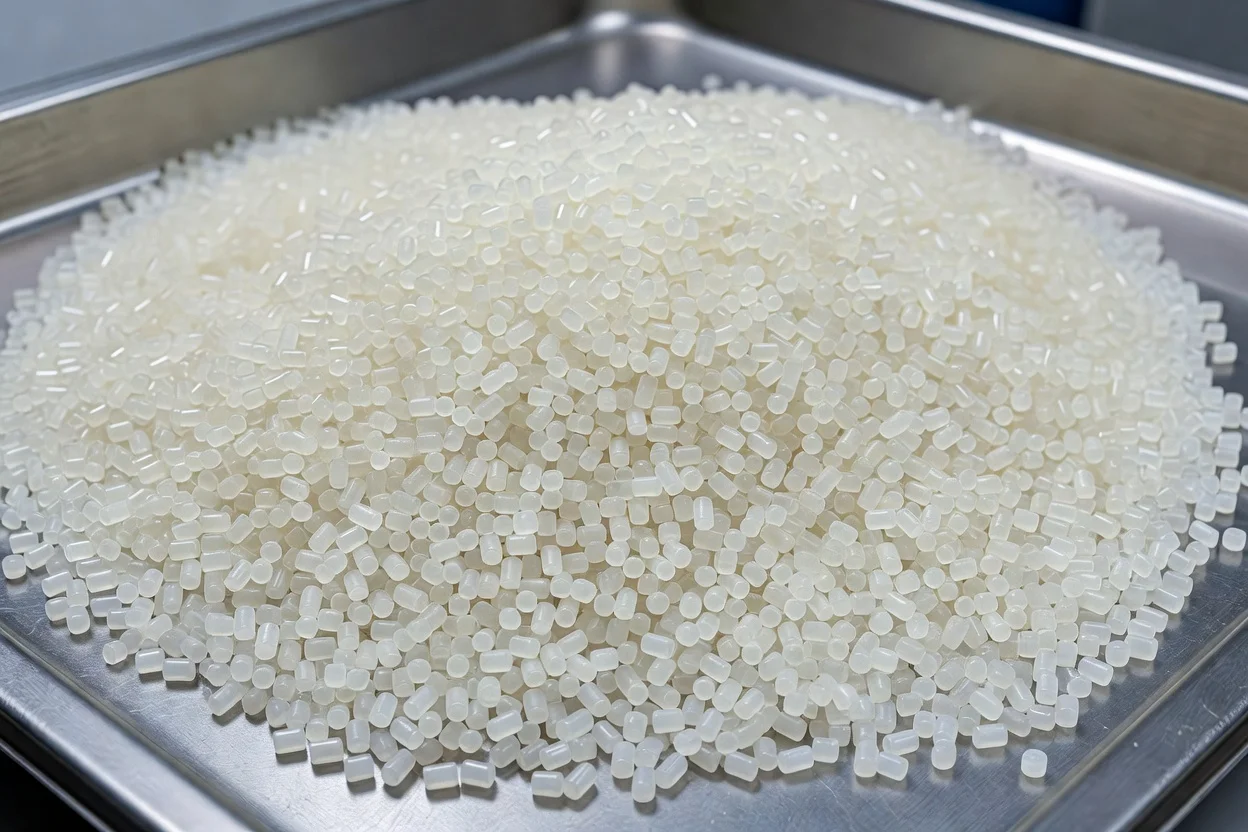
Key characteristics commonly associated with PEK include:
- High thermal stability, including sustained performance at elevated temperatures.
- Excellent chemical resistance to many acids, bases, hydrocarbons, lubricants, and hot water environments.
- Low wear and good fatigue resistance, especially in bearings, gears, and sliding components.
- Low flammability and good performance in electrically and thermally demanding settings.
Important limits and workarounds:
- Poor oxygen and grease barrier performance in film-like uses → caused by the inherently nonpolar, semi-crystalline structure and limited utility as a packaging barrier resin → workaround: use barrier multilayers, coatings, or alternative polymers such as EVOH, PA, or fluoropolymers where packaging barrier is critical.
- Low surface energy before treatment → caused by the chemically inert aromatic backbone, which reduces wetting and adhesion → workaround: plasma, corona, flame, or primer treatments are used when bonding, printing, or coating is required.
- High processing temperature requirement → caused by the high melting point and strong intermolecular forces → workaround: use high-temperature injection molding, extrusion, and tooling designed for elevated melt temperatures and controlled crystallization.
- High raw-material cost → caused by complex monomer synthesis and lower production scale than commodity polymers → workaround: reserve PEK for life-cycle-critical parts where weight reduction, service life, or maintenance savings justify the premium.
Production Processes and Raw Feedstocks
PEK is produced by step-growth polymerization using aromatic monomers under high-temperature, high-boiling, and carefully controlled conditions. The polymerization route typically relies on nucleophilic aromatic substitution chemistry, using bisphenol-type monomers and activated aromatic dihalides, followed by isolation, purification, and pelletization or downstream compounding.
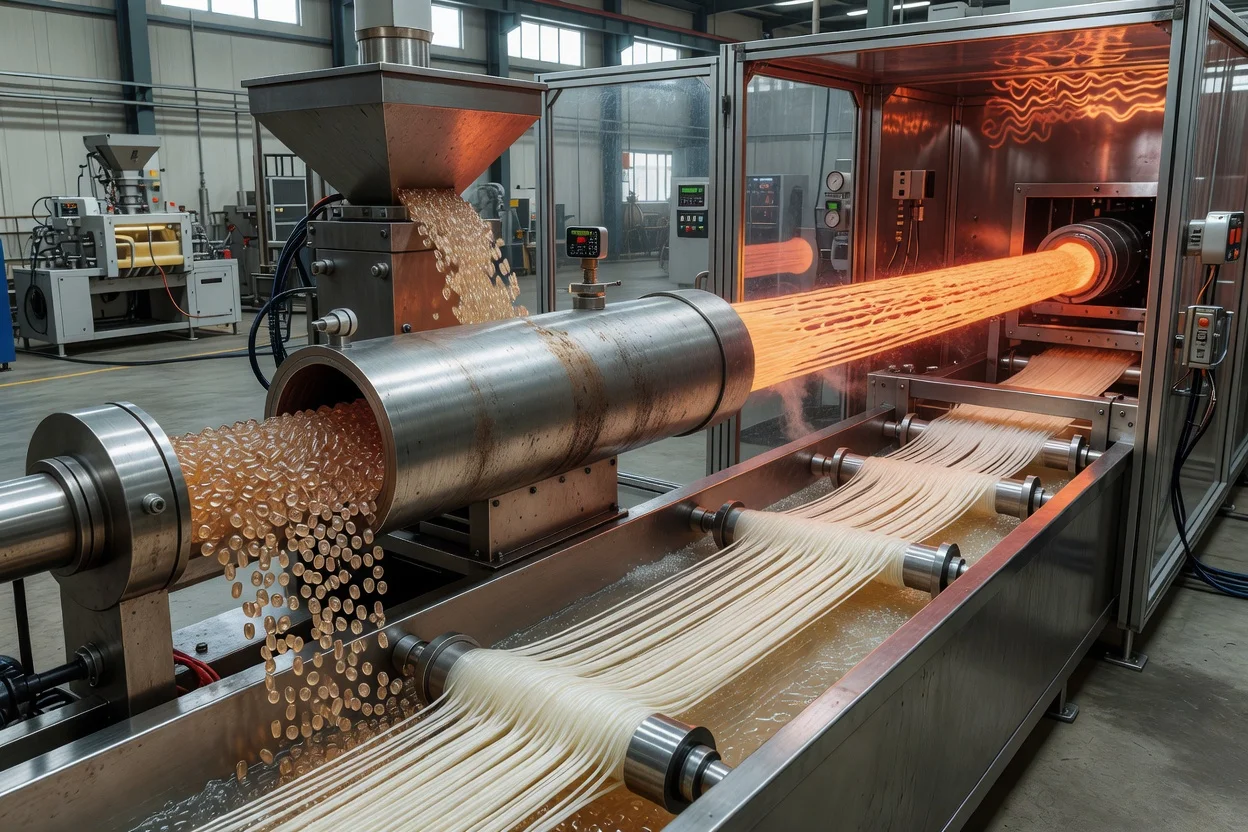
The process generally requires:
- Aromatic monomers and activated ketone-containing precursors.
- Strong bases such as potassium carbonate in many synthesis routes.
- High-boiling solvents and inert atmospheres to maintain reaction conditions.
- Elevated temperatures, often in the range required for melt or solution polymerization of PAEKs.
Raw-feedstock economics are influenced by the cost and availability of specialty monomers, energy demand, solvent handling, and the relatively small scale of production compared with mainstream thermoplastics. As a result, PEK is typically produced and consumed in higher-value forms such as pellets, machined stock shapes, fibers, or compounded grades rather than in commodity resin volumes.
Applications and End-Use Markets
PEK is selected when a part must retain stiffness, strength, and dimensional stability under prolonged heat, chemical exposure, or sliding contact. It is therefore concentrated in industrial and transportation niches rather than broad consumer markets.
Typical applications include:
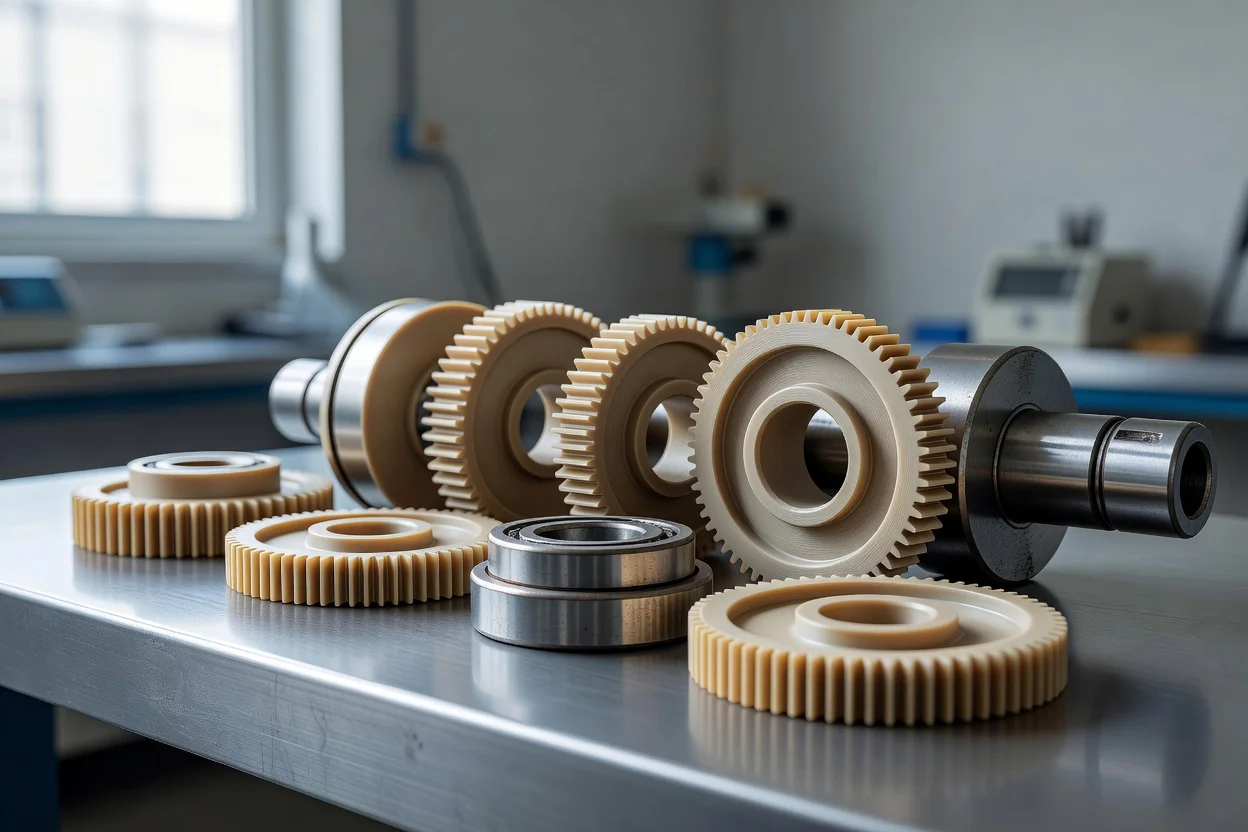
- Gears, bearings, bushes, and wear parts → usually injection-molded or machined grades, often unfilled or reinforced, because PEK provides low wear and stable friction behavior.
- Aerospace components → often reinforced or precision-machined parts, where high-temperature capability and weight reduction are critical.
- Oil and gas components → seals, insulators, and downhole-adjacent parts, typically using chemically resistant grades for harsh fluids and elevated temperatures.
- Electrical and electronics parts → connectors, insulators, and high-temperature structural pieces, where dielectric stability and thermal endurance matter.
- Medical and scientific components → selected implant-adjacent or instrument parts in cases where chemical resistance, sterilization tolerance, and dimensional stability are required.
- Industrial machinery → sliding elements, valve parts, compressor components, and precision mechanical parts, typically machined from stock shapes.
A poor-fit use is flexible packaging film, because PEK is too costly, too rigid, and not optimized for barrier packaging performance; multilayer commodity or barrier polymers are typically more appropriate.
Property and Application Comparison
| Material | Relative heat resistance | Wear resistance | Chemical resistance | Typical commercial role |
|---|---|---|---|---|
| PEK | Very high | Very high | Very high | Extreme-service engineering parts |
| PEEK | Very high | High | Very high | Broader high-performance engineering uses |
| PEKK | Very high | High | Very high | Aerospace, additive manufacturing, specialty parts |
PEK is often chosen when elevated-temperature mechanical retention is more important than broad market availability or lower cost, while PEEK remains the more widely used member of the family.
Environmental and Sustainability Aspects
PEK is not a mass-market circularity material in the way polyethylene or polypropylene are, but its sustainability profile is shaped by long service life, lightweighting benefits, and the ability to reduce maintenance or replacement frequency in demanding applications. In many uses, the environmental case is less about end-of-life recycling volumes and more about avoiding failure, reducing metal mass, and extending component lifetime.
Relevant sustainability points include:
- Mechanical recyclability and reprocessability: as a thermoplastic, PEK can in principle be remelted and reprocessed, especially in clean industrial scrap streams.
- Downcycling risk: high-performance engineering plastics often face contamination, reinforcement-matrix separation issues, and limited collection infrastructure.
- Biobased alternatives: there are no direct biobased PEK equivalents with comparable high-temperature performance at scale; substitution usually means changing the material platform entirely.
- Carbon footprint: the resin is energy-intensive to manufacture, but the total life-cycle impact can be favorable in applications where it replaces heavier metals or prevents frequent part replacement.
Economic and Global Market Impact
The PEK market is small relative to commodity resins but strategically important in sectors where failure costs are high and performance requirements are stringent. Its economics are driven by specialty monomers, high processing temperatures, and limited global producer concentration.
Leading commercial influence in the broader PAEK arena is strongly associated with Victrex, which is widely identified with PEK/PAEK supply in industrial markets. Compounders and stock-shape manufacturers, including firms such as Ensinger and other advanced materials processors, extend market reach by converting base resin into usable forms for machining, molding, and custom part production.
Because PEK is used in small volumes and high-value sectors, its market impact is amplified through:
- aerospace lightweighting,
- industrial durability,
- medical and scientific instrument performance,
- electrification and high-temperature electrical systems.
Current Challenges and Innovations
PEK faces several structural challenges:
- Cost pressure from specialized monomers and limited scale.
- Processing complexity due to high melt temperatures and crystallization control requirements.
- Competition from PEEK, PEKK, PPS, PPSU, and filled high-temperature polymers, depending on service conditions.
- Recycling and collection limitations in post-consumer streams.
Innovation trends include:
- Fiber- and mineral-reinforced PEK compounds to improve stiffness, tribology, and thermal dimensional stability.
- Advanced surface engineering to improve adhesion, bonding, and coating performance.
- Additive manufacturing grades for complex, low-volume, high-value parts, especially in aerospace and medical applications.
- Hybrid designs that combine PEK with metals or ceramics to exploit complementary performance advantages.
Future Outlook
PEK is likely to remain a niche but strategically important material, with growth concentrated in applications that reward durability, temperature resistance, and weight reduction. Its strongest future opportunities are in electrified transport, aerospace interiors and structures, oil and gas equipment, and precision industrial systems where long life and reliability outweigh resin cost.
Longer term, the main constraints will be supply-chain economics, processing know-how, and competition from adjacent high-performance polymers. If manufacturing efficiencies improve and compound development continues, PEK may expand modestly beyond its current specialty base, especially where regulatory pressure and engineering economics favor longer-lived, lighter, and more chemically robust components.
Summary
PEK is a high-performance PAEK thermoplastic defined by its rigid aromatic backbone, exceptional heat and chemical resistance, and strong wear behavior under load. It is not a broad-volume plastics material, but it is highly consequential wherever metal replacement, high-temperature service, and long component life are essential.
References
- •
Polyetherketone. (2012, June 10). In Wikipedia. https://de.wikipedia.org/wiki/PolyetherketoneLink
- •
PEK (Polyetherketone). (2022, January 24). Drake Plastics. https://drakeplastics.com/ultra-high-performance-plastic-materials-solutions-for-your-most-demanding-applications/pek-polyetherketone/Link
- •
Polyether ether ketone. (2003, June 24). In Wikipedia. https://en.wikipedia.org/wiki/Polyether_ether_ketoneLink
- •
What is Poly-ether-ether-ketone (PEEK) Polymer? Properties.... (2019, September 24). Victrex. https://www.victrex.com/en/blog/2017/a-closer-peek-at-peekLink
- •
Polyetherketones. (2022, May 11). In Wikipedia. https://en.wikipedia.org/wiki/PolyetherketonesLink
- •
PEK Material Properties and Performance Guide. (2025, October 30). PEEK China. https://www.peekchina.com/blog/pek-material-properties.htmlLink
- •
PEEK vs PEK vs PTFE Materials. (2023, January 16). Greene Tweed. https://www.gtweed.com/materials/peek-vs-pek-vs-ptfe/Link
- •
Polyetherketone (PEK). (2022, August 15). Xometry. https://www.xometry.com/resources/materials/polyetherketone/Link
- •
Recent Trends and Application of Peek Material. (n.d.). IRJET. https://www.irjet.net/archives/V8/i8/IRJET-V8I8157.pdfLink
- •
PEEK plastics - Polyetheretherketone properties & applications | MCG. (2026, August 25). Mitsubishi Chemical Advanced Materials. https://www.mcam.com/en/products/peekLink
- •
Polyetheretherketone (PEEK): How to select the right grade? (2025, July 9). SpecialChem. https://www.specialchem.com/plastics/guide/polyetheretherketone-peek-thermoplasticLink
- •
Recent Advances in PEEK for Biomedical Applications. (2025, July 17). PMC. https://pmc.ncbi.nlm.nih.gov/articles/PMC12300588/Link
- •
Poly Ether Ether Ketone Polymer: Comprehensive Analysis Of.... (n.d.). Patsnap Eureka. https://eureka.patsnap.com/materials/peek-polymer-synthesis-propertiesLink
- •
Physical And Mechanical. (2019, February 20). AZoM. https://www.azom.com/article.aspx?ArticleID=17671Link
- •
Description of Poly(aryl-ether-ketone) Materials (PAEKs.... (2023, May 2). PMC. https://pmc.ncbi.nlm.nih.gov/articles/PMC10180673/Link
- •
Polyetherketone (PEK) - TECAPEEK HT black. (n.d.). Ensinger. https://www.ensingerplastics.com/en/shapes/tecapeek-ht-blackLink
- •
PEEK (polyetheretherketone) vs PAEK.... (2026, July 29). Victrex. https://www.victrex.com/en/blog/2021/peek-or-paekLink
- •
Polyetherketoneketone. (2024, January 28). In Wikipedia. https://en.wikipedia.org/wiki/PolyetherketoneketoneLink
- •
Polyetheretherketone - an overview. (n.d.). ScienceDirect. https://www.sciencedirect.com/topics/engineering/polyetheretherketoneLink
- •
Polyether ether ketone (PEEK): Characteristics, Features, and Process. (2022, May 25). Xometry. https://www.xometry.com/resources/materials/polyether-ether-ketone/Link
- •
Understanding Polyetherketone (PEK): The High-Performance Engineering Plastic. (2024, July 11). Goldsupplier Blog. https://blog.goldsupplier.com/polyetherketone-pek/Link
- •
Polyetherketone (PEK). (2021, September 2). RTP Company. https://www.rtpcompany.com/products/product-guide/polyetherketone-pek/Link
- •
PEEK Material Properties and Applications. (2026, April 13). AON3D. https://www.aon3d.com/material-science/peek-material-properties-and-applications/Link
- •
Polyketone Engineering Plastic: Comprehensive Analysis Of.... (n.d.). Patsnap Eureka. https://eureka.patsnap.com/materials/polyketone-engineering-plasticLink
- •
PEEK vs PEK vs PTFE Comparison Guide | Properties &.... (2026, July 29). Infinita Lab. https://infinitalab.com/blog/peek-vs-pek-vs-ptfe-differences-comparison/Link