
Introduction
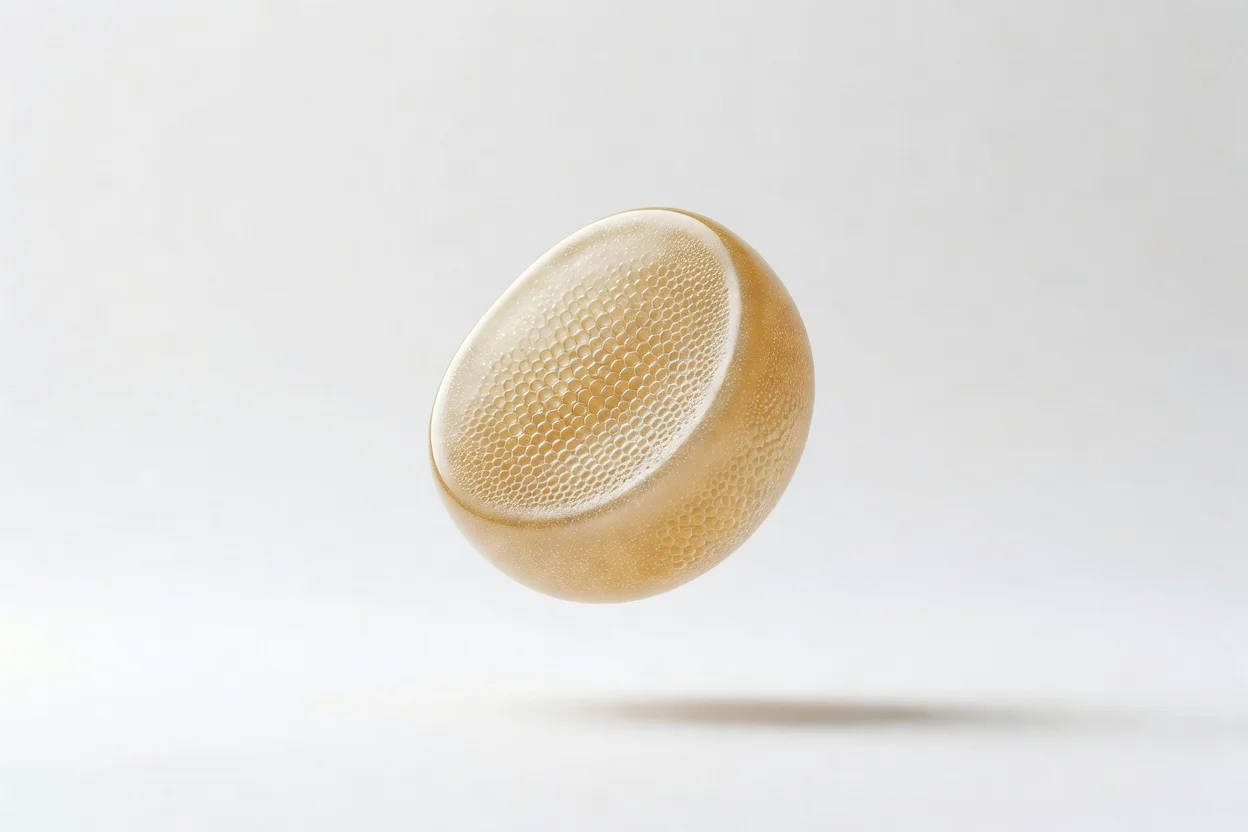
Epoxy resin foams are lightweight, cellular thermoset materials produced by foaming and curing epoxy-based formulations, often with curing agents, blowing agents, and stabilizers. They combine the adhesion, chemical resistance, dimensional stability, and electrical insulation associated with epoxy resins with the density reduction and energy absorption of a foam structure, making them important in structural, thermal-insulation, buoyancy, and protective applications.
In the plastics value chain, epoxy foams occupy a niche between conventional rigid foams and high-performance composites: they are not commodity insulation foams, but rather engineered materials used where low mass, rigidity, flame resistance, and processable shape retention are all required. Their development has expanded from early structural foam concepts into modern syntactic foams, bio-based systems, and composites reinforced with fibers, hollow microspheres, graphite, or nanoparticles.
From a sustainability perspective, epoxy foams present a mixed profile. Their long service life and weight-saving function can reduce energy use in transport and structural systems, but their thermoset crosslinked network limits remelting and conventional recycling. Current innovation is therefore focused on bio-derived epoxy precursors, lower-emission foaming processes, and hybrid or recyclable architectures that preserve performance while improving circularity.
History and Development
Epoxy foams emerged from broader advances in epoxy resin chemistry, especially the use of epoxies as structural adhesives, coatings, and composite matrices. Early patents and technical disclosures established foamable epoxy compositions for insulation, void filling, and structural reinforcement, particularly in aerospace and transportation.
As processing knowledge matured, epoxy foams diversified into several families:
- Rigid structural foams, used for reinforcement, sandwich cores, and load-bearing inserts.
- Syntactic foams, containing hollow microspheres to lower density while maintaining compressive strength and electrical insulation.
- Open-cell and macroporous foams, designed for sound absorption, filtration, or specialty thermal functions.
- Carbon and graphitized foams derived from epoxy precursors, developed for conductive or energy-related uses.
More recent research has emphasized low-density and bio-based epoxy foams, including systems derived from epoxidized cardanol and vegetable-oil-based amines, as well as foams produced by supercritical CO2 or other advanced foaming methods.
Chemical Structure and Key Properties
Epoxy foams are based on epoxy resins that cure through crosslinking to form a three-dimensional thermoset network. The foam morphology arises when gas is introduced or generated during curing, creating cells whose size, connectivity, and wall thickness govern the final mechanical and thermal behavior.
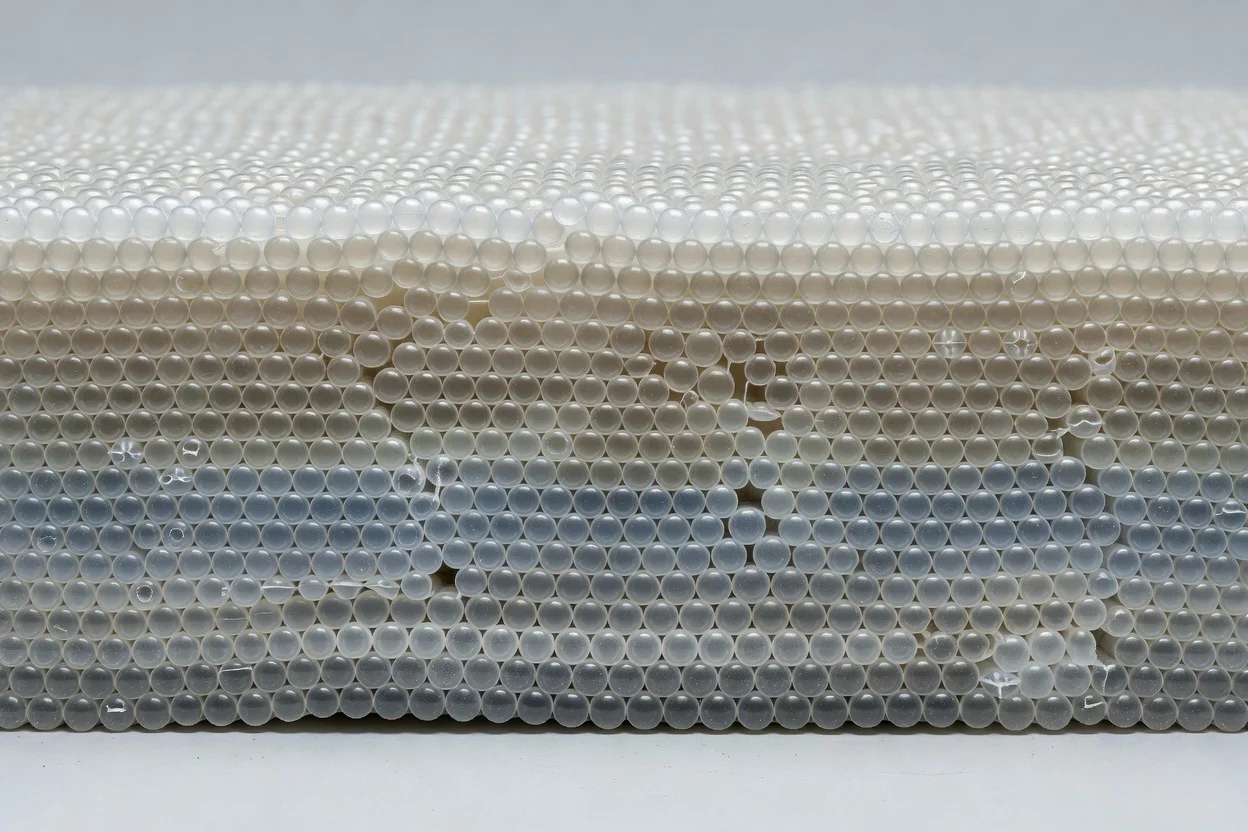
Key properties include:
- Low density relative to solid epoxy, often tuned for buoyancy, insulation, or weight reduction.
- High compressive strength compared with many other foam types, especially in syntactic and reinforced formulations.
- Good chemical and moisture resistance, due to the crosslinked network.
- Low thermal conductivity, making epoxy foams suitable for insulation roles.
- Electrical insulation, especially in closed-cell syntactic systems.
- Flame resistance or self-extinguishing behavior in many formulations, although performance depends strongly on additives and formulation design.
A useful technical distinction is that epoxy foams are generally rigid thermosets, whereas polyurethane foams span a much wider spectrum from soft to rigid. This makes epoxy foams especially suitable where stiffness, dimensional stability, and chemical resistance are more important than softness or resilience.
Practical limits and their causes
- Limited recyclability → thermoset crosslinking prevents remelting → use mechanical grinding, downcycling, chemical recycling research, or design-for-disassembly approaches.
- Brittleness in some formulations → high crosslink density and cellular defects can concentrate stress → use flexibilizers, tougheners, fiber reinforcement, or microsphere-based designs.
- Cell nonuniformity and processing sensitivity → foaming and curing must be synchronized precisely → use catalyst control, temperature profiling, and optimized blowing systems.
- Moisture or property loss in poorly designed open-cell structures → interconnected pores allow ingress and reduce insulation performance → use closed-cell designs, surface sealing, or syntactic foams.
Representative formulation examples
- Epoxy plus hollow glass microspheres, typically at moderate loadings, is used to reduce density while preserving compressive strength and insulation; the microspheres act as pre-formed voids that also help control shrinkage and thermal expansion.
- Bio-based epoxidized cardanol with vegetable-oil-derived amine, combined with a blowing agent, can yield partially bio-based rigid foams suitable for lightweight transportation interiors and shock/thermal insulation.
Production Processes and Raw Feedstocks
Epoxy foams are produced from a resin phase, a curing agent, and a foaming strategy. According to recent technical literature, epoxy foams are commonly made by combining epoxy resin with foaming agents, catalysts, and stabilizers under heat or other activation conditions.
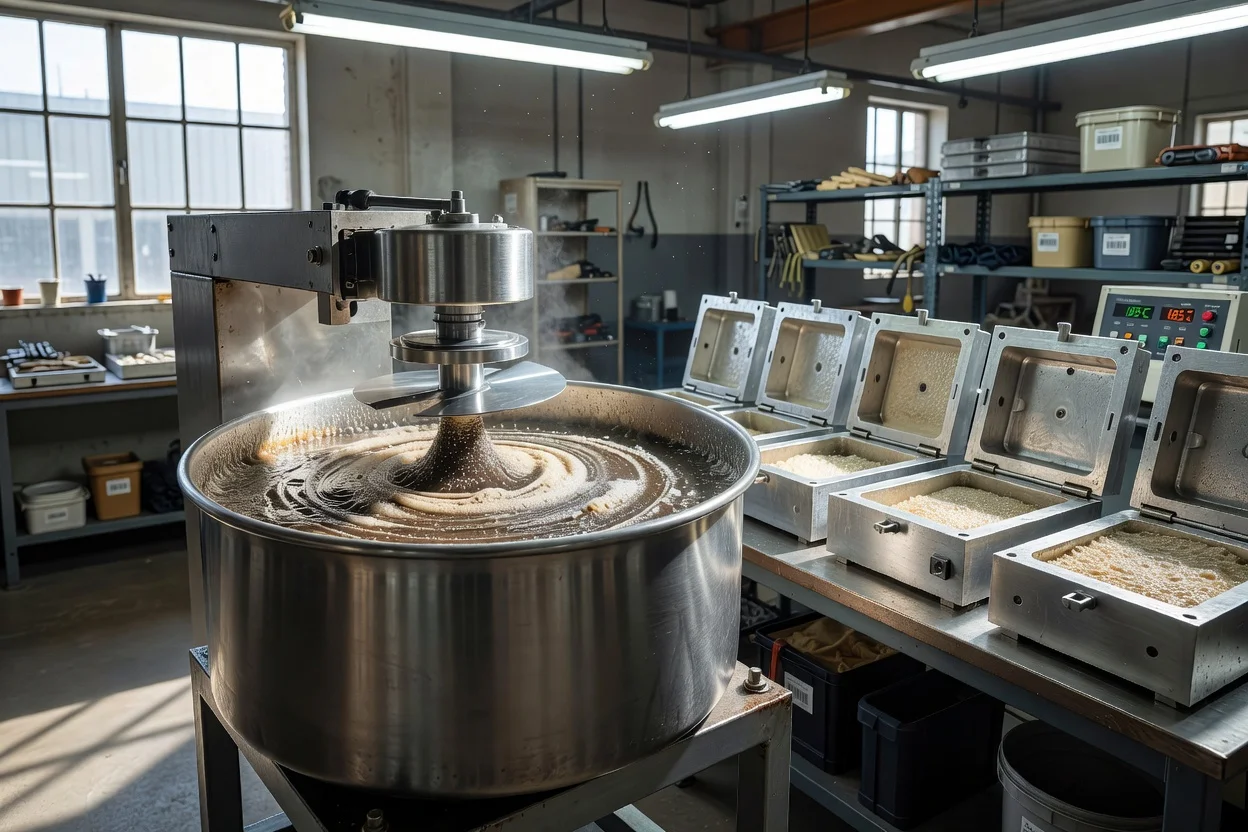
Main production routes
- Chemical blowing during cure, where gas-generation reactions or volatilization create cells as the network gels.
- Physical foaming, including methods that use dissolved gas or supercritical CO2 to generate pores during pressure release.
- Template-based foaming, where sacrificial phases or particle packing create open or macroporous structures.
- Syntactic foaming, where hollow microspheres are dispersed in epoxy to create a controlled cellular composite rather than a gas-blown foam.
- Foamable structural adhesives and gap-fill systems, where expansion occurs in situ to bond and reinforce assemblies.
Raw feedstocks
- Epoxy oligomers or resins, derived mainly from petrochemical feedstocks.
- Curing agents, such as amines, anhydrides, or tailored tougheners.
- Blowing agents, chemical or physical.
- Fillers and modifiers, including silica, perlite, graphite, carbon fibers, cellulose nanofibrils, and hollow glass or polymer microspheres.
- Bio-based epoxy precursors, such as epoxidized cardanol and vegetable-oil-derived building blocks.
Processing is highly formulation-dependent. Small changes in catalyst content, curing temperature, or blowing-agent kinetics can alter cell size, density, and mechanical performance substantially.
Applications and End-Use Markets
Epoxy foams are used where a combination of low mass, stiffness, insulation, and chemical resistance is valuable.
| End-use sector | Typical epoxy foam type or grade | Main function |
|---|---|---|
| Aerospace | Rigid structural foam, syntactic foam, reinforced foam | Lightweight structural parts, panels, buoyancy, insulation |
| Automotive and transport | Structural foam, sandwich core, foamable adhesive systems | Stiffening, crash absorption, vibration damping, weight reduction |
| Marine and offshore | Syntactic foam, buoyancy foam | Deep-sea buoyancy, flotation, protection |
| Construction | Insulating foam, repair foam, structural reinforcement foam | Thermal insulation, void filling, strengthening |
| Electronics and electrical | Closed-cell syntactic foam | Electrical insulation, encapsulation support, thermal protection |
| Sporting goods and consumer products | Moldable rigid foam | Lightweight shells, protective cores, shock absorption |
| Specialty industrial systems | Heat-resistant foam, carbon foam precursors | Sealing, thermal management, functional components |
Major application areas
- Aerospace and transportation: Epoxy foams are used in aircraft components, interior panels, crash pads, and structural reinforcement, where low mass and fire performance are critical.
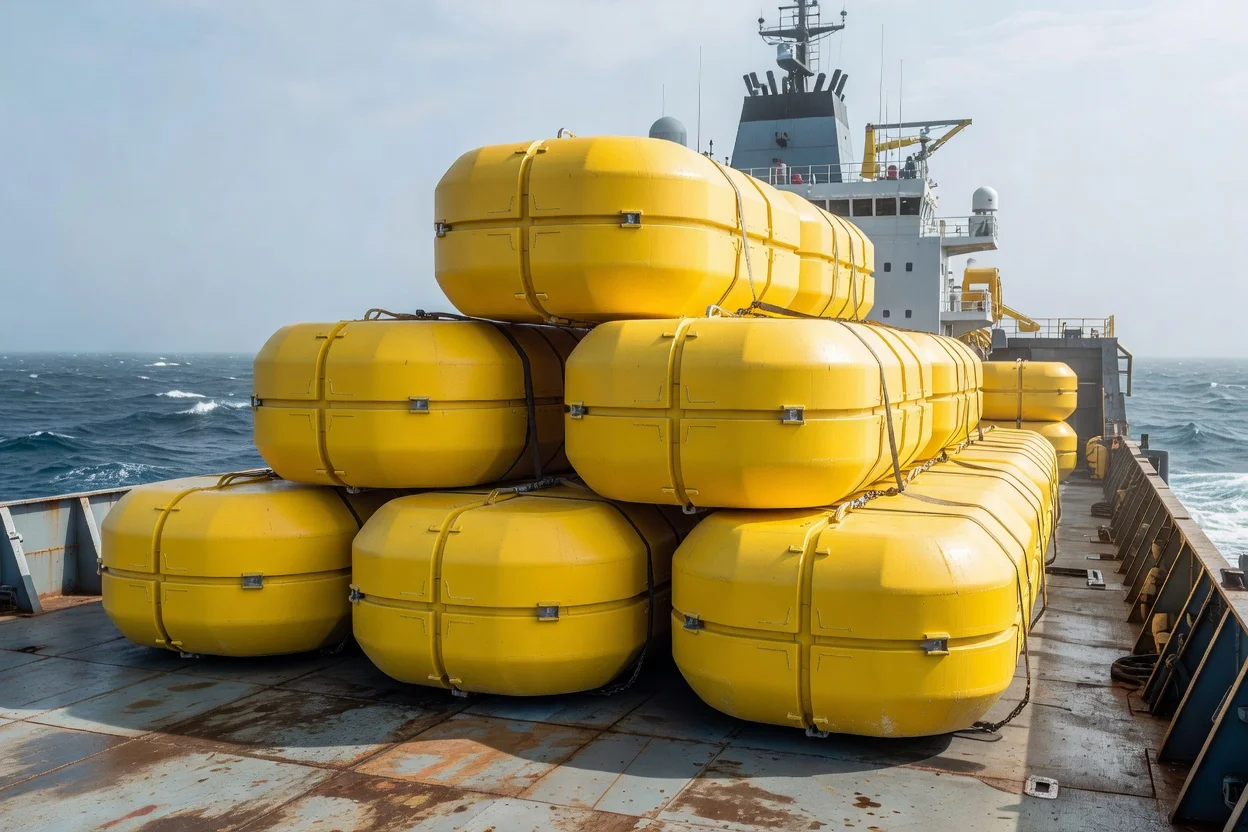
- Marine and deep-sea systems: Syntactic epoxy foams are valued for buoyancy and pressure resistance in offshore and underwater applications.
- Construction: Uses include thermal insulation, structural repair, crack filling, and reinforcement of composite or metal assemblies.
- Electrical and electronic equipment: Closed-cell epoxy syntactic foams offer high electrical insulation and low water uptake, supporting applications in internal insulation and encapsulation.
- Automotive: Lightweight rigid foams and foamable adhesives are used for body stiffening, local reinforcement, vibration control, and gap filling.
- Consumer and sporting goods: Molded foams are used in helmets, protective gear, and lightweight housings because they can absorb energy while maintaining form.
A poor-fit use
Epoxy foams are generally a poor fit for soft cushioning applications, because they are usually rigid, relatively brittle, and optimized for stiffness rather than elastic rebound. In such roles, polyurethane or elastomeric foams are typically more suitable.
Environmental and Sustainability Aspects
Epoxy foams are durable and high-performing, but their environmental profile is shaped by the thermoset nature of epoxy chemistry. Once cured, the network cannot be remelted, which makes conventional recycling difficult and often limits end-of-life pathways to mechanical size reduction or energy recovery.
Sustainability strengths
- Lightweighting can reduce transport emissions during use, especially in aerospace and automotive applications.
- Long service life can reduce replacement frequency in demanding environments.
- Thermal insulation can lower energy loss in buildings and industrial systems.
Sustainability challenges
- Fossil-based feedstocks still dominate many epoxy systems.
- Thermoset irreversibility limits circular recycling.
- Additive complexity can complicate recovery and formulation transparency.
Pathways under development
- Bio-based epoxy precursors, such as cardanol and vegetable-oil-derived amines, are being used to partially replace petrochemical feedstocks.
- Supercritical CO2 and other lower-emission foaming methods are being explored to reduce solvent use and improve process control.
- Hybrid foams and syntactic architectures can improve property efficiency, potentially reducing material intensity per unit performance.
- Reinforced and multifunctional foams may extend service life and reduce total material throughput.
Economic and Global Market Impact
The epoxy foam segment is much smaller than the markets for PE, PP, or polyurethane foams, but it has high strategic value because it serves demanding engineering applications rather than mass packaging or commodity insulation. Demand is closely tied to aerospace build rates, electric vehicles, offshore energy, electronics, and advanced construction systems.
Recent industry and technical reviews indicate that epoxy resins are already central to adhesives, coatings, composites, electronic materials, and biomedical systems, and epoxy foams extend that portfolio into cellular and lightweight structures. The strongest value proposition is not volume, but performance per kilogram.
Leading producers and technology providers in this space are often specialized formulators, composite-material suppliers, and industrial resin companies rather than large commodity polymer producers. Market leadership tends to be fragmented by application segment and region, with aerospace, marine, and specialty construction showing the highest technical barriers to entry.
Current Challenges and Innovations
Main technical challenges
- Cell control: Uniform pore structure is difficult to achieve because foaming and curing must remain synchronized.
- Toughness versus stiffness trade-off: Higher rigidity can increase brittleness.
- Thermal management: Some applications require low conductivity, while others require heat spreading or fire endurance.
- Cost-performance balance: High-performance formulations can be significantly more expensive than commodity foams.
- End-of-life handling: Recycling remains a persistent limitation for most thermoset foams.
Innovation directions
- Bio-based rigid foams from renewable epoxy precursors.
- Nanomodified foams using graphene, CNTs, silica, or cellulose nanofibrils to improve toughness, conductivity, or insulation balance.
- Syntactic foams with engineered microspheres for high compressive strength and low water uptake.
- Functional foams for electromagnetic shielding, sensing, and thermal management.
- In-situ foaming adhesives and structural reinforcements for automotive and aerospace assembly lines.
Future Outlook
Epoxy resin foams are likely to remain a specialized but strategically important class of advanced foam materials. Their strongest future opportunities lie in lightweight structural design, deep-sea and offshore systems, high-performance insulation, and multifunctional composites where one material must carry mechanical, thermal, and electrical roles simultaneously.
The most important development path is likely to be formulation-led rather than purely process-led: better bio-based monomers, more precise foaming control, tougher cellular architectures, and hybrid foam-composite systems will determine which applications scale beyond niche use. Sustainability pressure will also favor designs that reduce resin content, extend service life, and improve recoverability without sacrificing the performance advantages that distinguish epoxy foams from commodity alternatives.
Summary
Epoxy resin foams are high-performance thermoset cellular materials valued for low density, rigidity, chemical resistance, insulation, and structural integrity. They are widely used in aerospace, marine, automotive, construction, electronics, and specialty industrial applications, especially where ordinary foams are too weak or too unstable. Their main constraint is recyclability, but ongoing innovation in bio-based chemistry, syntactic foam design, and advanced foaming methods is expanding their technical and environmental potential.
References
- •
Recent advances in epoxy resin foaming methods and .... (2026, March 15). https://onlinelibrary.wiley.com/doi/full/10.1002/pol.20251016Link
- •
Recent advances in epoxy resin foaming methods and .... (2026, March 15). https://onlinelibrary.wiley.com/doi/10.1002/pol.20251016Link
- •
Green fabrication for ultra-lightweight polyethersulfone/ .... (2024, July 17). https://www.sciencedirect.com/science/article/abs/pii/S0014305724004968Link
- •
TEROSON® EP 1401-en_GL. (n.d.). https://datasheets.tdx.henkel.com/TEROSON-EP-1401-en_GL.pdfLink
- •
AltroFoam – Resin and Polyurethane Foam Systems. (n.d.). https://www.altropol.de/en/products/product-groups/altrofoam-resin-and-polyurethane-foam-systemsLink
- •
NEUKADUR EP RF 200. (n.d.). https://www.altropol.de/files/content/EN/products/product-groups/altrofoam-resin-and-polyurethane-foam-systems/data-sheets/E_EP_RF_200.pdfLink
- •
Polymeric foams: Fundamentals and types of foams (Volume 1). (2023, June 8). https://pubs.acs.org/doi/10.1021/bk-2023-1439.ch008Link
- •
Epoxy foam | Super Resin. (n.d.). https://www.super-resin.co.jp/en/epoxy-foam/Link
- •
Identifying gaps in practical use of epoxy foam/aerogels. (n.d.). https://repository.satbayev.university/uploads/by4vagna2wnzc69113cuad5xl.pdfLink
- •
Modified polyurethane foam and its adhesive properties. (2008, April 30). https://www.scientific.net/MSF.852.1391Link
- •
Microstructure, electrical conductivity and mechanical properties of graphitization carbon foam derived from epoxy resin modified with coal tar pitch. (n.d.). https://link.springer.com/article/10.1007/s42823-023-00642-9Link
- •
What is epoxy foam? Uses, how it works &. (2025, October 4). https://www.linkedin.com/pulse/what-epoxy-foam-uses-how-works-amp-top-companies-b0hffLink
- •
Buy epoxy foam - Polyestershoppen.com. (2025, August 29). https://polyestershoppen.com/epoxy/epoxyschuim-342.htmlLink
- •
Heat sensitive epoxy foam for permeability alteration in fractured geothermal fields. (2023, December 1). https://ui.adsabs.harvard.edu/abs/2023AGUFM.H12D..06O/abstractLink
- •
The thermal and mechanical properties of graphite foam/epoxy resin composites. (2012, September 29). https://www.sciencedirect.com/science/article/abs/pii/S0261306912002695Link
- •
A simple preparation method and characterization of epoxy reinforced microporous phenolic open-cell sound absorbent foam. (n.d.). https://citeseerx.ist.psu.edu/document?repid=rep1&type=pdf&doi=2a12682fc87ceefaa2d871a7b76fe484c4855127Link
- •
Epoxy foam encapsulants: Topics by .... (n.d.). https://www.science.gov/topicpages/e/epoxy+foam+encapsulantsLink
- •
Short-fiber-reinforced epoxy foams. (2006, November 2). https://www.sciencedirect.com/science/article/abs/pii/S1359835X05004410Link
- •
Lightweight rigid foams from highly reactive epoxy resins derived from vegetable oil for automotive applications. (n.d.). https://www.sciencedirect.com/science/article/abs/pii/S0014305715001998Link
- •
Compressive property of aluminum-epoxy resin-cenosphere interpenetrating phase composites foams. (n.d.). https://iopscience.iop.org/article/10.1088/2053-1591/ab4bb2Link
- •
Effect of graphene on graphitization, electrical and mechanical properties of epoxy resin carbon foam. (2025, April 22). https://www.researching.cn/articles/OJb59ddac9678340bfLink
- •
Epoxy resin reinforced high-performance conductive .... (n.d.). https://www.sciencedirect.com/science/article/abs/pii/S0013468624003517Link
- •
Formulation of bio‐based epoxy foams from epoxidized cardanol and vegetable oil amine. (n.d.). https://onlinelibrary.wiley.com/doi/full/10.1002/ejlt.201500232Link
- •
Preparation of polymer hollow microsphere filled epoxy resin-based syntactic foam material and its performance analysis. (2024, December 2). https://www.frontiersin.org/journals/materials/articles/10.3389/fmats.2024.1500015/fullLink
- •
Technical documents library. (2026, July 22). https://galaxieconstructionchemicals.com/technical-documents-library/Link
- •
Novolac-epoxy resin foam, foamable composition for making novolac-epoxy resin foam and method of making novolac-epoxy resin foam. (1999, November 9). https://patents.google.com/patent/US6492432B1/enLink
- •
Dried epoxy/cellulose nanofibril nanocomposite foam. (n.d.). https://www.fpl.fs.usda.gov/documnts/pdf2019/fpl_2019_li002.pdfLink
- •
Mechanical and thermal characterization of an epoxy foam as .... (n.d.). https://www.photopolymer.it/wp-content/uploads/2019/09/Cavasin_et_al-2018-Journal_of_Applied_Polymer_Science.pdfLink
- •
Novel cellular perlite-epoxy foams: Effects of particle size - Haleh Allameh-Haery, Christopher M Wensrich, Thomas Fiedler, Erich Kisi, 2017. (2017, November 6). https://journals.sagepub.com/doi/10.1177/0021955X16670528?icid=int.sj-abstract.similar-articles.1Link
- •
Minimizing drying shrinkage and enhancing impermeability of foam concrete modified with epoxy resin. (n.d.). https://onlinelibrary.wiley.com/doi/10.1155/2020/8897687Link
- •
Air templated macroporous epoxy foams with silica particles ... - NIH. (2019, January 28). https://pmc.ncbi.nlm.nih.gov/articles/PMC6433170/Link
- •
Synergistically improving mechanical, dielectric and .... (n.d.). https://www.sciencedirect.com/science/article/abs/pii/S1385894725084736Link
- •
Nr 9 (589— 664). (n.d.). https://polimery.ichp.vot.pl/index.php/p/article/download/1901/2097/3893Link
- •
Solid-state foaming of. (n.d.). https://citeseerx.ist.psu.edu/document?repid=rep1&type=pdf&doi=72a4d7ba440dd9ec025c1c193d3de34228b63c43Link
- •
HIGH EXPANSION TWO-COMPONENT STRUCTURAL FOAM - European Patent Office - EP 1590145 B1. (n.d.). https://data.epo.org/publication-server/rest/v1.0/publication-dates/20180221/patents/EP1590145NWB1/document.pdfLink
- •
Improving thermal insulation properties of lightweight epoxy resin matrix composites with millimeter-sized hollow glass microspheres/epoxy hollow spheres. (2022, December 15). https://www.sciencedirect.com/science/article/abs/pii/S0378778822007174Link
- •
Can you pour epoxy resin on foam safely? (2026, June 22). https://resin-pro.co.uk/faq/can-you-pour-epoxy-resin-on-foam-safely/Link
- •
FOAMED BODY AND LAYERED STRUCTURE - European Patent Office - EP 4524186 A1. (n.d.). https://data.epo.org/publication-server/rest/v1.2/patents/EP4524186NWA1/document.pdfLink
- •
Foaming epoxy. (2023, November 28). https://sicomin.com/en/epoxy-products/epoxy/foaming-epoxy/Link
- •
[PDF] TDS Additives for resin formulations BEL | HP-Textiles GmbH. (n.d.). https://www.hp-textiles.com/TDS/EN/Fillers_Additive/HP-BEL_Series/GTDS.pdfLink
- •
Epoxy (EP) encapsulants and potting compounds. (2025, January 1). https://www.globalspec.com/ds/3906/areaspec/chem_sys_epoxyLink
- •
Epoxy resin foams and method of making same. (2003, June 6). https://patents.google.com/patent/US3223654A/enLink
- •
Preparation of pros-foam sheets and their epoxy .... (n.d.). https://www.sciencedirect.com/science/article/pii/S0032386122005687Link
- •
Foamable compositions based on epoxy resins and polyesters. (2008, December 8). https://patents.google.com/patent/US8288447B2/enLink
- •
PREPARATION AND PROPERTIES OF EPOXY FOAM .... (n.d.). https://thermalscience.rs/pdfs/papers-2025/TSCI2502471Y.pdfLink
- •
Investigation of novel expandable polystyrene/ alumina aerogel composite thermal insulation material. (2023, March 2). https://papers.ssrn.com/sol3/papers.cfm?abstract_id=4376295Link
- •
EP: Epoxy resin - NETZSCH analyzing & testing. (n.d.). https://analyzing-testing.netzsch.com/en/polymers-netzsch-com/thermosets/ep-epoxy-resinLink
- •
Epoxy foam liquids - Pro quality - Fast delivery - ECF. (n.d.). https://www.ecfibreglasssupplies.co.uk/epoxy-foam-liquidsLink
- •
Current status of research on the modification of thermal .... (2021, September 19). https://pmc.ncbi.nlm.nih.gov/articles/PMC8469402/Link
- •
The compressive properties of expandable microspheres .... (n.d.). https://www.sciencedirect.com/science/article/pii/S135983681300543XLink
- •
Epoxy foam dielectric characterization | PDF | Polyurethane. (2026, January 2). https://www.scribd.com/document/119594627/Epoxy-foam-encapsulation-processing-and-dielectric-characternizationLink