
Introduction
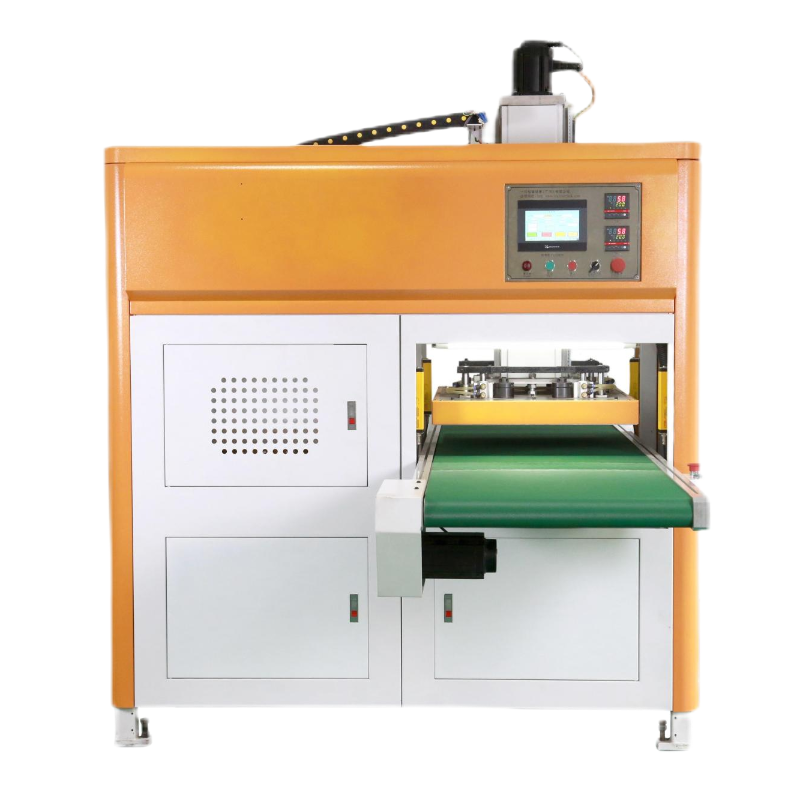
Hot-plate welding machines are industrial systems used to join thermoplastic parts by pressing their mating surfaces against a heated platen, withdrawing the heat source, and then consolidating the softened interfaces under controlled pressure. The process is valued for producing strong, often hermetic joints in large, complex, or highly contoured parts that are difficult to weld by ultrasonic or vibration methods.
In plastics processing, hot-plate welding occupies an important position between basic thermal joining and fully automated assembly, with machine designs ranging from simple pneumatic presses to servo- and hydraulically driven systems with precise temperature, displacement, and force control. Its principal strengths are weld strength, leak tightness, and tolerance to complex geometries; its principal trade-offs are comparatively longer cycle times, fixture complexity, and the need for accurate thermal management.
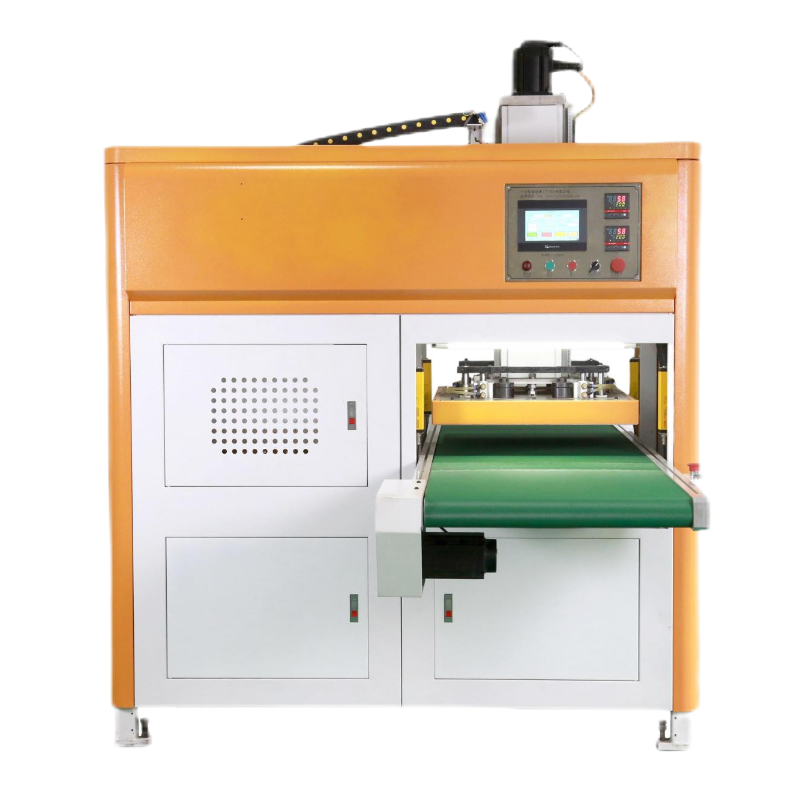
The technology has evolved from manually operated heated-tool equipment into programmable production cells used in automotive, appliance, medical, pipe, and industrial-component manufacturing. Current development emphasizes servo motion control, rotary and dual-station layouts, non-contact infrared variants, data logging, and tighter process monitoring for quality assurance and traceability.
Sustainability considerations are increasingly relevant because hot-plate welding can reduce scrap relative to mechanical fastening or adhesive bonding, support repairable thermoplastic assemblies, and integrate with recycled or recyclable polymers when joint design and contamination control are properly managed. Future progress is likely to center on lower-energy heating systems, faster changeover, smarter sensing, and more compact automation for high-mix production.
History and Development
Hot-plate welding developed as a practical thermal joining method for thermoplastics during the expansion of industrial plastics processing in the second half of the twentieth century. Its adoption was driven by the need to join molded parts with large weld perimeters, irregular contours, and demanding sealing requirements.
Several milestones shaped the process:
- Industrial standardization of the heated platen concept made the process repeatable for molded parts and pipe components, establishing the basic cycle of heating, changeover, and forging.
- Automotive and appliance adoption expanded the process into mass production for parts such as fluid reservoirs, ducts, housings, and lamp assemblies, where structural integrity and leak resistance were critical.
- Automation and digital control introduced closed-loop temperature regulation, servo motion, and programmable fixtures, improving repeatability and enabling integration into automated assembly lines.
More recently, some suppliers have combined hot-plate and infrared capabilities in one platform, reflecting the need to shorten cycle times and reduce contact-related contamination or sticking in selected applications.
Process Principle
Hot-plate welding is a thermal fusion process for thermoplastics. The parts are held in fixtures, heated by a platen or mirror until a controlled melt layer forms, and then pressed together so polymer chains diffuse across the interface during cooling under pressure.
The basic stages are:
- Loading and alignment: parts are located in custom fixtures so that the joint faces are concentric and stable.
- Heating: the parts move against the heated platen, or close enough for thermal transfer, until the interface softens or melts to the required depth.
- Changeover: the platen retracts and the fixtures move together rapidly; minimizing open time helps limit cooling and oxidation.
- Joining and cooling: the softened surfaces are brought together under controlled force and held until the weld has sufficient strength for release.
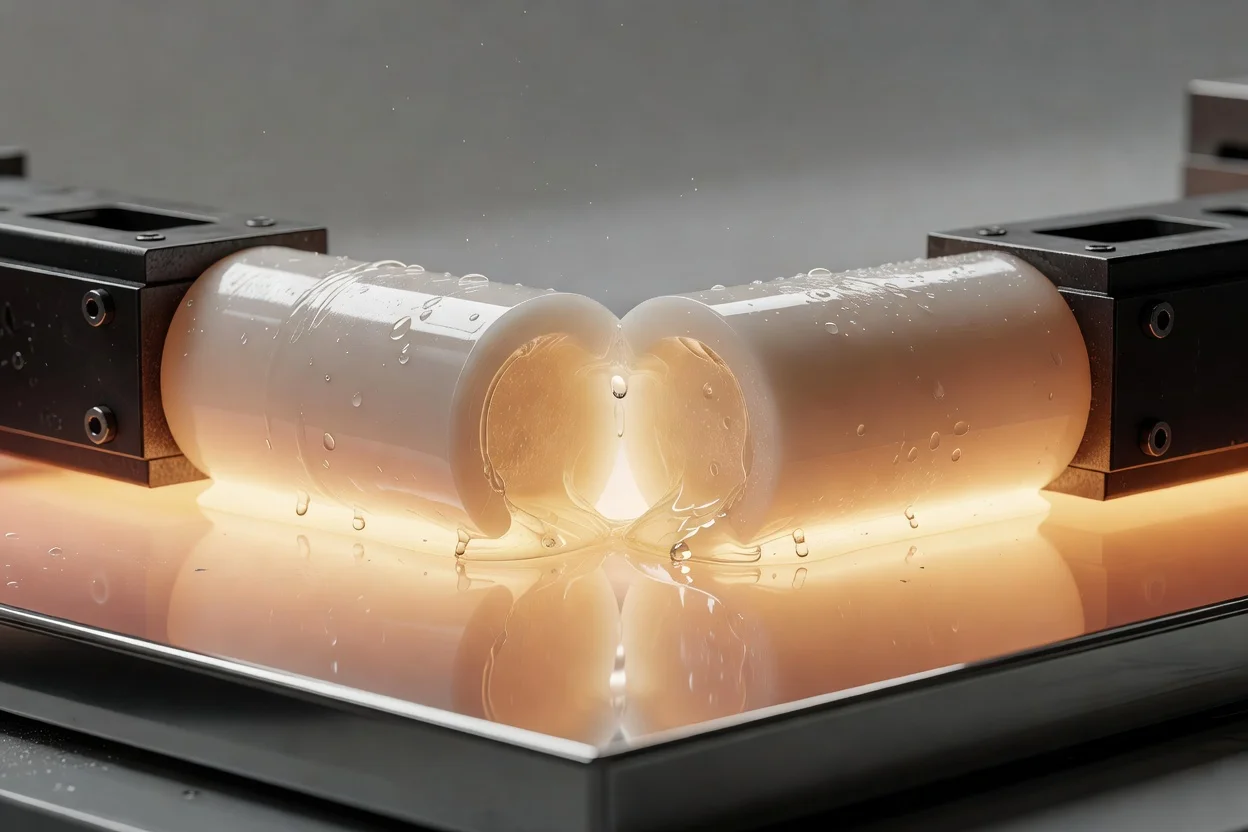
The process is especially effective when a bead or collapse can be controlled by hard stops or displacement limits in the tooling, because the amount of melt and squeeze-out becomes a measurable indicator of joint formation.
Key Characteristics and Technical Overview
Hot-plate welding machines are built around a heated platen, precision fixtures, a motion system, and a control package that regulates time, temperature, displacement, and pressure.
Typical engineering characteristics include:
- Platen temperature commonly set about 50–100 °C above the polymer melting point, with many systems operating roughly in the 146–300 °C range for common resins and higher for engineering polymers.
- Heating time often in the range of 5–60 seconds, depending on part mass, wall thickness, and resin type.
- Changeover time typically kept to about 1–3 seconds, because exposed molten surfaces cool quickly.
- Joining/forge time often around 5–30 seconds, with pressure maintained until the joint stabilizes.
- Wall thickness capability commonly spans from about 1 mm to 12 mm+ in large-part applications, depending on geometry and machine stiffness.
Machine architecture varies, but a conventional system includes:
- Hot plate or mirror: electrically heated, often with uniform-temperature cartridge heaters.
- Slides or guideways: provide controlled platen movement and alignment.
- Holding fixtures: custom nests that support part geometry and prevent distortion.
- Control system: manages temperature, force, travel, timing, alarms, and in advanced systems process data capture.
For larger or more demanding applications, suppliers offer hydraulic or servo-driven machines because they provide higher force capacity and better control over collapse distance and repeatability than simple pneumatic systems. Rotary or dual-station layouts may be used to overlap loading and unloading with heating, improving throughput in automated lines.
In production practice, performance is often judged by:
- Weld strength, sometimes approaching 80–95% of parent-material tensile strength when the joint design and process window are well matched.
- Leak tightness, particularly for fluid reservoirs, tanks, pipe fittings, and appliance housings.
- Dimensional stability, which depends on uniform heating and controlled squeeze-out.
Types and Variations
| Type | Main feature | Typical use |
|---|---|---|
| Pneumatic hot-plate welder | Lower-cost force generation, simpler mechanics | Smaller parts, lower-force applications |
| Hydraulic hot-plate welder | High clamping force and robust collapse control | Large automotive, appliance, and industrial parts |
| Servo hot-plate welder | Precise motion profiling and repeatability | High-accuracy production and data-rich quality control |
| Infrared/hot-plate hybrid | Non-contact heating option on the same platform | Parts sensitive to contamination or sticking |
| Rotary or multi-station system | Overlaps load, heat, and unload operations | Higher throughput automated cells |
| Pipe butt-fusion style hot plate machine | Specialized alignment and axial force control | Pipes, fittings, and large-diameter thermoplastic joints |
Hot-plate welding is also described under related terms such as heated tool welding, mirror welding, platen welding, and butt welding, although the exact terminology varies by region and application.
Applications and Uses
Hot-plate welding machines are widely used where strong structural joints and sealed interfaces are more important than very short cycle time.
Major sectors include:
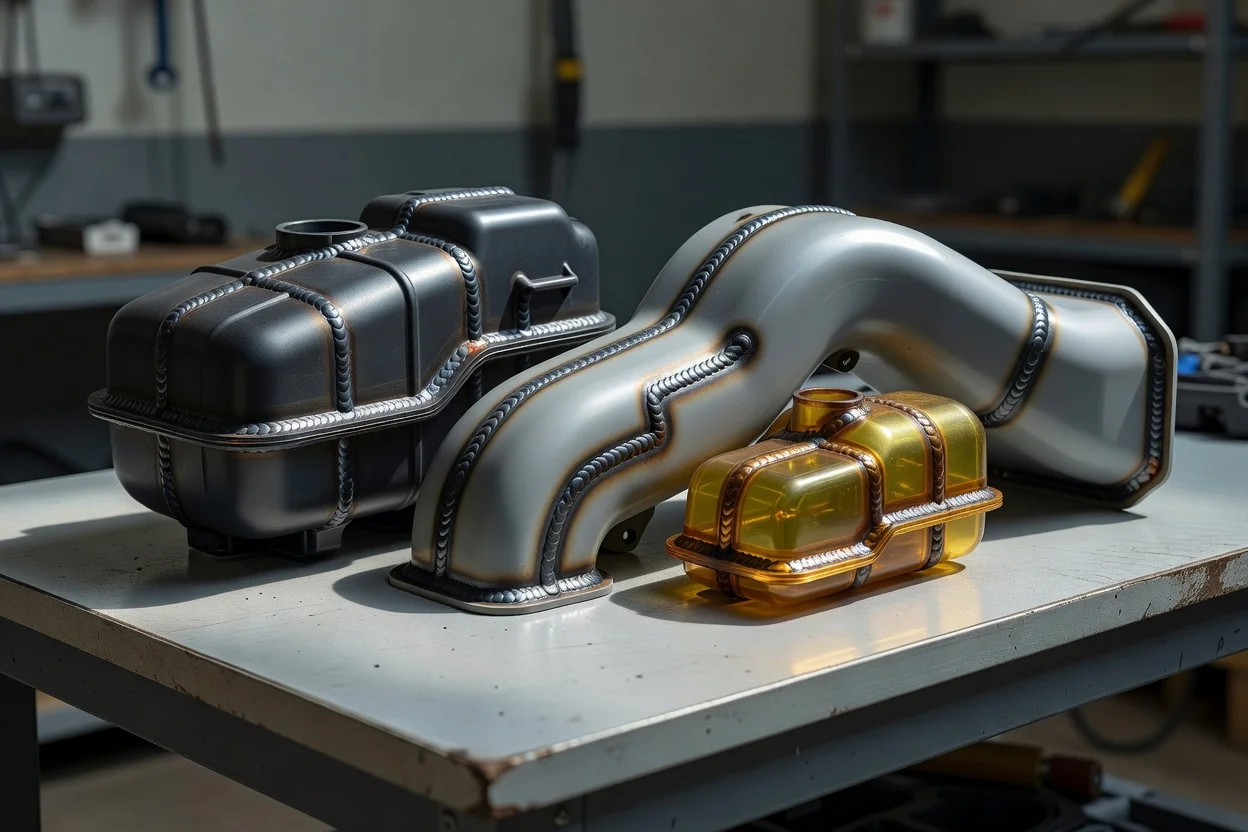
- Automotive: headlamps, tail lamps, intake manifolds, fuel tanks, air ducts, battery casings, reservoirs, and HVAC components.
- Appliances: dishwasher spray arms, washing-machine parts, vacuum components, detergent dispensers, and water-handling modules.
- Medical and life sciences: sharps containers, fluid-handling housings, filtration parts, and sterile or leak-proof assemblies.
- Piping and infrastructure: thermoplastic pipe and fitting joints for water and gas distribution, including butt and related joint geometries.
- Industrial products: pallets, barrels, crates, window frames, ducting, and large housings.
A notable poor-fit use is very thin, delicate, or heat-sensitive miniature assemblies, where ultrasonic or laser-based methods may offer better cycle speed and lower thermal load. Hot-plate welding can be technically possible in some cases, but it is usually not the first-choice method when part mass is low and throughput demands are extremely high.
Materials and Joint Design
Hot-plate welding is primarily used for thermoplastics, because these materials soften and reflow upon reheating. Common materials include PP, PE, ABS, PC, PA, POM, PVC, and engineering polymers such as glass-filled nylon in selected applications.
Key design considerations include:
- Compatible melt behavior between the two parts
- Sufficient joint area to distribute stress
- Bead or collapse allowance to accommodate melt flow
- Fixture support to prevent warpage
- Ventilation of trapped air in enclosed cavities
- Control of fillers and reinforcements, which can alter heat transfer and weld quality
Because the process is conducted above the polymer melt transition, joint design has a major effect on final performance. In practice, weld quality depends not only on surface temperature, but on melt depth, thermal uniformity, and stable pressure during cooling.
Technological Innovations and Automation
Modern hot-plate welding machines increasingly incorporate:
- Servo-driven motion systems for precise speed and position control.
- Programmable recipes for different part families and polymers.
- Temperature zoning for better platen uniformity.
- Data logging and traceability for regulated industries and quality audits.
- Safety interlocks, light curtains, and guarded enclosures to protect operators during platen motion.
- Hybrid platforms that combine hot plate, infrared, or hot gas capabilities in one machine family.
Automation has been especially important in automotive and appliance manufacturing, where repeatability, reduced manual handling, and in-line quality verification are central to production economics.
Environmental and Sustainability Aspects
Hot-plate welding can support sustainability goals in several ways:
- It can reduce the need for adhesives, solvents, and mechanical fasteners, simplifying end-of-life disassembly in some designs.
- It can produce low-scrap, high-integrity joints, which is useful in leak-sensitive components and large assemblies.
- It is compatible with many recyclable thermoplastics, provided contamination and material pairing are controlled.
- It can support lightweighting, particularly in automotive assemblies where plastic structures replace heavier multi-material constructions.
At the same time, the process has energy and operational trade-offs:
- The platen must remain heated, so idle losses can be significant without good thermal management.
- Longer cycle times can reduce line efficiency relative to faster joining processes.
- Recycled-content parts may show greater variation in melt behavior, requiring tighter process windows and more robust fixture design.
As a result, sustainability performance depends less on the machine alone than on the combination of material selection, joint design, cycle management, and production planning.
Economic and Global Market Impact
Hot-plate welding is a mature but still strategically important segment of plastics machinery because it serves components where failure is costly: fuel systems, fluid reservoirs, ducting, pipes, and safety-related housings.
Its market value is linked to several broader trends:
- growth in automotive plastics, including electric-vehicle housings and reservoirs
- expansion of appliance and water-handling products
- continued demand for pressure-tight pipe and fitting systems
- rising use of automation and digital quality control in high-value manufacturing cells
The equipment market includes both standard machine builders and highly specialized integrators offering application-specific tooling, leak-testing integration, and custom automation. In practice, the economic case often rests on reduced leak failure, lower rework, and improved long-term assembly reliability rather than on the fastest cycle time.
Current Challenges and Innovations
Current challenges include:
- Cycle time versus strength trade-off: hot-plate welding is robust, but it is generally slower than ultrasonic methods.
- Thermal uniformity: uneven platen temperature can produce weak or distorted joints.
- Tooling cost: custom fixtures are often essential and can be expensive for low-volume programs.
- Material variability: recycled or filled polymers can narrow the process window.
- Contamination control: dust, release agents, and mold residue can impair weld quality.
Innovation is focused on:
- faster changeover and transfer
- more accurate collapse-distance monitoring
- improved platen coatings and surface finishes
- hybrid heating concepts to reduce contact issues
- tighter process analytics for quality assurance and predictive maintenance.
Future Outlook
Hot-plate welding machines are likely to remain important wherever thermoplastic assemblies must be strong, sealed, and geometrically complex. Future development is expected to emphasize smarter control systems, energy-efficient heating, and integration with factory data systems, especially in automotive electrification, water infrastructure, and precision industrial assemblies.
The most probable direction of progress is not wholesale replacement by another joining process, but incremental improvement in speed, repeatability, traceability, and sustainability, allowing the technology to remain competitive in applications where joint integrity outweighs short cycle time.
References
- •
Hot plate welding. (2009, October 20). Wikipedia. https://en.wikipedia.org/wiki/Hot_plate_weldingLink
- •
Hot plate welding of plastics moulded components. (n.d.). TWI. https://www.twi-global.com/technical-knowledge/job-knowledge/hot-plate-welding-of-plastics-moulded-components-060Link
- •
What is hot plate welding? Process, materials & applications. (2024, May 29). https://jfortunemachine.com/hot-plate-welding-machine-hot-plate-welding-introduction/Link
- •
Hot plate plastic welding machine detailed introduction. (2025, March 26). https://jfortunemachine.com/hot-plate-plastic-welding-machine-detailed-introduction/Link
- •
Servo plastic hot plate welding machine manufacturer & ... (n.d.). https://www.dizo-global.com/hot-plate-plastic-welding-machineLink
- •
Hot-plate welding: For strong, sealed parts. (2026, May 15). Extol. https://www.extolinc.com/technology/hot-plate-welding/Link
- •
DUKANE HHB1229P. (n.d.). https://www.machinetools.com/en/models/type/hot-plate-weldersLink
- •
Hot plate welding. (n.d.). SONOTRONIC GmbH. https://sonotronic.de/en/technologies/hot-plate/hot-plate-welding/Link
- •
Hot plate plastic welding machine introduction. (2025, September 30). https://jfortunemachine.com/hot-plate-plastic-welding-machine-introduction/Link
- •
Hydraulic hot plate welding machine guide. (2025, February 22). Jfortune. https://jfortunemachine.com/hydraulic-hot-plate-welding-machine/Link
- •
The dish on hot-plate welding. (2011, December 28). Assembly Magazine. https://www.assemblymag.com/articles/84839-the-dish-on-hot-plate-weldingLink
- •
Hot plate welders. (n.d.). Forward Technology. https://www.forwardtech.com/plastic-assembly/hot-plate-weldersLink
- •
Hot plate welding machine in the real world: 5 uses you ... (2025, October 21). https://www.linkedin.com/pulse/hot-plate-welding-machine-real-world-5-uses-youll-actually-rzz4eLink
- •
HOT PLATE & INFRARED WELDERS. (n.d.). Forward Technology. https://www.forwardtech.com/custom/docs/Forward_Technology_Hot_Plate_Infrared_Welding_Brochure.pdfLink
- •
TH3 – Thermal welder by Dukane. (n.d.). Dukane. https://www.dukane.com/products/hot-plate-welders/hot-plate-welder-th3Link
- •
Hot plate welding secrets: Unbreakable thermoplastic ... (2024, March 5). https://www.dizo-global.com/hot-plate-welding-solutionLink
- •
Hot plate welding and infrared welding machines HPW. (n.d.). Sonimat. https://sonimat.com/en/plastic-welding/products/hot-plate-welding-and-infrared-welding-machine-hpw/Link
- •
Servo hot plate welder. (n.d.). https://www.ibortech.com/products/show/id/463.shtmlLink
- •
Hot plate welding machine. (2023, December 7). Dukane Intelligent Assembly Solutions. https://www.directindustry.com/prod/dukane-intelligent-assembly-solutions/product-15475-2088257.htmlLink
- •
Hot plate welding products. (n.d.). Dukane. https://www.dukane.com/products/hot-plate-welding-productsLink
- •
Hot plate welder. (n.d.). CHINA.Zhejiang Zhenbo Precision Machinery Co. https://www.mp-sonic.cn/welder-category/hot-plate-welder/Link
- •
What’s new with hot-plate welding. (2022, September 13). Assembly Magazine. https://www.assemblymag.com/articles/97311-whats-new-with-hot-plate-weldingLink
- •
Hot plate welding. (n.d.). FRIMO. https://www.frimo.com/en/hot-plate-weldingLink
- •
HV-15 - Hot plate welding machine by Branson Ultrasonics. (2024, September 13). https://www.directindustry.com/prod/branson-ultrasonics/product-5555-809061.htmlLink
- •
About hot plate welding: Thermal welding of thermoplastic. (n.d.). Forward Technology. https://www.forwardtech.com/plastic-assembly/hot-plate-welders/about-hot-plate-weldingLink
- •
Hot plate welding — Process guide. (2026, August 11). https://manufacturingprocesses.org/processes/joining/hot-plate-weldingLink
- •
Ultrasonic & hot plate welding: Thermal joining systems. (n.d.). https://amdmachines.com/solutions/thermal-processing/Link
- •
Everything you need to know about hot plate welder. (2025, March 8). https://hotplateweldingmachine.com/hot-plate-welder-guide/Link
- •
Hot plate plastic welding machines. (n.d.). https://www.unitechalliedautomation.com/hot-plate-plastic-welding-machines.htmlLink
- •
Hot-plate welding for high-melting polymers. (n.d.). https://res.cloudinary.com/sternwald-systems/raw/upload/v1/hugoprd/ARTIKEL_ATTACH/002433DC_0988012430F7/2228bf7063447bfdf0a26da2286332aafffd3af3/PE_2006_10_Processes-in-Synergy-Hot-plate-Welding-for-High-melting-Polymers.pdfLink
- •
Hot plate welding: Creating... (2025, November 9). https://amdmachines.com/blog/heat-staking-and-hot-plate-welding-applications/Link
- •
Hot plate plastic welding machine. (n.d.). https://b2bwiki.baidu.com/en/encyclopedic/hot-plate-plastic-welding-machineLink
- •
Hot plate welding machine product list. (n.d.). https://mono.ipros.com/en/cg2/Hot%20plate%20welding%20machine/Link
- •
Hot plate welders. (2005, July 1). Emerson. https://www.emerson.com/en-us/catalog/hot-plate-weldingLink
- •
Heat plate fusion welders. (2021, May 19). https://www.abbeon.com/Item--i-HEATPLATEFUSIONWELDERSLink
- •
Custom hot plate welding machines for plastic parts. (2026, August 1). Jfortune. https://hotplateweldingmachine.com/Link
- •
What is hot plate welding? Process explained. (n.d.). Dukane. https://www.dukane.com/resources/our-processes/hot-plate-weldingLink
- •
Hot plate welder at best price from manufacturers ... (2026, September 3). Tradeindia. https://www.tradeindia.com/manufacturers/hot-plate-welder.htmlLink
- •
Hot plate welding. (2021, October 31). https://www.global-plastics.com/secondary-operations/hot-plate-welding/Link
- •
The basics of hot plate welding plastic parts. (2023, March 27). Extol. https://blog.extolinc.com/the-basics-of-hot-plate-welding-plastic-partsLink
- •
Emabond welding vs hot plate welding. (n.d.). Emabond. https://emabond.com/emabond-welding-vs-hot-plate-welding/Link