

Introduction
Black pigments are insoluble particulate colorants used to impart black or near-black appearance, opacity, and in some formulations functional performance such as UV screening, electrical conductivity, and light blocking. In the plastics industry, the dominant black pigment is carbon black, though iron oxide blacks, mixed metal oxide blacks, and a smaller group of specialty organic or hybrid blacks also matter in niche applications.
Black pigments have a long history, beginning with charcoal, soot, lamp black, and bone-derived blacks in early art and craft uses; modern industrial grades evolved into tightly controlled engineered powders with defined particle size, structure, surface chemistry, and dispersion behavior. Today they sit at the intersection of color science and polymer engineering, supporting packaging, pipe, wire and cable, agriculture films, automotive parts, coatings, inks, and technical plastics.
Their importance in plastics extends beyond aesthetics. In many polymers, black pigments improve weatherability by absorbing ultraviolet radiation, can enhance heat management, and, in the case of carbon black, may contribute electrical conductivity or antistatic behavior depending on loading and dispersion. At the same time, black pigmentation raises sustainability questions because the most common source material, carbon black, is still largely fossil-based, energy-intensive to manufacture, and can complicate sorting and recycling in some waste streams.
The field is therefore shaped by two parallel trends: continued demand for high-performance black masterbatches and compounds, and growing interest in lower-carbon feedstocks, recovered carbon black, and better-designed circularity systems. The future of black pigments in plastics will likely be defined by how well producers balance jetness, durability, and processing efficiency against decarbonization and recyclability constraints.
History and Development
Black pigments are among the oldest colorants known to humans, with early examples made from charcoal, soot, and charred organic matter. Ancient and pre-industrial blacks were typically produced by burning wood, oil, vines, or animal remains under oxygen-limited conditions and then collecting the resulting carbonaceous residue.
Industrialization transformed black pigmentation from an artisanal practice into a chemical manufacturing sector. Carbon black emerged as a standardized pigment and reinforcing filler, manufactured through controlled incomplete combustion or thermal decomposition of hydrocarbon feedstocks. This shift produced more consistent particle size, stronger tinting, and better dispersion control than traditional soot-based materials.
In parallel, inorganic blacks such as iron oxide black and spinel-type black pigments developed as higher-heat, higher-weatherability alternatives for coatings, plastics, and ceramics. In art materials, the historical palette persisted through ivory black, lamp black, vine black, and Mars black, but industrial plastics increasingly converged on carbon black because of its combination of color strength and functional properties.
Chemical Structure and Key Properties
Black pigment is a functional class rather than a single chemical species. The most important industrial types differ markedly in composition and performance.
| Pigment family | Typical composition | Key traits | Main plastics relevance |
|---|---|---|---|
| Carbon black | Amorphous carbon | Very high tinting strength, UV absorption, conductivity at higher loadings | Widely used in polyolefins, masterbatches, cable, pipe, film |
| Iron oxide black | Magnetite-type iron oxide | Good opacity, heat and UV stability, lower conductivity | Engineering plastics, coatings, lower-demand black coloration |
| Mixed metal oxide black | Spinel or related oxides | High thermal stability, weather resistance | High-temperature plastics, coatings, ceramics |
| Bone/ivory black | Carbon plus mineral ash | Historical use, softer undertone | Niche art and specialty products |
Carbon black is usually described as highly aggregated, nanoscale primary particles forming larger chain-like aggregates and agglomerates. That structure creates intense light absorption and, depending on structure and dispersion, a percolating network that can impart electrical conductivity.
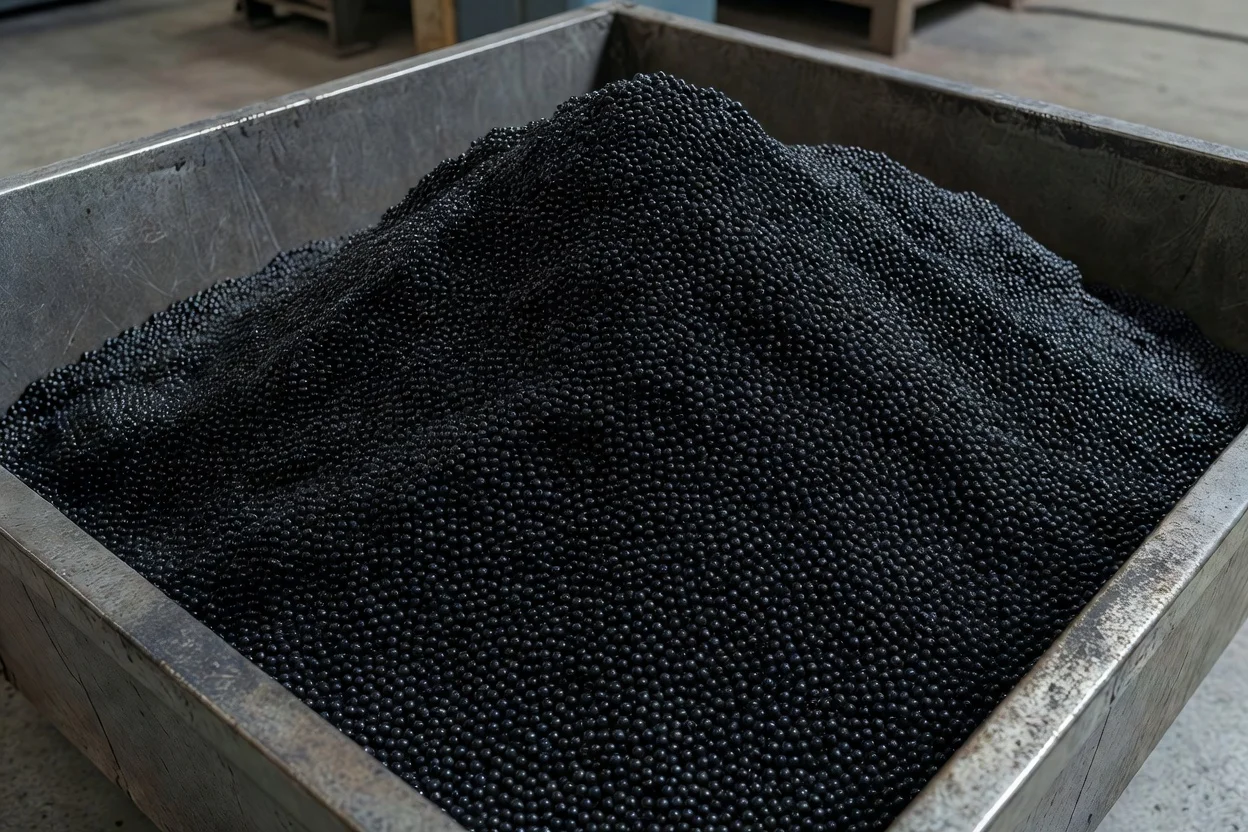
Key performance parameters include jetness, undertone, tinting strength, particle size, structure, surface area, dispersion quality, and oil absorption. In plastics, these parameters determine whether a formulation is optimized for deep black appearance, UV protection, mechanical reinforcement, or conductivity.
Practical limits and workarounds
- Poor oxygen and grease barrier in PE-like packaging films → black pigment does not inherently solve the permeability of the base polymer; the workaround is to use barrier-layer structures, metallization, or specialized multilayer packaging rather than relying on pigmentation alone.
- Low surface energy and difficult adhesion before treatment in polyolefins → the pigment does not raise surface energy by itself; the workaround is corona, plasma, flame treatment, or use of compatible coupling/masterbatch systems.
- Agglomeration and poor dispersion at inadequate shear → strong pigment-pigment attraction can reduce color consistency and mechanical properties; the workaround is high-quality masterbatching, optimized screw design, and dispersing additives.
- Conductivity only at sufficiently high loading and proper structure → not every black pigment makes a polymer conductive; the workaround is to select conductive carbon black grades with percolation-aware formulation design.
Production Processes and Raw Feedstocks
Carbon black is manufactured mainly from hydrocarbon feedstocks such as oil, natural gas, or process-derived aromatic streams through incomplete combustion or thermal decomposition. Furnace black is the most common industrial route, while lamp black, channel black, acetylene black, and thermal black are specialty variants with different structures and properties.
Typical process steps include:
- feedstock preparation and vaporization
- high-temperature reaction under limited oxygen
- quenching to stop particle growth
- separation and collection of the fine carbon particles
- pelletizing or compaction for dust control and handling
- post-treatment or surface modification in some specialty grades
Iron oxide black is generally produced by controlled oxidation or coprecipitation routes starting from iron salts or iron-bearing intermediates, followed by thermal processing to achieve the desired crystal form and particle characteristics. Mixed metal oxide blacks are made by high-temperature solid-state or precipitation-based synthesis, often designed for extreme thermal stability.
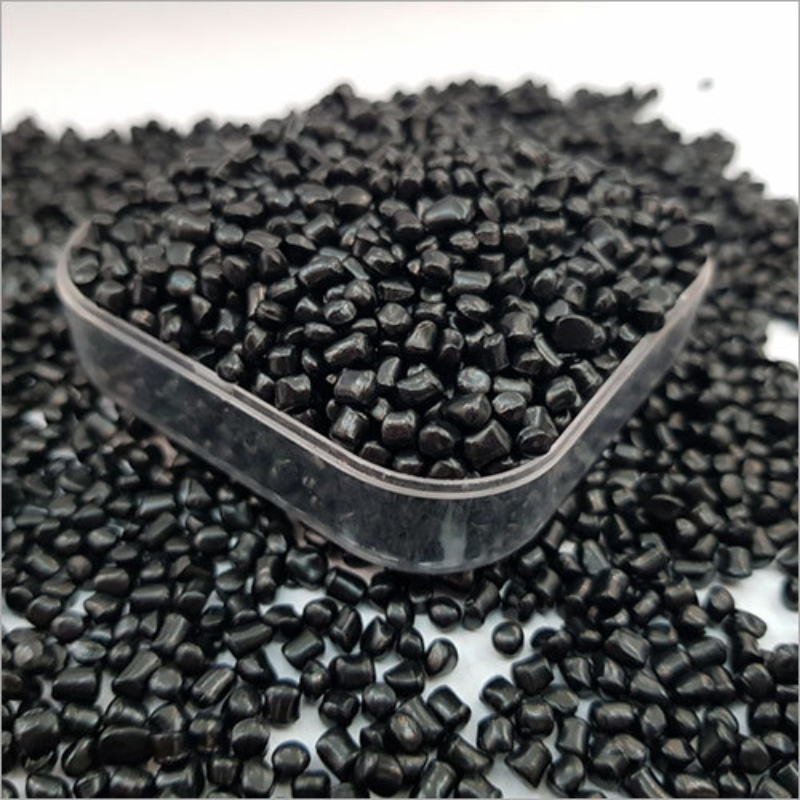
From a plastics-processing perspective, the pigment is usually not fed as a raw powder but as a masterbatch or pre-dispersed concentrate. This improves dosing accuracy, dispersion, dust management, and compounding throughput.
Applications and End-Use Markets
Black pigments are used across nearly every plastics segment, but the dominant applications are those where color, weatherability, and process reliability matter most.
| End use | Common polymer/grade | Usual black pigment choice | Why it is used |
|---|---|---|---|
| Film | PE, PP, multilayer structures | Carbon black masterbatch | UV protection, opacity, visual uniformity |
| Bottles and containers | HDPE, PET in some cases | Carbon black or iron oxide black | Light blocking, branding, aesthetics |
| Pipe | PE, HDPE, pressure pipe grades | Carbon black | Outdoor weatherability, long service life |
| Cable and wire | PE, XLPE, PVC | Conductive or semi-conductive carbon black | UV resistance, shielding, antistatic behavior |
| Agriculture film | LDPE, LLDPE | Carbon black | UV screening, service-life extension |
| Geomembrane | HDPE | Carbon black | Durability, sunlight resistance |
| Rotomolding | LLDPE, crosslinked systems | Carbon black, selected iron oxide blacks | Weatherability, uniform bulk coloration |
| UHMWPE wear and medical parts | UHMWPE | High-purity carbon black or specialty blacks | Wear resistance, appearance, controlled purity |
| PEX | Crosslinked PE | Carbon black | Outdoor durability, heat and UV protection |
The use of black pigments in polyethylene pipe is especially important because carbon black helps protect the polymer from sunlight-driven degradation, making it a standard choice for outdoor distribution and agricultural systems. In cable compounds, the pigment can serve both as a colorant and as a functional conductive component, depending on grade and loading.

A less suitable application is high-clarity packaging, where black pigments are inherently incompatible with transparency and can interfere with visual product inspection. In such cases, transparent or lightly tinted formulations are preferred.
Environmental and Sustainability Aspects
Sustainability is one of the most contested areas in black pigment chemistry. Carbon black is widely valued for performance, but much of its production remains dependent on fossil-derived feedstocks and energy-intensive thermal processes.
Important sustainability considerations include:
- Carbon footprint: conventional carbon black production is typically emissions-intensive because it relies on high-temperature hydrocarbon conversion.
- Recyclability: black plastics can be harder to sort when conventional near-infrared optical sorting systems cannot reliably identify the polymer beneath dark coloration; this is a major concern for post-consumer recycling streams.
- Recycled carbon black: recovered material from end-of-life tires and other carbon-containing wastes is increasingly studied as a lower-impact alternative, although consistent quality, ash content, and dispersion remain technical barriers.
- Bio-based routes: bio-oils, biomass-derived tars, and renewable feedstocks may reduce fossil dependence, but these routes still require rigorous performance validation.
- Material reduction: better dispersion and stronger tinting grades can reduce pigment dosage, lowering both cost and environmental burden.
In plastics, sustainability trade-offs are rarely absolute. Black pigments can extend service life in outdoor products such as pipe, geomembrane, and agricultural film, and longer durability can offset some of the environmental burden associated with pigment manufacture. The net impact therefore depends on product lifetime, recycling pathway, and formulation efficiency.
Economic and Global Market Impact
The black pigment market is strongly tied to the global carbon black industry, which serves both plastics and rubber. Demand is driven by tires, industrial rubber, coatings, inks, and especially polymer masterbatches and compounds.
Market dynamics are shaped by:
- feedstock availability and hydrocarbon price cycles
- regional energy costs and emissions regulation
- growth in packaging, construction, and infrastructure plastics
- rising interest in recycled and lower-carbon pigment sources
- increasing specification demands for dispersion, purity, and consistency
Leading global carbon black producers typically include large multinational specialty chemical and materials companies with integrated furnace-black capacity and worldwide distribution networks. In plastics, the commercial success of a pigment supplier often depends less on commodity tonnage than on masterbatch support, application engineering, and consistent particle morphology.
Current Challenges and Innovations
The main technical challenge is not simply making a pigment black, but making it dispersible, durable, safe, and compatible with increasingly demanding polymer systems.
Current areas of innovation include:
- Advanced surface modification: improving compatibility with polyolefins, engineering resins, and polar matrices.
- Higher-efficiency masterbatches: reducing let-down ratio while maintaining jetness and processability.
- Recycled carbon black purification: lowering ash and volatile content for higher-value plastic uses.
- Conductive black formulations: tuning structure and loading for antistatic packaging, EMI shielding, and sensors.
- Sustainable feedstock pathways: biomass-derived or waste-derived carbon black precursors.
- Sorting-friendly black plastics: developing dark colorants that remain detectable by optical sorting systems.
A practical formulation example is a PE pipe masterbatch using roughly 2 to 3 percent carbon black in the final pipe wall, where the pigment acts primarily as a UV screen and durability enhancer rather than as a simple colorant. Another common example is conductive plastics, where significantly higher loadings of structured carbon black may be used to create an electrically percolating network; the mechanism is particle-to-particle contact enabling electron transport through the polymer matrix.
Future Outlook
The future of black pigments in plastics will likely move in three directions at once:
- Performance optimization: higher jetness, better dispersion, and lower dosage at equal opacity.
- Circularity: greater use of recycled carbon black and more recyclable black plastic systems.
- Decarbonization: lower-emission manufacturing routes and more renewable feedstocks.
For many applications, especially infrastructure plastics, black pigments will remain indispensable because they provide a combination of aesthetics and functional protection that is difficult to replace economically. However, pressure from regulators, brand owners, and recyclers is likely to favor formulations that are both high-performing and easier to recover at end of life.
Summary
Black pigments are a diverse class of colorants led by carbon black, with important roles in plastics ranging from visual coloration to UV protection, conductivity, and long-term durability. Their history reaches back to charcoal and soot, but modern use is defined by engineered particle morphology, masterbatch technology, and increasingly strict sustainability requirements.
In the plastics value chain, black pigments are most essential in pipe, film, cable, agricultural products, and technical compounds, while their main drawbacks concern fossil dependence, sorting challenges, and dispersion sensitivity. The sector’s next phase will be shaped by how successfully manufacturers combine performance, circularity, and lower-carbon production.
References
- •
Black pigment. (n.d.). https://www.amixon.com/en/glossary/black-pigmentLink
- •
Carbon black pigments are applied in most of the pigment relevant systems. (n.d.). https://sci-hub.se/downloads/2021-07-05/b9/pfaff2021.pdfLink
- •
Pigment Colour Index: Black Pigments. (2021, November 17). https://www.jacksonsart.com/blog/2021/11/17/pigment-colour-index-black-pigments/Link
- •
What Is black pigment? + Advantages. (2025, September 4). https://farayandpowder.com/articles/what-is-black-pigmentLink
- •
Black Pigments. (2025, August 20). https://saitechinfo.com/black-pigments/Link
- •
The Deepest Shade – Exploring the World of Black Pigments. (2025, October 7). https://www.jackmansartmaterials.co.uk/blogs/news/the-deepest-shade-exploring-the-world-of-black-pigmentsLink
- •
Black Velvet - A Look at Black Pigments. (n.d.). https://greenandstone.com/blog/black-velvet-a-look-at-black-pigments/Link
- •
Black Pigment for Coating. (2021, August 26). https://www.tianswax.com/1521.htmlLink
- •
Let me see, what does the colorful black look like? (2021, July 2). http://www.lbsarts.com/en/materrial-knowledge/124.htmlLink
- •
Observing Shadow in Painting -A History of Black Pigments-. (n.d.). https://pigment.tokyo/en/blogs/article/black-pigmentsLink
- •
Top five black paint pigments. Which black is best? Warm blacks ... (2021, January 28). https://www.helenelliott.net/post/five-best-black-pigments-warm-blacks-and-cool-blacksLink
- •
Black Pigments. (n.d.). https://www.sinopia.com/-black-pigmentsLink
- •
A Guide to Black Paints. (2023, December 29). https://www.arttoart.net/a/blog/a-guide-to-black-paintsLink
- •
A Guide to Black Paints. (2023, December 29). https://www.arttoart.net/a-guide-to-black-paintsLink
- •
The Color of Art Pigment Database: Pigment Black - PBk. (n.d.). https://www.artiscreation.com/black.htmlLink
- •
Four different black pigments: How to choose the right one? (2024, October 17). https://www.aniatomicka.com/post/four-different-black-pigments-how-to-choose-the-right-oneLink
- •
Pigments through the Ages - Intro to the blacks. (n.d.). https://www.webexhibits.org/pigments/intro/blacks.htmlLink
- •
What are the differences between different black oil paints? (n.d.). https://crafts.stackexchange.com/questions/5813/what-are-the-differences-between-different-black-oil-paintsLink
- •
Pigments through the Ages - Overview - Carbon black. (n.d.). https://www.webexhibits.org/pigments/indiv/overview/carbonblack.htmlLink
- •
Why Are Black Pigments Essential in the Plastics Industry? (2025, June 3). https://nilrang.com/en/why-are-black-pigments-essential-in-the-plastics-industry/Link
- •
Ancient Color. (n.d.). https://exhibitions.kelsey.lsa.umich.edu/ancient-color/map_black.phpLink
- •
Black. (2001, August 10). https://en.wikipedia.org/wiki/BlackLink
- •
An In-Depth Guide to Black Water Colour. (2026, March 3). https://www.alibaba.com/product-insights/black-water-colour.htmlLink
- •
Selecting Pigments for Paints, Coatings and Inks. (2025, July 8). https://www.specialchem.com/coatings/guide/pigmentsLink
- •
A history of the colour black in art - London. (2025, January 1). https://www.nationalgallery.org.uk/podcast/colour-stories-blackLink
- •
Black Pigments: A Color or Lack Thereof? (2024, April 4). https://www.shepherdcolor.com/black-pigments-a-color-or-lack-thereof/Link
- •
Carbon Black Black Pigment: Advanced Surface Modification ... (n.d.). https://eureka.patsnap.com/materials/carbon-black-pigment-techLink
- •
science of colour - When to Use Black Pigment in Painting. (2025, April 15). https://sites.google.com/site/scienceofcolour/when-to-use-black-pigment-in-paintingLink
- •
Getting the Most Out of Using Black Pigments in Your Palette. (2020, November 27). https://www.jacksonsart.com/blog/2020/11/27/exploring-the-differences-between-black-pigments/Link
- •
Carbon black. (2004, July 27). https://en.wikipedia.org/wiki/Carbon_blackLink
- •
Black. (2025, March 6). https://en.wikipedia.org/?title=Black_Link
- •
Exploring the Depth of Chromatic Black in Painting. (2024, February 21). https://www.naturalpigments.com/artist-materials/chromatic-blacksLink
- •
More than Meets the Eye - Carbon Black Pigment. (2024, June 12). https://www.ulprospector.com/knowledge/17258/pc-more-than-meets-the-eye-carbon-black-pigment/Link