
Introduction
Permanent pigment in the context of plastics most commonly refers to a colorant designed to provide durable, lightfast coloration with long-term retention under processing and service conditions. In the plastics industry, this usually means an insoluble pigment rather than a dye, selected for resistance to heat, migration, solvents, and weathering, and incorporated into resins during compounding, masterbatch production, or direct let-down.
Permanent pigments are central to the visual identity, functional performance, and product stability of plastics used in packaging, construction, automotive, electrical, agricultural, and consumer applications. Their development has followed broader advances in organic chemistry, inorganic mineral processing, surface treatment, and additive engineering, with modern formulations balancing color strength, opacity, heat stability, and regulatory compliance. In parallel, sustainability pressures are reshaping pigment selection, especially through demands for recyclability, reduced hazardous impurities, lower-carbon production, and compatibility with circular plastics systems.
History and Development
Early plastics coloring relied heavily on mineral and metal-based pigments, many of which offered strong opacity and weather resistance but limited color range. As the plastics sector expanded in the twentieth century, organic pigments became increasingly important because they provided brighter shades, higher tinting strength, and broader design flexibility.
The term permanent in pigment technology became associated with resistance to fading and chemical degradation rather than absolute immutability. In plastics, permanence has long been tied to the ability of a pigment to survive melt processing temperatures, resist bleed and migration, and retain appearance over the service life of the article.
Key developments included:
- Improved synthesis of high-performance organic pigments such as azo, phthalocyanine, quinacridone, and perylene families.
- Refinement of inorganic pigments such as titanium dioxide, iron oxides, chromium oxides, and mixed metal oxides for opacity and weatherability.
- Surface treatment and micronization to improve dispersibility and reduce agglomeration.
- Growth of masterbatch technology, which enabled safer handling, better dosing accuracy, and more consistent color quality.
- Increasing regulatory scrutiny of heavy metals, aromatic amines, and other impurities, especially in consumer and food-contact applications.
Chemical Structure and Key Properties
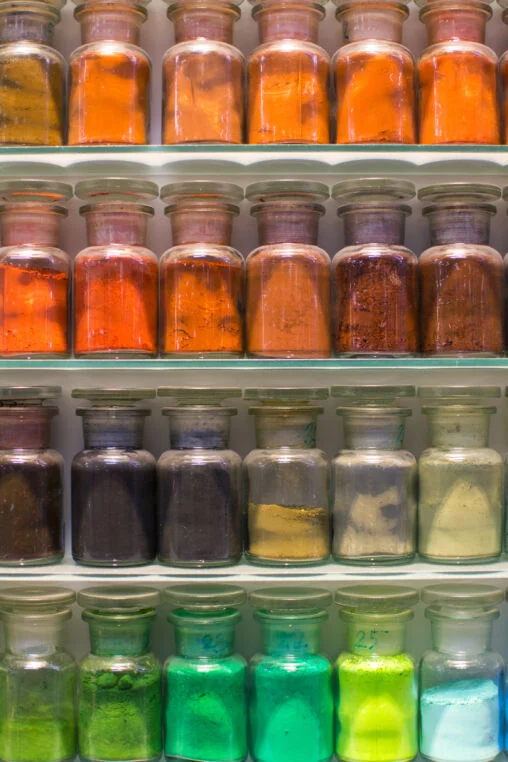
Permanent pigments are generally insoluble, particulate colorants whose performance depends on crystal structure, particle size, surface chemistry, and dispersion quality rather than on solubility. This distinguishes them from dyes, which color by dissolving into the medium.
Major pigment classes used in plastics
| Pigment class | Typical role in plastics | Strengths | Limitations |
|---|---|---|---|
| Inorganic pigments | Opacity, weatherability, heat resistance | Excellent durability, lightfastness, thermal stability | Narrower color range, higher density, possible regulatory issues for some compounds |
| Organic pigments | Bright coloration, high tinting strength | Vivid shades, strong color development, low dosage | Some grades can have lower heat or migration resistance |
| Effect pigments | Metallic, pearlescent, special visual effects | Decorative and branding value | More sensitive to orientation, surface finish, and processing window |
Key technical properties
- Lightfastness: resistance to photodegradation under UV and visible light.
- Thermal stability: ability to retain color during polymer processing, often at 180–320 C depending on resin.
- Migration resistance: low tendency to move into adjacent materials, food, skin, or packaging contents.
- Chemical resistance: tolerance to acids, alkalis, solvents, and oxidizing environments.
- Dispersion quality: uniform particle distribution that determines gloss, hiding power, and color consistency.
- Opacity and tint strength: capacity to conceal substrate color or impart strong hue at low loading.
Real-world limits and workarounds
- Low heat stability → pigment degradation or shade shift during extrusion/injection molding → use high-temperature stable pigment grades and shorten residence time.
- Poor dispersibility → specking, weak color, and property loss → use pre-dispersed masterbatch, optimized screw design, and surface-treated pigment particles.
- Migration or blooming in demanding formulations → surface staining or contamination of adjacent materials → select low-solubility pigments and compatible carriers or encapsulated grades.
- Limited barrier contribution → pigments do not meaningfully improve gas or moisture barrier on their own → pair coloration with barrier polymers, coatings, or fillers when barrier performance is required.
Two practical examples illustrate typical use:
- Titanium dioxide is often used at roughly 2–8% in opaque white polyolefin or PVC formulations, where its high refractive index provides hiding power and UV screening.
- Phthalocyanine blue or green may be used at very low loading, often below 0.5%, because strong molecular chromophore systems deliver high tint strength and good lightfastness.
Production Processes and Raw Feedstocks
Permanent pigments are produced through either inorganic mineral processing or organic chemical synthesis.
Inorganic pigment production
- Mining or chemical manufacture of precursor materials.
- Calcination, oxidation, precipitation, or hydrothermal processing.
- Milling, classification, and surface treatment.
- Quality control for particle size, shade, oil absorption, and impurity levels.
Common feedstocks include titanium ores, iron salts, chromium compounds, and zinc or mixed-metal precursors.
Organic pigment production
- Multi-step synthesis from petrochemical or coal-tar-derived intermediates.
- Coupling, condensation, cyclization, or metal-complex formation.
- Filtering, washing, finishing, and milling.
- Optional surface treatment to improve wetting and dispersibility in polymers.
Common organic pigment families include azo pigments, phthalocyanines, quinacridones, diketopyrrolopyrroles, and perylenes.
Compounding and incorporation into plastics
Pigments are not usually used as loose powders in final product manufacturing. Instead, they are incorporated through:
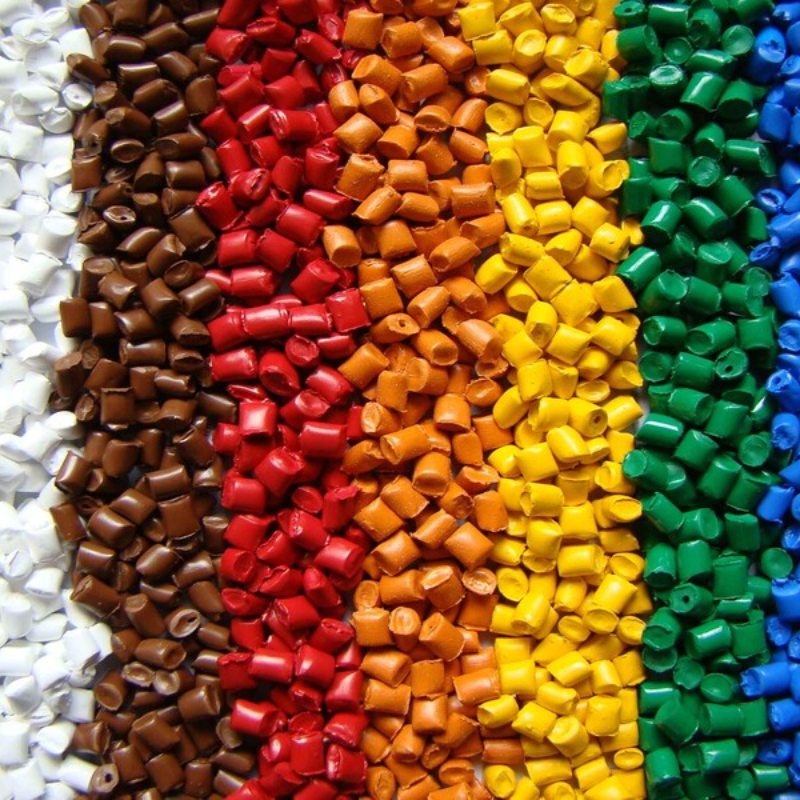
- Masterbatch production, where high pigment concentrations are dispersed into a carrier resin.
- Direct compounding, where pigment is added during resin blending.
- Dry blending in some lower-specification applications.
Masterbatch is often preferred because it reduces dust exposure, improves dosing accuracy, and produces more consistent color development.
Applications and End-Use Markets
Permanent pigments are used wherever long-lasting color, opacity, or identification is needed.
Packaging
- Usual grades: food-contact-compliant inorganic whites, selected organic colors, and low-migration blacks.
- Processes: film extrusion, injection molding, blow molding.
- Function: brand identity, UV protection, contents masking, and optical differentiation.
- Note: in packaging, pigment selection is constrained by migration limits, recyclability, and sortability in recycling streams.
Construction and building products
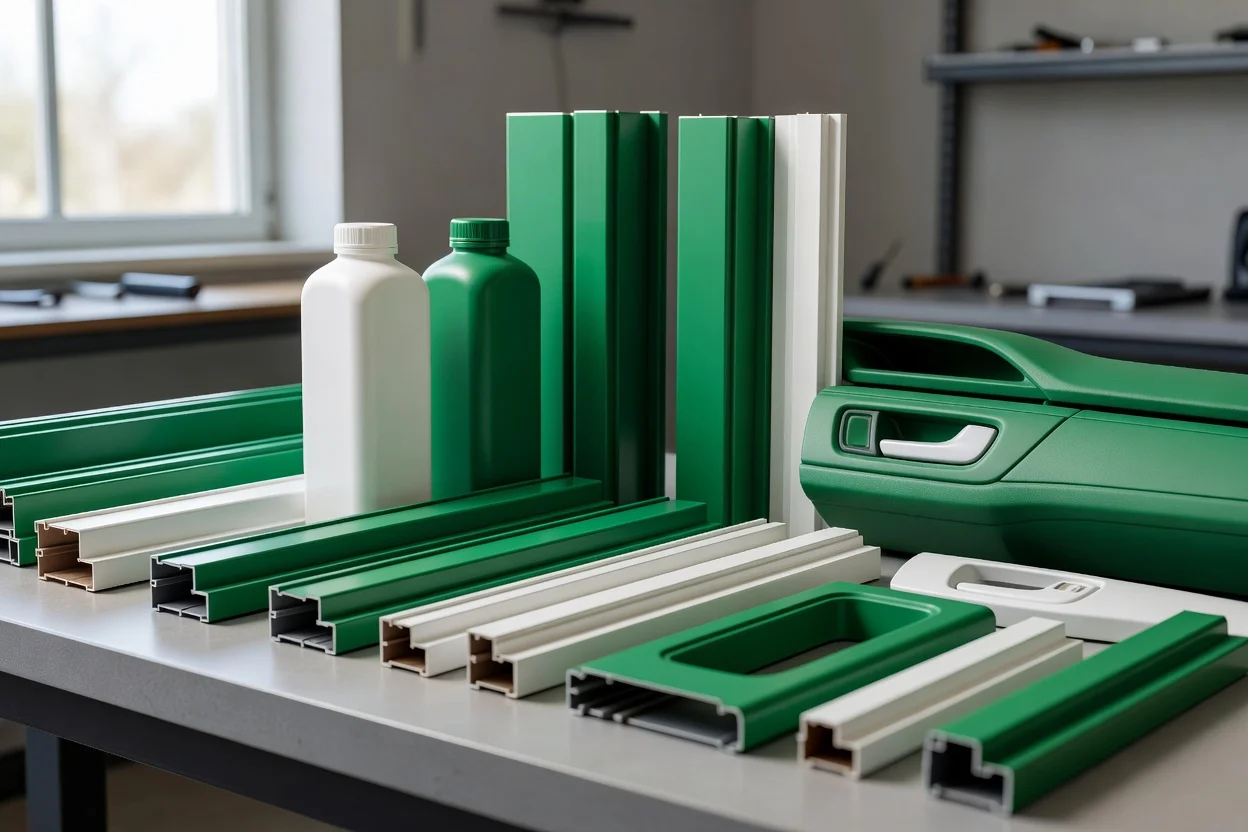
- Usual grades: weatherable titanium dioxide, iron oxides, chromium oxides, and carbon black.
- Processes: pipe extrusion, siding, profiles, roofing membranes, cables.
- Function: color retention, heat reflection, outdoor durability, and product identification.
Automotive and transportation
- Usual grades: high-performance organic pigments, effect pigments, and heat-stable inorganic shades.
- Processes: injection molding, compounding, coatings, interior trim production.
- Function: interior aesthetics, exterior styling, UV resistance, and brand-specific color matching.
Electrical and electronics
- Usual grades: thermally stable pigments with low ionic contamination.
- Processes: injection molding, wire and cable compounding.
- Function: coding, visibility, and electrical product identification.
Agriculture and geomembranes
- Usual grades: carbon black-containing black systems, UV-stabilized pigments, opaque whites.
- Processes: film extrusion, sheet extrusion.
- Function: solar control, UV protection, and lifetime extension in outdoor service.
Fibers and textiles
- Usual grades: pigment dispersions compatible with polyester, polypropylene, and specialty fibers.
- Processes: dope dyeing, melt spinning.
- Function: permanent coloration without conventional dye uptake.
Consumer goods and appliances
- Usual grades: cost-balanced organic and inorganic pigments.
- Processes: injection molding and extrusion.
- Function: aesthetic appeal, product differentiation, and surface masking.
Poor-fit use
- Highly transparent optical parts such as lenses or light guides are generally a poor fit for conventional permanent pigments because pigmentation reduces clarity and can interfere with light transmission.
Environmental and Sustainability Aspects
Permanent pigments have a mixed sustainability profile because their durability can extend product life, but pigment manufacture and end-of-life handling may create environmental burdens.
Recyclability
- Permanent pigments can complicate recycling when they:
- create dark or mixed-color waste streams,
- interfere with optical sorting,
- contain restricted substances,
- reduce the value of recycled resin through shade inconsistency.
- On the other hand, well-designed pigments can improve recyclability when they are:
- compatible with food-contact and recycled-content standards,
- low in heavy metals and other contaminants,
- optimized for sortation and reprocessing.
Bio-based alternatives
Bio-based pigment systems exist in limited forms, but most high-performance permanent pigments are still synthetic or mineral-based. Natural colorants often underperform in lightfastness, heat resistance, or batch-to-batch consistency, which is why they remain niche in demanding plastics applications.
Carbon footprint
Pigment carbon footprint depends on:
- precursor sourcing,
- synthesis complexity,
- energy intensity of calcination or purification,
- solvent use and waste treatment,
- transport and compounding efficiency.
In general, inorganic pigments can be energy-intensive when high-temperature calcination is involved, while organic pigments may have more complex multi-step chemical syntheses. The environmental balance must therefore be assessed case by case rather than assumed from pigment class alone.
Regulatory and toxicity concerns
Regulatory pressure is strongest where pigments or impurities raise concerns about:
- heavy metals,
- aromatic amines,
- persistent organic pollutants,
- poor labeling transparency,
- worker exposure to powders and dust.
For plastics, the most important sustainability trend is not simply “natural” color, but cleaner, lower-impact, and more recyclable formulations.
Economic and Global Market Impact
Permanent pigments are strategic commodities in the plastics value chain because color is tied directly to product differentiation, brand equity, and functional compliance. Demand is closely linked to packaging volumes, construction activity, consumer goods production, and automotive output.
The market is globally distributed, with strong production in Asia, Europe, and North America. Leading multinational pigment suppliers include major chemical companies and specialist colorant producers in Europe, China, India, Japan, and the United States. The competitive landscape is shaped by:
- feedstock availability,
- environmental compliance costs,
- export controls and trade policy,
- demand for low-migration and food-contact grades,
- consolidation among compounders and masterbatch suppliers.
In practice, value is increasingly created not only by the pigment itself but by the associated formulation know-how: dispersion, stabilization, weatherability, and regulatory documentation.
Current Challenges and Innovations
Main challenges
- Achieving permanence without restricted substances.
- Maintaining color consistency in recycled-content plastics.
- Avoiding contamination of recycling loops.
- Balancing heat stability with bright color performance.
- Meeting tightening regional rules on hazardous chemicals and impurities.
- Ensuring worker safety during powder handling.
Important innovations
- High-performance organic pigments with improved thermal and migration resistance.
- Encapsulated or surface-treated pigments for cleaner processing and better dispersion.
- Low-dust pigment preparations and liquid color concentrates.
- Design-for-recycling color systems that support sortability and high-value reprocessing.
- Digital color matching using spectral data and formulation software to reduce trial-and-error compounding.
- Low-carbon manufacturing routes and solvent reduction in pigment synthesis.
A notable technical trend is the move toward pigments that preserve visual permanence while also supporting circularity, especially in packaging, automotive interiors, and household plastics.
Future Outlook
The future of permanent pigments in plastics will likely be defined by three converging priorities:
- Performance: higher durability under heat, light, and chemical exposure.
- Compliance: stricter control of impurities, migration, and toxicological profile.
- Circularity: compatibility with recycled polymers, mechanical recycling, and more transparent supply chains.
Demand should remain strong in packaging, construction, and durable goods, but formulations will increasingly be judged by how well they perform in recycled and recyclable systems. The highest-growth opportunities are likely to favor pigments that combine strong permanence with low regulatory burden and minimal impact on resin recovery.
Summary
Permanent pigment is a durable colorant system designed to retain color, opacity, and service performance in plastics over long periods. It is used across nearly every major plastics sector, from packaging films to pipes, automotive parts, cables, and outdoor products. Its future depends not only on color quality, but also on safer chemistry, recyclability, and lower environmental impact.
References
- •
Safety of tattoos and permanent make-up: Compilation of ... (n.d.). Publications Office of the European Union. https://publications.jrc.ec.europa.eu/repository/bitstream/JRC94760/wp1_tr_pubsy.pdfLink
- •
Safety of permanent makeup. (2004, January 1). WebMD. https://www.webmd.com/beauty/features/how-safe-permanent-makeupLink
- •
Safety, sterility, and potential complications of permanent makeup ... [PDF]. (n.d.). https://ulopenaccess.com/papers/ULMHS_V03I04/ULMHS20250304_010.pdfLink
- •
Heavy metal content in tattoo and permanent makeup inks and European standards—Is there still a health risk? (2025, October 30). PubMed. https://pubmed.ncbi.nlm.nih.gov/41304486/Link
- •
Safety of tattoos and permanent make-up: State of play and ... (2016, May 27). Publications Office of the European Union. https://publications.jrc.ec.europa.eu/repository/handle/JRC96808Link
- •
Tattoos & permanent makeup: Fact sheet. (2024, October 15). U.S. Food and Drug Administration. https://www.fda.gov/cosmetics/cosmetic-products/tattoos-permanent-makeup-fact-sheetLink
- •
Tattoo inks and permanent make-up. (n.d.). European Chemicals Agency. https://echa.europa.eu/hot-topics/tattoo-inksLink
- •
Pigment health & safety quick guide. (2020, May 30). Conservation Wiki. https://www.conservation-wiki.com/wiki/Health_&_Safety:_Pigment_Health_&_Safety_Quick_GuideLink
- •
Understanding natural and organic permanent cosmetic ... (2026, March 2). Faces Artistry. https://facesartistry.com/blog/f/understanding-natural-and-organic-permanent-cosmetic-pigmentsLink
- •
Pigments in US cosmetic tattoo ink can trigger allergic contact dermatitis. (n.d.). Dermatology Advisor. https://www.dermatologyadvisor.com/news/pigments-in-us-cosmetic-tattoo-ink-can-trigger-allergic-contact-dermatitis/Link
- •
Safety of tattoos and permanent make-up: Final report. (2016, July 21). Publications Office of the European Union. https://publications.jrc.ec.europa.eu/repository/handle/JRC101601Link
- •
Gesundheitliche Risiken von Tattoos und Permanent Make-up. (2024, March 22). Verbraucherzentrale. https://www.verbraucherzentrale.de/wissen/gesundheit-pflege/aerztinnen-und-kliniken/gesundheitliche-risiken-von-tattoos-und-permanent-makeup-11745Link
- •
REVIEW TITLE AND BASIC DETAILS. (n.d.). PROSPERO. https://www.crd.york.ac.uk/PROSPERO/view/CRD420261283033Link
- •
Hair dye ingredients and potential health risks from exposure to ... (2022, June 6). PMC. https://pmc.ncbi.nlm.nih.gov/articles/PMC9214764/Link
- •
How tattoos work: Why ink stays under skin. (2026, July 1). Canggu Ink Club. https://cangguinkclub.com/blog/how-tattoos-work/Link
- •
Safety of tattoos and permanent make-up: Adverse health ... (n.d.). Publications Office of the European Union. https://publications.jrc.ec.europa.eu/repository/bitstream/JRC99882/jrc99882_wp3_report_on_tattoos_final_amended%20by%20ipo.pdfLink
- •
The risks of permanent makeup: What every client should know. (2025, March 19). The Brow Clinique. https://www.thebrowclinique.com/the-risks-of-permanent-makeup-what-every-client-should-know/Link
- •
Permanent cosmetics. (2023, January 1). Michigan State University. https://cosmetic.msu.edu/services/permanent-cosmetics.htmlLink
- •
Cosmetic tattooing. (2024, September 12). WebMD. https://www.webmd.com/beauty/cosmetic-tattooingLink
- •
Permanent makeup tattooing. (n.d.). The University of Kansas Health System. https://www.kansashealthsystem.com/care/treatments/aesthetic-services/permanent-makeupLink
- •
The art of permanence: How tattoo ink is deposited in the skin. (2025, February 17). The Rose Ink and Art. https://www.theroseinkandart.com/blog/the-art-of-permanence-how-tattoo-ink-is-deposited-in-the-skinLink
- •
Permanent makeup pigments explained: The different types. (2026, August 13). Dana Depta. https://www.danadepta.com/permanent-makeup-pigments-explained-the-different-types-and-how-they-ageLink
- •
Why permanent makeup fades & changes color. (2024, January 15). Le Kitsune. https://lekitsune.com/pmu-color-evolutionLink
- •
Safety of tattoos and permanent make up (PMU) colorants [PDF]. (n.d.). Semantic Scholar. https://pdfs.semanticscholar.org/1985/35f9740713551325b30f4ae1e656667b0c34.pdfLink
- •
A personal guide to semi & permanent makeup pigments. (2024, May 28). Botched Ink. https://botchedink.com/blogs/pmu-removal-professionals/permanent-makeup-pigmentsLink
- •
Aureolin definition & meaning. (n.d.). Dictionary.com. https://www.dictionary.com/browse/aureolinLink
- •
Is permanent makeup safe? Exploring your top safety concerns. (2024, November 1). BioMasertattoo. https://biomasertattoo.com/blogs/study/permanent-makeup-safety-tipsLink
- •
How to read an artist's paint tube label. (2021, June 9). Anna Bregman Portraits. https://www.annabregmanportraits.co.uk/project/how-to-read-a-paint-tube/Link
- •
Pigment definition & meaning. (n.d.). Dictionary.com. https://www.dictionary.com/browse/pigmentLink
- •
Pigment definition & meaning. (2026, May 3). Merriam-Webster. https://www.merriam-webster.com/dictionary/pigmentLink
- •
Permanent make-up FAQ. (2026, May 3). Laboratoires BIOTIC Phocea. https://www.biotic.fr/en/content/133-permanent-make-up-faqLink
- •
Severe unexpected adverse effects after permanent eye makeup ... (2014, August 11). PMC. https://pmc.ncbi.nlm.nih.gov/articles/PMC4136952/Link
- •
Dye dangers: Harmful chemicals in hair coloring products and their health concerns. (n.d.). Environmental Working Group. https://www.ewg.org/research/dye-dangers-harmful-chemicals-hair-coloring-products-and-their-health-concernsLink
- •
Tattoo pigments in skin and body, transportation processes ... [PDF]. (n.d.). BfR. https://www.bfr-akademie.de/media/wysiwyg/2021/Tattoo2021/tattoo-pigments-in-skin-and-body-transportation-processes-boosted-by-laser-light-and-uv-radiation.pdfLink
- •
What's in permanent makeup pigments? A behind-the- ... (2025, October 12). PC Northwest. https://www.pcnorthwest.com/post/what-s-in-permanent-makeup-pigments-a-behind-the-scenes-lookLink
- •
Tattoo. (2001, August 28). Wikipedia. https://en.wikipedia.org/wiki/TattooLink
- •
Art colours: Glossary of terms. (n.d.). Visual Arts Cork. http://www.visual-arts-cork.com/colour-art-glossary.htmLink
- •
ACM 2023 01 vE.indd [PDF]. (n.d.). Aesthetic Cosmetology. https://aestheticcosmetology.com/wp-content/uploads/2023/03/ACM-2023-01-vE-Godlewska-EN.pdfLink
- •
Additional details. (2016, November 16). Cleveland Clinic. https://my.clevelandclinic.org/health/treatments/11004-micropigmentationLink
- •
Permanent makeup. (2005, October 1). Wikipedia. https://en.wikipedia.org/wiki/Permanent_makeupLink
- •
Tattoo industry faces an ink makeover. (2025, June 25). C&EN. https://cen.acs.org/analytical-chemistry/Tattoo-industry-faces-ink-makeover/100/i43Link
- •
Safety of tattoos and permanent make up (PMU) colorants. (2021, June 7). MDPI. https://www.mdpi.com/2079-9284/8/2/47Link
- •
Pigment - Definition, meaning & synonyms. (n.d.). Vocabulary.com. https://www.vocabulary.com/dictionary/pigmentLink
- •
Process of tattooing. (2013, July 24). Wikipedia. https://en.wikipedia.org/wiki/Process_of_tattooingLink
- •
Tattoos: Does ink travel through your body? (2017, July 14). Medical News Today. https://www.medicalnewstoday.com/articles/318388Link
- •
Pigment. (2025, January 1). Cambridge Dictionary. https://dictionary.cambridge.org/us/dictionary/english/pigmentLink
- •
Tattoo ink. (2007, August 10). Wikipedia. https://en.wikipedia.org/wiki/Tattoo_inkLink
- •
Types of colourants used in tattoo and permanent make‐up ... (2023, September 8). PMC. https://pmc.ncbi.nlm.nih.gov/articles/PMC10485912/Link
- •
Pigment. (2002, April 18). Wikipedia. https://en.wikipedia.org/wiki/PigmentLink
- •
The best guide to scar tattooing for flawless skin ... (2025, October 28). Clara Brows. https://www.clarabrows.com/clarabrows-blog/the-best-guide-to-scar-tattooing-for-flawless-skin-restorationLink
- •
Questions and answers about tattoo inks. (2025, May 6). BfR. https://www.bfr.bund.de/en/service/frequently-asked-questions/topic/frequently-asked-questions-about-tattoo-inks/Link
- •
Physiology and histology of... (n.d.). PMC. https://pmc.ncbi.nlm.nih.gov/articles/PMC4382144/Link
- •
Questions and answers about tattoo inks [PDF]. (n.d.). BfR. https://www.bfr.bund.de/assets/01_Ver%C3%B6ffentlichungen/FAQ_englisch/questions-and-answers-about-tattoo-inks.pdfLink
- •
Brazilian medical & correctional tattooing | Skin camouflage. (2023, December 21). Liana Nunes. https://www.liananunes.com/medical-correctional-tattooing-camouflage/Link
- •
Pigmento. (2003, October 16). Wikipedia. https://es.wikipedia.org/wiki/PigmentoLink
- •
Permanent definition & meaning. (n.d.). Dictionary.com. https://www.dictionary.com/browse/permanentLink
- •
Scar camouflage - All you need to know. (2023, October 17). Fancy Shmancy. https://fs-pmu.com/fade-into-beauty-all-you-need-to-know-about-scars-camouflage/Link
- •
Why does permanent makeup change color over time? (2026, February 25). BioMasertattoo. https://biomasertattoo.com/blogs/study/why-permanent-makeup-changes-colorLink
- •
Organic pigments for permanent makeup. (2022, September 2). Li Pigments. https://www.lipigments.com/organic-pigments-for-permanent-makeup/Link