
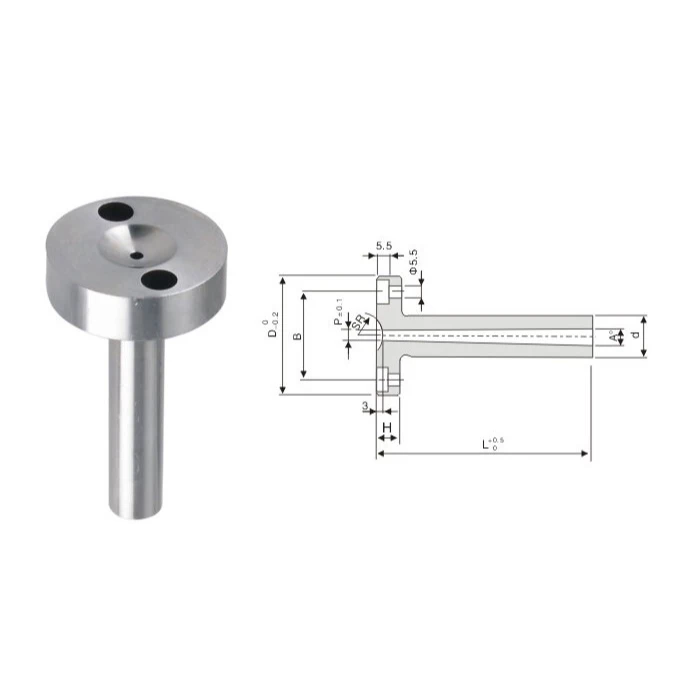
Introduction
Sprue separating equipment comprises the mechanical and automated systems used to separate molded parts from sprues, runners, or gates after injection molding and related forming operations. In plastics processing, these machines support part handling, quality control, and by-the-press recycling by directing good parts and sprue waste into separate paths immediately after ejection or transfer from the mold.
In practice, the category includes sprue pickers mounted on molding machines, conveyor-mounted separators such as roller, drum, paddle, spiral, blade, and screw types, and integrated downstream handling cells that combine conveying, sensing, and robotic sorting. The equipment is used most often where parts and sprues differ in size, shape, or surface area enough for mechanical separation to be reliable and repeatable.
Historically, sprue separation evolved from manual trimming toward mechanical separators positioned beside or downstream of the press, and then to compact robots and integrated automation cells that remove and classify parts shot by shot. Current development is driven by shorter cycle times, reduced labor, improved material recovery, and compatibility with automated recycling loops, while future systems are increasingly shaped by vision guidance, quick-change tooling, and tighter integration with Industry 4.0 line controls.
History and Development
Early sprue removal was largely manual, using hand tools or secondary trimming stations, which limited throughput and introduced variability in part quality and scrap handling. Mechanical degating mechanisms and size-based separators then emerged to reduce operator dependence and stabilize production flow.
A major milestone was the adoption of conveyor-integrated separators in injection molding cells, where parts and sprues could be divided immediately after discharge using gravity, rotation, or differential geometry. Roller and drum systems became especially common because they could separate components continuously without complex control logic.
A later milestone was the spread of sprue picker robots and compact pick-and-place units for small to medium-tonnage molding machines. These systems automated part removal, reduced manual labor, and enabled direct transfer of sprues to granulators or collection bins for reprocessing.
Key Characteristics and Technical Overview
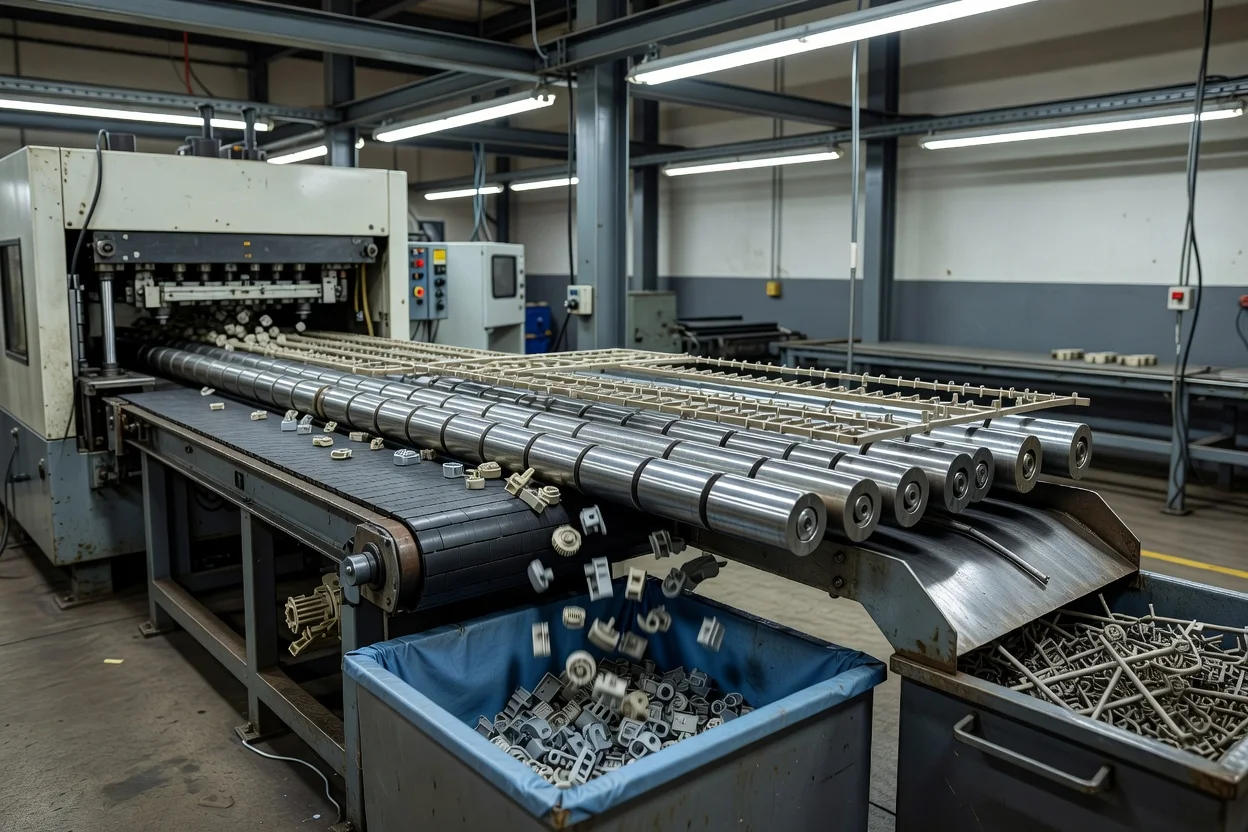
Sprue separating equipment works on one of three basic principles: size differential, geometric sorting, or robotic pick-off. In size-based systems, small parts fall through gaps or apertures while larger sprues continue along a roller, drum, screw, or spiral path.
Typical machine types
| Type | Working principle | Common strengths | Main limitations |
|---|---|---|---|
| Roller separator | Parts fall between rollers while sprues ride over them | Simple, compact, effective for flat or size-different combinations | Less effective when part and sprue have similar footprint |
| Separating drum | Rotating cage or drum sorts components by size and travel path | Good for larger throughputs and mixed geometries | Requires tuning of drum speed and inclination |
| Spiral separator | Helical transport separates lighter/smaller parts from larger ones | Gentle handling, compact footprint | Not ideal for all shapes or heavy sprues |
| Screw separator | Rotating screw and fixed plate create a sorting gap | Good for simple automatic sorting | Less versatile for complex part geometries |
| Sprue picker robot | Robot or picker extracts sprue or part directly from mold | Fast, repeatable, suitable for inline automation | Depends on mold design and available machine interface |
Engineering parameters
- Roller diameter in one commercial sprue separator design is about 108 mm, used to improve separation of very small component parts from sprues with a size differential of roughly 0 to 50 mm.
- Throughput depends strongly on geometry, but separating drums are typically selected when higher throughput is needed or when circulation improves the separation result.
- Sprue picker robots are commonly offered for injection molding machines in the 30 to 280 ton clamping-force range, with one model class reported for machines under 150 ton and another under 250 ton.
- Typical vertical stroke for a compact sprue picker can be around 550 mm to 700 mm, depending on machine size and reach requirements.
- After centrifugally assisted dewatering or cleaning in related separator systems, residual moisture in plastics processing is often designed to be low enough for downstream handling, although exact values vary widely by resin and dryer configuration; the search results here do not provide a universal figure, so no single benchmark should be assumed.
Separation mechanics
The key operating variable is the relative motion between good parts and sprues. For roller systems, the gap setting and angle determine whether the good part drops while the sprue rides on; for drums, speed and inclination govern dwell time and transport path; for robotic systems, motion precision and gripper design govern whether the sprue is removed without marking the finished part.
Types and Variations
Sprue separating equipment is typically grouped into the following variants:
- Roller separators, widely used for injection-molded parts with a clear footprint difference between part and sprue.
- Drum separators, used when larger throughput or more complex circulation improves sorting consistency.
- Paddle separators, often applied to larger components or when a conveyor-mounted directional split is preferred.
- Spiral separators, suitable for compact layouts and some mixed-size applications.
- Screw separators, used for simple automatic sorting where the geometry is compatible with the screw-gap principle.
- Sprue picker robots, used to remove sprues directly from the injection molding machine and often paired with downstream granulation.
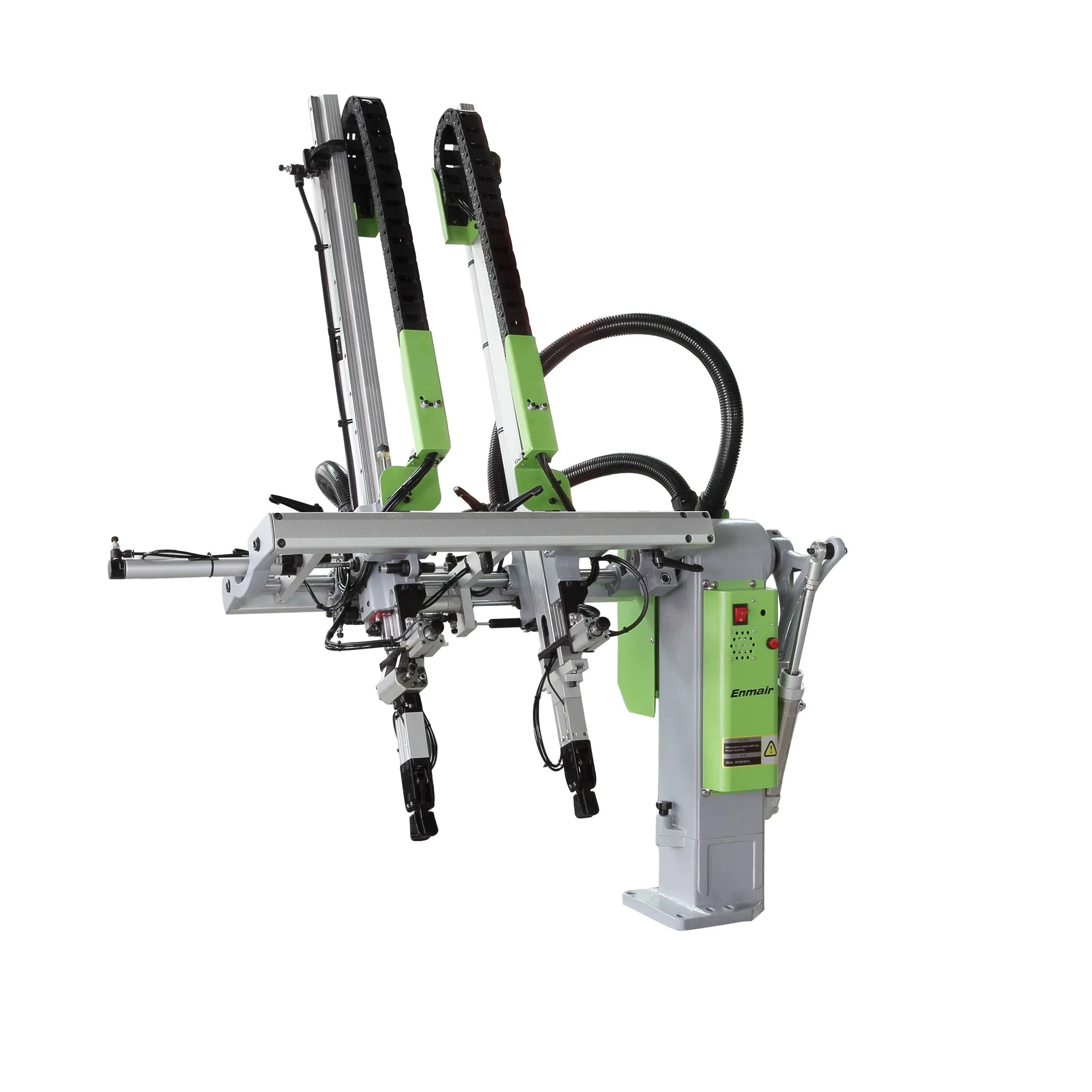
The choice of type depends on part geometry, sprue geometry, cycle time, available floor space, and whether the line is intended for automatic recycling or simple part discharge.
Applications and Uses
Sprue separating equipment is used mainly in plastic injection molding, where it separates finished goods from runners and sprues immediately after molding. It is also used in some die-casting and press environments where similar part-scrap separation tasks exist, although the terminology and machine design can differ by industry.
Major application areas include:
- Automotive components, where high-volume molding benefits from rapid, repeatable separation and direct scrap recovery.
- Packaging and closures, where cycle time and low labor input are important for high-output lines.
- Consumer goods, where part sizes vary and line-side sorting must remain flexible.
- Medical and technical plastics, where consistent handling reduces contamination and preserves part quality.
- Electrical and electronic housings, where clean separation supports assembly readiness and recycling.
- A poor-fit use case: very flexible, highly entangled, or nearly identical part-and-sprue geometries can exceed the capability of simple gravity or roller separators and may require robot-assisted handling instead.
Technological Innovations and Automation
Modern sprue separating equipment is increasingly integrated with conveyors, robot arms, machine vision, and programmable controls. A downstream cell may use cameras for detection, a gantry or robot for handling, and a rotary conveyor for sorting and dispatching good parts and sprues separately.
Automation offers several engineering benefits:
- Reduced manual labor and less operator variability.
- Shorter effective cycle times by removing the need for manual post-ejection handling.
- Better material recovery, especially when sprues are transferred directly to beside-the-press granulators for reprocessing.
- Tool-free or quick-adjust settings on some drum and roller systems, improving changeover for frequently changing part families.
At the same time, automation introduces trade-offs: more sensors and actuators improve precision but increase system complexity, maintenance requirements, and capital cost. For this reason, simpler mechanical separators remain attractive for stable, high-volume applications with predictable part geometry.
Environmental and Sustainability Aspects
Sprue separating equipment supports circular economy goals by helping manufacturers reclaim polymer scrap immediately after molding. When sprues are kept clean and segregated from finished parts, they can be ground and reintroduced into processing with less contamination risk.
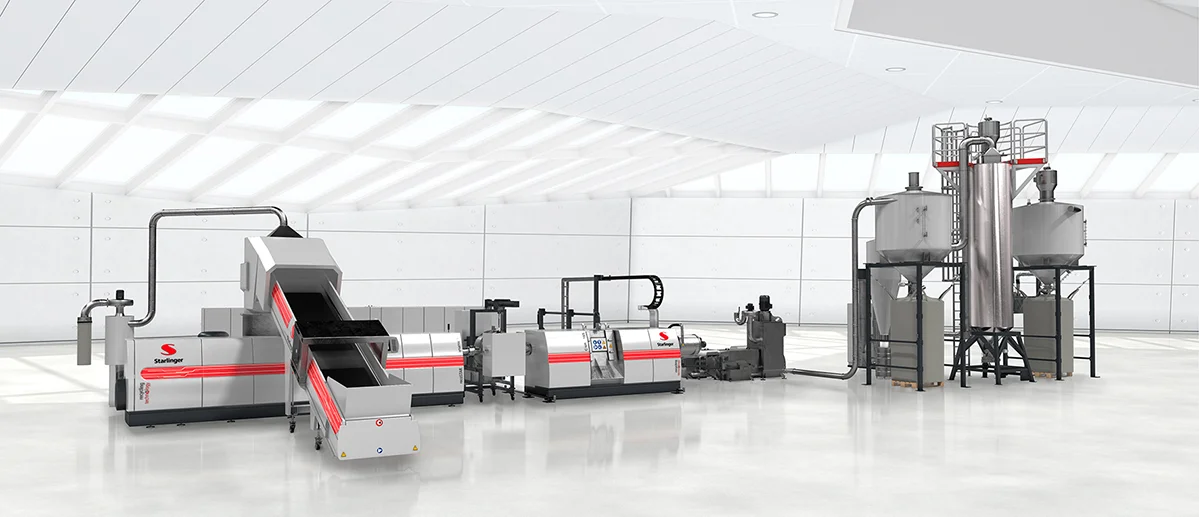
The sustainability value is strongest when the separator is part of a closed loop that includes:
- On-line segregation
- Immediate collection
- Granulation or regrind preparation
- Controlled reintroduction into the process
This approach reduces waste handling, lowers the risk of material loss, and can reduce the need for virgin polymer, depending on product specifications and quality constraints.
Energy efficiency varies by machine class. Mechanical roller or drum separators are usually low-power compared with full robotic cells, while sprue picker systems add motion axes and controls but can still reduce total production energy by shortening labor-intensive handling and improving line utilization. In practice, the most sustainable configuration is often the one that balances minimal handling, high recovery, and low reject rates rather than the one with the fewest components.
Economic and Global Market Impact
Sprue separating equipment has become a standard element of automated molding cells because it directly affects labor cost, scrap recovery, and throughput stability. For many processors, the return on investment comes from eliminating manual sorting, reducing cycle interruptions, and improving the consistency of recycled sprue streams.
The market is served by specialized conveyor and automation suppliers, with offerings spanning small stand-alone separators to integrated systems sold through plastics automation integrators. Regional strength is often tied to broader molding automation clusters in Europe and Asia, where separator design is commonly bundled with conveyor systems, robots, and downstream handling equipment.
Current Challenges and Innovations
The main technical challenge is that sprue separation depends heavily on part geometry, and no single mechanism works equally well for all products. Parts with similar dimensions, complex runners, or delicate surfaces may require customized tooling, test runs, or vision-assisted picking.
Other challenges include:
- Changeover sensitivity in multi-product plants
- Damage risk for cosmetically critical or thin-walled parts
- Integration complexity with varying mold layouts and press interfaces
- Maintenance of rollers, drums, and belts under continuous operation
Current innovation focuses on faster adjustment, modular conveyor integration, robotic flexibility, and better sensing. Tool-free adjustment mechanisms, quick-reconfigurable separator drums, and compact sprue picker systems are especially relevant where product mix changes frequently.
Future Outlook
Future sprue separating equipment is likely to become more adaptive, data-driven, and cell-integrated. The strongest development directions are vision-guided robotic separation, automatic recipe changeover, and tighter coupling between molding machines, separators, and regrind systems.
For high-volume plastics processors, the most important trend is not simply higher speed, but more reliable separation with less human intervention. For smaller molders, compact and economical sprue pickers will remain attractive when they can automate removal without requiring a major rebuild of the cell.
Summary
Sprue separating equipment is a practical but important class of plastics processing machinery that improves part handling, automation, and material recovery after molding. Its main forms—rollers, drums, paddles, spirals, screws, and sprue picker robots—serve different geometries and production scales, and the best choice depends on the balance between speed, flexibility, floor space, and recycling goals.
References
- •
Roller separators / sprue separators. (n.d.). https://stmachinery.com/conveyor-product-handling/roller-separator-sprue-separatorLink
- •
Sprue separators | blade, drum & spiral separators – T-Max. (n.d.). https://www.seperator-online.com/en/Link
- •
Sprue pickers & separators. (2021, July 23). https://geigerhandling.co.uk/automation-products/sprue-pickers-separators/Link
- •
Crizaf separators. (2022, January 1). https://www.moretec.nl/en/products/crizaf-separators/Link
- •
Plastic sprue separation & conveying. (n.d.). https://stmachinery.com/table/plastic-sprue-separation-conveying/Link
- •
Cut-off grinding machine TS for cast steel, gunmetal, investment cast. (n.d.). https://www.casting-finishing.com/en/Machines/Cut-off-machines/Cut-off-machine-TS/Link
- •
DUCTA-SPRUE® rotary sprue cleaner / consolidator. (2026, May 7). https://www.generalkinematics.com/product/sprue-rotary-drum/Link
- •
Conveyor separators. (2025, August 1). https://summitsystems.co.uk/plastics-automation/products/conveying-sprue-separation/conveyor-separators/Link
- •
Sprue separation. (2024, March 26). https://stmachinery.com/plastic-sprue-separation-conveying/plastic-sprue-separation-solutionsLink
- •
Cut-off grinding and fettling of investment castings. (n.d.). https://www.casting-finishing.com/en/Workpieces/Investment-castings/Link
- •
Reichmann | automatic grinding machines. (n.d.). https://www.casting-finishing.com/en/Machines/Automatic-grinding-machines/Link
- •
Presses & toolmaking. (2025, July 23). https://www.moessner-kg.de/en/products/giessereitechnik/pressen-werkzeugbau/Link
- •
Removing and separating sprues from the injection molding machine. (2025, January 15). https://rbtx.com/en-US/solutions/sprue-picker-removing-and-separating-sprues-from-the-injection-molding-machineLink
- •
Product finder for separating systems. (n.d.). https://www.mtf-technik.de/en/products/separating-systems/product-finder/Link
- •
Product. (2024, August 29). https://english.ciga.jp/product/Link
- •
Paddle separator conveyor. (2024, March 12). https://stmachinery.com/conveyor-product-handling/paddle-separator-conveyorLink
- •
Deburring and degating. (n.d.). https://www.ecoshotinc.com/deburring-and-degatingLink
- •
Efficient separation of material. (n.d.). https://www.mtf-technik.de/en/guide/efficient-separation-of-material/Link
- •
SM. (n.d.). https://mbconveyors.com/en/product/sm/Link
- •
Sprue pickers. (n.d.). https://www.wittmann-group.com/en/sprue-pickersLink
- •
Reichmann robot center – robot based fettling. (n.d.). https://www.casting-finishing.com/en/Machines/Automatic-grinding-center/Roboter-Center/Link
- •
Flush cutter. (2025, July 18). https://hugeminis.com/product/flush-cutter/Link
- •
Roller separators on the conveyor belt. (n.d.). https://www.mtf-technik.de/en/products/separating-systems/roller-separators/Link
- •
Screw separators for industrial use. (n.d.). https://www.mtf-technik.de/en/products/separating-systems/screw-separators/Link
- •
Separators and distributors. (n.d.). https://1plastcompany.com/separators-and-distributorsLink
- •
Swing frame grinders. (n.d.). https://www.foundryequipments.net/swing-frame-grinders.phpLink
- •
Conveying & sprue separation. (2026, June 11). https://summitsystems.co.uk/plastics-automation/products/conveying-sprue-separation/Link
- •
Sprue picker robot manufacturer in China. (2022, November 8). https://alfarobot.com/sprue-picker-robot/Link
- •
2026 grinding machine, pneumatic hammer products from China. (2017, July 28). https://m.made-in-china.com/company-craftsman/productlist?word=+Runner+BreakerLink
- •
SS sprue picker. (2025, April 9). https://www.hamiltonplasticsystems.com/equipment/ss-sprue-picker/Link
- •
Blue die casting sprue seperator conveyor and roller. (n.d.). https://www.tradeindia.com/products/die-casting-sprue-seperator-conveyor-and-roller-c6897312.htmlLink
- •
Sprue removal mechanism for die casting apparatus. (1996, June 14). https://patents.google.com/patent/US4060121A/enLink
- •
Downstream sprue separation. (2024, October 4). https://rbtx.co.uk/en-GB/solutions/downstream-sprue-separationLink
- •
Separating drums for material. (n.d.). https://www.mtf-technik.de/en/products/separating-systems/separating-drums/Link
- •
Injection molding sprue picker. (2016, July 22). https://www.shiniusa.com/products/conveyors/sprue-pickers/Link
- •
Robotic sprue picker for injection molding machines. (2026, June 16). https://www.wensuimachinery.com/news/robotic-sprue-picker-for-injection-molding-machinesLink
- •
Sprue separator. (2001, June 26). https://patents.google.com/patent/US4454030A/enLink
- •
Sprue removal. (1998, May 21). https://orchid.ganoksin.com/t/sprue-removal/5308Link
- •
Part separation systems. (2025, February 19). https://globeius.com/collections/part-separation-systemsLink