
Introduction
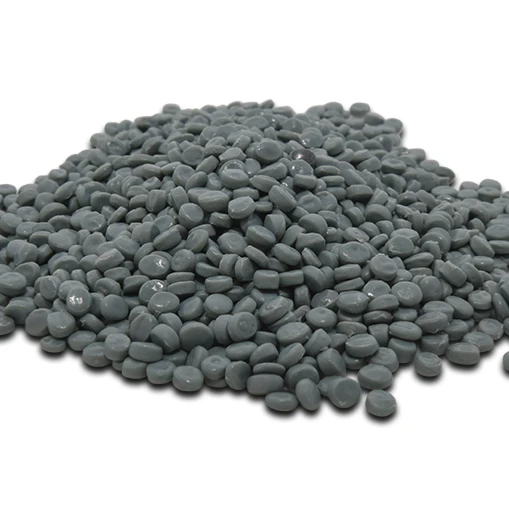
Recycled polypropylene (rPP) is polypropylene recovered from post-consumer or post-industrial waste and reprocessed into a usable thermoplastic resin for new products. It has become one of the most important circular feedstocks in plastics because it can often deliver a useful balance of cost, processability, chemical resistance, and sustainability benefits while reducing dependence on virgin propylene-based resin.
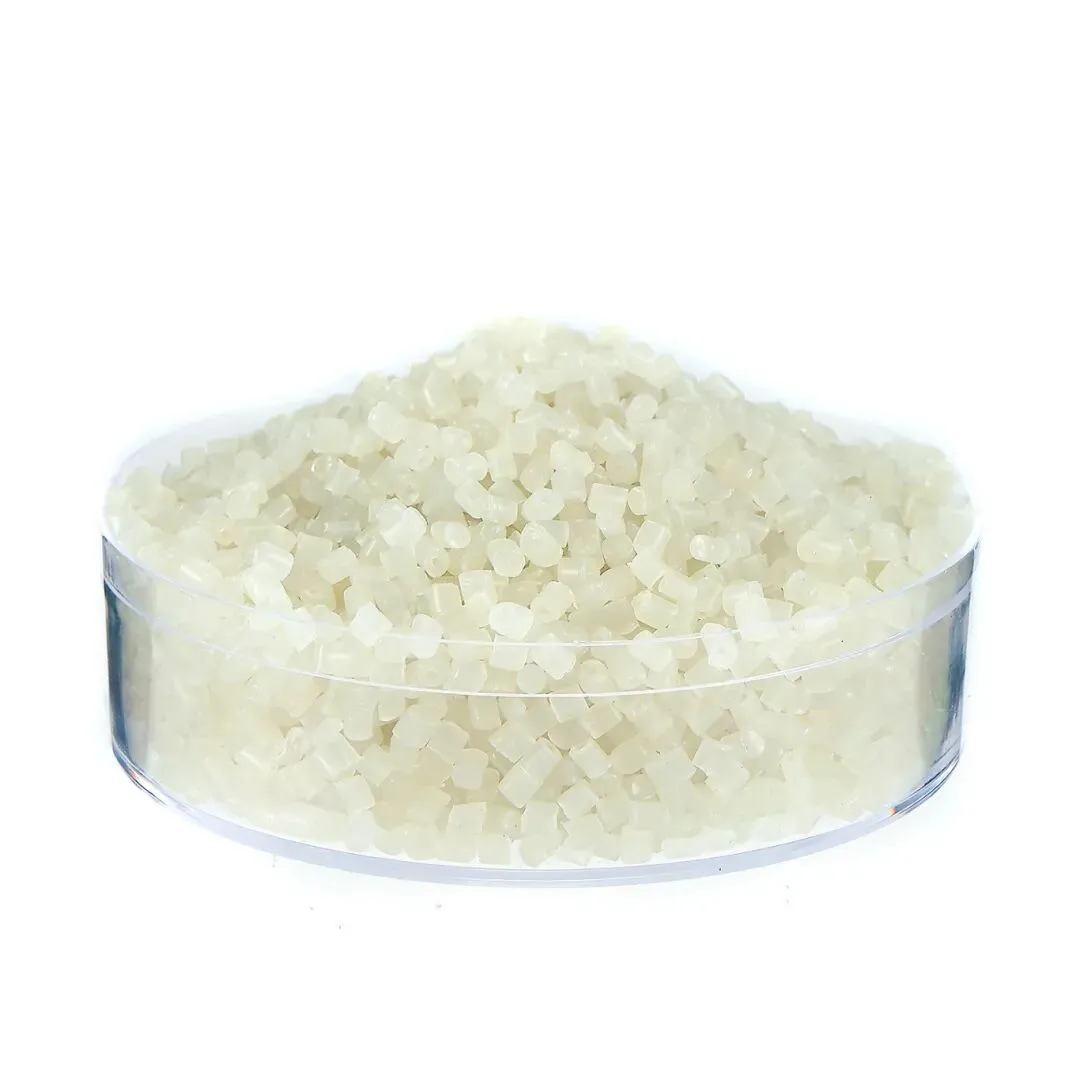
rPP is not a single uniform material but a family of recycled PP streams that differ by source, purity, color, melt flow behavior, and additive history. In practice, it is produced mainly by mechanical recycling, although advanced solvent-based purification and chemical recycling routes are also being developed to improve consistency and broaden applications. The material is especially important in non-food packaging, consumer goods, logistics, automotive interiors, construction items, and agricultural products, where recycled content targets and decarbonization goals are reshaping procurement decisions.
Like virgin polypropylene, rPP is valued for low density, good chemical resistance, and ease of molding, but recycling introduces variability and some property loss from thermal and oxidative degradation. These limitations are increasingly addressed through better sorting, decontamination, stabilization, compatibilization, and blending with virgin PP or performance additives. As circular economy regulation, brand-owner commitments, and waste-diversion pressures intensify, rPP is expected to remain a strategically important material in the plastics value chain.
History and Development
Polypropylene was commercialized in the mid-20th century and rapidly became one of the world’s most widely used thermoplastics because of its low cost, light weight, and broad processing window. Recycling of PP followed the broader development of plastics recovery systems, but rPP has only become a major industrial material in recent years as sorting technologies, washing systems, and pelletizing processes improved.
Early rPP use was largely limited to lower-value applications because mixed waste streams produced inconsistent resin quality and odor, contamination, and color control were difficult to manage. The emergence of near-infrared sorting, hot washing, high-efficiency filtration, odor reduction, and compounding has significantly improved the quality of post-consumer and post-industrial rPP. More recently, advanced purification approaches such as solvent-based recycling have been developed to recover material closer to virgin-grade purity.
The market development of rPP has also been driven by policy and procurement. Recycled-content targets, extended producer responsibility systems, and consumer-brand sustainability pledges have all increased demand for consistent recycled PP resin. This has shifted rPP from a niche secondary material into a mainstream industrial raw material for selected applications.
Chemical Structure and Key Properties
Polypropylene is a semicrystalline polyolefin built from propylene units, and rPP retains the same basic hydrocarbon backbone as virgin PP. Its performance depends strongly on crystallinity, molecular weight, melt flow rate, and the nature of stabilizers, fillers, pigments, and contaminants present in the source stream.
Key property profile
| Property | Typical rPP behavior | Practical significance |
|---|---|---|
| Density | Low, similar to virgin PP | Supports lightweight parts and packaging |
| Chemical resistance | Generally good | Suitable for many acids, alkalis, and detergents |
| Stiffness | Often maintained or slightly increased | Useful in crates, housings, and rigid goods |
| Impact strength | Can be reduced by degradation or contamination | Often improved with impact modifiers |
| Melt flow rate | Often higher than virgin PP | Can help injection molding but may signal chain scission |
| Thermal stability | Lower than virgin PP if poorly stabilized | Requires antioxidant packages and controlled processing |
rPP has several important limits. Poor O₂ and grease barrier → caused by the inherently nonpolar polyolefin structure and low crystallinity in many grades → workaround: multilayer structures, barrier coatings, or blending with barrier polymers for suitable packaging uses. Low surface energy before treatment → caused by the chemically inert hydrocarbon surface → workaround: corona, plasma, flame treatment, or primers to improve printability and adhesion. Property drift from batch to batch → caused by variable feedstock composition, oxidation, and contamination → workaround: tighter sorting, advanced filtration, deodorization, and formulation control.
Recycling often causes chain scission, which lowers molecular weight and can raise melt flow rate while reducing toughness and thermal robustness. In some studies, recycled PP has shown increased stiffness and higher flow relative to virgin PP, reflecting the practical reality that rPP is not necessarily “weaker” in every respect, but rather differently balanced in properties.
Production Processes and Raw Feedstocks
rPP is produced from two main feedstock categories: post-consumer recycled PP, recovered from household, commercial, and municipal waste streams, and post-industrial recycled PP, generated from manufacturing scrap, off-spec material, and converting trim. PIR streams are usually cleaner and more consistent than PCR streams, so they often command higher quality and easier processing.
Mechanical recycling
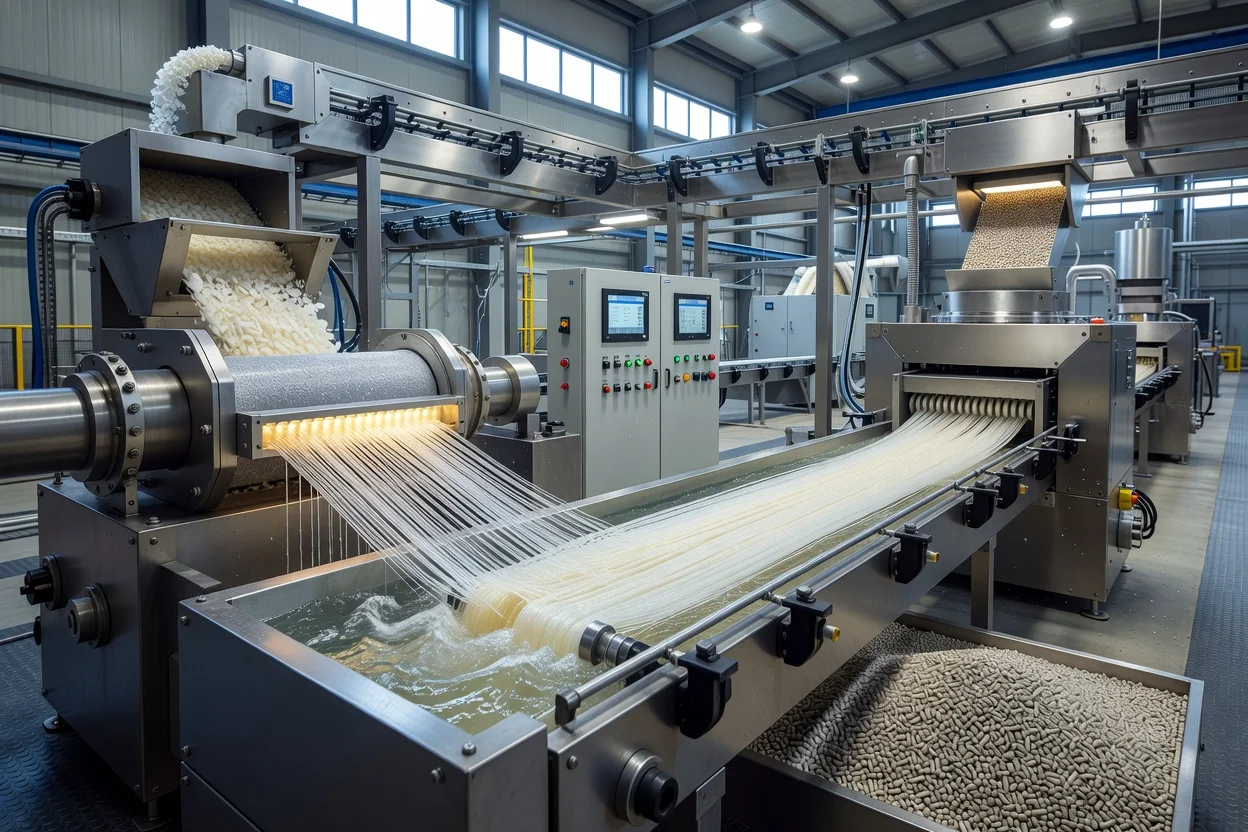
Mechanical recycling remains the dominant production route. The typical steps are:
- Collection and aggregation of PP-containing waste
- Sorting by resin type, color, and form
- Washing and contamination removal
- Shredding or granulation
- Drying
- Melt extrusion and filtration
- Pelletizing into regranulate or pellets
In extrusion, the recycled flake is melted, filtered, and reformed into pellets for injection molding, extrusion, or compounding. High-quality systems use NIR sorting, float-sink separation, multi-stage washing, fine filtration, and controlled pellet cooling to improve consistency.
Advanced purification and chemical routes
Some producers use solvent-based purification to remove contaminants and recover PP with near-virgin characteristics. Chemical recycling routes also exist in principle, where PP is broken down into smaller chemical components or converted into fuels and intermediates, but these routes are less established for large-scale PP circularity than mechanical recycling.
Stabilization and compounding
Because recycled PP can suffer oxidative degradation, formulation is central to rPP quality. Common practices include:
- Antioxidants, often at low loading levels, to slow thermal oxidation during reprocessing and service
- Compatibilizers to improve performance in mixed or blended streams
- Impact modifiers to restore toughness
- Color masterbatch to reduce variability
- Odor-reduction additives or devolatilization aids in sensitive applications
For example, antioxidant packages may be used at fractions of a percent to help preserve molecular weight during melt processing, while impact modifiers can be blended in when rPP is intended for molded housings or crates. The exact dosage depends on feedstock quality and the target application.
Applications and End-Use Markets
rPP is used where its combination of durability, chemical resistance, low density, and sustainability value outweighs its variability relative to virgin PP. It is especially common in non-food-contact, industrial, and semi-visible parts.
Main application sectors
| Sector | Typical products | Usual rPP grade/process |
|---|---|---|
| Packaging and transport | Crates, bins, pallets, industrial containers | Injection-molded or extrusion-grade rPP, often from cleaner PCR/PIR streams |
| Automotive | Interior trims, liners, underbody shields, acoustic parts | Compounded rPP, often with impact modification and color control |
| Construction | Drainage components, profiles, panels, non-pressure items | Stiffness-oriented compounded grades |
| Agriculture | Plant pots, trays, crates, irrigation accessories | Injection-molded or thick-wall molded rPP |
| Consumer goods | Storage boxes, chairs, furniture parts, garden products | Colored or filled rPP grades |
| Textiles and fibers | Selected nonwoven or fiber applications | Specialized grades with controlled rheology |
| E-commerce and logistics | Returnable transit packaging, bins, trays | Robust, fatigue-resistant grades |
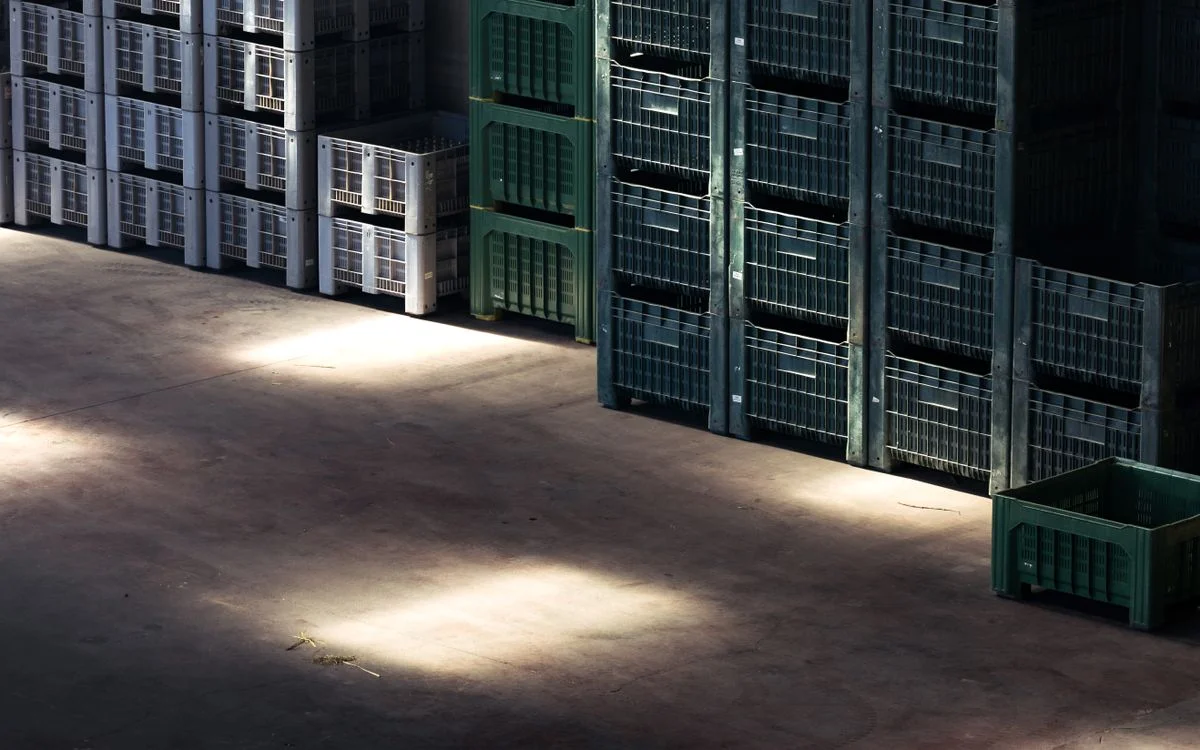
rPP is particularly strong in logistics and warehousing products, garden and household items, and automotive non-visible components where recycled content can be used without demanding optical perfection. It is also used in food packaging-related systems only when advanced decontamination and regulatory approval are in place.
A poor-fit use is high-clarity premium packaging or applications demanding highly stable barrier performance, because rPP typically has color variability, odor concerns, and weaker barrier properties than specialty packaging resins.
Environmental and Sustainability Aspects
rPP is a major enabler of plastic circularity because it diverts waste from disposal and reduces demand for fossil-based feedstock. Replacing virgin PP with recycled content can reduce greenhouse-gas emissions, though the exact benefit depends on collection efficiency, energy mix, transport, washing intensity, and yield loss.
Key sustainability dimensions
- Recyclability: PP is recyclable, but actual recovery rates depend heavily on collection systems, product design, and sorting infrastructure.
- Carbon footprint: Industry analyses commonly report substantial footprint reductions versus virgin PP when high-yield mechanical recycling is used.
- Bio-based alternatives: Bio-based PP remains limited in commercial availability, so rPP is often the more immediately scalable lower-carbon option for many uses.
- Food-contact circularity: Advanced decontamination and regulatory approval are expanding the possibility of closed-loop PP packaging, but this remains more demanding than non-food applications.
- Waste quality issues: Mixed-waste contamination, additives from legacy products, and inks or labels can limit closed-loop use and require downcycling or blending.
Mechanical recycling is usually the most resource-efficient pathway when feedstock is clean and collection is effective. By contrast, when streams are highly contaminated or mixed, solvent-based or chemical routes may offer better product quality, albeit with higher process complexity and capital intensity.
Economic and Global Market Impact
According to recent industry analyses, rPP demand is rising because it serves both cost and compliance objectives: it can help manufacturers meet recycled-content targets while often remaining competitive against virgin resin when supply chains are tight. The strongest demand is in non-critical industrial goods, packaging auxiliaries, consumer products, and automotive interiors.
The economics of rPP depend on several variables:
- Feedstock availability and collection quality
- Sorting and washing costs
- Energy prices
- Yield losses and contamination rates
- Required color or odor specifications
- Virgin PP market pricing
- Regulatory and brand-owner recycled-content requirements
Leading market participants include specialized recyclers, compounders, and integrated polymer producers investing in advanced purification. PureCycle is notable for solvent-based purification technology aimed at producing near-virgin recycled PP. Other recyclers and compounders focus on mechanical processing, masterbatching, and application-specific formulations that allow rPP to fit industrial procurement specifications.
Because PP is one of the world’s most common polymers, even modest recycled-content penetration can generate large absolute volumes of secondary material. This makes rPP strategically important for packaging, mobility, and durable goods supply chains.
Current Challenges and Innovations
rPP development is shaped by a tension between scalability and quality. The central challenge is that recycled feedstock is inherently more variable than virgin resin, and that variability affects processability and final performance.
Main challenges
- Odor and residual contamination in post-consumer streams
- Color inconsistency and limited transparency
- Property drift from oxidation and chain scission
- Difficulty meeting food-contact requirements
- Sorting losses and mixed-polymer contamination
- Weak barrier performance in packaging uses
Major innovations
- Better optical sorting and artificial-intelligence-assisted separation
- More effective hot washing and deodorization
- High-fineness melt filtration and degassing
- Reactive extrusion and compounding to rebuild performance
- Solvent-based purification for higher-purity PP recovery
- Compatibilizers and stabilizers designed specifically for recycled polyolefins
- Improved design-for-recycling packaging that avoids hard-to-remove labels, adhesives, and mixed materials
A notable technical direction is the use of targeted compounding to correct melt flow behavior in recycled PP. Patent and research activity shows that formulating rPP with compatible copolymers or reactive additives can help control MFR and make recycled feedstocks more suitable for demanding manufacturing windows.
Future Outlook
The outlook for rPP is positive, but segmented. Growth is likely to be strongest where regulators, brand owners, and OEMs can accept moderate appearance variation in exchange for lower environmental impact and lower reliance on virgin feedstock.
Three developments are likely to shape the market:
- Closed-loop packaging systems for PP tubs, caps, and containers where decontamination and food-contact approvals can be demonstrated
- Higher-specification automotive and appliance compounds that use more sophisticated stabilization and compatibilization
- Scaling of advanced purification routes that narrow the quality gap between rPP and virgin PP
The main constraint is not demand alone, but reliable supply of sufficiently clean PP waste and economically efficient processing. As collection, sorting, and purification improve, rPP is likely to move from a cost-driven secondary material toward a more engineered feedstock with clearly differentiated grades.
Summary
rPP is a recycled thermoplastic raw material derived from PP waste and reprocessed into pellets, flake, or compounded resin for new manufacturing uses. Its value lies in combining the familiar processing advantages of polypropylene with lower fossil-resource demand and reduced carbon intensity.
Its success depends on feedstock quality, stabilization, and application matching. In practice, rPP is strongest in rigid packaging, logistics, consumer goods, automotive interiors, and other uses where moderate variability is acceptable and recycled content has strategic value.
References
- •
Recycled Polypropylene (rPP) – Properties, Applications, and Benefits. (n.d.). Ambiomaterials. https://www.ambiomaterials.com/en/materials/rppLink
- •
Recycled PP (rPP), Explained: What It Is, Whether It's Safe .... (2026, June 13). Weilinplastic. https://weilinplastic.com/recycled-pp/Link
- •
What Is Recycled Polypropylene rPP? | A Simple Explanation. (n.d.). Langgengjayagroup. https://langgengjayagroup.co.id/blog/simple-explanation-of-recycled-polypropylene-ppLink
- •
Understand Recycled Polypropylene: A Comprehensive Guide - CTC Plastics. (2024, November 27). Ctcplastics. https://ctcplastics.com/2024/05/understand-recycled-polypropylene-a-comprehensive-guide/Link
- •
Understand Recycled Polypropylene: A Comprehensive Guide -. (n.d.). Ctcplastics. https://ctcplastics.com/understand-recycled-polypropylene-a-comprehensive-guide/Link
- •
What Is rPP? A 5-Minute Guide to Recycled Polypropylene (PP). (2026, July 14). Yungiee. https://www.yungiee.com/en/post/what-is-rpp-a-5-minute-guide-to-recycled-polypropylene-ppLink
- •
How Recycled Polypropylene Is Made Waste to Pellets. (2026, June 15). Egrowthsb. https://www.egrowthsb.com/how-recycled-polypropylene-is-made-waste-to-pellets/Link
- •
Exploring the Versatile Redispersible Polymer Powder Uses - ECHEMI.com. (2024, February 6). Echemi. https://www.echemi.com/cms/1675988.htmlLink
- •
Redispersible Polymer Powder in the Real World: 5 Uses .... (2025, September 30). Linkedin. https://www.linkedin.com/pulse/redispersible-polymer-powder-real-world-5-uses-qbllcLink
- •
Recycled Polypropylene: The Future of Sustainable Packaging. (n.d.). Langgengjayagroup. https://langgengjayagroup.co.id/blog/recycled-polypropylene-the-future-of-sustainable-packagingLink
- •
How is recycled polypropylene made? - Textiles. (2020, October 23). Yarns and Fibers. https://www.yarnsandfibers.com/textile-resources/synthetic-fibers/polypropylene-fiber/polypropylene-fiber-production-raw-materials/how-is-recycled-polypropylene-made/Link
- •
rPP (Recycled Polypropylene). (n.d.). Polystylex. https://polystylex.com/rpp-recycled-polypropyleneLink
- •
Mechanical recycling typically involves shredding, washing, milling or grinding, float-sink separation, drying, and extrusion (26). (n.d.). Escholarship. https://escholarship.org/content/qt9fc9n0qn/qt9fc9n0qn.pdf?t=s4o63qLink
- •
Understanding Redispersible Polymer Powders in Modern Construction. (2024, December 12). Hnxbntech. https://hnxbntech.com/blog-detail/understanding-redispersible-polymer-powders-in-modern-constructionLink
- •
[PDF] Supplementary Information Complementary ... - Semantic Scholar. (n.d.). Semanticscholar. https://pdfs.semanticscholar.org/1a0c/0183da40c9271778b36f7bcfbd2821e8346e.pdfLink
- •
Our Process | PureCycle | Polypropylene Plastic Recycling. (n.d.). Purecycle. https://www.purecycle.com/our-processLink
- •
Recycling Polypropylene from Waste Polymers: A Review. (2025, December 31). Reference-global. https://reference-global.com/article/10.2478/czoto-2025-0040Link
- •
What Is Rate Pressure Product and Why Does It Matter?. (2025, December 8). Biologyinsights. https://biologyinsights.com/what-is-rate-pressure-product-and-why-does-it-matter/Link
- •
Company Overview. (n.d.). Ohio.gov. https://dam.assets.ohio.gov/image/upload/epa.ohio.gov/Portals/34/document/general/PureCycle_SWMDWorkgroup_Presentation04082021.pdfLink
- •
1. (n.d.). Ohio.gov. https://dam.assets.ohio.gov/image/upload/epa.ohio.gov/Portals/34/document/general/PureCycle.pdfLink
- •
rPP | Saytek. (2025, February 20). Saytek. https://saytek.tr/en/products/rppLink
- •
An introduction to the Polypropylene Recycling Process. (2023, November 1). Ecoplashk. https://www.ecoplashk.com/resources/an-introduction-to-the-polypropylene-recycling-process.htmlLink
- •
Recycled Polypropylene (rPP) Packaging – An Introduction. (2025, June 19). Greiner-gpi. https://www.greiner-gpi.com/en_US/Newsroom/Blog/An-Introduction-to-Recycled-Polypropylene-rPP-A-Sustainable-Plastic-Packaging-Solution_s_359613Link
- •
Simple Explanation of Recycled Polypropylene (PP). (2024, July 15). Ecoplashk. https://www.ecoplashk.com/resources/simple-explanation-of-recycled-polypropylene-pp.htmlLink
- •
Exploring the Versatile Uses of RPP Material. (2025, May 10). Fimaxcuttingboard. https://www.fimaxcuttingboard.com/news/exploring-the-versatile-uses-of-rpp-material/Link
- •
Polypropylene Recycling Guide: From Scrap to High-Quality Resin. (2026, March 8). Poly-source. https://www.poly-source.com/blogs/polypropylene-recycling-guide-from-scrap-to-high-quality-resinLink
- •
Polypropylene - Wikipedia. (2003, March 26). Wikipedia. https://en.wikipedia.org/wiki/PolypropyleneLink
- •
PCR r-PP - Polypropylene. (n.d.). Sinox-polymers. https://www.sinox-polymers.com/en/plastic-recycled-pellets-pcr-pp-polypropylene.htmlLink
- •
What items can be made from recycled Polypropylene (PP) .... (2022, May 19). Cmsplastic. https://cmsplastic.com/what-items-can-be-made-from-recycled-polypropylene-pp-plastics/Link
- •
RRPP – Applied Multivariate Statistics in R. (2026, January 2). Uw.pressbooks. https://uw.pressbooks.pub/appliedmultivariatestatistics/chapter/rrpp/Link
- •
— RPP Remote Power Panels, Power Distribution Unit .... (n.d.). Library.e.abb. https://library.e.abb.com/public/613ecc73ae5c423fa3ec04c9d7f42313/RPP_Catalougue_9AKK108466A4423.pdf?x-sign=pYjv8zV2G0VOd6LtCSM1H0dcsuyzUHaemf24CcHiHDaELslSGqoR+NljvY2HLfMhLink
- •
RPP Architecture - IETF. (2026, February 27). Ietf. https://www.ietf.org/ietf-ftp/internet-drafts/draft-ietf-rpp-architecture-01.htmlLink
- •
Closed-loop recycling of polypropylene: A case study on mechanical .... (n.d.). Sciencedirect. https://www.sciencedirect.com/science/article/pii/S0921344924001320Link
- •
Why is Polypropylene (PP) So Difficult to Recycle?. (2024, August 28). Cleantech. https://cleantech.com/why-is-polypropylene-pp-so-difficult-to-recycle/Link
- •
RPP Benefits: Sustainable Solution for Industrial Applications. (2026, March 13). Linkedin. https://www.linkedin.com/posts/ecoplas-hk-limted_rpp-%E5%9B%9E%E6%94%B6%E5%A1%91%E8%86%A0-%E6%B0%B8%E7%BA%8C-activity-7438071498222833664-CBmJLink
- •
Polypropylene (PP) Recycling: The Complete Guide to .... (2026, April 22). European-recycling. https://european-recycling.com/polypropylene-pp-recycling-guide/Link
- •
A Complete Guide to Rpp Pp: Specifications, Types, and Applications. (2026, March 15). Alibaba. https://www.alibaba.com/product-insights/rpp-pp.htmlLink
- •
EP4308636A1 - Process of recycled polypropylene. (2022, April 5). Patents.google. https://patents.google.com/patent/EP4308636A1/enLink
- •
Community Housing - CNIC Fleet and Family Readiness. (n.d.). Ffr.cnic.navy. https://ffr.cnic.navy.mil/navy-housing/community-housing/Link
- •
THE GROWING MARKET FOR. (n.d.). Recyclingpartnership. https://recyclingpartnership.org/wp-content/uploads/dlm_uploads/2021/01/TRP-APR-Polypropylene-1.pdfLink
- •
Recycling Polypropylene: How To Recycle PP & The Benefits. (2021, August 11). Palmetto-industries. https://www.palmetto-industries.com/recycling-polypropylene/Link
- •
How Is Polypropylene Made? Polypropylene Manufacturing Process .... (2025, May 28). Palmetto-industries. https://www.palmetto-industries.com/how-is-polypropylene-made/Link
- •
[PDF] RECYCLING POLYPROPYLENE FROM WASTE POLYMERS. (n.d.). Reference-global. https://reference-global.com/download/article/10.2478/czoto-2025-0040.pdfLink
- •
Polypropylene Recycling: How to Recycle PP Guide. (2023, August 29). Renegadeplastics. https://renegadeplastics.com/blog/polypropylene-recycling-how-to-recycle-pp-guide/Link
- •
Rental Partnership Program: Eligibility and Benefits. (2023, August 18). Militarymoney. https://www.militarymoney.com/housing/rental-partnership-program/Link
- •
What is the Rental Partnership Program and How Does It .... (2025, October 17). Innago. https://innago.com/what-is-the-rental-partnership-program-and-how-does-it-work/Link
- •
Polypropylene - an overview. (n.d.). Sciencedirect. https://www.sciencedirect.com/topics/materials-science/polypropyleneLink
- •
Military Rental Partnerships a Boon for Service Members, .... (2025, April 25). Naahq. https://naahq.org/news/military-rental-partnerships-boon-service-members-housing-providersLink
- •
Recycling rigid polypropylene from mixed waste. (2025, August 20). Pmc.ncbi.nlm.nih. https://pmc.ncbi.nlm.nih.gov/articles/PMC12728084/Link
- •
Sustainable Polypropylene Blends: Balancing Recycled .... (2025, June 3). Pmc.ncbi.nlm.nih. https://pmc.ncbi.nlm.nih.gov/articles/PMC12158057/Link
- •
Environmental impacts of polypropylene (PP) production .... (n.d.). Sciencedirect. https://www.sciencedirect.com/science/article/pii/S2214785321075969Link
- •
Polypropylene (PP) Recycling. (2026, August 14). Wastetrade. https://www.wastetrade.com/resources/plastics/polypropylene-pp-properties-uses-and-recyclingLink