
Introduction
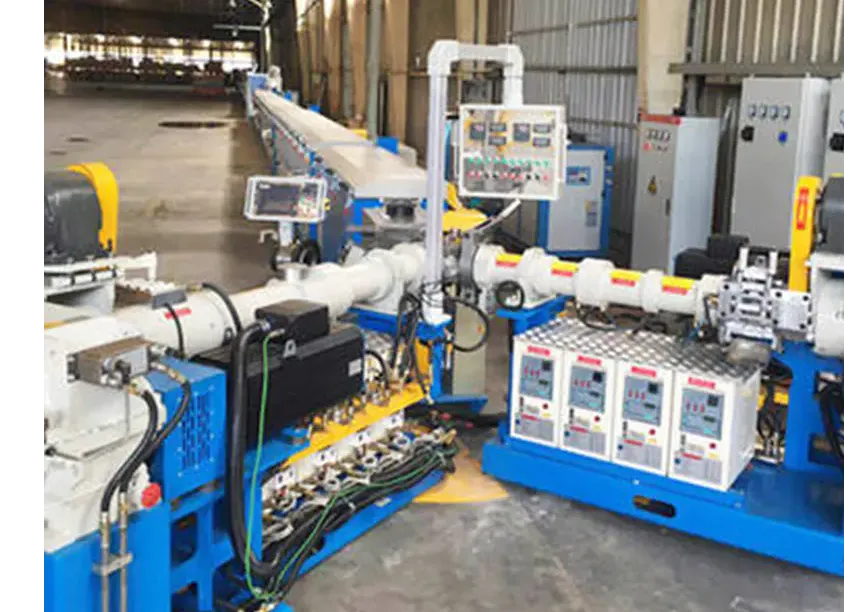
Extrusion lines for rubber are continuous processing systems that convert rubber compounds into uniform profiles, tubes, seals, cords, treads, hoses, sheets, and other semi-finished products by forcing the material through a shaped die and then curing or stabilizing the extrudate in-line or downstream. In industrial practice, these lines range from compact profile systems to large tire-component and cable-insulation installations, and they are typically built around a rubber extruder, die tooling, vulcanization or cooling equipment, haul-off, cutting, and winding or stacking units.
Their development has closely followed advances in elastomer compounding, screw design, temperature control, and continuous vulcanization technology, with modern systems increasingly emphasizing automation, dimensional stability, energy efficiency, and integration with connected production monitoring. Common variants include cold-feed and hot-feed extruders, single- and multi-extruder co-extrusion lines, and specialized lines for tires, cables, hoses, sponge profiles, and sealing strips.
History and Development
Early rubber extrusion was adapted from general screw-extrusion principles but required specialized solutions because elastomer compounds are highly viscous and sensitive to heat buildup, die swell, and premature curing. As rubber processing evolved, manufacturers introduced dedicated feed systems, tighter barrel-temperature management, and improved die geometry to make continuous production more stable and repeatable.
A major milestone was the transition from simple shaping to continuous vulcanization, which made it practical to produce long-length rubber articles with usable mechanical properties directly on the line rather than as batch-finished goods. Another important development was the expansion of multi-extruder systems for layered products such as cable insulation, innerliners, barrier layers, and co-extruded seals, where different compounds must be combined in a single continuous process.
A third milestone has been the spread of highly automated, turnkey lines for automotive and technical-rubber applications, including servo-controlled haul-offs, in-line measurement, microwave or hot-air curing, and recipe-based control of process conditions. This shift has reduced dependence on manual intervention while improving throughput consistency and scrap control.
Technical Overview
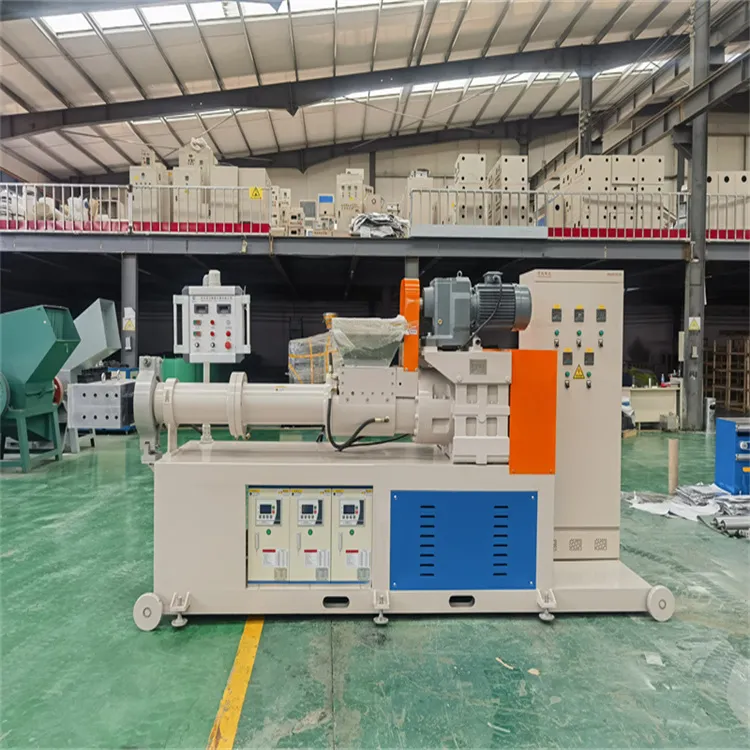
Rubber extrusion begins when a prepared compound, usually supplied as strips, pellets, slabs, or preforms, is fed into the extruder hopper or feeder and conveyed by a rotating screw toward the die. The screw generates pressure and shear, while barrel heating and friction plasticize the compound so it can be forced through a profile-specific die opening.
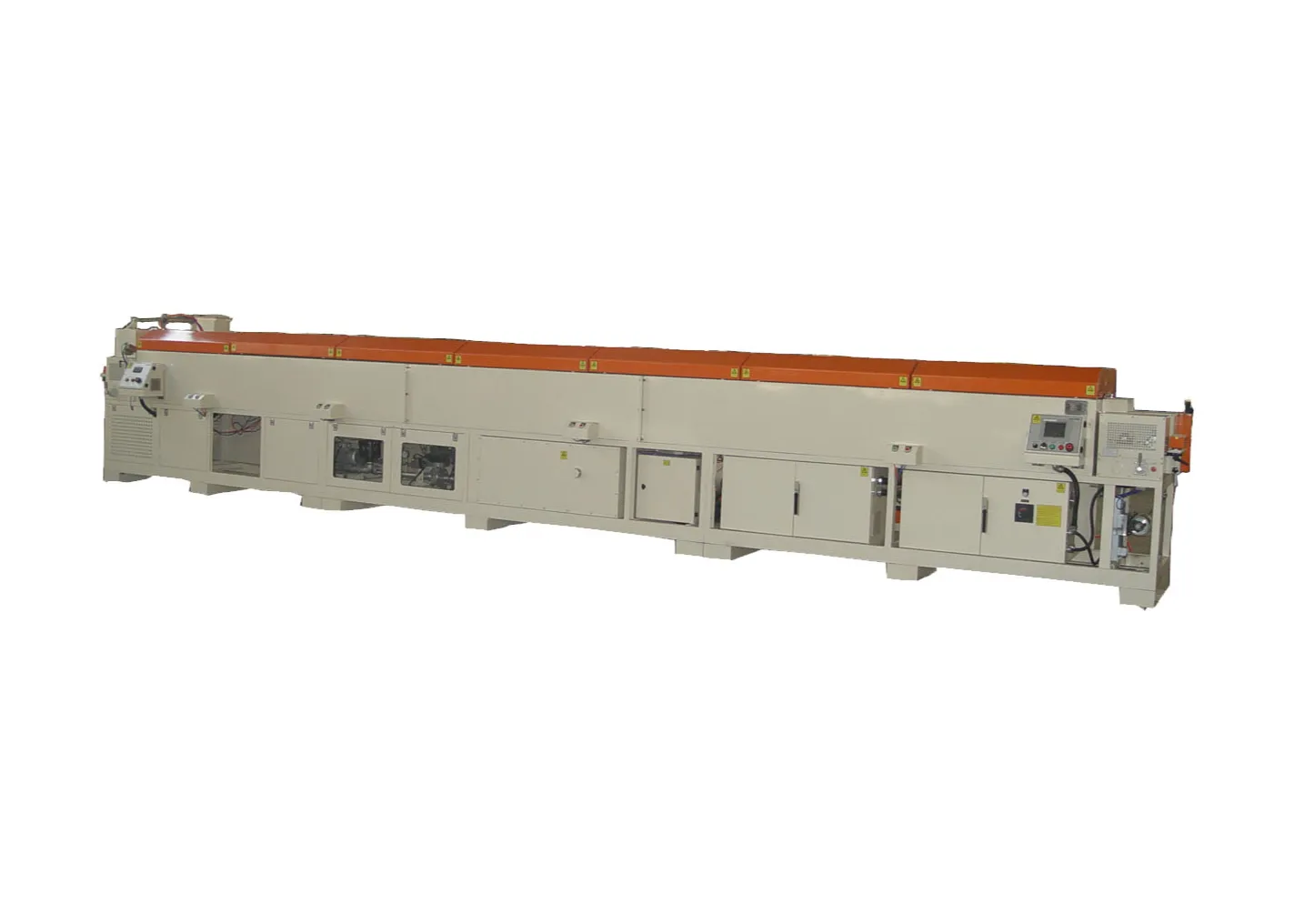
Unlike thermoplastic extrusion, rubber extrusion usually does not rely on a fully molten state; instead, the process is governed by viscoelastic flow, temperature rise, and control of premature crosslinking. The downstream section often includes:
- Hot-air tunnels, microwave units, or steam systems for vulcanization.
- Cooling baths or air-cooling sections to stabilize dimensions.
- Haul-off and cutting systems for length control or coiling.
- Calibration tools or guide systems where tight dimensional tolerances are required.
Typical equipment parameters vary by product class, but several benchmark ranges are common in industry practice:
- Screw diameter: approximately 45–300 mm for industrial rubber extruders in broad commercial portfolios.
- Throughput: small-profile lines may run at only tens of kg/h, while larger industrial systems for tire, hose, or cable production can operate at much higher outputs depending on compound, screw size, and cure method.
- Line speed: tire-component extrusion systems can reach about 45 m/min for tread and 60 m/min for sidewall in high-speed applications.
- Curing pressure: rubber cable continuous vulcanization lines may use saturated steam at 18–24 bar.
Process performance is strongly shaped by the compound formulation. Materials such as EPDM, NBR, SBR, and silicone require different feed behavior, temperature windows, and cure systems, which is why many vendors offer dedicated machines for specific elastomer families.
Main Components of a Rubber Extrusion Line
| Component | Function |
|---|---|
| Feeder or bale feeder | Supplies rubber compound to the extruder, especially for high-viscosity or baled stock. |
| Extruder | Plastifies and pressurizes the compound for die formation. |
| Die or toolhead | Shapes the extrudate into the required cross-section. |
| Vulcanization unit | Cures the rubber using hot air, steam, microwave, or other heating methods. |
| Cooling section | Stabilizes the extrudate and preserves dimensions. |
| Haul-off | Maintains line tension and regulates output speed. |
| Cutter or coiler | Cuts to length or winds continuous product into manageable form. |
Types and Variations
Rubber extrusion lines are usually classified by feed method, product geometry, and curing technology.
- Cold-feed extrusion lines: Use preheated or room-temperature compound and are widely used where stable feeding and better energy control are desired.
- Hot-feed extrusion lines: Feed compound from a warm supply and are traditionally used for certain rubber stocks and legacy process setups.
- Single-extruder lines: Produce one compound or one-layer profile, common in seals, tubing, and simple strips.
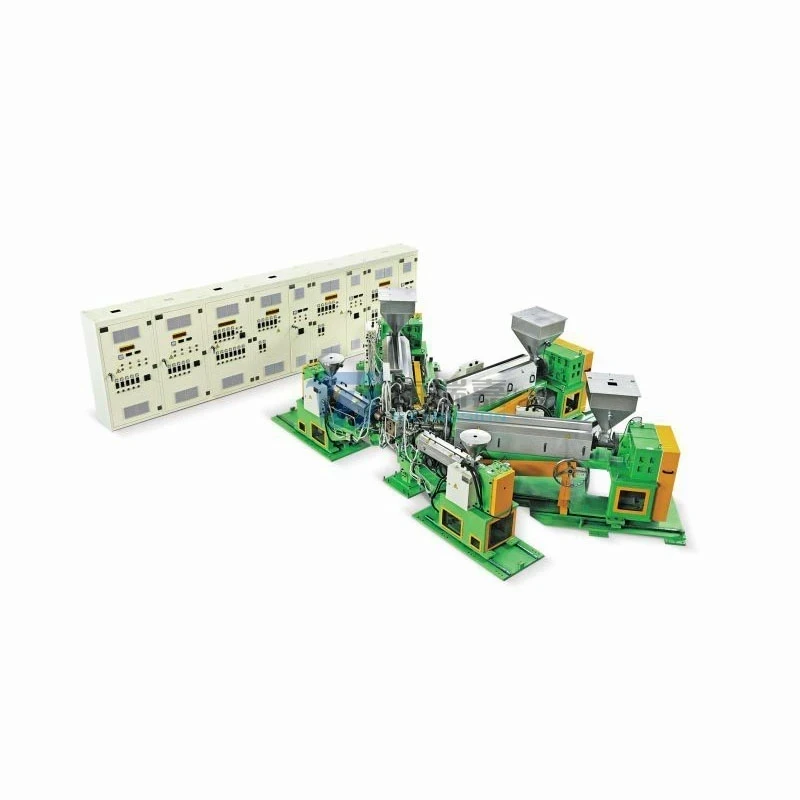
- Co-extrusion lines: Combine multiple compounds in one profile, such as multi-material seals or cable layers.
- Tire-component lines: Produce tread, sidewall, apex, and innerliner webs for tire manufacturing.
- Hose and tube lines: Build reinforced or unreinforced hose constructions, often with downstream curing and winding.
- Cable insulation lines: Use continuous vulcanization systems, sometimes with multiple extruders for layered insulation or sheathing.
- Sponge or foam rubber lines: Form cellular elastomer products where expansion and cure control are critical.
- Seal and profile lines: Produce weatherstrips, glazing seals, gaskets, and technical profiles for automotive, construction, and appliance uses.
Applications and Uses
Rubber extrusion lines are used across sectors that require continuous elastomeric products with consistent geometry and mechanical performance.
- Automotive: Seals, weatherstrips, hoses, belts, innerliners, tread strips, apex strips, and vibration-control profiles.
- Tires: Continuous extrusion of tread and sidewall components, as well as tire barrier and semi-finished layers.
- Cable and electrical: Silicone and rubber insulation, sheathing, and specialty wire coverings with continuous curing.
- Construction: Expansion profiles, glazing gaskets, waterstops, and weatherproofing strips.
- Industrial equipment: Tubing, anti-vibration profiles, protective edge trims, and technical hoses.
- Consumer and appliance goods: Seals, edge protectors, and flexible extruded components.
A less suitable application is highly complex discrete 3D shapes with undercuts or thick-to-thin transitions, because extrusion is inherently optimized for continuous cross-sections rather than isolated three-dimensional parts.
Key Engineering Characteristics
The performance of a rubber extrusion line depends on balancing pressure generation, compound temperature, die design, cure rate, and dimensional control. Several engineering parameters are especially important:
- Die swell control: Rubber expands after exiting the die, so die design and puller speed must compensate for elastic recovery.
- Residence time: Excessive residence time can trigger scorch or premature crosslinking, especially in sensitive compounds.
- Temperature profile: Stable barrel and die temperatures are essential to avoid surface defects and output variation.
- Cure uniformity: In continuous vulcanization, insufficient heating causes undercure, while excessive heat can degrade surface quality and mechanical properties.
- Dimensional repeatability: This is critical for sealing profiles and tire components where tolerance affects downstream assembly.
For process optimization, modern lines increasingly use closed-loop control, line-speed synchronization, and in-line inspection to reduce waste and improve first-pass yield.
Technological Innovations and Automation
Recent innovations have focused on making rubber extrusion more controllable, faster, and more integrated with downstream finishing. Common advances include:
- Recipe-controlled PLC systems for repeatable parameter setting.
- Microwave and hot-air curing to increase line speed and shorten vulcanization time.
- Multi-layer co-extrusion for improved functionality in seals, hoses, and cable products.
- In-line gauging and monitoring for diameter, profile consistency, and speed correction.
- Integrated feeding and compounding modules that improve compound handling and reduce manual loading.
These technologies reduce labor intensity and variability, but they also raise capital cost and maintenance complexity, especially when multiple cure methods and product changeovers are required.
Environmental and Sustainability Aspects
Rubber extrusion lines influence sustainability mainly through energy use, scrap generation, and material efficiency. Continuous processing can reduce handling losses compared with batch shaping, while tighter control of die swell, cure, and dimensional stability helps minimize off-spec material.
Sustainability improvements increasingly include:
- Energy-efficient drives and heaters that reduce electricity demand.
- Reduced scrap through automation and real-time process control.
- Material reuse strategies where process scrap can be reintroduced into suitable noncritical formulations, subject to performance limits.
- Lower-loss curing systems, including microwave-assisted lines that shorten heating times in selected applications.
Environmental trade-offs remain important. More advanced lines can consume less energy per acceptable meter of product, but they also require more electronics, cooling, and maintenance infrastructure.
Economic and Global Market Impact
Rubber extrusion lines are strategically important in tire manufacturing, automotive sealing, industrial hose production, and wire and cable industries, all of which depend on high-volume continuous output and consistent quality. Suppliers with broad portfolios commonly provide both standalone extruders and complete lines, reflecting the market’s preference for integrated process solutions rather than isolated machines.
The segment is globally distributed, with strong machine-building activity in Europe, China, India, and North America, and with competitive emphasis on customization, turnkey integration, and application-specific know-how. In this field, company differentiation often comes from expertise in cure technology, tooling, multi-layer extrusion, and process engineering rather than from generic machine size alone.
Current Challenges and Innovations
The main technical challenges are scorch control, die stability, compound variability, and consistent vulcanization across changing line speeds and profile geometries. For reinforced or multi-layer products, bond integrity between layers is an additional issue, especially when materials differ in viscosity or cure kinetics.
Current innovation priorities include:
- Better integration between mixing, feeding, extrusion, and cure stages.
- Faster changeovers for smaller batch sizes and more product variants.
- More precise thermal management for silicone and specialty elastomers.
- Improved digital diagnostics for predictive maintenance and reduced downtime.
Future Outlook
Future rubber extrusion lines are likely to become more modular, more sensor-rich, and more closely linked to plant-wide data systems. Demand will remain strongest in automotive sealing, cable, tire semifinished goods, industrial hose, and technical profiles, but product requirements will continue to shift toward tighter tolerances, lower emissions, and compatibility with recyclable or lower-impact formulations.
The most important direction of development is not simply higher throughput, but higher useful throughput—that is, more meters or kilograms of acceptable product per hour with less scrap, lower energy use, and more reliable cure control.
References
- •
Steelastic. (2021, March 31). Rubber extrusion systems. https://www.steelastic.com/rubber-extrusion-systems/Link
- •
Rubicon Gummitechnik & Maschinenbau GmbH. (n.d.). Extruder. https://www.rubicon-halle.de/en/products/extrusion/extruderLink
- •
The Bonnot Company. (2025, April 16). Rubber extruder. https://thebonnotco.com/extruders/materials/rubber-extruders/Link
- •
Ohji Rubber & Chemicals Co., Ltd. (2021, November 16). Rubber & plastic extrusion equipment. https://ohji-rubber.co.jp/en/list/hispo-about/hispo-facility/Link
- •
PrimeTech Plast. (n.d.). Extrusion equipment. https://primetech-plast.co.il/assets/uploads/suppliers/TROESTER/attachments/12_Extrusion%20Equipment%20for%20Tire%20&%20Rubber%20Industry.pdfLink
- •
KraussMaffei. (n.d.). Rubber extrusion. https://www.kraussmaffei.com/en/our-processes/rubber-extrusionLink
- •
RPM Mach. (2024, September 30). Rubber extruders and vulcanizing ovens. https://rpmmach.com/en/products/rubber-extruders-and-vulcanizing-furnaces/Link
- •
Wire & Plastic Machinery Corp. (n.d.). All | Extrusion lines - Rubber. https://wireandplastic.my.salesforce-sites.com/All/Extrusion%20Lines%20-%20RubberLink
- •
Steelastic. (2018, September 28). RMS rubber extruder machines. https://www.steelastic.com/rubber-extrusion-systems/rms-extruders/Link
- •
Guangzhou Nuotong Machinery Co., Ltd. (n.d.). Product center. http://www.nuotong.com/en/products.phpLink
- •
Chodos. (n.d.). Rubber processing machines. https://www.chodos.cz/en/stroje-na-zpracovani-pryzeLink
- •
KEGN Automation. (2018, July 6). KEGN Automation. https://kegn.in/Link
- •
Qingdao Seashore Industrial Co., Ltd. (2019, April 10). Rubber extrusion profile suppliers & manufactures China. https://www.seashoreseal.com/Link
- •
Aochen Rubber. (n.d.). China foam rubber extrusion line manufacturers factory suppliers. https://www.aochenrubber.com/showroom/foam-rubber-extrusion-line/Link
- •
Bainite Machines. (n.d.). Bainite Machines. https://www.linkedin.com/company/bainite-machinesLink
- •
Julong Rubber Machine. (2015). Rubber processing machinery. http://jl-rubbermachine.com/1-2-1-rubber-extruder.htmlLink
- •
Zhejiang Baina Rubber and Plastic Equipment Co., Ltd. (2007, January 25). Zhejiang Baina Rubber and Plastic Equipment Co., Ltd. https://bainasb.en.made-in-china.com/Link
- •
Davis-Standard. (2022, October 18). Extrusion systems. https://davis-standard.com/extrusion-systems/Link
- •
KraussMaffei Group. (n.d.). Rubber extruder (GE). https://www.kraussmaffei.com/en/products/gummiextruderLink
- •
Chuangbo Extrusion. (2024, January 9). Extrusion machine manufacturer | Extrusion line. https://www.chuangboextrusion.com/Link
- •
DirectIndustry. (2025). Rubber extruder. https://www.directindustry.com/industrial-manufacturer/rubber-extruder-148158.htmlLink
- •
Omit Rubber. (2024, August 7). Rubber extrusion manufacturers in China - OMIT. https://www.omitrubber.com/Link
- •
Ger-Lin. (n.d.). Rubicon - Tailor-made rubber extrusion. https://www.ger-lin.com/file/flyer/rubicon_Brochure_website.pdfLink
- •
Colmec Spa. (n.d.). Rubber mixing and extrusion. https://www.colmec.it/rubber-mixing-and-extrusion/Link
- •
IndiaMART. (2024, December 1). Rubber extruder machines. https://dir.indiamart.com/impcat/rubber-extruder-machines.htmlLink
- •
Made-in-China.com. (2020, December 31). Rubber extrusion. https://www.made-in-china.com/products-search/hot-china-products/Rubber_Extrusion.htmlLink
- •
Accio. (2025, July 22). Rubber extruder machines: Top suppliers & custom solutions. https://www.accio.com/plp/rubber-extruderLink
- •
TradeIndia. (2026, August 30). Rubber extrusion manufacturers, suppliers, dealers & prices. https://www.tradeindia.com/manufacturers/rubber-extrusion.htmlLink
- •
Casati Macchine. (2025, July 21). Rubber extrusion: Process, types and applications. https://www.casatimacchine.com/en/blog/rubber-extrusion/Link
- •
Ensun. (2026, February 27). Top 100 rubber extruding machinery manufacturers in 2026. https://ensun.io/search/rubber-extruding-machineryLink
- •
Davis-Standard. (2022, December 15). Elastomer extrusion machinery. https://davis-standard.com/extrusion_system/elastomer/Link
- •
OpenPR. (2026, August 15). Shun Cheong Rubber Machinery: Leading China manufacturer. https://www.openpr.com/news/4604681/shun-cheong-rubber-machinery-leading-china-manufacturerLink
- •
Zhejiang Baina. (2024, March 28). Key components of a typical rubber extrusion production line. https://www.zjbaina.com/news/key-components-of-a-typical-rubber-extrusion-production-line.htmlLink
- •
TROESTER. (n.d.). CV lines for the production of rubber cables. https://www.troester.de/content/uploads/2022/05/Rubber-CV-2018-04_web1.pdfLink
- •
Made-in-China.com. (2026, March 3). Rubber extrusion line. https://www.made-in-china.com/products-search/hot-china-products/Rubber_Extrusion_Line.htmlLink
- •
UET Machine. (2026, January 3). Rubber extruder. https://uetmachine.com/rubber-extruder/Link
- •
RubberMakingMachinery.com. (n.d.). EPDM rubber extrusion line. https://www.rubbermakingmachinery.com/quality-13226559-epdm-rubber-extrusion-lineLink
- •
US Extruders. (2024, August 23). Single screw extruders & extrusion systems. https://www.us-extruders.com/extrudersLink
- •
Rubicon Gummitechnik und Maschinenbau GmbH. (2024, September 20). Rubicon Gummitechnik und Maschinenbau GmbH. https://www.linkedin.com/company/rubicon-halleLink
- •
Accio. (2026, August 22). Rubber extruders: Efficient solutions for industrial use. https://www.accio.com/plp/rubber-extrudersLink
- •
IQS Directory. (2000). Additional extruded rubber manufacturers. https://www.iqsdirectory.com/extruded-rubber/extruded-rubber-2/Link
- •
NW Rubber Extruders. (2026, February 3). NW Rubber Extruders - We are the flexible people. https://nwreinc.com/Link
- •
IQS Directory. (2000). Rubber extrusion suppliers manufacturers. https://www.iqsdirectory.com/rubber-extrusions/rubber-extrusions-2/Link
- •
Reiss Manufacturing. (2025, October 22). Silicone rubber extrusions. https://reissmfg.com/extrusion/Link
- •
Erhardt+Leimer. (2022, April 26). Extrusion line. https://www.erhardt-leimer.com/in/en/industries/tires-and-rubber/extrusion-line.htmlLink
- •
Chuangbo. (n.d.). Rubber extruder manufacturer | Chuangbo. https://www.chuangboextrusion.com/rubber-extruder.htmlLink
- •
Melion Retread. (n.d.). Rubber extruder machine. https://www.melionretread.com/product/rubber-extruder-machine/Link
- •
Rubicon. (n.d.). Rubicon - Cable manufacturing lines. https://primetech-plast.co.il/assets/uploads/suppliers/Rubicon/attachments/3_rubicon_Cable%20Manufacturing%20Lines.pdfLink
- •
WARCO. (2026, June 23). Rubber extrusions: Custom profiles, tubing, spliced seals. https://warco.com/capabilities/rubber-extrusion/Link
- •
Computers & Chemical Engineering. (n.d.). Optimization of extrusion production lines for EPDM rubber vulcanized with sulphur: A two-phase model based on Finite Elements and kinetic second order differential equation. https://www.sciencedirect.com/science/article/abs/pii/S0098135412001081Link
- •
IQS Directory. (n.d.). Rubber extrusion manufacturers and companies. https://www.iqsdirectory.com/rubber-extrusions/Link
- •
ThyssenKrupp Elastomertechnik. (2025, December 29). Extruder 1. https://ru.scribd.com/document/80528163/Extruder1Link
- •
Metoree. (n.d.). 17 rubber extrusion companies in 2026. https://us.metoree.com/categories/101809/Link
- •
Seals Direct. (2024, July 9). The manufacturing process of rubber extrusions. https://www.sealsdirect.co.uk/blog/news-5/the-manufacturing-process-of-rubber-extrusions-64Link