
Introduction
CO2 based polymer is a broad term for polymers in which carbon dioxide is incorporated into the polymer backbone or used as a major carbon source for polymer precursors and intermediates. These materials are central to a fast-growing branch of carbon capture and utilization because they can turn an abundant, low-cost greenhouse gas into useful plastics, polyols, elastomers, and specialty materials.
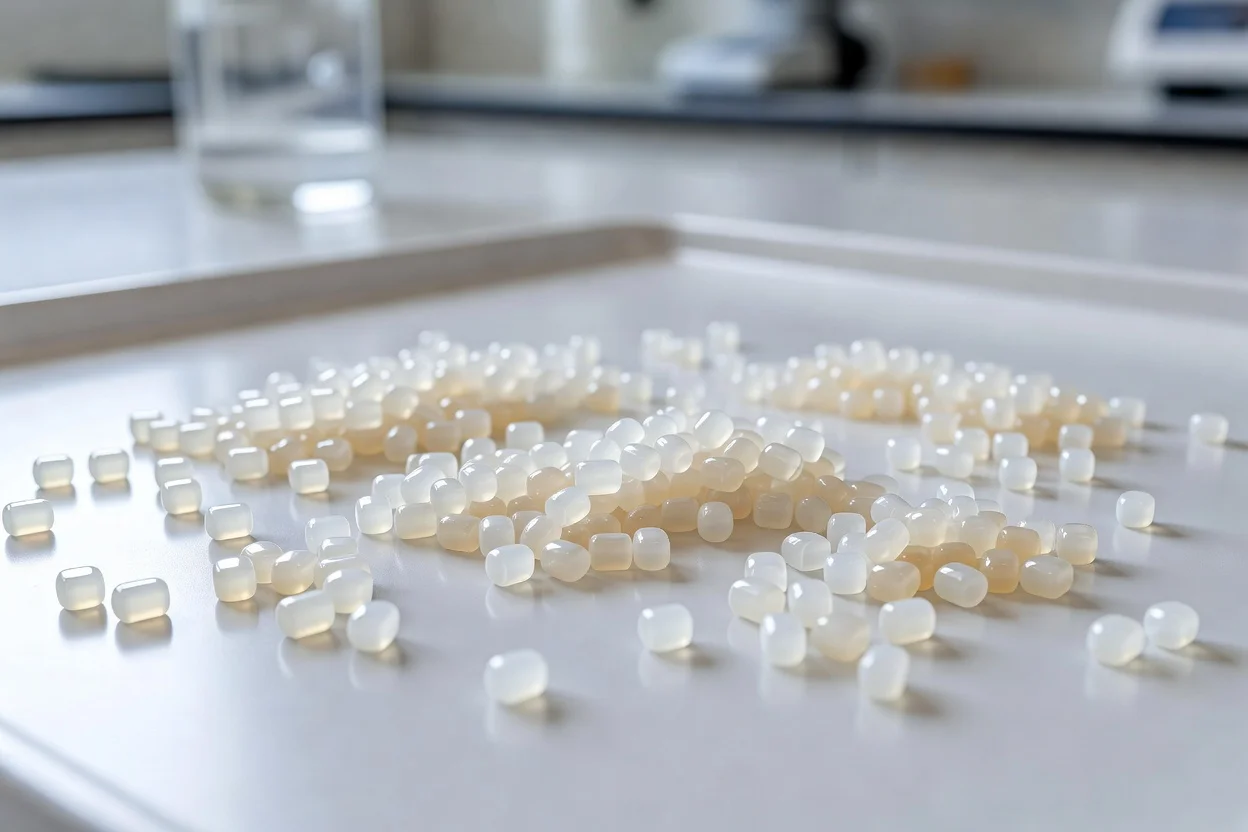
The field is best known for epoxide-CO2 copolymerization, which produces aliphatic polycarbonates such as polypropylene carbonate and related materials, but it also includes CO2-derived polyurethanes, cyclic carbonates, polyols, non-isocyanate polyurethanes, polyketones, and newer routes that use electrochemical, biological, or tandem catalytic cascades. Interest in CO2-based polymers has expanded because they combine partial carbon storage with potentially lower fossil feedstock use, while offering useful properties such as biodegradability, gas barrier performance, and tunable thermal and mechanical behavior.
Despite this promise, CO2-based polymers are not a universal substitute for conventional plastics. Many current grades remain limited by moderate heat resistance, narrower processing windows, or lower mechanical performance than established commodity and engineering polymers, so commercial success depends on careful matching of chemistry, catalyst system, and end use. The sector is therefore evolving along two tracks: direct CO2 incorporation into polymer chains and indirect CO2 conversion into polymer building blocks such as polyols, diols, acids, and olefins.
History and Development
The modern field traces back to the pioneering epoxide-CO2 copolymerization work reported by Inoue and colleagues in 1969, which established that carbon dioxide could be inserted into a growing polymer chain rather than merely being seen as a waste gas. Early systems demonstrated the basic feasibility of making aliphatic polycarbonates from epoxides and CO2, but catalyst productivity, selectivity, and molecular-weight control remained major barriers for decades.
Subsequent progress in homogeneous catalysis, including zinc, cobalt, chromium, salen-metal, and related catalyst families, greatly improved polymerization control and enabled higher CO2 incorporation, better molecular-weight distribution, and broader monomer scope. More recently, frustrated Lewis pair catalysis, multifunctional organocatalysts, and tailored ionic-liquid or supported catalysts have further expanded the toolbox for CO2 fixation into polymers.
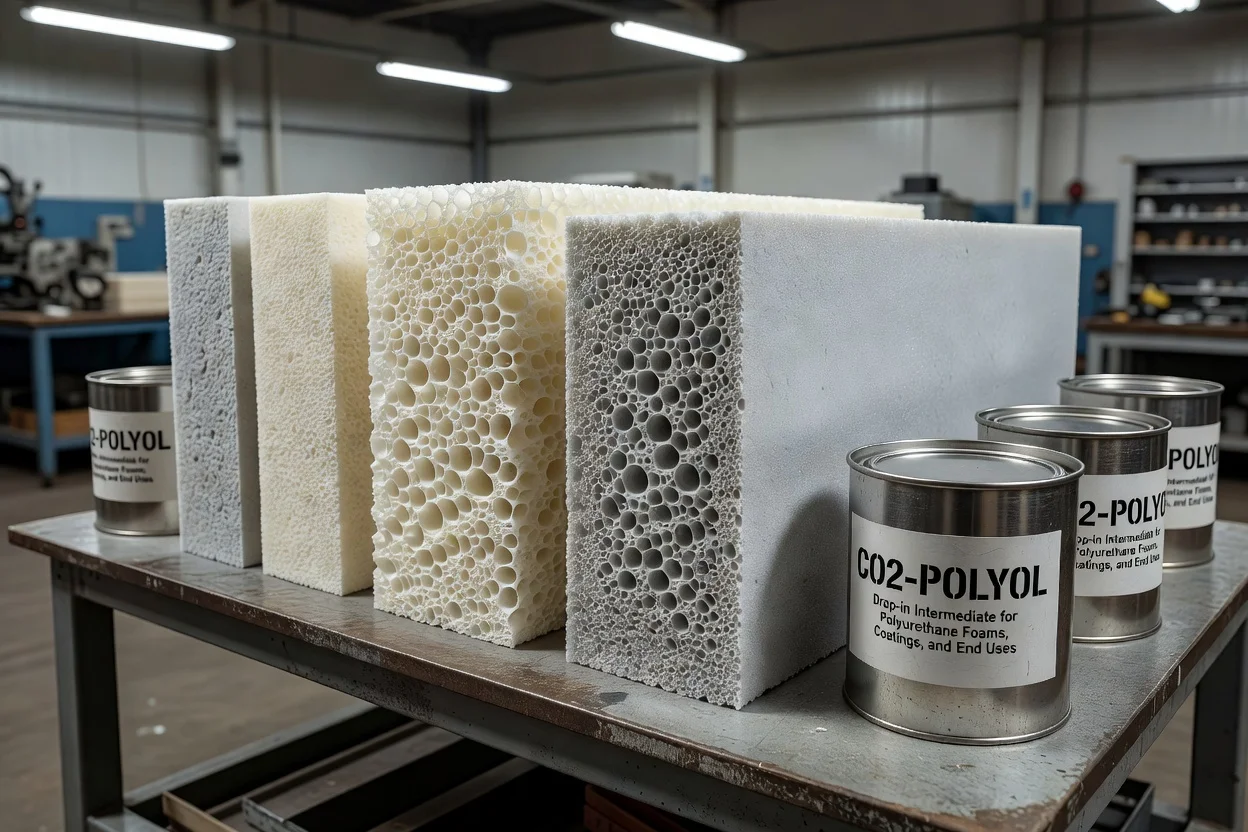
Industrial interest accelerated when companies began commercializing CO2-derived polyols for polyurethane formulations, especially for foams, coatings, adhesives, and elastomers. This was strategically important because polyurethanes can accommodate CO2-containing polyols as intermediates without requiring a wholesale redesign of downstream processing, making them one of the most practical near-term outlets for CO2 utilization in polymers.
Chemical Structure and Key Properties
CO2-based polymers are not a single chemical family. They include:
- Aliphatic polycarbonates, where carbonate linkages are integrated into the main chain.
- Polycarbonate polyols, which are intermediates for polyurethane production.
- Polyurethanes and non-isocyanate polyurethanes, in which CO2-derived cyclic carbonates or polyols help build the network.
- Cyclic carbonates used as monomers, solvents, or reactive intermediates.
- Polyketones and other polymers made through indirect CO2 conversion pathways.
The key structural feature is the carbonate group, which introduces polarity, oxygen-containing functionality, and in many cases hydrolyzable or degradable linkages. That chemistry often improves gas barrier behavior and compatibility with certain polar formulations, while also enabling biodegradation or chemical recyclability in selected systems.
Typical property profile
| Property | Typical tendency in CO2-based polycarbonates / related materials | Practical implication |
|---|---|---|
| Gas barrier | Often good, especially to oxygen and water vapor in some formulations | Useful in packaging and coatings |
| Thermal resistance | Often lower than many conventional engineering plastics | Limits high-temperature structural uses |
| Mechanical strength | Can be adequate but often below benchmark engineering resins | Often used in blends, foams, or intermediates |
| Biodegradability | Frequently improved relative to fossil analogues | Attractive for disposable or short-life products |
| Polarity / adhesion | Generally higher than nonpolar polyolefins due to carbonate content | Helps in coatings, binders, and formulations |
A key limitation is modest thermal stability → caused by relatively labile carbonate backbones in many aliphatic systems → workaround: use copolymerization, chain extension, stereochemical control, blending, crosslinking, or move to higher-performance monomer pairs such as cyclohexene oxide-derived systems.
Another common limitation is lower mechanical and heat performance than commodity polycarbonate or engineering plastics → caused by flexible aliphatic segments and incomplete crystallinity control → workaround: reinforce with fillers, formulate as polyols for polyurethane systems, or design hybrid copolymers and block architectures.
For polymer-processing applications, a further practical constraint is narrow process robustness in some CO2-derived resins → caused by catalyst sensitivity, side reactions, and molecular-weight control challenges → workaround: use more selective catalysts, continuous reactors, improved feed purification, and post-polymerization finishing.
Production Processes and Raw Feedstocks
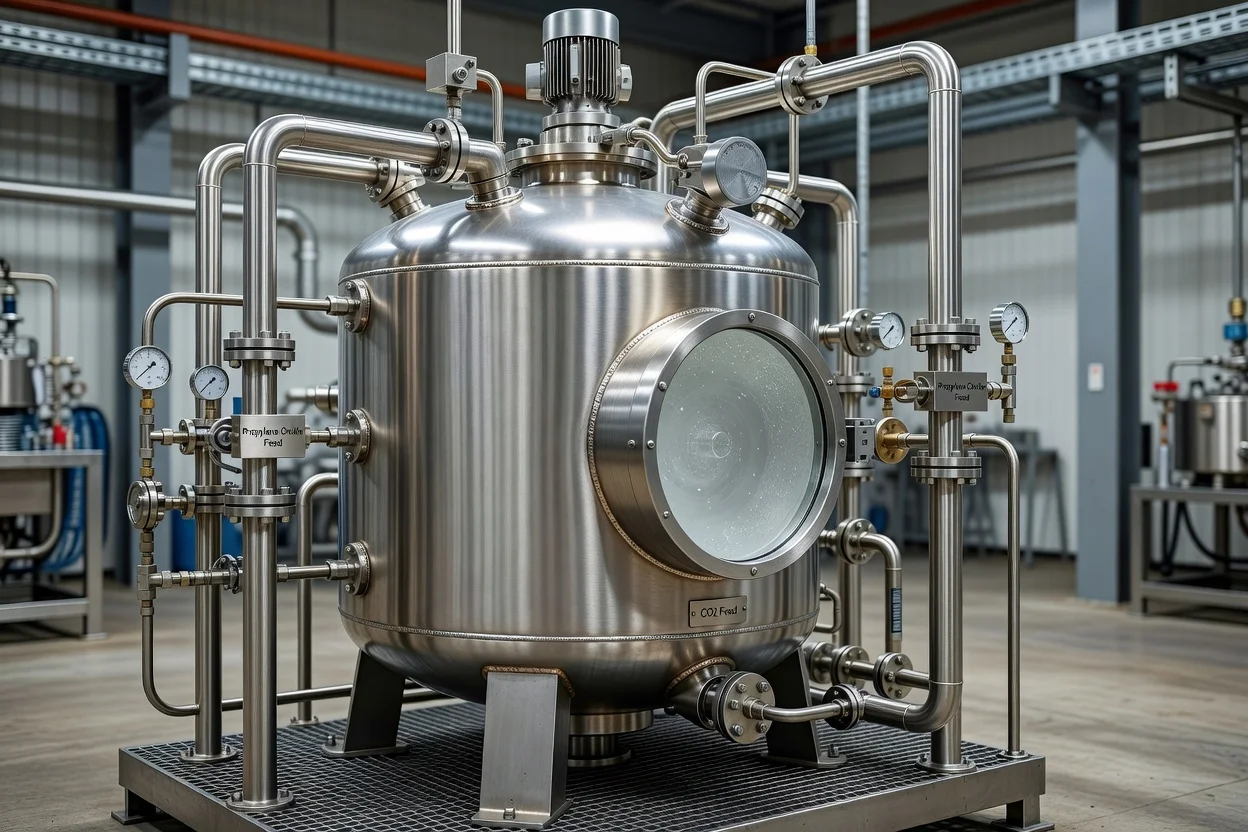
The most established production route is copolymerization of CO2 with epoxides, especially propylene oxide and cyclohexene oxide. In this process, a catalyst promotes ring-opening of the epoxide and insertion of CO2 into the polymer chain, yielding aliphatic polycarbonates or poly(carbonate-ether) structures.
Main production routes
- Direct epoxide-CO2 copolymerization
- Produces polypropylene carbonate, polyethylene carbonate, and related polycarbonates.
- Often the most mature direct route for CO2-based polymers.
- CO2 to cyclic carbonate, then polymerization or transcarbonation
- Epoxide + CO2 first yields cyclic carbonates, which can be further transformed into polycarbonates, polyurethanes, or non-isocyanate urethanes.
- CO2-derived polyols for polyurethane manufacturing
- CO2 is incorporated into polyether/polycarbonate polyols that are then reacted with isocyanates in conventional PU processes.
- Indirect routes through CO2-derived intermediates
- Electrochemical and tandem routes
- Emerging systems combine CO2 electroreduction with polymerization catalysis to produce intermediates such as CO, ethylene, formic acid, or diacids, which then feed polymer synthesis.
- Biological conversion routes
- Microbial and fermentation-based pathways can turn CO2 into acids, amino alcohols, and other precursors for biodegradable polymers.
The raw feedstock base therefore extends beyond CO2 itself and includes epoxides, alcohols, H2, electricity, catalysts, and sometimes biomass-derived co-monomers. This means the sustainability profile depends strongly on the entire process chain, not simply on the presence of CO2 in the polymer backbone.
Example chemistry and dosage-style formulation notes
- In polyurethane foams, CO2-derived polyols may replace part of fossil polyols at meaningful blend levels, with the CO2 content in commercial polyols reported at more than 40 wt% in some product lines; the mechanism is that carbonate-containing polyols alter chain polarity and segmental flexibility, improving the sustainability profile while retaining foam processing compatibility.
- In cyclic carbonate synthesis, catalyst loading is typically low relative to monomer, but the exact level depends on epoxide type and reactor design; the mechanism is CO2 activation and epoxide ring opening followed by carbonate ring closure, with gas-liquid mass transfer often becoming rate-limiting in batch systems.
Applications and End-Use Markets
CO2-based polymers are used in markets where their polarity, degradability, or intermediate-function value outweighs their current performance limitations.
Major application sectors
| Sector | Usual CO2-based material type | Typical processing route | Why it fits |
|---|---|---|---|
| Polyurethane foams, coatings, adhesives | CO2-based polyols | Conventional PU formulation and foaming | Drop-in substitution and large volume potential |
| Packaging films and barrier layers | Aliphatic polycarbonates, blends | Film extrusion, blending | Good gas barrier and biodegradability |
| Electronics and specialty binders | Polycarbonates, polyols, binders | Solution processing, coating, formulation | Polarity, tunable adhesion, dielectric use in niche systems |
| Agriculture | Mulch films, seedling trays, controlled-release products | Film and molding applications | Short-life use and compostable/biodegradable positioning |
| Biomedical and healthcare | Scaffolds, drug delivery, disposable devices | Solvent processing, foaming, scaffold fabrication | Biocompatibility and controlled degradability |
| Composites and coatings | Reactive intermediates, PU systems | Compounding, coating formulations | Improved interfacial interaction and process flexibility |
| Polyketone plastics | CO2-derived intermediates in tandem systems | Copolymerization after CO2 conversion to CO/ethylene | Mechanical utility and carbon utilization potential |
A particularly strong commercial fit is polyurethane: CO2-derived polyols can be incorporated into existing PU supply chains with relatively limited requalification compared with completely new polymer platforms. This is one reason PU is frequently described as one of the largest near-term outlets for CO2 utilization in polymers.
A weaker fit is high-temperature structural parts. Many CO2-based aliphatic polycarbonates do not yet match the heat resistance and long-term dimensional stability required for demanding automotive under-hood, electrical insulation, or load-bearing engineering applications. In such cases, the materials are more often used as intermediates, modifiers, or blend components than as standalone replacements.
Environmental and Sustainability Aspects
CO2-based polymers are often discussed as a climate-positive technology, but the environmental outcome depends on whether the process truly displaces fossil carbon and how much energy is required.
Sustainability advantages
- Carbon utilization: CO2 is chemically fixed into materials, delaying its return to the atmosphere during the product life cycle.
- Lower fossil feedstock use: Some formulations replace a portion of petroleum-derived carbon with captured or emitted CO2.
- Potential biodegradability: Many aliphatic CO2-derived polycarbonates show enhanced biodegradation under suitable conditions.
- Process integration: CO2 can be coupled with renewable electricity, biomass, or industrial off-gases in broader circular pathways.
Sustainability limitations
- Not all CO2 is permanently stored: If a polymer is incinerated, the carbon is ultimately released again.
- Energy intensity matters: CO2 capture, compression, purification, and conversion can carry substantial emissions if powered by fossil energy.
- Recyclability varies: Some CO2-based polymers are chemically recyclable, but others remain difficult to recover economically at scale.
- End-of-life infrastructure is uneven: Biodegradability claims depend on local conditions and collection systems, and do not automatically solve mismanaged waste.
A nuanced point is that biodegradable does not necessarily mean better in all contexts. For durable goods, reuse and mechanical recycling may outperform biodegradation from a systems perspective, whereas short-life applications can benefit more directly from degradable CO2-based chemistries.
Economic and Global Market Impact
The CO2-based polymer market is still small relative to commodity plastics, but it is expanding quickly from a technology-commercialization base into broader industrial deployment.
Recent industry analyses have projected strong growth, with one cited market estimate placing the sector at 2.28 billion dollars in 2022 and forecasting 6.94 billion dollars by 2033, implying a double-digit CAGR. While such forecasts vary by methodology, they reflect the same underlying trend: growing demand for lower-carbon materials, especially in polyurethane, packaging, and specialty applications.
Market drivers
- Corporate decarbonization targets and Scope 3 pressure
- Regulatory and consumer demand for lower-carbon materials
- Availability of commercial CO2-derived polyols and cyclic carbonate intermediates
- Compatibility with incumbent PU and coating systems
- Interest in biodegradable packaging and agricultural films
Leading companies and industrial position
| Company | Contribution / position |
|---|---|
| Covestro | Widely recognized for commercial CO2-based polyols used in polyurethane foams and related applications. |
| Novomer | Early pioneer in CO2-to-polymer catalysis and PPC-related technology. |
| Cardia Bioplastics | Known for CO2-containing blends aimed at carrier bags and related consumer items. |
| Empower Materials | Supplies CO2-derived polycarbonates and related materials for binders and specialty uses. |
| Asahi Kasei | Active in CO2-based polycarbonate and specialty resin development. |
The most important economic feature is that many CO2-based polymers are currently sold not as standalone commodity resins but as functional intermediates or performance additives that fit existing manufacturing lines. That lowers adoption barriers and helps explain why polyurethane value chains have been more commercially receptive than packaging or engineering plastics.
Current Challenges and Innovations
The field faces a recurring tension between sustainability ambition and materials performance.
Main challenges
- Catalyst efficiency and cost: High activity, selectivity, and long catalyst life are still required for industrial competitiveness.
- Monomer scope: The best-performing systems still depend heavily on a limited set of epoxides.
- Mechanical and thermal properties: Many materials need improvement before they can replace established engineering plastics.
- Scale-up and purification: Continuous operation, impurity tolerance, and downstream separation remain important bottlenecks.
- True carbon footprint: Life-cycle benefits depend on electricity mix, capture source, and process yields.
Innovation directions
- Recyclable polycarbonates
- New catalyst and monomer designs are enabling depolymerization or closed-loop recycling concepts.
- Bio-based and CO2 hybrid monomers
- CO2 combined with terpene-derived or lignin-derived feedstocks can improve renewability and tailor thermal behavior.
- Thermoplastic elastomers and tougher materials
- Recent work has focused on strengthening CO2-derived elastomers through coordination, block design, or hybrid architectures.
- Non-isocyanate polyurethane routes
- CO2-derived cyclic carbonates are being explored as safer or more sustainable precursors for NIPU systems.
- Integrated electrochemical-to-polymer cascades
- New systems aim to convert CO2 directly into polymer precursors such as ethylene, CO, or diacids using renewable power.
One practical example is the use of polyol formulations with carbonate content in polyurethane foams, where the key mechanism is not just carbon storage but also formulation compatibility with existing foam lines, enabling faster industrial adoption than a fully new resin platform.
Future Outlook
CO2-based polymers are likely to grow first in intermediate and niche functional markets, then expand into larger-volume applications as catalyst performance, process economics, and end-of-life solutions improve.
The most plausible near-term growth areas are:
- Polyurethane polyols
- Barrier packaging and coatings
- Agricultural films
- Biomedical and disposable products
- Specialty elastomers and binders
Longer term, the most transformative opportunities lie in integrated carbon conversion platforms, where captured CO2 is converted by electrochemical, catalytic, or biological steps into a portfolio of polymer building blocks. If these systems are powered by low-carbon electricity and combined with circular design, CO2-based polymers could shift from niche sustainability products to a meaningful component of low-carbon materials manufacturing.
At the same time, commercial success will depend on avoiding overstatement. The strongest case for CO2-based polymers is not that they eliminate plastic pollution or fully solve climate emissions, but that they can partially decouple polymer manufacturing from fossil carbon while preserving or improving function in selected applications.
References
- •
Syntheses, properties, and applications of CO2-based functional polymers. (n.d.).Link
- •
1. Introduction. (n.d.).Link
- •
Polymeric materials based on carbon dioxide. (2022, February 13).Link
- •
CO2 to polymers. (2022, July 11).Link
- •
Pure - University of Birmingham. (n.d.).Link
- •
Valuing CO2 in the development of polymer materials. (2021, August 31).Link
- •
Harnessing CO₂ for the development of biodegradable polymers: A review of. (n.d.).Link
- •
Current challenges and perspectives in CO2-based polymers. (2023, February 28).Link
- •
CO2-responsive polymeric materials: Synthesis, self-assembly, and functional applications. (2016, July 25).Link
- •
Carbon dioxide-based polymers. (2020, December 22).Link
- •
The advent of recyclable CO2-based polycarbonates. (n.d.).Link
- •
CO 2 -fixation into cyclic and polymeric carbonates. (2019, February 4).Link
- •
Turning CO₂ into plastics: How carbon‑negative polymers can transform. (2025, December 5).Link
- •
CO2-responsive vinyl polymers: From synthesis to application. (2025, May 28).Link
- •
Process cascade for the production of green polymers. (2024, May 1).Link
- •
En route to CO2-based (a)cyclic carbonates and polycarbonates from alcohols substrates by direct and indirect approaches. (2022, January 20).Link
- •
CO 2 as a raw material for next-generation polymers. (2024, April 10).Link
- •
Recent progress in carbon dioxide (CO2) as feedstock for. (n.d.).Link
- •
CO2 to polymer conversion routes and market analysis. (2026, March 19).Link
- •
Special issue: CO2: Capture of, utilization of, and degradation into. (2021, January 5).Link
- •
CO2 derived biodegradable polycarbonates: Synthesis, modification and applications. (n.d.).Link
- •
Research article. (n.d.).Link
- •
Upcycling of atmospheric CO2 to self-healing recyclable. (2026, March 2).Link
- •
Energy transition: Climate action and circularity. (2022, August 29).Link
- •
Sustainable and recyclable polymers from CO2 and lignin. (2023, August 16).Link
- •
Carbon dioxide copolymers: Emerging sustainable materials for versatile applications. (n.d.).Link
- •
Heat-resistant CO2-based polycarbonate thermoplastics. (2024, May 22).Link
- •
CO2-based polycarbonates with low glass transition temperatures sourced from long-chain terpenes. (2024, May 31).Link
- •
Production of biopolymer and polymer from carbon dioxide employing ionic liquid supported on dendritic fibrous nanosilica. (2026, January 27).Link
- •
The future of carbon dioxide for polymer processing. (2013, January 4).Link
- •
Chemical synthesis of CO2-based polymers with enhanced thermal stability and unexpected recyclability from biosourced monomers. (2021, June 23).Link
- •
Roadmap to the sustainable synthesis of polymers: From the perspective of CO 2 upcycling. (2003, October 11).Link
- •
Plastics from thin air: Polymers from carbon dioxide. (2023, November 16).Link
- •
Sustainable polycarbonates production from CO2. (n.d.).Link
- •
Green chemistry. (n.d.).Link
- •
A new biodegradable CO2-based poly(ester-co-carbonate): Molecular chain building up with crosslinkable domain. (n.d.).Link
- •
Recycling carbon dioxide to make plastics. (2013, May 20).Link
- •
Designing CO2-responsive and degradable polymers. (2024, December 30).Link
- •
Making plastic from carbon dioxide, water, and electricity. (2025, June 24).Link
- •
Synthesis of cyclic carbonates from CO2 cycloaddition to bio-based. (2023, July 26).Link
- •
Can CO2 be used to make plastics? (2024, September 3).Link
- •
Polymeric and crystalline materials for effective and. (2016, March 4).Link