
Introduction
Extrusion lines for foam materials are integrated processing systems used to manufacture continuous foamed plastics such as sheets, boards, tubes, profiles, beads, and specialty lightweight products. These lines combine polymer melting, gas or blowing-agent dosing, pressure control, die expansion, cooling, and downstream calibration into one continuous operation, and they are widely used for PE, PP, PS, PET, PLA, TPU, and XPS/EPS-derived products.
In practice, foam extrusion is one of the most important routes for producing lightweight polymer structures because it can lower material use while preserving stiffness, cushioning, thermal insulation, and processability. Modern line concepts range from single-screw systems for simpler foams to tandem twin-screw/single-screw configurations for high-output sheet production, with newer systems using supercritical CO₂ or nitrogen as physical blowing agents to improve cleanliness, cell uniformity, and density control.
The technology has evolved from earlier chemical foaming approaches toward highly engineered physical foaming lines with better melt homogenization, gas dissolution, and pressure management. Leading suppliers now offer foam extrusion platforms for packaging, building insulation, thermoforming, and engineering applications, and current development priorities include higher output, lower specific energy use, reduced emissions, wider recyclate compatibility, and improved automation for stable cell morphology.
History and Development
Foam extrusion developed as an extension of conventional plastic extrusion once processors learned to dissolve a blowing agent in the melt and expand it in a controlled way at the die. Early foam products were largely based on commodity polymers such as polystyrene and polyolefins, with chemical foaming agents and relatively simple equipment layouts.
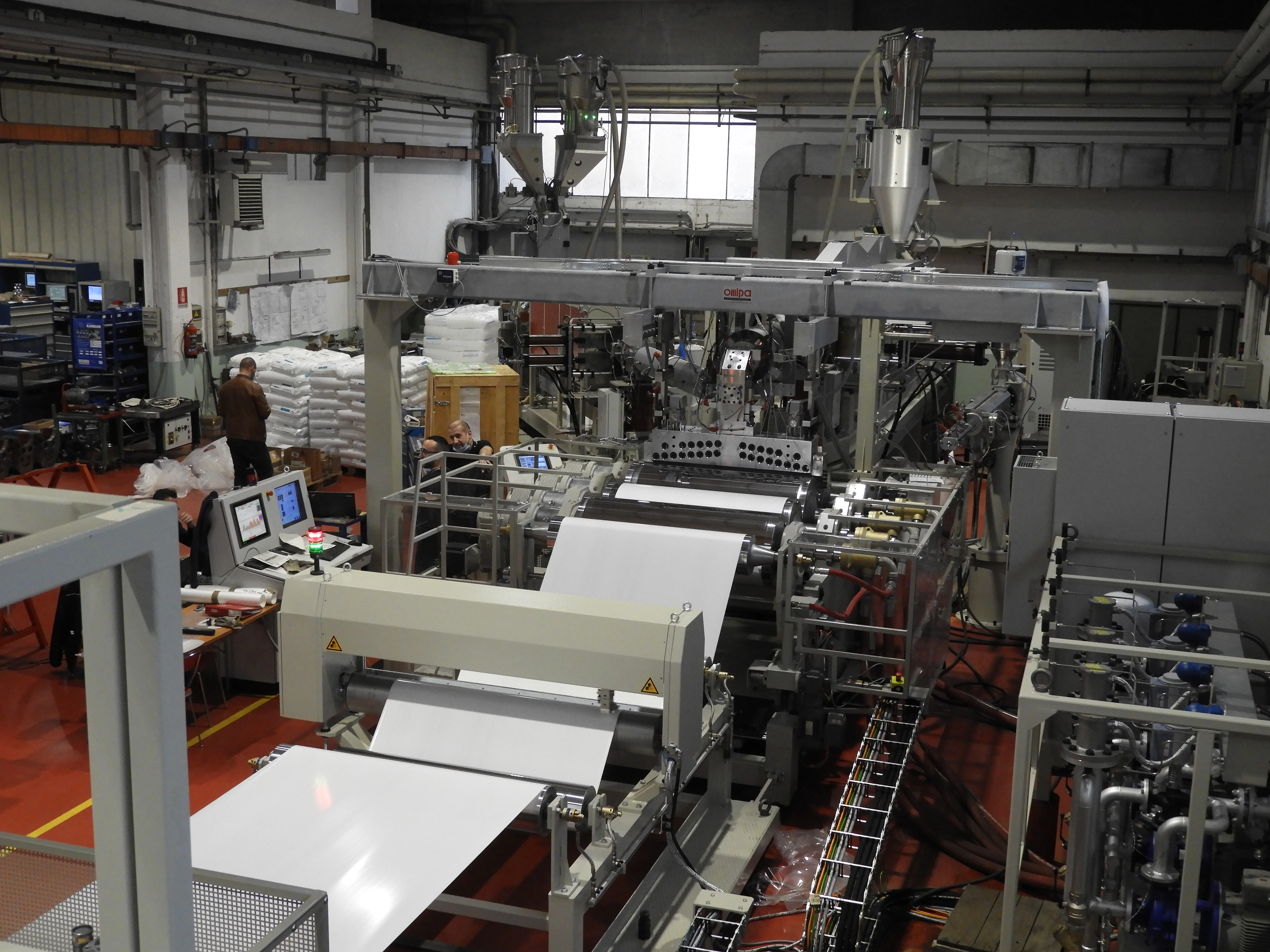
A major milestone was the adoption of tandem foam sheet extrusion, in which two extruders are used in sequence: the first for plasticization and mixing, the second for controlled cooling before expansion. This architecture became a standard solution for high-output PS foam sheet because it improved melt strength management and cellular structure at industrial production rates.
A second milestone was the widespread move to physical foaming with gases such as CO₂ or N₂, often injected under pressure into the melt. This allowed cleaner processing, more consistent cell size, and broader application to PET, PLA, TPU, PE, and PP products. More recent development has focused on supercritical CO₂-based systems and compact gas-dosing modules that can be retrofitted into sheet and board lines.
Technical Overview
Foam extrusion lines are engineered around a central requirement: the gas must be dissolved uniformly in the polymer melt and then expanded in a controlled manner as pressure drops in the die or tool. To achieve that, the line must maintain sufficient melt pressure, accurate temperature control, and a stable residence time profile through plasticization, mixing, cooling, and shaping.
A typical foam extrusion line includes the following major subsystems:
- Feeding and drying
- Metering and gravimetric dosing
- Extruder or tandem extruder set
- Gas injection and pressure-control system
- Melt pump, vacuum, or venting section where applicable
- Foaming die, sheet die, profile head, or bead pelletizing section
- Calibration, cooling, haul-off, and winding or cutting units
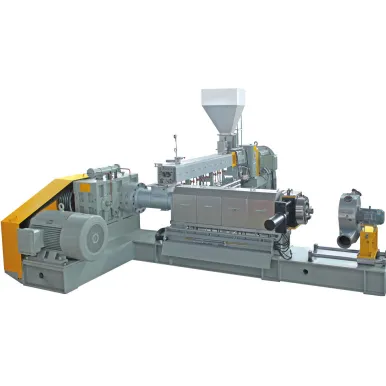
For foam sheet production, tandem lines are especially common. The primary extruder handles melting, intensive mixing, and additive dispersion, while the secondary extruder reduces melt temperature to the foaming window while preserving pressure. This division of labor helps optimize nucleation and strain hardening, both of which influence final cell size and surface quality.
Typical engineering and performance characteristics include:
- Output ranges from about 20 kg/h to 200 kg/h for foam tubes and profiles, and roughly 150 kg/h to 1500 kg/h for larger sheet-line families depending on configuration.
- Line speeds reported for some foam sheet systems of up to 50 m/min.
- Thickness capability on some sheet systems from about 20 mm to 100 mm for thicker foam products.
- Maximum capacities on selected industrial lines reaching around 1000 kg/h and, in some configurations, 1500 kg/h.
- Rotor or screw designs often favor high shear and strong distributive mixing in the primary stage, with the secondary stage tuned for cooling rather than aggressive mixing.
- Specific energy use is highly process-dependent; modern foam systems generally aim to reduce energy per kilogram by lowering material usage in the final part, but actual consumption varies strongly with polymer type, output, and auxiliary equipment. The supplied technical sources emphasize efficiency improvements rather than a single universal benchmark.
Chemical foaming processes require sufficient melt pressure and temperature to decompose the agent and hold generated gas in solution until expansion. Industry guidance notes that many single-screw extruders can be adapted if the screw, venting, and pressure profile are properly designed, with L:D ratios often around 24:1 to 30:1 and higher melt pressures needed as processing temperature rises.
Types and Variations
| Type of foam extrusion line | Main characteristics | Typical products |
|---|---|---|
| Single-screw foam line | Simpler layout, lower mixing intensity, suitable for certain PE and chemically foamed products | Tubes, profiles, simple sheets |
| Tandem foam sheet line | Two extruders in series; strong mixing in the first stage and controlled cooling in the second stage | PS, PE, PP, PET foam sheet and board |
| Twin-screw foam line | Better distributive mixing, especially useful for gas injection and multi-component formulations | Advanced sheet, specialty foam, recyclable blends |
| Physical foaming line | Uses CO₂ or N₂ rather than chemical agents; cleaner and more controllable | Microcellular sheet, insulation board, lightweight packaging |
| Chemical foaming line | Uses decomposing blowing agents; often simpler for some formulations | Profiles, pipes, specialty foam products |
| Bead foaming line | Produces expandable beads for secondary molding | EPP, EPS, expandable bead products |
Material choice strongly affects machine configuration. PS remains closely associated with tandem sheet extrusion, while PE and PP are widely used for cushioning and insulation products. PET and PLA are increasingly present in modern foam sheet systems because of lightweighting, thermoforming, and sustainability demands.
Applications and Uses
Foam extrusion lines serve a broad range of industrial sectors, with the machine configuration tailored to the end product:
- Packaging: PE and PP foam sheets, food trays, protective cushioning, and thermoformable foam sheet for consumer goods.
- Building and construction: XPS boards, insulation sheets, pipe and profile insulation, and thermal barrier products.
- Automotive and transportation: Lightweight interior components, acoustic insulation, and protective inserts.
- Thermoforming and converting: Foam sheet for trays, clamshells, and shaped packaging.
- Industrial and logistics: Void fill, edge protection, pallet cushioning, and shock absorption.
- Consumer products: Mats, bonded sheets, laminates, and comfort materials.
One weaker-fit application is high-temperature structural components, because most standard foam extrusion products are optimized for low density, insulation, or cushioning rather than continuous load-bearing at elevated temperature. In those cases, engineering thermoplastic foams or alternative composite processes are usually more appropriate.
Technological Innovations and Automation
Recent progress in foam extrusion has centered on physical foaming, supercritical CO₂ dosing, and precise melt-temperature profiling. These technologies improve cell uniformity, reduce residual chemical content, and support finer density control, especially in PET, PLA, and microcellular sheet production.
Automation is also expanding across the line:
- Gravimetric feed control stabilizes polymer and additive ratios.
- Closed-loop pressure and temperature control improves gas solubility and nucleation consistency.
- Melt pumps and vacuum management help decouple screw fluctuations from the die.
- Digital line monitoring supports faster recipe changes and quality traceability.
Some suppliers now offer lines that can switch between rigid and foamed sheet production, or between different foam grades, with reduced changeover time. That flexibility is strategically important for processors serving both commodity packaging and higher-value engineering applications.
Environmental and Sustainability Aspects
Foam extrusion is inherently aligned with material reduction because foamed structures deliver useful thickness, stiffness, or insulation with less polymer mass than solid alternatives. That can lower raw material demand and reduce transport weight, especially in packaging and construction.
Sustainability performance depends heavily on process choice:
- Physical foaming with CO₂ or N₂ is generally cleaner than chemical foaming because it avoids decomposition residues and can simplify emissions control.
- Recyclate use is possible in several foam product lines, especially PE and PS systems, although melt stability, contamination, and odor management remain important constraints.
- Bio-based or biodegradable polymers such as PLA are now used on selected foam sheet lines, supporting lower-carbon product strategies where performance requirements are compatible.
- Waste reduction improves when stable cell structure lowers off-spec production and when downstream trimming and edge trim recycling are integrated into the line.
At the same time, sustainability claims must be assessed carefully: foamed products can be difficult to recycle when multilayer structures, laminates, or contamination are introduced, and some blowing-agent systems require strict safety controls.
Economic and Global Market Impact
Foam extrusion lines occupy an important position in the global plastics machinery market because they serve packaging, insulation, and lightweighting segments with relatively high material leverage. In many applications, a well-designed foam product can reduce polymer consumption while still delivering the required functional performance, which supports cost competitiveness.
Industrial suppliers emphasize output scale and process flexibility as key buying criteria. Reported commercial line capacities range from compact systems around 20–200 kg/h for profiles and tubes to high-output sheet systems at 1000 kg/h or more, which allows processors to match line investment to local demand and product mix.
The market has also become more specialized. Suppliers differ by machine architecture, gas-handling technology, and product focus, with some emphasizing PS foam sheet, others PET or PLA foam board, and others EPE/EPP packaging materials. This specialization tends to reward processors that integrate formulation expertise, die design, and downstream converting capability.
Current Challenges and Innovations
Foam extrusion remains technically demanding because small fluctuations in temperature, pressure, or gas dosage can produce visible defects such as nonuniform cell size, collapse, shrinkage, skin irregularities, or density drift. The challenge is especially acute in low-density and high-output sheet lines.
Key industrial challenges include:
- Cell stability at higher line speeds
- Melt strength management for thin or very low-density products
- Recycle compatibility without degrading foaming behavior
- Process safety for high-pressure gases and flammable blowing agents in some systems
- Energy optimization across drying, cooling, extrusion, and downstream handling
Innovation is moving toward better screw design, improved gas-dosing accuracy, advanced nucleation control, and tighter integration between process simulation and line commissioning. These developments are intended to widen the process window and make foam extrusion more reliable for challenging polymers such as PET and PLA.
Future Outlook
The future of foam extrusion lines is likely to be shaped by three converging trends: lightweighting, sustainable materials, and automation. Demand for lower-density materials in packaging and insulation should continue to support investment in high-output sheet and board lines.
Technically, the most important direction is the broader use of physical foaming and supercritical gas systems, particularly where processors need cleaner formulations, tighter control of cell morphology, or compatibility with engineering polymers. The expansion of PET and PLA foam processing also suggests growing interest in foam products that can fit circular-economy strategies more closely than legacy materials.
Over time, foam extrusion is likely to become more data-driven, with tighter closed-loop control, predictive maintenance, and recipe optimization improving consistency and lowering scrap. Processors that can combine polymer science, tooling expertise, and digital line management will be best positioned to benefit from the next phase of development.
References
- •
FOAM EXTRUSION LINES FOR PE and PP PRODUCTION. (2023, September 1). https://fapitaly.com/en/foam-extrusion-lines/Link
- •
Foam Extrusion. (2022, May 17). https://alemo.eu/foam-extrusion/Link
- •
PRODUCTIVITY AND EFFICIENCY IN FOAM EXTRUSION - Press. https://press.kraussmaffei.com/Downloadportal/public-brochures/Brochures/Brochures/03%20Technologies%20%20Series/04%20EXT%20-%20Extrusion%20Technology/01%20Technologies/Flat/EXT_BR_Schaumex_Schaumtandex_XE_EN.pdfLink
- •
Foam Extrusion Line - chuangbo. (2024, July 17). https://www.cbextrusion.com/foam-extrusion-line/Link
- •
Extrusion lines - ALEMO | Foam machinery, foam production .... (2026, May 26). https://alemo.eu/Link
- •
Foam Sheet Extrusion Line. https://www.sunwellglobal.com.tw/en/product/Foam-Sheet-Extrusion-Lines.htmlLink
- •
FUNDAMENTALS OF FOAM SHEET EXTRUSION USING A TANDEM EXTRUSION LINE. https://static.prod01.ue1.p.pcomm.net/smeng/user_content/forums/topics/files/1445/762556b9706c09bbd2377f74aa65ec30-fundamentals-of-foam-sheet-extrusion-using-a-tandem-extrusion-line.pdfLink
- •
PET extrusion lines: from rigid to foam sheet on the fly. (2019, January 24). https://www.gneuss.com/en/from-rigid-to-foam-sheet-on-the-fly-fast-and-flexible-production-changes-with-gneuss-sheet-lines/Link
- •
Foam Extrusion. https://www.kraussmaffei.com/en/our-processes/foam-extrusionLink
- •
Foam Extrusion System | MITSUBA MFG. CO., LTD. https://www.mitsuba-ss.co.jp/en/products/foam-extrusion-system/Link
- •
Plastic Foam Machine | Uniform Cell Structure & Stable ... - Wecoex. (2025, December 17). https://wecoex.com/plastic-foam-machine/Link
- •
Expandable Foam Extrusion Machines. (2025, January 1). https://www.plastemart.com/plastic-processing-machinery/expandable-foam-extrusion-machines/1312Link
- •
Foam Sheet Extrusion Line. (2022, August 28). https://www.allplastix.com/product/foam-sheet-extrusion-line/Link
- •
Foam Sheet Extrusion Line - CHUANGBO. (2023, November 23). https://www.cbextrusion.com/foam-sheet-extrusion-production-line/Link
- •
Extrusion Lines: Definition, Components, Types, and .... (2025, August 18). https://polytechme.com/extrusion-lines/Link
- •
Twin screw extrusion Advanced foam technology - Sulzer. https://www.sulzer.com/-/media/files/products/separation-technology/brochures/english/sulzer_aixfotec_twin_screw_extrusion_e10734_en_web.pdfLink
- •
Foam Extrusion Machinery. (2022, October 28). https://davis-standard.com/extrusion_system/foam/Link
- •
Working Principle. (2023, November 23). https://www.cbextrusion.com/continuous-bead-foaming-extrusion-line/Link
- •
Supercritical CO2 Foam Board Extrusion Line - chuangbo. (2023, November 23). https://www.cbextrusion.com/foam-board-extrusion-line/Link
- •
Pacific Industry: PE foam sheet extruder, XLPE, EPE, PS foam .... (2026, February 10). https://www.foampacific.co.kr/Link
- •
FUNDAMENTALS OF FOAM SHEET EXTRUSION USING A TANDEM EXTRUSION LINE. https://static.prod01.ue1.p.pcomm.net/smeng/user_content/forums/topics/files/1445/dea2cac6cb4b8d3ce4d3e3dc77e9c892-fundamentals-of-foam-sheet-extrusion-using-a-tandem-extrusion-line.pdfLink
- •
Back to Basics: Tandem Foam Sheet Extrusion. (2025, October 10). https://www.ptonline.com/articles/back-to-basics-tandem-foam-sheet-extrusionLink
- •
XPS Production Line - USEON. https://www.useon.com/resources/XPS-Production-Line_en.pdfLink
- •
PE TECH FOAM CO LTD. http://www.crosslinkfoam.com/?module=Html&action=SiteComp&sSubNo=9Link
- •
XPS Foam Extrusion Line. (2022, November 7). https://www.cowellextrusion.com/xps-foam-extrusion-line/Link
- •
Foam Extrusion Lines for Tubes and Profiles - FAP Srl. (2024, April 12). https://fapitaly.com/en/foam-extrusion-lines-for-tubes-and-profiles/Link
- •
Foam PE Foam Machine. (2024, January 9). https://global.jldepe.com/allproduct/foam-pe-foam-machine/Link
- •
SULZER CHEMTECH LTD Foam Extrusion Equipment | IPROS GMS. (2024, March 25). https://mono.ipros.com/en/product/detail/2000670248/Link
- •
Superiority of twin screw counter-rotating extruders for .... https://www.extrusionconsultinginc.com/superior-foam-extrusion.htmlLink
- •
Foam Extrusion. (2025, August 2). https://www.useon.com/foam-extrusion/Link
- •
Know Your Options for Foaming Sheet. (2026, May 1). https://www.ptonline.com/articles/know-your-options-for-foaming-sheetLink
- •
Foaming Extruder Lines vs. Traditional Extrusion - Taizheng. (2025, May 26). https://www.taizhengmachine.com/Foaming-Extruder-Lines-vs-Traditional-Extrusion-A-Comparative-Analysis-of-Efficiency-and-Innovation-id45825606.htmlLink
- •
When to Choose EPE Foam Sheet Extrusion Line Over .... (2024, August 21). https://www.moldingmachinetepai.com/news/when-to-choose-epe-foam-sheet-extrusion-line-over-traditional-foam-extrusion.htmlLink
- •
Foam Extruder Machine Suppliers - Made-in-China.com. (2022, May 6). https://www.made-in-china.com/manufacturers/foam-extruder-machine.htmlLink
- •
Epe Foam Sheet Extrusion Line - Made-in-China.com. (2026, March 5). https://www.made-in-china.com/products-search/hot-china-products/Epe_Foam_Sheet_Extrusion_Line.htmlLink
- •
Foam extrusion - Plastics - Leistritz Extrusion Technology. https://extruders.leistritz.com/en/applications/plastics/foamingLink
- •
Polyethylene foam extrusion machine. (2024, August 7). https://www.alibaba.com/showroom/polyethylene-foam-extrusion-machine.htmlLink
- •
Chemical Foaming Agent Extrusion Processing Guide. https://bergeninternational.com/processing-tips/extrusion-extruding-chemical-foaming-agents-plastics-processing-guide/Link
- •
How to Manufacture EPS Granules with an Extruder | EPS Recycling .... https://www.ruizad.com/news-detail/0313-eps-recycling-extrusion-line/Link
- •
A Foam Extrusion Company. (2026, February 6). https://www.sinclair-rush.com/foam-extrusion/Link
- •
Extrusion of Plastic Foams - Fundamentals & Introduction. (2018, February 9). https://www.specialchem.com/plastics/guide/extruding-plastic-foamLink
- •
Quality Issues in PE and PP Extruded Foam - Extrusion Consulting, Inc. https://www.extrusionconsultinginc.com/quality-issues-in-foam-extrusion.htmlLink