
Introduction
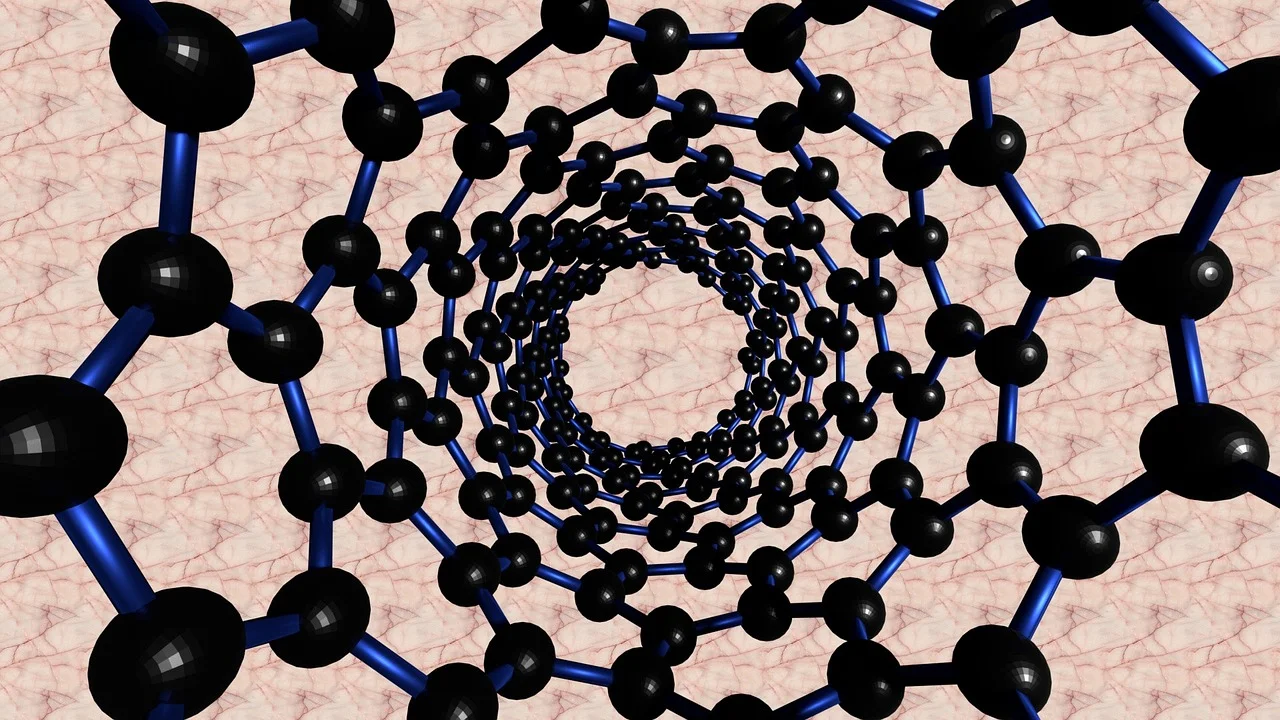
Carbon nanotubes (CNTs) are one-dimensional nanomaterials made entirely of carbon atoms arranged in a rolled graphene-like cylinder, typically with diameters in the nanometre range and exceptionally high aspect ratios. In plastics and polymer compounding, CNTs are used primarily as high-performance functional fillers that can impart electrical conductivity, antistatic behavior, electromagnetic interference shielding, thermal management, and mechanical reinforcement at very low loadings compared with conventional carbon fillers.
CNTs occupy a distinctive position in the plastics value chain because they bridge structure and function: the same additive can simultaneously reinforce a polymer matrix, create conductive pathways, and alter processing behavior through dispersion, interfacial interactions, and network formation. The market has expanded from early composite demonstrations into commercial uses in batteries, conductive plastics, coatings, sporting goods, automotive parts, and advanced filtration, while research continues to push into electronics, sensors, biomedical systems, and energy devices.
CNTs are commonly divided into single-walled carbon nanotubes and multi-walled carbon nanotubes, with additional distinctions made by chirality, diameter, length, purity, defect density, and surface functionalization. These structural variables strongly influence conductivity, mechanical performance, and processability, which is why CNT grades are often specified for a narrow set of end uses rather than as a universal “one-size-fits-all” additive.
From a sustainability perspective, CNTs raise both promise and concern. They can enable lighter parts, more efficient batteries, and longer service life, but they are also energy-intensive to produce, require careful occupational handling, and remain challenging to recycle when embedded in thermoset or highly integrated composite systems. Recent progress in synthesis, purification, alignment, and chirality control is improving performance consistency and opening routes to more efficient manufacturing, which may broaden their use in mainstream plastics and electronic materials.
History and Development
CNTs entered modern materials science after their identification in 1991, and early research rapidly highlighted their unusual combination of strength, conductivity, and nanoscale geometry. Initial development was dominated by laboratory-scale studies in physics and nanotechnology, followed by broader interest in composite reinforcement, field emission, and energy storage.
As synthesis methods matured, especially chemical vapor deposition routes, the focus shifted from discovery to scale-up, purification, alignment, and property control. Commercial adoption has followed this trajectory: first in specialty composites and conductive additives, then in batteries, industrial coatings, and high-value functional materials.
Recent milestones have centered on precision manufacturing rather than simply higher yield. Reported advances include longer CNT fibers, improved wet-spinning and alignment, better control of chirality, and direct growth of ordered arrays that may support next-generation electronics and interconnects. These developments matter for plastics because they improve reproducibility, a persistent barrier to large-volume compounding.
Chemical Structure and Key Properties
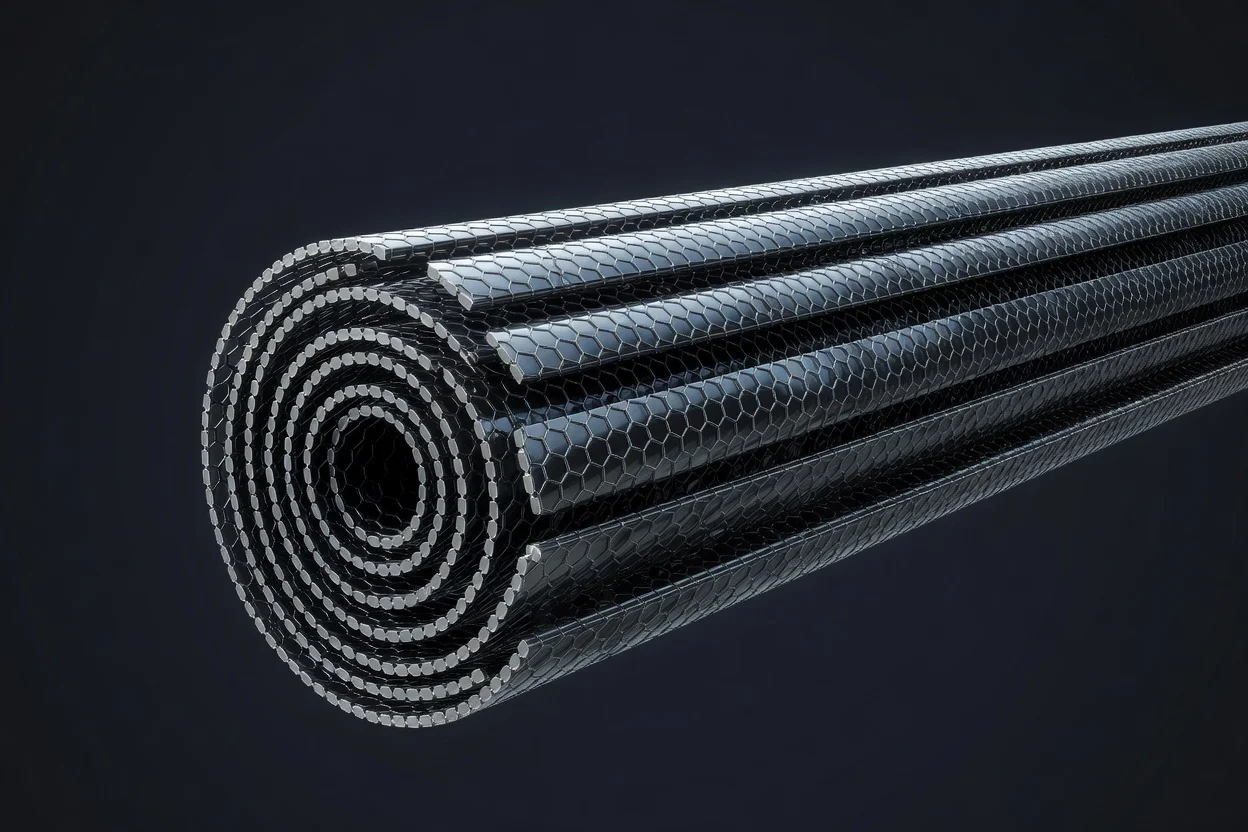
CNTs are tubular allotropes of carbon built from sp2-bonded carbon atoms arranged in hexagonal networks, conceptually formed by rolling a graphene sheet into a cylinder. In single-walled CNTs, a single graphene cylinder defines the tube; in multi-walled CNTs, several concentric tubes are nested together.
Key properties relevant to plastics
- High aspect ratio: A very long length relative to diameter allows network formation at low loading, which is central to electrical percolation in polymers.
- Electrical conductivity: CNTs can create conductive pathways in otherwise insulating resins, enabling antistatic and EMI-shielding formulations.
- Mechanical reinforcement: Their high intrinsic stiffness and tensile strength make them effective nanoscale reinforcers when dispersion and interfacial adhesion are adequate.
- Thermal transport: CNTs can enhance heat dissipation, which is valuable in battery housings, electronics, and thermal-interface composites.
- Chemical tunability: Surface functionalization can improve compatibility with polymers, though it may reduce pristine conductivity if the conjugated structure is disrupted.
Real limits and practical workarounds
- Limit: poor dispersion in many polymers → cause: strong van der Waals attraction and tube bundling → workaround: masterbatches, melt compounding with optimized shear, surfactants, and covalent or noncovalent functionalization.
- Limit: property variability between CNT grades → cause: differences in chirality, length, defects, purity, and catalyst residue → workaround: tighter grade specification, purification, and application-specific qualification.
- Limit: conductivity may be lost at low strain or weak network integrity → cause: network disruption under processing or deformation → workaround: hybrid filler systems, alignment, and controlled aspect-ratio selection.
- Limit: in plastics, CNTs are not a universal barrier solution → cause: they improve conductivity and mechanics more readily than gas-tightness → workaround: combine with layered barrier architectures or specialty barrier polymers rather than relying on CNTs alone.
Typical structure-property implications
| CNT attribute | Main effect in plastics | Practical implication |
|---|---|---|
| Higher aspect ratio | Lower percolation threshold | Less filler may be needed for conductivity |
| Better dispersion | More uniform performance | More reliable molding and extrusion |
| Higher purity | Better electrical performance | Lower ash and fewer catalytic impurities |
| Functionalized surface | Better matrix wetting | Improved reinforcement, sometimes lower conductivity |
| Aligned CNTs | Directional conductivity and strength | Useful in films, fibers, and tapes |
Production Processes and Raw Feedstocks
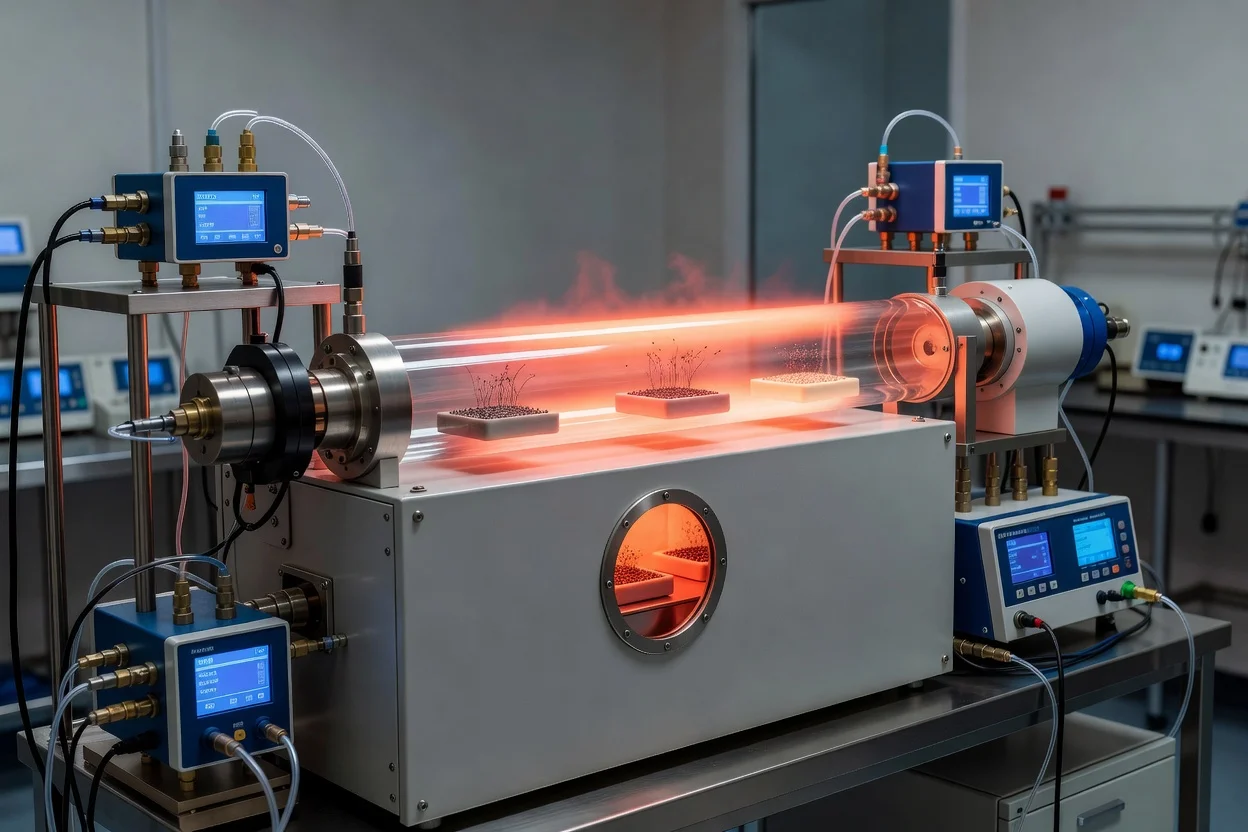
Industrial CNT production is commonly based on chemical vapor deposition and related catalytic growth methods, although arc discharge and laser ablation remain important in some high-purity or research contexts. In catalytic growth, hydrocarbon feedstocks decompose on metal nanoparticles, and carbon precipitates into tubular structures under controlled temperature and gas composition.
Main feedstocks and process inputs
- Carbon sources: hydrocarbons such as methane, ethylene, acetylene, or alcohols, depending on the process design.
- Catalysts: typically transition metals such as iron, cobalt, or nickel, often supported on oxide substrates.
- Process gases: carrier and diluent gases used to control carbon supply, residence time, and CNT morphology.
Downstream processing steps
- Purification to remove catalyst residue, amorphous carbon, and by-products.
- Classification by length, diameter, and bundle state for targeted applications.
- Functionalization to improve dispersion or interfacial bonding in polymers.
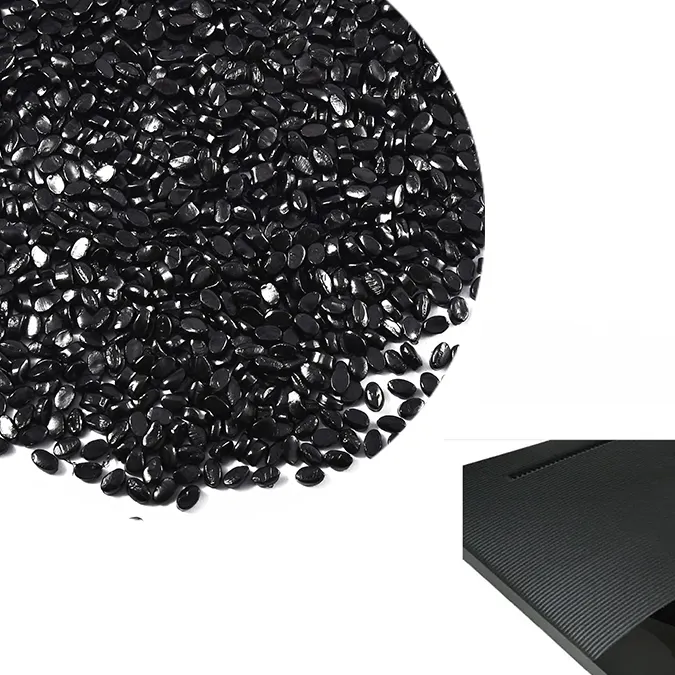
- Formulation into masterbatches, powders, dispersions, or pre-dispersed concentrates for compounding.
For plastics processors, the most important technical issue is not synthesis alone but dispersion reproducibility. A CNT that performs well in a laboratory resin may underperform in a melt-compounded thermoplastic if agglomerates survive extrusion or if the matrix chemistry is incompatible.
Applications and End-Use Markets
CNTs are used across several plastics-adjacent sectors, but their most established role remains as a functional additive in composites and conductive systems.
Major application areas
- Conductive plastics and antistatic parts: Typical in housings, trays, packaging components, and industrial articles where static dissipation or conductivity is needed at low loading.
- EMI shielding: CNT-filled polymers can be used in electronic enclosures, cables, and device components where electromagnetic absorption or shielding is required.
- Batteries and energy storage: CNTs serve as conductive additives and structural support in electrodes, especially where rapid charge-discharge performance is desired.
- Automotive and transport composites: Used in lightweight parts where mechanical reinforcement and conductivity are both useful.
- Sporting goods and durable goods: Applications include rackets, bicycles, boats, and yachts, where stiffness, durability, and reduced mass are valued.
- Filtration and membranes: CNTs can support structural, conductive, or adsorptive functions in advanced filtration systems.
- Sensors and smart materials: CNT networks are widely studied for strain, gas, chemical, and biosensing applications.
- Biomedical and drug-delivery research: Significant research activity exists, but commercial plastic-material relevance is more limited and heavily regulated.
Usual grades and process fit
| End use | Typical CNT type/grade emphasis | Usual process route | Notes |
|---|---|---|---|
| Antistatic plastics | Multi-walled CNTs, robust dispersion grades | Melt compounding | Often chosen for cost and processing tolerance |
| EMI shielding | Multi-walled or hybrid CNT systems | Extrusion, injection molding, coating | Network continuity is critical |
| Batteries | High-purity, well-dispersed CNTs | Slurry coating, electrode formulation | Conductive pathways and adhesion matter |
| Structural composites | High-aspect-ratio CNTs, sometimes functionalized | Resin infusion, extrusion, thermosets | Dispersion and interfacial bonding dominate |
| Sensors | Often high-purity single-walled or aligned CNTs | Thin-film deposition, printing | Device performance depends on uniformity |
One poor-fit use
- Bulk, low-cost structural replacement for glass fiber or carbon fiber is a poor fit because CNTs are far more expensive per unit mass and usually cannot match the economic efficiency of conventional reinforcements in commodity load-bearing plastics.
Environmental and Sustainability Aspects
CNTs can support sustainability goals indirectly by enabling lighter products, improved battery performance, and longer service life, all of which may reduce material intensity or energy consumption in use. In plastics, low-load conductive networks can also replace heavier or higher-loading carbon fillers, potentially lowering part mass and preserving design freedom.
However, the sustainability profile is mixed.
- Production footprint: CNT synthesis is energy- and process-intensive, especially when high purity, alignment, or chirality control is required.
- Recyclability: CNT-filled thermoplastics are generally more recyclable than thermoset composites, but sorting, reprocessing, and property retention remain challenging in mixed waste streams.
- Bio-based and recycled matrices: CNTs have been investigated in renewable or biodegradable polymers such as PLA, but the sustainability benefit depends on the full life cycle, not the matrix alone.
- Occupational and environmental management: Nanomaterial handling requires controlled exposure, dust management, and lifecycle assessment because nanoscale forms can present different risks from bulk carbon materials.
A central trade-off is that CNTs can improve product efficiency while complicating end-of-life management. The net environmental outcome depends on whether the CNT-enabled part displaces a heavier, shorter-lived, or less efficient alternative.
Economic and Global Market Impact
According to recent industry and technical assessments, CNT adoption is strongest where performance justifies premium pricing, especially in batteries, conductive plastics, high-end composites, and electronic materials. Market growth is shaped less by raw tonnage and more by the value of performance per kilogram added.
Leading producers and technology developers have included major chemical and materials companies in Asia, Europe, and North America, with commercial offerings spanning multi-walled CNT powders, dispersions, and masterbatches. The competitive landscape is increasingly influenced by process consistency, purity, and the ability to supply application-specific grades rather than merely high-volume powder.
For plastics compounding, the economic case usually depends on one of four payoffs:
- lower filler loading than conventional conductive additives,
- multifunctionality in one additive package,
- part-weight reduction through improved strength-to-mass performance,
- or access to premium applications such as EMI shielding or battery electrodes.
Current Challenges and Innovations
Key challenges
- Dispersion control remains the central technical barrier in polymer matrices.
- Cost-performance balance is still difficult for commodity plastics.
- Grade consistency is essential because minor changes in CNT morphology can produce major property shifts.
- Health, safety, and regulatory scrutiny require strict exposure management and product stewardship.
- End-of-life complexity increases when CNTs are embedded in multilayer or thermoset structures.
Notable innovations
- Chirality and diameter control for more predictable electronic behavior.
- Aligned CNT arrays and fibers for improved anisotropic conductivity and strength.
- Wet-spun CNT fibers and yarns that extend CNT utility beyond powders into structural forms.
- Hybrid filler systems combining CNTs with graphene, carbon black, or traditional reinforcements to balance cost and performance.
- Functionalized dispersions tailored for thermoplastics, thermosets, and coatings.
Where CNTs are most competitive, the innovation is often not “more CNT” but better CNT architecture.
Future Outlook
CNTs are likely to expand further in high-value plastics and energy-related materials rather than displacing conventional fillers across all markets. The strongest growth opportunities appear to be:
- conductive and antistatic plastics,
- battery electrodes and current-collector enhancements,
- EMI shielding and thermal-management composites,
- sensors and printed electronics,
- aligned fibers and films for advanced engineering applications.
The most important technical trend is the move from dispersed powders toward engineered CNT structures with controlled orientation, purity, and interconnectivity. If these advances are coupled with lower-cost synthesis and better life-cycle management, CNTs could become a more mainstream specialty additive in the plastics industry.
Summary
CNTs are highly versatile carbon nanomaterials that add conductivity, reinforcement, and thermal functionality to plastics at very low loadings. Their value lies in multifunctionality, but their commercial success depends on precise control of grade, dispersion, and processing, as well as careful attention to safety, cost, and end-of-life considerations.
References
- •
Carbon nanotubes: Tiny technology, big possibilities. (2023, October 25). CAS. https://www.cas.org/resources/cas-insights/tiny-technology-big-possibilitiesLink
- •
Saifuddin, N., Raziah, A. Z., & Junizah, A. R. (2013). Carbon nanotubes: A review on structure and their interaction with proteins. Journal of Chemistry, 2013, Article 676815. https://pmc.ncbi.nlm.nih.gov/articles/PMC4141964/Link
- •
Carbon nanotube uses, from batteries to drug delivery. (2024, March 29). CAS. https://www.cas.org/resources/cas-insights/batteries-drug-delivery-emerging-applications-carbon-nanotubesLink
- •
Gupta, N., Gupta, S. M., & Sharma, S. K. (2019). Different technical applications of carbon nanotubes. International Journal of Engineering and Technology, 8(4), 1241–1247. https://pmc.ncbi.nlm.nih.gov/articles/PMC4573081/Link
- •
Carbon nanotube. (n.d.). In Wikipedia. https://en.wikipedia.org/wiki/Carbon_nanotubeLink
- •
Recent insights and multifactorial applications of carbon nanotubes. (2021). Journal of Nanomaterials, 2021, Article 8708822. https://pmc.ncbi.nlm.nih.gov/articles/PMC8708822/Link
- •
カーボンナノチューブとは? [What is a carbon nanotube?]. (n.d.). National Institute of Advanced Industrial Science and Technology. https://www.aist.go.jp/aist_j/magazine/20231206.htmlLink
- •
Carbon nanotube. (2016, August 5). In Encyclopædia Britannica. https://www.britannica.com/science/carbon-nanotubeLink
- •
Realizing the promise of carbon nanotubes. (n.d.). National Nanotechnology Initiative. https://www.nano.gov/sites/default/files/pub_resource/2014_nni_cnt_tech_meeting_report.pdfLink
- •
Applications of carbon nanotubes. (2024, August 9). Malvern Panalytical. https://www.malvernpanalytical.com/en/learn/knowledge-center/insights/the-applications-of-carbon-nanotubesLink
- •
Baughman, R. H., Zakhidov, A. A., & de Heer, W. A. (2002). Carbon nanotubes—The route toward applications. Science, 297(5582), 787–792. https://www.sciencedirect.com/science/article/abs/pii/S0927796X03001268Link
- •
Schnorr, J. M., & Swager, T. M. (2011). Emerging applications of carbon nanotubes. Chemistry of Materials, 23(3), 646–657. https://pubs.acs.org/doi/10.1021/cm102406hLink
- •
Advances and applications of carbon nanotubes. (2023). Nanomaterials, 13(19), Article 10574115. https://pmc.ncbi.nlm.nih.gov/articles/PMC10574115/Link
- •
De Volder, M. F. L., Tawfick, S. H., Baughman, R. H., & Hart, A. J. (2013). Carbon nanotubes: Present and future commercial applications. Science, 339(6119), 535–539. https://www.eng.cam.ac.uk/uploads/news/files/devolder13sciencereview.pdfLink
- •
Carbon nanotubes: A novel material for multifaceted applications in human healthcare. (2017). Chemical Society Reviews, 46(11), 2976–2998. https://pubs.rsc.org/en/content/articlehtml/2017/cs/c6cs00517aLink
- •
Applications of carbon nanotubes in biotechnology and medicine. (2009). Nano Biomedicine and Engineering, 1(1), 1–10. https://pmc.ncbi.nlm.nih.gov/articles/PMC2745127/Link
- •
Carbon nanotubes: Applications in pharmacy and medicine. (2013). BioMed Research International, 2013, Article 3806157. https://pmc.ncbi.nlm.nih.gov/articles/PMC3806157/Link
- •
CNT. (n.d.). LG Chem. https://www.lgchem.com/product-detail/cntLink
- •
Baughman, R. H., Zakhidov, A. A., & de Heer, W. A. (2002). Carbon nanotubes—The route toward applications. Science, 297(5582), 787–792. https://www.science.org/doi/10.1126/science.1060928Link
- •
Applications of carbon nanotubes in the Internet of Things era. (2021). Journal of Nanomaterials, 2021, Article 8435483. https://pmc.ncbi.nlm.nih.gov/articles/PMC8435483/Link
- •
Carbon nanotube. (n.d.). In ScienceDirect Topics. https://www.sciencedirect.com/topics/materials-science/carbon-nanotubeLink
- •
Carbon nanotubes: Structure, properties and applications in the ... (n.d.). Materials Today Communications. https://www.sciencedirect.com/science/article/pii/S2590048X24001286Link
- •
Carbon nanotube—An overview. (n.d.). In ScienceDirect Topics. https://www.sciencedirect.com/topics/engineering/carbon-nanotubeLink
- •
Carbon nanotubes for wound healing: Material design ... (2026). PMC. https://pmc.ncbi.nlm.nih.gov/articles/PMC12832643/Link
- •
Exposure data. (2017). In IARC Monographs on the Evaluation of Carcinogenic Risks to Humans. https://www.ncbi.nlm.nih.gov/books/NBK436612/Link
- •
Carbon nanotube. (2014, March 1). TCI America. https://www.tcichemicals.com/CA/en/c/12960Link
- •
CNTs can be multi-walled... (n.d.). Springer. https://link.springer.com/content/pdf/10.1007/s11434-011-4879-z.pdfLink
- •
Carbon nanotubes in neuroscience. (2010). PMC. https://pmc.ncbi.nlm.nih.gov/articles/PMC2908329/Link
- •
Occupational nanosafety considerations for carbon nanotubes... (2015). PMC. https://pmc.ncbi.nlm.nih.gov/articles/PMC4690205/Link
- •
CNT analysis. (n.d.). Horiba. https://www.horiba.com/esp/materials/material-types/carbon/cnt-carbon-nanotubes/Link
- •
Saifuddin, N., Raziah, A. Z., & Junizah, A. R. (2013). Carbon nanotubes: A review on structure and their interaction with proteins. Journal of Chemistry, 2013, Article 676815. https://onlinelibrary.wiley.com/doi/full/10.1155/2013/676815Link
- •
Carbon nanotubes from Canatu. (n.d.). Canatu. https://canatu.com/carbon-nanotube/Link
- •
Large-scale synthesis of carbon nanotube (CNT). (n.d.). Bhabha Atomic Research Centre. https://www.barc.gov.in/technologies/cnt/index.htmlLink
- •
Carbon nanotubes. (n.d.). Carbonage. https://carbonage.tech/carbon-nanotubes/Link
- •
Review of carbon nanotube research and development... (2024). ACS Applied Nano Materials. https://pubs.acs.org/doi/10.1021/acsanm.4c02721Link
- •
Synthesiology(シンセシオロジー). (n.d.). AIST. https://www.aist.go.jp/pdf/aist_j/synthesiology/vol06_02/vol06_02_p75_p83.pdfLink
- •
Carbon nanotube—An overview. (n.d.). In ScienceDirect Topics. https://www.sciencedirect.com/topics/chemical-engineering/carbon-nanotubeLink
- •
Occupational exposure to carbon nanotubes and nanofibers. (n.d.). CDC. https://www.cdc.gov/niosh/docs/2013-145/pdfs/2013-145.pdfLink
- •
Can carbon nanotubes deliver on their promise in biology?... (2016). ACS Central Science, 2(4), 190–200. https://pubs.acs.org/doi/10.1021/acscentsci.6b00005Link
- •
碳基半导体迎关键进展:北京大学张锦院士团队破解碳纳米管管径调控瓶颈 [Key progress in carbon-based semiconductors...]. (n.d.). EET-China. https://www.eet-china.com/mp/a511781.htmlLink
- •
科学家找到碳纳米管 手性和导电性调控新途径 [Scientists find new way to regulate chirality and conductivity of carbon nanotubes]. (2022, January 5). Xinhua. http://www.news.cn/tech/20220105/77323763a1e641f38bca0c90577999fa/c.htmlLink
- •
碳纳米管2022研究进展 [Carbon nanotube 2022 research progress]. (2025, March 6). China Powder Network. https://m.cnpowder.com.cn/news_info.php?id=68005Link
- •
突破30年难题,纯手性碳纳米管阵列“问世” [Breakthrough of 30-year problem, pure chiral carbon nanotube array “born”]. (n.d.). ScienceNet. https://news.sciencenet.cn/htmlnews/2025/3/540565.shtmLink
- •
碳纳米管赋能新一代传感技术:前沿进展与未来展望 [Carbon nanotubes empower new generation sensing technology...]. (n.d.). EET-China. https://www.eet-china.com/mp/a417084.htmlLink
- •
金属所高性能碳纳米管纤维研究获进展 [Institute of Metal Research achieves progress in high-performance carbon nanotube fiber research]. (2024, July 26). Chinese Academy of Sciences. https://www.cas.cn/syky/202407/t20240726_5027098.shtmlLink
- •
最新新闻 [Latest news]. (2024, July 6). Peking University. https://news.pku.edu.cn/jxky/30e87712715445339707f320f87c59cb.htmLink
- •
单一手性密排碳纳米管阵列制备取得突破 [Breakthrough in preparation of single-chirality densely packed carbon nanotube arrays]. (2025, January 1). Institute of Physics, Chinese Academy of Sciences. https://www.iop.cas.cn/xwzx/kydt/202503/t20250319_7560884.htmlLink
- •
碳纳米管的研究与应用进展 [Research and application progress of carbon nanotubes]. (n.d.). EET-China. https://www.eet-china.com/mp/a59245.htmlLink
- •
清华魏飞教授团队制备出世界最长碳纳米管 [Tsinghua University Professor Wei Fei’s team prepares the world’s longest carbon nanotube]. (2013, July 16). Tsinghua University. https://www.tsinghua.edu.cn/info/1181/54141.htmLink
- •
清华大学化工系与航院在《自然·纳米技术》报道超强碳纳米管纤维领域重大突破 [Tsinghua University Chemical Engineering and Aviation departments report major breakthrough...]. (2018, May 16). Tsinghua University. https://www.tsinghua.edu.cn/info/1175/19475.htmLink
- •
清华化工系魏飞研究组发文揭示原位缠绕超长碳纳米管制备单色碳纳米管线团 [Tsinghua Chemical Engineering Wei Fei research group publishes...]. (2016, December 7). Tsinghua University. https://www.tsinghua.edu.cn/info/1181/43941.htmLink
- •
我国学者在超耐久性超长碳纳米管研究方面取得进展 [Chinese scholars achieve progress in super-durable ultra-long carbon nanotube research]. (2020, September 4). National Natural Science Foundation of China. https://www.nsfc.gov.cn/publish/portal0/tab1288/info85184.htmLink
- •
碳纳米管:个性十足的神奇材料 [Carbon nanotubes: Magical materials with unique personalities]. (n.d.). National Natural Science Foundation of China. https://www.nsfc.gov.cn/csc_phone/kqkd29/kjyq1/28604/index.htmlLink
- •
把石墨烯卷起来 “万能”的碳纳米管或改变未来 [Roll up graphene, “all-purpose” carbon nanotubes may change the future]. (n.d.). CCTV. https://news.cctv.com/2021/08/27/ARTIQ1NixwhlHPfw4sPq8L3h210827.shtmlLink
- •
化工系魏飞、张如范团队发文报道碳纳米管耐疲劳性能研究取得重大突破 [Chemical Engineering Wei Fei and Zhang Rufan teams report major breakthrough...]. (n.d.). Tsinghua University. https://www.tsinghua.edu.cn/info/1175/21377.htmLink
- •
科学家利用DNA首次实现碳纳米管可控有序修饰 [Scientists use DNA to achieve first controllable ordered modification of carbon nanotubes]. (n.d.). ScienceNet. https://news.sciencenet.cn/htmlnews/2022/8/484561.shtmLink