
Introduction
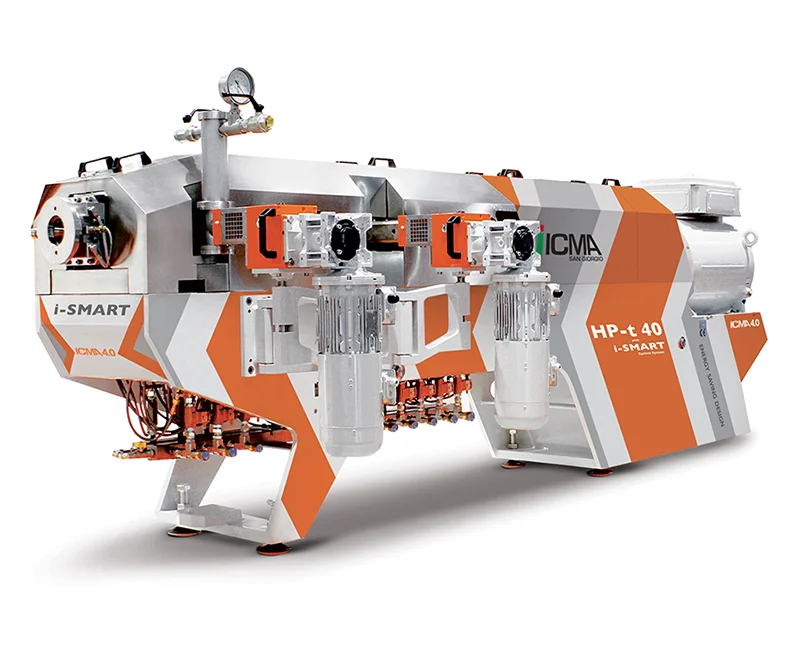
Twin-screw extruders are continuous plastic-processing machines that use two screws inside a heated barrel to convey, melt, mix, vent, react, and shape polymers into pellets, profiles, sheet, film, or directly extruded products. In plastics processing, they are valued for high-intensity mixing, precise thermal control, and flexible process staging, which makes them central to compounding, masterbatch production, recycling, reactive extrusion, and specialty formulations.
Their industrial importance comes from the way the two screws interact: material is moved by a combination of drag flow and positive displacement, producing more controlled throughput and a narrower residence-time distribution than many single-screw systems. The main machine families are co-rotating and counter-rotating designs, each available in parallel or conical geometries, with choice driven by shear sensitivity, pressure requirements, and the target product.
Historically, twin-screw technology developed from specialized mixing and compounding equipment into a highly engineered platform for continuous processing, with modern systems extending from laboratory-scale instruments to large industrial lines. Current development priorities include higher torque density, improved devolatilization, automation, energy efficiency, and greater compatibility with recycled and bio-based feedstocks. Looking ahead, twin-screw extruders are expected to gain further importance in circular-economy processing, advanced composites, reactive functionalization, and digitally monitored production.
History and development
Early twin-screw machines were adopted because they could perform more intensive mixing than conventional single-screw extruders, especially where additives, fillers, or temperature-sensitive materials required tighter control. Over time, screw element modularity, barrel zoning, and venting options made the platform far more versatile for compounding and devolatilization.
A major milestone was the rise of co-rotating intermeshing extruders, which became widely associated with polymer compounding because they combine strong distributive and dispersive mixing with self-wiping action that helps limit stagnant zones. A second milestone was the broader industrial use of counter-rotating and conical machines for lower-shear duties such as PVC pipe, profile, and sheet processing, where stable pressure generation and gentler treatment are useful.
A third development has been the expansion of lab- and pilot-scale platforms for formulation screening, process development, and scale-up, allowing processors to optimize screw configurations before committing to production lines. In parallel, modern high-torque industrial extruders have increased output while preserving control over residence time, melt quality, and devolatilization performance.
Technical overview
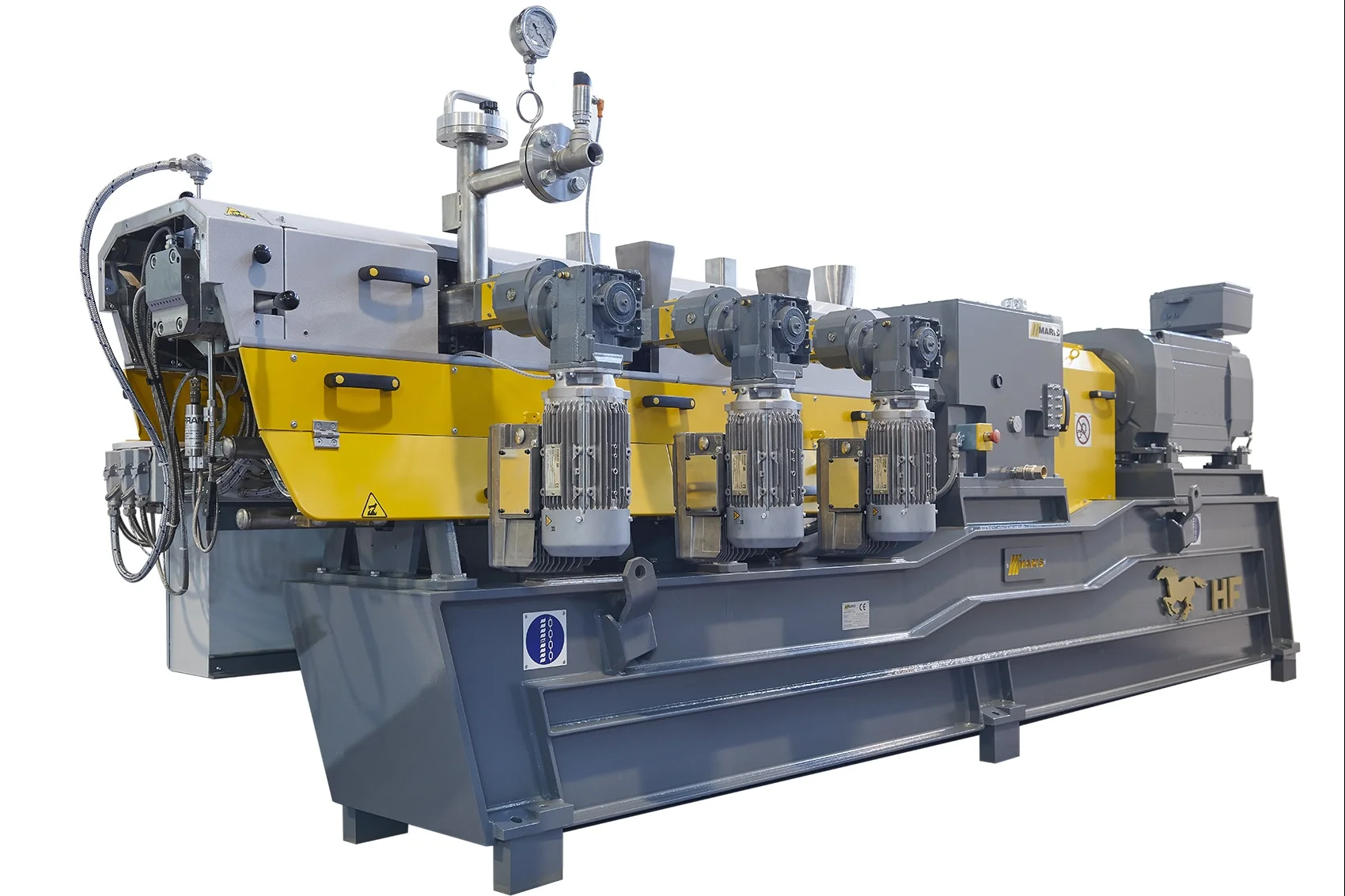
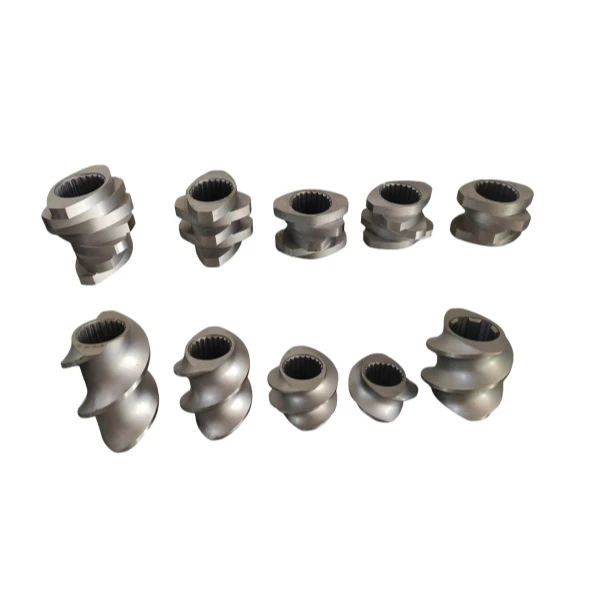
A twin-screw extruder typically consists of a feeding system, segmented barrel zones, rotating screws mounted on splined shafts, heating and cooling control, venting ports, and a die or downstream pelletizing system. The barrel is commonly described as figure-eight shaped in cross-section for intermeshing designs, which supports close screw interaction and controlled material transport.
The process is staged rather than continuous in a single function: feed, convey, compress, melt, mix, vent, pressurize, and discharge through a die. This zoning allows the machine to be tuned for either early melting and intensive mixing or lower-shear transport and late fusion, depending on the screw profile and operating speed.
Key engineering characteristics include:
- Screw speed: laboratory and pilot systems may run at variable speeds, while industrial co-rotating compounding machines commonly operate in the several-hundred rpm range, with some systems reaching about 900–1,200 rpm.
- Throughput: commercial compounding lines can range from about 150 kg/h to several tonnes per hour, with large systems reported at roughly 5–60 t/h depending on screw diameter and formulation.
- Specific torque: modern compounding extruders are often specified by torque density, with reported values around 9–15 Nm/cm³ for current industrial series.
- Residence-time distribution: twin-screw systems generally provide a narrower distribution than drag-dominated single-screw processes because of their positive-displacement conveying and intermeshing action.
- Mixing behavior: kneading blocks and mixing elements produce dispersive mixing, while conveying elements support throughput and pumping stability.
For recycled materials, twin-screw systems are frequently used after wash and size reduction stages, where flake or regrind may already be prepared for compounding or repelletizing; typical downstream granulate or pellet output is then standardized for reprocessing rather than defined by a single universal flake size. Where dewatering is integrated upstream, centrifugal dewatering can reduce moisture substantially before extrusion; in practice, the target residual moisture depends on polymer type and line design, but the process is commonly engineered to minimize hydrolytic degradation and steam-related defects.
Specific energy consumption varies widely with formulation, shear demand, screw design, and scale. High-speed, energy-input compounding systems are deliberately designed to deliver substantial mechanical work for mixing and devolatilization, whereas low-speed machines are selected to minimize thermal and mechanical stress.
Main types and configurations
| Type | Screw rotation | Geometry | Typical strengths | Typical uses |
|---|---|---|---|---|
| Co-rotating parallel | Same direction | Parallel | High shear, strong self-wiping, excellent mixing | Compounding, masterbatch, reactive extrusion, fillers, recycling |
| Counter-rotating parallel | Opposite direction | Parallel | Stable pressure generation, lower shear | PVC pipe, profile, sheet, some calender-feed duties |
| Counter-rotating conical | Opposite direction | Conical | Compact footprint, gentle processing, good for PVC dry blends | PVC profiles, pipe, building products |
| Specialty lab/pilot systems | Either direction | Modular | Fast changeover, formulation screening | R&D, scale-up, process development |
Co-rotating parallel extruders dominate modern compounding because they provide strong distributive mixing and easy modular screw-element customization. Counter-rotating designs remain important where a more pressure-oriented and less aggressive process is preferable, especially for PVC and other heat-sensitive formulations.
Working principle
Twin-screw extrusion depends on the interaction of the screws with each other and with the barrel. As the screws rotate, material is grabbed, compressed, and transferred from one screw channel to another, creating a repeating flow path that mixes and conveys the melt forward.
The intermeshing region is critical because it produces controlled shear and self-wiping behavior. This reduces material stagnation and supports more uniform residence time, which is especially important when processing fillers, pigments, fibers, or reactive additives. In practice, the screw design determines whether the machine behaves mainly as a mixer, a reactor, a devolatilizer, or a pump.
Typical applications and uses
Twin-screw extruders are used across a wide range of plastics-processing tasks:
- Polymer compounding: blending base resin with fillers, pigments, flame retardants, impact modifiers, stabilizers, and glass or mineral reinforcements.
- Masterbatch production: high-concentration color and additive concentrates requiring excellent dispersion.
- Recycling and reclaim: melt filtration, deodorization, devolatilization, and repelletizing of post-consumer or industrial waste streams.
- Reactive extrusion: grafting, polymerization, depolymerization, chain extension, and chemical modification under continuous conditions.
- PVC pipe, profile, and sheet: particularly in counter-rotating and conical configurations.
- Direct extrusion and sheet/film lines: some systems can form sheet or film directly, reducing pelletizing and drying steps.
- Specialty markets: food, pharmaceuticals, and advanced materials, where continuous mixing and controlled residence time are valuable.
A poor-fit application is very low-shear, highly fragile mixing where the material must experience minimal mechanical stress; in such cases, other mixing or pumping technologies may be preferable.

Process advantages
Twin-screw extruders are preferred when processors need more than simple melting and pumping. Their main advantages include:
- Excellent mixing quality for multi-component formulations.
- Broad formulation flexibility for powders, pellets, flakes, fibers, and liquids.
- Efficient devolatilization through venting zones and controlled melt surface renewal.
- Stable output control via positive displacement conveying and starve feeding.
- Modular screw design that enables rapid adaptation to new compounds or recycled feedstocks.
These characteristics make the platform strategically important in sectors where formulation changes are frequent and product performance depends on dispersion quality.
Limitations and engineering trade-offs
Twin-screw systems are not universally superior. Their complexity brings trade-offs in capital cost, screw wear, energy demand, and process development effort. Abrasive fillers and glass fiber can accelerate wear, requiring hardened barrel and screw materials, while aggressive mixing can increase melt temperature and degrade heat-sensitive polymers if not controlled carefully.
Lower-shear counter-rotating machines reduce thermal stress but also reduce flexibility for highly filled or highly dispersive compounding. Co-rotating systems offer stronger mixing, but they can require more sophisticated control of feeding, venting, and temperature management to maintain product quality.
Automation and digital control
Modern twin-screw lines increasingly integrate:
- Loss-in-weight feeders for precise gravimetric dosing.
- Melt-pressure, torque, and temperature monitoring for closed-loop process stability.
- Vacuum venting and devolatilization control for moisture and solvent removal.
- Inline analytics such as NIR or rheological monitoring in advanced lab and pilot systems.
- Recipe management and data logging for reproducible scale-up and quality assurance.
Automation improves consistency, but it also raises the importance of sensor reliability and process engineering expertise, especially when formulations include recycled content or variable feedstocks.
Sustainability and circular-economy role
Twin-screw extruders are increasingly important in plastics circularity because they can process reclaimed materials, blends, and contaminated feedstocks that require intensive mixing and devolatilization. They support the use of post-consumer and post-industrial recyclate by homogenizing variable streams and enabling filtration, deodorization, and additive rebalancing.
They also contribute to energy and resource efficiency when they replace multiple batch steps with one continuous operation or when they enable direct extrusion instead of pelletizing followed by remelting. At the same time, sustainability performance depends heavily on screw design, throughput utilization, maintenance practices, and the degree of thermal over-processing; poorly optimized lines can waste energy and damage recycled polymers.
Market and industrial significance
Twin-screw extruders occupy a strategic position in the plastics machinery market because they sit at the intersection of compounding, recycling, and advanced materials manufacturing. They are essential for producers of engineering plastics, masterbatches, PVC products, and specialty compounds that require reproducible melt homogeneity.
Major manufacturers are active in this segment through distinct machine families and regional strengths. For example, Coperion is strongly associated with the ZSK co-rotating compounding platform, while other suppliers emphasize conical twin-screw machines, lab-scale systems, or high-output compounding lines. The market trend is toward higher torque, wider process windows, and better handling of recycled and bio-based feedstocks.
Current challenges and innovations
Current engineering challenges include:
- Processing variability in recycled feedstocks.
- Wear management under high filler or fiber loading.
- Energy optimization without sacrificing dispersion quality.
- Process scale-up from lab to plant without changing product properties.
- Volatile and solvent handling in reactive and specialty formulations.
Innovation is concentrated in modular screw architectures, improved alloys and wear-resistant coatings, better vacuum venting, and digital process control. There is also growing interest in using twin-screw extrusion for highly filled, functional, and reactive formulations that were previously difficult to process continuously.
Future outlook
Twin-screw extruders are likely to remain a core technology for plastics compounding and recycling, with demand shaped by circular-economy regulations, lightweighting, and the need for high-performance polymer blends. Future systems will probably emphasize lower specific energy, higher uptime, better sensor integration, and more robust processing of variable waste streams.
In the longer term, the platform’s adaptability should support expanded use in advanced composites, battery materials, medical formulations, and direct shaping of specialty compounds. The central technical challenge will be to preserve the machine’s mixing power while reducing wear, thermal stress, and process variability.
References
- •
Thermo Scientific. (2020, April 16). Twin screw extruder. https://www.thermofisher.com/us/en/home/industrial/manufacturing-processing/extrusion-compounding-equipment/instruments/twin-screw-extruders.htmlLink
- •
Nanoscience Instruments. (2026, May 13). What is a twin screw extruder? Types, applications, and benefits explained. https://www.nanoscience.com/blogs/what-is-a-twin-screw-extruder-types-applications-and-benefits-explained/Link
- •
Torontech. (2024, May 18). Twin screw extruder explained: From basics to applications. https://www.torontech.com/articles/twin-screw-extruder-explained-from-basics-to-applications/Link
- •
Leistritz Extrusion. (n.d.). Leistritz extrusion: Quick TSE overview technical article, ref. 11.2020. https://extruders.leistritz.com/en-us/extrusion/newsletter/2022-01/3-Quick-overview-of-TSEs.pdfLink
- •
UD Machine. (2026, March 24). Twin screw extruder: Types, working principle & selection guide. https://ud-machine.com/blog/twin-screw-extruder/Link
- •
NHY Screws. (2026, August 20). Beyond plastics: Application of twin screw extruder you're missing. https://www.nhyscrews.com/blog/application-of-twin-screw-extruderLink
- •
Cowell Extrusion. (2023, March 15). Twin screw extruder working principle. https://www.cowellextrusion.com/twin-screw-extruder-working-principle/Link
- •
GSmach. (2024, June 13). Twin screw extruder working principle. https://www.gsextruder.com/twin-screw-extruder-working-principle/Link
- •
PLA Mirai. (2025, May 6). Basic knowledge of twin screw extruders. https://www.pla-mirai.net/twinscrew-extruder/en/knowledge/Link
- •
Shibaura Machine. (n.d.). Twin screw extruders applications. https://www.shibaura-machine.co.jp/en/product/oshidashi/lineup/nijiku/compound.htmlLink
- •
NHY Screws. (2026, August 12). Twin screw extruder uses most processors haven't explored yet. https://www.nhyscrews.com/blog/twin-screw-extruder-usesLink
- •
Monomex. (2026, August 12). MEX T-PRO twin screw extruder. https://www.monomex.com/en/twin-screw-extruders/mex-t-proLink
- •
Nanhaiya Screw & Barrel. (2026, August 19). Twin screw extruder working: The physics most engineers miss. https://www.nhyscrews.com/blog/twin-screw-extruder-workingLink
- •
Nanhaiya Screw & Barrel. (2026, August 27). Twin screw extrusion dissected: Design, optimize. https://www.nhyscrews.com/blog/twin-screw-extrusionLink
- •
Nanhaiya Screw & Barrel. (2026, August 17). Working principle of twin screw extruder: Every zone decoded. https://www.nhyscrews.com/blog/working-principle-of-twin-screw-extruderLink
- •
Chilat. (n.d.). Twin screw extruder: Basics, types, and applications. https://www.chilat.com/blog/2020063179477774337Link
- •
Technovel. (2025, August 1). What is a twin screw extruder? https://www.technovel.co.jp/en/3697/Link
- •
Pragolab. (n.d.). Thermo Scientific twin-screw extruders. https://www.pragolab.cz/documents/2_Twin-Screw%20Extruders.pdfLink
- •
Nanhaiya Screw & Barrel. (2026, August 17). Twin-screw extruder decoded: From screw design to process mastery. https://www.nhyscrews.com/blog/twinscrew-extruderLink
- •
Jwell Machine. (2026, July 3). How does a twin screw extruder work? https://www.jwellmachine.com/sl/how-does-a-twin-screw-extruder-work/Link
- •
PMC - NIH. (2016, February 16). Twin screw extruders as continuous mixers for hot melt extrusion. https://pmc.ncbi.nlm.nih.gov/articles/PMC4766122/Link
- •
Cowell Extrusion. (2023, March 13). The application of twin screw extruder. https://www.cowellextrusion.com/the-application-of-twin-screw-extruder/Link
- •
Deer Machine. (2025, December 25). Applications of twin screw extruders in polymer processing and reactive extrusion. https://deermachine.com/applications-of-twin-screw-extruders-in-polymer-processing-and-reactive-extrusion/Link
- •
Leistritz Extrusion. (n.d.). 101. https://extruders.leistritz.com/en-us/extrusion/newsletter/life-science-newsletter-2020-02/10_general-counterrotating-characteristics.pdfLink
- •
Milacron. (2025, August 21). Twin screw extruders for plastic processing. https://www.milacron.com/product/twin-screw/Link
- •
Useon. (2026, March 18). Twin screw extruders for compounding & sheet extrusion. https://www.useon.com/twin-screw-extruder/Link
- •
Anton Paar. (n.d.). Lab- and pilot-scale twin screw extruders: TwinLab. https://www.anton-paar.com/us-en/products/details/twinlab/Link
- •
Useon. (2021, November 19). Single screw extruder vs twin screw extruder. https://www.useon.com/guide/single-screw-extruder-vs-twin-screw-extruder/Link
- •
Nanhaiya Screw & Barrel. (2026, August 20). Twin screw extruder working principle: What textbooks leave out. https://www.nhyscrews.com/blog/twin-screw-extruder-working-principleLink
- •
GSmach. (2024, March 26). Exploring the different types of twin screw extruders. https://www.gsextruder.com/exploring-the-different-types-of-twin-screw-extruders/Link
- •
eBay. (2025, January 1). Twin-screw extruder. https://www.ebay.com/shop/twin-screw-extruder?_nkw=twin-+screw+extruderLink
- •
Skills Engine. (2026, June 11). Twin screw extruders for polymer compounding. https://skills-engine.net/twin-screw-extruders/Link
- •
TwinScrew. (2025, April 21). 7 twin screw extruder types: Design, benefits & uses. https://www.twinscrew.net/en/article/types-of-twin-screw-extruder.htmlLink
- •
Wenger. (n.d.). Magnum ST twin screw series. https://wenger.com/productLink
- •
Coperion. (n.d.). ZSK twin screw extruders. https://coperion.com/en/products-services/extruders-compounding-machines/zsk-twin-screw-extrudersLink
- •
Wanplas. (2024, August 2). Twin screw extruder. https://www.wanplas.com/industry-knowledge/plastic-machine/twin-screw-extruder/Link
- •
Useon. (2025, March 27). Co-rotating twin screw extruder manufacturer. https://www.useon.com/machine/sat-twin-screw-extruder/Link
- •
PMC. (2022, January 10). Modeling of twin screw extrusion of polymeric materials. https://pmc.ncbi.nlm.nih.gov/articles/PMC8779974/Link
- •
Jwell Machinery. (2025, March 20). Classification of twin-screw extruders. https://jwell.co/company-news/classification-of-twin-screw-extruders/Link
- •
B&P Littleford. (n.d.). Twin screw extrusion & compounding machines. https://www.bplittleford.com/twin-screw.htmlLink
- •
Anton Paar. (n.d.). Lab- and pilot-scale twin screw extruders: TwinLab. https://www.anton-paar.com/corp-en/products/details/twinlab/Link
- •
PlasticsToday. (2023, November 16). Words of wisdom: Understanding twin-screw extruders: The high-speed energy input (HSEI) concept. https://www.plasticstoday.com/extrusion-film-sheet/words-of-wisdom-understanding-twin-screw-extruders-the-high-speed-energy-input-hsei-conceptLink
- •
Aaron Equipment. (n.d.). Used twin screw co-rotating extruders for sale. https://www.aaronequipment.com/equipment/plastics-equipment/extruders-twin-screw-corotateLink