
Introduction
Foams & Intermediates refers to two closely linked segments of the plastics and chemicals value chain: foams are lightweight cellular materials made by dispersing gas within a polymer, elastomer, or other matrix, while intermediates are the upstream chemical building blocks that enable foam synthesis and the production of related additives, surfactants, catalysts, and curing agents. In industrial practice, the topic spans both finished foam materials such as polyurethane, polystyrene, polyethylene, polypropylene, phenolic, PVC, and silicone foams, and the key intermediates that feed them, including isocyanates, polyols, amines, glycol derivatives, and blowing-agent systems. The sector is large and growing, with recent market analyses placing the global foam market in the roughly USD 115 billion to USD 120 billion range in the mid-2020s and forecasting continued expansion through the early 2030s, supported by demand from construction, packaging, automotive, furniture, bedding, and cold-chain logistics.
Foams are valued for their unique combination of low density, energy absorption, thermal insulation, acoustic damping, and design versatility, but they also present material-specific trade-offs, particularly around end-of-life recovery, flame retardancy, and the environmental profile of blowing agents and petrochemical feedstocks. Intermediates are equally strategic because they determine reaction kinetics, cell structure, mechanical performance, and processability; in polyurethane systems, for example, the upstream balance among polyols, isocyanates, catalysts, surfactants, and blowing agents governs whether a formulation yields flexible cushioning foam, rigid insulation foam, spray foam, or specialty elastomeric grades. The long-term direction of the field is being shaped by bio-based polyols, recycled content, lower-global-warming-potential blowing agents, improved sortation and chemical recycling, and advanced functional foams for energy-efficient buildings, lightweight mobility, filtration, and biomedical applications.
History and Development
Foams have a long technological history, but modern polymer foams emerged in the twentieth century as chemical manufacturers learned to control gas generation and stabilize cellular structures in synthetic polymers. A major breakthrough occurred when controlled moisture or chemical reactions were used to generate carbon dioxide in polymerizing systems, creating hollow cells that improved flexibility and reduced density. Subsequent advances in surfactants, catalysts, and blowing agents transformed foams from simple cushioning materials into engineered products with precise cell morphology, load-bearing behavior, and thermal performance.
The development of polyurethane foams was especially influential because it established a highly tunable platform for both flexible and rigid products. Upstream intermediates such as aniline-derived MDI chemistry and polyether or polyester polyols became central to industrial foam production, and these chemistry chains remain foundational today. At the same time, polystyrene foams, polyethylene foams, and phenolic foams became important in packaging, insulation, flotation, and structural sandwich cores, broadening the market beyond furniture and bedding into construction and transport.
Chemical Structure and Key Properties
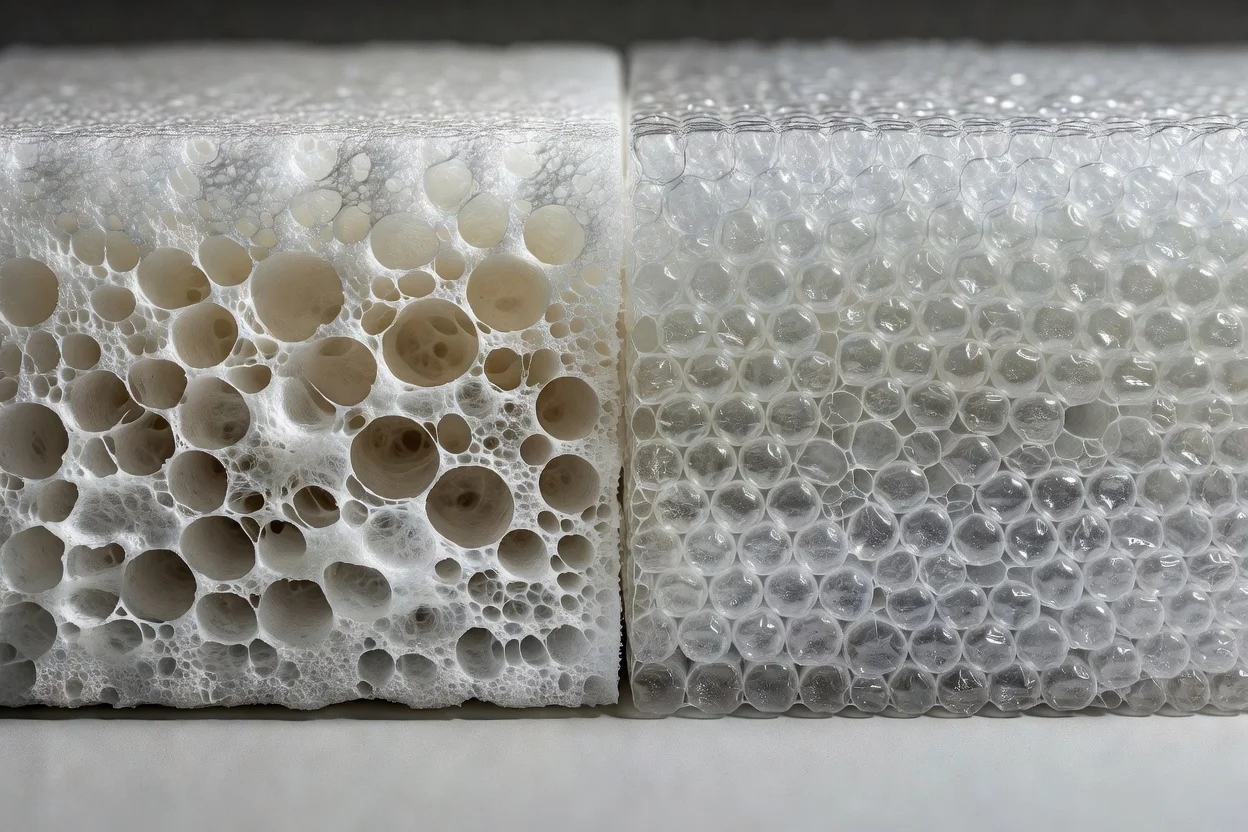
Foams are cellular materials in which gas is trapped in a continuous solid or liquid phase; the main distinction is between open-cell foams, where pores are interconnected, and closed-cell foams, where cells are largely isolated from one another. This architecture drives the property set: open-cell foams are typically softer, more compressible, and better suited for filtration, cushioning, and acoustic absorption, while closed-cell foams are better for buoyancy, thermal insulation, moisture resistance, and structural integrity.
A practical way to understand foam performance is through its main technical limitations and workarounds:
| Limitation | Cause | Common workaround |
|---|---|---|
| Poor thermal or gas barrier in open structures | Interconnected pores allow gas diffusion and convective heat transfer | Use closed-cell design, skin formation, or laminate facings |
| Moisture uptake in hydrophilic foams | Polar chemistry and open porosity increase water absorption | Select hydrophobic formulations, coatings, or closed-cell morphology |
| Dimensional instability under load | Thin cell walls can buckle or creep over time | Increase crosslink density, use reinforcing fillers, or choose higher-density grades |
| Flammability in many organic foams | Hydrocarbon-rich polymer backbone burns readily | Add flame-retardant packages, use mineral fillers, or switch to phenolic/specialty foams |
For polyurethane foams, cell structure is dictated by the reaction between isocyanate and polyol, while gas formation is controlled by water, physical blowing agents, or both. Catalysts such as tertiary amines accelerate the urethane and gas-forming reactions, while surfactants stabilize bubble growth and prevent collapse; commercial amine catalysts are widely used across flexible, molded, rigid, semi-flexible, and elastomeric foam systems. As a result, foam performance is not determined by a single ingredient but by the interplay among intermediates, rheology, cure rate, and process temperature.
Representative property differences by foam family are shown below:
| Foam family | Typical strength | Typical use profile | Main advantage | Common limitation |
|---|---|---|---|---|
| Flexible polyurethane | Soft, resilient | Seating, bedding, packaging | Comfort and energy absorption | Limited thermal insulation compared with rigid grades |
| Rigid polyurethane | High compressive strength | Insulation panels, appliances, spray foam | Very low thermal conductivity | Cost and recycling complexity |
| Polyethylene foam | Light, tough | Protective packaging, marine, sports | Excellent cushioning and moisture resistance | Lower heat resistance |
| Polystyrene foam | Very light, rigid | Insulation, packaging, disposable formats | Low cost and easy processing | Brittle under impact and solvent-sensitive |
| Phenolic foam | Very low smoke and good fire performance | Building insulation, fire-sensitive applications | Superior fire behavior | Higher brittleness and processing sensitivity |
Production Processes and Raw Feedstocks
Foam manufacturing begins with upstream intermediates and formulative chemistry rather than with the foam shape itself. In polyurethane systems, the key raw materials are isocyanates such as MDI and TDI, polyols, catalysts, surfactants, chain extenders, flame retardants, and blowing agents; the polyurethane foam value chain begins with aromatics and olefins, moves through intermediates such as aniline and propylene oxide, and then into polyols and isocyanates. MDI is especially important for rigid foam applications, while polyols are used across rigid, flexible, and non-foam polyurethane products.

Foam production is generally organized into several industrial routes:
- Reaction foaming: gas is generated during polymer formation, as in polyurethane systems, where chemical blowing from water reacts with isocyanate and physical blowing can be added for control.
- Extrusion foaming: polymers such as polyethylene, polypropylene, and polystyrene are melted and expanded using hydrocarbon or other blowing agents.
- Batch and molding processes: materials are mixed and expanded in molds for seating, packaging inserts, insulation parts, and specialty components.
- Specialty foaming with physical agents: supercritical CO2 and other clean agents are increasingly used where lower emissions, fine cell size, or process intensification are desired.
Typical upstream intermediates and auxiliaries include:
- Polyether polyols and polyester polyols, which define flexibility, hydrolysis resistance, and resilience in polyurethane foams.
- Isocyanates, especially MDI, which provide the hard segment and structural integrity in PU foams.
- Amine catalysts, which accelerate foam rise and cure; commercial grades are used across flexible slabstock, molded, rigid, semi-flexible, and elastomeric systems.
- Blowing agents, including hydrocarbons, HFCs, HCFCs, and low-impact alternatives, which determine density and cell morphology.
- Speciality intermediates, such as diethyl maleate in some polyaspartate and polyurea-related systems, which support coatings and foam-adjacent applications.
A small formulation example illustrates the chemistry: a rigid polyurethane insulation foam may use MDI plus a high-functionality polyol blend with catalyst levels in the low parts-per-hundred range; the catalyst accelerates urethane formation and gas generation, while a surfactant stabilizes small closed cells that improve thermal performance. A second example is a one-component polyurethane foam, where carefully controlled polyol purity and moisture sensitivity are important for storage stability and field expansion performance.
Applications and End-Use Markets
Foams are used across almost every major downstream plastics market because the same cellular architecture can be tuned for comfort, insulation, protection, flotation, sound control, or structural support. The best-fit grade depends on density, cell openness, mechanical recovery, and thermal behavior.
| End-use sector | Typical foam type | Typical process or grade | Why it fits |
|---|---|---|---|
| Furniture and bedding | Flexible polyurethane | Slabstock, molded foam | Comfort, resilience, and cushioning |
| Building and construction | Rigid polyurethane, phenolic, EPS/XPS | Panels, spray foam, boardstock | Thermal insulation and air sealing |
| Packaging | PE, EPS, PU, PP foams | Expanded sheets, inserts, molded protection | Shock absorption and lightweight protection |
| Automotive and transport | Flexible PU, NVH foams, structural foams | Molding, laminates, sprayed insulation | Weight reduction and noise control |
| Appliances and cold chain | Rigid PU, polystyrene foams | Insulation cores, cabinets, panels | Thermal efficiency |
| Medical and hygiene | Specialty PU, PE, silicone foams | Soft cushioning, filters, support pads | Biocompatibility and controlled compression |
| Filtration and separation | Open-cell foams | Reticulated or porous grades | High surface area and flow-through permeability |
| Marine and flotation | Closed-cell PE, EPS, PU | Buoyant parts and blocks | Water resistance and positive buoyancy |
Polyurethane foam is one of the most versatile families, with flexible grades used in mattresses, seating, and medical positioning, and rigid grades used in refrigerators, freezers, building envelopes, and spray insulation. Polypropylene foam is commonly used in seating components, thermal insulation, shock protection, and lightweight building or transport parts. Open-cell foams are also used in filtration and acoustic applications, while closed-cell products are preferred for waterproofing, marine use, and insulation.
One notable poor-fit use is high-temperature, long-term service in chemically aggressive environments, where conventional organic foams may soften, degrade, or lose properties; in such cases, specialty silicone, phenolic, metallic, or ceramic foams may be more appropriate. Likewise, applications requiring very high fire resistance or ultra-low smoke often move away from standard hydrocarbon foams toward more specialized formulations.
Environmental and Sustainability Aspects
Foams present a mixed sustainability profile. Their primary environmental benefit is functional: by reducing mass and improving insulation, they can lower transport energy use and building operational energy consumption over the service life of the product. This is especially significant in rigid insulation foams, lightweight automotive components, and cold-chain packaging, where performance can translate into measurable efficiency gains.
The main environmental concerns are upstream and end-of-life related:
- Fossil feedstock dependence remains high in most foam systems, especially polyurethane, polystyrene, and polyethylene foams.
- Blowing-agent emissions can be significant if high-global-warming-potential agents are used, although the market is moving toward lower-impact alternatives.
- Recycling is difficult for many crosslinked or multi-material foams, particularly flexible PU and laminated construction foams, because collection, separation, and reprocessing are technically and economically challenging.
- Volume-to-mass imbalance makes collection logistics expensive, since foams occupy large space relative to recovered polymer mass.
Several sustainability pathways are already visible:
- Bio-based polyols from plant oils and other renewable feedstocks are expanding in furniture, automotive, and packaging formulations.
- Recycled content is increasing in some foams, especially where mechanical reclamation or chemical recycling of polyols is feasible.
- Lower-GWP blowing agents and clean physical foaming methods, including supercritical CO2, are improving the environmental profile of certain product classes.
- Design for disassembly and mono-material construction is being explored to simplify recovery in mattresses, insulation systems, and transport interiors.
The sustainability debate is therefore not simply whether foams are “good” or “bad,” but whether a given foam system delivers enough operational benefit to justify its upstream footprint and end-of-life burden. In energy-efficient buildings, for example, the insulation value of rigid foam can offset much of its embodied impact over time, whereas short-life packaging foams may face stronger pressure to use recycled content or alternative formats.
Economic and Global Market Impact
The foam sector is economically significant because it sits at the intersection of petrochemicals, construction, mobility, consumer goods, and packaging. Recent industry reports estimate a global foam market size of about USD 119 billion in 2025, with projections rising toward USD 186 billion by 2033 under moderate-to-strong growth assumptions. Other market analyses place the sector in a broadly similar range and expect mid-single-digit annual growth, supported by housing, infrastructure, furniture, cold-chain logistics, and vehicle lightweighting.
The polyurethane foam segment is a particularly large submarket. Market studies indicate that demand is anchored by rigid foam insulation and flexible cushioning, while intermediate demand tracks the output of MDI, polyols, and catalyst systems. In geographic terms, Asia-Pacific is widely described as the largest and fastest-growing region, driven by industrialization, urban housing, appliance production, and automotive manufacturing.
Leading global intermediates and foam-related chemical suppliers include large integrated chemical groups such as BASF and Huntsman, which maintain broad portfolios spanning intermediates, polyols, isocyanates, and foam-adjacent specialties. Their integrated positions matter because foam economics are highly sensitive to feedstock prices, catalyst availability, energy costs, and regulatory changes affecting blowing agents and flame retardants.
Current Challenges and Innovations
The foam industry is being reshaped by a combination of regulatory pressure, performance demands, and circular-economy targets.
- Blowing-agent transition: legacy hydrofluorocarbon and other higher-impact blowing agents are under pressure, driving reformulation toward lower-emission systems.
- Recycling of crosslinked foams: many PU foams cannot be remelted, so chemical recycling, glycolysis, and feedstock recovery are areas of active development.
- Fire performance without toxicity trade-offs: building and transport foams increasingly need robust flame performance with lower smoke and lower regulatory burden.
- Smart and functional foams: conductive fillers, sensors, antimicrobial additives, and tailored pore structures are enabling foams for soft robotics, medical scaffolds, NVH control, and process intensification.
- Process efficiency: improved catalysts, metering control, and scCO2 foaming are being explored to reduce waste and sharpen cell-size control.
One concrete example is the use of amine catalysts at low dosage to control polyurethane rise profile and cure balance; even small changes in catalyst structure can shift cream time, gel time, and final cell structure, which is why catalyst selection remains central to foam formulation. Another example is the use of polyol intermediates with low water and ion content in one-component foam systems to improve storage stability and shelf life.
Future Outlook
The medium-term outlook for Foams & Intermediates is positive, but more technically demanding than in the past. Growth is likely to remain strongest in building insulation, energy-efficient appliances, protective packaging, and lightweight mobility, while premium opportunities will come from bio-based formulations, recyclable systems, and advanced functional foams. Intermediate suppliers that can offer lower-carbon, lower-toxicity, and process-stable chemistries are likely to gain strategic importance because foam performance is increasingly defined by the quality of its upstream inputs rather than by the polymer alone.
The most important strategic shift is that foams are moving from being viewed only as low-cost bulk materials to being engineered platforms for energy efficiency, comfort, protection, and process intensification. That shift should increase the value of specialized intermediates, tighter formulation control, and circular design, especially where regulation and customer specifications reward measurable sustainability gains.
Summary
Foams & Intermediates is a value chain built on cellular materials and the upstream chemicals that create them, with polyurethane chemistry, polystyrene expansion, and specialty foam systems forming the core of industrial demand. The sector combines major commercial scale with strong technical differentiation: foams deliver insulation, cushioning, buoyancy, and lightweight structure, while intermediates determine reaction control, cell morphology, and final performance. Its future will depend on cleaner feedstocks, lower-impact blowing agents, improved recyclability, and the continued expansion of high-value applications in construction, transport, packaging, and advanced functional materials.
References
- •
Polymer. (n.d.). Somochem.Link
- •
BASF Report 2012. (n.d.). BASF.Link
- •
Business Segments. (2021, February 26). BASF.Link
- •
Foam Companies - Top Industry Manufacturers 2024. (2021, April 6). MarketsandMarkets.Link
- •
Foam Market Size, Share & Growth | Industry Report, 2033. (n.d.). Grand View Research.Link
- •
Foams and foam materials. (2025, January 1). GlobalSpec.Link
- •
Popular Chemical Intermediates for C.A.S.E. Applications. (2022, August 10). Van Horn, Metz & Co.Link
- •
1 Uses of foams. (2013, July 11). Oxford Academic.Link
- •
JEFFOL®. (2025, September 9). Huntsman.Link
- •
WANNATE®. (2026, January 2). Palmer Holland.Link
- •
Aniline. (n.d.). LANXESS.Link
- •
Evonik - DABCO Crystalline - 280-57-9 - Amines - High Purity Grade. (2024, December 2). Knowde.Link
- •
Rokopol® D1002 - Polyoxypropylenediol - PCC Group Product Portal. (2017, January 3). PCC Group.Link
- •
DABCO - Evonik - Knowde. (2024, December 2). Knowde.Link
- •
Foam. (2003, July 15). Wikipedia.Link
- •
Metallic Foam Research - Market Analysis - Mordor Intelligence. (2026, January 13). Mordor Intelligence.Link
- •
Huntsman Corporation AR 2025 - ProxyVote.com. (n.d.). Huntsman.Link
- •
Foaming Technology. (n.d.). ACS Publications.Link
- •
Foam Market 2026–2032: Emerging Trends, Demand Drivers. (2026, April 10). Maximize Market Research.Link
- •
Advanced Foams for Process Intensification. (2025, October 7). IntechOpen.Link
- •
Foam Market Size to Reach USD 201.02 Billion by 2034. (n.d.). Towards Chem and Materials.Link
- •
Foam Blowing Agents Market Size, Share & Forecast. (n.d.). Market Research Future.Link
- •
Foam | Chemistry | Research Starters. (2022, September 1). EBSCO.Link
- •
Foam Market Size & Forecast [Latest] - MarketsandMarkets. (n.d.). MarketsandMarkets.Link
- •
Foam Market | Global Market Analysis Report - 2035. (2025, October 20). Future Market Insights.Link
- •
Global Foaming Agent Market Size, Trends, Share 2033. (2026, July 22). Custom Market Insights.Link
- •
Foam Blowing Agents Market Size, Industry Share. (2026, August 3). Fortune Business Insights.Link
- •
Foam Market Size, Share, Trends & Forecast 2033. (2025, November 26). SkyQuest.Link
- •
Polymer Foam Market Size, Growth Report, 2026-2033. (n.d.). Grand View Research.Link
- •
The Complete Guide to Foam Selection. (2026, April 22). Amcon Foam.Link
- •
Chemistry, Processing, Properties, and Applications of Rubber Foams. (2021, May 13). PMC.Link
- •
India Foam Market Share, Companies & Trends Report. (2026, August 27). Ken Research.Link
- •
Industry Data. (2025, January 24). Polyurethane Foam Association.Link
- •
Polymer Foam Market Report 2025-2031 [260 Pages & ... (n.d.). MarketsandMarkets.Link
- •
Polyurethane Foam Market Size & Industry Report 2031. (2026, August 10). Mordor Intelligence.Link
- •
Polyurethane Foam: A Versatile Material with Many Applications. (2020, August 6). Gantrade.Link
- •
Polymer Foams Market Report 2033 | Industry Growth & ... (2021, August 7). Data Bridge Market Research.Link
- •
Europe Polymer Foam Market. (n.d.). MarketsandMarkets.Link
- •
Foam Products Manufacturing - 2025 U.S. Market Research Report. (2025, June 11). Kentley Insights.Link
- •
Technical Foam Market Size, Share, Growth, Analysis. (n.d.). Straits Research.Link
- •
Foam Manufacturers and Suppliers in the USA – A Thomas Industry. (2025, April 29). ThomasNet.Link
- •
Polyurethane Foam Market Size, Share | Industry Report [2034]. (n.d.). Fortune Business Insights.Link
- •
High Performance Foam Market Growth Outlook 2026–2035. (n.d.). USD Analytics.Link
- •
Industrial Foam Market Size To Hit USD 88 Billion By 2035. (n.d.). Precedence Research.Link
- •
Polystyrene Foam Product Manufacturing in the US. (2026, May 3). IBISWorld.Link
- •
Technical Foam Market | Market Size, Share & Forecast. (2026, May 14). Stratview Research.Link