
Introduction
Iron oxide pigments are inorganic colorants based on iron oxides and iron oxyhydroxides, used for their durability, chemical stability, lightfastness, and relatively low cost. In plastics and auxiliaries, they are especially important as masterbatch colorants and as durable pigments for construction plastics, coatings, rubber, and specialty formulations where long-term weather resistance matters.
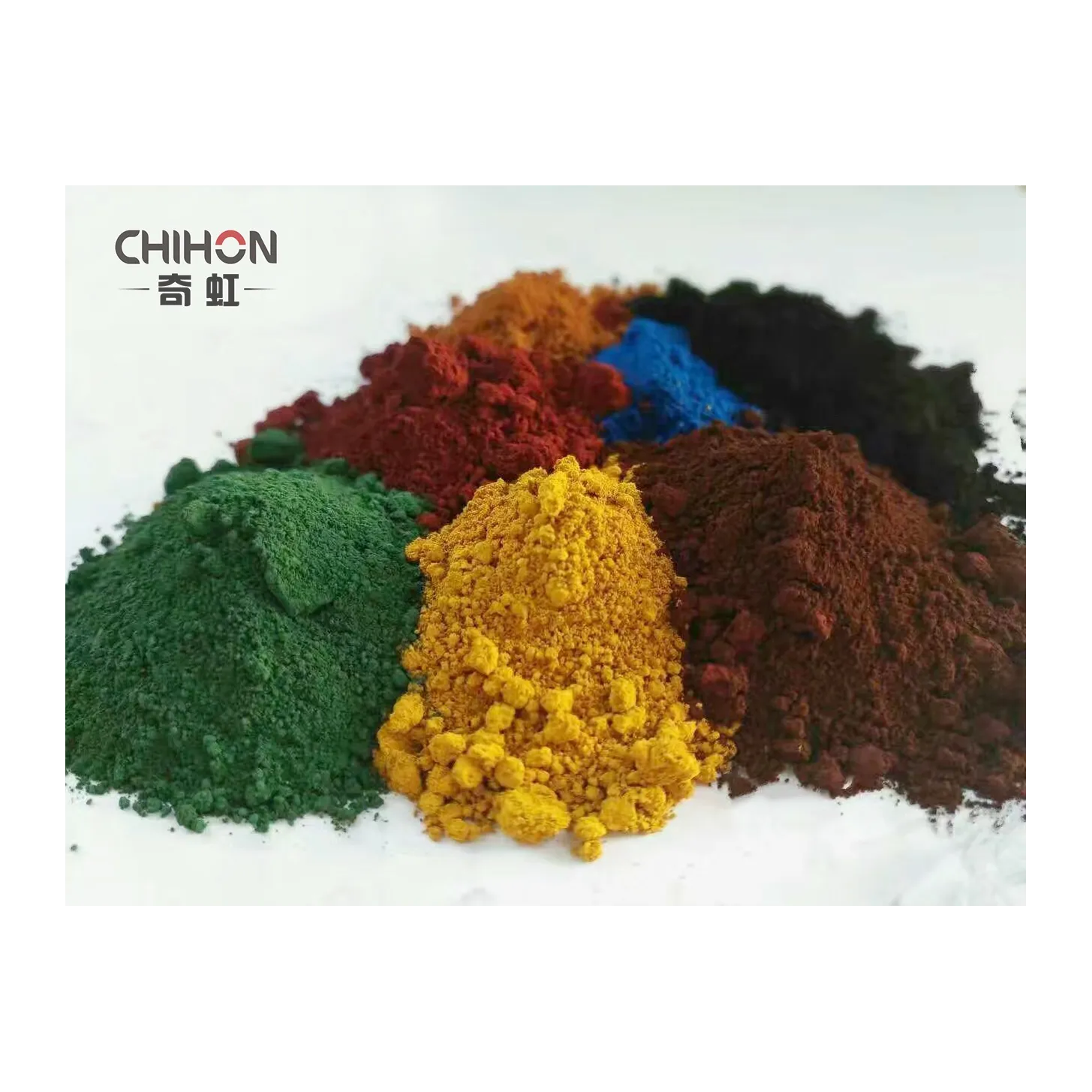
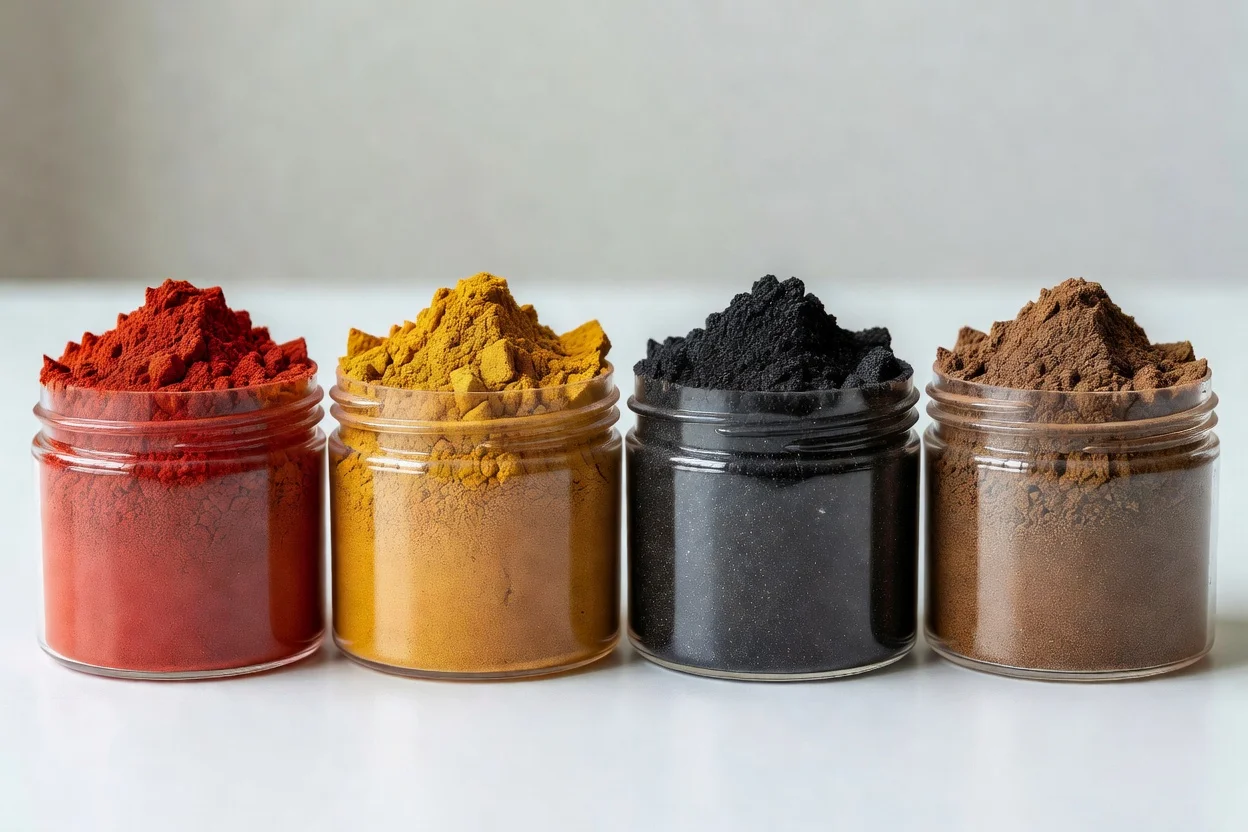
These pigments are available mainly as red, yellow, black, and blended brown or orange shades, with the hue determined by crystal structure, oxidation state, particle size, and surface treatment. Natural and synthetic grades both remain commercially important, although synthetic products dominate many high-consistency industrial uses because they offer tighter color control and more uniform performance.
Their importance extends well beyond coloration. Iron oxide pigments are widely used because they are non-toxic in many standard industrial contexts, resistant to weathering, and compatible with cementitious systems, coatings, plastics, and rubber. At the same time, sustainability debates increasingly focus on mining impacts for natural ores, energy use in synthetic production, and the need for low-carbon, recycled, or by-product-derived pigment routes.
History and Development
Natural iron oxide earth pigments were among the earliest colorants used by humans, with evidence of use going back to prehistoric art and later in glass, coatings, and construction materials. Over time, these naturally occurring ochres and umbers were supplemented and then partly displaced by synthetic iron oxides made through controlled industrial processes that improved purity, shade reproducibility, and dispersion behavior.
Industrial demand expanded as construction, coatings, and plastics required pigments with better consistency than many natural deposits could provide. Modern synthetic iron oxide pigments are now manufactured in large volumes, and recent technical literature notes that they are among the most widely used inorganic pigments worldwide, after titanium dioxide and carbon black in many applications.
Chemical Structure and Key Properties
Iron oxide pigments are a family rather than a single material. The principal commercial phases include yellow iron oxide, red iron oxide, and black iron oxide, corresponding mainly to iron oxyhydroxide, hematite, and magnetite-type structures. Color arises from electronic transitions in iron centers and from light scattering controlled by particle size and morphology.
Common performance traits include:
- Excellent lightfastness, making the pigments suitable for outdoor and long-life products.
- High thermal and chemical stability, which supports use in plastics, coatings, and construction products exposed to heat, alkali, and weather.
- Low solubility in water and many organic media, which helps preserve color under service conditions.
- Good tinting strength and broad shade range, especially in finely milled synthetic grades.
Two practical limits are especially important in plastics and coatings:
- Limit: some yellow grades can transform or darken at elevated temperatures → cause: dehydration or phase change during heating → workaround: use heat-stabilized synthetic grades and keep processing temperatures within the pigment supplier’s recommended window.
- Limit: dispersion quality can be poor in nonpolar polymers or viscous systems → cause: pigment agglomeration and high surface area demand → workaround: use pre-dispersed masterbatches, surface-treated grades, or higher-shear compounding.
A few formulation examples are useful:
- In PVC, PE, or PP masterbatch, iron oxide pigments are often used at relatively low loadings, with the final dosage determined by target color depth and opacity; the key mechanism is uniform particle dispersion, not chemical reaction. Synthetic grades are favored because smaller, more uniform particles improve shade reproducibility.
- In cementitious plastics or colored concrete products, iron oxides are added directly to the mix, where they color the matrix by particle distribution rather than by dissolving into it; the mechanism is essentially physical coloration with high weather resistance.
Production Processes and Raw Feedstocks
Iron oxide pigments are produced by two main routes: natural mineral processing and synthetic manufacture. Natural pigments are obtained from iron-rich deposits that may contain clay, silica, or manganese impurities, followed by beneficiation, grinding, and classification.
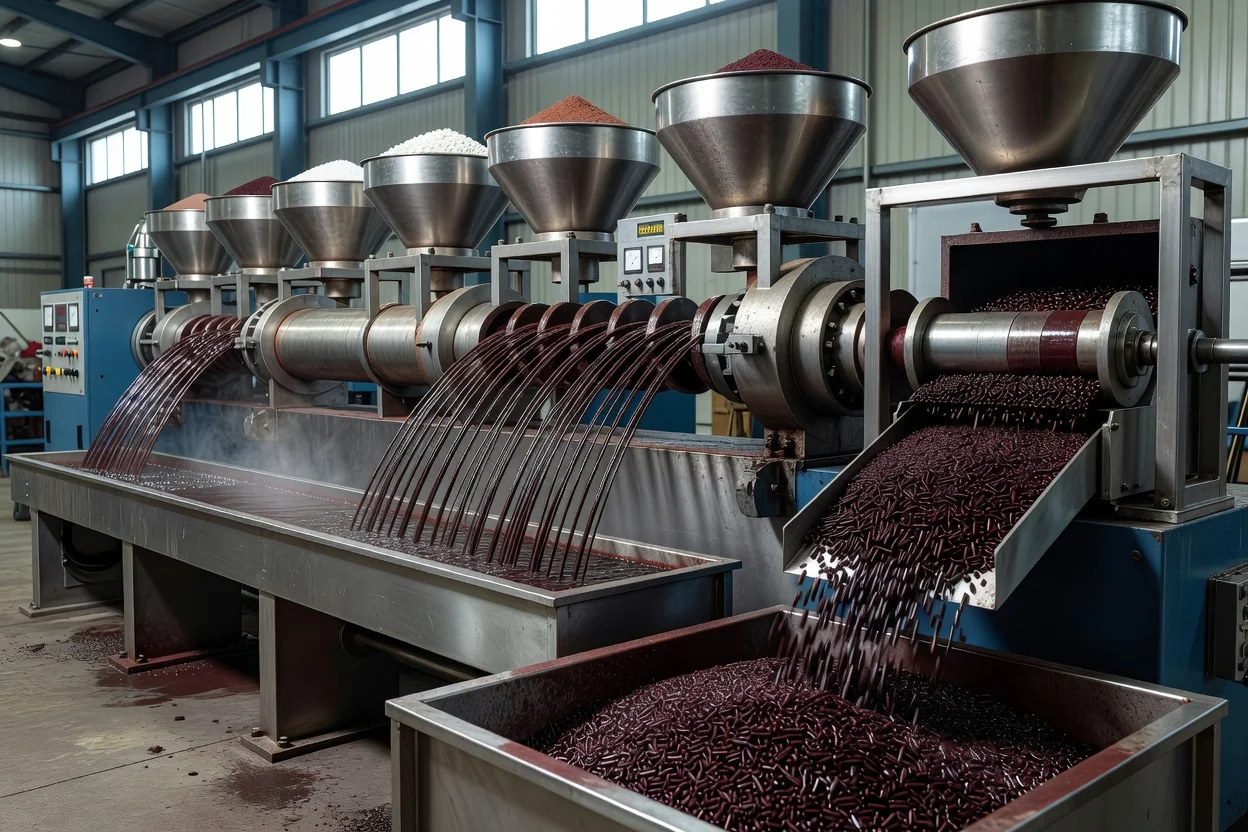
Synthetic production typically uses controlled wet precipitation, oxidation, calcination, or thermal routes starting from iron salts, iron metal, or other iron-bearing intermediates. These methods allow manufacturers to tune particle size, crystallinity, and shade, which is critical for plastics and coatings that require batch-to-batch consistency.
The industrial logic is straightforward: the pigment producer is not merely making “red” or “yellow” powder, but controlling:
- crystal phase,
- particle morphology,
- surface area,
- dispersibility,
- moisture content,
- and impurity profile.
This control is what makes synthetic grades especially valuable in masterbatch production, where small variations in pigment properties can affect melt processing, opacity, gloss, and final color coordinates.
Applications and End-Use Markets
Iron oxide pigments are used across a wide range of markets, but their strongest position is in construction-related materials, coatings, and colored plastics.
| End-use sector | Typical iron oxide role | Common grade or form | Usual processing route |
|---|---|---|---|
| Plastics | Color masterbatch, direct coloration, UV-stable pigmentation | Synthetic red, yellow, black; micronized grades | Twin-screw compounding, masterbatch dilution |
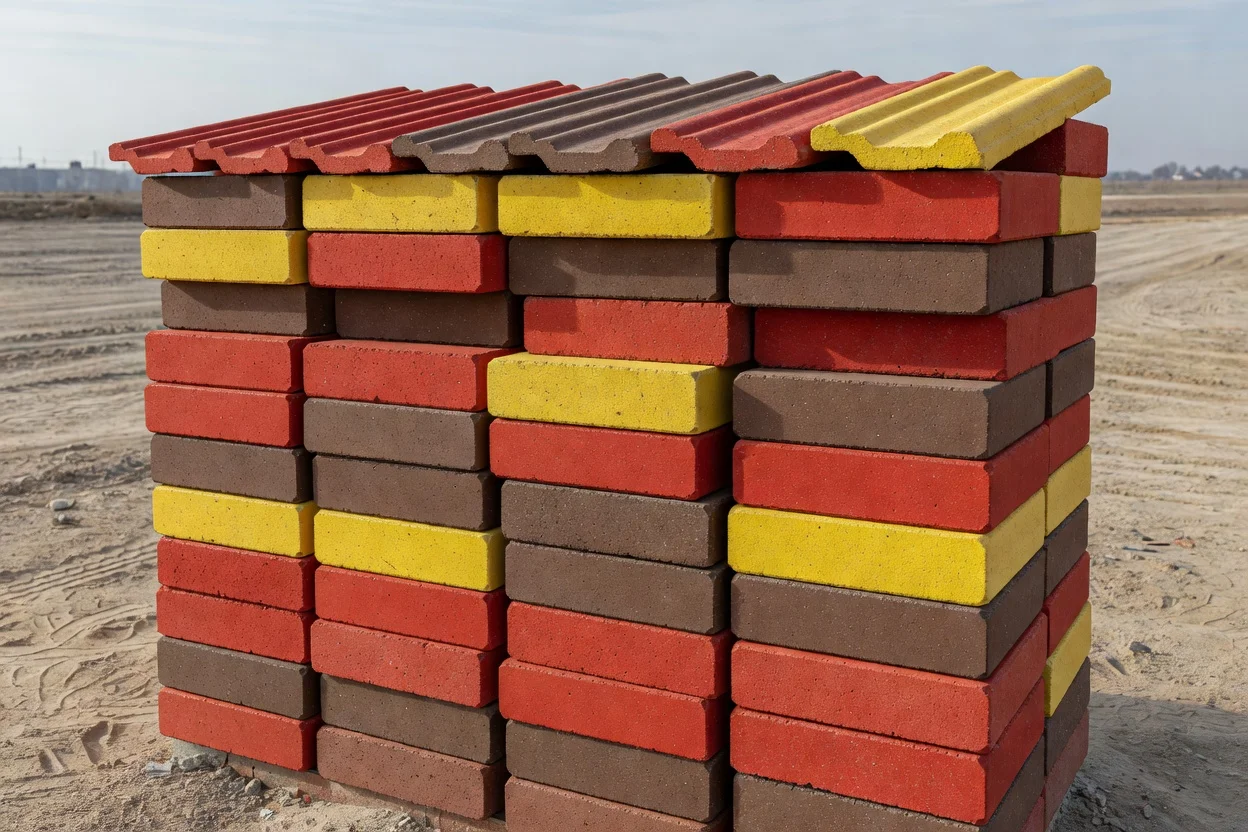
| Construction materials | Colored concrete, mortar, pavers, roof tiles | Standard synthetic or natural grades | Direct addition into cementitious mix |
| Coatings and paints | Architectural, industrial, anticorrosive coloration | Micronized, high-dispersion grades | Letdown into liquid or powder coating systems |
| Rubber | Colored rubber goods and technical compounds | Fine-particle red, yellow, black grades | Banbury or internal mixing |
| Ceramics and glass | Body stains, glazes, decorative coloration | Heat-stable grades | Milling into frits, slips, or glazes |
| Cosmetics | Foundations, concealers, eye and lip products | High-purity cosmetic grades | Controlled dispersion in oil or aqueous systems |
In plastics, iron oxide pigments are used in thermoplastics and thermosets, including consumer goods, construction profiles, cable compounds, and molded parts. They are particularly suited to PVC, PE, and PP when long-term color retention and weatherability matter more than very bright or transparent effects.
One poor-fit use is high-transparency optical plastics, where strong light scattering from pigment particles conflicts with the need for clarity; in such cases, iron oxides are generally unsuitable unless a tinted or opaque appearance is intended. This limitation follows directly from their role as particulate colorants rather than molecular dyes.
Environmental and Sustainability Aspects
Iron oxide pigments are often viewed as comparatively benign inorganic colorants because they are durable, insoluble, and available in grades that support long service life. Their stability can reduce repainting, recoating, and replacement frequency, which is an important indirect sustainability benefit in construction and outdoor plastics.
However, sustainability is more complex than the “non-toxic” label suggests:
- Natural pigments may involve mining, transport, and beneficiation impacts, including land disturbance and tailings management.
- Synthetic pigments require process energy, chemical inputs, and wastewater or by-product handling.
- Plastic recycling can be complicated by pigment carryover, where the color limits downcycling or requires careful sorting and formulation control. This is a practical rather than chemical barrier.
Potentially more sustainable pathways include:
- producing pigments from recovered iron-bearing by-products or remediation streams,
- improving process efficiency and heat recovery in synthetic routes,
- designing pigment packages that remain compatible with mechanically recycled polymers,
- and using concentrated masterbatches to minimize overdosage.
Bio-based alternatives are not direct substitutes for iron oxide pigments in most durable applications because many “green” colorants lack the same lightfastness, opacity, and thermal robustness. For long-life plastics, the relevant sustainability question is often durability per unit impact, not simply renewable origin.
Economic and Global Market Impact
Iron oxide pigments are a large-volume commodity pigment group with strong demand from construction, coatings, plastics, and industrial materials. Their economics are shaped by feedstock availability, energy costs, freight, and the ability to deliver consistent shade and particle properties at scale.
The market is geographically broad, but major supply is typically associated with large industrial pigment producers in Asia, Europe, and North America, alongside local manufacturers serving construction and regional plastics markets. In practice, value is often created less by raw pigment chemistry than by milling, surface treatment, quality control, and masterbatch integration.
Because pigments are bulky, low-to-moderate value additives, logistics and formulation efficiency matter. Fine control over tinting strength can reduce dosage, which lowers total formulation cost and shipping burden.
Current Challenges and Innovations
Key technical challenges include:
- maintaining shade consistency across batches and suppliers,
- achieving strong dispersion in low-polarity polymers,
- avoiding agglomeration in high-load formulations,
- and managing thermal behavior during extrusion or molding.
Current innovation directions include:
- micronized and nano-dispersed grades for improved color strength and gloss,
- surface-treated pigments for better compatibility with polymer matrices,
- high-purity cosmetic and food-contact grades with tight impurity limits,
- and hybrid color systems that combine iron oxides with organic pigments or effect pigments for tailored aesthetics.
In plastics processing, the most important advance is often not a new pigment chemistry but a better dispersion architecture: masterbatch design, optimized screw configuration, and polymer-specific wetting strategies can substantially improve color quality without changing the pigment itself.
Future Outlook
Demand for iron oxide pigments is likely to remain resilient because they serve applications that prioritize permanence, outdoor stability, and cost control. Construction materials, infrastructure coatings, and durable plastics are especially likely to sustain long-term use.
Future growth will probably depend on three linked developments:
- more circular feedstocks and lower-carbon production routes,
- better pigment compatibility with recycled polymers,
- and higher-performance micronized or surface-modified grades for demanding appearance and weathering specifications.
For the plastics industry, the strategic role of iron oxide pigments will remain clear: they are not the most vivid colorants, but they are among the most dependable. Their combination of durability, availability, and mature manufacturing makes them a foundational auxiliary wherever stable coloration is more important than optical brilliance.
References
- •
Man-Made Oxide Pigment. (2026, February 23). Earth Pigments. https://earthpigments.com/oxide-pigments/Link
- •
1-48 of 708 results for "iron oxide pigment". (2024, September 17). Amazon. https://www.amazon.com/iron-oxide-pigment/s?k=iron+oxide+pigmentLink
- •
Iron Oxide Pigments. (2021, January 4). 911 Metallurgist. https://www.911metallurgist.com/blog/iron-oxide-pigments/Link
- •
Iron oxide pigments [PDF]. (n.d.). NSW Resources. https://www.resources.nsw.gov.au/sites/default/files/2022-11/ironoxide.pdfLink
- •
IC 8771 Iron Oxide Pigments (Part 1 [PDF]. (n.d.). CDC Stacks. https://stacks.cdc.gov/view/cdc/235897/cdc_235897_DS1.pdfLink
- •
Properties of iron oxide pigments. (n.d.). Pigment Iron Oxide. https://pigmentironoxide.com/news/properties-of-iron-oxide-pigments-14.htmlLink
- •
Toda United Industrial (Zhejiang) Co., Ltd. (2017, November 17). The main purpose of iron oxide pigments. https://www.zjunited.com/the-main-purpose-of-iron-oxide-pigments.htmlLink
- •
Mineral Resource of the Month: Iron oxide pigments. (2021). Earth Magazine. https://www.earthmagazine.org/article/mineral-resource-month-iron-oxide-pigments/Link
- •
Iron Oxide Pigments: Essential Guide to Their Properties and Uses. (2025, February 10). Henan Chemger Group Corporation. https://www.chemger.com/iron-oxide-pigments-essential-guide-to-their-properties-and-uses/Link
- •
Key Attributes. (n.d.). Golchha Oxides. https://www.golchhaoxides.com/iron-oxide-pigments.phpLink
- •
Pigment Grade Iron Oxide: Comprehensive Analysis Of.... (n.d.). Eureka PatSnap. https://eureka.patsnap.com/materials/pigment-grade-iron-oxideLink
- •
Iron Oxide Pigment Material: Comprehensive Analysis Of.... (n.d.). Eureka PatSnap. https://eureka.patsnap.com/materials/iron-oxide-pigment-materialLink
- •
41 Iron oxide pigments. (2022, January 19). De Gruyter. https://www.degruyter.com/document/doi/10.1515/9783110587104-041/html?lang=enLink
- •
Iron oxide pigments. (2021, October 1). De Gruyter. https://www.degruyter.com/document/doi/10.1515/psr-2020-0179/htmlLink
- •
Iron Oxides [PDF]. (n.d.). HORIBA. https://www.horiba.com/fileadmin/uploads/Scientific/Documents/PSA/Application_Notes/AN132_Iron_Oxides.pdfLink
- •
Iron Oxide Applications. (n.d.). Golchha Pigment. https://www.golchhapigments.com/iron_oxide_applications.htmlLink
- •
Iron Oxide Powder: Uses, How It's Made, and How to Use It. (2026, May 25). Demei Pigment. https://www.demeipigment.com/news/industry-news/iron-oxide-powder-uses-how-it-s-made-and-how.htmlLink
- •
Mineral Resource of the Month: Iron Oxide Pigments. (n.d.). Earth Magazine. https://www.earthmagazine.org/article/mineral-resource-month-iron-oxide-pigments-0/Link
- •
Iron Oxide Colorants in the Real World: 5 Uses You'll.... (2025, October 1). LinkedIn. https://www.linkedin.com/pulse/iron-oxide-colorants-real-world-5-uses-youll-actually-pypceLink
- •
IRON OXIDE PIGMENTS. (n.d.). Ataman Chemicals. https://www.atamanchemicals.com/iron-oxide-pigments_u36224/Link
- •
Irons Oxides and Other Matte Pigments. (2024, November 20). Just Pigments. https://justpigments.com/collections/iron-oxides-and-other-matte-pigmentsLink
- •
Iron Oxide Pigments in the Real World: 5 Uses You'll.... (2025, September 18). LinkedIn. https://www.linkedin.com/pulse/iron-oxide-pigments-real-world-5-uses-youll-actually-see-2025-s6tzeLink
- •
Iron Oxide Red Pigment: Advanced Synthesis Routes, Structural.... (n.d.). Eureka PatSnap. https://eureka.patsnap.com/materials/iron-oxide-red-pigmentLink
- •
Names for Iron Oxide Earth Pigments. (2018, April 15). Natural Pigments. https://www.naturalpigments.com/artist-materials/iron-oxide-earth-pigmentsLink
- •
Iron Oxide Pigment: Manufacturing, Applications, and Color Control. (2025, May 20). Raw Chemical Mart. https://rawchemicalmart.com/iron-oxide-pigment-manufacturing-applications-and-color-control/Link
- •
Iron Oxide Yellow Pigment: Comprehensive Analysis Of.... (n.d.). Eureka PatSnap. https://eureka.patsnap.com/materials/iron-oxide-yellow-pigmentLink
- •
Iron Oxide Pigments. (n.d.). Fineland Chem. https://www.finelandchem.com/iron-oxide-pigments/Link
- •
Iron Oxide Pigments (in Two Parts) 2. Natural Iron.... (2017). CDC Stacks. https://stacks.cdc.gov/view/cdc/235896Link
- •
Iron(III) oxide. (2003, April 25). Wikipedia. https://en.wikipedia.org/wiki/Iron(III)_oxideLink
- •
Geology and Mineral Resources - Iron Oxide Pigments. (n.d.). Virginia Energy. https://energy.virginia.gov/geology/FeOxide.shtmlLink
- •
The Properties of Iron Oxide Nanoparticle Pigments. (n.d.). Wiley Online Library. https://onlinelibrary.wiley.com/doi/abs/10.1002/9781119436782.ch22Link
- •
Iron oxide. (2003, July 25). Wikipedia. https://en.wikipedia.org/wiki/Iron_oxideLink
- •
Category:Iron oxide pigments. (2013, March 30). Wikipedia. https://en.wikipedia.org/wiki/Category:Iron_oxide_pigmentsLink
- •
Synthetic Iron Oxide : Colour, Uses and Characteristics. (2020, November 20). Bansal Trading. https://bansaltrading.com/usage-of-synthetic-iron-oxideLink
- •
A Study of the Effect of Different Iron Oxide Pigment Grades on.... [PDF]. (n.d.). Paint.org. https://www.paint.org/wp-content/uploads/2021/09/FEB00_Iron-Oxide-Pigment-Industrial-Latex-Coating.pdfLink
- •
Iron Oxide Pigments [PDF]. (n.d.). USGS. https://pubs.usgs.gov/myb/vol1/2019/myb1-2019-feoxi.pdfLink
- •
Iron Oxides in Skincare: Benefits, Uses, & More. (2024, November 4). Colorescience. https://www.colorescience.com/blogs/blog/what-are-iron-oxidesLink
- •
Expert Guide to Transparent Iron Oxide Pigments for Artists. (2024, January 19). Natural Pigments. https://www.naturalpigments.com/artist-materials/transparent-iron-oxide-pigmentLink
- •
Iron Oxide Concrete Pigments for Rich, Lasting Color. (n.d.). Solomon Colors. https://www.solomoncolors.com/concrete-colors/iron-oxide-pigments.htmlLink
- •
Application Of Iron Oxide Pigment. (n.d.). Golchha Oxides. https://www.golchhaoxides.com/application.phpLink
- •
Iron Oxide Pigments Statistics and Information. (n.d.). USGS. https://www.usgs.gov/centers/national-minerals-information-center/iron-oxide-pigments-statistics-and-informationLink
- •
Diversity of Iron Oxides: Mechanisms of Formation,.... (n.d.). MDPI. https://www.mdpi.com/2312-7481/9/5/119Link