
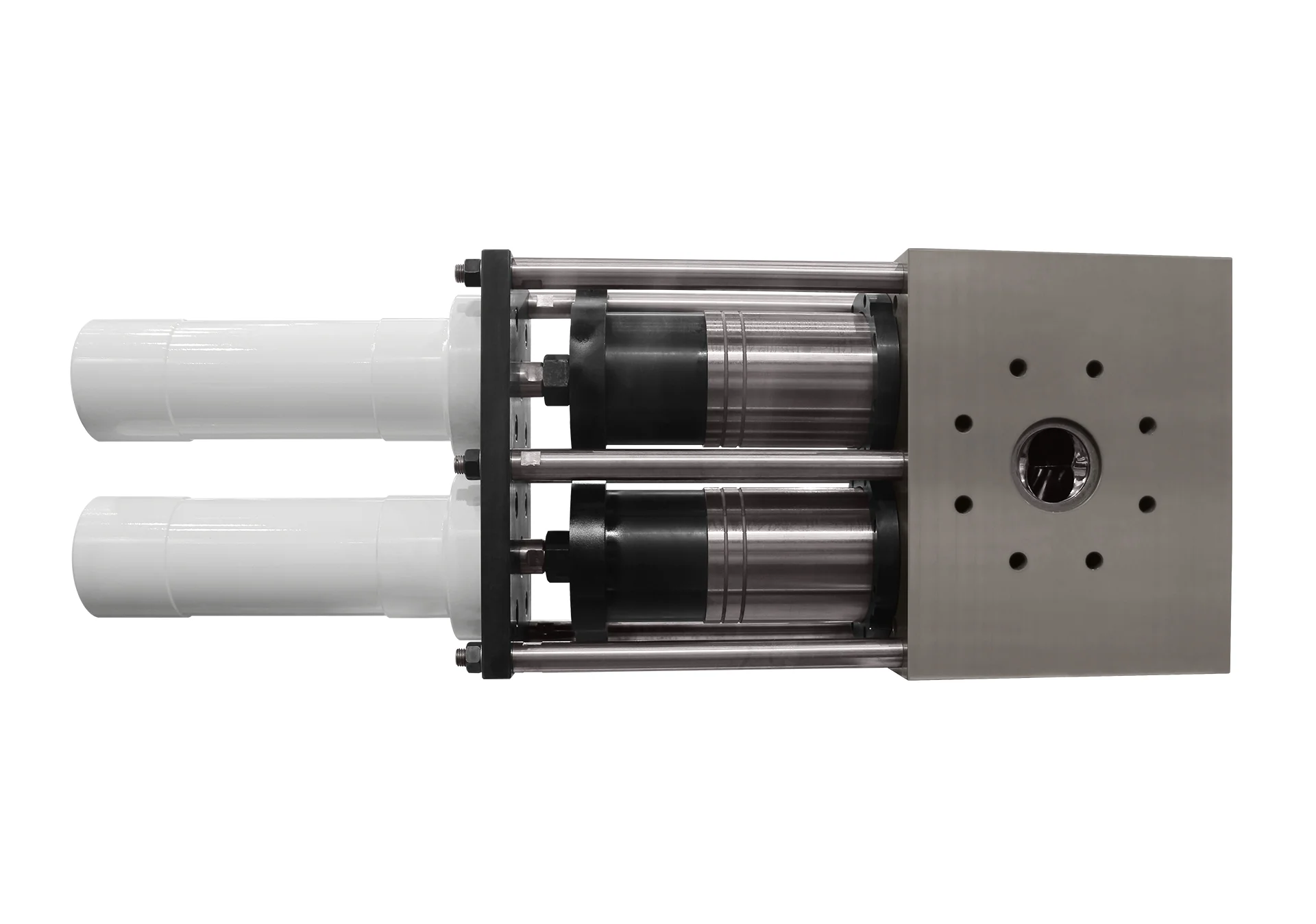
Introduction
Material loading and unloading equipment refers to the machines, devices, and integrated systems used to transfer raw materials, semi-finished parts, and finished products into and out of processing equipment, storage points, and transport interfaces in manufacturing and logistics. In plastics processing, the term most often covers automatic loaders, unloaders, conveyors, hoists, vacuum pick-and-place systems, robotic handling cells, depalletizers, and bulk-material feeding/unloading systems that support injection molding, extrusion, blow molding, thermoforming, sheet processing, recycling, and packaging lines.
Within the plastics industry, these systems are important because they connect upstream material preparation and downstream product removal, helping stabilize cycle times, reduce contamination, improve operator safety, and support unmanned or lightly attended production. Their development has moved from manually assisted handling toward servo-driven, sensor-based, and robot-integrated automation, with growing emphasis on energy efficiency, compact layouts, traceability, and compatibility with recycled and regrind-based material streams.
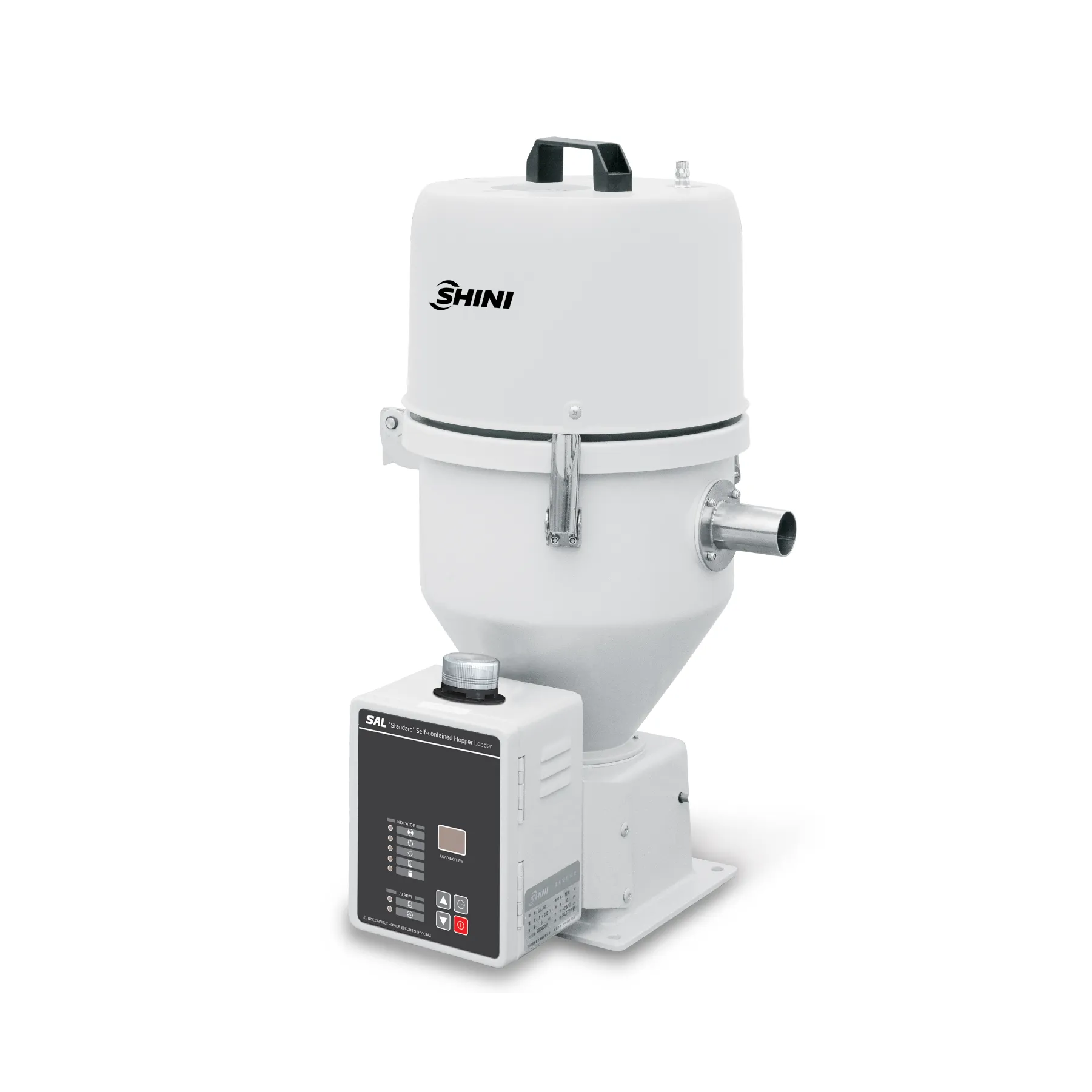
History and Development
Early industrial loading and unloading systems were largely manual or mechanically assisted, using lifting devices, conveyors, and positioning aids to reduce physical labor and speed material transfer. As factory automation expanded, handling equipment became more specialized, separating into transport, positioning, and unit-load management functions.
Several developments shaped the modern plastics-processing version of the technology:
- Mechanization of part transfer: fixed conveyors, lift tables, and hopper loaders reduced direct manual handling in molding and finishing operations.
- Vacuum and gripper-based automation: sheet and part handling increasingly used suction cups, mechanical grippers, and transfer rails for repeatable placement and removal, especially in sheet metal and flat-stock processing that influenced plastics automation design.
- Robot-integrated and cell-based systems: current loading/unloading units are often integrated with CNC, presses, laser cutting, and molding cells, enabling continuous operation, sorting, buffering, and downstream transfer.
Chinese industrial patent literature and equipment catalogues also show the broad spread of dedicated 上、下料装置 in machine-tool, sheet, tray, glass, and inspection systems, indicating that the concept has become a standard automation block across discrete manufacturing.
Technical Overview
At a functional level, material loading and unloading equipment performs one or more of the following tasks:
- Feeding raw material to a machine inlet, hopper, mold station, magazine, or carrier.
- Removing finished parts, scrap, or bulk material from a machine outlet or process zone.
- Repositioning items for the next operation, sorting, stacking, or recycling.
- Buffering material to decouple machine cycles and reduce downtime.
In plastics processing, equipment selection depends on whether the handled material is pellets, flakes, powders, regrind, sheets, preforms, or molded parts. Bulk handling for resin often uses vacuum loaders, hopper receivers, gravimetric feeders, and drum/bag unloading stations, while part handling often uses robotic end effectors, conveyors, depalletizers, and transfer frames.
Typical technical characteristics include:
- Throughput
- Small part handling systems: tens to hundreds of parts per minute, depending on pick-and-place geometry and machine cycle.
- Bulk loaders/unloaders: from a few hundred kg/h in compact units to multi-ton-per-hour systems in industrial bulk transfer service.
- Rotor or drive speeds
- For granulation-linked loading/unloading systems, rotor speeds are commonly in the low-thousands rpm range; many industrial shredder and granulator designs operate roughly around 300–1,000 rpm for cutting rotors and higher for secondary size reduction, depending on material and screen design.
- Residual moisture after dewatering
- In plastics recycling lines, centrifugal dewatering and drainage stages commonly reduce surface moisture to approximately the low single-digit percentage range, often around 1–3% for washed flakes, depending on polymer, flake geometry, and downstream drying. This is an engineering benchmark rather than a fixed standard.
- Flake size
- Washed and sorted plastic flakes are often specified in practical handling ranges such as roughly 10–12 mm or larger fragments, with size distributions adapted to re-extrusion or pelletizing requirements.
- Specific energy consumption
- Energy demand varies widely by duty: simple conveyor transfer is comparatively low, while vacuum lifting, robotic manipulation, and heavy bulk unloading can be substantially higher. In modern automation, energy optimization is increasingly achieved through servo drives, standby modes, and reduced compressed-air dependence.
From an engineering perspective, the most important design variables are payload, reach or travel stroke, cycle time, positioning accuracy, material compatibility, dust control, cleanability, safety interlocks, and integration with machine controls.
Types and Variations
| Type | Main function | Common plastics-processing use |
|---|---|---|
| Vacuum loader | Transfers pellets or regrind by suction | Feeding injection molding and extrusion hoppers |
| Conveyor-based loader/unloader | Moves parts or containers along a fixed path | Sheet, tray, and molded-part transfer |
| Robotic loader/unloader | Picks, places, sorts, or stacks items | Molded parts removal, tray handling, packaging |
| Depalletizer / palletizer interface | Loads or unloads stacked units | Resin bags, cartons, preforms, or finished packs |
| Bulk bag or silo unloading system | Discharges dry bulk material into a process line | Resin, additives, regrind, masterbatch, powders |
| CNC or machine-tool loading unit | Automatically feeds blanks and removes finished parts | Secondary machining of molded or cut plastic parts |
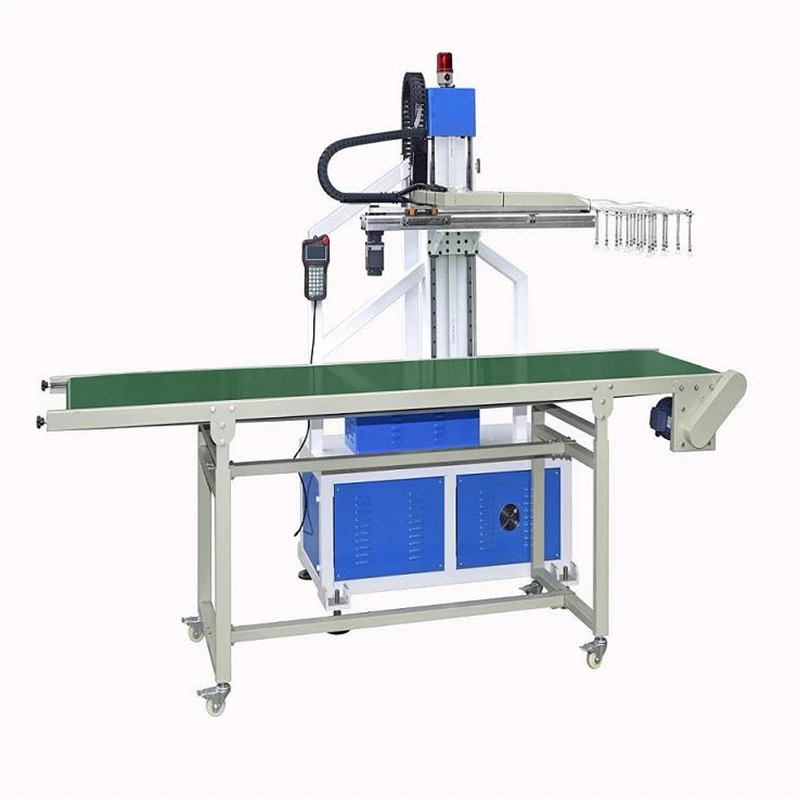
Common configuration differences include:
- Single-sided loading/unloading systems, which save floor space and simplify machine access.
- Dual-station systems, which separate loading and unloading for higher throughput and process security.
- Continuous transfer lines, which use rollers, elevators, or transverse conveyors to maintain flow between stations.
- Flexible robotic cells, which combine vision, grippers, and programmable motion to serve multiple part types.
Applications and Uses
Material loading and unloading equipment is used across nearly every plastics-processing segment.
- Injection molding
- Hopper loading, insert placement, molded-part removal, part counting, and box packing are typical uses.
- Extrusion
- Resin conveyance, additive dosing, downstream take-off, cooling-line transfer, and reel or stack handling are common.
- Blow molding
- Preform feeding, bottle discharge, trimming removal, and case packing often require synchronized handling.
- Thermoforming and sheet processing
- Sheet loading, formed-part removal, nesting, stacking, and scrap take-off rely heavily on vacuum and conveyor systems.
- Recycling and reprocessing
- Bulk unloading of baled or bagged material, sorting, dewatering, and transfer of washed flakes are central tasks.
- Packaging and distribution
- Resin bags, finished goods, trays, and cartons are loaded, offloaded, palletized, and depalletized for shipment.
One poor-fit use is highly fragile, irregular, or contamination-sensitive specialty parts in mixed manual environments, where overly aggressive automation can damage parts or increase changeover complexity if not carefully engineered.
Technological Innovations and Automation
Automation in loading and unloading equipment is increasingly defined by robotics, sensors, software, and data connectivity. Current systems may use vision inspection, force feedback, vacuum monitoring, barcode or RFID identification, and machine-to-machine communication to adjust handling paths and reject defective items.
Key innovations include:
- Flexible automation cells that can run manual and automatic cycles in parallel, improving machine uptime.
- Servo-driven motion systems that improve repeatability and reduce compressed-air use.
- Integrated safety controls with light curtains, interlocks, and safe-speed monitoring for operator protection.
- Adaptive end effectors that can handle multiple product geometries with fewer tool changes.
- Buffer-and-transfer logic that decouples upstream and downstream stations to stabilize production flow.
In plastics plants, these developments are especially valuable where resin feeding, part removal, and packaging must be synchronized with tight cycle times and quality-sensitive processes.
Environmental and Sustainability Aspects
Loading and unloading equipment can contribute to sustainability in several ways:
- Lower material loss through closed transfer paths, better containment, and reduced spillage.
- Reduced labor and rehandling through direct transfer between process steps, which lowers damage and scrap risk.
- Improved energy efficiency through optimized drive systems, reduced idling, and fewer unnecessary transport steps.
- Better circular-economy compatibility by supporting regrind, washed flakes, recycled pellets, and take-back material streams.
At the same time, automation can increase embodied equipment complexity, maintenance demand, and sensitivity to contamination if systems are not designed for the full material spectrum. In practice, the most sustainable solutions are those that balance throughput, cleanability, durability, and repairability rather than maximizing automation alone.
Economic and Global Market Impact
The economic role of loading and unloading equipment is tied to labor substitution, cycle-time reduction, and line uptime. In many plastics operations, the business case depends less on the equipment itself than on the avoided cost of downtime, manual handling, part damage, and downstream congestion.
Global demand has been supported by several structural trends:
- growth in automated manufacturing and warehouse logistics,
- tighter safety and ergonomics expectations,
- rising use of recycled polymers and bagged or bulk-fed material streams,
- expansion of compact, modular automation for small and medium plants.
Suppliers in this segment range from general material-handling manufacturers to machine-tool and plastics-line integrators, with many systems sold as application-specific automation packages rather than as stand-alone equipment.
Current Challenges and Innovations
The main challenges are:
- Product variability, which complicates gripping, orientation, and stacking.
- Space constraints, especially in retrofit installations with limited access to molding or press cells.
- Dust, fines, and contamination, especially in resin and recycling operations.
- Changeover complexity, where frequent product variation can erode automation benefits.
- Safety and compliance, which require robust guarding, control logic, and operator training.
Ongoing innovation focuses on modularity, digital commissioning, predictive maintenance, and easier integration with manufacturing execution systems. These features are intended to make loading and unloading devices more adaptable to short production runs, mixed-material streams, and higher traceability requirements.
Future Outlook
Future material loading and unloading equipment in plastics processing is likely to become more modular, data-driven, and cell-oriented. The strongest growth areas are expected to be robotic unloading, smart conveying, automated bulk material transfer, and integrated handling systems for recycled-feedstock preparation.
In engineering terms, the next generation of systems will likely emphasize:
- lower energy use per handled unit,
- faster product changeovers,
- better handling of recycled and irregular materials,
- tighter integration with quality inspection,
- and greater compactness for brownfield retrofits.
Summary
Material loading and unloading equipment is a foundational automation category in plastics processing, linking raw-material intake, machine feeding, part removal, buffering, and packaging. Its evolution from manual aids to robotic, sensor-based, and system-integrated handling reflects the industry’s priorities of productivity, safety, quality, and sustainability.
References
- •
Material-handling equipment. (2007, April 28). Wikipedia. https://en.wikipedia.org/wiki/Material-handling_equipmentLink
- •
Industrial loading and unloading equipment. (2026, May 15). Unloadingrobot.com. https://www.unloadingrobot.com/a-comprehensive-guide-to-industrial-loading-and-unloading-equipment/Link
- •
Role of logistics equipment (material handling devices). (n.d.). Keyence. https://www.keyence.com/ss/products/auto_id/logistics/role/material-handling.jspLink
- •
Bulk material loaders unloaders. (n.d.). GlobalSpec. https://www.globalspec.com/learnmore/material_handling_packaging_equipment/material_handling_equipment/bulk_material_loaders_unloadersLink
- •
工业设计. (n.d.). Cinn.cn. https://wap.cinn.cn/p/W020230504593196673169.pdfLink
- •
S4+P4 柔性生产线. (2025, October 16). Salvagnini. https://www.salvagninigroup.com/zh-CN/products/fms-systems/S4-P4Link
- •
上下料裝置. (n.d.). Newton.com.tw. https://www.newton.com.tw/wiki/%E4%B8%8A%E4%B8%8B%E6%96%99%E8%A3%9D%E7%BD%AELink
- •
Loading and unloading conveyor manufacturer. (n.d.). Nailishen.com. https://www.nailishen.com/en/productsLink
- •
Loading unloading equipment. (n.d.). Ecer.com. https://www.ecer.com/china-loading-unloading-equipmentLink
- •
上下料装置(Compact Express). (n.d.). Primapower.com. https://www.primapower.com/zh-hans/technologies/automation/material-handling/material-loading-and-unloading-device-compact-expressLink
- •
4 types of material handling equipment and their uses. (n.d.). BigRentz. https://www.bigrentz.com/blog/types-of-material-handling-equipmentLink
- •
Loading and unloading conveying line. (n.d.). Hz-hsly.com. https://www.hz-hsly.com/cms/en/prod/id/24.htmlLink
- •
Loading systems for multiple.... (2025, August 26). Beumergroup.com. https://www.beumergroup.com/products-systems/loading-technology/Link
- •
热处理后锥齿轮副生产线智能化建设. (n.d.). Auto1950.com. https://www.auto1950.com/cn/article/pdf/preview/10.3969/j.issn.1672-657X.2019.08.008.pdfLink
- •
Loading equipment. (2024, April 23). Sennder.com. https://www.sennder.com/glossary/loading-equipmentLink
- •
折轨式曲轴上下料装置的应用. (2026, June 18). Auto.jgvogel.cn. https://auto.jgvogel.cn/c701981.shtmlLink
- •
一种数控转塔冲床自动上下料装置. (2014, July 9). Patents.google.com. https://patents.google.com/patent/CN204018581U/zhLink
- •
PA 自动上/下料系统. (n.d.). Lvdgroup.com. https://www.lvdgroup.com/zh-hans/chongchuang/zidonghuaxitong/pa-zidongshangxialiaoxitongLink
- •
CN120079610A - 一种三温测试分选机. (2025, April 29). Patents.google.com. https://patents.google.com/patent/CN120079610A/zhLink
- •
钣金自动上下料指南. (2025, July 29). Shen-chong.com. https://www.shen-chong.com/zh/sheet-metal-automatic-loading-and-unloading-guide/Link
- •
Material handling equipment. (2023, January 29). Studocu.com. https://www.studocu.com/row/document/mekdela-amba-university/introduction-to-agribusiness-management/material-handling-by-dr-ing-daniel-kitaw/45343070Link
- •
Types of material handling equipment. (2026, June 4). Chicagoindustrial.com. https://www.chicagoindustrial.com/blog/material-handling-equipment/Link
- •
板料加工设备的自动上下料装置. (n.d.). Patents.google.com. https://patents.google.com/patent/CN201931321U/zhLink
- •
What is bulk cargo handling equipment? (2025, June 11). A1autotransport.com. https://www.a1autotransport.com/what-is-bulk-cargo-handling-equipment/Link
- •
CN211366206U - 一种上下料装置. (2019, October 9). Patents.google.com. https://patents.google.com/patent/CN211366206U/zhLink
- •
Shiploading direct from trucks. (n.d.). Telestack.com. https://www.telestack.com/products/ship-loading/ship-loading-direct-from-trucks/Link
- •
How automated material handling systems help loading efficiency. (n.d.). Joloda.com. https://www.joloda.com/en/news/how-automated-material-handling-systems-help-loading-efficiency/Link
- •
Loading and unloading automation technologies. (n.d.). Automation.honeywell.com. https://automation.honeywell.com/us/en/products/warehouse-automation/solutions-by-technology/robotics/loading-and-unloading-automation-technologiesLink
- •
【英语】轧钢术语中英文对照. (2018, June 16). 163.com. https://www.163.com/dy/article/DKDP0GLV0514CLN0.htmlLink
- •
A guide to warehouse loading and unloading procedure. (2025, April 29). Qmhinc.com. https://www.qmhinc.com/warehouse-loading-and-unloading-procedure/Link
- •
Bulk bag equipment: Types & applications. (n.d.). IQS Directory. https://www.iqsdirectory.com/articles/pneumatic-conveyor/bulk-bag-equipment.htmlLink
- •
CN103481107A - 下料设备及下料方法. (2012, November 28). Patents.google.com. https://patents.google.com/patent/CN103481107A/zhLink
- •
Material handling equipment (types, applications, and ...). (2023, June 30). Thomasnet.com. https://www.thomasnet.com/articles/materials-handling/material-handling-equipment/Link
- •
S4+P4 柔性生产线. (n.d.). Salvagnini.com.cn. https://www.salvagnini.com.cn/zh-CN/products/fms-systems/S4-P4Link
- •
Loader (equipment). (2004, February 23). Wikipedia. https://en.wikipedia.org/wiki/Loader_(equipment)Link
- •
一种自动上下料装置. (2021, March 1). Patents.google.com. https://patents.google.com/patent/CN112850152A/zhLink
- •
Tray盘自动化上下料装置. (2021, January 19). Patents.google.com. https://patents.google.com/patent/CN214494906U/zhLink
- •
自动上下料机. (2019, October 29). Patents.google.com. https://patents.google.com/patent/CN110842101A/zhLink
- •
自动喂料系统. (2013, April 3). Patents.google.com. https://patents.google.com/patent/CN103141407A/zhLink