
Introduction
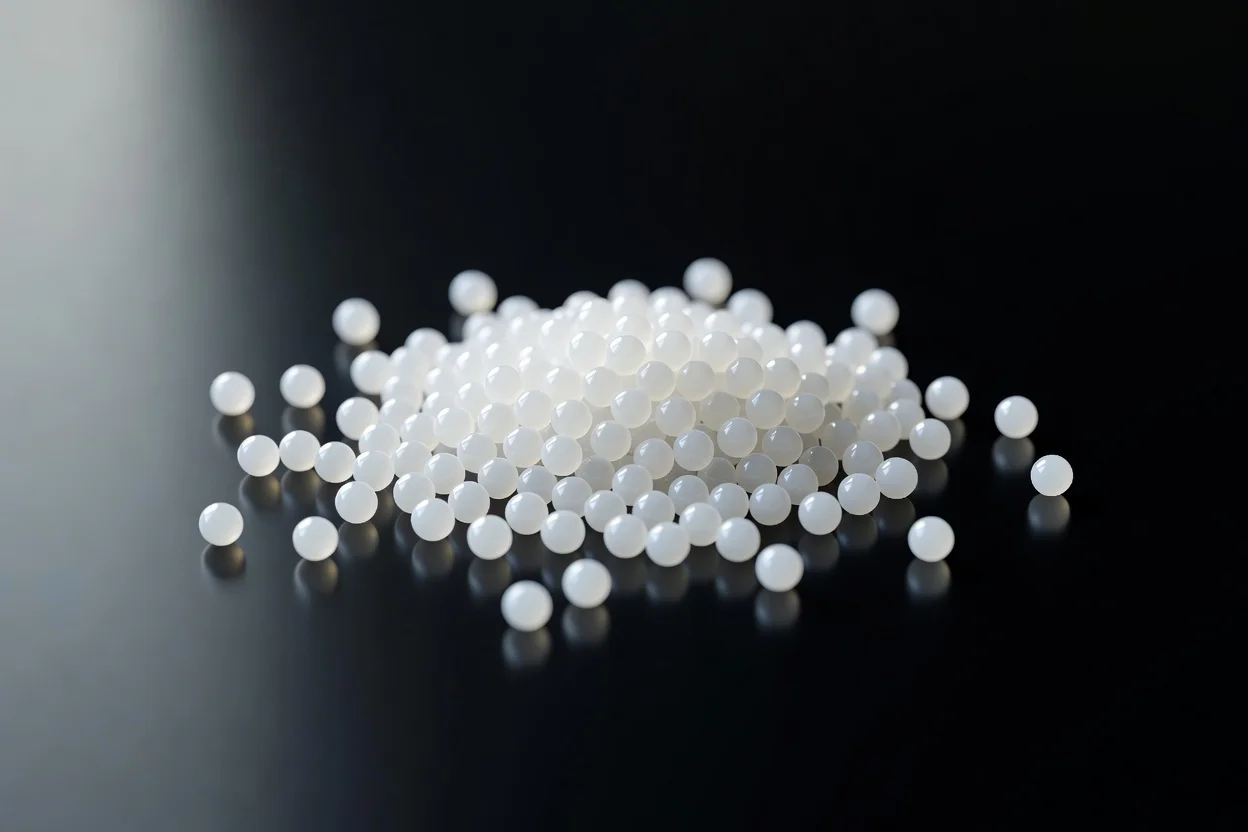
Polyglycolic acid (PGA), more commonly called polyglycolide, is the simplest linear aliphatic polyester and one of the earliest commercially important biodegradable thermoplastics. It is best known as a high-strength, fast-resorbing material for surgical sutures, but its unusually high crystallinity, high melting point, and exceptional gas-barrier performance have also made it relevant to packaging, fiber reinforcement, tissue-engineering scaffolds, and selected industrial specialty uses.
PGA is typically produced from glycolic acid or, more commonly in high-performance grades, from glycolide via ring-opening polymerization. Its structure gives it a combination of high stiffness and rapid hydrolytic degradation, but also creates practical limits such as brittleness and poor solubility in most common solvents, which have historically restricted processing and broader commercial adoption.
The material occupies an important position in the broader plastics and auxiliaries ecosystem because it bridges two demanding requirements that are often hard to combine: temporary service life and high mechanical or barrier performance. In medicine, that balance enabled the first generation of absorbable sutures; in packaging and specialty films, it has attracted attention as a biodegradable barrier layer; and in composites and copolymers, it serves as a reinforcing or property-tuning component.
From a sustainability perspective, PGA is attractive because it is biodegradable and can be derived through routes that are compatible with circular-material thinking, but it is not a universal replacement for petrochemical polymers. Its cost, moisture sensitivity, processing window, and end-of-life infrastructure remain major constraints, while ongoing innovation focuses on copolymers such as PLGA, improved catalyst systems, fiber engineering, and multilayer structures that extend its usefulness.
History and Development
PGA was among the earliest degradable polymers investigated for biomedical use, and its strength and thermal properties were recognized decades ago. Commercial medical adoption came first, especially in absorbable sutures, where its combination of high initial strength and predictable hydrolysis was highly valuable.
A major development path has been the shift from the homopolymer to copolymers, especially PLGA, because pure PGA is difficult to process and degrades relatively quickly. This copolymer strategy has allowed the polymer family to expand into drug delivery, scaffolds, and other medical materials where degradation rate must be tuned more precisely.
More recently, interest has broadened beyond medicine. Research has emphasized PGA as a high-barrier biodegradable film material, a reinforcing phase in blends, and a candidate for high-performance temporary structures where conventional plastics are difficult to recover or where complete removal after service is desirable.
Chemical Structure and Key Properties
PGA is a linear aliphatic polyester built from glycolic-acid-derived repeat units. Its molecular simplicity has a strong practical consequence: chains pack tightly, crystallinity is high, and the material therefore shows high stiffness, a high melting point, and relatively low permeability to gases.
Core property profile
| Property | Typical character of PGA | Practical effect |
|---|---|---|
| Crystallinity | High, often around 45–55% in many references | Raises stiffness, barrier performance, and melting point |
| Melting point | About 215–230 °C | Allows use in higher-temperature processing windows than many other biodegradable polyesters |
| Glass transition temperature | Roughly 35–40 °C | Means the polymer is relatively rigid near room temperature |
| Tensile strength | Often reported around 60–115 MPa | Supports sutures, films, and reinforcement uses |
| Tensile modulus | About 6–7 GPa in many studies | Indicates very high stiffness for a biodegradable polyester |
| Gas barrier | Exceptionally high, especially to oxygen | Supports food and pharmaceutical packaging concepts |
Important limits
- Brittleness → caused by high crystallinity and rigid chain packing → workaround: use copolymerization with lactic acid, blending, plasticization, or fibrous orientation control.
- Poor solubility in common organic solvents → caused by strong crystallinity and tightly packed chains → workaround: use specialized solvents, melt processing where feasible, or process PGA as a copolymer or composite rather than as a neat resin.
- Hydrolytic sensitivity → caused by ester bonds that cleave in water → workaround: choose PGA only where a temporary service life is desired, or use coatings and multilayer design to slow premature moisture exposure.
Mechanism note
A typical biomedical strategy is to use PLGA rather than neat PGA when a slower or more tunable degradation profile is needed, because the lactic-acid units disrupt crystallinity and modify water uptake and hydrolysis kinetics.
Additive and surface-modification example
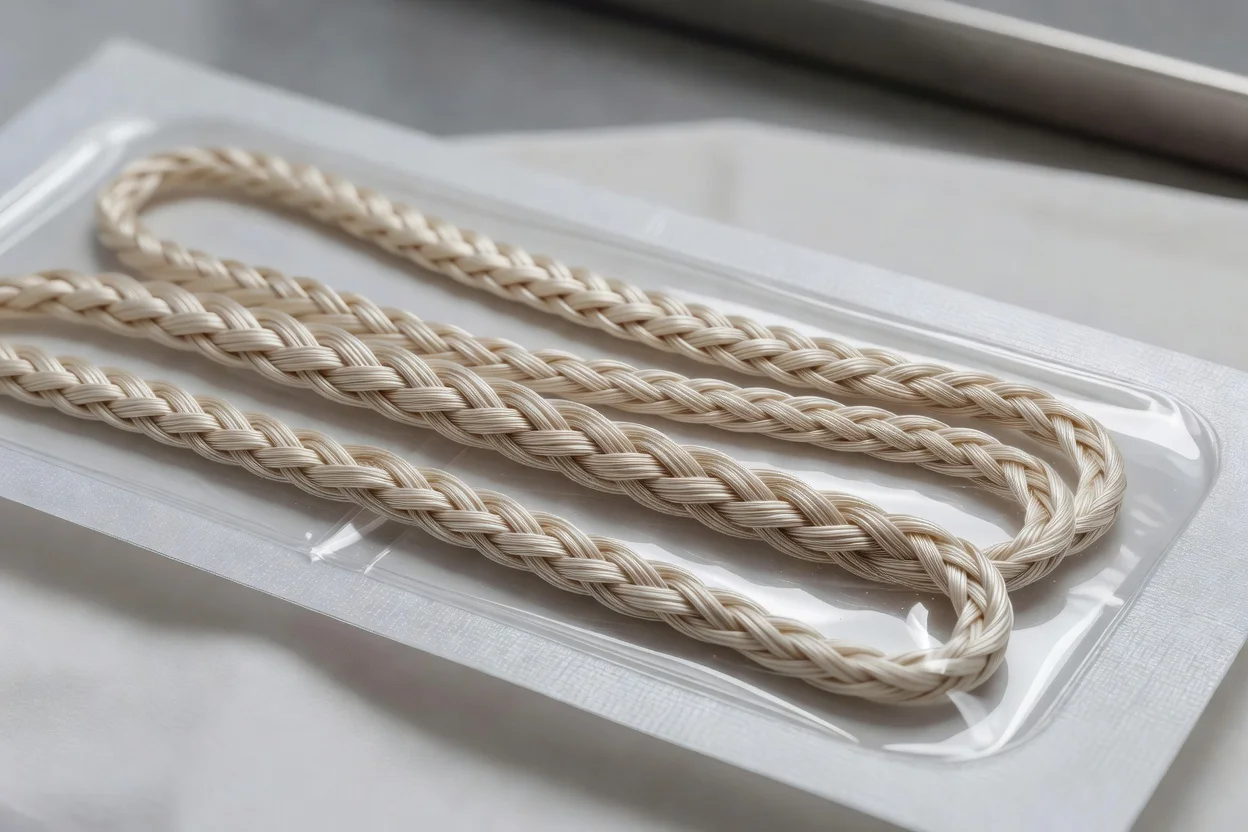
PGA sutures are often coated with polycaprolactone and calcium stearate to improve handling and reduce friction during surgical placement; in antibacterial variants, chlorhexidine diacetate may be added at very low loading levels to provide local antimicrobial activity. Surface modification studies also highlight that PGA’s chemically simple backbone lacks many reactive groups, so post-treatment is used when biomolecule attachment is needed.
Production Processes and Raw Feedstocks
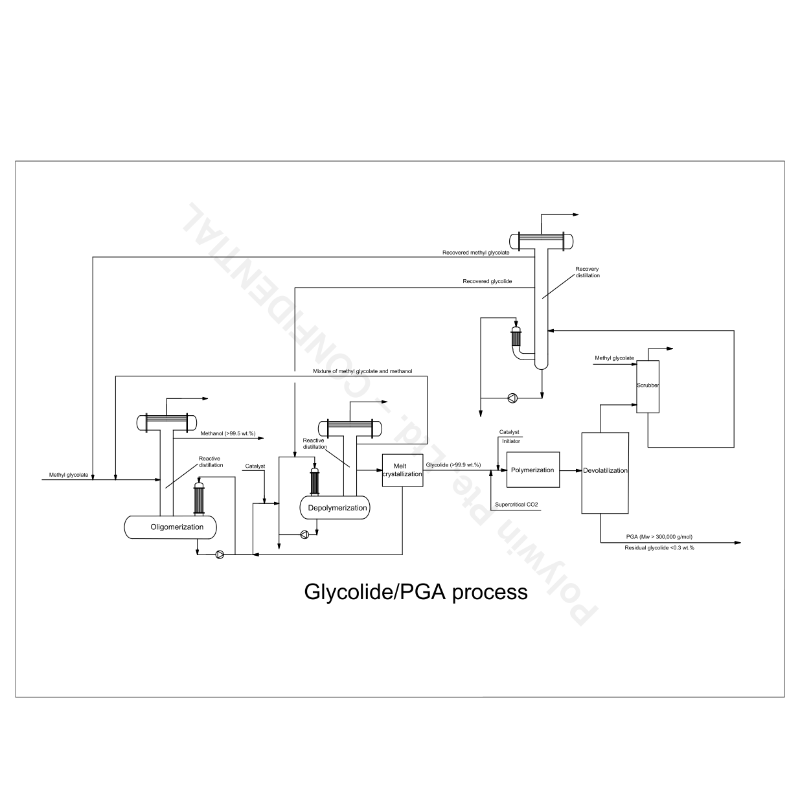
PGA can be made by direct polycondensation of glycolic acid or, more commonly for high-performance material, by ring-opening polymerization of glycolide. The glycolide route generally offers better molecular-weight control and is therefore preferred for demanding fiber and medical grades.
Main feedstock route
- Glycolic acid is the basic monomeric feedstock, while glycolide is its cyclic dimer and the preferred precursor for high-quality PGA.
- Glycolide production and purification are critical because polymer purity strongly influences molecular weight, residual monomer content, and degradation behavior.
Processing routes
- Fiber spinning and drawing are central for sutures and reinforcement applications, because molecular orientation can substantially raise strength.
- Injection molding and extrusion are feasible for certain grades, although processing is narrower than for commodity plastics because of the polymer’s thermal and hydrolytic sensitivity.
- Composite and blend processing is often used to overcome brittleness and improve manufacturability.
Grade distinctions
- Medical/pharmaceutical grade: highest purity, tight molecular-weight control, and stringent biocompatibility requirements.
- Fiber grade: optimized for orientation, tensile performance, and predictable resorption.
- Industrial or research grade: used for films, blends, and experimental scaffold or barrier applications.
Industry leadership
The PGA market is much smaller than commodity-polymer markets, so leadership is fragmented and application-specific rather than dominated by a few petrochemical giants. Publicly visible supply is concentrated among specialty chemical and medical-material companies, research suppliers, and vertically integrated medical-device manufacturers, with the strongest commercial footprint historically in absorbable sutures and related surgical products.
Applications and End-Use Markets
PGA’s commercial relevance is highest where strength, temporary function, and biodegradability must coexist.
| End use | Usual PGA form | Why PGA fits | Main limitation |
|---|---|---|---|
| Surgical sutures | Braided fiber, often coated | High initial tensile strength and predictable resorption | Brittle handling if unmodified |
| Tissue engineering scaffolds | Porous fibers, nonwovens, or composites | Temporary mechanical support and biodegradation | Process complexity |
| Drug delivery and implants | Copolymers, scaffolds, microsystems | Controlled hydrolysis and biocompatibility | Requires tight purity control |
| Barrier films and multilayers | Thin films or coextruded layers | Excellent oxygen barrier | Moisture sensitivity and brittleness |
| Reinforcement in blends | Short fibers or dispersed phase | Raises stiffness and strength | Compatibility issues |
| Oil-and-gas temporary materials | Specialty degradable components | Water-degradable temporary function | Narrow qualification window |
Medical applications
The most established market is absorbable sutures, where PGA has been used for decades and is widely regarded as a landmark biodegradable medical polymer. It is also used in scaffolds for tissue regeneration, where the material temporarily maintains structure while cells and extracellular matrix develop.
Packaging and barrier materials
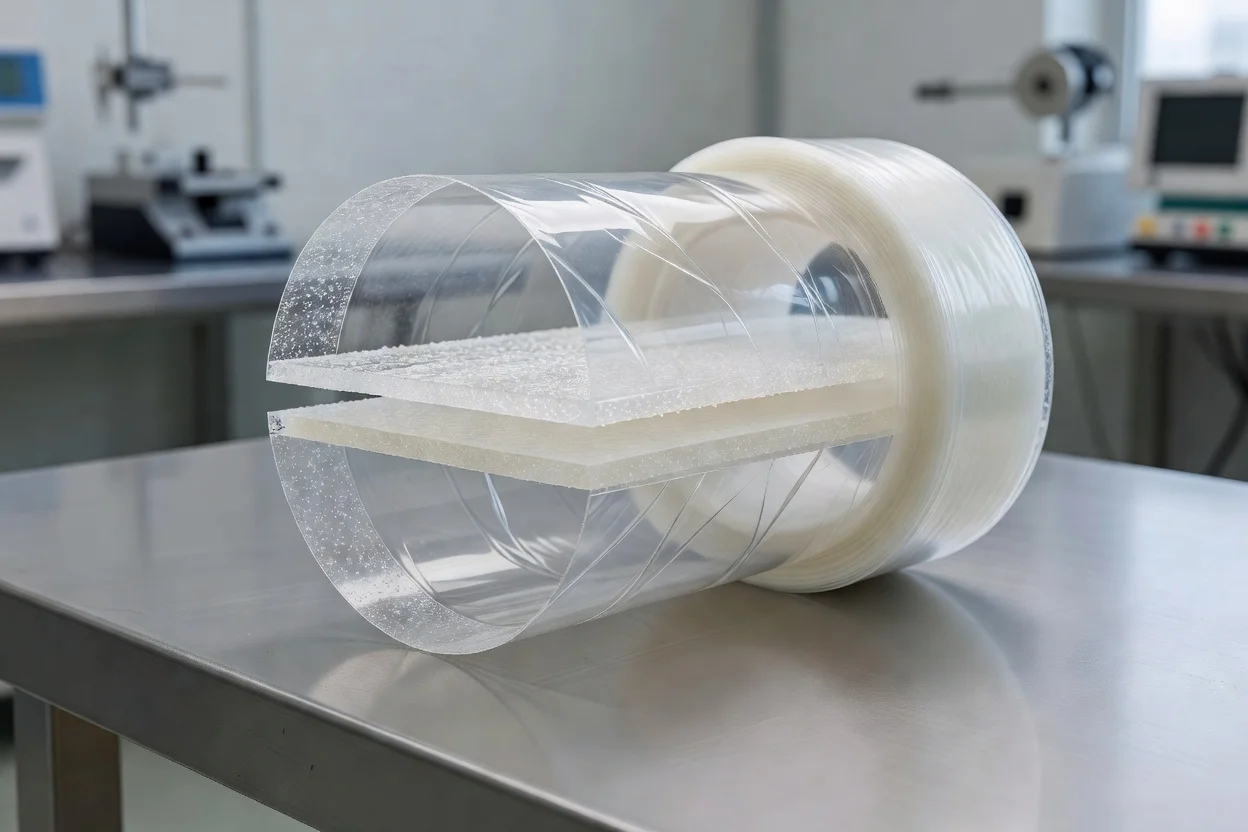
PGA has drawn attention as a high oxygen-barrier biodegradable film and as a layer in multilayer packaging structures. In this role, it is particularly suited to oxygen-sensitive foods and pharmaceuticals, although moisture management and process cost are major obstacles.
Composite and specialty uses
PGA is also used as a reinforcing component in biodegradable blends to improve stiffness and mechanical performance. Its role here is less as a stand-alone commodity resin and more as a property-enhancing specialty polymer in engineered systems.
One poor-fit use
PGA is a poor fit for flexible, long-life consumer goods such as durable films or repeated-use household products, because its brittleness and hydrolytic degradability work against long service life and repeated mechanical cycling.
Environmental and Sustainability Aspects
PGA is biodegradable and bioresorbable, and its degradation products ultimately enter normal metabolic pathways in medical contexts. That makes it especially useful where controlled disappearance is an advantage rather than a disadvantage.
Recyclability and end-of-life
- Mechanical recycling is generally not the primary end-of-life pathway for PGA.
- In many use cases, hydrolysis and biodegradation are the intended routes after service.
- This is beneficial in short-life medical or temporary industrial applications, but it also means PGA is not a substitute for durable circular plastics in long-lived products.
Bio-based and low-carbon considerations
PGA can be part of a lower-carbon materials strategy when it displaces fossil-based polymers in applications where its functional profile is uniquely valuable. However, the true footprint depends on feedstock sourcing, synthesis efficiency, purification intensity, and whether the application justifies the material’s more specialized production route.
Sustainability trade-offs
- Advantage: temporary function with biodegradable end-of-life.
- Advantage: potential to reduce persistence of waste in selected applications.
- Trade-off: more difficult processing and narrower application window than commodity polyolefins.
- Trade-off: high-performance grades may require energy-intensive purification and controlled polymerization.
Economic and Global Market Impact
PGA is a specialty polymer, not a mass commodity, so its market economics are driven by medical value, performance premiums, and niche industrial opportunities rather than by tonnage alone. The strongest commercial demand remains in healthcare, where regulatory acceptance, consistency, and clinical performance matter more than resin price.
According to recent technical and industry-oriented analyses, growth opportunities are concentrated in medical devices, bioresorbable scaffolds, and high-barrier sustainable packaging, but each of these segments is constrained by cost and manufacturing complexity. PGA’s price structure therefore reflects not only polymer chemistry but also the purification, form-factor conversion, and quality assurance required for end use.
Because production volumes are limited relative to PE, PP, or PET, the economic role of PGA is better understood as enabling high-value applications than as displacing commodity plastics at scale.
Current Challenges and Innovations
Key challenges
- Processing difficulty: tight temperature window and limited solvent options.
- Brittleness: high crystallinity limits toughness in neat form.
- Moisture sensitivity: premature hydrolysis can be problematic in storage and service.
- Purity requirements: medical grades need strict control of residuals and molecular weight.
Innovation directions
- Copolymerization with lactic acid to create PLGA and related materials with tunable degradation.
- Fiber engineering to improve tensile performance and handling.
- Multilayer packaging design to exploit barrier performance while protecting PGA from moisture.
- Surface modification to add biofunctionality, since the backbone is chemically simple and not naturally rich in reactive groups.
- Composite formulations that retain biodegradability while reducing brittleness and improving processability.
Mechanism note
A common formulation logic is to use low loadings of reinforcing or functional additives rather than heavy modification, because PGA already has high stiffness and barrier performance; the challenge is usually not strength alone, but toughness, handling, and environmental stability.
Future Outlook
PGA is likely to remain a specialty high-performance biodegradable polymer rather than a commodity resin. Its strongest future lies in applications where service life is intentionally short, performance demands are high, and disposal or resorption benefits outweigh the cost and processing complexity.
The most promising expansion paths are:
- Advanced medical materials, especially scaffolds, sutures, and drug-delivery formats.
- Barrier packaging, especially in multilayer structures for oxygen-sensitive products.
- Temporary industrial materials, including selected oil-and-gas and degradable-component uses.
- Biodegradable composites, where PGA acts as a reinforcing phase rather than the sole matrix.
Its broader future will depend on whether producers can lower synthesis costs, improve processability, and integrate PGA into realistic circular-economy systems without losing the properties that make it valuable in the first place.
Summary
PGA is a high-crystallinity, biodegradable, high-strength polyester whose most established role is in absorbable medical materials, especially sutures. Its combination of stiffness, thermal resistance, and gas-barrier performance gives it broader promise in packaging and engineered biodegradable systems, while brittleness, moisture sensitivity, and processing difficulty continue to constrain scale-up.
References
- •
Polyglycolide. (2005, January 17). In Wikipedia. https://en.wikipedia.org/wiki/PolyglycolideLink
- •
ポリグリコール酸. (2009, June 10). In Wikipedia. https://ja.wikipedia.org/wiki/%E3%83%9D%E3%83%AA%E3%82%B0%E3%83%AA%E3%82%B3%E3%83%BC%E3%83%AB%E9%85%B8Link
- •
POLYGLYCOLIC ACID (PGA). (n.d.). CP Medical. https://cpmedical.ifuonline.com/wp-content/uploads/2024/01/CP-Medical-PUB019-Polyglycolic-Acid-PGA-IFU-Rev-08.pdfLink
- •
Polyglycolic acid - an overview. (n.d.). ScienceDirect. https://www.sciencedirect.com/topics/nursing-and-health-professions/polyglycolic-acidLink
- •
PUB203. (n.d.). CP Medical. https://cpmedical.ifuonline.com/wp-content/uploads/2024/01/CP-Medical-PUB203-Polyglycolic-Acid-PGA-Antibacterial-IFU-Rev-06.pdfLink
- •
Poly(glycolic acid) (PGA): A versatile building block expanding high performance and sustainable bioplastic applications. (2020, July 6). RSC Publishing. https://pubs.rsc.org/en/content/articlelanding/2020/gc/d0gc01394cLink
- •
Acide polyglycolique. (2016, September 2). In Wikipédia. https://fr.wikipedia.org/wiki/Acide_polyglycoliqueLink
- •
Fiber grade polyglycolic acid: Molecular engineering. (2026, March 25). Patsnap Eureka. https://eureka.patsnap.com/materials/fiber-grade-pga-productionLink
- •
What is polyglycolic acid (PGA)? Properties and uses. (2026, June 5). DODGEN. https://dgchemtech.com/what-is-polyglycolic-acid-pga.htmlLink
- •
Polyglycolide acid (PGA). (2025, May 7). Assista Industry Ltd. http://www.assistainc.com/pd.jsp?id=7Link
- •
Pharmaceutical grade polyglycolic acid (PGA). (n.d.). Patsnap Eureka. https://eureka.patsnap.com/materials/pharma-grade-pga-biomedicalLink
- •
Surface modification of poly(glycolic acid) (PGA) for ... (n.d.). PubMed. https://pubmed.ncbi.nlm.nih.gov/12712412/Link
- •
Polyglycolide, poly(glycolic acid) (PGA). (2025, September 3). Polysciences. https://polysciences.com/collections/polyglycolide-polyglycolic-acid-pgaLink
- •
Poly(glycolic acid) - an overview. (n.d.). ScienceDirect. https://www.sciencedirect.com/topics/chemistry/poly-glycolic-acidLink
- •
Polyglycolic acid: Comprehensive analysis of synthesis, properties. (n.d.). Patsnap Eureka. https://eureka.patsnap.com/materials/polyglycolic-acid-synthesisLink
- •
Polyglycolic acid PGA 26009-03-0. (n.d.). Sigma-Aldrich. https://www.sigmaaldrich.com/PH/en/product/aldrich/46746Link
- •
Biomedical applications of polyglycolic acid (PGA). (n.d.). DergiPark. https://dergipark.org.tr/en/download/article-file/313951Link
- •
PGA. (2025, November 4). Alfa Chemistry. https://www.alfa-chemistry.com/plastics/pga.htmlLink
- •
Medical grade polyglycolic acid: Comprehensive analysis of. (n.d.). Patsnap Eureka. https://eureka.patsnap.com/materials/medical-grade-pga-synthesisLink
- •
Preparation and properties of poly(ethylene glycol-co. (2021, January 31). PMC. https://pmc.ncbi.nlm.nih.gov/articles/PMC7866821/Link
- •
Polyglycolic acid (PGA). (2024, August 31). Nanochemazone. https://www.nanochemazone.com/product/polyglycolic-acid-pga/Link
- •
Poly(lactic-co-glycolic) acid (PLGA) has attracted considerable interest. (2014, February 28). PMC. https://pmc.ncbi.nlm.nih.gov/articles/PMC3975359/Link
- •
Biodegradable polyglycolic acid (PGA). (n.d.). Patsnap Eureka. https://eureka.patsnap.com/materials/biodegradable-pga-synthesisLink
- •
Poly(glycolic acid). (2009, May 22). Oxford Academic. https://academic.oup.com/book/52773/chapter-abstract/421868270?redirectedFrom=PDFLink
- •
Polyglycolic acid polymer (PGA). (n.d.). Patsnap Eureka. https://eureka.patsnap.com/materials/polyglycolic-acid-polymerLink
- •
Properties of poly (lactic-co-glycolic acid) and progress of. (2023, March 17). PMC. https://pmc.ncbi.nlm.nih.gov/articles/PMC10058621/Link
- •
Application and properties of polyglycolic acid as a. (2024, January 8). PMC. https://pmc.ncbi.nlm.nih.gov/articles/PMC10820963/Link