
Introduction
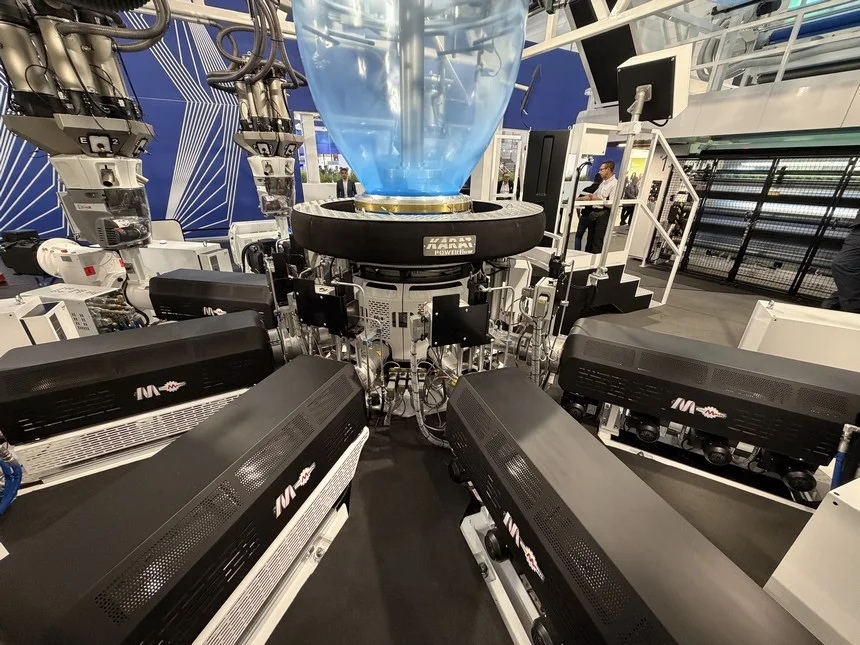
Extrusion lines for blown film are integrated processing systems that convert polymer pellets into continuous tubular film, which is then inflated, cooled, flattened, and wound into rolls for packaging, industrial, agricultural, and technical uses. The process is one of the most important film-forming methods in plastics processing because it combines high productivity, broad material compatibility, and the ability to tailor properties through multilayer coextrusion, bubble control, and downstream handling equipment.
A modern blown film line typically includes one or more extruders, a circular die, an air ring or internal bubble cooling system, a collapsing frame, nip rolls, and a winder, with auxiliary systems such as gravimetric feeding, melt filtration, thickness measurement, surface treatment, and automatic profile control increasingly common on high-end lines. Over time, the technology has evolved from simple monolayer polyethylene lines into highly engineered systems capable of producing complex multilayer structures, wide lay-flat widths, and higher output with improved energy efficiency and process stability.
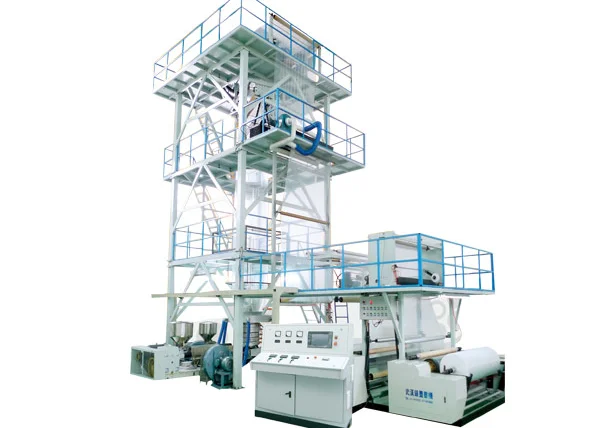
The technology is central to flexible packaging, especially for bags, pouches, liners, lamination webs, and industrial films, but it also serves medical, agricultural, geomembrane, and specialty technical markets. At the same time, the sector is being reshaped by sustainability demands, including the need to process recycled and downgauged materials, reduce energy use, and support mono-material designs that are easier to recycle.
History and Development
Early blown film production relied on relatively simple single-extruder systems that formed a tube through an annular die and used external air cooling and mechanical nip rolls to create lay-flat film. The basic process principle has remained stable, but line design has become much more sophisticated as film performance requirements have increased.
Key development milestones include:
- The commercialization of coextrusion, which allowed multiple polymers to be combined in one film structure and enabled functional layers for sealing, barrier, stiffness, and printability.
- The adoption of internal bubble cooling (IBC) and advanced air-ring systems, which improved output rates and bubble stability on higher-performance lines.
- The expansion of automated process control, including thickness gauges, closed-loop profile control, and data logging, which improved gauge uniformity and reduced scrap on demanding packaging grades.
More recently, manufacturers have introduced wider lines, higher layer counts, and systems optimized for recycled and downgauged film production, reflecting both market pressure and regulatory change.
Technical Overview
A blown film extrusion line works by melting polymer in an extruder, forcing the melt through an annular die, inflating the emerging tube with air, cooling the bubble, and collapsing it into lay-flat film for winding. The inflation step stretches the film in both machine direction and transverse direction, which helps determine film strength, clarity, and dimensional balance.
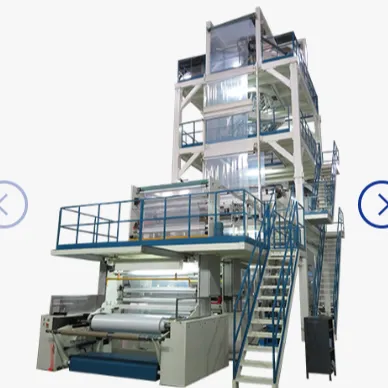
Main process modules
- Extruder and hopper system: feeds and plastifies the resin, often PE grades such as LDPE, LLDPE, and HDPE, though PP, PA, EVA, and blends are also used.
- Screen changer and melt filtration: removes contamination and protects the die from gels or unmelted particles.
- Die head: usually annular, with multilayer lines using one extruder per material and a common coextrusion die.
- Air ring and bubble cooling: removes heat from the film surface and stabilizes bubble geometry.
- Collapsing frame and nip rolls: flatten the bubble into lay-flat tubing and pull it through the line.
- Winder: rewinds the film into rolls for converting, slitting, printing, or bag making.
Common operating parameters
Typical line performance depends heavily on resin, die diameter, cooling, and output target, but several practical benchmarks are widely cited in industry sources:
- Blow-up ratio (BUR) is commonly in the range of about 1.5:1 to 4:1, with product-dependent optimization.
- Lay-flat width can range from narrow pilot-line formats around 25–1100 mm to industrial lines around 1000–3300 mm, with some systems reaching 4000 mm or more.
- Output on commercial systems may range from pilot quantities to several hundred kilograms per hour, with some high-output lines advertised up to 800–1000 kg/h.
- Line speed for blown film is often in the range of roughly 100–200 m/min, though actual speed is strongly dependent on film gauge and cooling capacity.
- Layer count on production lines commonly ranges from 3 to 11 layers, with special systems extending beyond that in advanced coextrusion configurations.
Film structure and quality control
Film properties are governed by the interaction of melt strength, cooling rate, drawdown, BUR, frost line height, and layer composition. Multilayer films allow separate layers to perform different functions, such as seal initiation, puncture resistance, barrier performance, or recycled-content placement. Surface treatment such as corona treatment is often added when print adhesion or lamination performance is required.
Types and Variations
| Type of blown film line | Main features | Typical use |
|---|---|---|
| Monolayer line | One extruder, simpler die, lower capital cost | General-purpose bags, liners, basic packaging |
| Multilayer coextrusion line | Two or more extruders feeding one die | Barrier films, sealable packaging, technical films |
| Water-cooled blown film line | Enhanced cooling for special film grades and faster stabilization | Certain specialty films, processing-sensitive polymers |
| IBC-equipped line | Internal bubble cooling for higher output and better bubble control | High-output packaging and wide-width production |
| Pilot/lab line | Small extruder diameters and modular configuration | R&D, formulation trials, process development |
| High-layer-count line | Advanced feedblock or die design for many layers | Premium packaging, functional and barrier structures |
Monolayer lines remain important where cost and simplicity matter, but multilayer lines dominate higher-value packaging because they allow one film to combine toughness, sealability, optical properties, and downgauged material usage. Some modern systems also target narrow-width technical films or very wide industrial webs, reflecting the diversity of end-use requirements.
Applications and Uses
Blown film extrusion lines are used most heavily in flexible packaging, including shopping bags, produce bags, garbage bags, stretch-hood film, and form-fill-seal webs. They are also widely used for lamination film, food packaging, medical-pharmaceutical packaging, agricultural film, and industrial protective films.
Additional applications include:
- Agricultural film, where toughness and environmental resistance are important.
- Geomembranes and waterproofing films, especially for thicker technical grades and biodegradable formulations.
- Medical and pharmaceutical packaging, where cleanliness, consistency, and barrier performance are critical.
- Industrial liners and heavy-duty sacks, where puncture resistance and seal integrity matter.
One poorer-fit application is optically critical rigid-sheet production, because blown film is optimized for tubular film and lay-flat conversion rather than the flat, highly polished surfaces typically required for rigid sheet or optical glazing uses.
Technological Innovations and Automation
Automation has become a defining feature of modern blown film lines. Recent systems increasingly use:
- Automatic thickness control based on scanning gauges and closed-loop bubble adjustment.
- Recipe management and digital diagnostics for repeatable startup and grade changes.
- Gravimetric dosing and loss-in-weight feeding to improve formulation accuracy and reduce variation.
- Advanced bubble stabilization, including better air-ring design and IBC integration for higher throughput.
- Inline surface treatment and inspection, supporting downstream printing, lamination, and converting.
Multilayer lines are particularly dependent on precise extruder balancing and melt distribution, since layer thickness is controlled by the relative throughput of each extruder and the flow design of the die. This makes modern coextrusion systems highly sensitive to screw design, melt temperature control, and residence-time consistency.
Environmental and Sustainability Aspects
Blown film lines are under increasing pressure to improve their environmental profile. The most important sustainability themes are:
- Energy efficiency: lower specific energy use through improved heating zones, efficient drives, optimized cooling, and reduced scrap generation.
- Material reduction: downgauging and profile control allow thinner films with equivalent performance.
- Recycled-content processing: modern lines are increasingly expected to handle reprocessed and post-consumer recycled polymers, although contamination and melt stability remain challenges.
- Recyclable structures: mono-material and simplified multilayer structures are becoming more attractive than legacy mixed-polymer laminates.
- Waste reduction: stable bubble control, better filtration, and automated gauge management reduce trim and off-spec output.
A central trade-off is that multilayer films can improve functional performance and reduce total material use, yet they may also complicate recycling if incompatible polymers are combined. This has accelerated interest in polyolefin-based barrier architectures and other recyclable-by-design strategies.
Economic and Global Market Impact
Blown film lines occupy a major position in the global flexible packaging machinery market because they serve high-volume, repeat-demand products with relatively fast commercialization cycles. Demand is driven by food packaging, consumer goods, logistics, hygiene, agriculture, and industrial containment, all of which rely on low-cost, high-throughput film production.
The market is also shaped by a split between:
- Commodity-oriented lines, where output, uptime, and cost per kilogram dominate.
- High-specification lines, where barrier performance, downgauging, and recyclability justify higher capital cost.
- Pilot and development systems, which support resin innovation, process validation, and customer qualification.
Manufacturers such as Reifenhäuser, Windmöller & Hölscher, Davis-Standard, Colines, Luigi Bandera, Windsor Machines, and Kabra ExtrusionTechnik are prominent in different segments, particularly in high-layer coextrusion, wide-format systems, and application-specific line engineering.
Current Challenges and Innovations
The segment faces several persistent technical challenges:
- Bubble instability at higher outputs or with low-melt-strength recycled blends.
- Gauge variation across wide webs, especially in multilayer structures.
- Die buildup and contamination sensitivity, particularly when using recycled content or additives.
- Energy intensity and carbon footprint, especially for older lines with limited automation.
- Compatibility between performance and recyclability, which increasingly constrains material selection.
Innovation is concentrated in better cooling, improved melt distribution, digital control, and process windows tailored to recycled or bio-based materials. There is also strong development activity in compact lines, fast changeover concepts, and designs that reduce purging losses and startup scrap.
Future Outlook
Future blown film extrusion lines are likely to emphasize digitalization, resource efficiency, and recyclability-oriented film design. Line builders are expected to continue pushing higher layer counts where function demands it, while simultaneously developing simpler mono-material structures that can meet sustainability targets without sacrificing barrier or machinability.
Further progress is likely in:
- More accurate closed-loop gauge control
- Better handling of recycled and variable feedstocks
- Higher cooling efficiency and lower specific energy consumption
- Faster grade changes with reduced purge loss
- Integration of process data into factory-wide analytics and predictive maintenance
As a result, blown film extrusion lines will remain a core technology in flexible packaging, but with increasing emphasis on material efficiency, line intelligence, and end-of-life compatibility rather than throughput alone.
References
- •
Blown film extrusion process explained. (n.d.). Amcor Plastics. https://amcorplastics.com/blown-film-extrusion-process-explained/Link
- •
Blown film extrusion process for polybags: Technical overview and applications. (n.d.). Scientific Research Publishing. https://www.scirp.org/pdf/aces2024144_23701299.pdfLink
- •
Blown film lines by W&H. (2025, March 14). Windmöller & Hölscher. https://www.wh.group/na/en/our_products/extrusion/blown_film_lines/Link
- •
Blown film. (n.d.). British Plastics Federation. https://www.bpf.co.uk/plastipedia/processes/Blown_Film.aspxLink
- •
Beginner's guide to blown film extrusion. (2026, August 5). Green Extrusion. https://green-extrusion.eu/know-how/extrusion-technology/beginners-guide-to-blown-film-extrusion/Link
- •
Blown film: An overview. (2016, October 21). ScienceDirect. https://www.sciencedirect.com/topics/engineering/blown-filmLink
- •
Guide to blown film extrusion machines. (2023, May 22). Chi Yang. https://www.chyiyang.com/guide-to-blown-film-extrusion-machinesLink
- •
Blown film extrusion process for polybags: Technical overview and applications. (2024, September 29). Scientific Research Publishing. https://www.scirp.org/journal/paperinformation?paperid=136385Link
- •
What is blown film extrusion? (2021, October 1). FKuR. https://fkur.com/en/knowledgebase/blown-film-extrusion/Link
- •
How does blown film extrusion work? (2025, June 24). Zhuxin Machine. https://www.zhuxinmachine.com/blog/how-does-blown-film-extrusion-work.htmlLink
- •
5 steps to the blown film extrusion manufacturing process. (2024, June 25). Dallas Plastics. https://dallasplastics.com/blog/blown-film-extrusion-manufacturing-process/Link
- •
Blown film lines from Reifenhäuser. (n.d.). Reifenhäuser. https://reifenhauser.com/en/lines-components/extrusion-lines/blown-film-lines/Link
- •
Blown film extrusion lines. (2023, December 15). Plastic-Industry.gr. https://plastic-industry.gr/en/blown-film-extrusion-lines/Link
- •
Mechanik-science.com. (n.d.). https://pdfs.semanticscholar.org/9f39/9fb1be0ae0050a05ab27e9daa75cace9da17.pdfLink
- •
Blown film extrusion lines. (2026, June 15). Colines SpA. https://www.colines.it/extrusion-lines/blown-film-linesLink
- •
Blown film extrusion lines. (2026, May 22). Luigi Bandera. https://www.luigibandera.com/products/blown-film/Link
- •
7-layer blown film extrusion line. (2023, February 22). Windsor Machines. https://windsormachines.com/7-layer-blown-film-extrusion/Link
- •
Film extrusion: An overview. (n.d.). ScienceDirect. https://www.sciencedirect.com/topics/engineering/film-extrusionLink
- •
EVO. (n.d.). Reifenhäuser. https://reifenhauser.com/en/lines-components/extrusion-lines/blown-film-lines/evoLink
- •
Faqs of blown film extrusion. (n.d.). Plastar Machine. https://www.plastar-machine.com/en/article/the-manufacturing-process-of-blown-film-extrusion.htmlLink
- •
Cost-effectiveness. (2019, May 16). PPC Flex. https://ppcflex.com/blog/the-blown-film-process/Link
- •
Extrusion lines product finder. (n.d.). Reifenhäuser. https://reifenhauser.com/en/lines-components/extrusion-lines-product-finder/Link
- •
Film extrusion guide. (n.d.). LyondellBasell. https://www.lyondellbasell.com/globalassets/archives/sites/2022/tappi/a-guide-to-film-extrusion.pdfLink
- •
Blown film extrusion lines. (2014). Boolani. http://www.sme.in/boolani/product.htmlLink
- •
Blown film extrusion machinery. (2018, April 26). Davis-Standard. https://davis-standard.com/converting_system/blown-film/Link
- •
EVO multi bubble. (n.d.). Reifenhäuser. https://reifenhauser.com/en/lines-components/extrusion-lines/blown-film-lines/evo-multibubbleLink
- •
Polymer processing lab machines. (2026, April 16). Scribd. https://www.scribd.com/document/464677997/Coex-BlownFilm-0805Link
- •
Blown film lines. (n.d.). Kabra ExtrusionTechnik. https://www.kolsite.com/blown-film-lines.phpLink
- •
Advanced coextrusion systems guide. (2026, January 20). Scribd. https://www.scribd.com/document/658585504/MultilayerBlownupLink
- •
Polymer processing lab machines. (2026, January 6). Scribd. https://id.scribd.com/document/464677997/Coex-BlownFilm-0805Link
- •
Extrusion of tubular (blown) film. (n.d.). Polyregion. http://www.polyregion.org/files/attachments/13135/449165_02_Extrusion_of_tubular.pdfLink
- •
Blown film coex. (2025, July 22). Scribd. https://www.scribd.com/doc/314748035/Blown-Film-CoexLink
- •
Blown film lines P (air-cooled). (2024, October 22). COLLIN Lab & Pilot Solutions. https://www.collin-solutions.com/en/product/blown-film-lines-p-air-cooled/Link
- •
Extrusion systems. (2024, October 22). The Free Library. https://www.thefreelibrary.com/Extrusion+systems.-a0138996619Link
- •
Blown film catalogue. (n.d.). https://2.imimg.com/data2/UW/TV/MY-2325449/rex-series-ibc-three-layer-blown-film-co-extrusion-lines.pdfLink
- •
12 essential components of blown film line. (2024, May 27). Plastar Machine. https://www.plastar-machine.com/en/article/Components-of-Blown-Film-Extrusion-Lines.htmlLink
- •
Plastic extrusion. (2006, June 11). Wikipedia. https://en.wikipedia.org/wiki/Plastic_extrusionLink
- •
Types of blown film extrusion machines. (2024, January 30). Plasco. https://www.plasco.com.tw/en/article/Types-of-Blown-Film-Extrusion-Machines-for-Plastic-Bags.htmlLink
- •
Extrusion: Equipment, processing techniques & troubleshooting. (2025, July 8). SpecialChem. https://www.specialchem.com/plastics/guide/an-in-depth-look-at-extrusionLink
- •
Blown film. (2025, May 20). Scribd. https://www.scribd.com/document/83161700/Blown-FilmLink
- •
Extrusion blown film. (2025, May 3). Scribd. https://pt.scribd.com/document/360343843/extrusion-blown-filmLink
- •
Two types of plastic extrusion process—recycling and film blowing. (n.d.). Polystar. https://www.polystarco.com/blog-detail/two-types-of-plastic-extrusion-process-recycling-and-film-blowing/Link