

Introduction
Polyoxymethylene (POM), also known as acetal or polyacetal, is a high-performance engineering thermoplastic valued for its high stiffness, low friction, excellent dimensional stability, and good wear resistance. It is manufactured in two main families—homopolymer (POM-H) and copolymer (POM-C)—that are closely related in use but differ in chain architecture, thermal stability, crystallinity, and processing behavior.
POM occupies a distinctive position in the plastics value chain because it combines metal-like functional performance with thermoplastic processing efficiency. Its use is concentrated in precision mechanical components, automotive systems, electrical and electronic parts, fluid-handling devices, consumer products, and industrial machinery, where low creep and stable dimensions are more important than very high impact toughness or long-term exposure to hot strong chemicals. The material’s sustainability profile is mixed: POM is technically recyclable within established industrial streams, but its fossil feedstocks, difficult multi-material product designs, and thermal degradation concerns remain important barriers to broader circularity.
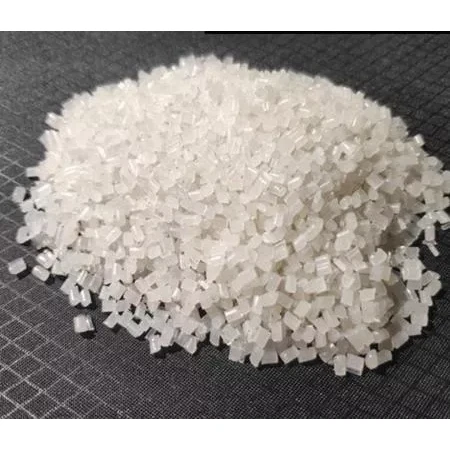
The two commercial variants serve slightly different design windows. POM-H generally offers higher crystallinity, stiffness, strength, and fatigue resistance, while POM-C typically provides improved thermal stability, better resistance to hydrolysis and alkaline media, and a wider processing window. Current innovation is focused on lower-emission grades, improved stabilization, recycled-content strategies, and formulation approaches that preserve POM’s characteristic tribological and dimensional performance while reducing environmental impact.
History and Development
POM emerged as an important engineering plastic after formaldehyde chemistry and controlled polymerization methods made it possible to convert a reactive monomer into a stable, semicrystalline material. The earliest commercial success came from homopolymer acetal, followed by copolymer grades designed to improve processing stability and reduce degradation during molding.
As industrial adoption widened, POM became especially attractive for precision parts that previously relied on machined metals, since it offered low friction, good fatigue behavior, and the ability to hold tight tolerances with lower part weight and lower manufacturing cost. Over time, the market split into clearly differentiated homopolymer and copolymer platforms, with brand families and application-specific grades tailored to molding, extrusion, wear, food contact, and medical uses.
Chemical Structure and Key Properties
POM is a semicrystalline polymer whose repeating backbone is dominated by oxymethylene units. In the homopolymer, the chain is highly regular, which increases crystallinity and stiffness but also makes the material more sensitive to thermal and acid-catalyzed degradation. In copolymer grades, a small amount of comonomer interrupts chain regularity, lowering crystallinity slightly and improving thermal stability and processing robustness.
Key material characteristics
| Property | POM-H | POM-C | Practical significance |
|---|---|---|---|
| Crystallinity | Higher | Lower | Higher stiffness and strength vs. better processability and stability |
| Melting temperature | About 178 °C | About 166 °C | Useful for selecting molding window and service temperature |
| Density | Slightly higher | Slightly lower | Reflects higher packing efficiency in POM-H |
| Dimensional stability | Excellent | Excellent | Supports precision gears, housings, and mechanisms |
| Friction and wear | Very low friction, excellent wear | Very low friction, excellent wear | Enables bearings, bushings, sliders, and gears |
| Chemical resistance | Good, but more limited in hot water/alkali | Better against hot water and alkalis | Important in pumps, valves, and fluid systems |
Real limits and practical workarounds
- Poor resistance to strong acids and oxidizing environments → backbone cleavage and formaldehyde-related degradation → use copolymer grades, limit chemical exposure, or switch to more resistant polymers such as PA, PPS, or fluoropolymers depending on the medium.
- Lower surface energy before treatment → difficult bonding, painting, or printing → use surface activation, primers, mechanical interlocks, or design parts to avoid adhesive reliance.
- Sensitivity to thermal degradation during processing → formaldehyde release and viscosity loss → maintain tight melt-temperature control, minimize residence time, and use stabilized grades.
- Limited suitability for prolonged UV exposure → photo-oxidative aging and surface embrittlement → add stabilizers or use protected indoor applications.
Typical performance profile
POM is notable for low moisture uptake, which helps it maintain dimensional precision in humid service conditions. It also offers good creep resistance, making it suitable for parts that must hold load over time, such as latch systems, fasteners, gears, and valve elements. Its low coefficient of friction and strong abrasion resistance are central to its role in motion systems and tribological components.
Where POM is a poor fit
POM is generally a poor choice for prolonged exposure to strong acids, strong oxidizers, or high-heat oxidative environments, where chain scission and loss of mechanical properties can occur. It is also less suitable than high-performance fluoropolymers or specialty barrier materials where extreme chemical resistance or gas-barrier performance is required.
Production Processes and Raw Feedstocks
Commercial POM production is based on formaldehyde chemistry, usually via trioxane and related intermediates. The process route differs by product family:
- POM-H is made by polymerizing formaldehyde or trioxane into a highly regular chain structure.
- POM-C is made by copolymerizing trioxane with a small amount of comonomer such as ethylene oxide or related cyclic ethers to improve thermal stability and reduce chain-unzipping tendency.
The upstream feedstock chain begins with methanol-derived formaldehyde in many integrated systems, then conversion to trioxane for copolymer routes. This makes POM sensitive to both methanol economics and formaldehyde/trioxane plant integration. Because the chemistry is tightly controlled, product quality depends strongly on catalyst choice, monomer purity, stabilization package, and residual formaldehyde management.
Processing notes
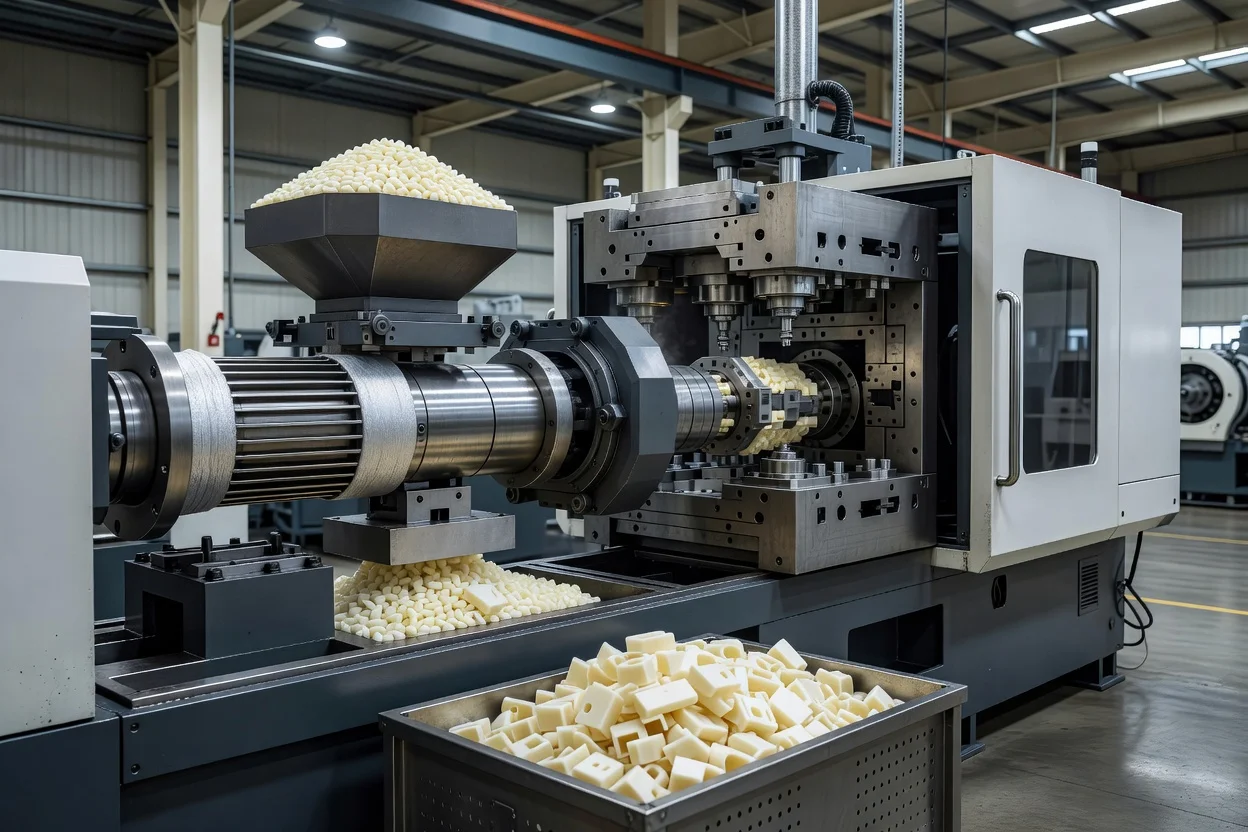
POM is commonly processed by injection molding, extrusion, and machining of semifinished stock. Compared with many engineering plastics, it offers a narrow but manageable processing window, which is one reason copolymer grades are often preferred for thicker sections or more demanding molding conditions. Its good machinability also makes it a preferred stock material for precision parts and prototypes.
Applications and End-Use Markets
POM is used wherever a part must move, fit, slide, latch, or retain its dimensions under repeated load. The usual grade and process depend on the application.
| End-use sector | Typical POM grade | Common process | Why POM is used |
|---|---|---|---|
| Automotive | POM-H or POM-C | Injection molding | Gears, clips, fuel-system parts, lock mechanisms, interior functional parts |
| Electrical and electronics | POM-C often preferred | Injection molding | Precision housings, switches, connectors, actuator parts |
| Industrial machinery | POM-H for stiffness, POM-C for stability | Molding and machining | Bearings, bushings, rollers, slides, wear strips |
| Consumer goods | Either, depending on load | Injection molding | Zippers, buckles, appliance mechanisms, handles |
| Food, pharma, medical | Stabilized POM-C | Injection molding and machining | Valves, dosing parts, handle components, precision motion parts |
| Water and fluid systems | POM-C | Injection molding | Pump components, fittings, valve seats, buoyant mechanisms |
Major application areas
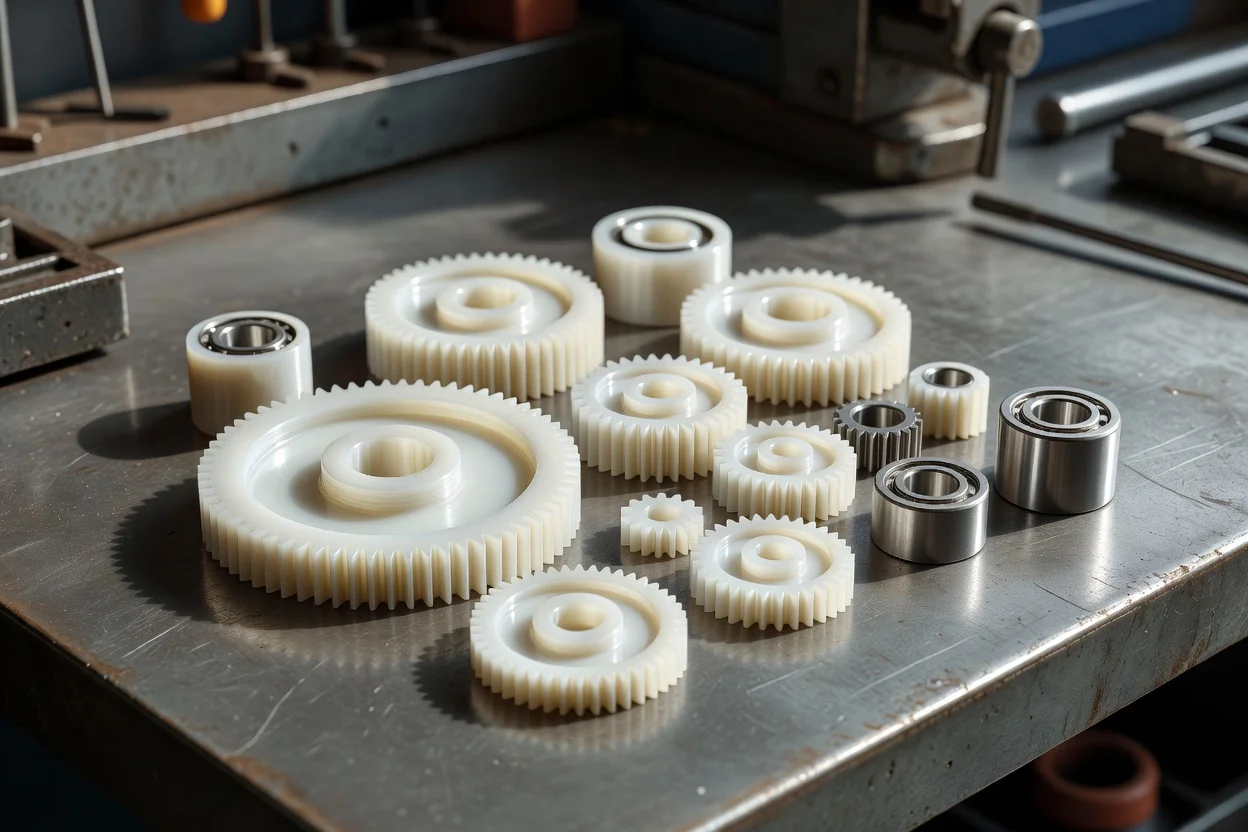
- Precision gears and gear trains benefit from POM’s high stiffness, low friction, and dimensional stability.
- Bearings, bushings, rollers, and slide rails use POM’s wear resistance and self-lubricating behavior.
- Automotive lock and latch systems exploit POM’s fatigue resistance, low moisture absorption, and stable snap-fit performance.
- Valves, fittings, and pump components rely on the material’s low creep and chemical resistance to oils, fuels, and many aqueous media.
- Medical and food-contact parts use high-purity grades where low extractables and clean machinability matter.
- A notable poor-fit use is long-term outdoor structural exposure, because UV sensitivity limits unprotected weathering performance.
Environmental and Sustainability Aspects
POM is a fossil-derived engineering polymer whose environmental performance is shaped by monomer sourcing, part design, durability, and end-of-life management. Its strongest sustainability argument is functional: by replacing metal in many precision components, it can reduce weight, simplify assembly, and lower energy use during manufacturing and service. Its weakest point is that many POM parts are small, embedded in multi-material assemblies, or contaminated in ways that complicate recycling.
Recyclability
POM can be mechanically recycled in controlled industrial loops, especially when scrap is clean and compositionally consistent. However, post-consumer recovery is often limited by mixed plastics, fillers, coatings, and bonded assemblies. Chemical recycling routes are a longer-term possibility, but economic and sorting constraints remain significant.
Bio-based and lower-carbon pathways
Bio-based formaldehyde or methanol pathways could, in principle, reduce cradle-to-gate carbon intensity, but these routes are still limited by cost, scale, and certification complexity. Another strategy is lightweighting through design, where POM replaces heavier materials without sacrificing function. This is often the most immediately practical carbon-reduction lever for the material.
Formulation and emissions considerations
Thermal degradation can release formaldehyde, so modern grades emphasize stabilization and processing control. This is both a product-safety and sustainability issue, since lower emissions improve workplace conditions and reduce waste from off-spec molding.
Economic and Global Market Impact
POM is a mature but strategically important engineering plastic with demand closely tied to automotive production, machinery output, consumer durables, and industrial maintenance cycles. It competes with PA, PBT, PP compounds, metals, and specialty tribological polymers depending on service conditions and cost constraints.
Industry leadership
Global supply is led by major chemical and engineering-plastics producers such as BASF, Celanese, DuPont-related Delrin capacity, Mitsubishi Chemical/MCAM, and other regional suppliers that serve automotive and industrial customers with differentiated homopolymer and copolymer grades. Their market position is driven by process know-how, quality consistency, proprietary stabilization systems, and application-specific compounding rather than by commodity scale alone.
Market dynamics
- Demand is strongest in precision parts where metal substitution produces clear value.
- Copolymer grades often gain preference in chemically harsher or thicker-section applications.
- Homopolymer grades retain a strong position where stiffness, fatigue endurance, and load-bearing performance dominate.
- Price competitiveness is affected by formaldehyde/trioxane integration, energy costs, and downstream automotive and industrial cycles.
Current Challenges and Innovations
Main challenges
- Thermal degradation control remains central because chain scission affects color, odor, emissions, and mechanical integrity.
- Design for recycling is difficult when POM is embedded in complex assemblies.
- Chemical limits restrict use in harsh media and high-temperature aqueous/alkaline service.
- UV sensitivity reduces outdoor durability without protection.
- Adhesion and coating challenges arise from low surface energy.
Innovation directions
- Stabilized low-emission grades for improved processing and reduced formaldehyde release.
- Recycled-content development in industrial scrap loops.
- Tribology-tailored compounds with internal lubricants, PTFE, or mineral fillers for specific wear regimes; for example, a small loading of PTFE can reduce the coefficient of friction by forming a low-shear transfer film at the sliding interface, while glass fiber can raise stiffness but usually sacrifices wear smoothness.
- Medical and food-contact formulations optimized for purity and regulatory compliance.
- Hybrid design strategies combining POM with metals or elastomers to exploit each material’s strengths.
Future Outlook
POM is likely to remain a core engineering plastic in motion, precision, and load-bearing applications because its property balance is difficult to replace economically. The strongest growth opportunities are expected in high-precision automotive electrification components, compact electromechanical devices, industrial automation, and medical or fluid-control parts that need stable low-friction performance.
The main strategic question is not whether POM will remain relevant, but how its value chain will adapt to circularity, emissions reduction, and design-for-disassembly requirements. Grades with lower processing emissions, improved recyclability, and better chemical durability are likely to gain importance, especially where regulators and OEMs increasingly scrutinize material footprints and end-of-life behavior.
Summary
POM is a semicrystalline engineering thermoplastic whose combination of stiffness, low friction, wear resistance, and dimensional stability makes it one of the most useful materials for precision mechanical parts. The two principal variants, POM-H and POM-C, are closely related but differ in crystallinity, thermal stability, and chemical resistance, giving designers a practical choice between maximum mechanical performance and broader processing or chemical robustness. Its future will be shaped by sustainability improvements, smarter part design, and continued demand for compact, durable, low-friction components across industrial and consumer markets.
References
- •
Acetal Polyoxymethylene Homopolymer - POM - AZoM. (2001, August 30). AZoM. https://www.azom.com/article.aspx?ArticleID=762Link
- •
Polyoxymethylene. (2004, November 1). Wikipedia. https://en.wikipedia.org/wiki/PolyoxymethyleneLink
- •
Polyoxymethylene (POM): Properties, applications and processing. (2022, August 18). K.D. Feddersen. https://kdfeddersen.com/en/products/polymers/polyoxymethyleneLink
- •
POM. (n.d.). Techné. https://www.techne.fr/en/expertise/materials/pomLink
- •
POM (Acetal) Homopolymer vs Copolymer: Selection. (2026, July 7). OmniaStrata. https://www.omniastrata.com/blog/pom-homopolymer-vs-copolymerLink
- •
POM plastics: copolymer and homopolymer acetals. (2026, August 25). MCAM. https://www.mcam.com/en/products/pomLink
- •
Acetal Polyoxymethylene Copolymer - POM - AZoM. (2024, May 16). AZoM. https://www.azom.com/article.aspx?ArticleID=381Link
- •
What is the difference between POM-H and POM-C? (2022, March 15). Cylex Plastics. https://cylexplastics.com/difference-between-pom-h-and-pom-c/Link
- •
Acetal- Why Two Types? (2021, August 20). WS Hampshire, Inc. https://www.wshampshire.com/acetal-why-two-types/Link
- •
Polyoxymethylene Polyacetal: Comprehensive Analysis Of ... (n.d.). Eureka PatSnap. https://eureka.patsnap.com/materials/polyoxymethylene-polyacetalLink
- •
What Is POM Plastic? Properties, Uses, And Industrial ... (2025, November 8). Beska Mold. https://www.beskamold.com/what-is-pom-plastic/Link
- •
Polyoxymethylene (POM): How to select the right grade? (2025, July 8). SpecialChem. https://www.specialchem.com/plastics/guide/polyacetal-polyoxymethylene-pom-plasticLink
- •
POM Resin (Polyoxymethylene / Acetal): Complete Material Guide ... (2026, April 1). POM Material. https://pom-material.com/blog/pom-resin-polyoxymethylene-acetal-complete-material-guide/Link
- •
POM Plastic: Applications and Uses. (2023, September 1). Beeplastic. https://www.beeplastic.com/blogs/plastic-insights/the-many-applications-and-uses-of-pom-plasticLink
- •
Acetal (POM): Definition, Properties, and Uses. (2022, April 29). Xometry. https://www.xometry.com/resources/materials/acetal-plastic/Link
- •
Polyoxymethylene. (2004, October 1). Wikipedia. https://de.wikipedia.org/wiki/PolyoxymethyleneLink
- •
Acetal Polymer - an overview. (n.d.). ScienceDirect. https://www.sciencedirect.com/topics/engineering/acetal-polymerLink
- •
Polyoxymethylene (POM): The Versatile Acetal Plastic ... (2025, March 17). POM Material. https://pom-material.com/blog/polyoxymethylene-material/Link
- •
POM. (n.d.). Tangram. https://tangram.co.uk/wp-content/uploads/Plastics-Data-File-POM.pdfLink
- •
Polyoxymethylene Engineering Plastic. (n.d.). Eureka PatSnap. https://eureka.patsnap.com/materials/polyoxymethylene-plasticLink
- •
Acetal Copolymer vs Homopolymer: A Manufacturing ... (2026, June 12). Shanghai Yunshan Plastics. https://shanghaiyunshanplastics.goldsupplier.com/blog/37861.htmlLink
- •
POM plastic. (n.d.). Ensinger. https://www.ensingerplastics.com/en/thermoplastic-materials/pom-acetalLink
- •
Acetal Homopolymer vs. Copolymer - What's the Difference? (n.d.). Plastics International. https://www.plasticsintl.com/news-blog-page/acetal-homopolymer-vs-copolymer-whats-the-difference/Link
- •
POM (Acetal/Delrin®) Plastic: Properties, Advantages, and ... (2025, September 22). Fictiv. https://www.fictiv.com/articles/pom-acetal-delrin-plastic-manufacturingLink
- •
Polyoxymethylene Polymer: Comprehensive Analysis Of Molecular ... (n.d.). Eureka PatSnap. https://eureka.patsnap.com/materials/polyoxymethylene-polymer-engineeringLink
- •
c5py01418b 184..190 ++ (n.d.). Max Planck Society. https://pure.mpg.de/rest/items/item_2241053_2/component/file_2260626/contentLink
- •
How Do You Like Your Acetal: Homopolymer or Copolymer? (2026, June 29). Plastics Technology. https://www.ptonline.com/articles/how-do-you-like-your-acetal-homopolymer-or-copolymerLink
- •
Polyoxymethylene (POM) (n.d.). Sternwald Systems. https://res.cloudinary.com/sternwald-systems/raw/upload/v1/hugoprd/ARTIKEL_ATTACH/0024404F_1AE43B9F04DC/d8af7e4a743171f31a2e03f036addcd44b62758f/PE_2013_10_Polyoxymethylene-POM.pdfLink
- •
POM plastics: copolymer and homopolymer acetals. (2026, August 25). Mitsubishi Chemical Advanced Materials. https://www.mcam.com/en/mcam/products/pomLink
- •
© Carl Hanser Verlag, Munich Kunststoffe international 10/2019 (n.d.). Sternwald Systems. https://res.cloudinary.com/sternwald-systems/raw/upload/v1/hugoprd/ARTIKEL_ATTACH/0022D8ED_20D597C25E9A/fcfe7209e0f73faa0f80fe8930fcdd877aec4ed5/Polyoxymethylene%20_POM_%20-%20KUint%2008%202019.pdfLink
- •
POM Plastic: Key Benefits and Applications. (n.d.). Protolabs. https://www.protolabs.com/materials/pom-plastic-key-benefits-and-applications/Link
- •
POM-H vs POM-C. (2025, December 22). Modulus Metal. https://www.modulusmetal.com/pom-h-vs-pom-c/Link
- •
Polyoxymethylene Copolymer: Comprehensive Analysis Of ... (n.d.). Eureka PatSnap. https://eureka.patsnap.com/materials/polyoxymethylene-copolymerLink
- •
Polyoxymethylene Homopolymer: Molecular Structure, Synthesis ... (n.d.). Eureka PatSnap. https://eureka.patsnap.com/materials/polyoxymethylene-homopolymerLink
- •
Polyoxymethylene copolymers and thermoplastic pom composition. (2014, April 14). Google Patents. https://patents.google.com/patent/US20160083499A1/enLink
- •
POM vs POM-C: Understanding Key Differences & Material Selection. (2023, June 21). Cylex Plastics. https://cylexplastics.com/pom-vs-pom-c-differences-engineering-plastics-comparison/Link
- •
The Practical Difference Between POM-H and POM-C. (2025, April 30). Port Plastics. https://portplastics.com/blog/the-practical-difference-between-pomh-and-pomc/Link
- •
Polyoxymethylene - an overview. (n.d.). ScienceDirect. https://www.sciencedirect.com/topics/engineering/polyoxymethyleneLink