
Introduction
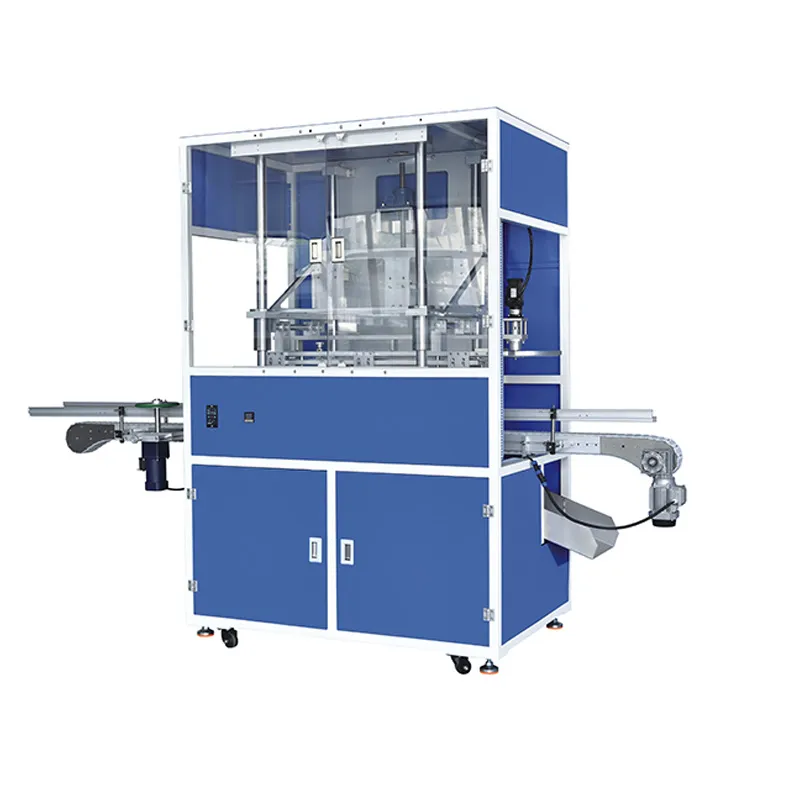
Deflashing equipment is a class of plastics-processing and finishing machinery used to remove excess material, or flash, from molded or formed parts after production. In the plastics industry, it is most closely associated with rubber, thermoset, silicone, and some rigid-plastic components where parting-line flash, gate remnants, or thin burrs must be removed to meet dimensional, cosmetic, or functional requirements.
The term covers several machine families rather than one single design. The most established are cryogenic deflashing systems, mechanical trim and cut systems, blast deflashing units, and specialized automated stations that use knives, cutters, rotating tools, or molded fixtures to remove flash reproducibly. These machines are important because flash can interfere with sealing, mating, electrical insulation, safety, and appearance, while manual trimming is often slower, more variable, and more labor intensive.
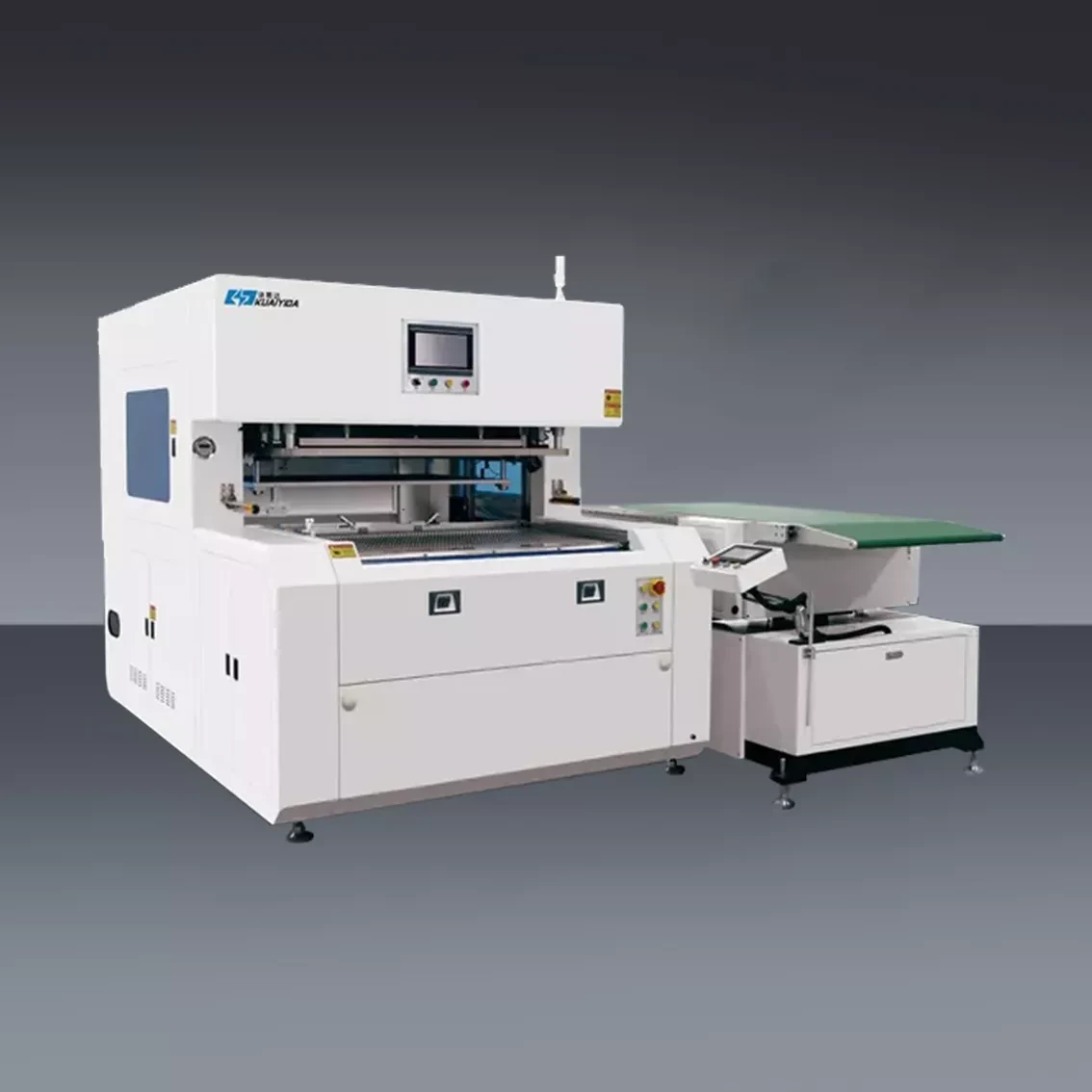
In plastics manufacturing, deflashing equipment occupies a bridge between molding and final quality assurance. Its design reflects the material behavior of the polymer, especially whether the material becomes brittle at low temperature, how thick the flash is, and whether internal flash must also be removed. The segment has evolved from hand trimming and simple presses toward automated cryogenic tumblers, mesh-belt blast units, and multi-axis servo trimming cells that improve repeatability and throughput.
Sustainability is now a central design concern. Modern equipment is increasingly evaluated by energy use, nitrogen or media consumption, flash capture efficiency, and its ability to support closed-loop recycling of removed material or reuse of blast media. Future development is likely to focus on digital monitoring, recipe control, robotics, and narrower process windows for high-value parts.
History and development
Early flash removal in plastics production was largely manual, relying on knives, scrapers, scissors, and operator skill. As molded volumes increased, manufacturers adopted mechanical trimming fixtures and press-based systems for parts with predictable flash geometry.
A major milestone was the commercialization of cryogenic deflashing in the mid-20th century. The process became widely used after processors discovered that cooling elastomeric and some plastic parts near or below their glass-transition region makes flash brittle enough to fracture away under tumbling or media impact.
Another key development was the move from batch tumblers to more controlled systems, including drum, basket, and mesh-belt blast machines with programmable temperature, tumble rate, and media velocity. More recently, manufacturers have introduced automated trim stations for molded plastics and blow-molded parts, including multi-axis servo-guided knife systems that follow the contour of the product.
Technical overview
Deflashing equipment works by exploiting a difference between the flash and the main part:
- In cryogenic deflashing, the flash is embrittled by lowering the part temperature with liquid nitrogen or, less commonly, carbon dioxide.
- In mechanical trimming, the flash is cut or sheared by blades, dies, rotary tools, or press tooling while the part is held in a fixture.
- In blast deflashing, parts are exposed to accelerated media that fractures or strips thin flash from the surface and edges.
Typical operating principles
- Cryogenic tumblers cool parts in a rotating drum or basket, then use part-to-part impact, sometimes assisted by media, to fracture flash.
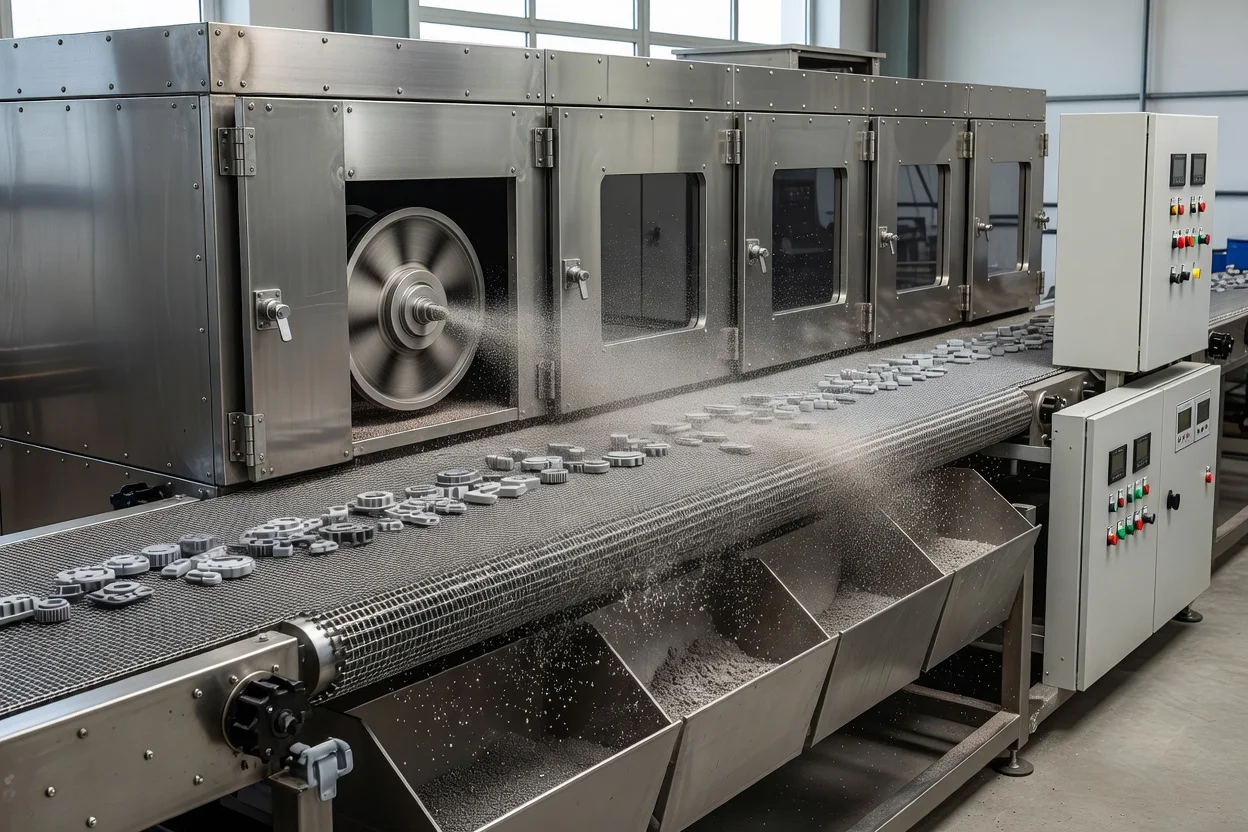
- Mesh-belt blast units cool the load and then propel media by a variable-speed impeller wheel to remove internal and external flash.
- Drum or basket blast machines combine multi-directional tumbling with impeller-driven media impact for higher finishing action.
- Servo trimming cells use programmed axes, often with pneumatic or electric knife drives, to track complex contours and remove flash with high repeatability.
Typical process parameters
Published industry descriptions give several useful benchmark ranges:
- Cryogenic chamber temperature: typically about \(-50^\circ\text{F}\) to \(-200^\circ\text{F}\) \((\-46^\circ\text{C} \text{ to } \-129^\circ\text{C})\).
- Tumbling speed: about 5 to 50 rpm depending on part geometry and fragility.
- Cryogenic blast media size: typically 0.015 to 0.060 inch \((0.38 \text{ to } 1.52 \text{ mm})\).
- Post-dewatering moisture after centrifugal separation in related cleaning lines: often described in the broader plastics-wash context as low residual surface moisture, typically a few percent by mass; in deflashing systems, the more relevant indicator is removal efficiency rather than flake moisture.
Because deflashing is a finishing operation rather than a primary conversion step, throughput is highly application-specific. Small-part cryogenic systems are commonly selected for batch productivity, while continuous or semi-continuous belt systems are used where consistent loading supports higher output. Suppliers market equipment across a wide capacity range, from compact units for small molded parts to larger industrial machines for batch loads of thermoset plastics.
Quantitative performance considerations
The actual removal rate depends on flash thickness, polymer hardness, part mass, and whether internal flash is present. In practice:
- Thin parting-line flash is easiest to remove by cryogenic methods.
- Heavy flash or flash tied to thick sections may require trimming dies or knife stations.
- Deep internal flash often favors blast systems, media-assisted tumblers, or dedicated tooling.
Types and variations
| Type | Main mechanism | Best suited to | Strengths | Limitations |
|---|---|---|---|---|
| Cryogenic tumbler | Cooling plus tumbling fracture | Rubber, silicone, thermoset parts with thin flash | Uniform treatment, low manual labor | Less effective on very heavy flash or delicate thin-walled parts |
| Cryogenic blast machine | Cooling plus impeller-driven media impact | Parts needing internal and external flash removal | Stronger flash removal, wider part range | Higher equipment complexity and media management needs |
| Mechanical trim machine | Knife, die, or rotary cutting | Blow-molded, thermoplastic, or contour-defined parts | Precise geometric control | Requires tooling or part fixturing |
| Servo trim cell | Multi-axis automated cutting | Complex molded geometries | High repeatability and programmability | Higher engineering and integration cost |
| Deburring/deflashing machine | Combined finishing processes | Molded, cast, or formed parts | Flexible use across multiple materials | Process optimization can be application-specific |
Common machine configurations
- Tumble drum deflashing machines for batch loads of thermoset plastic parts.
- Tumble belt deflashing machines for multiple small parts or complex molded geometries with medium to heavy flash.
- Wire mesh belt machines for fully automated batch handling and continuous-style processing.
- Press-like or die-trim equipment for flash lines that can be cut cleanly at a fixed interface.
Materials and part types
Deflashing equipment is used most often on:
- Rubber and elastomer components, including seals, gaskets, bushings, and molded vibration-control parts.
- Thermoset plastics, where brittle flash can be removed efficiently by cryogenic or mechanical batch systems.
- Silicone, urethane, and other specialty molded materials.
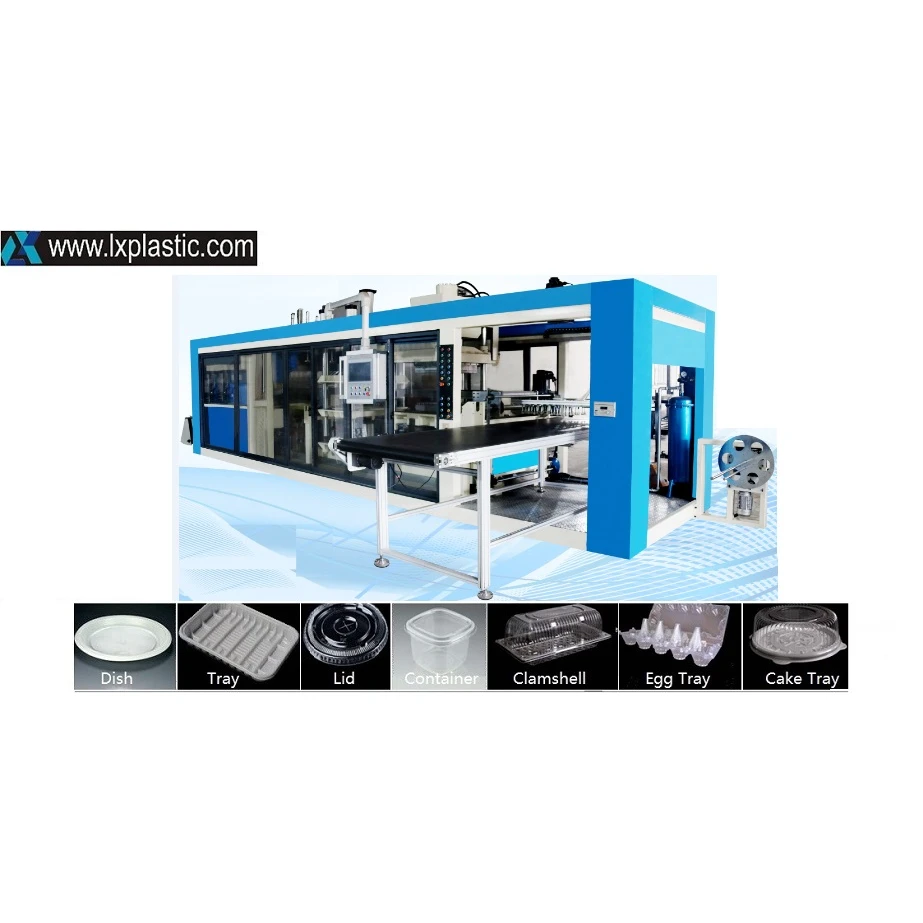
- Selected thermoplastics, especially blow-molded or vacuum-formed components with parting-line excess.
A poor-fit use case is very soft, highly ductile thermoplastics with thick or smeared flash, because brittle-fracture-based methods may be ineffective and can risk surface damage. In such cases, precision trimming or automated knife cutting is usually more suitable.
Applications and uses
Deflashing equipment is used wherever excess material threatens performance or finish quality:
- Automotive: seals, grommets, vibration mounts, under-hood elastomers, and molded service parts.
- Appliances and consumer goods: soft-touch components, gaskets, and visible cosmetic parts.
- Medical and healthcare: silicone and elastomer parts requiring consistent edge quality.
- Electrical and electronics: insulating or sealing components where flash can affect fit or creepage distance.
- Industrial equipment: molded seals, diaphragms, and vibration-control parts.
The equipment choice usually matches the defect type:
- External thin flash: cryogenic tumbling or light trimming.
- Internal flash: blast units, tooling-based trimming, or combined processes.
- Heavy, localized flash: press trimming or dedicated cut stations.
- High-mix, low-volume parts: programmable trim cells or flexible batch systems.
Technological innovations and automation
Recent innovation has centered on reducing labor dependence and improving repeatability. Key advances include:
- Multi-axis servo trimming that follows part contours using programmable motion paths.
- Automated batch handling with conveyors, baskets, and part orientation systems.
- Improved control systems for temperature, tumble time, media velocity, and cycle repeatability in cryogenic machines.
- Integration with robotics for loading, unloading, and part inspection in high-volume lines.
Process monitoring is also becoming more important. Operators increasingly want traceability for cycle time, temperature setpoint, media condition, and part pass/fail data so that deflashing can be tied more closely to quality management systems.
Environmental and sustainability aspects
Deflashing equipment has a direct sustainability role because it can reduce scrap, rework, and manual handling losses. In cryogenic systems, however, sustainability depends strongly on efficient nitrogen use and good insulation, since refrigeration energy and cryogen consumption are major operating costs.
Important sustainability considerations include:
- Flash recovery and reuse where removed material is clean enough to re-enter recycling streams.
- Media recirculation in blast systems to reduce consumable use.
- Energy efficiency through optimized cycle times and improved chamber insulation.
- Lower reject rates by removing flash consistently before assembly or shipment.
The environmental profile varies by process. Cryogenic systems can be highly productive, but they add cryogen demand. Mechanical trimming avoids cryogen use, but may require tooling and can generate more labor or tooling waste. The most sustainable choice is usually the one that minimizes total life-cycle cost and scrap for the specific part family.
Economic and global market impact
Deflashing equipment is economically important because flash removal is often a bottleneck between molding and final assembly. Automating this step can reduce labor content, stabilize quality, and improve throughput, especially in high-volume rubber and thermoset production.
The global market is shaped by several factors:
- Growth in automotive sealing and vibration-control parts.
- Rising quality demands in medical and electronics components.
- Expansion of automated molding cells that require downstream finishing integration.
- Regional strengths in machinery manufacturing, particularly among suppliers of cryogenic and trim systems in North America, Europe, and Asia.
Industrial sourcing also shows a split between premium engineered systems and lower-cost generic machines. High-precision applications generally favor integrated equipment with better controls, service support, and process validation.
Current challenges and innovations
The main engineering challenges are:
- Maintaining consistent results across changing part geometries.
- Avoiding over-deflashing, which can nick sealing surfaces or alter dimensions.
- Managing internal flash that is difficult to access mechanically.
- Balancing throughput against part fragility.
- Controlling operating cost, especially energy and consumables in cryogenic systems.
Current innovation is aimed at:
- Better recipe control for different polymers and flash geometries.
- Vision inspection before and after trimming.
- More precise servo motion control for contour-following trim stations.
- Hybrid lines that combine cryogenic embrittlement with mechanical finishing when one method alone is insufficient.
Future outlook
Deflashing equipment is likely to become more automated, more data-driven, and more closely tied to upstream molding conditions. The most advanced systems will probably combine machine vision, adaptive control, robotics, and traceable process records to support zero-defect production.
For plastics processors, the strategic direction is clear: deflashing will be judged not only by its ability to remove flash, but by its contribution to total manufacturing efficiency, part consistency, and material circularity. Cryogenic, mechanical, and hybrid systems will continue to coexist, with selection increasingly determined by polymer behavior, part geometry, and the economics of automation rather than by process tradition alone.
References
- •
Cryogenic rubber deflashing - Airgas. (n.d.). Airgas. https://www.airgas.com/solutions/engineering_solutions/cryogenic_rubber_deflashingLink
- •
Customize your GlobalSpec experience. (2025, January 1). GlobalSpec. https://www.globalspec.com/learnmore/manufacturing_process_equipment/abrasives_grinding_finishing/grinding_machines_finishing_equipment/deburring_machinesLink
- •
Deflashing equipment | Automated deflash machines & solutions. (2025, March 11). Surface Technologies. https://surfacetechnologies.ca/deflash-equipment/Link
- •
Cryogenic deflashing and deburring machines. (2025, October 1). Nitrofreeze. https://www.nitrofreeze.com/equipment/deburring-deflashing/Link
- •
Dry ice cleaning equipment for plastic deburring & deflashing. (2025, September 26). Cold Jet. https://www.coldjet.com/dry-ice-blasting/applications/deburring-deflashing/Link
- •
Cryogenic finishing. (2010, May 28). Cold Facts. https://cold-facts.org/2010/05/28/cryogenic_finishing/Link
- •
Cryogenic deflashing equipment. (2019, March 4). Polyblast. https://www.polyblast.com/products/cryogenic-deflashing-equipment/Link
- •
Deflashing. (2011). GlobalSpec. https://www.globalspec.com/industrial-directory/deflashingLink
- •
Leonard Enterprises - Cryogenic deflashing & stainless steel. (2026, August 27). Leonard Enterprises. https://leonardenterprises.com/Link
- •
Deflashing machine. (2025, January 20). Alibaba. https://www.alibaba.com/showroom/deflashing-machine.htmlLink
- •
Tumble drum deflashing machine | Surface Technologies. (2025, April 4). Surface Technologies. https://surfacetechnologies.ca/deflash-equipment/tumble-drum-deflashing-machine/Link
- •
Deflash machine. (2025, January 20). Alibaba. https://www.alibaba.com/showroom/deflash-machine.htmlLink
- •
Tumble belt deflashing machine | Surface Technologies. (2025, April 4). Surface Technologies. https://surfacetechnologies.ca/deflash-equipment/tumble-belt-deflashing-machine/Link
- •
Deflashing machine: Efficient rubber & plastic processing - Accio. (2025, November 8). Accio. https://www.accio.com/plp/deflashing-machineLink
- •
Deflashing machines for industrial use [PDF]. (n.d.). Fintec1. https://fintec1.com/wp-content/uploads/2018/12/Deflashing-Machines-for-Industrial-Use-186.4.pdfLink
- •
Wire mesh belt deflashing machine | Surface Technologies. (2025, April 4). Surface Technologies. https://surfacetechnologies.ca/deflash-equipment/wire-mesh-belt-machines/Link
- •
修边机. (n.d.). Tope International. https://www.topeintl.com/cn/%E4%BF%AE%E8%BE%B9%E6%9C%BA.htmlLink
- •
Comparison of deflashing methods [PDF]. (n.d.). Solvay. https://www.solvay.com/sites/g/files/srpend616/files/2018-07/Comparison-of-Deflashing-Methods-for-Molded-Components.pdfLink
- •
Cryogenic deflashing for rubber products. (n.d.). MATEC Web of Conferences. https://www.matec-conferences.org/articles/matecconf/pdf/2018/03/matecconf_rimes2017_03004.pdfLink
- •
Rubber deflashing machine - Manufacturers, suppliers, prices. (2026, September 5). TradeIndia. https://www.tradeindia.com/manufacturers/deflashing-machine.htmlLink
- •
Cryogenic systems [PDF]. (n.d.). Air Products. https://www.airproducts.com/-/media/files/en/312/312-18-005-us-cryogenic-deflashing-for-high-perf-mat.pdfLink
- •
乐善智能取得吹塑制品飞边修整机构专利. (2023, August 27). 财富号. https://caifuhao.eastmoney.com/news/20240711121352136717560Link
- •
为什么选择冷冻修边机? (2023, July 27). 南京昭凌精密机械有限公司. https://www.showtan-tech.com/sys-nd/25.htmlLink
- •
木工机械修边机板材修整切割和封边后的圆角. (2025, April 16). Alibaba. https://chinese.alibaba.com/product-detail/Woodworker-Machinery-Edge-Trimmer-Machine-Plate-60197392565.htmlLink
- •
修边机都有什么用处. (2026, March 10). B2B Wiki. https://b2bwiki.baidu.com/article/d0raibhftjsk5qv9sbggLink
- •
サービスセンター. (n.d.). DJI. https://www.dji.com/service/repair/centersLink
- •
橡塑膠毛邊去除機. (2022, March 25). CENS. https://www.cens.com/cens/html/zh/category/cate_list_M0241.htmlLink
- •
雙光邊機/四邊磨:玻璃邊緣研磨與拋光技術. (n.d.). 友士股份有限公司. https://www.use.com.tw/product-detail/Intelligent-high-speed-polishing-double-edger-machine-seaming-machine/Link
- •
去毛邊工具. (2024, February 16). Mindman. https://www.mindman.com.tw/webls-zh-tw/category-Deburring-Tool.htmlLink
- •
木工自動封邊機 - 封邊機. (2025, March 17). TechPro CNC. https://www.techpro-cnc.com/zh-tw/products/panel-furniture-machine/edge-banding-machineLink
- •
连续运动式去毛边修整机器. (2013, April 4). Google Patents. https://patents.google.com/patent/CN104125880B/zhLink
- •
金屬修邊機圖片. (n.d.). 1688. http://tw.1688.com/pic/-BDF0CAF4D0DEB1DFBBFACDBCC6AC.htmlLink
- •
修剪操作 101:机器、设备和工具. (2024, June 5). ProleanTech. https://proleantech.com/zh-CN/trimming-operations-101-machines-equipment-and-tools/Link
- •
修剪操作 101:機器、設備和工具. (2024, June 5). ProleanTech. https://proleantech.com/zh-TW/trimming-operations-101-machines-equipment-and-tools/Link
- •
中铁建电气化局集团轨道交通器材有限公司自动去飞边毛刺生产线. (n.d.). CRCC. https://ece.crcc.cn/unlogin/downLoadFile.jhtml?id=22dffa2b5e364dc58098052f35d96d89Link
- •
適用於木工業務的頂級邊條機. (2025, February 7). TechPro CNC. https://www.techpro-cnc.com/zh-tw/product/top-rated-edge-banding-machine-woodLink
- •
多功能修边机:高效精准的多场景应用. (2026, September 8). Accio. https://zh.accio.com/plp/%E5%A4%9A%E5%8A%9F%E8%83%BD%E4%BF%AE%E8%BE%B9%E6%9C%BALink
- •
Slouching toward airworthiness. (n.d.). AeroLogic. http://www.aerologic.com/M2website/texts/Progress.htmLink