
Introduction
Foam stabilisers are specialty additives that improve the persistence, uniformity, and processing behavior of foams by slowing bubble collapse, drainage, coalescence, and disproportionation. In plastics and adjacent formulation markets, they are most closely associated with polyurethane foams, mechanically foamed PVC systems, fire-fighting foams, foam concrete, and other gas-dispersed materials where controlled cell structure is essential.
Within the plastics value chain, foam stabilisers are best understood as interface-active or structure-building auxiliaries rather than as bulk polymers. They may be surfactants, polymeric thickeners, particulate stabilizers, or composite systems, and they work by modifying surface tension, reinforcing liquid films, increasing viscosity, or anchoring particles at the gas–liquid interface. The most industrially important subgroup in polyurethane processing is the organosilicon surfactant family, often described as silicone-based foam stabilisers or cell regulators, which help control nucleation, cell size, and foam rise.
Their industrial importance reflects a broader materials trend: lightweighting, thermal insulation, cushioning, acoustic damping, energy absorption, and fire-performance tuning increasingly depend on fine control of cellular morphology. At the same time, sustainability pressure is pushing formulators toward lower-emission chemistries, reduced fluorinated content in foam systems, bio-based and biodegradable stabilizers in some niches, and better recyclability of foamed products.
History and Development
Foam stabilisation predates modern polymer chemistry. Early foam systems relied on proteins and other natural colloids; a classic historical example is foam used in fire suppression, where bubbles were stabilized by protein-containing materials such as dried blood or glue. As industrial foams expanded in the twentieth century, surfactants became the dominant stabilizing class, followed by polymer thickeners and engineered particles for more demanding applications.
In plastics processing, the development of polyurethane foam technology strongly accelerated demand for dedicated silicone surfactants and formulation-specific stabilizers. Over time, stabilizer packages evolved from single-component surfactants to multifunctional blends that could simultaneously emulsify raw materials, promote nucleation, regulate open-cell versus closed-cell structure, and prevent collapse during rise and cure. In parallel, fire-fighting foam, oilfield foam, and foam-concrete research expanded the use of polymers such as xanthan gum, cellulose derivatives, and polyacrylamide to improve drainage resistance and foam lifetime.
Chemical Structure and Key Properties
Foam stabilisers are a functional class rather than a single chemical family. Their performance depends on molecular architecture and the target foam system.
| Stabiliser family | Typical structural feature | Main stabilising mechanism | Common use patterns |
|---|---|---|---|
| Silicone surfactants | Polyether-modified siloxane backbone | Lowers surface tension, regulates cell nucleation and coalescence | Polyurethane foams, some mechanically foamed systems |
| Polymeric stabilisers | High-molecular-weight water-soluble polymers | Increase viscosity, slow drainage, strengthen lamellae | Firefighting foams, drilling-related foams, foam concrete |
| Particulate stabilisers | Inorganic particles such as silica or alumina | Irreversibly adsorb at the interface and reinforce films | Enhanced oil recovery, specialty aqueous foams |
| Composite stabilisers | Surfactant–polymer or particle–surfactant systems | Combine interfacial control with rheology control | High-performance industrial foams |
Key functional properties include:
- Surface tension reduction, which makes bubble formation easier and improves initial foam generation.
- Film elasticity and strength, which help resist rupture during rise and curing.
- Drainage control, usually by raising viscosity or creating interfacial barriers.
- Cell-size regulation, especially important in rigid and flexible polyurethane foams.
- Open-cell/closed-cell balance, which determines airflow, insulation, cushioning, and mechanical performance.
Two practical limits are especially important:
- Low dosage window → overuse can trap gas or overly close cells → adjust surfactant level and polymer balance. In polyurethane systems, excessive stabilizer can produce very fine, overly closed foam with reduced breathability or altered mechanical response.
- Viscosity improvement alone → not sufficient for strong interfacial films → combine with surfactants or particles. Polymer thickeners can slow drainage, but durable stability often requires a coordinated interfacial mechanism from surfactants or nanoparticles.
Production Processes and Raw Feedstocks
Foam stabilisers are produced through several chemical and formulation routes:
- Silicone-based stabilisers are typically made by modifying siloxane backbones with polyether side chains to create amphiphilic molecules that migrate to the gas–liquid interface and tune bubble behavior.
- Polymeric stabilisers such as xanthan gum, carboxymethyl cellulose, hydroxyethyl cellulose, polyacrylamide, and related water-soluble polymers are produced through fermentation, etherification, or polymerization routes and then incorporated as rheology modifiers.
- Particle-based stabilisers use silica, alumina, calcium carbonate, or other inorganic particles, often surface-treated to improve interfacial adsorption.
- Composite systems combine viscosity control, emulsification, and film reinforcement in a single package, which is common in industrial foam concentrates and polyurethane additive blends.
Raw feedstocks depend on the stabiliser family:
- Petrochemical intermediates for silicone and surfactant production
- Natural polysaccharides such as xanthan-derived materials for biobased or partially biobased systems
- Inorganic mineral feedstocks for particle stabilizers
- Blended formulation components such as co-surfactants, thickener aids, and compatibilizers
A useful formulation example is xanthan gum in aqueous foams. Concentrations around 0.3–0.4% have been reported to give strong stability in certain aqueous film-forming foam systems, while higher loading can further increase half-life but may reduce spreading or extinguishing performance depending on the application target. The mechanism is mainly viscosity-driven: the polymer increases lamella viscosity and slows drainage.
Applications and End-Use Markets
Foam stabilisers are used wherever foam morphology determines product performance.
- Polyurethane flexible foam: Silicone surfactants are the dominant stabilisers, used to emulsify the formulation, promote nucleation, prevent collapse, and regulate cell size and openness. This is the core market for many organosilicon foam stabilisers.
- Polyurethane rigid foam: Stabilizers are selected to support fine, uniform cells and appropriate closed-cell content for insulation performance. Excess stabilizer can improve dimensional uniformity but may increase closed-cell character beyond the desired range.
- Mechanically foamed PVC plastisols: Foam stabilizers help manage bubble formation and stability in shear-induced foaming systems.
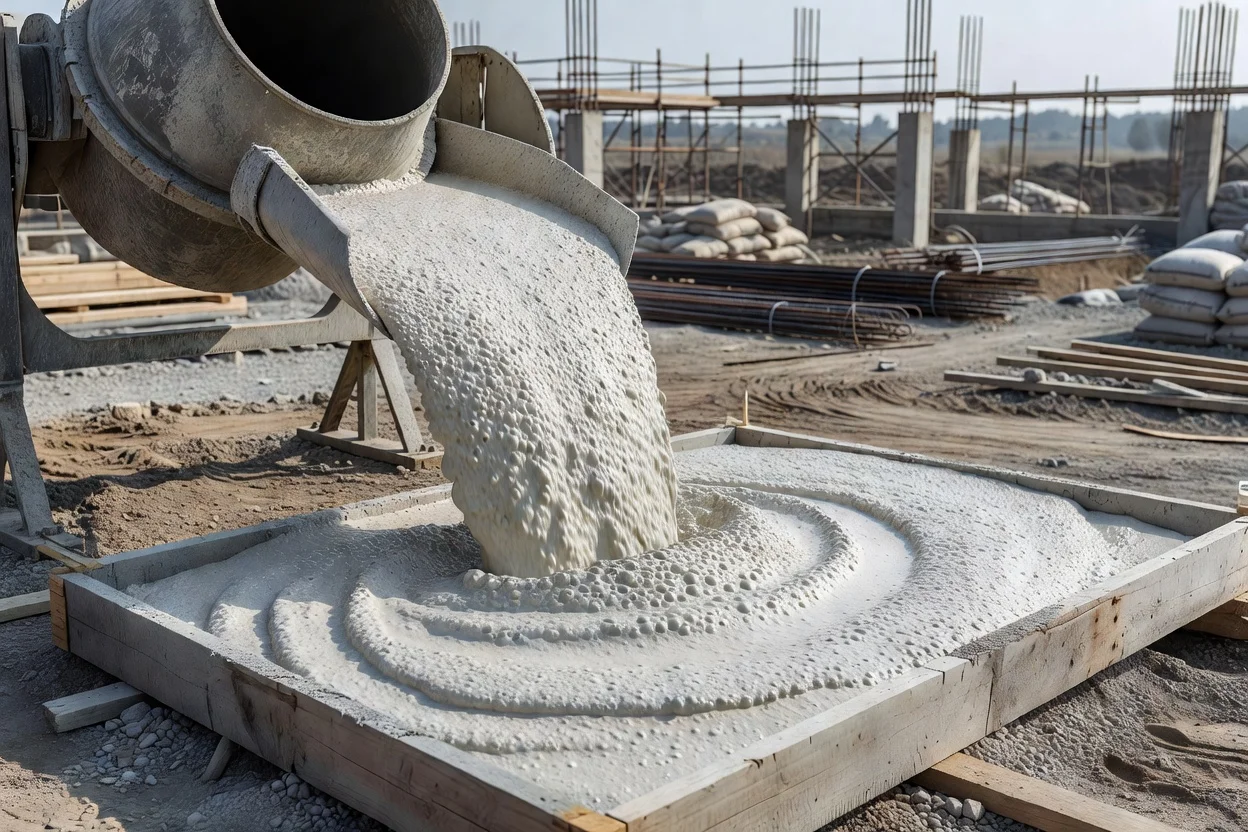
- Foam concrete: Polymer-based, surfactant-based, particulate, and composite stabilizers are used to prevent bubble breakage during mixing, transport, and curing.
- Firefighting foams and AFFF systems: Cellulose derivatives, xanthan gum, and related thickeners are used to improve foam stability, although formulation trade-offs can reduce spreading or film-forming ability if overused.
- Drilling, enhanced oil recovery, and aqueous industrial foams: Polymers, surfactants, and nanoparticles are used to extend foam half-life and control drainage under harsh salinity or temperature conditions.
- Specialty foams in personal care and cleaning: Foam stabilisers are used to tune foam density, texture, and persistence, though this segment is less relevant to plastics than to surfactant formulation broadly.
One poor-fit use is in applications where a foam must collapse quickly. In such systems, a foam stabiliser is counterproductive, and a defoamer or antifoam is preferred instead.
Environmental and Sustainability Aspects
Foam stabilisers raise sustainability questions because they are often essential for lightweight products but may complicate recycling, emissions, or end-of-life handling.
- Recyclability: In foamed plastics, the stabiliser is usually present at low concentration, but it can still affect cell morphology, contamination behavior, and the compatibility of recycled flakes or reprocessed melt streams.
- Bio-based alternatives: Polysaccharide stabilisers such as xanthan gum and cellulose derivatives offer routes to more renewable formulations in aqueous foam systems.
- Carbon footprint: Silicone and petrochemical surfactants depend on energy-intensive upstream chemistry, although their high efficiency at very low dosage can reduce total material use in the final foam.
- Fluorinated chemistry reduction: In some foam applications, reformulation toward lower-fluorine or fluorine-free packages is an important market trend, especially in fire-fighting foam.
- Nanoparticle and composite routes: These can improve stability and reduce dosage, but they introduce questions about particle sourcing, dispersion safety, and downstream separability.
The sustainability trade-off is often a systems problem: a stabiliser that improves foam quality can reduce density, material consumption, and energy use in insulation or cushioning products, yet the same stabiliser may make recycling or clean disposal more complex. The environmental value therefore depends on total life-cycle performance rather than on additive origin alone.
Economic and Global Market Impact
The market for foam stabilisers is tied to the growth of polyurethane insulation, automotive cushioning, building materials, fire protection, and specialty aqueous foams. Industry commentary suggests continued expansion in foam-related additives as construction insulation, consumer comfort materials, and technical foams remain structurally important end markets.
Global supply is concentrated among large specialty chemical groups and additive formulators. In polyurethane-related systems, major players include multinational silicone and additive suppliers such as Evonik, Dow, Wacker, Elkem, Momentive, and other regional formulators; in China, a growing number of local suppliers serve polyurethane, fire-fighting, and plastic-processing markets. Competitive advantage typically comes from formulation know-how, consistency in cell control, compatibility with polyols and blowing agents, and the ability to tailor open-cell versus closed-cell behavior.
Current Challenges and Innovations
Current technical challenges center on balancing foam stability with downstream performance:
- Over-stabilization can create overly fine or closed cells, weakening airflow, comfort, spreading behavior, or fire performance in certain systems.
- Compatibility constraints arise because stabilisers must work across varying polyols, surfactants, catalysts, flame retardants, and blowing systems in polyurethane formulations.
- Harsh-condition stability is difficult in high-salinity, high-temperature, or chemically aggressive environments, which drives interest in polymer blends and particle-assisted systems.
Innovation is focused on:
- Low-emission and fluorine-reduced packages for fire-fighting foams
- Bio-based polymer stabilisers for aqueous foams and selected plastics-adjacent uses
- Nanoparticle-assisted stabilization to improve interfacial resilience at lower dosage
- Multifunctional additive packages that combine emulsification, nucleation control, and rheology modification in one product
Future Outlook
Foam stabilisers are likely to become more formulation-specific, more sustainability-driven, and more tightly integrated with processing design. In plastics, this means greater use of tailored silicone surfactants in polyurethane systems, broader adoption of renewable thickeners where performance permits, and more sophisticated hybrid systems that reduce total additive loading while improving cell control.
The most important development direction is likely to be performance per unit dosage: stabilisers that deliver better morphology control at lower concentration will have advantages in cost, carbon intensity, and product consistency. At the same time, regulatory pressure and circular-economy requirements will continue to favor chemistries that support safer manufacturing, lower emissions, and easier recycling or reuse pathways.
Summary
Foam stabilisers are essential auxiliaries for controlling bubble formation, film strength, drainage, and cell structure in foamed materials. They include silicone surfactants, polymeric thickeners, particulate stabilizers, and hybrid formulations, with polyurethane foam representing the most commercially important plastics-related application. Their future is being shaped by sustainability constraints, tighter performance demands, and the need to balance foam quality with recyclability and low-carbon production.
References
- •
Foam stabilizer | chemical compound | Britannica. (2025, August 23). Britannica. https://www.britannica.com/science/foam-stabilizerLink
- •
Foam stabilizers are essential additives in foam concrete production. (n.d.). https://jresm.org/wp-content/uploads/resm2025-585ma1221rs.pdfLink
- •
Polyurethane additives foam stabilizer: Comprehensive .... (n.d.). Eureka. https://eureka.patsnap.com/materials/pu-foam-stabilizer-chemistryLink
- •
Foam silicone stabilizer. (2025, August 15). Topwin. https://www.topwinsilicone.com/news/foam-silicone-stabilizer.htmlLink
- •
泡沫稳定剂市场展望2035:电子与半导体需求驱动增长 - 新闻和统计 - IndexBox. (2026, September 19). IndexBox. https://www.indexbox.io/zh-hans/blog/foam-stabilizing-agents-market-forecast-to-2035-electronics-and-semiconductor-demand-drives-5-8-cagr/Link
- •
Addovate® surfactants act mainly as emulisifiers and foam stabilizers. (2024, March 1). Lanxess. https://lanxess.com/en/products/industries/polymer-additives/emulsifiers-and-foam-stabilizersLink
- •
技术】泡沫稳定剂(硅油)讲义. (2023, March 17). Pu18. https://www.pu18.com/show/1089.htmlLink
- •
酿酒科技. (n.d.). Chemalink. https://www.chemalink.net/data/download/05c0e7a1c86263a0.htmlLink
- •
Foam stabilizers. (n.d.). Chempoint. https://www.chempoint.com/industries/personal-care/foam-stabilizersLink
- •
Effects of different types of stabilizers on the properties of foam .... (2023, August 17). PMC. https://pmc.ncbi.nlm.nih.gov/articles/PMC10458476/Link
- •
Table 3. (2025, January 1). PMC. https://pmc.ncbi.nlm.nih.gov/articles/PMC12656394/table/polymers-17-02966-t003/Link
- •
Stabilizers - functional additives - cleaning ingredients. (2025, June 30). Knowde. https://www.knowde.com/b/technologies-cleaning-ingredients/functional-additives/stabilizers/productsLink
- •
聚氨酯软泡的性质与哪些因素有关?还有这3点格外注意. (2023, January 1). Foamandtape. https://www.foamandtape.com/zh-cn/media-centre/hyxw/1/19.htmlLink
- •
Polysaccharides and polyacrylamide as linear polymeric .... (2025, November 24). PMC. https://pmc.ncbi.nlm.nih.gov/articles/PMC12693878/Link
- •
表面活性剂发泡能力与泡沫稳定性研究. (n.d.). Sina. https://blog.sina.com.cn/s/blog_13043ee740102wnvf.htmlLink
- •
发泡剂. (n.d.). Kruss Scientific. https://www.kruss-scientific.com/zh-CN/know-how/glossary/foaming-agentsLink
- •
Foam stabilization process for nano-Al2O3 and its effect .... (2024, September 18). PMC. https://pmc.ncbi.nlm.nih.gov/articles/PMC11434740/Link
- •
泡沫剂. (2024, December 3). Zgbk. https://www.zgbk.com/ecph/words?SiteID=1&ID=212545&Type=bkzybLink
- •
聚氨酯泡沫塑料的原料和发泡助剂的简介. (2018, August 23). 163. https://www.163.com/dy/article/DPTG2Q970518W7LM.htmlLink
- •
产品中心_1-东莞市恩科化工有限公司| 纺织助剂| 柔软剂. (n.d.). Htekgroup. https://www.htekgroup.com/product_1/p-9-9.htmlLink
- •
聚氨酯各种原料对软泡的影响-新闻资讯-苏州达维科新材料科技有限公司. (2018, August 31). Daveon. https://www.daveon.cn/article238/detail115.htmlLink
- •
2. Name and type of foam stabilizers (FS series). (2025, January 1). PMC. https://pmc.ncbi.nlm.nih.gov/articles/PMC12355427/table/tbl2/Link
- •
Experimental study on effect of foam stabilizers on aqueous .... (n.d.). Springer. https://link.springer.com/article/10.1007/s10694-017-0681-z?error=cookies_not_supported&code=39a576c1-4051-49de-b471-0104ccef6fdaLink
- •
Preparation and rheological properties of a stable aqueous foam .... (2017, August 11). RSC. https://pubs.rsc.org/en/content/articlehtml/2017/ra/c7ra06799bLink
- •
Foam stabilizers. (2025, March 3). Google Patents. https://patents.google.com/patent/US3053763A/enLink
- •
A review on foam stabilizers for enhanced oil recovery. (2021, March 15). ACS. https://pubs.acs.org/doi/abs/10.1021/acs.energyfuels.1c00035Link
- •
Stabilization of foams with inorganic colloidal particles. (2006, November 14). ACS. https://pubs.acs.org/doi/abs/10.1021/la061825aLink
- •
Experimental study on effect of foam stabilizers on aqueous film-forming foam - fire technology. (2017, October 16). Springer. https://link.springer.com/article/10.1007/s10694-017-0681-z?error=cookies_not_supported&code=568ace91-b28c-458e-bc73-d8d6876f6425Link
- •
Foam stability evaluation of a biodegradable surfactant with .... (2026, February 10). PMC. https://pmc.ncbi.nlm.nih.gov/articles/PMC12947212/Link
- •
PVC 增塑糊用助剂 - BYK. (n.d.). BYK. https://www.byk.com/zh/applications/pvc-plastisolsLink
- •
一种水成膜泡沫灭火剂. (2004, October 15). Google Patents. https://patents.google.com/patent/CN1759905B/zhLink
- •
分散烯烃聚合物泡沫. (n.d.). Google Patents. https://patents.google.com/patent/CN1842561A/zhLink
- •
泡沫控制剂. (2025, November 5). Dow. https://www.dow.com/zh-cn/product-technology/pt-antifoams.htmlLink
- •
含有有机硅表面活性剂的高醇含量发泡组合物. (2006, March 7). Google Patents. https://patents.google.com/patent/CN103417388A/zhLink
- •
烷烃类发泡b1级阻燃聚氨酯硬质泡沫及其制备方法. (2020, August 10). Google Patents. https://patents.google.com/patent/CN111909339B/zhLink
- •
可发泡农药组合物. (2010, April 28). Google Patents. https://patents.google.com/patent/CN102458126B/zhLink
- •
建设项目环境影响报告表. (n.d.). Jiangmen. http://www.jiangmen.gov.cn/attachment/0/163/163302/2274586.pdfLink
- •
有机胺盐发泡剂. (2017, December 5). Google Patents. https://patents.google.com/patent/WO2019075875A1/zhLink
- •
具有减低的氟含量的水性灭火泡沫. (n.d.). Google Patents. https://patents.google.com/patent/CN103237577B/zhLink