
Introduction
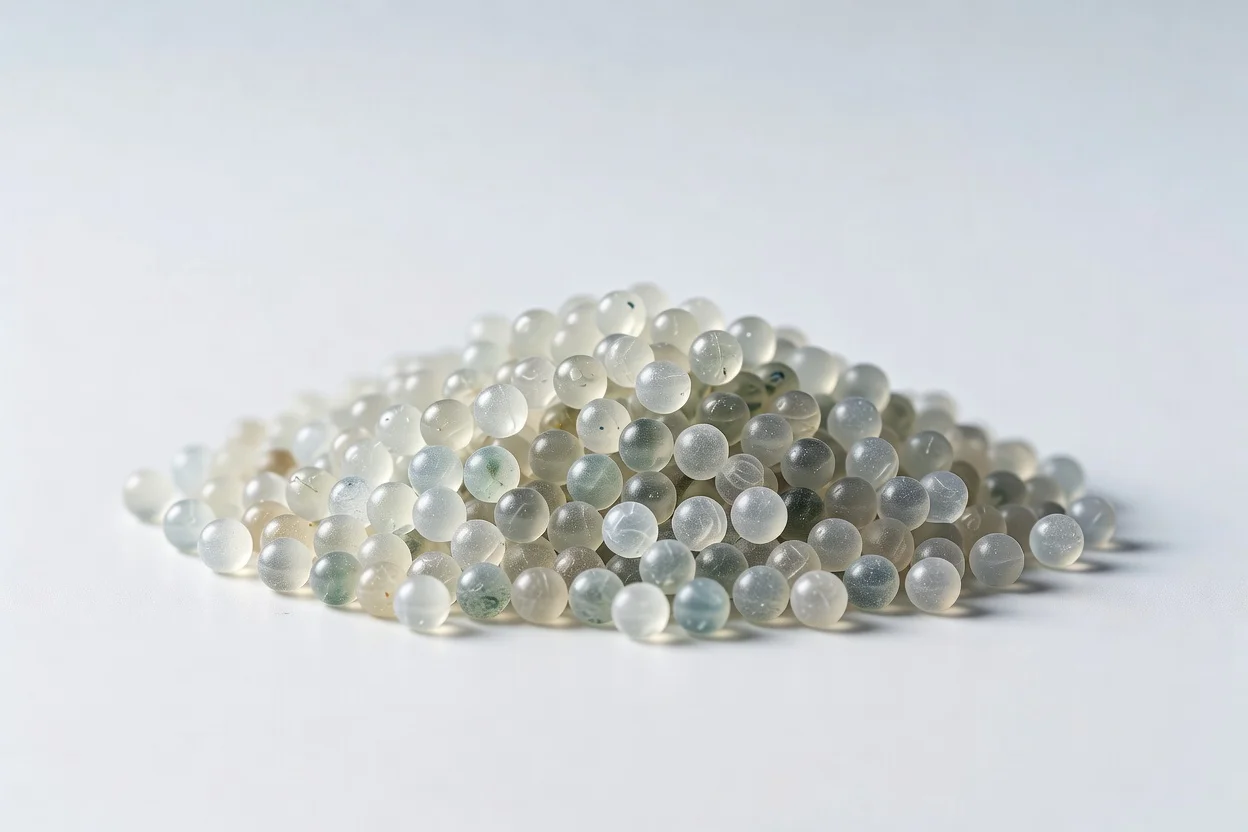
Recycled polyoxymethylene (rPOM) is a recovered and reprocessed form of polyoxymethylene, also known as acetal or polyacetal, used primarily as a high-performance engineering plastic for precision components. In practice, rPOM is produced from post-industrial scrap or post-consumer POM waste and is valued where low friction, dimensional stability, wear resistance, and good fatigue performance matter, especially in automotive, electrical, appliance, and industrial parts.
rPOM sits at the intersection of engineering plastics and circular materials management. It inherits many of the functional advantages of virgin POM, but its use is shaped by feedstock quality, contamination control, stabilisation, and the sensitivity of acetal polymers to thermal and chemical degradation during reprocessing. Recent work on POM waste valorisation also shows that, beyond mechanical recycling, chemical upcycling routes can convert waste POM into value-added chemicals and C1 building blocks, broadening the sustainability story around this polymer family.
History and Development
Polyoxymethylene established itself as a major engineering thermoplastic because it combined metal-like stiffness with low friction and excellent machinability, making it attractive for precision moving parts. As manufacturing scrap streams matured and post-consumer recovery systems improved, recycled grades emerged to meet demand for lower-carbon materials and for cost-effective substitution in non-critical applications.
The development of rPOM reflects two parallel trends. First, processors increasingly seek recycled engineering plastics that can retain enough mechanical performance for demanding applications. Second, researchers and industry have expanded beyond remelting into chemical recycling and upcycling pathways, using POM waste as a source of methylene units or other simple intermediates for synthesis of solvents, fuel-related chemicals, and other products.
Chemical Structure and Key Properties
POM is a semi-crystalline thermoplastic built from formaldehyde-derived repeating acetal units, typically supplied as homopolymer or copolymer grades. The crystalline morphology is responsible for the material’s high stiffness, low creep, low water absorption, and excellent dimensional stability, while also limiting chain mobility and contributing to good wear resistance and elastic recovery.
Key properties that carry into rPOM include:
- High stiffness and hardness, supporting load-bearing precision parts.
- Low coefficient of friction, useful for sliding and gear applications.
- Low water absorption, which helps preserve dimensions in humid environments.
- Good fatigue and creep resistance, important for repeated motion and spring-like components.
Important limits remain, and these shape where rPOM can be used:
- Poor thermal stability → POM can degrade during overheating or excessive residence time in processing → use tight temperature control, short residence times, and stabilised grades.
- Sensitivity to outdoor aging and UV exposure → long-term weathering can reduce performance → use indoor applications, pigmentation, stabilisers, or protective design measures.
- Processing shrinkage and dimensional control challenges → high crystallinity leads to relatively large shrinkage → use tool design compensation, process optimisation, and grade selection.
- Recycling performance drift → repeated thermal history can reduce properties in some streams → use controlled blend ratios, stabiliser packages, and restrict to non-critical parts when needed.
A practical distinction in the POM family is between homopolymer and copolymer grades. Homopolymer POM typically offers slightly higher stiffness and strength, while copolymer grades generally improve thermal and hydrolytic stability.
Production Processes and Raw Feedstocks
rPOM is produced through collection, sorting, size reduction, washing, melt reprocessing, and pelletising of POM-containing waste streams. The most valuable feedstocks are relatively clean post-industrial scrap, rejected sprues and runners, and well-characterised post-consumer streams from durable goods.
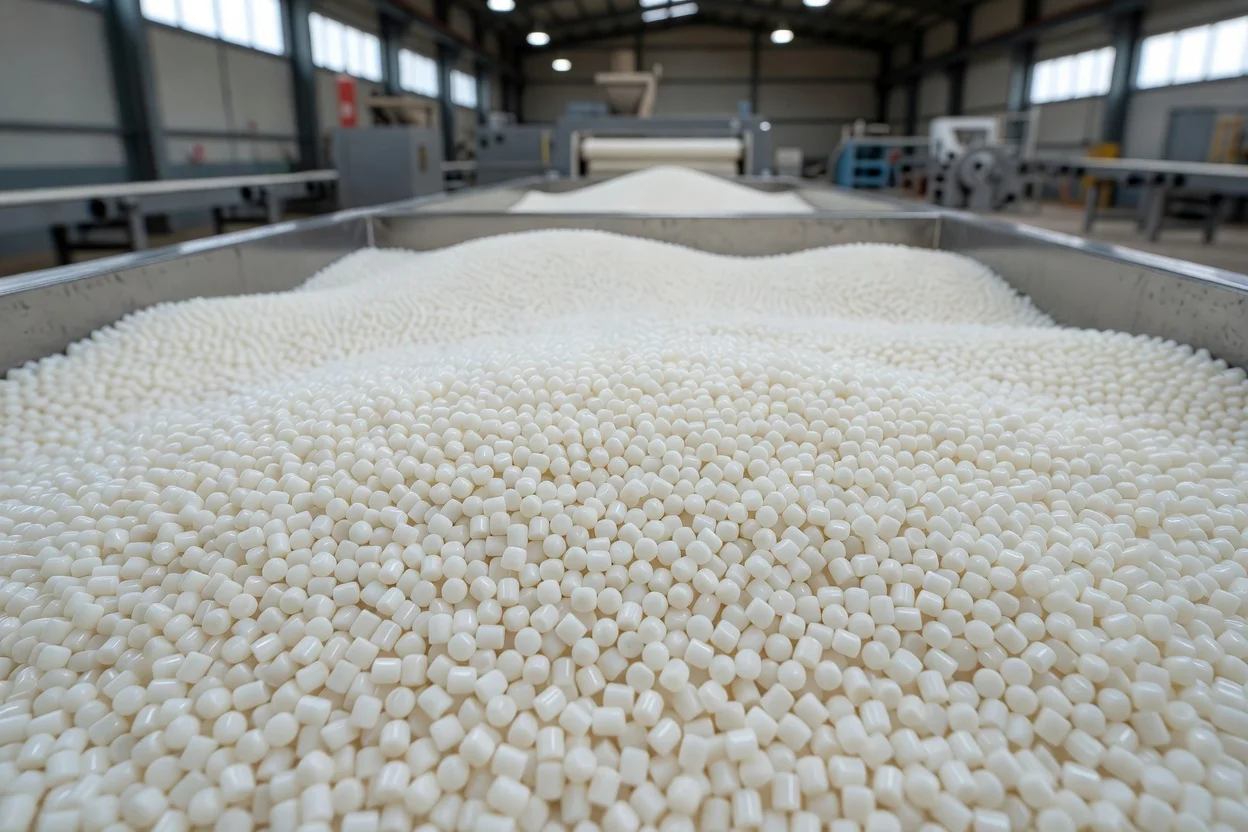
Typical feedstock sources include:
- Industrial injection molding scrap and extrusion waste.
- Post-consumer electrical, appliance, and automotive components.
- Mixed engineering-plastics recovery streams, although these are more difficult because POM must be separated carefully from PA, PBT, ABS, and other resins.
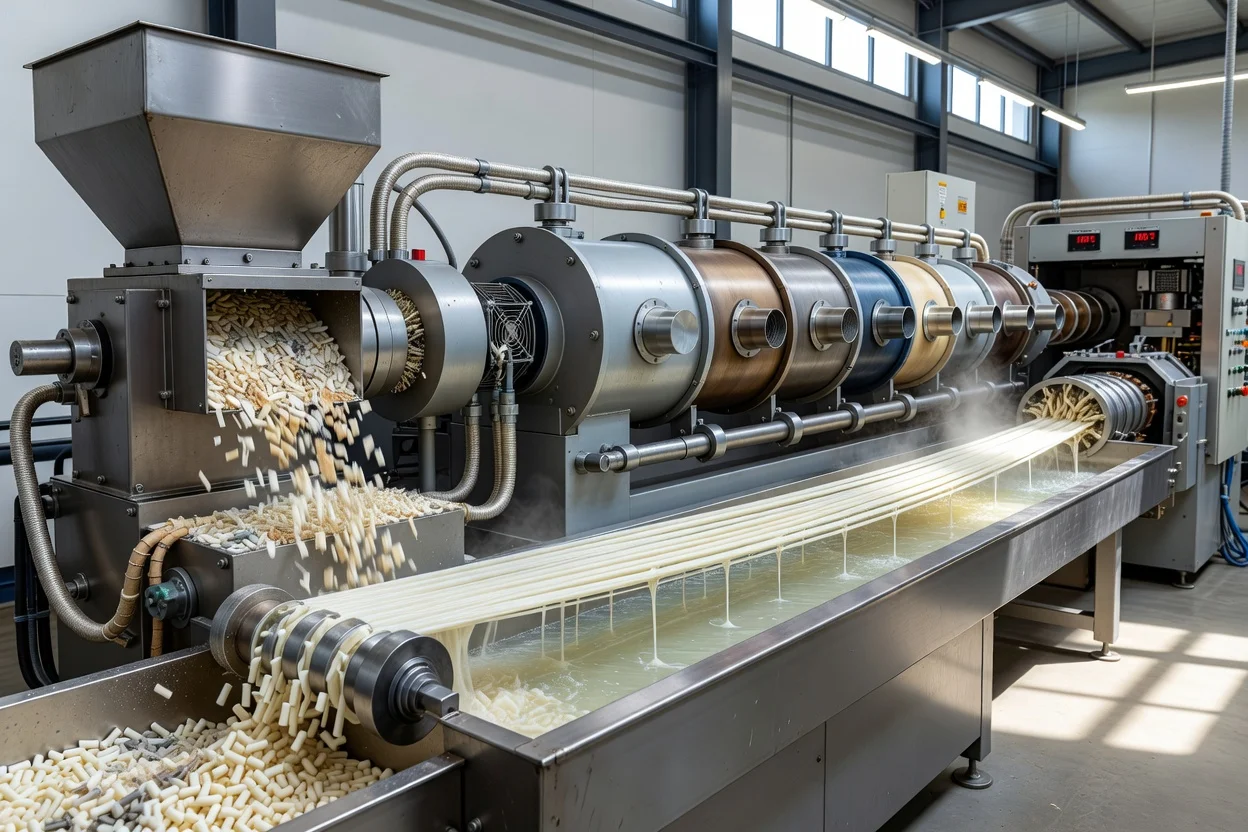
Processing is usually mechanical recycling, but stabiliser selection is critical because recycled POM has already experienced at least one thermal cycle. In practice, compounding often includes antioxidants, heat stabilisers, pigments, and sometimes lubricants or reinforcing fillers, depending on the target application. A common industrial strategy is to reserve rPOM for parts where appearance and tightest long-term property retention are less critical than function and cost.
Chemical recycling is also gaining attention. Studies published in 2025 and 2026 report upcycling of waste POM into dialkoxymethanes, cyclic aminals, and other valuable products, showing that POM waste can function as a C1 synthon rather than only as a feedstock for remelting.
Applications and End-Use Markets
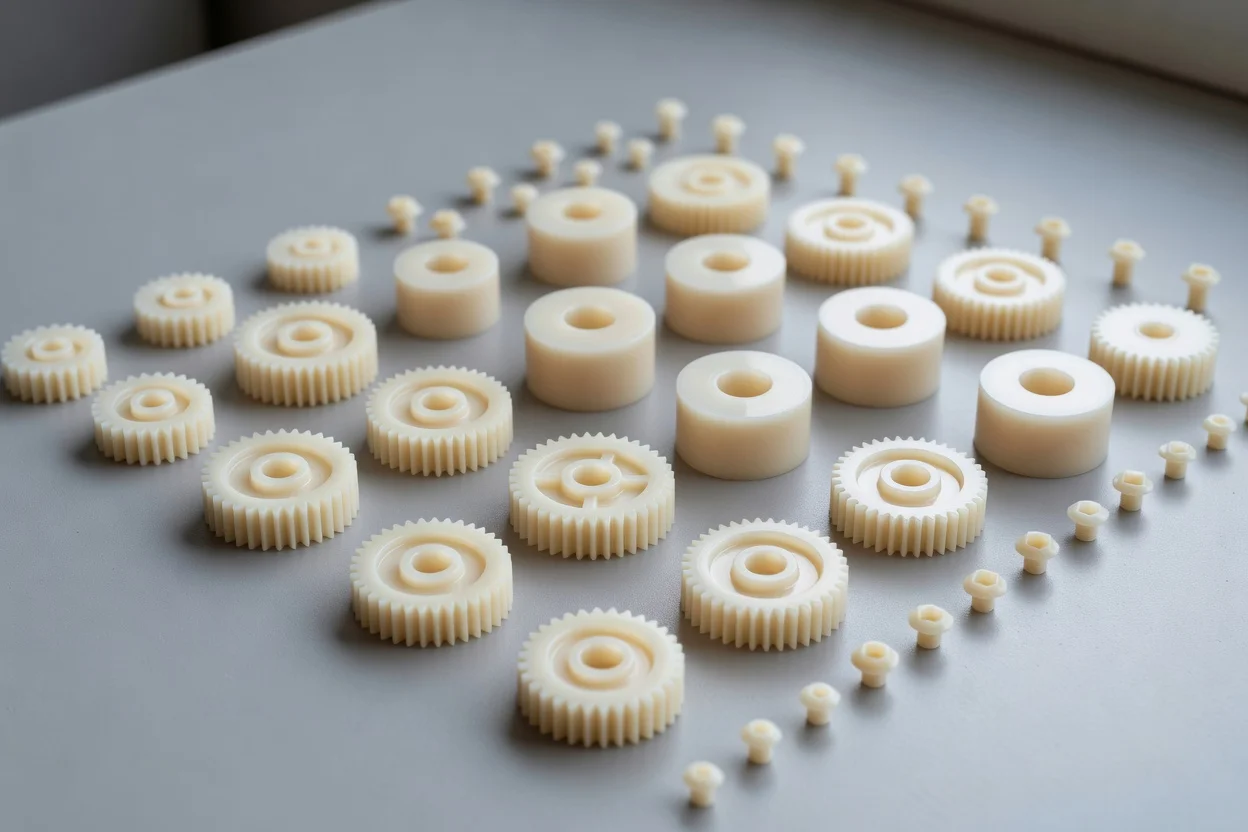
rPOM is mainly used in precision mechanical parts where low wear, stable dimensions, and reliable sliding behavior are more important than premium cosmetic finish.
| End-use sector | Typical rPOM parts | Usual grade or processing fit |
|---|---|---|
| Automotive | Gears, clips, fasteners, bushings, seat-belt components, lock parts, fuel-related housings | Injection-molded rPOM, often stabilised; non-critical to semi-critical parts |
| Electrical and electronics | Switch housings, insulators, cable ties, appliance mechanisms | Fine-tolerance injection molding; controlled-color compounds |
| Industrial machinery | Bearings, rollers, cams, sprockets, shafts, pump and valve parts | Wear-resistant rPOM with lubricant or stabiliser packages |
| Consumer goods | Zippers, buckles, handles, knobs, appliance parts | Molded functional parts where aesthetics are secondary |
| Building and hardware | Door-lock components, fittings, sliding elements, hinges | Dimensionally stable molded parts |
| Medical and specialty | Selected non-implant components and housings, where qualification permits | Narrowly specified grades and strict traceability |
One poor-fit use is outdoor structural exposure, because POM is relatively vulnerable to weathering and UV aging compared with many commodity engineering plastics. Another limited-fit area is applications requiring very high oxygen barrier performance, because POM is not typically chosen as a barrier polymer in the way that some multilayer packaging resins are.
Industry sources describe recycled POM as being used in gears, sprockets, shafts, bearings, and other precision parts, with automotive often the largest demand driver. Because rPOM is a recycled engineering plastic rather than a commodity resin, qualification tends to be application-specific and customer-driven rather than standardized across broad markets.
Environmental and Sustainability Aspects
rPOM contributes to sustainability primarily by extending material life, reducing demand for virgin feedstock, and lowering embodied energy relative to new polymer production. Several commercial and technical sources state that recycled POM can reduce energy use and carbon footprint compared with virgin material.
Key sustainability advantages include:
- Material circularity through mechanical recycling of clean scrap streams.
- Lower carbon footprint relative to virgin production, depending on collection and reprocessing efficiency.
- Waste reduction in durable goods sectors that generate POM-rich scrap.
Constraints remain significant:
- POM is often embedded in mixed assemblies, which makes dismantling and sorting difficult.
- Recycled material quality can vary by origin, contamination, and thermal history.
- Mechanical recycling can be limited by property drift, especially after multiple cycles.
A useful distinction is that POM recycling is not limited to closed-loop remelting. Recent chemical upcycling studies demonstrate pathways to break down waste POM into smaller industrially relevant molecules, opening an alternative route when mechanical recycling is not suitable.
Economic and Global Market Impact
The rPOM market is still smaller and less transparent than the virgin POM market, but it is expanding alongside corporate recycled-content targets and broader engineering-plastics decarbonisation efforts. Market analyses identify automotive, electrical and electronics, industrial equipment, and consumer goods as the principal demand sectors.
Economic value is strongly influenced by:
- Feedstock availability and consistency, especially access to clean post-industrial scrap.
- Technical qualification costs, since many applications require testing for wear, creep, and dimensional stability.
- Price competition with virgin POM, which can narrow or widen depending on energy and polymer market conditions.
- Regulatory and customer pressure for recycled content and lower emissions.
Leading producers and compounders in the broader POM market include major global chemical companies such as Celanese, DuPont, BASF, KOLON Plastics, and Asahi Kasei, which are recognized for their established POM platforms and technical-grade supply chains. In recycled POM, the field is more fragmented and often consists of regional recyclers, compounders, and specialty suppliers rather than a small set of dominant global brands.
Current Challenges and Innovations
The main technical challenge for rPOM is preserving the material’s hallmark properties after one or more melt histories. Because POM is sensitive to heat and can depolymerize under adverse processing conditions, recycling demands careful thermal control and formulation discipline.
Current innovation themes include:
- Better sorting and traceability for POM-containing waste streams.
- Stabilised recycled compounds designed for specific tolerance and wear requirements.
- Design-for-recycling approaches that simplify disassembly of POM-rich products.
- Chemical upcycling to turn waste POM into useful chemicals when material reuse is not ideal.
A practical formulation example is the use of heat stabiliser and antioxidant packages at low additive loadings to slow thermal degradation during reprocessing; the mechanism is to suppress chain scission and reduce the formation of unstable end groups during melt history. In wear-focused parts, small lubricant additions can improve sliding behavior by reducing interfacial friction and surface abrasion, although the exact loading depends on the target part geometry and certification requirements.
Future Outlook
rPOM is likely to grow fastest in applications where recycled content can be used without compromising safety or lifetime performance, especially in automotive trim, appliance mechanisms, hardware, and industrial motion components. The strongest long-term opportunity may lie in grade-specific recycling ecosystems, where clean scrap is matched to known end uses and property windows are tightly controlled.
Chemical recycling and upcycling may also become strategically important if mechanical recycling remains constrained by contamination or quality loss. The recent literature suggests that POM waste can serve as a valuable molecular resource, not just a secondary polymer feedstock. If collection systems improve and product design becomes more recycling-friendly, rPOM could move from a niche sustainable substitute to a more established engineering-material category.
Summary
rPOM is a recycled engineering plastic that preserves much of the stiffness, wear resistance, and dimensional stability that make virgin POM valuable in precision parts. Its appeal comes from circular-economy benefits and technical usefulness, but its adoption depends on stringent feedstock control, stabilisation, and careful end-use selection.
References
- •
Efficient Plastic Waste Recycling to Value‐Added Products by Integrated Biomass Processing. (2020, January 8). https://pmc.ncbi.nlm.nih.gov/articles/PMC7027741/Link
- •
POM applications. (2025, April 1). https://www.plasticosalser.com/en/news/pom-applications/Link
- •
POM post-consumption regeneration PCR. (2024, January 1). http://en.jiafa-plas.com/product/33/Link
- •
Polyacetals (POM) Recycling Guide. (2025, May 11). https://www.recyclingtoday.org/blogs/news/polyacetals-pom-recycling-guideLink
- •
CNC Machining Recycled Materials. (2024, September 26). https://www.protolabs.com/en-gb/resources/blog/from-scrap-to-success/Link
- •
recycled pom. (n.d.). https://www.pycycling.com/product-tag/recycled+pomLink
- •
Recycled Polyoxymethylene Market Size & Share 2025-2032. (2025, February 1). https://www.360iresearch.com/library/intelligence/recycled-polyoxymethyleneLink
- •
CNC matériaux recyclés | Protolabs. (2024, September 26). https://www.protolabs.com/fr-fr/ressources/blog/de-la-ferraille-au-succes/Link
- •
Recycelte Materialien für die CNC-Bearbeitung | Protolabs. (2024, October 2). https://www.protolabs.com/de-de/ressourcen/blog/aus-abfall-entsteht-fortschritt/Link
- •
Valorization of polyoxymethylene (POM) waste as a C 1 synthon for .... (2025, March 5). https://pubs.rsc.org/de-at/content/articlehtml/2025/su/d4su00547cLink
- •
Oradea 1. (n.d.). https://imt.uoradea.ro/auo.fmte/files-2008/TCM_files/MARIES%20RADU%202.pdfLink
- •
[PDF] Print this article - ACTA TECHNICA NAPOCENSIS. (n.d.). https://atna-mam.utcluj.ro/index.php/Acta/article/download/2799/2205Link
- •
Recycled Polyoxymethylene Pom Market Report | Global Forecast From 2025 To 2033. (2024, October 16). https://dataintelo.com/report/recycled-polyoxymethylene-pom-marketLink
- •
Valorization of polyoxymethylene (POM) waste as a C1 synthon for industrially relevant dialkoxymethanes and cyclic aminals. (n.d.). https://pubs.rsc.org/en/content/articlepdf/2025/su/d4su00547cLink
- •
Upcycling waste polyoxymethylene to value-added chemicals using .... (2026, February 9). https://pubs.rsc.org/en/content/articlehtml/2026/gc/d5gc06065fLink
- •
Polyoxymethylene. (n.d.). https://avl.dk/wp-content/uploads/2025/12/POM-SDS-1.4-ENG.pdfLink
- •
www.remoplastic.com | [email protected]. (n.d.). https://www.remoplastic.com/wp-content/uploads/2021/11/RPOM-NLDRT.pdfLink
- •
Polyoxymethylene - Wikipedia. (2004, November 1). https://en.wikipedia.org/wiki/PolyoxymethyleneLink
- •
Polyoxymethylene – Wikipedia. (2004, October 1). https://de.wikipedia.org/wiki/PolyoxymethyleneLink
- •
Polyoxymethylene Upcycling into Methanol and Methyl Groups .... (2024, July 24). https://pmc.ncbi.nlm.nih.gov/articles/PMC11311220/Link
- •
Recycled Polyoxymethylene (POM) Market Size 2026. (2025, November 22). https://www.linkedin.com/pulse/recycled-polyoxymethylene-pom-market-size-2026-vfvwfLink
- •
(rPOM) Recycled polyoxymethylene Suppliers - Chinaplas. (2026, March 30). https://www.chinaplasonline.com/eMarketplace/Quality/AllSuppliers/?v=c7&Sprods=535&SearchBy=ExhLink
- •
POM Material: The Good, The Bad, And The Brilliant Applications. (2024, June 17). https://www.polychemer.com/news/pom-material-the-good-the-bad-and-the-brill-78318197.htmlLink
- •
POM - Tangram. (n.d.). https://tangram.co.uk/wp-content/uploads/Plastics-Data-File-POM.pdfLink
- •
Polyoxymethylene (POM): Properties, applications and processing. (2022, August 18). https://kdfeddersen.com/en/products/polymers/polyoxymethyleneLink
- •
Polyoxymethylene (POM): How to select the right grade?. (2025, July 8). https://www.specialchem.com/plastics/guide/polyacetal-polyoxymethylene-pom-plasticLink
- •
Valorization of polyoxymethylene (POM) waste as a C1 synthon for industrially relevant dialkoxymethanes and cyclic aminals. (2025, March 5). https://pubs.rsc.org/en/content/articlelanding/2025/su/d4su00547cLink
- •
Application and characteristics of POM materials -. (n.d.). https://www.aixihardware.com/application-and-characteristics-of-pom-materials/Link
- •
What is POM Material - Excellent Chemical Seal Resistance. (n.d.). https://www.fst.com/materials/pom/Link
- •
POM樹脂とは?用途や特徴、長所・短所、加工方法など .... (2022, October 14). https://www.y-skt.co.jp/magazine/knowledge/guide-pom/Link
- •
Recent advances in chemical recycling of polyoxymethylene waste - Doeun Choi, Jechan Lee, 2025. (2025, February 28). https://journals.sagepub.com/doi/10.1177/0958305X241289558Link
- •
The Development of Sustainable Polyoxymethylene (POM). (n.d.). https://www.mdpi.com/2504-477X/8/8/315Link
- •
Polyoxymethylene Engineering Plastic. (n.d.). https://eureka.patsnap.com/materials/polyoxymethylene-plasticLink
- •
What are polyacetal resins (POM resins)? | Asahi Kasei engineering .... (2023, March 15). https://www.asahi-kasei-plastics.com/en/column/06/Link
- •
POM - Caldara Plast. (2022, March 2). https://www.caldara.it/en/materie_plastiche/pom/Link
- •
Top 20 Companies in Recycled Polyoxymethylene Pom .... (2025, September 17). https://www.sphericalinsights.com/blogs/top-20-companies-in-recycled-polyoxymethylene-pom-market-worldwide-2025-market-research-report-2024-2035Link
- •
POM Plastic | Material Series for Product Design - First Mold. (2025, August 4). https://firstmold.com/guides/pom-plastic/Link
- •
POM Regrind Natural Supplier | Plastic Recycling. (2025, October 3). https://www.royalscrapindustriesinc.com/pom-regrind-natural/Link
- •
Property changes in polyoxymethylene (POM) resulting .... (2007, December 1). https://www.sciencedirect.com/science/article/abs/pii/S0141391007002479Link
- •
What is Polyoxymethylene? POM | Fluorocarbon. (2016, December 21). https://fluorocarbon.co.uk/resources/blog/what-is-polyoxymethylene-pom/Link
- •
Polyacetals (POM) Recycling. (2026, August 17). https://www.wastetrade.com/resources/plastics/polyacetals-pom-recyclingLink
- •
The most common thermoplastic material properties. (2018, December 5). https://www.nexpcb.com/blog/summary-of-common-thermoplastic-material-propertiesLink
- •
Properties and Applications of Polypropylene Polystone PPH. (2008, March 13). https://www.azom.com/article.aspx?ArticleID=4087Link
- •
Research and application of polypropylene: a review - PMC. (2024, January 2). https://pmc.ncbi.nlm.nih.gov/articles/PMC10761633/Link
- •
A Closer Look at Material Properties. (n.d.). https://www.protolabs.com/resources/design-tips/plastic-and-metal-material-properties/Link
- •
Material Properties: Polymers. (n.d.). https://libraryguides.missouri.edu/c.php?g=28273&p=174081Link
- •
Polypropylene (PP). (n.d.). https://www.bpf.co.uk/plastipedia/polymers/PP.aspxLink