
Introduction
Extrusion lines for laminating and coating are continuous converting systems that apply a molten thermoplastic layer to a moving substrate, either as a protective coating on one surface or as a bonding layer between two substrates in a laminate. They are central to the production of flexible packaging, paper-and-plastic composites, foil-based barrier structures, industrial sacks, hygiene materials, and technical laminates, and they are usually built as custom-engineered lines with tightly integrated extrusion, web handling, surface treatment, cooling, and winding sections.
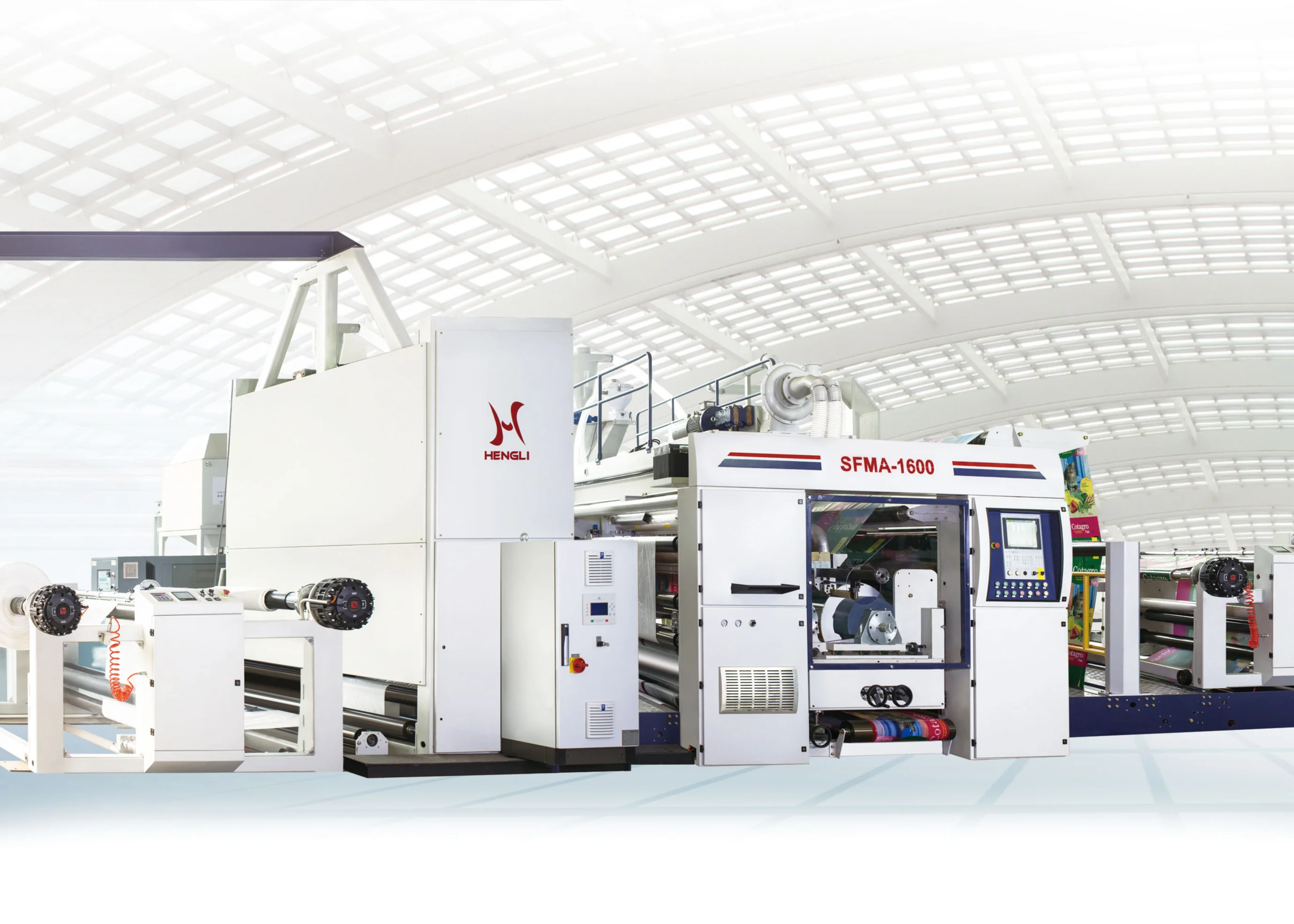
In industrial practice, the same equipment family is often described as extrusion coating lines, extrusion laminating lines, or coating and laminating lines, because the process may be configured for single-layer coating, tandem coating, coextrusion, or sandwich lamination depending on the substrate and performance target. These systems have evolved from simpler single-extruder lines into high-speed, automation-rich platforms capable of multilayer structures, rapid grade changeover, and precise gauge control, with modern commercial lines advertised at speeds from about 250 m/min to 600 m/min depending on application and configuration.
Their engineering significance lies in the fact that the molten polymer serves both as a functional coating and, in many laminates, as the adhesive that bonds dissimilar materials such as paper, film, aluminum foil, woven fabric, or board. Sustainability considerations are increasingly important as processors seek thinner coatings, lower-energy operation, reduced solvent use, greater recyclability, and compatibility with mono-material packaging strategies, while future development is being shaped by multilayer coextrusion, digital process control, improved die technology, and broader integration with Industry 4.0 systems.
History and Development
Early extrusion coating emerged from the broader development of flat-die polymer extrusion, when processors recognized that a precisely metered molten web could be applied directly onto a running substrate to create a moisture barrier or bonding layer. The process became especially important in packaging because it offered a continuous alternative to adhesive lamination and enabled strong, heat-sealable structures.
A major milestone was the adoption of polyethylene as the dominant coating resin, because its melt processability, adhesion behavior, moisture barrier performance, and sealability made it suitable for paper, foil, and film substrates. Over time, other resins such as PP, LLDPE, LDPE, EVA, EMA, ionomer, and EVOH were added for special performance requirements such as heat resistance, seal integrity, optical properties, or barrier enhancement.
A second milestone was the transition from single-layer systems to coextrusion coating and lamination, where multiple melts are combined before the die or across multiple stations to improve adhesion, barrier performance, or tie-layer design. Commercial suppliers now offer tandem and multistage lines, and some high-end systems provide up to seven layers in coextrusion coating.
A third milestone has been the shift toward high-speed, tightly controlled production with automated gauge control, web inspection, corona or plasma surface treatment, advanced chill roll design, and computerized line management. Modern lines are increasingly sold as turnkey systems rather than as isolated extruders, reflecting the need to coordinate melt rheology, web tension, cooling, bonding pressure, and winding performance.
Technical Overview
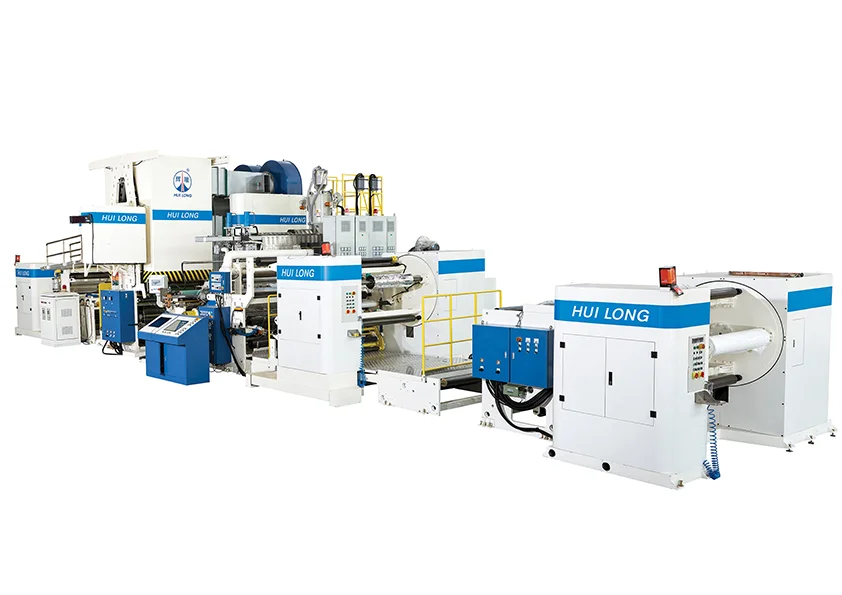
An extrusion coating or laminating line typically includes resin handling and dosing, one or more extruders, melt filtration, a flat or slot die, a substrate unwinder, surface treatment, a bonding or nip section with pressure rolls, chill rolls or cooling rolls, edge trim removal, thickness measurement, and rewinding. In the laminating variant, the molten polymer is applied between two webs and pressed into a bonded composite under heat and pressure.
The core process principle is straightforward: the extruder plasticizes the polymer, the die converts the melt into a uniform thin web, and the nip or laminating station brings the molten layer into intimate contact with the moving substrate while the chill roll solidifies the structure. Good adhesion depends on melt temperature, substrate surface energy, line speed, drawdown, nip pressure, die-to-substrate distance, and pre-treatment such as corona treatment or chemical priming.
Typical commercial line capabilities reported by manufacturers include:
- Web widths commonly around 800 to 1,600 mm, with some systems extending beyond this range for large-format industrial fabrics and paperboard.
- Line speeds commonly from about 100 to 400 m/min, with high-speed systems reaching 600 m/min in certain configurations.
- Coating weights in the low single-digit to tens of g/m² range, depending on barrier or bonding demand; one commercial example cites about 6.5 to 40 g/m².
- Coextrusion layers from single-layer to tandem or up to seven-layer systems in advanced lines.
- Process materials including paper, board, aluminum foil, BOPP, BOPET, CPP, nonwovens, woven PP/PE fabrics, jute, and technical textiles.
For moisture and barrier applications, the coating thickness is often intentionally thin yet continuous, because the target is not structural bulk but a defect-free film with uniform coverage and low pinholing. In practice, the quality of the die lip, melt stability, and web cleanliness often determines whether the product meets barrier and seal-performance requirements.
Typical engineering benchmarks
- Rotor or screw speeds: line extruders commonly operate in the moderate-to-high rpm range typical of film and coating extrusion, with exact values dependent on resin, throughput, and screw design; manufacturers emphasize speed stability more than absolute rpm.
- Throughput: commercial systems are designed for continuous production from medium to high throughput, with output governed by width, coating weight, resin density, and line speed rather than a single universal kg/h rating.
- Residual moisture after auxiliary dewatering: not directly relevant to the coating line itself, but for upstream recycled-content feedstocks and wash-line integration, centrifugal dewatering systems in plastics recycling commonly leave only a small residual moisture fraction before extrusion drying; this is a process-integrity issue when recycled resin is used as coating feedstock.
- Specific energy consumption: published machine brochures often emphasize productivity and coating quality rather than energy figures, but extrusion coating is generally more energy-intensive than simple cold adhesive lamination because polymer must be melted, filtered, and pumped continuously; however, it can reduce solvent drying energy and eliminate solvent emissions.
Types and Variations
| Type | Main function | Typical structure | Common use cases |
|---|---|---|---|
| Mono-extrusion coating line | Applies one polymer layer onto a substrate | Single extruder, slot die, nip and chill roll | Paper cups, moisture barrier paper, basic packaging |
| Extrusion laminating line | Bonds two substrates using the molten polymer as adhesive | One melt layer between two webs | Paper/film laminates, foil laminates, woven sack laminates |
| Tandem line | Performs sequential coating or multi-step bonding | Two or more coating stations inline | High-barrier packaging, complex laminates, multilayer composites |
| Coextrusion coating line | Combines multiple molten layers before or during coating | Feedblock or multilayer die system | Barrier packs, specialty sealant structures, tie-layer systems |
| Wide-web industrial line | Coats large substrates at scale | Heavy-duty unwinding, wide dies, high cooling capacity | Technical textiles, woven fabrics, FIBC materials |
Modern suppliers also differentiate between single-station, tandem, multistage, and coextrusion configurations, and some systems integrate primer application, corona treatment, and thickness measurement in a single production flow.
A useful practical distinction is between extrusion coating and extrusion lamination. In coating, the molten polymer remains on one substrate as a functional layer, often for barrier or seal performance; in lamination, the molten layer acts primarily as the adhesive joining two or more webs.
Applications and Uses
Extrusion coating and laminating lines are used wherever a combination of barrier performance, stiffness, heat-sealability, printability, and cost efficiency is required. Major application sectors include:
- Flexible packaging: snack packs, retort pouches, frozen food packs, sachets, and barrier webs for dry or moist products.
- Paper and board packaging: milk and beverage cartons, paper cups, paperboard wraps, and coated carton structures.
- Industrial packaging: cement sacks, fertilizer bags, dry-chemical sacks, and other heavy-duty woven or paper-based formats.
- Hygiene and nonwovens: barrier backings, lamination of nonwoven substrates, and technical absorbent structures.
- Technical textiles: woven PP/PE fabrics, geotextile-related laminates, coated industrial cloth, and secondary-backed specialty materials.
- Insulation and protective materials: laminated barrier and protective wraps, including foil-based structures.
One comparatively poor-fit use is small-batch, highly variable custom jobs, because extrusion lines typically justify their setup and stabilization time through extended continuous runs, whereas adhesive lamination can be more flexible for short production lots. This is a central economic reason why converters choose extrusion lamination for high-volume, standardized products and adhesive systems for lower-volume, frequent-change operations.
Surface Preparation and Bonding Mechanism
Bond strength in extrusion coating and lamination depends heavily on the surface state of the substrate. Many lines therefore include corona treatment or primer coating so that the molten polymer wets the substrate effectively and develops durable adhesion.
The main bonding mechanism is a combination of thermal wetting, mechanical anchoring, and, where present, chemical compatibility between substrate and coating resin. In multilayer packaging, tie layers may be used to connect otherwise incompatible materials such as polyolefins and polar barrier layers.
For this reason, line design frequently includes:
- substrate pre-treatment
- melt temperature stabilization
- accurate die gap control
- controlled nip pressure
- fast and uniform cooling
- defect detection and edge trim handling
Technological Innovations and Automation
Automation has become a defining feature of modern extrusion coating lines. Suppliers now promote computerized die adjustment, automatic gauge control, recipe management, non-stop turret winding, and integrated operator interfaces for high repeatability.
Notable innovations include:
- Coextrusion dies and feedblocks that enable multilayer structures with better barrier or tie-layer design.
- Computerized gauge control for tighter coating-weight uniformity across web width.
- Integrated primer and corona stations for difficult-to-bond substrates.
- Non-stop winding and turret systems to reduce downtime in continuous production.
- Digital line monitoring for temperature, tension, pressure, and thickness diagnostics.
These features improve product consistency, but they also raise engineering complexity, maintenance demands, and capital cost. The trade-off is especially important in high-value packaging, where small variations in coating thickness or adhesion can create significant scrap risk.
Environmental and Sustainability Aspects
Extrusion coating has an environmental advantage in that it can eliminate solvent-based adhesives and the associated drying stages, reducing volatile organic compound concerns and simplifying air-handling requirements. It is also compatible with high-speed continuous production, which can lower waste per unit output when the line is properly tuned.
At the same time, sustainability remains a technical challenge because many conventional structures combine different materials that are difficult to separate during recycling. This has pushed converters and machine builders toward:
- thinner coating weights
- mono-material-friendly structures
- recyclable polyolefin-based laminates
- reduced trim loss through better web control
- energy-efficient drives and cooling systems
- use of recycled or partially recycled feedstocks where performance permits
The most important sustainability issue is not only the machine’s direct energy use but also the end-of-life compatibility of the laminate. A technically excellent laminate may still be environmentally problematic if it prevents economical material recovery.
Economic and Global Market Impact
Extrusion coating and laminating lines occupy a strategic position in the packaging and converting industries because they enable high-performance structures at industrial scale. Their economic value is strongest in sectors that need high throughput, stable product quality, and long production campaigns.
The global market is shaped by:
- growth in flexible packaging demand
- expansion of e-commerce and industrial packaging
- food safety and shelf-life requirements
- increasing use of barrier materials
- pressure to simplify packaging structures for recycling
Machine suppliers serve a broad international base, and the segment is characterized by customized engineering rather than commodity manufacturing. Established suppliers include companies with a strong role in coating-line technology, such as SML, Davis-Standard, Reifenhäuser, BOBST, Sumitomo Heavy Industries, Rajoo, and others operating in specific regional or application niches.
Current Challenges and Innovations
The main engineering challenges are:
- maintaining uniform gauge at high speed
- achieving strong adhesion on low-surface-energy substrates
- minimizing neck-in, edge bead, and thickness variation
- handling heat-sensitive or low-melt substrates
- reducing scrap during start-up and changeover
- adapting to recyclable mono-material package designs
Innovation is focusing on better melt distribution, improved die design, more precise tension control, and tighter integration of process sensing with automatic control systems. Another important trend is adaptation to nontraditional substrates and specialty polymers, including lower-melt-temperature materials and mineral-filled backing systems.
Future Outlook
Future development is likely to emphasize sustainability-compatible laminates, higher automation, and greater process flexibility. As brand owners and regulators push for more recyclable packaging, machine builders are expected to prioritize structures that keep performance while reducing multi-material complexity.
Three areas are especially important:
- Mono-material redesign: replacing difficult-to-recycle combinations with all-polyolefin or otherwise compatible structures.
- Digital process control: using inline sensing and closed-loop adjustment to reduce waste and improve reproducibility.
- Broader substrate compatibility: expanding into technical textiles, specialty papers, medical packaging, and functional industrial composites.
Despite competition from adhesive lamination and alternative barrier technologies, extrusion coating and laminating lines will remain essential where a molten thermoplastic layer offers the best balance of adhesion, barrier, sealability, and throughput.
References
- •
Rajoo. (n.d.). Extrusion coating lines & machinery manufacturers | LAMEX. https://www.rajoo.com/lamex.htmlLink
- •
SML. (n.d.). Extrusion coating and laminating lines. https://www.sml.at/coating-lines/extrusion-coating-and-laminating-linesLink
- •
SML. (n.d.). Coating lines. https://www.sml.at/sites/default/files/2023-09/prospekt%20Extrusion%20coating%20and%20Laminating%20Lines.pdfLink
- •
Glenroy, Inc. (2026, April 13). Extrusion laminating & coating. https://www.glenroy.com/flexible-packaging-capabilities/extrusion-coating-laminating/Link
- •
Sumitomo Heavy Industries, Ltd. (n.d.). Extrusion coating line. https://www.shi.co.jp/english/products/machinery/laminator/index.htmlLink
- •
Technology Plastomech Private Limited. (n.d.). Technology Plastomech Private Limited. https://www.tpplindia.com/extrusion_coating_and_lamination_lines.htmlLink
- •
Plex Machines. (2026, June 5). Extrusion coating & lamination lines. https://www.plexmachines.com/product/extrusion-coating-lamination-lines/Link
- •
Nordson. (2025, February 24). EDI® extrusion coating & laminating dies. https://www.nordson.com/en/products/polymer-processing-systems-products/edi-epc-diesLink
- •
Reifenhäuser. (n.d.). Extrusion lines product finder. https://reifenhauser.com/en/lines-components/extrusion-lines-product-finder/Link
- •
SML. (n.d.). Coating lines. https://www.sml.at/sites/default/files/2018-11/SML%20prospekt%20coating_2016_final.pdfLink
- •
Heaven Extrusions. (n.d.). Engineering excellence in extrusion. http://5.imimg.com/data5/SELLER/Doc/2026/5/609477210/XS/BW/JS/8884010/cast-film-extrusion-line.pdfLink
- •
Long New Industrial Co., Ltd. (n.d.). Extrusion coating-laminating machine. https://www.long-new.com/product_d.php?lang=en&tb=1&id=372Link
- •
Davis-Standard. (2022, November 2). Blown film extrusion machinery. https://davis-standard.com/converting_system/blown-film/Link
- •
Extrusion-info. (2018, August 7). Extrusion coating & laminating line. https://www.extrusion-info.com/videos/1279Link
- •
Ferben. (n.d.). Corona treatment: Extrusion coating and laminating. https://www.ferben.com/technology/corona/extrusion-coating-and-laminating.klLink
- •
Reifenhäuser. (n.d.). EVEREX coating. https://reifenhauser.com/en/lines-components/extrusion-lines/flat-film-lines/everex-coating/Link
- •
Wellson. (2015). Coating and laminating line | Compound production line. http://castfilmextruder.com/2-coating-laminating-line.htmlLink
- •
TAPPI. (n.d.). A technology decision. https://media.enerconind.com/wp-content/uploads/sites/3/2023/10/02144649/Enercon-a-technology-decision.pdfLink
- •
SML Maschinengesellschaft. (n.d.). SML. https://pdf.directindustry.com/pdf/sml-maschinengesellschaft/sml/77554-480051.htmlLink
- •
SML. (n.d.). Extrusion coating & laminating lines. https://smlnew.roromedia.at/sites/default/files/2023-04/Folder%20FlexPack.pdfLink
- •
TAPPI. (n.d.). Flat die extrusion cast film, coating & laminating. https://www.tappi.org/content/events/09placesy/course_papers/christie.pdfLink
- •
Macro Engineering & Technology. (n.d.). Blown film lines. https://www.macroeng.com/products/blown-film-lines/Link
- •
JP Extrusiontech. (n.d.). Multilayer sheet lines. https://www.jpel.in/SheetExtrusionLink
- •
W&H. (2025, March 14). Blown film lines by W&H. https://www.wh.group/int/en/our_products/extrusion/blown_film_lines/Link
- •
W&H. (2025, March 14). Blown film lines by W&H. https://www.wh.group/na/en/our_products/extrusion/blown_film_lines/Link
- •
Davis-Standard. (2022, July 21). Extrusion coating extrusion machinery. https://davis-standard.com/converting_system/extrusion-coating/Link
- •
Luigi Bandera. (2026, May 22). Blown film extrusion lines. https://www.luigibandera.com/products/blown-film/Link
- •
Davis-Standard. (2025). Extrusion coating. https://davis-standard.com/DS_wordpress/wp-content/uploads/2022/08/EXTRUSION-COATING_Overview_EN.pdfLink
- •
SML Maschinengesellschaft. (n.d.). Coating lines. https://pdf.directindustry.com/pdf/sml-maschinengesellschaft/coating-lines/77554-771436.htmlLink
- •
Jwell Plastic Machinery. (n.d.). Film extrusion line manufacturer. https://jwellanhui.com/product-category/film-extrusion-line/Link
- •
Cast Film Extruder. (n.d.). Extrusion coating and laminating line for flexible packaging. https://castfilmextruder.com/2-1-extrusion-coating-machine.htmlLink
- •
PRM Taiwan. (n.d.). Extrusion coating lamination machine. https://www.prm-taiwan.com/category/Extrusion-Coating-Lamination-Machine.phpLink
- •
Laiyi Extrusion. (2025, June 2). What is extrusion laminating line? https://www.laiyiextrusion.com/news/what-is-extrusion-laminating-line-216799.htmlLink
- •
Lohia. (2025, January 1). BOPP extrusion lines. https://www.directindustry.com/industrial-manufacturer/bopp-extrusion-line-214459.htmlLink
- •
MEAF. (2014, June 6). Extrusion coating & laminating. https://meaf.com/applications/extrusion-coating-laminating/Link
- •
MachinePoint. (n.d.). Used stretch film extrusion lines for sale. https://www.machinepoint.com/machinepoint/inventory.nsf/web2utreetype?openform&catarbol=fsheet&mt=mt00000231&ln=enLink
- •
Yilian Machine. (2000). Extrusion coating lamination machine. https://www.yilianmachine.com/extrusion-coating-lamination-machineLink
- •
Randcastle Technology. (2019). Cast film/coating lines. https://www.randcastletechnology.com/home/castfilmLink
- •
Karlville. (2025, October 15). Extrusion coating and lamination machine. https://www.karlville.com/product/extrusion-coating-lamination/Link
- •
Macro Engineering & Technology. (n.d.). Cast film lines. https://www.macroeng.com/products/cast-film-lines/Link
- •
Reifenhäuser. (n.d.). Blown film lines from Reifenhäuser. https://reifenhauser.com/en/lines-components/extrusion-lines/blown-film-lines/Link
- •
Diamat. (2024, June 28). Extrusion lamination machines. https://diamat.com/components/lamination/Link
- •
SHM. (n.d.). Extrusion coating and laminating line. https://shinhan21.com/flex-product/extrusion-coating-and-laminating-line/Link
- •
BOBST. (n.d.). Extrusion coating processes. https://www.bobst.com/djen/products/extrusion-coating/process/Link
- •
TAPPI. (n.d.). Extrusion coating & laminating. https://www.tappi.org/content/events/10EXTRU/papers/1.6.pdfLink
- •
Jwell Machine. (2015, July 23). Film extrusion line. https://www.jwellmachine.com/film-extrusion-line/Link
- •
GSmach. (2025, January 9). What is extrusion coating lamination machine? https://www.gsextruder.com/what-is-extrusion-coating-lamination-machine/Link
- •
Industrial Extrusion Machinery. (n.d.). Extrusion coating. http://www.industrialextrusionmachinery.com/plastic_extrusion_extrusion_coating.htmlLink
- •
Fluke Process Instruments. (2019). Extrusion coating temperature control. https://www.flukeprocessinstruments.com/en-us/industry/plastic/extrusion-coatingLink
- •
Winrich Machine. (2025, February 21). What is the difference between extrusion coating and lamination? https://www.winrichmachine.com/news/what-is-the-difference-between-extrusion-coating-and-laminationLink
- •
Sure Controls. (2023, March 22). Cast film extrusion lines: Achieving optimal control. https://www.surecontrols.com/blog/cast-film-lines-how-to-achieve-optimal-control/Link
- •
Webcontrol. (2025, July 3). FML-EXL series extrusion lamination machine. https://www.webcontrolgroup.com/fml-exl-series-lamination-machineLink
- •
ScienceDirect. (n.d.). Film extrusion - An overview. https://www.sciencedirect.com/topics/engineering/film-extrusionLink