
Introduction
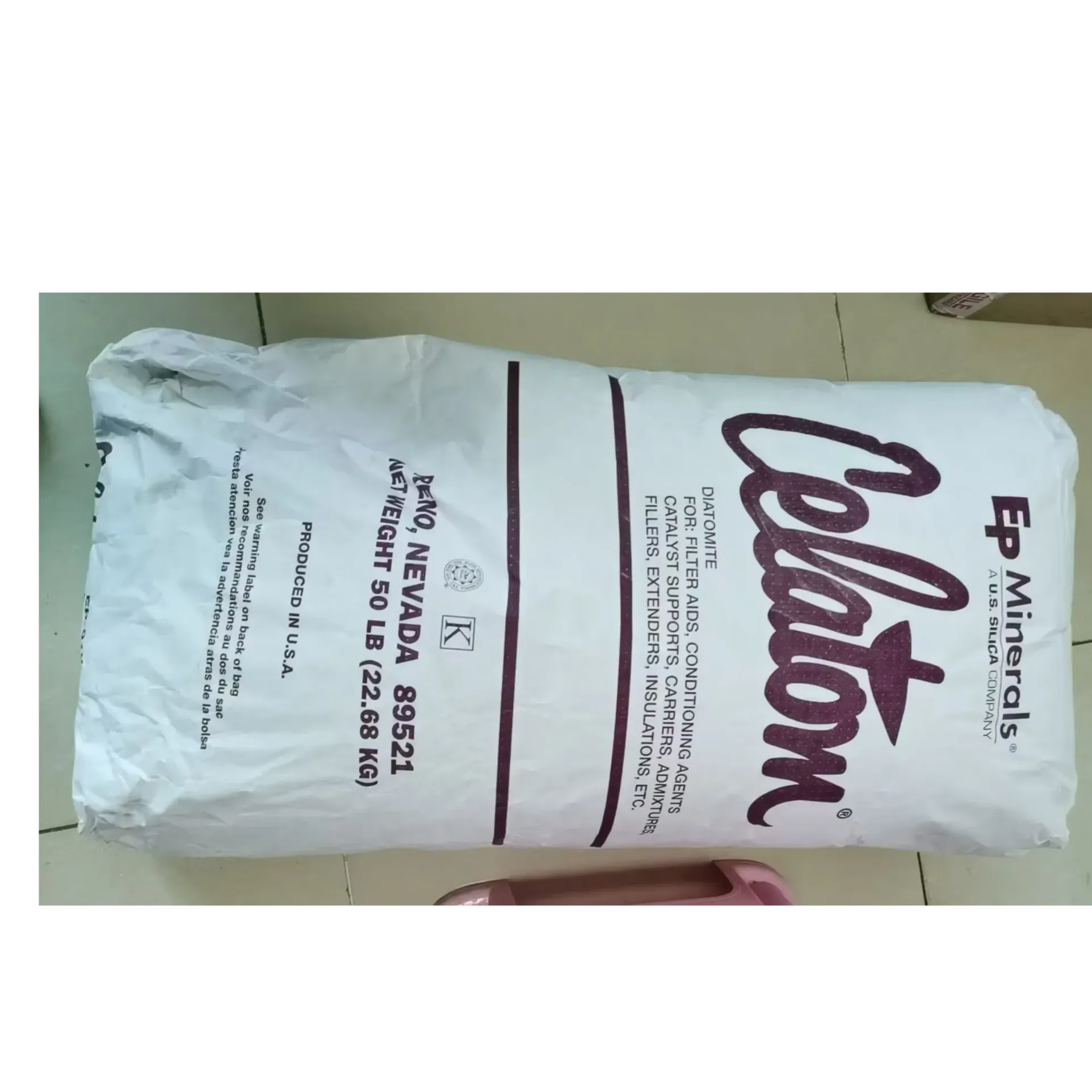
Kieselguhr is a naturally occurring, highly porous form of diatomite, also known as diatomaceous earth, composed chiefly of the siliceous skeletons of fossil diatoms. In the plastics and auxiliaries value chain, it is used primarily as a filler, anti-block agent, and functional extender, while in adjacent industries it is more widely known as a filtration aid, absorbent, and thermal insulator.
Its industrial significance comes from a combination of low bulk density, high porosity, chemically inert character, and a large internal surface area, which together make it useful in processing and performance-enhancing roles across polymers, coatings, rubber, construction materials, and chemical systems. At the same time, kieselguhr is part of a broader sustainability discussion because it is mineral-based, mined from deposits, and usually not biodegradable, even though it can sometimes improve material efficiency, reduce density, or replace more carbon-intensive additives in selected formulations.
History and Development
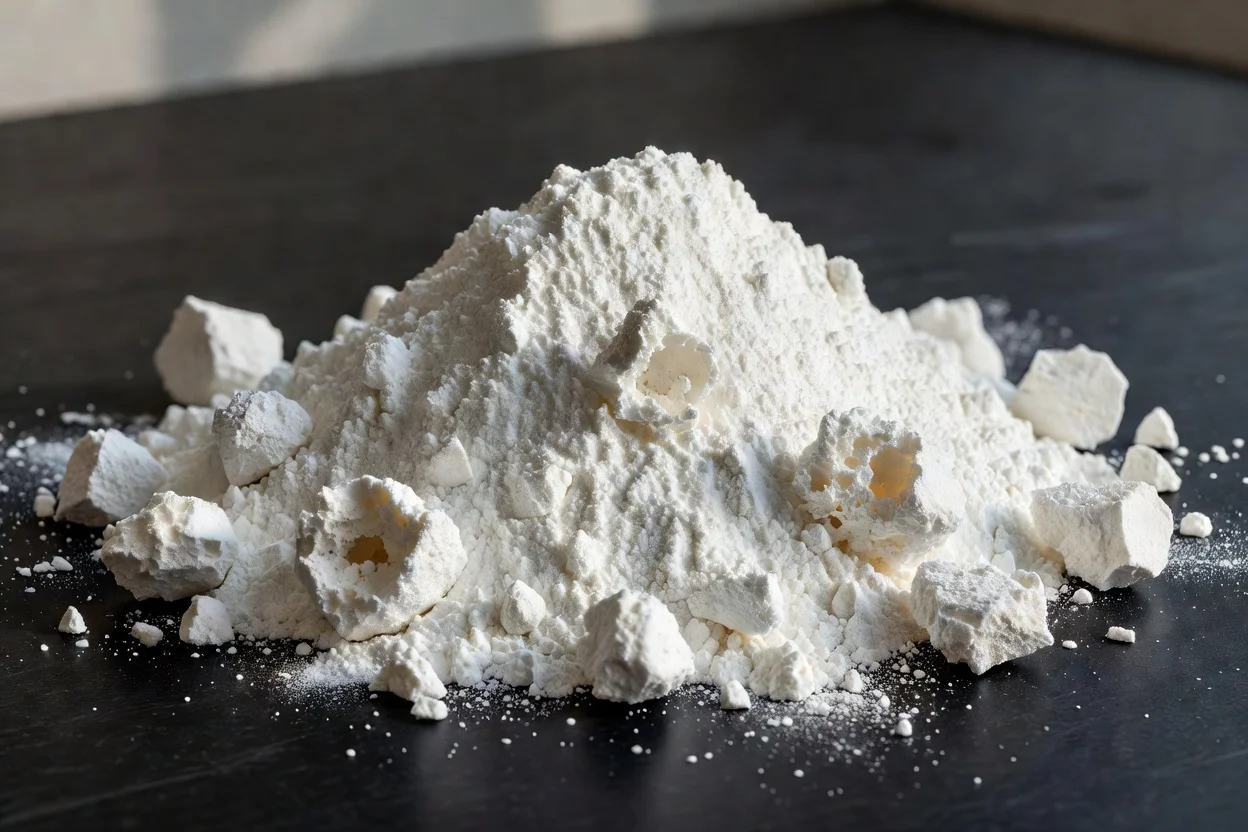
Kieselguhr entered industrial use in the nineteenth century, when its absorbent properties were exploited in explosives and filtration. The best-known historical application is as an inert absorbent for nitroglycerin in dynamite, a role associated with Alfred Nobel and still frequently cited in the material’s industrial history.
Over time, its use expanded from explosives and clarification media into broader materials processing. By the twentieth century, kieselguhr had become established in beverage filtration, food and chemical processing, insulation, and as a filler in paper, paints, plastics, and rubber. This diversification reflected a shift from simple absorbency toward engineered performance in which particle size, calcination state, purity, and surface chemistry were adjusted to suit end-use requirements.
Chemical Structure and Key Properties
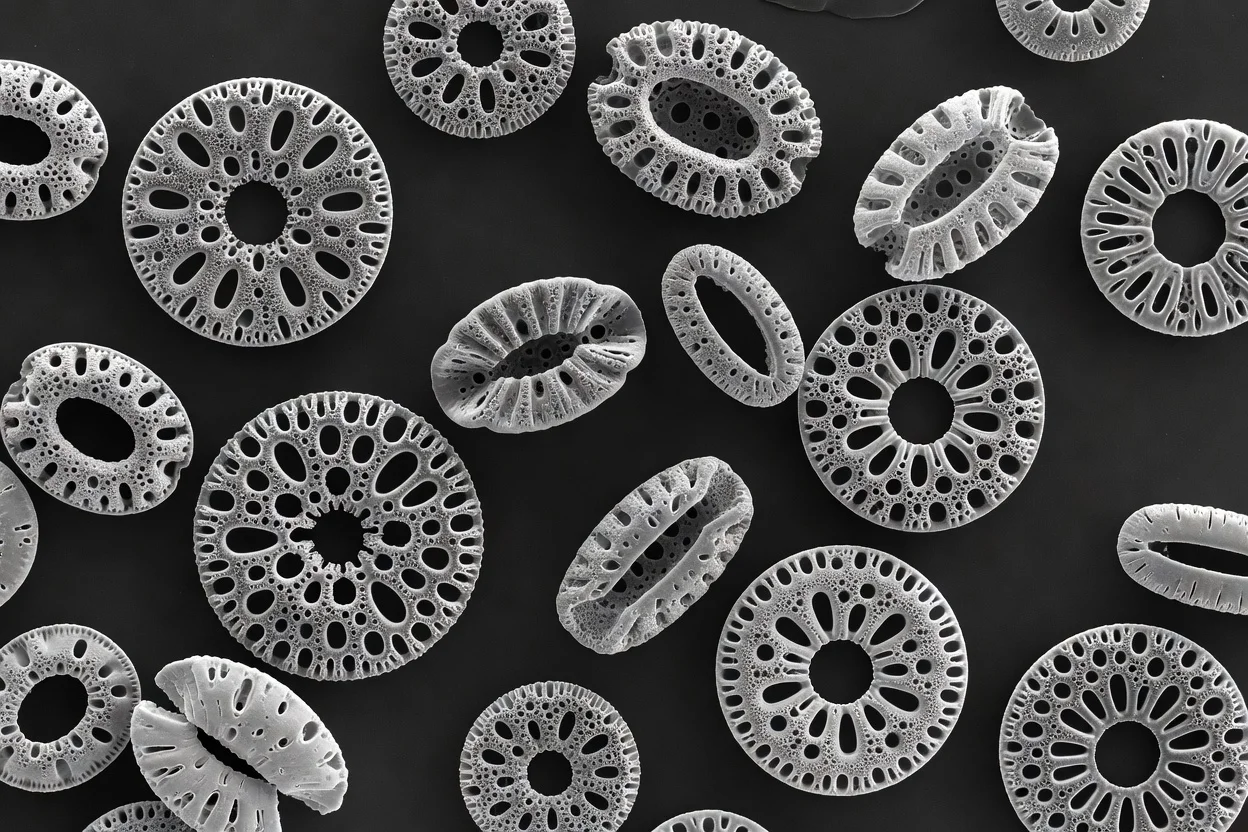
Kieselguhr consists of microscopic, fossilized diatom frustules made mainly of amorphous silica rather than crystalline silica. Its characteristic porous structure gives it a very low apparent density and a high void volume, which are central to its use in filtration, adsorption, and as a lightweight extender.
Key technical features
- High porosity → large internal pore network → effective liquid uptake, filtration, and matting behavior.
- Low bulk density → lightweight filler effect → reduced density in certain composites and coatings.
- Chemical inertness → limited reactivity in many systems → useful as a stable functional additive.
- Thermal resistance → suitability for insulating and high-temperature applications → especially in calcined or purified grades.
- Abrasive microstructure → mild mechanical action → useful in polishing and cleaning products.
Practical limits and workarounds
- Poor reinforcement efficiency in high-performance plastics → the particle shape is porous and irregular, so it does not provide the same strength gain as fibrous or plate-like fillers → use coupling agents, hybrid filler packages, or switch to talc, calcium carbonate, glass fiber, or mica when mechanical reinforcement is the main target.
- Dusting and inhalation exposure risk → very fine powders can generate respirable dust during handling → use closed transfer systems, local extraction, and appropriate respiratory protection; many producers also offer purified or granulated grades.
- Limited barrier improvement → the porous silica structure does not create a continuous tortuous path like plate-like minerals → use only where anti-block, rheology, or extensibility matter, not where gas-barrier performance is the primary requirement.
Production Processes and Raw Feedstocks
Kieselguhr is mined from diatomite deposits formed by the accumulation and lithification of diatom remains in ancient aquatic environments. After extraction, the material is typically dried, crushed, milled, classified, and sometimes calcined or flux-calcined to modify purity, brightness, particle structure, and performance.
Main processing variants
- Natural grades: minimally processed, retaining more of the original porous structure and lower-temperature properties.
- Purified grades: reduced impurity content for food, beverage, and sensitive industrial uses.
- Calcined grades: heat-treated to increase clarity, durability, and filtration performance.
- Flux-calcined grades: treated with fluxing agents during firing to modify pore structure and filtration efficiency.
The exact route depends on the target market. For filtration aids, purity and controlled permeability are important; for plastics and coatings, particle-size distribution, brightness, and dispersibility matter more; for insulation and construction uses, thermal performance and bulk structure are central.
Applications and End-Use Markets
Kieselguhr is a versatile industrial mineral, but its largest and most established market remains filtration. In plastics, it is a specialty filler rather than a universal bulk mineral.
Major applications by sector
| Sector | Typical role of kieselguhr | Usual grade/process |
|---|---|---|
| Food and beverage | Filter aid for beer, wine, juices, sugar solutions, edible oils | Purified, calcined or flux-calcined |
| Plastics | Anti-block, matting agent, reinforcing extender, process aid | Milled, classified, sometimes surface-treated |
| Rubber | Extender and rheology modifier | Fine powder grades |
| Paints and coatings | Flatting/matting agent, filler, texture modifier | Fine, purified grades |
| Construction | Lightweight filler in bricks, cement, and insulating products | Natural or calcined |
| Agriculture | Insecticidal dust, anti-caking agent, feed additive support | Food/feed-grade purified material |
| Insulation and refractories | Loose-fill insulation, insulating boards, fire-resistant panels | Calcined grades |
| Catalysis and chemistry | Catalyst support, adsorbent, stationary phase material | High-purity, controlled-pore grades |
In plastics
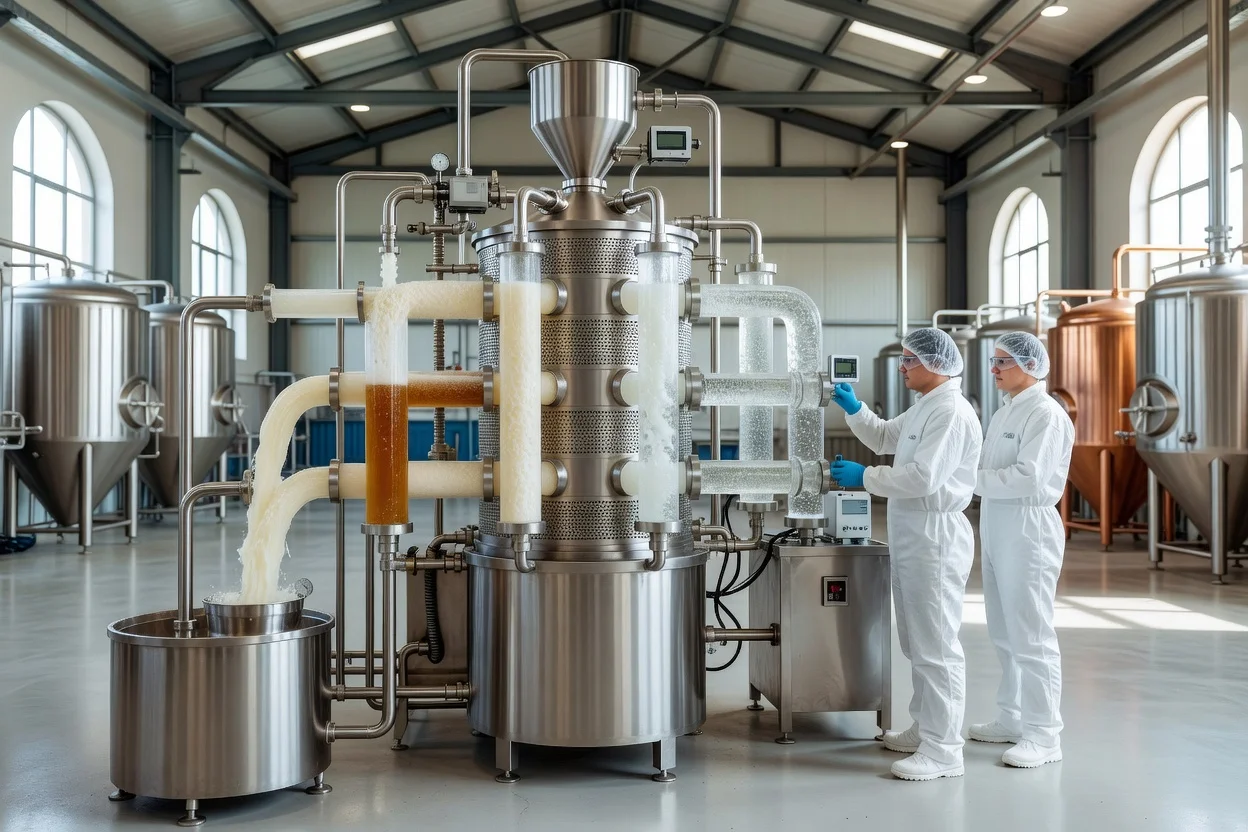
In polymers, kieselguhr is mainly used where a mineral filler is needed to improve handling, reduce tack, or modify surface finish rather than to maximize strength. Reported uses include reinforcing filler in plastics and rubber, anti-block in plastic films, and filler in a range of compounds.
Typical roles include:
- Anti-block in film: reduces contact area between adjacent film layers and helps prevent sticking during winding and converting.
- Matting and surface control: lowers gloss in coatings and some polymer surfaces.
- Extending and cost optimization: partially replaces resin volume in lower-performance applications.
- Rheology modification: can influence viscosity and flow in filled systems.
A poor-fit use is structural reinforcement in demanding engineering plastics, because kieselguhr’s porous particle morphology does not deliver the same modulus and impact benefits as glass fiber or mica.
Dosage examples and mechanism notes
- Anti-block in film: approximately 0.2 to 1.0 wt% can be used in some polymer films, where particles create microscopic surface asperities that reduce intimate contact between film layers.
- Feed and powder applications: purified kieselguhr can be used at low levels as an anticaking aid or flow modifier, where its porous particles adsorb surface moisture and help reduce clumping.
Environmental and Sustainability Aspects
Kieselguhr is a mined mineral, so its environmental profile is shaped by quarrying, drying, milling, transport, and sometimes calcination energy demand. It is not a renewable bio-based feedstock, and it does not biodegrade in the way organic fillers or fibers may.
Sustainability considerations
- Recyclability: kieselguhr itself is generally inert in polymer recycling streams, but it can complicate reprocessing if used at high loadings because mineral residues remain in the recycled polymer.
- Bio-based alternatives: depending on function, starch-based additives, cellulose fillers, rice-husk ash, and other bio-derived materials may replace part of the mineral filler demand in selected applications, although each has its own performance and stability constraints.
- Carbon footprint: the main emissions driver is typically processing energy, especially for calcined grades, rather than the mineral chemistry itself.
- Circularity role: in some applications, kieselguhr can help extend resin use, reduce density, or replace more expensive functional additives, which may lower material intensity even if it does not create a circular feedstock loop.
A related sustainability issue is occupational and product safety. Fine silica-bearing powders require careful dust management, and product specifications may distinguish between natural, purified, calcined, and flux-calcined forms to control purity and health-related exposure concerns.
Economic and Global Market Impact
The market for kieselguhr is closely tied to filtration, food and beverage processing, construction materials, and niche industrial mineral demand. Its economics depend on deposit quality, impurity content, porosity, and energy-intensive upgrading steps.
Recent industry and supplier literature indicates continued strong demand for filtration-grade material, especially in beverage processing, edible oils, and specialty liquids, while smaller but stable demand persists in plastics, paints, insulation, absorbents, and agricultural products. Supplier datasheets also show a meaningful segmentation by permeability and particle grade, reflecting how end-use performance drives pricing and selection.
Leading global producers and marketers are typically industrial mineral companies with diatomite operations rather than polymer producers, and the market is often regional because freight costs are significant relative to value density.
Current Challenges and Innovations
The main technical challenge for kieselguhr is balancing its useful porosity with consistency, purity, and handling safety. Variability in deposit composition can affect brightness, permeability, and impurity profile, which is especially important in food, beverage, and high-specification polymer applications.
Innovation directions
- Surface treatment: improving compatibility with hydrophobic polymers and coatings to enhance dispersion and reduce dusting.
- Granulation and pelletization: lowering airborne dust during handling and dosing.
- Hybrid filler systems: combining kieselguhr with talc, calcium carbonate, or fibers to balance cost, rheology, and mechanical properties.
- Upcycling of spent filter cake: using kieselguhr-rich filtration residues as raw material in bricks, cementitious products, or silica recovery routes.
- Specialty pore engineering: tailoring calcination and classification to obtain more precise filtration or adsorption behavior.
Future Outlook
Kieselguhr is likely to remain important where porosity, absorbency, and lightweight mineral function are needed, especially in filtration, processing aids, and selected polymer formulations. In plastics, its future will depend on whether formulators value its low density and anti-block behavior enough to offset its limited reinforcement performance and dust-management requirements.
The most promising opportunities are in specialty grades, hybrid additive packages, and applications where a mineral extender can improve processing efficiency or product feel without demanding high mechanical reinforcement. At the same time, sustainability pressures are likely to favor lower-energy processing, more precise grading, and greater use of recovered or downcycled kieselguhr-bearing residues in construction and mineral-based products.
Summary
Kieselguhr is a porous diatomite-based mineral valued for filtration, absorbency, insulation, and selective use as a filler or anti-block additive. In the plastics industry, it functions best as a specialty auxiliary rather than a primary reinforcement filler, with its main strengths lying in surface modification, cost extension, and process control.
References
- •
KIESELGUHR Definition & Meaning - Dictionary.com. (n.d.). Dictionary.com. https://www.dictionary.com/browse/kieselguhrLink
- •
Kieselguhr : définition et explications - AquaPortail. (2007, September 18). AquaPortail. https://www.aquaportail.com/dictionnaire/definition/837/kieselguhrLink
- •
Kieselguhr: Comprehensive Applications, Properties, and Industrial Benefits. (2024, November 27). Chemiis. https://chemiis.com/product/kieselguhr/Link
- •
Définition de KIESELGUHR. (n.d.). CNRTL. https://www.cnrtl.fr/definition/kieselguhrLink
- •
How Kieselguhr is Obtained & Used - Seema Minerals. (2025, July 7). Seema Minerals. https://seemaminerals.com/how-kieselguhr-is-obtained-from-ancient-deposits-to-industrial-processing/Link
- •
Kieselgur. (2002, October 3). Wikipedia. https://de.wikipedia.org/wiki/KieselgurLink
- •
kieselguhr | Dictionnaire de l'Académie française | 9e édition. (n.d.). Dictionnaire de l'Académie française. https://www.dictionnaire-academie.fr/article/A9K0099Link
- •
Kieselguhr (Diatomaceous Earth) - Overview | StudyGuides.com. (n.d.). StudyGuides.com. https://studyguides.com/study-methods/overview/cmkue71ca79c801d5q5j7o4f1Link
- •
TECHNISCHE UNIVERSITÄT MÜNCHEN. (n.d.). Mediatum. https://mediatum.ub.tum.de/doc/1006818/1006818.pdfLink
- •
KIESELGUHR Definition & Meaning - Merriam-Webster. (n.d.). Merriam-Webster. https://www.merriam-webster.com/dictionary/kieselguhrLink
- •
Kieselguhr (Diatomaceous Earth) – Study Guide | StudyGuides.com. (n.d.). StudyGuides.com. https://studyguides.com/study-methods/study-guide/cmkue71ca79c801d5q5j7o4f1Link
- •
Kieselguhr CAS#: 91053-39-3 - ChemicalBook. (n.d.). ChemicalBook. https://m.chemicalbook.com/ProductChemicalPropertiesCB00130876_EN.htmLink
- •
Définition de kieselguhr | Dictionnaire français. (2024, March 29). La Langue Française. https://www.lalanguefrancaise.com/dictionnaire/definition/kieselguhrLink
- •
Définition de kieselguhr - étymologie, synonymes, exemples. (2024, April 18). Universalis. https://www.universalis.fr/dictionnaire/kieselguhr/Link
- •
kieselguhr - Wiktionary, the free dictionary. (n.d.). Wiktionary. https://en.wiktionary.org/wiki/kieselguhrLink
- •
Kieselguhr - NobelPrize.org. (2013, June 11). NobelPrize.org. https://www.nobelprize.org/alfred-nobel/kieselguhr/Link
- •
Kieselguhr CAS#: 61790-53-2 - ChemicalBook. (n.d.). ChemicalBook. https://m.chemicalbook.com/ProductChemicalPropertiesCB00131965_EN.htmLink
- •
KIESELGUHR Definition und Bedeutung | Collins Englisch Wörterbuch. (2025, August 4). Collins. https://www.collinsdictionary.com/de/worterbuch/englisch/kieselguhrLink
- •
kieselguhr | GDT - Vitrine linguistique. (2025, January 1). Vitrine linguistique. https://vitrinelinguistique.oqlf.gouv.qc.ca/fiche-gdt/fiche/17087924/kieselguhrLink
- •
kieselguhr. (2025, January 1). WordReference. https://www.wordreference.com/definition/kieselguhrLink
- •
Kieselgur. (n.d.). TheFreeDictionary. https://www.thefreedictionary.com/KieselgurLink
- •
kieselguhr — Wiktionnaire, le dictionnaire libre. (2022, January 1). Wiktionnaire. https://fr.wiktionary.org/wiki/kieselguhrLink
- •
Diatomaceous earth - Wikipedia. (2004, July 3). Wikipedia. https://en.wikipedia.org/wiki/KieselgurLink
- •
Top Uses of Kieselguhr in Various Industries - Seema Minerals. (2023, April 25). Seema Minerals. https://seemaminerals.com/the-top-uses-of-kieselguhr-from-seema-minerals/Link
- •
Kieselguhr | 10279-57-9 - ChemicalBook. (2025, August 19). ChemicalBook. https://www.chemicalbook.com/ChemicalProductProperty_EN_CB00130142.htmLink
- •
Encyclopedia of Wine > Kieselguhr (or Kieselgur). (2026, March 24). Cavesa. https://www.cavesa.ch/en/definition/kieselguhr-or-kieselgurLink
- •
Kieselguhr calcined, purified 91053-39-3 - MilliporeSigma. (2025, October 23). MilliporeSigma. https://www.sigmaaldrich.com/US/en/product/supelco/18514Link
- •
What is Kieselguhr? Uses, How It Works & Top Companies ... (2025, October 7). LinkedIn. https://www.linkedin.com/pulse/what-kieselguhr-uses-how-works-top-companies-2025-researcharena-8thzeLink
- •
Kieselguhr | 68855-54-9. (2025, April 29). ChemicalBook. https://www.chemicalbook.com/ChemicalProductProperty_EN_CB00128160.htmLink
- •
Diatomaceous earth | Uses, Benefits & Safety. (2025, September 24). Britannica. https://www.britannica.com/science/diatomaceous-earthLink
- •
Kieselgur | 60676-86-0 - ChemicalBook. (2026, January 13). ChemicalBook. https://www.chemicalbook.com/ChemicalProductProperty_EN_CB00126337.htmLink
- •
Safety and efficacy of a feed additive consisting of Kieselguhr (diatomaceous earth) for all animal species (Imerys France). (2025, April 16). EFSA. https://pmc.ncbi.nlm.nih.gov/articles/PMC12000819/Link
- •
Anwenderhinweis. (n.d.). Eaton. https://www.eaton.com/content/dam/eaton/products/filtration-solutions/filter-aids/kieselgur-c/kieselgur-c1200/technical-datasheets/Eaton-Kieselguhr-C-1200-TechnicalDataSheet-EN.pdfLink
- •
Kieselguhr, soda ash flux-calcined - PubChem. (n.d.). PubChem. https://pubchem.ncbi.nlm.nih.gov/compound/Kieselguhr,%20soda%20ash%20flux-calcinedLink
- •
Kieselguhr. (n.d.). Fisher Scientific. https://www.fishersci.ca/shop/products/kieselguhr-thermo-scientific/p-7080505Link
- •
Fiche de Données de Sécurité: Kieselguhr. (n.d.). Carl Roth. https://www.carlroth.com/medias/SDB-8019-BE-FR.pdf?context=bWFzdGVyfHNlY3VyaXR5RGF0YXNoZWV0c3wyMjcxNDJ8YXBwbGljYXRpb24vcGRmfGFESmlMMmd3WVM4NU1qSXdPRGt6T0RZNE1EWXlMMU5FUWw4NE1ERTVYMEpGWDBaU0xuQmtaZ3wwODM4NDUzMTRhYzdmYTJmOTAyMGE2Zjg4ZWYxYjg2NTZlYmY4N2VhZmU2ZWUwNmMxMTFjMTM0NDZkNzA2NGNmLink
- •
Kieselguhr sludge from the deep bed filtration of beverages as a source for silicon in the production of calcium silicate bricks. (n.d.). ScienceDirect. https://www.sciencedirect.com/science/article/pii/S0955221905004802Link
- •
Kieselguhr CAS 68855-54-9. (2013, June 20). Merck Millipore. https://www.merckmillipore.com/INTL/en/product/Kieselguhr,MDA_CHEM-107910Link
- •
Kieselguhr CAS 68855-54-9 | 107910. (2013, June 20). Merck Millipore. https://www.merckmillipore.com/IN/en/product/Kieselguhr,MDA_CHEM-107910Link
- •
Kieselgur - AERU - University of Hertfordshire. (2026, May 16). University of Hertfordshire. https://sitem.herts.ac.uk/aeru/bpdb/Reports/2487.htmLink
- •
Kieselguhr - Definition, Meaning & Synonyms - Vocabulary.com. (2025, March 26). Vocabulary.com. https://www.vocabulary.com/dictionary/kieselguhrLink
- •
Kieselguhr Brewing industry - Nak Group. (n.d.). Nak Group. https://www.nak-group.kz/eng/kizilgur-pivovareniya.htmlLink
- •
Influence of diatomaceous earth on the material properties of clay ... (2024, January 9). Zi-online. https://www.zi-online.info/en/artikel/influence-of-diatomaceous-earth-on-the-material-properties-of-clay-bricks-3963963.htmlLink
- •
Kieselguhr / Diatomite / Diatomaceous earth / Infusorial earth. (2014, March 10). Bourgogne-wines. https://www.bourgogne-wines.com/glossary/kieselguhr-diatomite-diatomaceous-earth-infusorial-earth,2532,9412.html?&args=Y29tcF9pZD0xNTc1JmFjdGlvbj12aWV3R2xvc3NhaXJlJmlkPSZtb3Q9MjU4fA==Link
- •
The Application of Diatomaceous Earth/Diatomite/Kieselguhr in ... (2019, March 29). LinkedIn. https://www.linkedin.com/pulse/application-diatomaceous-earthdiatomitekieselguhr-sugar-lauLink
- •
Diatomaceous earth | hudsonresources. (n.d.). Hudson Resources. https://www.hudsonresources.com/diatomaceous-earth-2Link
- •
Diatomaceous Earth and its Applications - AZoM. (2018, August 10). AZoM. https://www.azom.com/article.aspx?ArticleID=16463Link
- •
How to use diatomaceous earth: 3 little-known applications - Imerys. (2022, June 7). Imerys. https://www.imerys.com/news/how-use-diatomaceous-earth-3-little-known-applicationsLink
- •
Innovative Uses for Diatomaceous Earth - Dicalite Management Group. (2025, May 12). Dicalite. https://www.dicalite.com/2025/05/innovative-uses-diatomaceous-earth/Link
- •
Diatomaceous earth products, processes for preparing them, and ... (2009, October 7). Google Patents. https://patents.google.com/patent/WO2010042614A1/enLink