
Introduction
Biostabilisers, microbicides, and antibacterial finishing agents are additive systems used to suppress microbial growth, prevent odor and staining, and protect materials from biodeterioration in plastics, textiles, coatings, and related consumer and industrial products. In plastics and auxiliaries, these functions are often grouped under the broader category of antimicrobial additives or biocides, with formulations tailored either for in-can preservation, dry-film protection, or surface-active antibacterial performance. The same chemistry may be used in different ways depending on whether the goal is to protect the product during storage, protect the finished article in use, or both.
In plastics, these additives are especially relevant for flexible PVC, polyolefins, engineering plastics, sealants, coatings, medical devices, building materials, and water-contact products, where moisture, warmth, and organic residues can encourage microbial colonization. In textiles, the same functional class is used to create biostatic or biocidal finishes that help control odor, reduce cross-contamination, and limit microbial degradation of fibers and finishes. The field spans both leaching systems, which release an active agent over time, and nonleaching or bound systems, which rely on contact killing or surface inhibition and are generally more durable.
History and Development
Early antimicrobial finishing relied on relatively simple mineral salts, phenolics, halogenated compounds, and metal-based treatments, particularly for textiles and flexible materials exposed to moisture or fouling. Over time, increasing demands for durability, lower odor, and better regulatory acceptance pushed development toward quaternary ammonium compounds, polybiguanides, silver-based systems, N-halamines, and polymer-anchored or encapsulated delivery systems.
A major conceptual shift was the move from purely biocidal “kill on contact” thinking to more nuanced material functions: preserving the stored formulation, preventing degradation of the finished article, and managing microbial load without excessive leaching. This shift is reflected in the distinction between biostatic materials, which inhibit growth, and biocidal materials, which kill microorganisms. In textiles, durable regenerable systems such as chlorinated hydantoin-based finishes demonstrated that an antimicrobial function could be renewed during laundering, an approach that influenced later regenerable surface chemistries.
Chemical Structure and Key Properties
At the functional level, these additives are defined less by one molecule than by a set of action modes:
- Membrane disruption: cationic species, especially quaternary ammonium compounds, interact with negatively charged microbial cell surfaces and disrupt membrane integrity.
- Protein and enzyme inactivation: some actives interfere with sulfhydryl groups or key enzymes, limiting metabolism.
- Controlled release: leaching systems deliver active species gradually from a reservoir or matrix.
- Contact-active surfaces: nonleaching systems immobilize the biocidal function on the surface, improving durability and reducing migration concerns.
Key technical properties include:
- Broad-spectrum activity against bacteria, and in some formulations fungi and some viruses.
- Durability under washing, abrasion, or weathering, which is strongly dependent on fixation chemistry and matrix compatibility.
- Compatibility with processing temperatures and shear histories, especially in thermoplastics where additive loss or degradation can occur during extrusion or molding.
- Low impact on appearance and mechanical performance, since excessive loading can affect clarity, odor, color, softness, or processability.
Real limitations are important in this class of additives:
- Limited durability in leaching systems → active migrates out during use or washing → use immobilization, encapsulation, or regenerable chemistry.
- Potential leaching, odor, or regulatory scrutiny for some actives → migration into the environment or toward the user → select lower-migration systems, bound technologies, or approved preservative packages.
- Performance loss in high-soil or high-biofilm environments → microbial shielding and organic contamination reduce contact efficacy → combine with cleaning protocols, texture control, or multi-mode formulations.
Production Processes and Raw Feedstocks
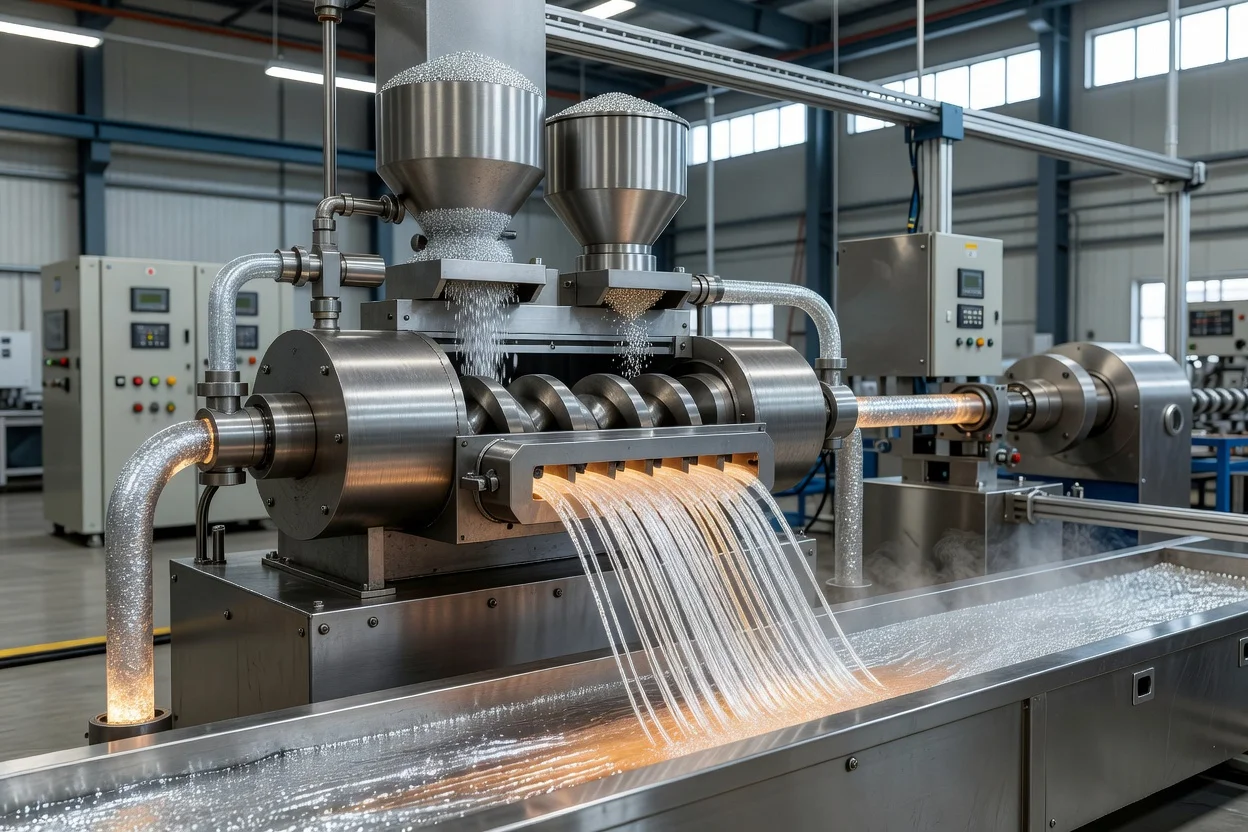
These additives are produced through conventional fine-chemical, inorganic, and polymer-modification routes, then incorporated into host materials by compounding, surface coating, padding, extrusion, grafting, or microencapsulation. In plastics, addition usually occurs during melt compounding, masterbatch dilution, or downstream coating of formed articles. In textiles, application may occur during fiber spinning, wet finishing, padding, coating, or post-treatment.
Typical feedstock families include:
- Silver, zinc, copper, and other metal salts or complexes for broad antimicrobial function.
- QACs and related cationic organics for membrane-active performance.
- PHMB and polybiguanides for durable antimicrobial treatment in selected textile and medical applications.
- Triclosan and related halogenated phenols, though their use has been constrained or reduced in many markets due to regulatory and stewardship concerns.
- N-halamines and regenerable chlorine-donor systems for reusable antibacterial surfaces.
- Chitosan and other bio-based agents for bio-derived or lower-toxicity positioning, especially in textiles.
A practical formulation example is silver-polymer masterbatch for textile or plastic surfaces, where a low-dose dispersed silver phase provides persistent antimicrobial activity by slowly releasing ionic species at the surface; another example is QAC-based coatings used at relatively low loading levels to create a cationic contact-kill layer that destabilizes bacterial membranes.
Applications and End-Use Markets
These additives are used wherever microbial growth threatens hygiene, product life, aesthetics, or process stability.
| End use | Typical function | Common additive family | Usual process route |
|---|---|---|---|
| Medical and healthcare textiles | Reduce bioburden and touch transfer | Silver, QACs, PHMB, N-halamines | Padding, coating, fiber treatment |
| Sportswear and underwear | Odor control, biostatic comfort | QACs, silver, chitosan | Fiber incorporation, finishing |
| Industrial and outdoor textiles | Mildew, rot, and stain resistance | Biocides, metal salts | Final finishing, coating |
| Flexible PVC and plasticized products | Protection from bacterial and fungal growth | Biocides, preservative packages | Compounding, stabilization package |
| Plastics for building and interiors | Surface hygiene and odor control | Silver, copper, biostabilisers | Masterbatch, surface coating |
| WPC and moisture-prone composites | Mold and decay resistance | Fungicidal and antibacterial packages | Compounding |
| Water-contact and filtration materials | Biofouling suppression | Silver, copper, biocide systems | Coating, extrusion, incorporation |
In textiles, the best-fit uses are medical textiles, protective clothing, sportswear, socks, underwear, upholstery, awnings, tarpaulins, and filtration media. The poor-fit use is often high-skin-contact casual apparel with strong, persistent biocidal action, because consumer expectations, skin compatibility, and laundering durability can conflict with the need for strong antimicrobial release.
In plastics, these additives are also used in plasticized PVC and similar materials to suppress bacterial and fungal growth and associated discoloration, as well as in building products and interior surfaces where repeated contact and humidity can promote colonization.
Environmental and Sustainability Aspects
The sustainability profile is mixed and depends heavily on chemistry, dosage, fixation, and end-use.
- Leaching systems can lose activity over time and may raise concerns about environmental release or reduced durability.
- Nonleaching systems generally offer better retention and lower release, but can be more complex or expensive to engineer.
- Bio-based agents such as chitosan offer a route toward lower-toxicity or renewable feedstocks, although performance and wash durability can be application-specific.
- Regenerable systems can reduce reapplication frequency, as shown by chlorinated hydantoin-type finishes that restore antimicrobial function after laundering with bleach exposure.
From a circular-economy perspective, antimicrobial additives can both help and hinder sustainability. They may extend article life by reducing microbial degradation, odor, and premature replacement, but they can also complicate recycling if they alter material chemistry, contaminate recyclate streams, or create regulatory constraints. The main sustainability target is therefore not simply “more antimicrobial,” but fit-for-purpose, low-migration, durable, and recyclable-compatible systems.
Economic and Global Market Impact
Demand is driven by healthcare, hygiene-sensitive consumer goods, building interiors, technical textiles, and specialty plastics. The strongest commercial momentum typically comes from products that can demonstrate either reduced odor, improved cleanliness, or longer service life with minimal trade-offs in touch, appearance, or processability.
The market is competitive and fragmented, with suppliers ranging from specialty additive companies to textile chemical formulators and masterbatch producers. Public product offerings and industry references indicate active use in plastics, WPC, flexible PVC, coatings, and textiles, with silver-, copper-, and QAC-based systems among the most visible commercial classes. In practice, value is captured not only by the active ingredient but by the delivery platform: masterbatch, coating chemistry, binders, encapsulation, or fiber-level incorporation.
Current Challenges and Innovations
The main challenges are:
- Resistance and tolerance concerns when microbes are repeatedly exposed to low-dose actives, especially with poorly designed leaching systems.
- Durability versus safety trade-offs, because higher release can improve initial efficacy but weaken lifetime performance and increase migration risk.
- Regulatory pressure on certain legacy actives, particularly some halogenated or broad-spectrum compounds.
- Performance verification, since antimicrobial claims must be supported by standardized testing and can vary with soil load, laundering, humidity, and surface texture.
Innovation is moving toward:
- Immobilized contact-active surfaces with lower migration.
- Hybrid systems combining antimicrobial action with UV, oxidation, or anti-fouling functions.
- Microencapsulation and controlled-release carriers for longer service life.
- Bio-derived and lower-impact chemistries such as chitosan-based or enzyme-inspired approaches.
- Multi-functional additives that combine microbial control with stabilization, odor management, or durability enhancement, especially in plastics and coatings.
Future Outlook
Future growth is likely to favor formulations that are durable, low-migration, regulatory-resilient, and compatible with recycling and repeated use. In textiles, this means more demand for finishes that survive laundering without excessive release and that can be justified by medical, occupational, or hygiene-critical use cases. In plastics, the strongest opportunities are in moisture-prone, high-touch, or long-life applications where antimicrobial performance adds clear value without undermining mechanical recycling or formulation stability.
The likely direction is away from generic “biocide-heavy” packages and toward engineered antimicrobial systems: controlled chemistry at the surface, targeted release only where needed, and additive packages integrated with stabilizers and processing aids to preserve performance throughout the product life cycle.
Summary
Biostabilisers, microbicides, and antibacterial finishing agents are a strategically important additive class that protects plastics, textiles, and related materials from microbial growth, odor, staining, and biodeterioration. Their technical value lies in the balance between efficacy, durability, migration control, and compatibility with manufacturing and sustainability goals, with the most successful systems increasingly relying on immobilized, regenerable, or multi-functional chemistries rather than simple high-dose biocide loading.
References
- •
Performance on Antibacterial Finishes for Textile Applications. (n.d.).Link
- •
Antimicrobial Finishes – Textile colouration and finishes. (n.d.).Link
- •
Textile Finishing - an overview. (n.d.).Link
- •
Promising Methods of Antibacterial Finishing of Textile Materials. (2022, January 17).Link
- •
Indian Journal of Fibre & Textile Research. (n.d.).Link
- •
Preliminary Assessment of Commercial Antibacterial Finishes on .... (2025, November 25).Link
- •
Antimicrobial Agents for Textiles: Types, Mechanisms and .... (2021, July 27).Link
- •
Antimicrobial finishes for Textiles. (n.d.).Link
- •
Antimicrobial and Mercerization Finishes | PDF | Textiles. (2026, March 27).Link
- •
Antibacterial Agents in Textiles | PDF | Antimicrobial - Scribd. (2026, March 2).Link
- •
Antimicrobial Finishes - Fibre2Fashion. (2007, January 3).Link
- •
Antimicrobial Finishing Methodologies - Fibre2Fashion. (2005, November 8).Link
- •
Antimicrobial Finish - an overview. (n.d.).Link
- •
Review of Antimicrobial Textile Finishes - Gavin Publishers. (2018, December 14).Link
- •
Antimicrobial Approaches for Textiles: From Research to .... (2016, June 21).Link
- •
Antimicrobials & Biocides. (n.d.).Link
- •
Recent Advances in Antimicrobial Treatments of Textiles - FAO AGRIS. (2008).Link
- •
Antimicrobial textile: recent developments and functional .... (2021, July 13).Link
- •
Antimicrobial Textile Finishes Explained. (2024, April 9).Link
- •
Biocides in Textile - Fibre2Fashion. (2005, August 17).Link
- •
Recent Advances in Antimicrobial Treatments of Textiles. (n.d.).Link
- •
Antibacterial finishes | PPT. (2016, July 1).Link
- •
Novel Antimicrobial Agents and Processes for Textile .... (n.d.).Link
- •
Intercide OBF 10 DOTP | One-click to Connect with.... (2025, September 22).Link
- •
Antimicrobial reagents as functional finishing for textiles intended for .... (n.d.).Link
- •
Advancements in Antimicrobial Textiles: Fabrication ... - PMC. (2025, March 28).Link
- •
Durable and Regenerable Antibacterial Finishing of Fabrics .... (2001, January 18).Link
- •
Advances in the Development of Antimicrobial Agents for .... (n.d.).Link
- •
Comparative evaluation of antimicrobials for textile applications. (n.d.).Link
- •
Antibacterial Finish - an overview. (n.d.).Link
- •
935. (n.d.).Link
- •
Plastic Biostabilisers & microbicides & antibacterial finishing agents. (2025, January 4).Link
- •
Comparative evaluation of antimicrobials for textile applications. (n.d.).Link
- •
Eco-friendly flame retardant and antibacterial finishing solutions for cotton textiles: A comprehensive review - Bekinew Kitaw Dejene, Mulat Alubel Abtew, Mihret Pawlos, 2025. (2025, March 11).Link
- •
Synthetic vs. natural antimicrobial agents for safer textiles - PMC - NIH. (2024, September 26).Link
- •
A Mini-Review of Synthetic Organic and Nanoparticle Antimicrobial Agents for Coatings in Textile Applications. (2023, March 28).Link
- •
Antimicrobials / Biostabilisers. (n.d.).Link
- •
▷ Textile Protection | Reduce bacteria while ensuring .... (2025, April 1).Link
- •
Biocides - Plastics. (n.d.).Link
- •
Antimicrobial Fabric Protection Explained. (2020, January 7).Link
- •
Textile Treatment Keeps Microbes at Bay. (2024, January 10).Link
- •
Antimicrobial Finishing - an overview. (n.d.).Link
- •
The Effectiveness of Antimicrobial Agents in Textiles. (2017, August 11).Link
- •
What Is An Antibacterial Fabric?Top Benefits Of .... (2024, September 27).Link
- •
Antimicrobial Finishing. (n.d.).Link
- •
Antibacterial finishing agent and preparation method thereof. (2021, October 20).Link
- •
Biocide Selection: In-can Preservation, Dry Film Protection, Anti-fouling.... (2025, July 8).Link
- •
Frontiers | Antimicrobial properties of hindered amine light stabilizers in polymer coating materials and their mechanism of action. (2024, July 3).Link
- •
Biocides in Plastics. (n.d.).Link
- •
Compositions containing antimicorbial agents in combination with stabilizers. (2005, January 3).Link
- •
Antiseptics and Disinfectants: Activity, Action, and Resistance - PMC. (n.d.).Link
- •
Antimicrobial Preservatives Part One: Choosing a Preservative System. (n.d.).Link
- •
Mecanismos de acción de los microbicidas comúnmente .... (2024, July 3).Link
- •
Compositions containing antimicrobial agents in combination with stabilizers. (1999, April 15).Link
- •
Microbicides: Topical Prevention against HIV - PMC - NIH. (n.d.).Link