
Introduction
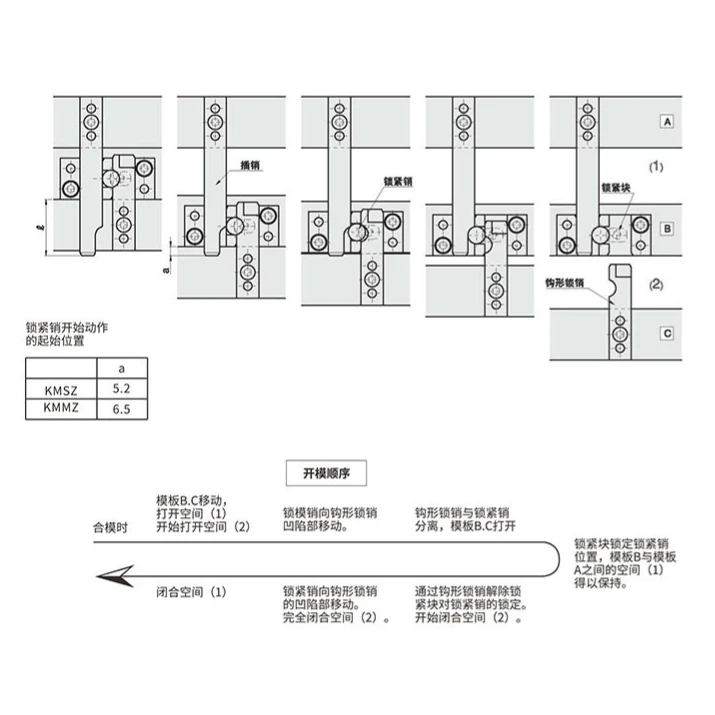
Mold clamping systems are the mechanical, hydraulic, magnetic, pneumatic, and electromechanical devices used to secure a mold to a machine platen and keep it closed against process pressure during injection molding and related plastics processing operations. In quick mold change practice, the related term energy couplings usually refers to the fast-connect interfaces that join coolant, hydraulic, electrical, and sometimes pneumatic services to the mold, enabling rapid, repeatable changeovers with reduced downtime.
In industrial practice, the topic spans both the clamping hardware that applies holding force and the utility coupling systems that connect thermal control and other services. The combination is central to productivity because mold closing force, positional accuracy, and connection integrity directly affect part quality, cycle stability, leak prevention, and changeover time. Contemporary systems range from manual strap and T-slot clamps to automated hydraulic clamps and magnetic clamping plates, while energy couplings include dripless coolant quick couplers and multi-coupler plates for heating, cooling, and auxiliary lines.
Historically, clamp technology developed from simple mechanical fixings toward higher-force hydraulic and direct-pressure designs, then toward faster, safer quick-change concepts for high-mix production. More recent developments emphasize shorter setup times, reduced manual handling, better platen repeatability, and lower energy use through servo-hydraulic and all-electric architectures, as well as permanent-magnet systems that eliminate many clamp-side mechanical operations. Sustainability considerations are now increasingly important because clamp-unit power draw, cooling-line losses, and avoided scrap during first-shot stability all influence the environmental footprint of molding cells.
History and Development
Early injection molding machines relied on mechanical clamp mechanisms such as toggles, levers, bolts, and T-slot fasteners, which were robust but slow to change and less adaptable to rapid production scheduling. As mold sizes and cavity pressures increased, hydraulic clamping became the dominant approach for many machines because it could provide controllable force across a wide tonnage range and sustain high clamp loads during fill and pack phases.
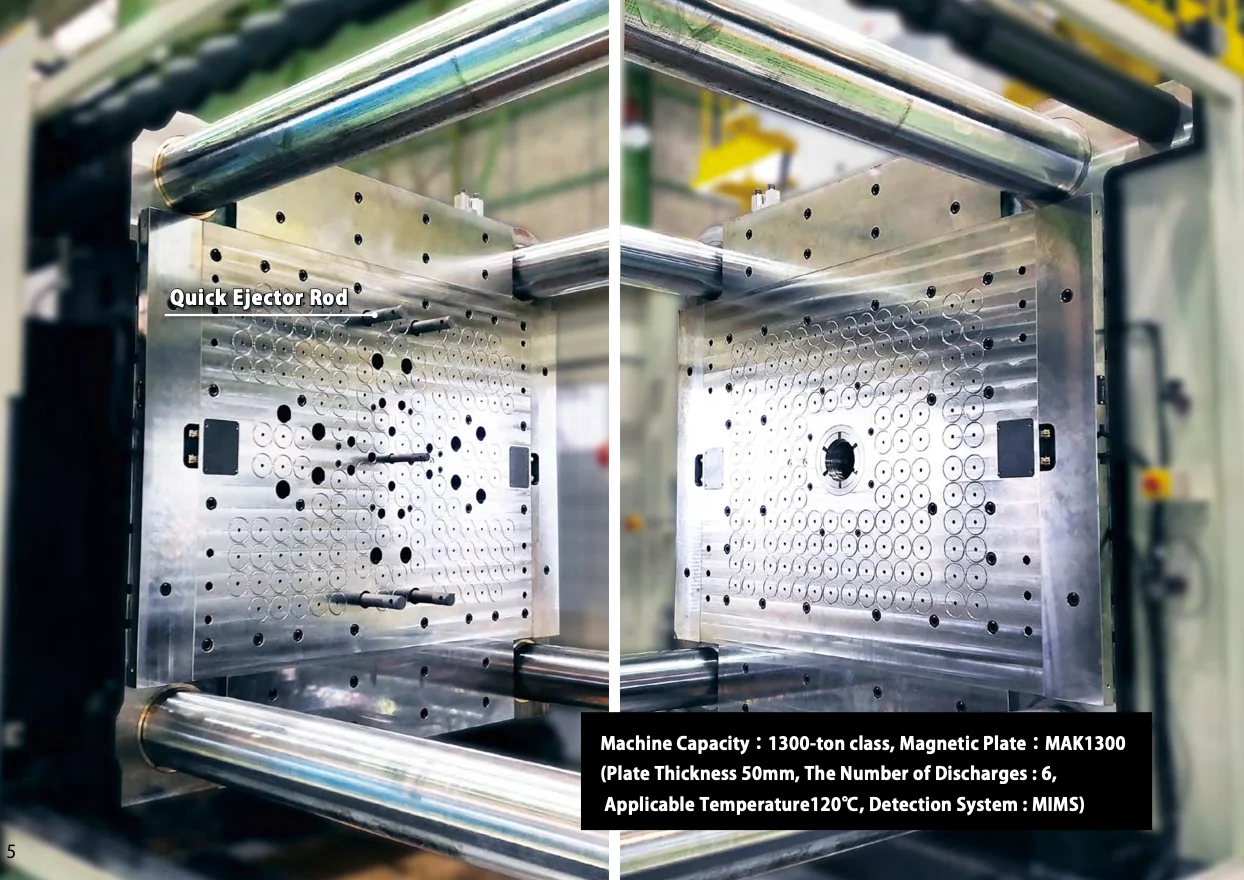
A major milestone was the development of quick mold change systems, which standardized or automated the mounting of molds and connected utilities. Industrial suppliers document three principal QMC technologies—mechanical, hydraulic, and magnetic—with magnetic systems gaining traction because they enable fast locking and unlock without conventional bolting. A second milestone was the spread of magnetic clamping plates, which distribute holding force uniformly across the mold interface and can reduce changeover time dramatically compared with manual clamping.
A third development stage has been the integration of energy couplings for coolant, thermal oil, and other services. Quick release couplings designed for mold thermostating are built for high flow, compact form factors, and resistance to hot water, glycol, and hot oil, allowing repeated connection with minimal leakage risk. In parallel, modern machine makers have introduced direct-pressure and holdless platen concepts to improve trajectory repeatability and reduce mold damage, especially where precision tooling benefits from tighter platen control.
Key Characteristics and Technical Overview
At the most basic level, the clamping system must generate enough force to prevent mold separation under cavity pressure, which otherwise would cause flash, dimensional defects, or tool damage. Clamp force is selected from the projected area of the part and the expected cavity pressure, with a safety margin for material viscosity, venting condition, and wear on the tooling interfaces. In practice, clamping requirements are usually expressed in kN or tons, and industrial injection machines span from compact machines to very large systems in the thousands of tons.
Main clamping architectures
| Type | Working principle | Typical strengths | Typical limitations |
|---|---|---|---|
| Mechanical / toggle | Linkage multiplies force near lock position | Fast motion, good energy efficiency in the lock phase, compact for many applications | More sensitive to overtravel and wear; force profile is less flexible than hydraulic systems |
| Hydraulic | Cylinders generate and maintain clamp force | High tonnage, force control over a wide range, suitable for large molds | Higher hydraulic infrastructure requirement and potential standby losses |
| Direct-pressure / straight-hydraulic | Platen driven directly by hydraulic actuation | Improved trajectory repeatability and mold protection in precision applications | More complex design and higher initial cost |
| Magnetic | Permanent or controlled magnetic fields hold the mold | Very fast changeover, uniform force distribution, safety and reduced setup labor | Requires compatible platen interfaces and disciplined tool management |
| Pneumatic / force-multiplying air clamp | Compressed air powers clamp or multiplier mechanism | Lightweight, rapid for low-force uses | Limited clamping force relative to hydraulic systems |
Engineering features and performance notes
- Clamp force range: industrial hydraulic systems are commonly described from about 500 kN to 25,000 kN, depending on machine class and application.
- Platen guidance: high-precision systems may use long-span support, linear guides, central ball screws, or tie-barless concepts to improve repeatability and reduce platen skew.
- Holding behavior: the clamp must remain stable through injection, packing, and cooling, not merely at closure, because cavity pressure persists while the part solidifies.
- Energy profile: clamp action is only one of several power consumers in an injection molding machine, but it contributes materially to overall electrical demand alongside plastification, heating, ejection, and barrel movement.
- Energy efficiency: servo-electric or hybrid architectures can reduce standby and peak load versus conventional hydraulic systems, while optimized process conditions and lower-viscosity grades can also reduce total energy use.
Energy couplings in mold change systems
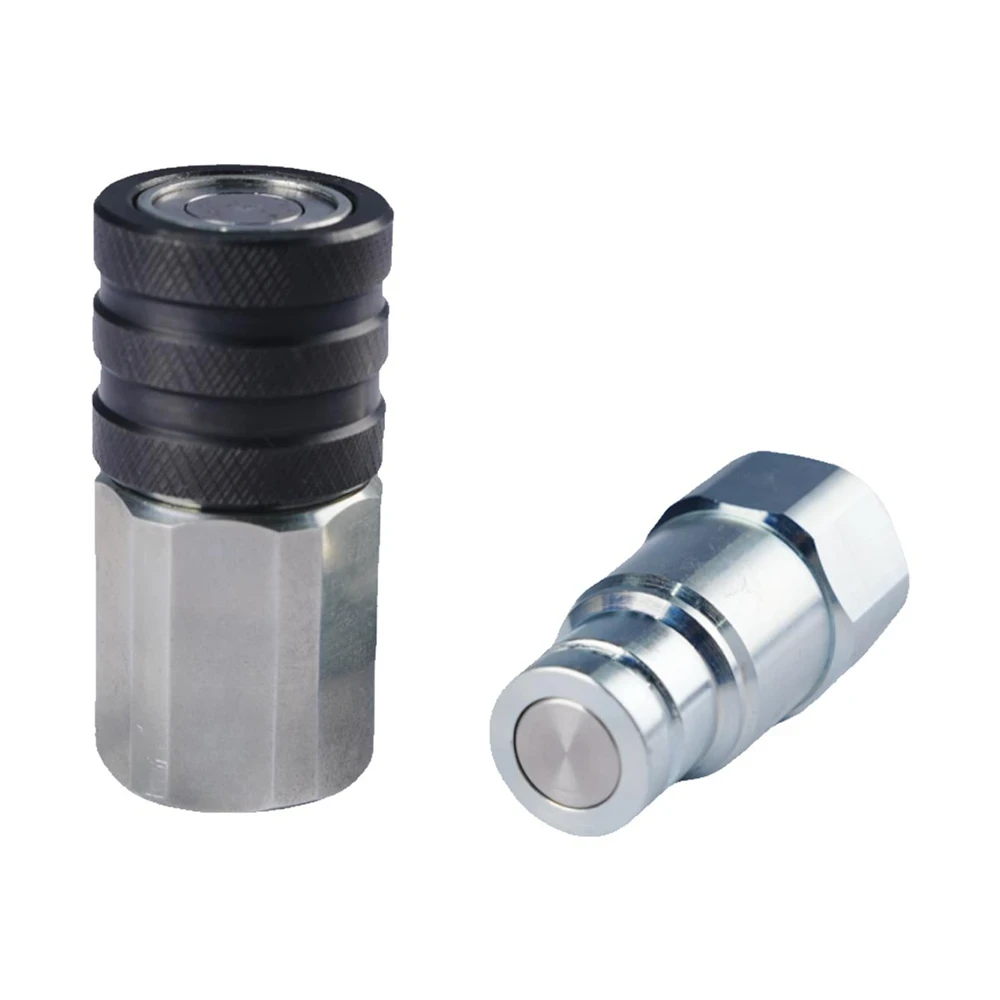
Energy couplings are the service interfaces that connect the mold to the machine or auxiliary manifold. The most common are coolant quick couplers, but mold-change packages may also include hydraulic, pneumatic, and electrical connectors for ejectors, valve gates, heaters, sensors, and hot-runner systems. In practice, these couplings are selected for:
- Leak-free connection under repeated cycling.
- High flow rate with low pressure drop for cooling efficiency.
- Compact geometry to fit dense manifold layouts inside molds.
- Thermal and chemical resistance for hot water, glycol, and hot oil service.
Typical process numbers
- Cooling-line quick-connect systems are often optimized to reduce connection from minutes of manual hose work to a single action or a few seconds, depending on the installation.
- Quick mold change systems are frequently designed to shorten changeover substantially; magnetic systems are commonly marketed for large reductions in downtime, especially in high-mix production.
- In process terms, the clamping phase must complement the injection and cooling cycle, because even small losses in setup time can outweigh cycle-time gains in short-run manufacturing.
Types and Variations
By clamping mechanism
- Manual clamps: simple bolts, straps, T-slot clamps, and related fixtures used in low-volume or lower-cost installations.
- Hydraulic clamp systems: common on medium to large machines and in quick-change platforms where controllable force is required.
- Magnetic clamp systems: used where frequent mold changes, clean platen surfaces, and rapid setup justify higher capital cost.
- Pneumatic or air-assisted clamps: applied mainly where lower force and fast actuation are sufficient.
By machine and mold layout
- Two-platen systems: widely used where large clamp force and a compact footprint are both important.
- Three-platen systems: often used in blow molding or special configurations where symmetry and mold movement geometry are important.
- Tie-bar machines: traditional injection molding layout with platen travel on guide bars.
- Tie-barless machines: favored for certain large molds, automation access, and mold height flexibility.
By utility connection concept
- Single-circuit coolant couplings: for mold cooling or heating lines.
- Multi-coupler plates: consolidate several utilities into one docking action, reducing setup time and misconnection risk.
- Hydraulic quick couplings: used where mold-side hydraulic functions, ejectors, or core pulls must be connected rapidly.
- Electrical energy couplings: used for hot-runner power, temperature control, sensors, and instrumentation, especially in higher-value molds; these are typically integrated into broader coupling plates rather than used as standalone clamps.
Applications and Uses
Injection molding is the principal application, where the clamp must hold the cavity closed during fill, pack, and cooling. Automotive components, appliance housings, packaging closures, medical disposables, technical parts, and consumer goods all rely on the alignment and holding accuracy of the clamping unit.
- Automotive and transportation: large hydraulic or direct-pressure clamp systems are favored for bumper fascias, structural trim, and other large-format parts where cavity pressure and mold size are high.
- Medical and electronics: precision clamping and repeatable platen motion support thin-wall, low-flash, and high-cosmetic-quality parts.
- Packaging and closures: rapid cycle rates make energy-efficient clamp action and fast mold change important for high-output production.
- Household and consumer products: quick mold change and multi-cavity tooling support variable demand and shorter production runs.
- Blow molding: clamping units secure the blow mold around the parison, with hydraulic and electric/hybrid solutions used depending on part size.
- A poor-fit use: a highly manual clamp system is generally a poor choice for frequent product changeovers in high-mix medical production, because the labor and alignment time can dominate the economics of the cell.
Technological Innovations and Automation
Automation has shifted mold clamping from a purely mechanical task to a cell-level logistics function. Modern quick-change systems combine clamp actuation, mold identification, cooling-line coupling, and sometimes automated platen positioning to shorten setup time and reduce operator exposure.
Key innovations include:
- Magnetic clamping plates with uniform force distribution across the mold interface.
- Hydraulic self-locking clamps for repeatable securement with reduced manual intervention.
- Direct-pressure clamp control to improve trajectory repeatability and lower mold wear.
- Integrated multi-coupling plates that connect coolant, hydraulics, and electrical services in one docking action.
- Condition monitoring and energy analytics, which help quantify clamp-unit load, cycle profiles, and utility consumption at machine level.
Automation trade-offs are real: advanced systems reduce downtime and human error, but they add complexity, require compatibility between mold and platen interfaces, and can increase capital cost. Magnetic systems, for example, are especially effective in frequent-change environments, but they are not universally optimal for every machine class or legacy mold design.
Environmental and Sustainability Aspects
Sustainability in clamp and coupling design is driven by three main factors: energy use, material waste, and water/thermal efficiency. Energy studies on injection molding show that machine-stage power can vary materially with machine design and process settings, and clamp systems are part of that energy balance.
Important sustainability effects include:
- Reduced idle and setup losses through faster mold changeovers.
- Lower leak risk from modern quick couplings, which helps conserve coolant and maintain stable thermal control.
- Improved first-shot quality, reducing scrap during setup and startup.
- Potential electrical savings from servo-driven or hybrid clamp architectures relative to older hydraulic systems.
- Process optimization: choosing a freer-flowing resin grade or optimizing cycle parameters can reduce energy demand and shorten clamping-related dwell times.
At the same time, sustainability claims must be interpreted carefully. Magnetic and automated systems can reduce repeated manual operations, but they also introduce embedded material and control-system complexity, so environmental performance depends on duty cycle, mold-change frequency, and utility design.
Economic and Global Market Impact
The economic value of mold clamping systems is closely tied to availability, changeover time, and tool protection. In high-mix production, a shorter mold exchange can create more sellable output than a modest reduction in cycle time, which is why quick-change and coupling systems have become important competitive tools.
Global demand is strongest where manufacturers run multiple SKUs, high tooling turnover, or tight delivery schedules. Automotive, packaging, medical, and contract manufacturing operations are particularly sensitive to clamp technology because downtime costs often exceed the direct cost of the clamp hardware itself. Suppliers such as Stäubli, Pascal, Kosmek, Sodick, and other tooling- and connector-oriented manufacturers are notable in specific niches such as magnetic clamping, hydraulic quick-change systems, and high-precision clamp engineering.
Current Challenges and Innovations
Several engineering issues remain central:
- Mold compatibility: not all legacy molds are suited to magnetic plates or standardized quick-coupler layouts.
- Force verification: inadequate clamp force can cause flash, while excessive force can accelerate wear or distort tooling interfaces.
- Leak management: thermal and hydraulic couplings must resist wear, contamination, and repeated cycling without dripping.
- Precision versus footprint: compact machines must still provide stable platen travel and accurate mold alignment.
- Cost justification: high-capital systems are easier to justify where changeover frequency is high and labor is expensive.
Current innovation work is focused on better sensor feedback, automatic docking, reduced-energy clamp drives, and more integrated mold service plates that combine mechanical securing with utility connection in a single routine.
Future Outlook
The most likely direction is continued movement toward fully integrated mold interfaces in which clamping, utility connection, and machine identification are managed as one automated sequence. Magnetic and hybrid clamp concepts are likely to expand where frequent changeovers, product diversification, and tool protection matter most.
Future development will probably emphasize:
- Lower energy consumption through servo-electric and optimized hydraulic designs.
- Higher repeatability for precision molding and sensitive tooling.
- Smarter couplings with embedded monitoring for temperature, pressure, leakage, and connection status.
- Greater flexibility for mixed-machine fleets and modular production cells.
- Improved sustainability metrics, especially where reduced scrap and lower utility losses can be documented in production data.
Summary
Mold clamping systems provide the force, alignment, and stability that make plastic molding possible, while energy couplings enable rapid and reliable connection of coolant, heating, hydraulic, and electrical services during mold change. Together, they influence not only machine uptime and part quality but also energy efficiency, operator safety, and the economics of modern plastics manufacturing.
References
- •
Everything You Need to Know About Mold Clamping Systems. (2023, November 10). https://www.forwell.com/en/article/all-about-mold-clamping-systems.htmlLink
- •
Key Components of Injection Molding Part 2: Clamping Unit - Aprios. (2025, May 29). https://www.aprios.com/insights/key-components-of-injection-molding-part-2-the-clamping-unitLink
- •
Quick mold change solutions for plastics industry | Stäubli - Staubli. (2025, December 17). https://www.staubli.com/global/en/fluid-connectors/industries/plastics-process.htmlLink
- •
Quick Mold Change Systems: Comparison of 3 Types. (2023, March 21). https://www.hvrmagnet.com/blog/quick-mold-change-systems-comparison-of-3-types/Link
- •
Pascal mold change system - PDF Catalogs | Brochure. (n.d.). https://pdf.directindustry.com/pdf/pascal-engineering-inc/pascal-mold-change-system/246120-1090170.htmlLink
- •
Plastics Molding & Manufacturing/Clamp System. (2022, January 1). https://en.wikibooks.org/wiki/Plastics_Molding_&_Manufacturing/Clamp_SystemLink
- •
Mold clamping system - Pascal Engineering Inc. (2025, January 1). https://pdf.directindustry.com/pdf/pascal-engineering-inc/mold-clamping-system/246120-1090169.htmlLink
- •
AIR CLAMP SYSTEM. (n.d.). https://www.kosmek.co.jp/data/pdf/en/HZ-08-GB.pdfLink
- •
UK. (n.d.). https://easchangesystems.com/wp-content/uploads/EASE151855_Folder-QMC-engels_LR.pdfLink
- •
MEK2000-8S. (n.d.). https://www.kosmek.co.jp/data/pdf/en/QMC001-01-GB.pdfLink
- •
Mold Clamps Injection Molding: A Comprehensive Guide. (2024, May 11). https://www.ace-mold.com/mold-clamps-injection-molding-a-comprehensive-guide/Link
- •
Kosmek Quick Mold Change Systems - Southeastern Polymer Machinery. (2023, November 28). https://spminc.net/products/kosmek-quick-mold-change-systems/Link
- •
Straight-Hydraulic Mold Clamping System|Sodick. (n.d.). https://www.sodick.co.jp/en/tech/clamping_system.htmlLink
- •
kosmek - quick mold change systems. (n.d.). http://www.autoclamp.net/kosmek/data/pdf/en/MQ_06_02.pdfLink
- •
Clamp | MoldingHub. (n.d.). https://moldinghub.com/en/knowledge/glossary/clampLink
- •
Blow Mold Cooling. (2024, March 25). https://cmppin.com/blog/clamping-units-in-extrusion-blow-moulding/Link
- •
Quick mold change solutions for plastics industry - Stäubli. (2025, July 8). https://www.staubli.com/cz/en/fluid-connectors/industries/plastics-process.htmlLink
- •
Master Clamping Methods in Injection Molding. (2024, November 29). https://www.moldall.com/clamping-methods-in-injection-molding/Link
- •
Reduce Mold Change Time in Injection Molding: SMED Guide from .... (2026, May 12). https://www.kinghou.net/smed-injection-molding-cut-mold-change-time/Link
- •
What are mold clamps? - LinkedIn. (2020, February 2). https://www.linkedin.com/pulse/what-mold-clamps-jasmine-hlLink
- •
Hydraulic Mold Clamp for Quick Mold Change | MoldJet. (n.d.). https://moldjet.net/products/hydraulic-mold-clamp/Link
- •
Energy-Efficient Enhancement for Viscoelastic Injection Rheomolding Using Hierarchy Orthogonal Optimization. (n.d.). https://onlinelibrary.wiley.com/doi/10.1155/2018/7054385Link
- •
Magnetic Clamping System for Injection Molding and Stamping. (2022, December 21). https://www.pascalenginc.com/magnetic-clamps/Link
- •
A guide to the selection of quick clamping systems for plastic .... (n.d.). https://designsolutionsmag.co.uk/a-guide-to-the-selection-of-quick-clamping-systems-for-plastic-injection-moulds/Link
- •
Mold Clamps for Injection Molding: A Guide - ACE Group. (n.d.). https://www.ace-mold.com/mold-clamps-for-injection-molding-a-guide/Link
- •
[PDF] MSEC2013-1222 - National Institute of Standards and Technology. (n.d.). https://tsapps.nist.gov/publication/get_pdf.cfm?pub_id=912839Link
- •
What is Mold Clamp?. (2021, November 3). https://dgmfmoldclamps.com/what-is-mold-clamp/Link
- •
085-088_PE110605_PE12 nach Korrektur. (n.d.). https://download.basf.com/p1/8a8081c57fd4b609017fd64d3b485e75/en/Flowing_Faster_and_Saving_Energy_Articles_in_Technical_Journals_Englisch.pdfLink
- •
Internal circulation clamping system with supplementary volume for small and medium types of two-platen injection molding machine. (n.d.). https://www.sciencedirect.com/science/article/pii/S2542504819300259Link
- •
Semi-empirical Modeling of the Energy Consumed during the Injection Molding Process. (n.d.). https://escholarship.org/content/qt6j39z8nj/qt6j39z8nj.pdf?t=n8i3dnLink
- •
How to Improve the Energy Balance of Injection Molding. (n.d.). https://res.cloudinary.com/sternwald-systems/raw/upload/v1/hugoprd/ARTIKEL_ATTACH/00243A1F_AAA0666063DF/33dfa62bf83fb12e12604b71ce1e4946a7b1f77a/PE_2008_10_How-to-Improve-the-Energy-Balance-of-Injection-Molding.pdfLink
- •
Estimating energy consumption of injection moulding for environmental-driven mould design. (2017, December 1). https://www.sciencedirect.com/science/article/abs/pii/S0959652617315913Link
- •
Energy Consumption Modelling in the Injection Moulding .... (n.d.). https://scholar.tecnico.ulisboa.pt/api/records/SRB6EbgfesaykiFtJv4UuQrUD8fxF4mYvDEr/file/d228e2465ce32754007d4b63182cb5753b6a74b1a00b43ec4ce30e90d450b244.pdfLink
- •
(PEPLIŃSKI_UTP_PL_2011_Energy_menagement in plastic technologies_v3). (n.d.). https://yadda.icm.edu.pl/baztech/element/bwmeta1.element.baztech-article-BPG8-0056-0048/c/CIMAC_2011_6_3_026.pdfLink
- •
Hydraulic Quick Mould Clamping Systems | PDF - Scribd. (2026, April 8). https://pt.scribd.com/document/672881404/Staubli-Mould-Clamping-Systems-HydraulicLink
- •
What kind of clamping system is needed for large injection molding .... (2025, August 16). https://www.topstarmachine.com/what-kind-of-clamping-system-is-needed-for-large-injection-molding-machine-with-high-clamping-force/Link
- •
Central magnet core. (n.d.). https://www.pascaleng.co.jp/application/files/6115/7415/2399/qmc-10e_mag.pdfLink
- •
New. (n.d.). https://www.barrysalesinc.com/cmss_files/attachmentlibrary/Mold--Tooling/Magnetic-Clamping.pdfLink
- •
Magnetic clamping systems advance as mold-changing .... (n.d.). https://easchangesystems.com/wp-content/uploads/2015/09/Plastics_Machinery_Magazine_072015.pdfLink
- •
Mold coolant quick release couplings - Tubes International. (2026, April 14). https://www.tubes-international.com/products/industrial-fittings/mold-coolant-quick-release-couplings/Link
- •
Energy monitoring of plastic injection molding process running with hydraulic injection molding machines. (2017, April 1). https://www.sciencedirect.com/science/article/abs/pii/S0959652617302676Link
- •
[PDF] Analysis and Modelling of Energy Consumption in the Injection .... (n.d.). https://fenix.tecnico.ulisboa.pt/downloadFile/281870113703251/70972_Resumo%20alargado%20-%20versao%20Final.pdfLink
- •
Magnetic Clamping System for Mold Change - HVR MAG. (n.d.). https://www.hvrmagnet.com/product/magnetic-clamping-system-for-mold-change-16.htmlLink
- •
Electricity Consumption Estimation of the Polymer Material .... (2018, September 16). https://pmc.ncbi.nlm.nih.gov/articles/PMC6164802/Link
- •
An Energy Saving Guide for Plastic Injection Molding .... (n.d.). https://www.mobil.com/en/industrial/~/media/C19701CE80A046DD8D1073C545C262E7.ashxLink
- •
Powerful mold clamping through actuators made of shape memory .... (2022, August 11). https://www.ifw.uni-hannover.de/en/institute/news-und-veranstaltungen/news/news-details/news/powerful-mold-clamping-through-actuators-made-of-shape-memory-alloysLink
- •
Staubli Corporation: Duncan, SC 29334 - Thomasnet. (2018, December 5). https://www.thomasnet.com/company/staubli-corporation-30096476/profileLink
- •
EXPERIMENTAL STUDY ON ENERGY CONSUMPTION IN .... (n.d.). https://stumejournals.com/journals/innovations/2019/4/155.full.pdfLink
- •
Demystifying Energy Saving Devices on Injection Molding .... (2013, August 31). https://plasticsengineering.wordpress.com/2013/08/31/demystifying-energy-saving-devices-on-injection-molding-machines/Link
- •
Clamping Unit Injection Molding Machine Energy Guide 2026. (2026, January 4). https://www.daobenmachinery.com/clamping-unit-injection-molding-machine/Link
- •
An Environmental Analysis of Injection Molding. (n.d.). https://web.mit.edu/ebm/Publications/Thiriez_ISEE_2006.pdfLink
- •
[PDF] Accurate Profiling of Energy Consumption for Injection Molding .... (n.d.). https://tsapps.nist.gov/publication/get_pdf.cfm?pub_id=905587Link
- •
Energy Conservation in Textile and Polymer Processing. (2025, April 6). https://pubs.acs.org/doi/10.1021/bk-1979-0107Link
- •
The Results Prove The.... (2026, February 12). https://www.scribd.com/document/716067242/Plastic-Injeccion-Parameter-to-Safe-EnergyLink
- •
Two Ways to Reduce Energy Consumption in Injection .... (2024, October 1). https://www.plasticsengineering.org/2024/10/two-ways-to-reduce-energy-consumption-in-injection-molding-006791/Link
- •
Mouldpro Power Sliding Mold Clamps (without inbus bolt) - Plastixs. (2025, August 18). https://www.plastixs.com/product/mouldpro-power-sliding-mold-clamp-supplied-without-inbus-bolt/Link