

Introduction
Flocking equipment refers to the machinery and associated systems used to apply short textile fibers, called flock, onto a substrate coated with adhesive, creating a surface that is decorative, functional, or both. In plastics processing and finishing, this equipment is used especially for molded parts, profiles, packaging components, automotive interiors, and consumer products where a soft-touch, non-slip, noise-damping, or light-absorbing surface is desired.
The core industrial principle is straightforward: fibers are cut to a controlled length, electrically charged or pneumatically propelled, and anchored upright in a wet adhesive layer so that the finished surface appears velvety and uniform. Modern flocking installations range from manual hand units to semi-automatic workstations and fully automatic lines, with specialized configurations for flat sheets, rotationally symmetrical parts, glove boxes, roll-to-roll substrates, and profile components.
From a plastics-industry perspective, flocking equipment occupies a niche between surface decoration and functional finishing. It supports product differentiation, improves tactile quality, and can add useful performance such as friction control, sealing, insulation, and noise reduction, while also raising process demands for cleanliness, electrical safety, adhesive control, and particle recovery. Ongoing development has focused on higher automation, better coverage of complex geometries, lower waste, and improved energy efficiency, especially where flocking is integrated into larger production lines.
History and development
Flocking is an older surface-finishing concept, but industrial equipment for it developed alongside modern textile cutting, adhesive chemistry, and electrostatic application technology. Early systems relied on manual or mechanically assisted application, while later equipment used electrostatic fields to orient fibers vertically and improve uniformity.
Key milestones include the following:
- Industrial electrostatic flocking became the dominant technical route because it enabled fibers to stand upright in adhesive, producing a more consistent and durable pile than purely mechanical methods.
- Specialized machine classes emerged for different product geometries, including flat-sheet, cylindrical, glove-box, and profile flocking systems, reflecting the growing need to process molded plastics and complex assemblies.
- Automation and inline integration expanded from stand-alone applicators to complete lines that combine sizing, flocking, drying, and fluff removal, particularly for packaging, automotive parts, and film or sheet products.
The historical trajectory mirrors broader plastics machinery development: from manual craftsmanship toward repeatable, high-throughput, process-controlled equipment designed for quality consistency and labor reduction.
Technical overview
Flocking equipment typically includes a fibre feed system, a charging or propulsion unit, an adhesive application stage, a grounded workpiece holder or conveyor, and a cleaning or recovery stage for excess flock. In electrostatic systems, the adhesive-coated substrate is placed under high voltage so that the flock is attracted into the adhesive film and aligned approximately perpendicular to the surface.
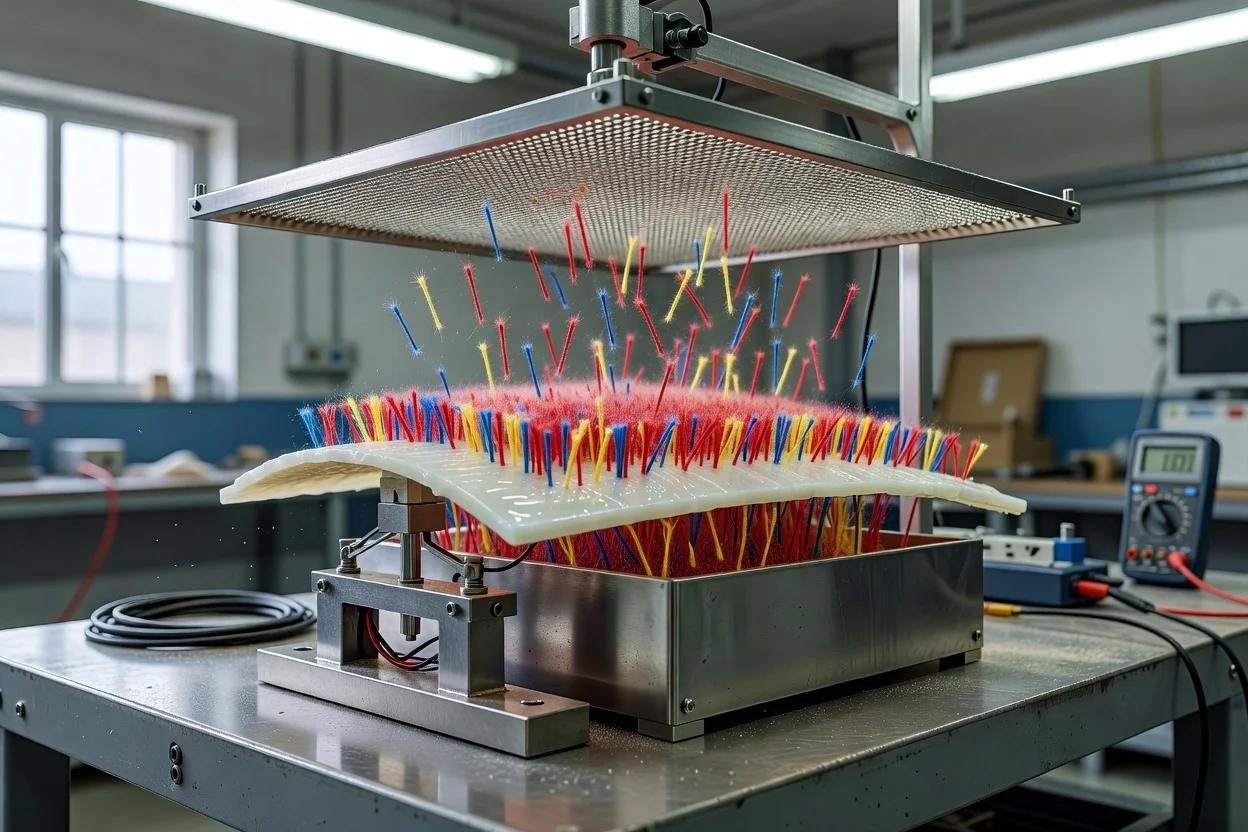
Working principle
- The substrate is first coated with a suitable adhesive.
- Flock fibers are introduced into an electrostatic field or air stream.
- The fibers are accelerated toward the substrate and embedded in the adhesive.
- After curing or drying, surplus flock is removed and often recovered for reuse depending on quality requirements.
Electrostatic flocking is the most common method for high-quality finishing because it improves fiber orientation and coverage uniformity. Pneumatic or blown systems are often preferred when deep recesses, pockets, corners, or three-dimensional cavities must be covered more reliably than with pure electrostatics alone.
Typical technical ranges
Published industry sources do not standardize one universal specification set, but commonly cited operating characteristics are as follows:
- Flock fiber length: often very short, with precision-cut fibers commonly around 150 microns and above depending on the application.
- Rotor or applicator speeds: rotary or mechanically assisted flocking systems may operate at high speeds to vibrate or agitate the substrate, while air and electrostatic systems rely more on field strength and airflow than on mechanical speed.
- Throughput: manual units are suited to single parts and small batches, whereas automated lines are used for continuous or repetitive production such as sheets, profiles, and vehicle components.
- Residual moisture after dewatering: in flock material preparation and recovery systems, centrifugal dewatering is used to reduce moisture before drying or reuse; exact values vary by plant design and are typically specified by the equipment supplier rather than by a common industry standard.
- Specific energy consumption: highly dependent on line design, extraction, drying, and recovery stages; electrostatic generation itself is modest, but total energy demand rises with drying ovens, compressed air, and dust extraction.
Because flocking performance depends heavily on adhesive rheology, humidity, substrate conductivity, field geometry, and fiber length distribution, machine selection is usually application-specific rather than standardized across the industry.
Types and variations
| Type | Main principle | Typical strengths | Typical limitations |
|---|---|---|---|
| Manual flocking equipment | Hand application with electrostatic or pneumatic assistance | Low investment, flexible for prototypes and repair work | Lower repeatability, operator dependent |
| Semi-automatic systems | Partial mechanization with manual loading or positioning | Good for small series and mixed products | Limited throughput compared with inline systems |
| Fully automatic lines | Conveyor or robotic handling with controlled flocking, drying, and cleaning | High repeatability, higher throughput, lower labor input | Higher capital cost and integration complexity |
| Electrostatic flocking machines | Charged flock aligns in the electric field | Best fiber orientation and appearance | Sensitive to grounding, humidity, and geometry |
| Pneumatic or air-assisted systems | Flock is propelled by compressed air | Better access to recesses and cavities | Can be less uniform without careful control |
| Rotary flocking machines | Rotating drum or holder exposes the surface evenly | Effective for cylindrical or rotationally symmetric parts | Less suitable for irregular geometries |
| Special-purpose stations | Built for glove boxes, profiles, rolls, or sheets | High process fit for one product family | Narrower flexibility |
The Flock Association of Europe notes that equipment exists from hand flocking tools to semi-automatic and fully automatic machines for standard and special applications. Commercial product ranges likewise distinguish between surface flocking, painter-roller flocking, rotationally symmetrical parts, glove box systems, roll-to-roll processing, and corner or profile flocking.
Applications and uses
Flocking equipment is used across both technical and decorative markets, with plastics often serving as the substrate, carrier, or housing material.
- Automotive and transport
- Packaging and premium consumer goods
- Textiles, footwear, and apparel components
- Furniture and interior products
- Medical and personal-care items
- Toys, crafts, and promotional goods
- Industrial technical parts
- Architectural and construction-related surfaces
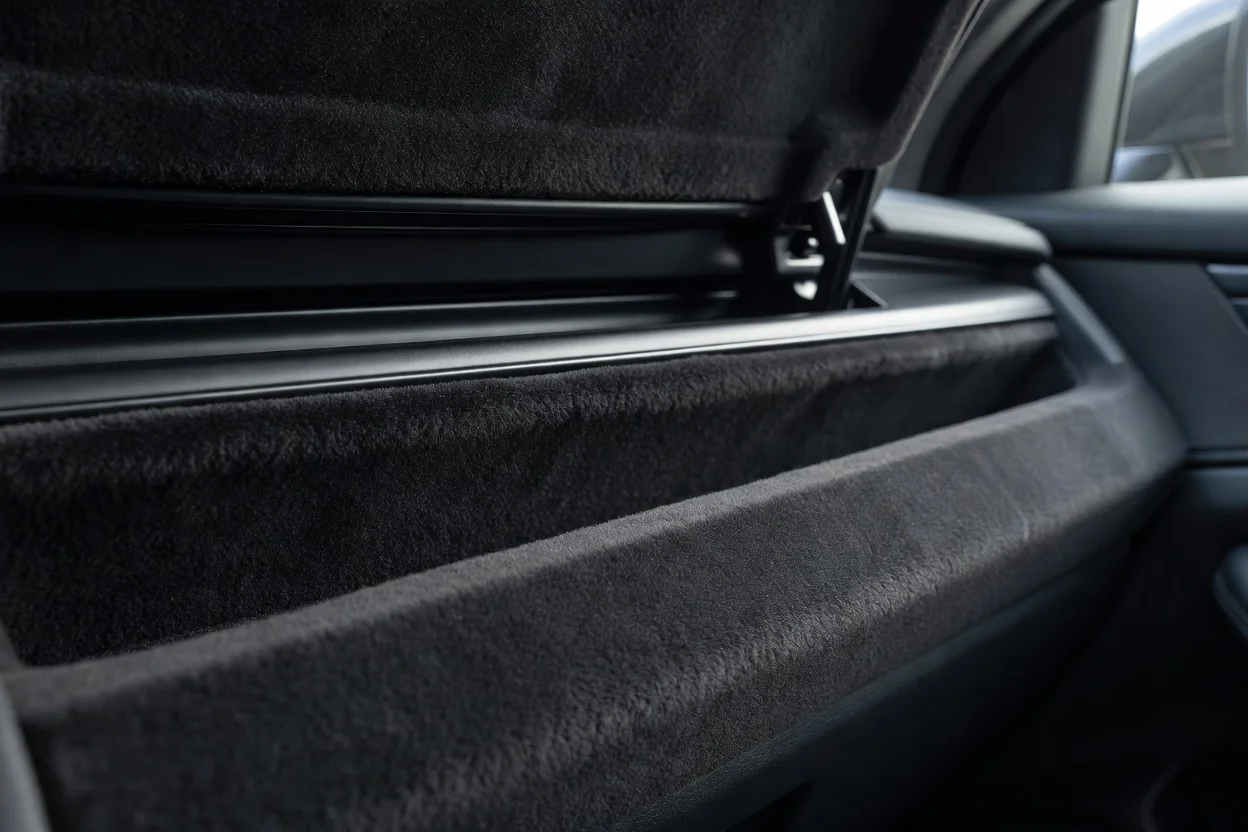
In automotive applications, flocking is used on glove boxes, dashboard trim, storage compartments, sealing profiles, and window guide profiles to improve feel, reduce noise, and support sliding performance. In packaging and cosmetics, it is used on boxes, flacons, inserts, and applicators to create a premium tactile effect. In furniture and interiors, flocking can contribute to acoustic damping and surface protection.
A less suitable use is high-abrasion structural surfaces that require heavy mechanical wear resistance rather than a soft or textile-like finish, because flock is optimized for surface feel and function rather than load-bearing durability.
Role in plastics processing
Although flocking is not a primary polymer forming process like injection molding or extrusion, it is closely tied to plastics manufacturing because many flocked goods are molded plastic parts, PVC films, thermoplastic profiles, foam components, or composite housings. The process often follows molding, trimming, cleaning, and adhesive priming, making it a downstream finishing technology that can materially affect final product value.
Typical plastics-related use cases include:
- Injection-molded interior parts for vehicles
- Extruded seals and guide profiles
- Thermoformed packaging inserts
- Foam and elastomer components
- Plastic displays, cases, and housings
Surface preparation is especially important on plastics because release agents, low surface energy, and molding residues can reduce adhesive bond strength. For that reason, pretreatment, plasma activation, cleaning, and controlled adhesive application are common in higher-end lines.
Technological innovations and automation
Recent developments in flocking equipment have centered on improving repeatability and lowering manual labor. Manufacturers offer workstation-based systems for ergonomic operation, automatic add-on stations for print-and-flock workflows, and dedicated cabinets or conveyor lines for continuous production.
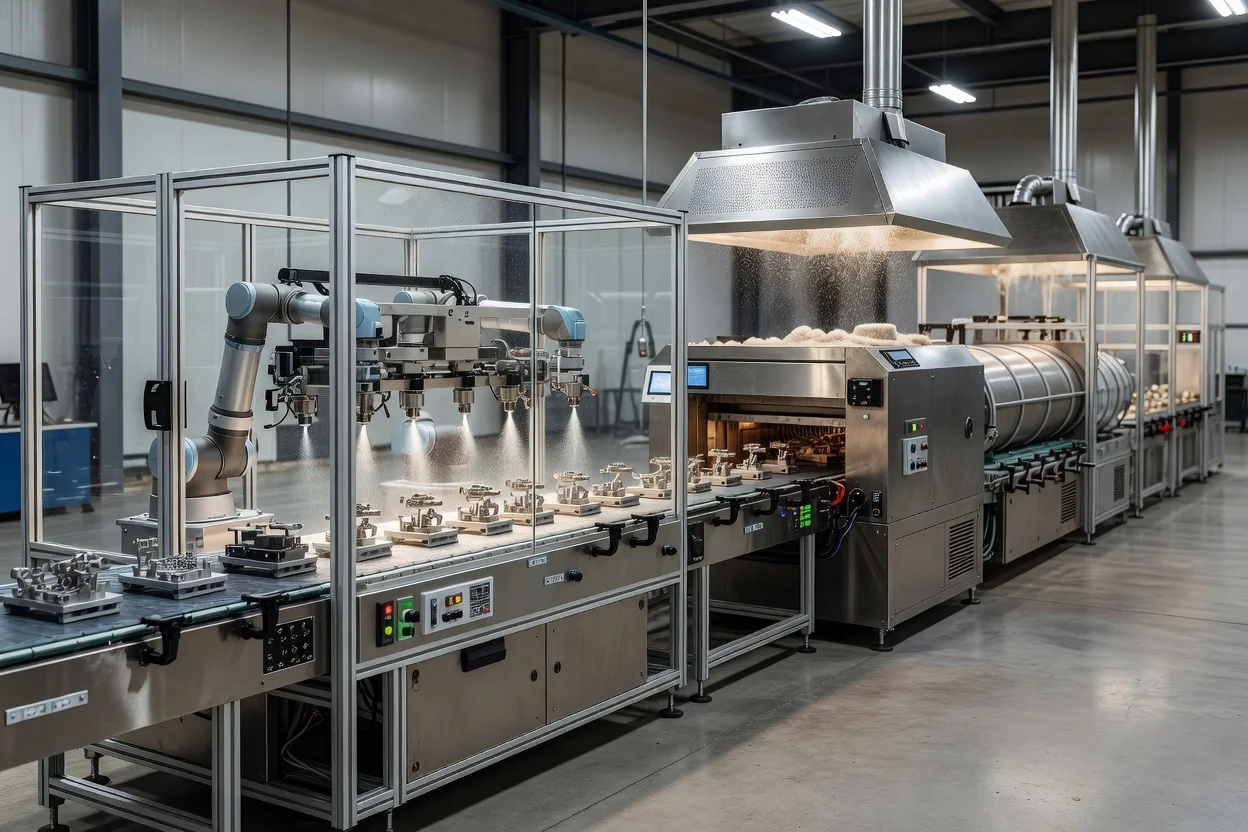
Important innovations include:
- Inline integration of adhesive coating, flock application, drying, and fluff removal.
- Robotic handling for irregular parts and enclosed cabins for safety and contamination control.
- Combined electrostatic and pneumatic systems for better coverage in corners and recessed geometries.
- Process monitoring for voltage, humidity, extraction flow, and adhesive condition to stabilize finish quality.
Automation improves consistency, but it also increases capital cost, maintenance requirements, and sensitivity to process drift. In practical terms, the highest-performing installations are often those that tightly control pretreatment, adhesive thickness, grounding, and environmental conditions.
Environmental and sustainability aspects
Flocking can contribute to material efficiency by upgrading relatively simple substrates into higher-value products without changing the base polymer structure. It can also extend service life in some applications by improving surface protection, reducing wear, or adding anti-slip properties.
Sustainability considerations include:
- Material waste reduction through flock recovery and reuse where contamination allows.
- Energy efficiency in electrostatic systems relative to more intensive thermal or mechanical finishing processes, although overall line energy use depends strongly on drying and extraction.
- Lower material intensity compared with some alternative soft-touch coatings or textile laminations.
- Recyclability trade-offs, since adhesives and fiber residues can complicate downstream recycling of flocked plastics.
In circular-economy terms, flocked plastics can be more difficult to mechanically recycle if the adhesive-fiber layer is not separable. As a result, designers increasingly consider whether flocking is applied to components with long service life, easy disassembly, or clear value-added function rather than purely cosmetic use.
Economic and market impact
The economics of flocking equipment depend on production scale, part geometry, quality targets, and labor availability. Manual systems have low entry cost and suit repair or short-run work, while automated lines justify their expense when throughput, uniformity, and reduced labor offset the capital investment.
Economic value is strongest where flocking:
- differentiates a product in a crowded consumer market,
- improves function enough to replace secondary parts or inserts,
- reduces noise or wear complaints in automotive and industrial parts,
- supports premium packaging and brand positioning.
Because flocking is often a finishing step, its business case is frequently judged not only by direct machine productivity but also by the downstream effect on scrap rate, rework, and perceived product quality.
Current challenges and innovations
Flocking equipment faces several technical challenges:
- Uniform coverage on complex geometry, especially in pockets, ribs, and recessed corners.
- Adhesive control, because uneven coating can cause patchiness or poor fiber anchoring.
- Dust and fiber management, which affects cleanliness, safety, and line hygiene.
- Electrostatic stability, particularly in changing humidity or poorly grounded environments.
- Quality assurance, since visual defects are often immediately visible to end users.
Innovation is concentrated on improved field design, better extraction and recapture systems, robotics, and process integration with upstream molding or printing lines. There is also growing interest in specialized flocking for technical functions, such as anti-slip surfaces, low-noise interfaces, and controlled tactile feedback rather than purely decorative effects.
Future outlook
Flocking equipment is likely to remain a specialized but durable segment of surface-finishing machinery. Future growth will probably be driven by automotive interiors, premium packaging, consumer electronics accessories, and technical polymer parts where touch, friction, and acoustic performance matter as much as appearance.
The most important trends are likely to be:
- higher automation for labor-intensive applications,
- better process monitoring and recipe control,
- more efficient recovery of surplus flock,
- improved pretreatment for difficult plastic substrates,
- more function-driven use cases in technical polymers and composites.
As plastics manufacturers seek greater product differentiation with controlled material use, flocking equipment is expected to remain relevant wherever a soft, high-value surface effect can be achieved efficiently and repeatably.
References
- •
Flock. (2020, August 10). Tek-Ind. https://www.tek-ind.it/en/flock/Link
- •
Surface flocking. (2021, December 15). Maag Flock. https://maagflock.com/en/flocking-machines/surface-flocking/Link
- •
Machines/equipment. (n.d.). Flock Association of Europe. https://www.flock.de/this-is-flock/machines/equipmentLink
- •
Flocking machine. (n.d.). Wordln. https://wordln.com/article/10291194.htmlLink
- •
Electrostatic flocking equipment. (2026, August 2). B2B Wiki. https://b2bwiki.baidu.com/en/encyclopedic/electrostatic-flocking-equipmentLink
- •
Understanding the flock and the flocking process. (n.d.). Swicofil. https://www.swicofil.com/consult/industrial-applications/para-textil-and-carpets/flockLink
- •
What should you know about the flocking machine? (n.d.). Wanxin TZ. https://www.wanxintz.com/news/industry-news/what-should-you-know-about-the-flocking-machine.htmlLink
- •
How to purchase the ideal flocking machine. (2024, February 18). Reads Alibaba. https://reads.alibaba.com/how-to-purchase-ideal-flocking-machine/Link
- •
Basics of flocking. (n.d.). Schnier Flock. https://schnier-flock.de/media/pages/produkte/flockgeraete/mini-flocker-evo-set/6e5c3191db-1680249302/basics-of-flocking.pdfLink
- •
Application areas. (n.d.). Flock Association of Europe. https://www.flock.de/this-is-flock/application-areasLink
- •
Home. (2021, March 2). Maag Flock GmbH. https://maagflock.com/en/Link
- •
Application examples of flocking. (2021, October 8). Maag Flock. https://maagflock.com/en/flock-school/anwendungsbeispiele/Link
- •
What is an electrostatic flocking machine. (2025, August 14). Zhangs Flock. https://www.zhangsflock.com/what-is-an-electrostatic-flocking-machine.htmlLink
- •
Flocking equipment / electrostatic flocking process introduction. (2019, September 23). Liaoning EO Technology. https://www.eocarpet.com/info/flocking-equipment-electrostatic-flocking-pr-39324497.htmlLink
- •
Flocking machines. (n.d.). Maag Flock. https://maagflock.com/en/flock-grundausstattung-beflockungsgeraete/Link
- •
AFA FAQ. (n.d.). American Flock Association. https://www.flocking.org/afa-faqLink
- •
Automatic flocking machines. (n.d.). Maag Flock GmbH. https://maagflock.com/en/category/flocking-machines/Link
- •
Types of flocking. (n.d.). American Flock Association. https://www.flocking.org/flocking-typesLink
- •
Maag maschinenprospekt E. (n.d.). Pals Print. https://www.palsprint.com/wp-content/uploads/2017/12/maag_maschinenbroschuere_eng_lowres.pdfLink
- •
Automatic flocking machine. (2025, January 20). Alibaba. https://www.alibaba.com/showroom/automatic-flocking-machine.htmlLink
- •
Inside glove flocking machine: Technical details, quality. (2026, March 19). Alibaba. https://www.alibaba.com/product-insights/glove-flocking-machine.htmlLink
- •
Do you know how the flocking machine works? (2022, July 25). Wanxin TZ. https://www.wanxintz.com/news/industry-news/do-you-know-how-the-flocking-machine-works.htmlLink
- •
Flocking (texture). (2004, December 27). Wikipedia. https://en.wikipedia.org/wiki/Flocking_(texture)Link
- •
1. (n.d.). Swiss Flock. https://www.swissflock.com/view/data/4207/swissflock_broschuere_e_einzelseiten.pdfLink
- •
Products overview. (n.d.). Flocking.biz. https://flocking.biz/products_overview.htmlLink
- •
News. (2025, December 16). Jiangsu Xintu Machinery. https://www.xintu-machine.com/en/What-Products-Are-Suitable-for-Electrostatic-Flocking-n4851.htmlLink
- •
What is flocking? (n.d.). Flock It! https://www.flockit.com/what-is-flocking/whatisflockingLink
- •
Flocking machine. (2025, January 20). Alibaba. https://www.alibaba.com/showroom/flocking-machine.htmlLink
- •
FLOCKING definition & meaning. (2026, May 1). Merriam-Webster. https://www.merriam-webster.com/dictionary/flockingLink
- •
Flocking. (n.d.). AIGLE Macchine Srl. https://www.aiglemacchine.com/flocking/Link
- •
Flocking objects. (2014, January 20). AIGLE Macchine Srl. https://www.aiglemacchine.com/flocking/flocking-objects/Link
- •
Flocking. (2025, September 9). TU Dresden. https://tu-dresden.de/ing/maschinenwesen/itm/forschung/forschungsfelder/textile-prozesse/technologien-fuer-2d-und-3d-textilkonstruktionen/beflocken?set_language=enLink
- •
Comprehensive guide to flocking in packaging. (2025, December 24). EPACK Printing. https://www.epackprinting.com/support/what-is-flocking/Link
- •
The home of flocking equipment and consumables. (n.d.). Flocking.biz. https://www.flocking.biz/Link
- •
Flocking fibres & equipment UK. (1995, January 1). The Flocking Shop. https://www.theflockingshop.co.uk/Link
- •
Top 5 benefits of flocking. (2025, January 1). Nyatex. https://www.nyatex.com/nyatex-blog/12-solutions/224-top-5-benefits-of-flockingLink