
Introduction
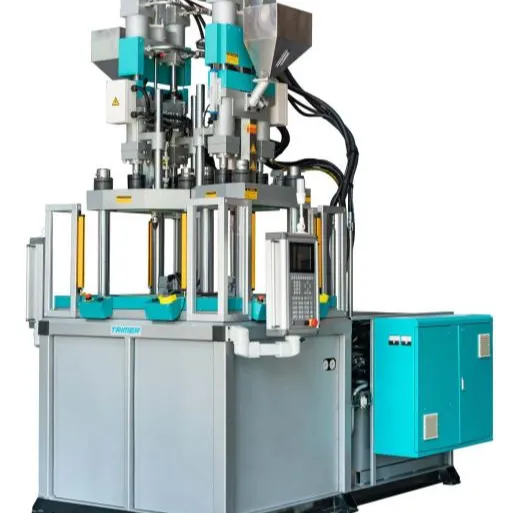
Multi-station injection molding machines are a specialized class of injection molding equipment in which mold stations, rotary tables, or transfer systems are used to separate and parallelize steps such as injection, cooling or curing, insert handling, part removal, inspection, and post-processing. In practice, the term covers both multi-station rotary presses and broader multi-station production systems in which several work modules are combined to improve throughput, reduce idle time, and support multi-component or insert-molding processes.
These machines are used where a conventional single-station press would spend too much time waiting for cooling, vulcanization, assembly, or operator handling. The result is higher equipment utilization, more stable cycle control, and easier integration of multi-material, multi-color, or overmolding processes. Modern systems are often modular, servo-driven, and automation-ready, with configurations ranging from two-station rotary tables to three-station and four-station systems, and in some high-output applications even larger rotary arrangements.
History and Development
The development of multi-station injection molding grew out of the need to shorten cycle times and decouple time-consuming secondary operations from the injection phase. Instead of leaving a mold clamped while a part cools or cures, manufacturers began transferring mold bottoms, cavity plates, or partially finished parts between stations so that each station could perform a dedicated task in parallel.
A few concrete milestones stand out:
- Parallelized production concepts emerged as a way to separate plasticizing, injection, heating or vulcanization, and manipulation into individual stations operated concurrently.
- Multi-station rotary tables became established in multi-component and insert-molding applications, especially for two-color and three-color parts where a first-shot substrate is indexed to one or more additional injection stations.
- Modular multi-station systems were commercialized more explicitly in the late 2010s and early 2020s, including concepts that use interchangeable cavity sets and robots to move mold elements through a circuit of stations.
In parallel, machine builders extended the concept into specialized niches such as silicone and elastomer processing, multi-compound molding, and cell-based automation for medical, consumer, automotive, and electrical products.
Key Characteristics and Technical Overview
At the core of a multi-station machine is the idea that one station injects while another station cools, cures, inserts, demolds, or assembles. This raises effective utilization because the expensive clamping and injection hardware no longer waits for the slowest part of the cycle.
Typical technical features include:
- Rotary tables or indexing platens with two, three, or more stations for transferring molds or cavity plates between process positions.
- One or more injection units, often arranged vertically or horizontally depending on part geometry and process sequence.
- Servo-electric or servo-hydraulic drives for precise positioning, repeatability, and reduced energy use.
- Automation interfaces for robot loading, insert placement, in-process inspection, and part removal.
Common quantitative benchmarks reported for this class of equipment include:
- 2-station and 3-station rotary tables are especially common in two-color, three-color, and insert-molding systems.
- 4- to 12-station rotary configurations are used in specialized high-throughput systems such as multi-station rotary molding for seals and elastomeric parts.
- Some multi-station machines are configured with two injection units so that sequential or simultaneous injection is possible, while others are designed for one injection unit and multiple process stations.
- Commercial multi-station systems can be scaled so that cooling or curing time runs in parallel with injection, increasing the number of production cycles per hour without increasing the machine’s active waiting time.
For multi-component applications, the process may be arranged as follows:
- First station: mold filling or substrate creation
- Second station: transfer, reorientation, or overmolding
- Third station: cooling, curing, demolding, or assembly
- Additional stations: inspection, insert loading, sealing, labeling, or secondary processing
A useful engineering distinction is between station count and injection-unit count. A machine may have multiple stations but only one injection unit, or multiple injection units feeding different materials into the same rotary workflow.
Typical performance notes
- Cycle-time reduction is achieved by parallel processing rather than by faster filling alone.
- Positioning precision is critical on multi-color and multi-component machines because mold alignment governs part-to-part repeatability and color boundary quality.
- In rotary systems, rotation and indexing accuracy directly affect flash, knit-line control, and insert placement.
- Multi-station systems are often selected when long cooling, curing, or heating intervals would otherwise dominate the cycle in a conventional press.
Relation to downstream material handling
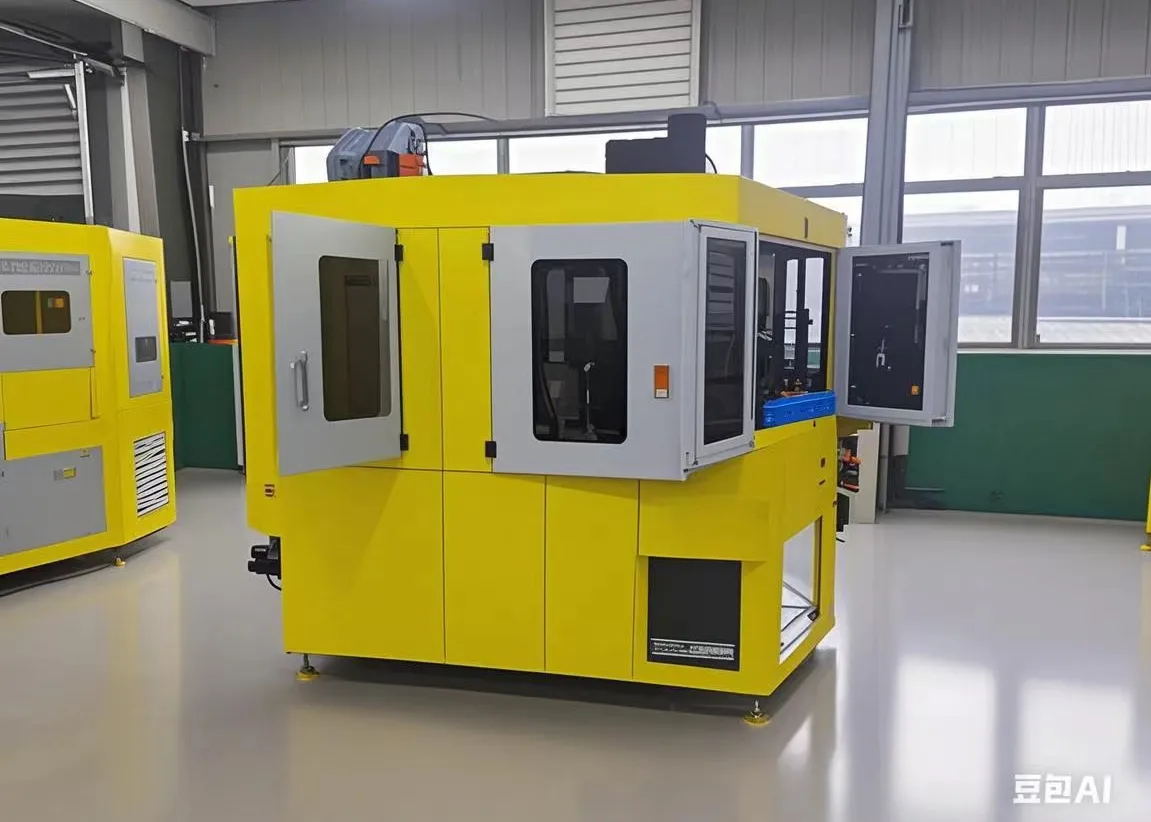
Multi-station systems often sit at the center of a small production cell rather than functioning as isolated presses. Typical accompanying equipment includes:
- industrial robots
- hot runners and mold temperature control
- drying and conveying systems
- vision inspection
- stacking, packing, or assembly devices
This cell-based arrangement is one reason the technology is widely used in automated high-mix manufacturing.
Types and Variations
| Type | Main configuration | Typical strengths | Typical use cases |
|---|---|---|---|
| Two-station rotary machine | Two indexed positions, often 180 degrees apart | Compact layout, straightforward automation, good for two-shot work | Two-color parts, insert molding, overmolding |
| Three-station rotary machine | Three indexed positions, often 120 degrees apart | Better process separation and staging | Three-color parts, sequential overmolding, insert plus finish molding |
| Four-plus station rotary machine | Multiple process positions on a rotary table | Higher throughput, more process steps in one cell | Elastomer sealing, curing, transfer and post-processing |
| Modular multi-station system | Independent stations linked by robots or cavity-plate transfer | Flexible capacity scaling, easier process tailoring | Prototype-to-series production, complex multi-step parts |
| Dual-injection multi-station machine | Multiple stations plus two or more injection units | Multi-material or multi-color integration | Functional, decorative, or sealing components |
Beyond station count, machines are also classified by process architecture:
- Turntable or rotary-table systems for transferring molds or part carriers between stations.
- Transfer systems that move cavity plates, inserts, or mold bottoms through a production loop.
- Multi-clamp systems that allow different workpieces to be processed in parallel.
- Specialized elastomer or foam systems in which curing and demolding are integrated into the station sequence.
Applications and Uses
Multi-station injection molding is most valuable where parts require more than a simple one-shot fill-and-eject cycle.
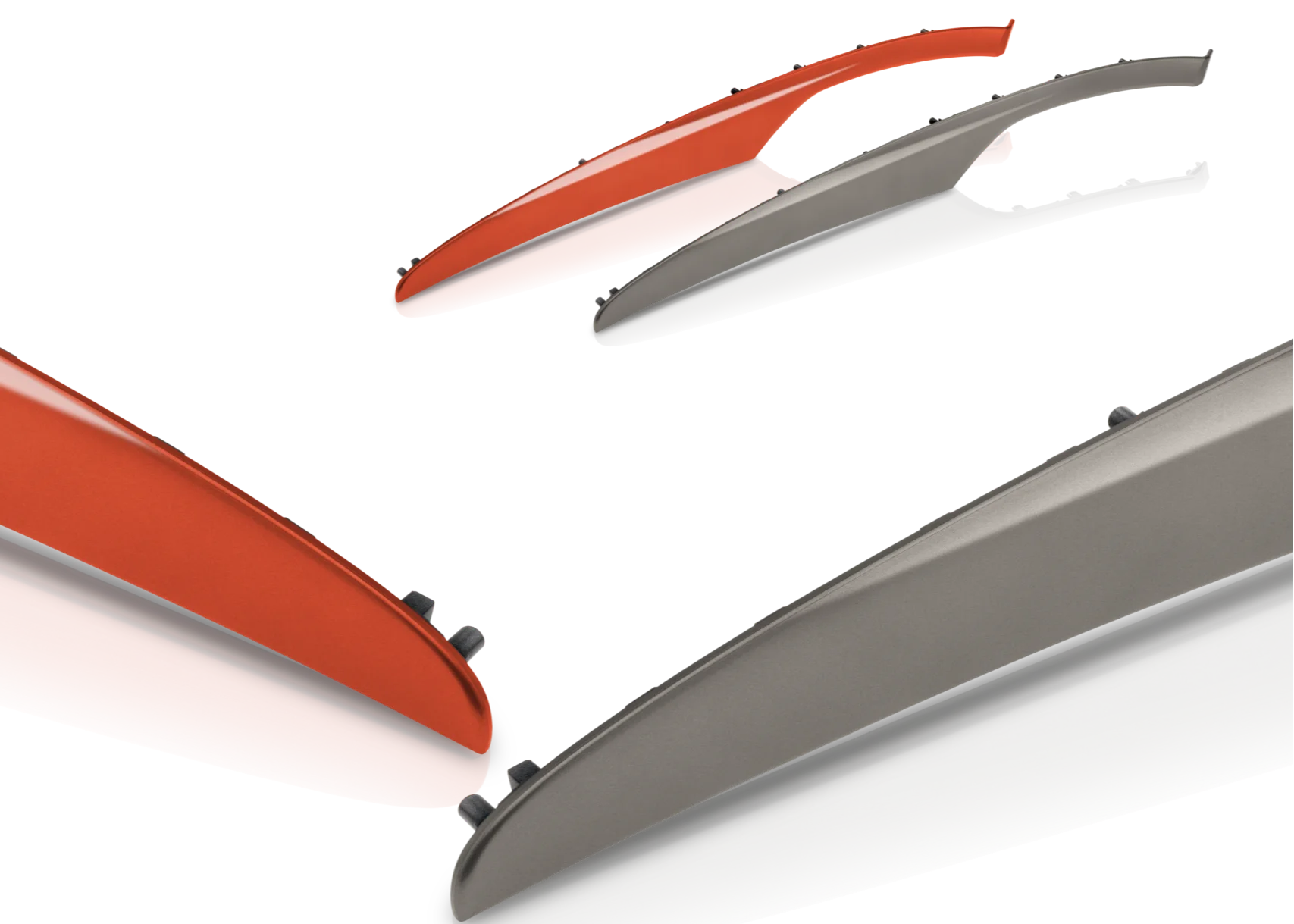
- Automotive: multi-color interior trim, switch components, decorative elements, seals, and lighting parts benefit from rotary or multi-injection systems.
- Electrical and electronics: connectors, housings, buttons, overmolded interfaces, and insulation-related parts are commonly produced with multi-material or multi-station methods.
- Medical and life science: ergonomic grips, diagnostic housings, fluid-handling components, and clean-room-compatible products often use compact, repeatable multi-station cells.
- Consumer goods: toothbrush handles, tool grips, appliance controls, kitchenware, and wear-resistant soft-touch parts are typical targets.
- Packaging and closures: multi-material caps, functional closures, and tactile or decorative components can be made in one cycle.
- Elastomer and sealing products: rotary multi-station machines are used for vehicle seals and related continuous curing or shaping operations.
A poor-fit use case is very simple, low-volume, single-material parts with short cooling times and no secondary operation. In that situation, the added complexity of a multi-station cell usually cannot be justified against a standard single-station press.
Technological Innovations and Automation
Recent innovation has focused on improving flexibility, precision, and cell integration rather than merely increasing station count.
- Servo-electric motion control improves indexing accuracy and energy efficiency, especially in clean-room and precision applications.
- Robot-mediated mold or cavity transfer allows station functions to be decoupled more cleanly and makes the system easier to scale.
- Multi-injection units enable two-shot, three-shot, or multi-material molding without external assembly.
- Process tracking and recipe control allow different shot sizes, sequential injection programs, and production data logging for higher repeatability.
- Clean-room-oriented layouts are increasingly important in medical and electronics production, where compact footprints and reduced lubrication are advantageous.
A notable trend is the move from rigid “all-in-one” machine design toward modular cells that can be expanded by adding stations, increasing cavity-plate pools, or automating post-processing steps.
Environmental and Sustainability Aspects
Multi-station systems can support sustainability goals when they reduce scrap, cut secondary assembly, and improve equipment utilization.
- Lower idle losses: parallel cooling or curing can reduce dead time in the main injection unit.
- Less material waste: multi-component molding can combine functions in one part, reducing assembly scrap and adhesive use.
- Potential energy savings: servo-electric and optimized rotary systems may reduce energy consumption relative to older hydraulic arrangements.
- Circular-economy compatibility: multi-layer or sandwich processes can sometimes combine virgin skin with recycled core materials, although compatibility depends on adhesion, performance requirements, and recycling strategy.
At the same time, sustainability trade-offs remain important:
- multi-station systems are more mechanically complex and may require higher capital input
- rotary and transfer mechanisms add maintenance and calibration demands
- highly integrated parts can be harder to disassemble for recycling
Economic and Global Market Impact
The economic appeal of multi-station machines lies in higher output per press-hour, lower labor dependence, and integration of several operations into one production cell. These systems are especially attractive where a part’s value comes from combined functions such as sealing, color, grip, aesthetics, and structural integrity.
Vendors position the technology as a way to increase production efficiency with manageable investment steps, particularly when capacity can be expanded by adding stations or cavity sets rather than purchasing a completely new machine.
Global market demand is strongest in sectors that reward short cycles, repeatability, and automation:
- automotive interior and lighting
- medical and life-science components
- consumer electronics
- technical consumer goods
- seals and elastomeric products
Because the technology sits at the intersection of machine building, automation, and tooling, its value is often determined less by press tonnage than by system-level productivity, uptime, and part quality.
Current Challenges and Innovations
Several technical and commercial challenges continue to shape development:
- Tooling complexity: multi-station molds and cavity-transfer systems are more demanding to design and maintain than standard molds.
- Synchronization: rotary indexing, robot movement, and injection timing must remain tightly coordinated to avoid defects.
- Space and integration: although some systems are compact, others require careful cell planning because of stations, access zones, and safety guarding.
- Application-specific economics: the machine only pays off when the process truly benefits from parallelization or multi-material integration.
Innovation is concentrated in:
- improved rotary-table accuracy
- faster servo drives
- cleaner and more energy-efficient actuation
- greater machine openness to automation and MES connectivity
- more flexible multi-material sequencing and recipe management
Future Outlook
The next stage of multi-station machine development is likely to emphasize flexibility, digital control, and process integration. Systems will increasingly be designed as configurable production cells rather than fixed-function presses, allowing manufacturers to switch between insert molding, overmolding, multi-color production, and post-processing with less retooling.
Three themes are likely to define future demand:
- Greater modularity, enabling capacity to be added by station or cell module rather than by replacing the whole machine.
- More automation, especially robotic insert loading, in-cell inspection, and end-of-line handling.
- Higher efficiency and sustainability, driven by servo-electric motion, reduced scrap, and better use of recycled or multifunctional materials.
For manufacturers, the strategic value of multi-station injection molding will continue to lie in its ability to merge multiple operations into one coordinated process while improving consistency, traceability, and throughput.
References
- •
Quality up through innovative multi-station-injection molding. (2026, February 5). LWB Steinl. https://www.lwb-steinl.com/en/news-press-releases/lwb-multistation/Link
- •
Quality up through innovative multi-station-injection molding. (n.d.). LWB Steinl. https://www.lwb-steinl.com/fileadmin/user_upload/PDF_Dokumente/LWB-Mulitstation-E.pdfLink
- •
LWB-Steinl-Press release. (n.d.). LWB Steinl. https://www.lwb-steinl.com/fileadmin/user_upload/News___Presse/K_2022/PR_-_LWB_Steinl_at_the_K-2022.pdfLink
- •
LWB-Steinl-Press Release. (n.d.). LWB Steinl. https://www.lwb-steinl.com/fileadmin/user_upload/News___Presse/DKT_2022/LWB_Steinl_at_the_DKT-2022.pdfLink
- •
VSS Series- Vehicle Sealing System - Gluco Inc. (2017, August 24). Gluco. https://www.gluco.com/gluco-products/vss-series/Link
- •
Multi-Color Injection Molding Machine. (n.d.). Multiplas. https://www.injection.com.tw/en/product/MultiColor-Injection-Molding-Machine.htmlLink
- •
V A N D O R N P R A X I S. (n.d.). Sumitomo (SHI) Demag. https://sumitomo-shi-demag.us/wp-content/uploads/2019/05/Praxis_Brochure.pdfLink
- •
KINGSTEEL-Physical Foaming Elastomer Injection Molding Solution. (2023, December 21). Kingsteel. https://www.kingsteel.com/Link
- •
SmartPower COMBIMOULD 60 – 400 t. (n.d.). Wittmann Group. https://www.wittmann-group.com.tw/upload_files/injection-molding/hydraulic-machines/SmartPower_COMBIMOULD_EN_2018-09_WEB.pdfLink
- •
VM-英-2023年8月. (n.d.). Yizumi. https://www.euromaplast.com/wp-content/uploads/2024/03/EN_VM-SERIES_202308.pdfLink
- •
Multi The multi-function machine. (n.d.). https://www.interempresas.net/FeriaVirtual/Catalogos_y_documentos/197307/TP_Multi_gb.pdfLink
- •
ADDING COMPONENTS TO ADD VALUE. (n.d.). KraussMaffei. https://www.kraussmaffei.com/Processes/IMM/01%20Mehrkomponenten/Mulitinject/KM_BR_Multinject_en.pdfLink
- •
MILACRON - MV. (2025, July 23). Milacron. https://www.scribd.com/document/484693646/MILACRON-MVLink
- •
ALLROUNDER T. (n.d.). Arburg. https://www.arburg.com/en/us/product-world/injection-molding-machines/vertical-machines/allrounder-t/Link
- •
Dual-compound injection. (n.d.). REP International. https://www.repinjection.com/custom-built-machines/dual-compound-injectionLink
- •
Key Applications of Multi-Stage Injection in Molding. (2024, November 28). MoldAll. https://www.moldall.com/multi-stage-injection-applications/Link
- •
LUMINA Series - Injection Molding - Wilmington Machinery. (2025, September 10). Wilmington Machinery. https://wilmingtonmachinery.com/machinery/injection-molding/lumina-series/Link
- •
KEY FEATURES. (n.d.). Mold-Masters. https://www.moldmasters.com/sites/default/files/2024-04/E-Multi%20Feature%20Sheet.pdfLink
- •
Thesis Topic:. (n.d.). https://shulab.mie.utoronto.ca/wp-content/uploads/pubs/Conference/2001_WolfEtAl_DFM_InjectionMolding.pdfLink
- •
Multi-Color Injection Molding Machine Suppliers. (2019, July 25). Multiplas. https://www.multiplas-tw.com/category-multi-color-injection-molding-machine.htmlLink
- •
Double Injector Rotary Vertical Plastic Injection Molding .... (2024, July 5). Hommar. https://www.hommar.com/video/products-detail-4770770Link
- •
Multi-Shot Injection Molding The Inevitable Product of Injection Molding Development. (2024, January 25). Prototool. https://prototool.com/multi-shot-injection-molding/Link
- •
Injection molding machine :: Woojin Plaimm Co., Ltd. (n.d.). https://blog.yeogie.com/en/wjpim/product/G153990?page=2&Link
- •
Vertical Allrounders: Ergonomic overmolding of inserts. (n.d.). Arburg. https://www.arburg.com/en/us/product-world/injection-molding-machines/vertical-machines/Link
- •
Multi Injection Molding: Advanced Configurations & Applications for .... (2024, December 11). Huarong. https://www.huarong.com.tw/page/news/en/company_news/detail/118/Link
- •
Multi-Material & Multi-Colour Injection Molding Machines. (2026, July 30). Chen Hsong. https://chenhsong.com/injection-molding-machines/multi-material/Link
- •
Willmann巴顿威猛注塑机micropower en 2022-08 web - Scribd. (2022, August 1). https://www.scribd.com/document/816042390/Willmann%E5%B7%B4%E9%A1%BF%E5%A8%81%E7%8C%9B%E6%B3%A8%E5%A1%91%E6%9C%BAmicropower-en-2022-08-webLink
- •
Prev. (2021, February 7). Sumitomo (SHI) Demag. https://www.demagplasticsgroup.cn/en/index.php/news/detail.html?id=56Link
- •
Multi-station injection molding mold. (2014, April 23). https://patents.google.com/patent/CN103950143B/enLink
- •
THE MOST VERSATILE, ALL ELECTRIC SERVO DRIVEN .... (n.d.). Mold-Masters. https://www.moldmasters.com/sites/default/files/2021-09/E-Multi%20Brochure.pdfLink
- •
Used Multi-Shot Injection Molding Machines for Sale. (2026, February 13). Meadoworks. https://www.meadoworks.com/equipment/multi-shot-injection-moldingLink
- •
Two Platen Injection Molding Machines - BIPOWER. (2022, September 26). Negri Bossi. https://www.negribossi.com/en-us/products/bipower-ip-injection-molding-machines/Link
- •
THE MOST VERSATILE, ALL ELECTRIC. (n.d.). Mold-Masters. https://www.moldmasters.com/sites/default/files/2022-05/E-Multi%20BRO%202022REV%20ENG%20LTR.pdfLink
- •
Injection: High Performance Injection Molding Machines. (2025, July 21). Milacron. https://www.milacron.com/injection/Link
- •
Multi-Component Injection Molding Machines: Built for Complexity. (2026, July 31). Yizumi. https://www.yizumi.com/en/news/product/industry-trend/multi-component-injection-molding-machines-built-for-complexityLink
- •
Two-Component Injection Molding Machine Is The Future, .... (2021, July 26). FCS. https://www.fcs.com.tw/news-two-color-injection-molding-machine-is-developing-to-large-scale-and-precisionLink
- •
Overview of Injection Molding Machines. (2024, June 22). Yushine. https://yushineplastics.com/overview-of-injection-molding-machines/Link
- •
Three-station turntable structure of injection molding machine. (2011, April 22). https://patents.google.com/patent/CN202011120U/enLink
- •
Injection Molding: Definition, Types, Diagram. (2022, April 29). Xometry. https://www.xometry.com/resources/injection-molding/types-of-injection-molding-technology/Link
- •
Injection Molding Processing: The Basic Guide to Using .... (2022, February 9). Conair. https://www.conairgroup.com/resources/resource/injection-molding-processing-the-basic-guide-to-using-auxiliary-equipment/Link